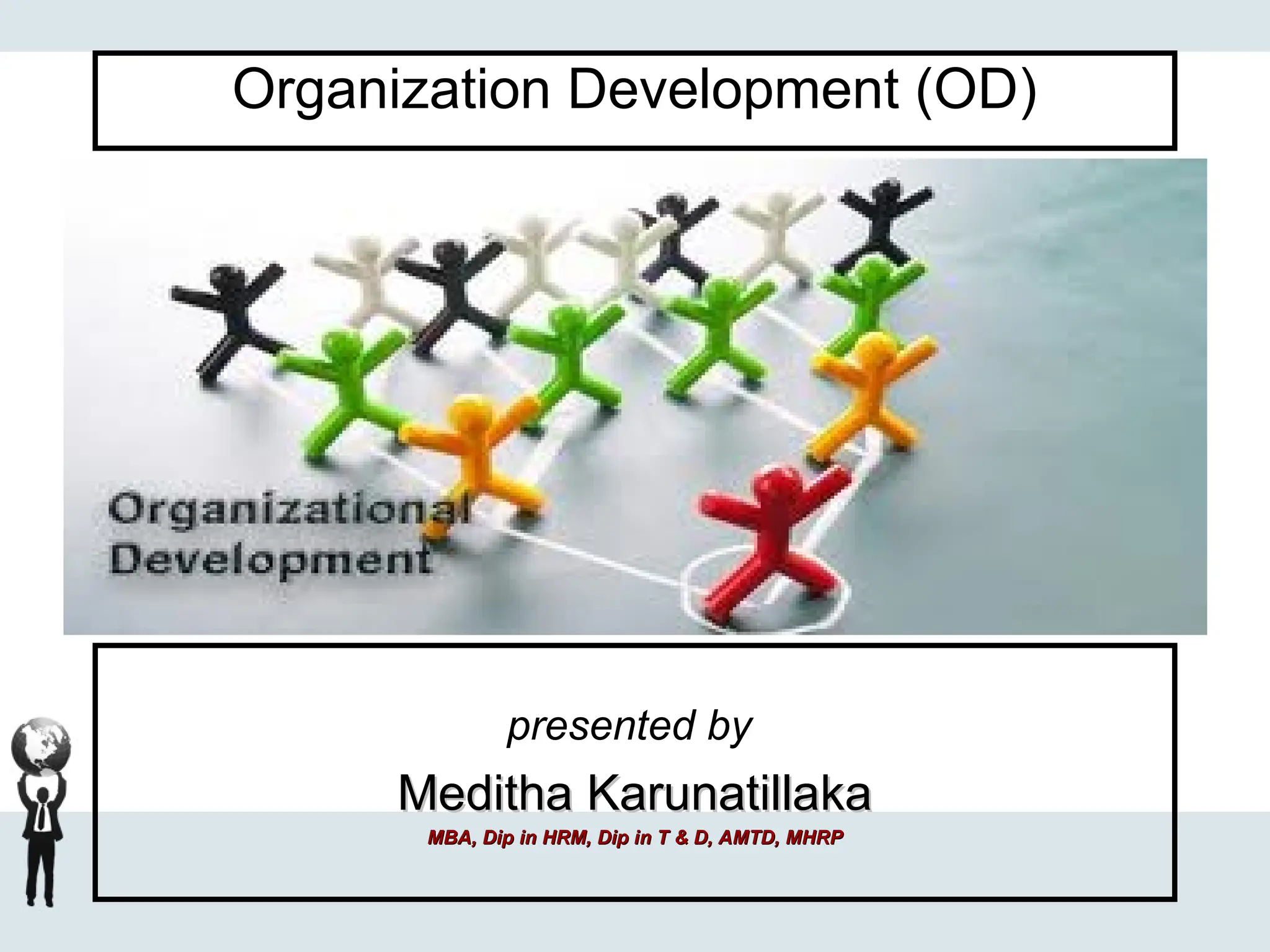
Organization Development (OD)
presented by
Meditha Karunatillaka
MBA, Dip in HRM, Dip in T & D, AMTD, MHRP
Definition-what is an organization
An organization is the planned coordination
of the activities of a number of people for
the achievement of some common explicit
purpose or goal, through division of labor
and function, and through a hierarchy of
authority and responsibility –(Edgar Shein)
Definition
Definition
Organization Development (OD)
OD is an effort (1) planned (2)
organization wide (3)managed from
the top (4) increase organization
effectiveness and health through (5)
planned interventions in the
organization’s processes, using
behavioral science knowledge.
(Richard Beckhard)
(Richard Beckhard)
Why Study OD ?
 Can improve individual performance
 Create better morale
Increase organizational profitability
Related to OD
• Vision and Mission
• Behavior of the Organization
• Individual Behavior
• Structure of the Organization
• Culture of the Organization
WHY DO OD?
• Human resources
• Changing nature of the workplace
• Global markets
• Accelerated rate of change
Distinctive Features of OD
• an OD program is a long range, planned and sustained
effort that is based on an overall strategy.
• consultant establishes a unique relationship with the
client system: the consultant seeks and maintains a
collaborative relationship of relative equality with the
organization members
OD interventions are..........
• Unique in nature
• Reflexive
• Self-analytical
• Self-skill building in nature
Benefits
• It mainly tries to deal with the changes throughout the
organization or in any one of the major units.
• It develops greater motivation.
• It increases productivity.
• A better quality of work.
– It creates higher job satisfaction
– Team work is improved and encouraged
– It finds better solution for conflicts
– Commitment to objectives
– Increases the willingness to change
– Absenteeism is reduced.
– Turnover is lower
Limitations
• Organizational development is long-way process
and requires more time.
• It consists of substantial expense, delayed payoff
periods
• Failures are possible
• Possibility for invasion of privacy
• Possible for psychological harms
• It emphasizes only in group process compared to
performance
• Conceptual ambiguity is possible.
Elements of the OD process
• Entering and contracting
• Diagnosing ( Organization, groups and jobs)
• Planning and implementing change
• Evaluating and institutionalizing
Entering and contracting
• Entering & Contracting are the initial steps in the OD
process
• Entering and Contracting set the initial Para meters for
carrying out the subsequent phases of OD :
–Diagnosing the organization
–Planning & Implementation changes
–Evaluating and Institutionalizing them
• Entering into an OD relationship comprises
of three (3) elements- i.e.
- Clarifying the Organizational Issue
- Determining the relevant Clients
- Selecting the appropriate OD Practitioner
Clarifying the Organizational Issues
• An Organization generally starts an OD
programme by presenting the problem. i.e. the
issue that caused them to consider an OD
process. It may be Specific,( e.g. :decrease in
market share, increase in absenteeism, Increase
in industrial disputes or General (eg:
Organization growing too fast, needs a rapid
change)
• At this stage, presenting the problem is only a
symptom of an underlined problem
Determining the relevant client
• Generally the relevant client includes those organization
members who can directly impact on the change issue.
• Unless these Members are identified and included in the
entering and contracting process, they may with hold
their support for and commitment to the OD process.
• E.g. In trying to improve the productivity of a unionized
plant the relevant client may include union officials as
well as Managers and staff personnel.
• It is not unusual for an OD project to fail because the
relevant client was inappropriately defined.
Diagnosing Organization
• Diagnosis is the process of understanding current
functioning of the organization. It will provides the
information necessary for designing change
interventions. It generally follows from successful entry
and contracting.
• This is a collaborative process between organization
members and OD consultants to collect pertinent
information, analyze it and draw conclusions of action
planning and interventions .
• Diagnosis may be aim uncovering causes for specific
problems or it may be directed at assessing the overall
functioning of the organization / department to discover
the areas for future development.
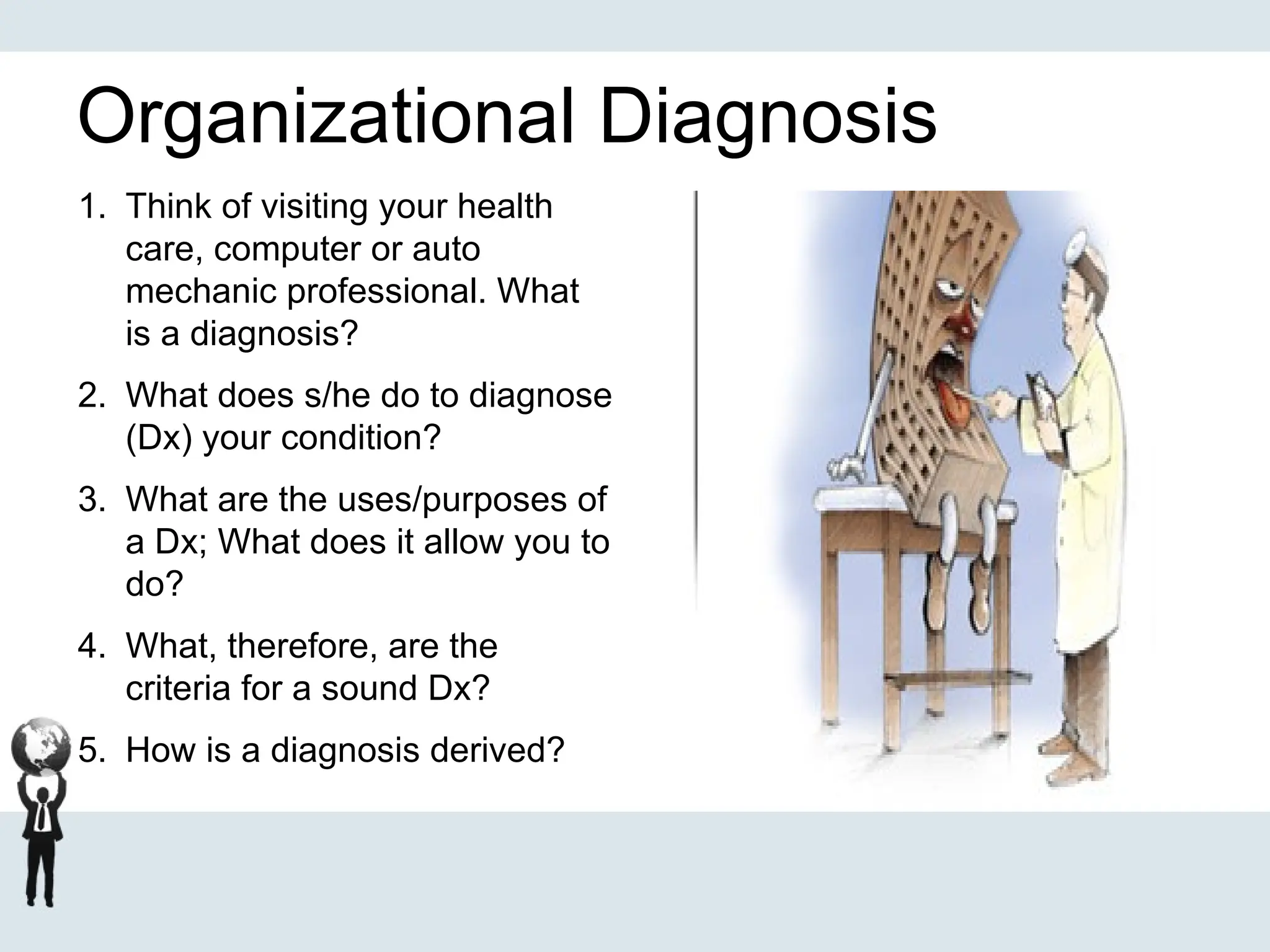
Organizational Diagnosis
1. Think of visiting your health
care, computer or auto
mechanic professional. What
is a diagnosis?
2. What does s/he do to diagnose
(Dx) your condition?
3. What are the uses/purposes of
a Dx; What does it allow you to
do?
4. What, therefore, are the
criteria for a sound Dx?
5. How is a diagnosis derived?
Planning and implementing change
• In this stage ,organization members and practitioners
jointly plan and implement OD interventions.
• They design interventions to achieve the organization's
vision or goals and make action plans to implement them.
• There are several criteria for designing
interventions ,including the organization's readiness for
change ,its current change capability, its culture and
power distributions and change agent’s kills and abilities .
• Depending on the outcomes of diagnosis, there are four
major types of interventions in OD
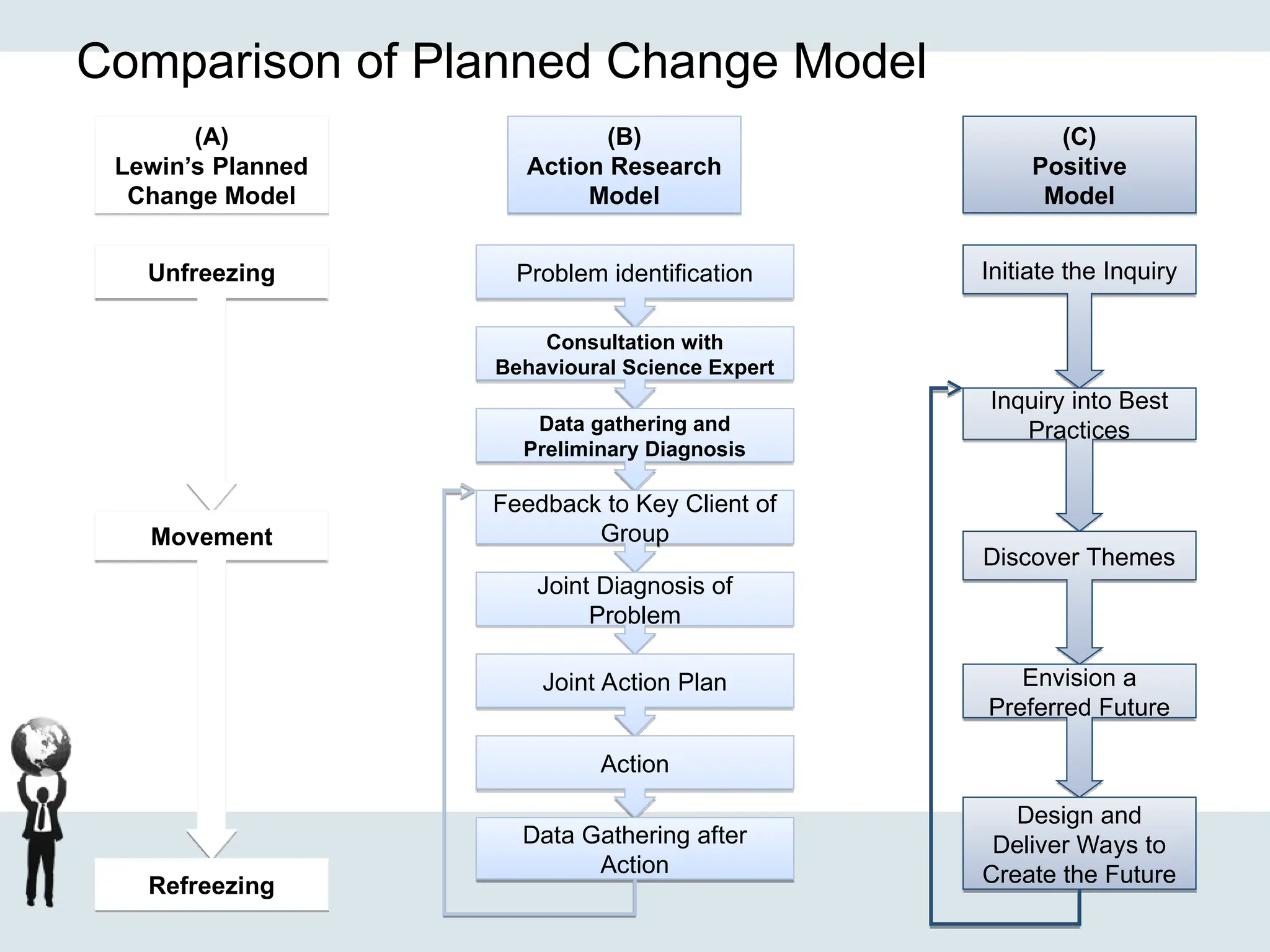
Comparison of Planned Change Model
Problem identification
Consultation with
Behavioural Science Expert
Data gathering and
Preliminary Diagnosis
Feedback to Key Client of
Group
Joint Diagnosis of
Problem
Joint Action Plan
Action
Data Gathering after
Action
Unfreezing
Movement
Refreezing
Initiate the Inquiry
Inquiry into Best
Practices
Discover Themes
Envision a
Preferred Future
Design and
Deliver Ways to
Create the Future
(A)
Lewin’s Planned
Change Model
(B)
Action Research
Model
(C)
Positive
Model
Major Types of Interventions in OD .
• Human Process Interventions
Human Process Interventions
• Techno structural Interventions
Techno structural Interventions
• Human Resources Management
Human Resources Management
Interventions
Interventions
• Strategic Interventions
Strategic Interventions
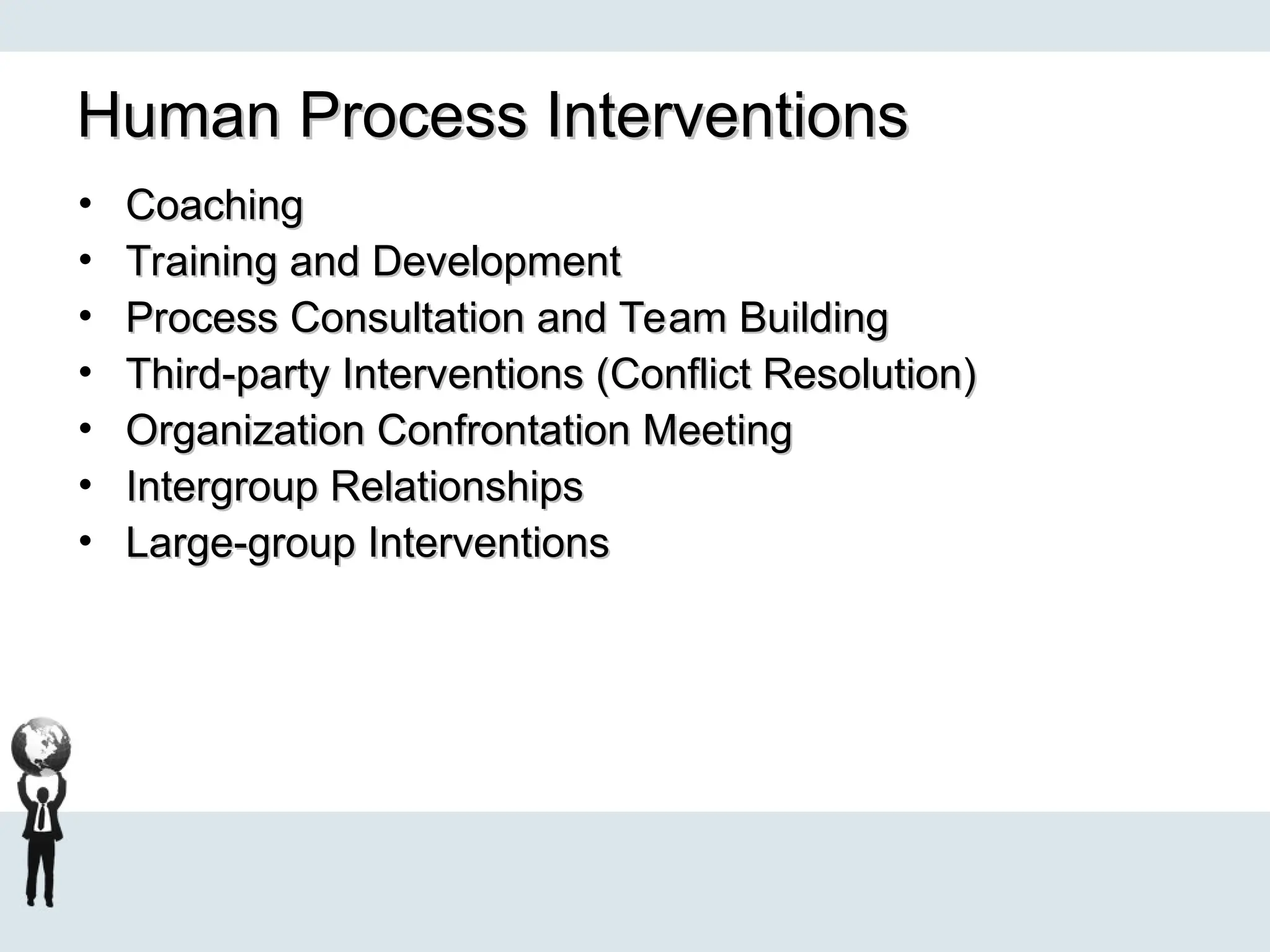
Human Process Interventions
• Coaching
Coaching
• Training and Development
Training and Development
• Process Consultation and Team Building
Process Consultation and Team Building
• Third-party Interventions (Conflict Resolution)
Third-party Interventions (Conflict Resolution)
• Organization Confrontation Meeting
Organization Confrontation Meeting
• Intergroup Relationships
Intergroup Relationships
• Large-group Interventions
Large-group Interventions
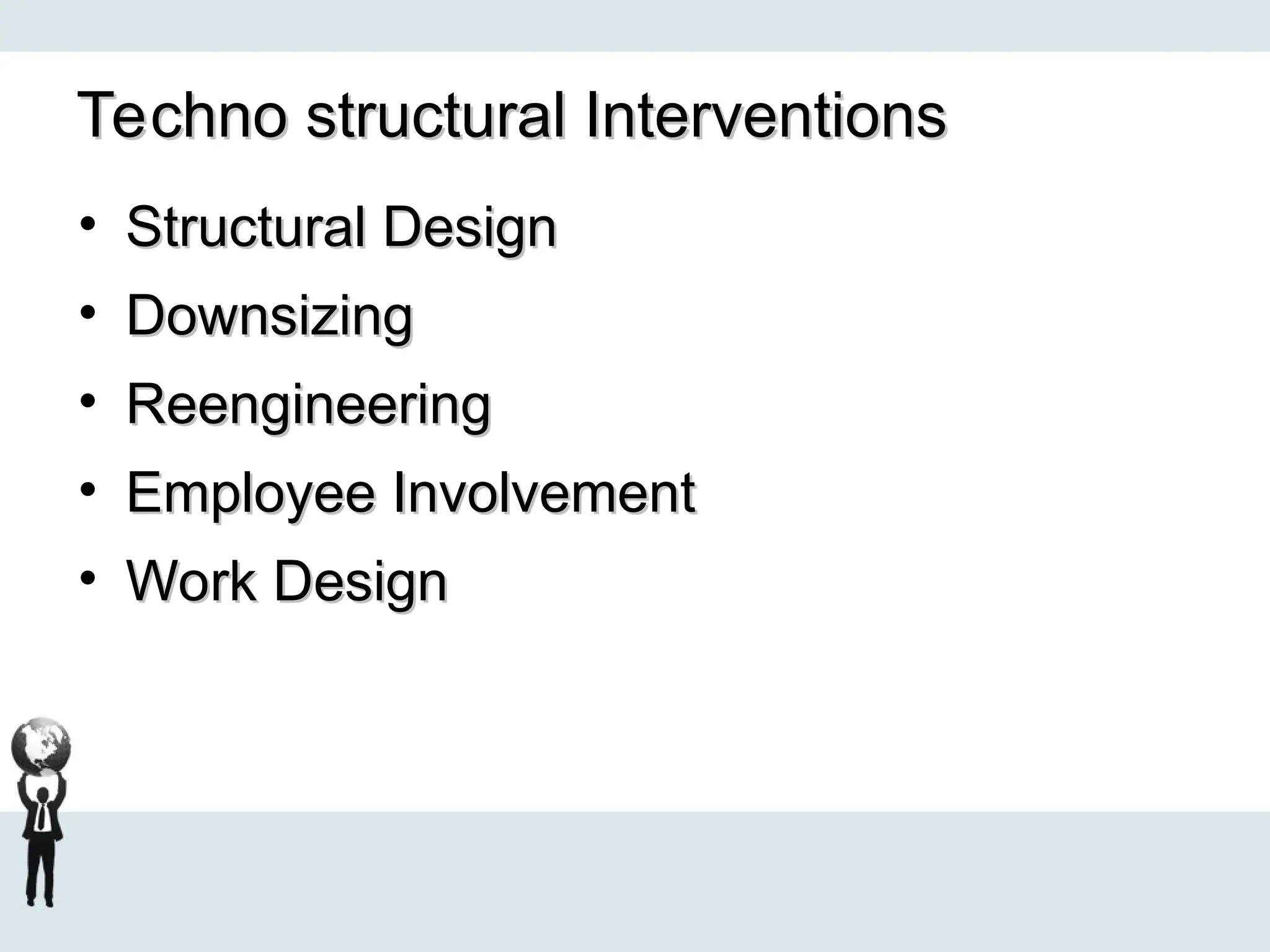
Techno structural Interventions
• Structural Design
Structural Design
• Downsizing
Downsizing
• Reengineering
Reengineering
• Employee Involvement
Employee Involvement
• Work Design
Work Design
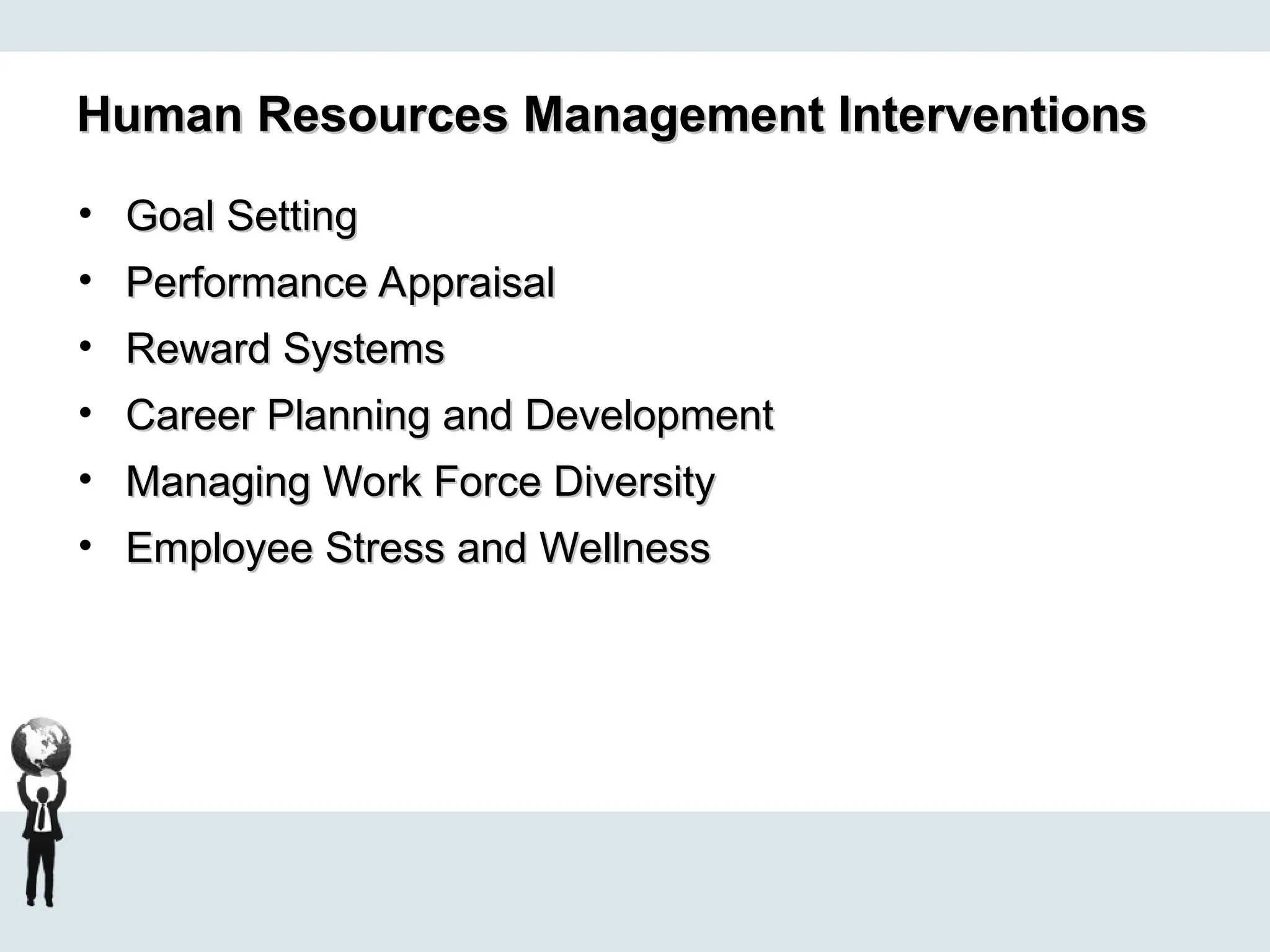
Human Resources Management Interventions
• Goal Setting
Goal Setting
• Performance Appraisal
Performance Appraisal
• Reward Systems
Reward Systems
• Career Planning and Development
Career Planning and Development
• Managing Work Force Diversity
Managing Work Force Diversity
• Employee Stress and Wellness
Employee Stress and Wellness
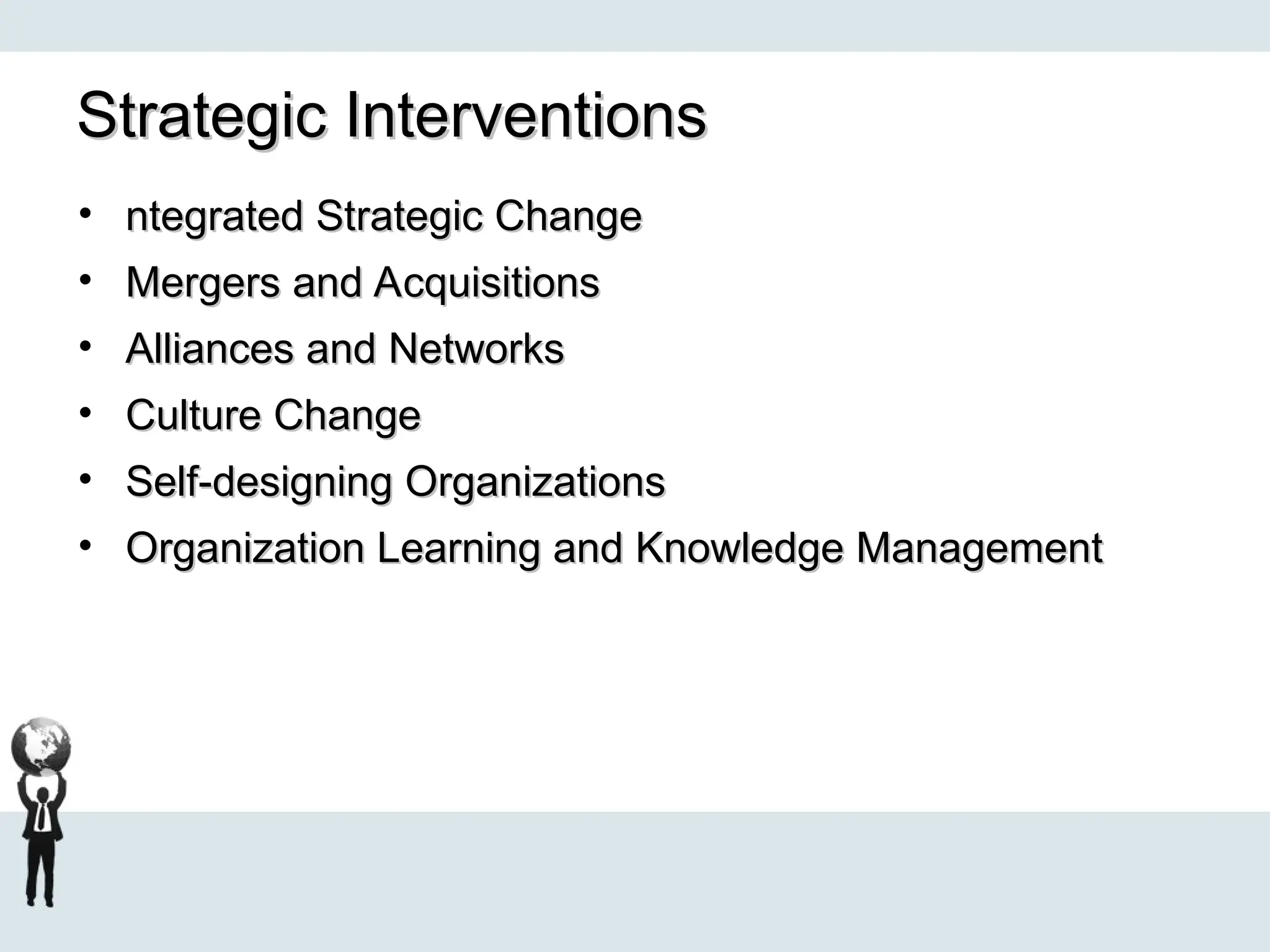
Strategic Interventions
• ntegrated Strategic Change
ntegrated Strategic Change
• Mergers and Acquisitions
Mergers and Acquisitions
• Alliances and Networks
Alliances and Networks
• Culture Change
Culture Change
• Self-designing Organizations
Self-designing Organizations
• Organization Learning and Knowledge Management
Organization Learning and Knowledge Management
Evaluating and Institutionalizing
• The final stage in planned change involves evaluating the
effects of the intervention and managing the
institutionalization of successful change programs .
• Feed back to organization members about the
intervention’s results provide information about whether
the changes should be continued ,modified or
suspended.
• There are several criteria for designing
interventions ,including the organization's readiness for
change ,its current change capability, its culture and
power distributions and change agent’s kills and abilities .
• Depending on the outcomes of diagnosis, there are four
major types of interventions in OD
Organizational Development
Techniques
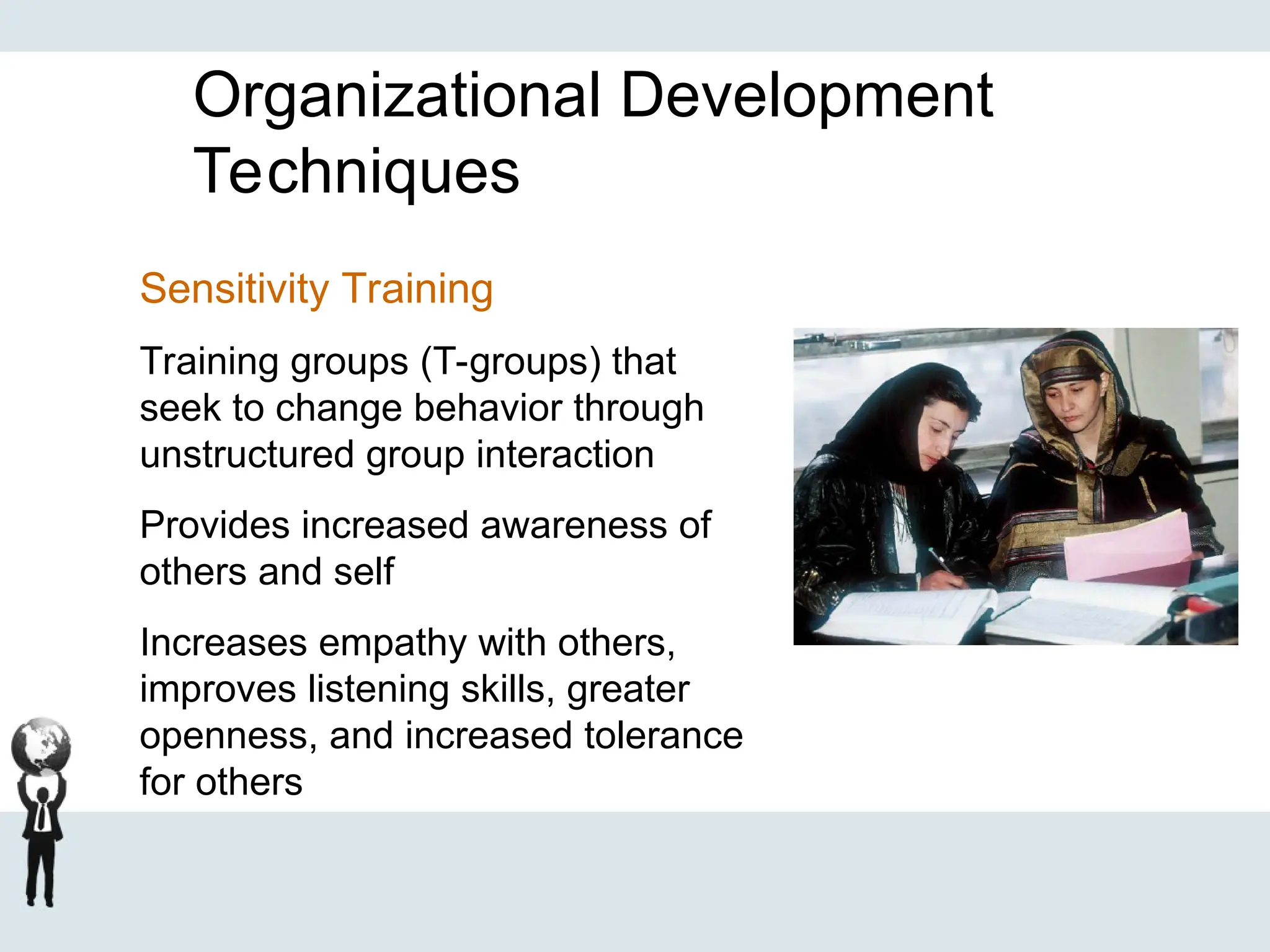
Sensitivity Training
Training groups (T-groups) that
seek to change behavior through
unstructured group interaction
Provides increased awareness of
others and self
Increases empathy with others,
improves listening skills, greater
openness, and increased tolerance
for others
Organizational Development
Techniques (cont’d)
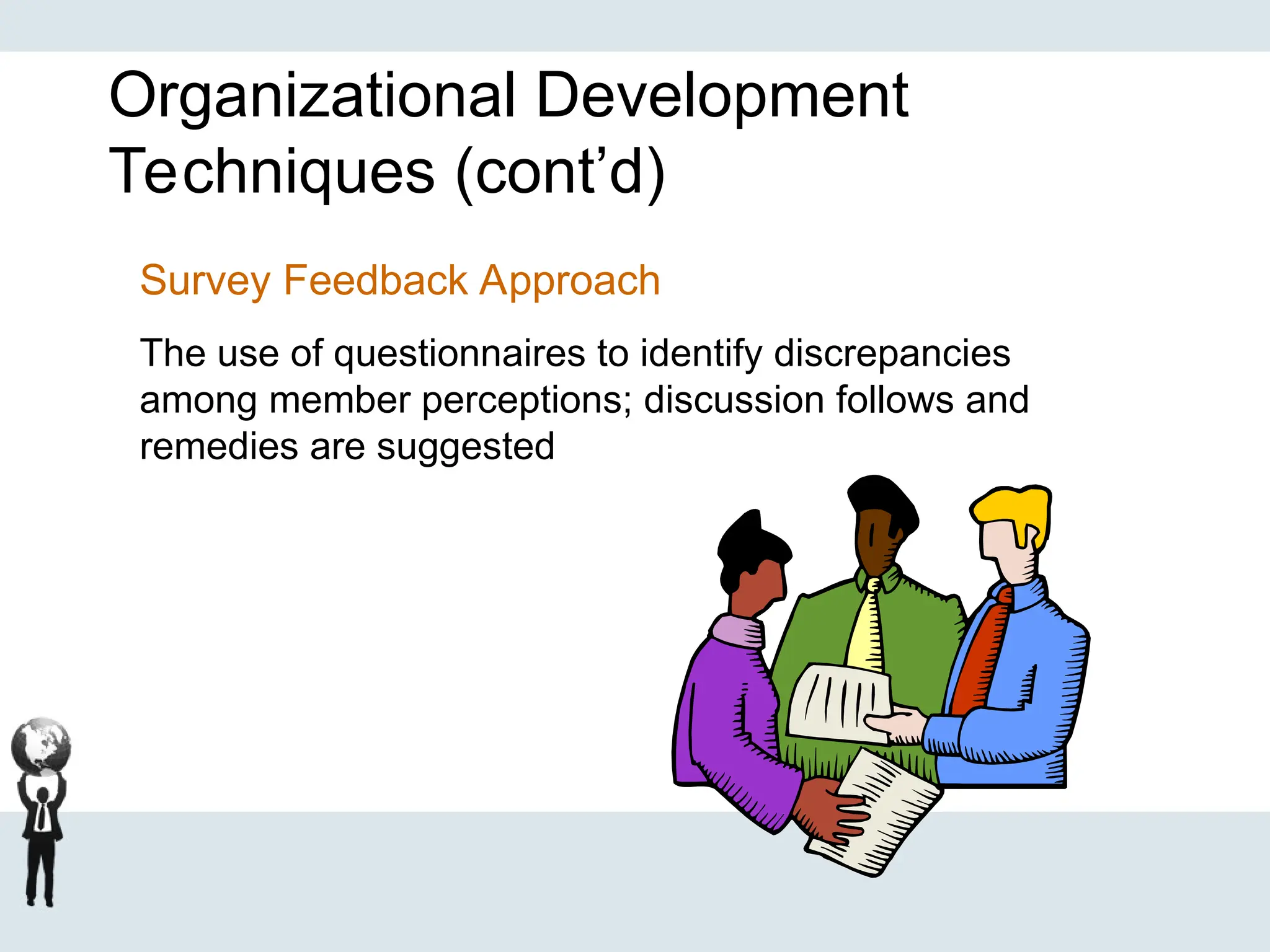
Survey Feedback Approach
The use of questionnaires to identify discrepancies
among member perceptions; discussion follows and
remedies are suggested
Organizational Development
Techniques (cont’d)
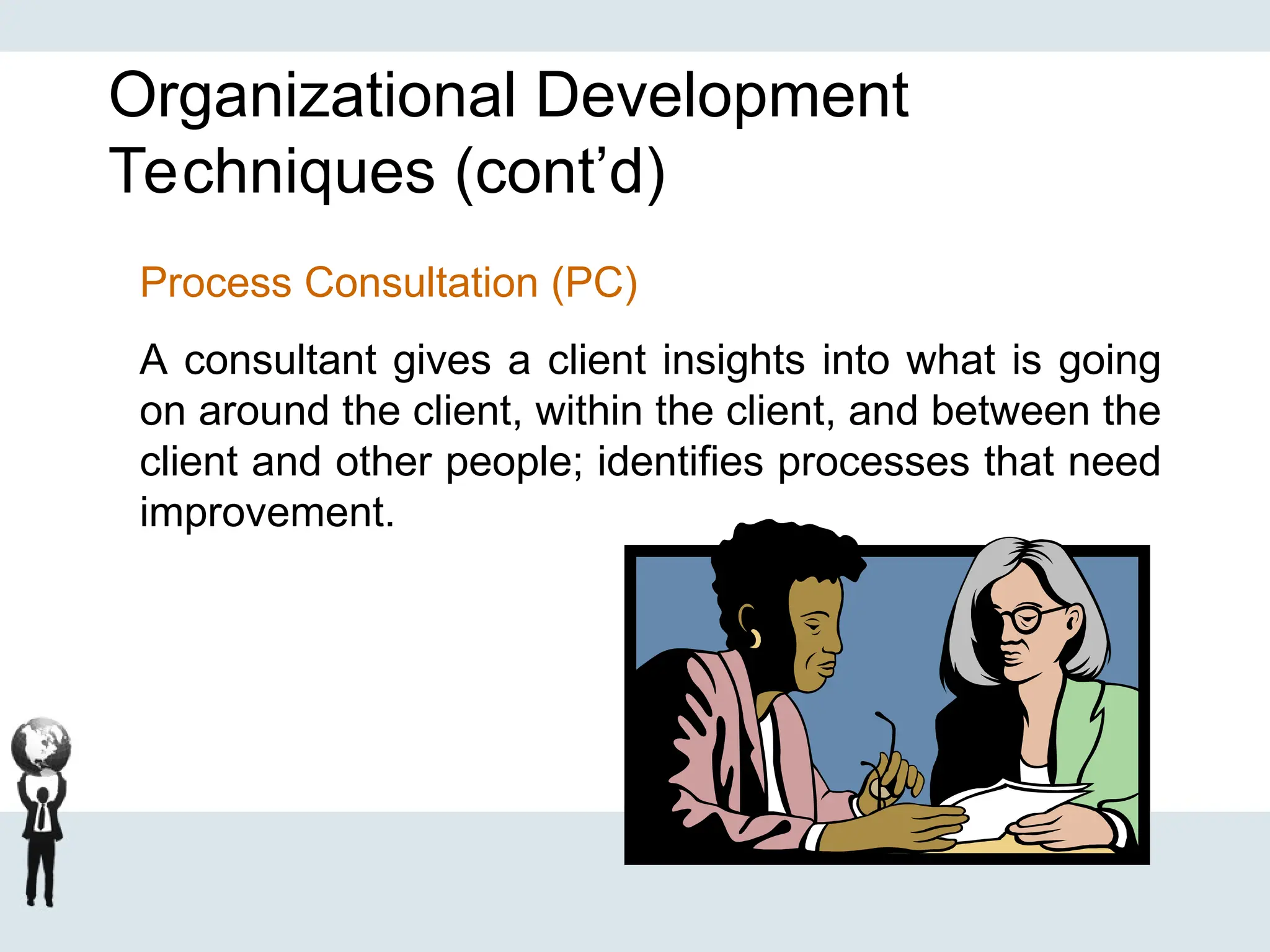
Process Consultation (PC)
A consultant gives a client insights into what is going
on around the client, within the client, and between the
client and other people; identifies processes that need
improvement.
Organizational Development
Techniques (cont’d)
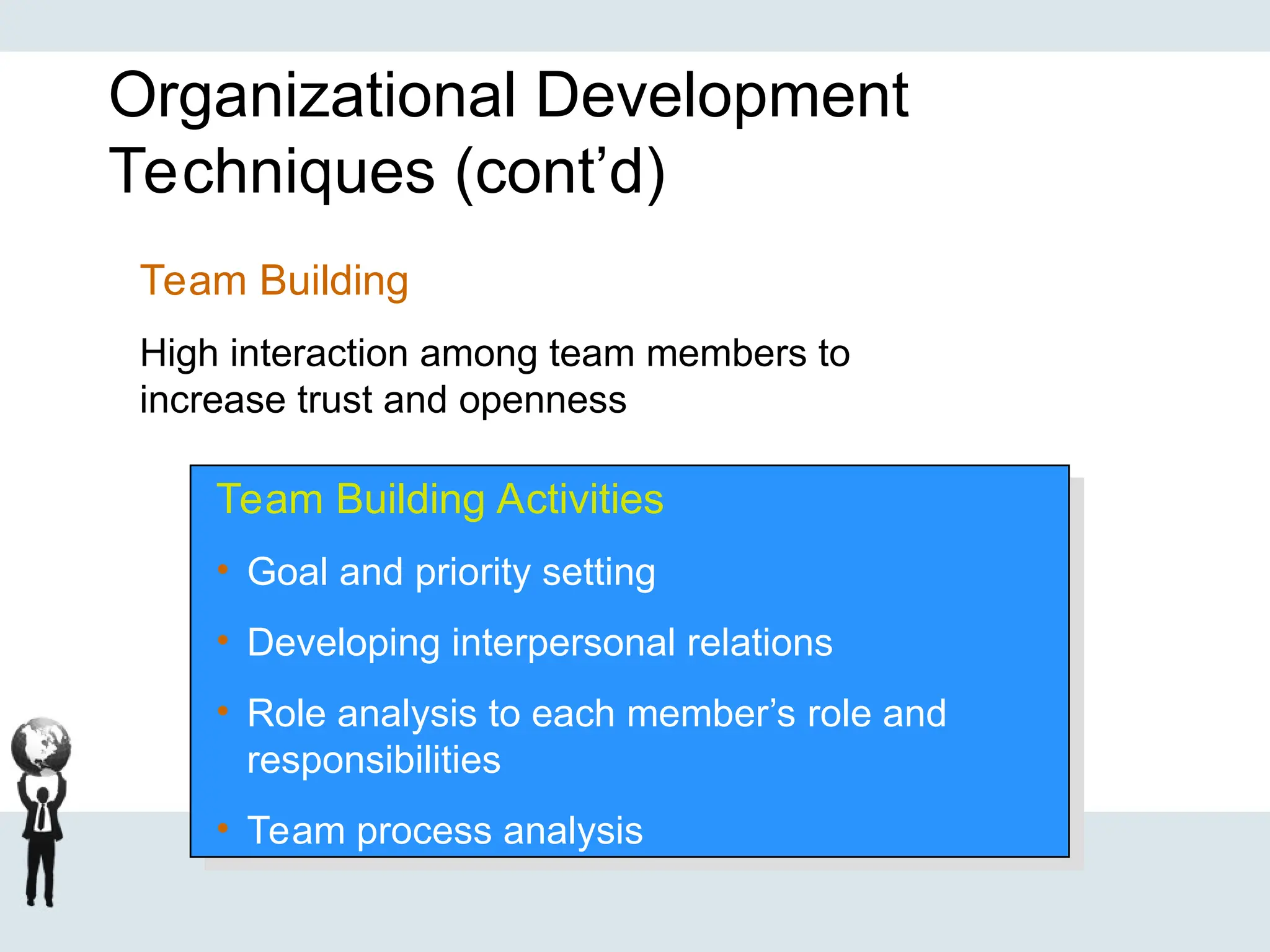
Team Building Activities
• Goal and priority setting
• Developing interpersonal relations
• Role analysis to each member’s role and
responsibilities
• Team process analysis
Team Building
High interaction among team members to
increase trust and openness
Organizational Development
Techniques (cont’d)
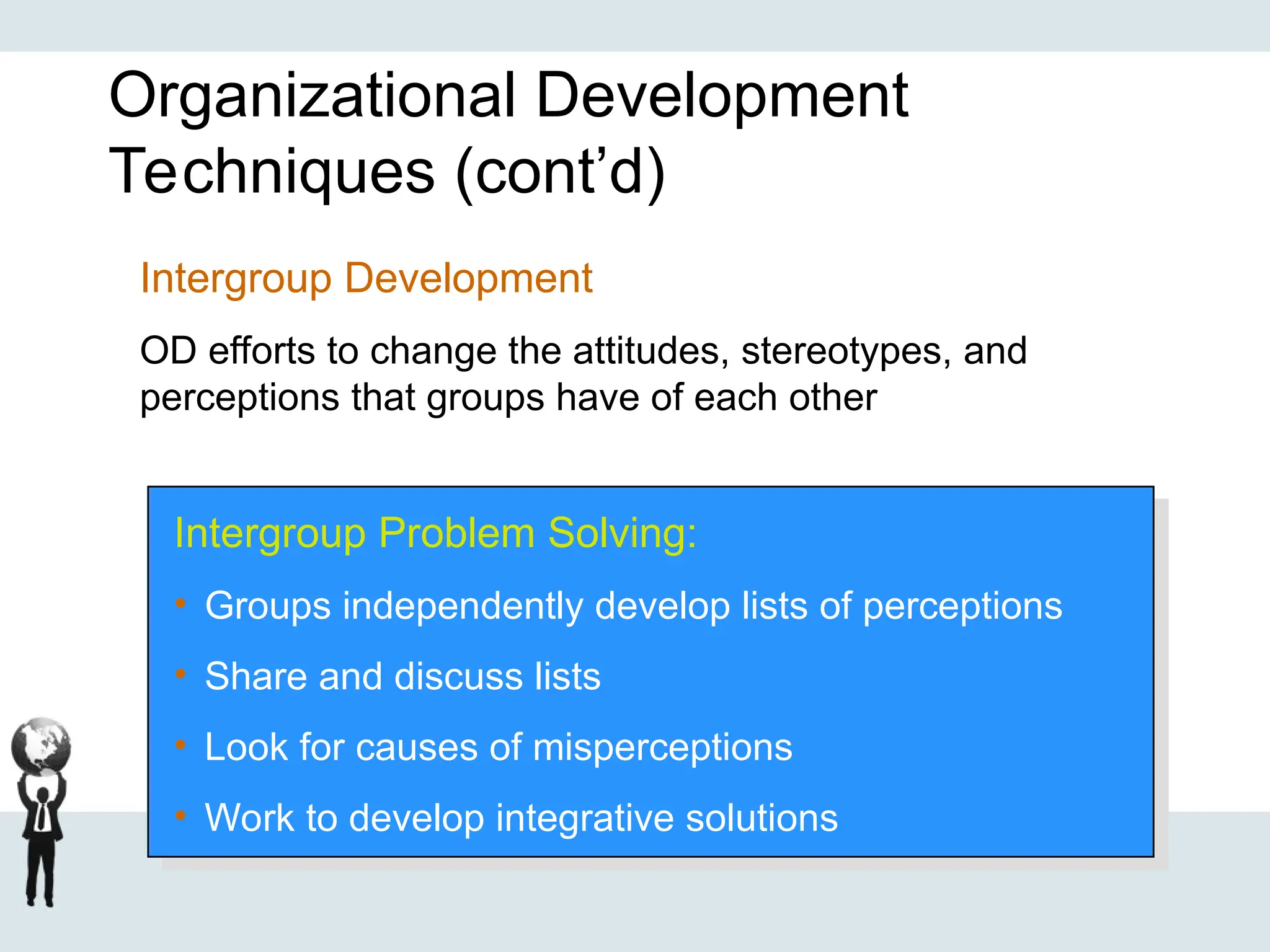
Intergroup Problem Solving:
• Groups independently develop lists of perceptions
• Share and discuss lists
• Look for causes of misperceptions
• Work to develop integrative solutions
Intergroup Development
OD efforts to change the attitudes, stereotypes, and
perceptions that groups have of each other
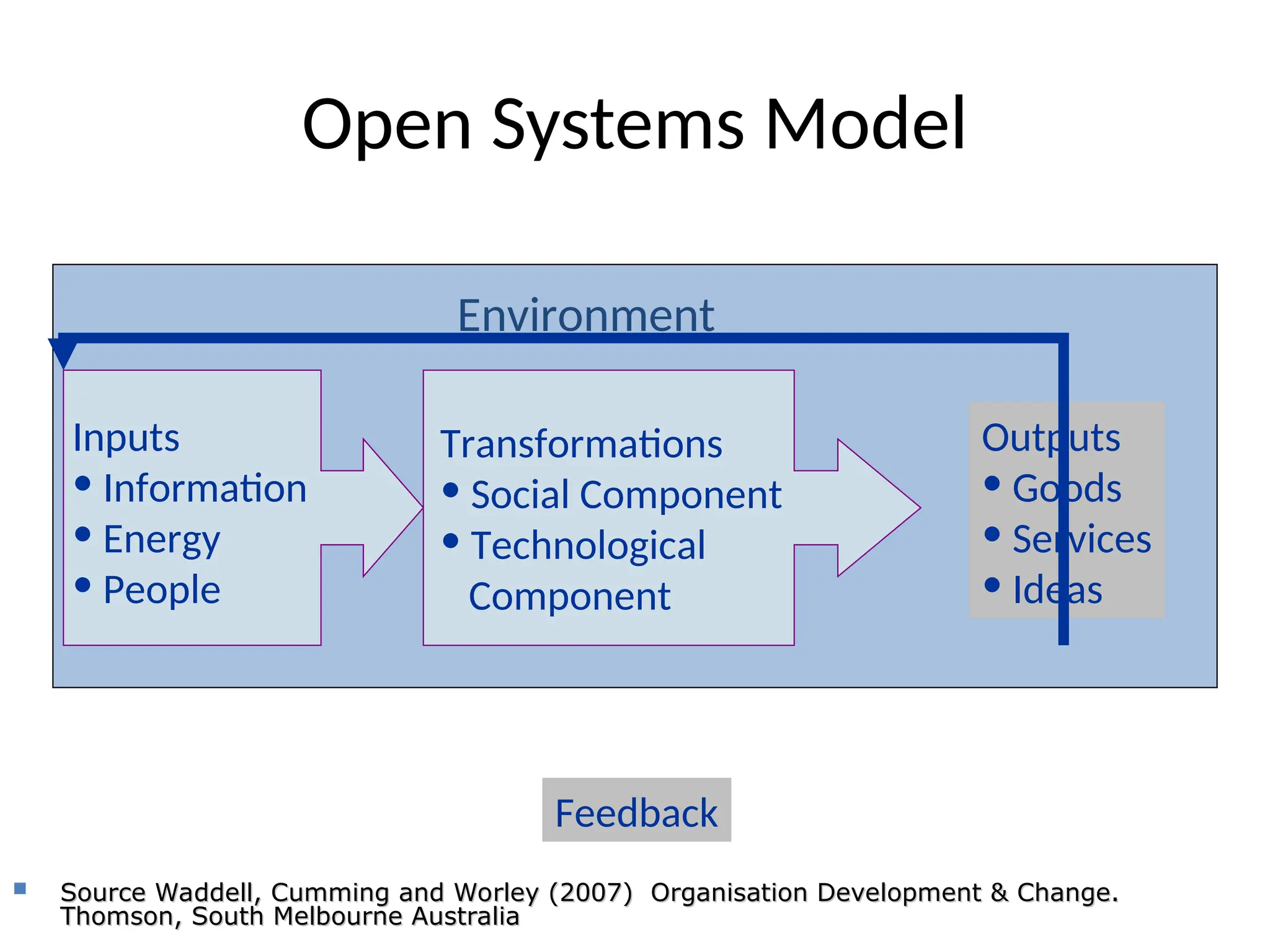
Open Systems Model
Inputs
• Information
• Energy
• People
Transformations
• Social Component
• Technological
Component
Outputs
• Goods
• Services
• Ideas
Environment
Feedback
 Source Waddell, Cumming and Worley (2007) Organisation Development & Change.
Source Waddell, Cumming and Worley (2007) Organisation Development & Change.
Thomson, South Melbourne Australia
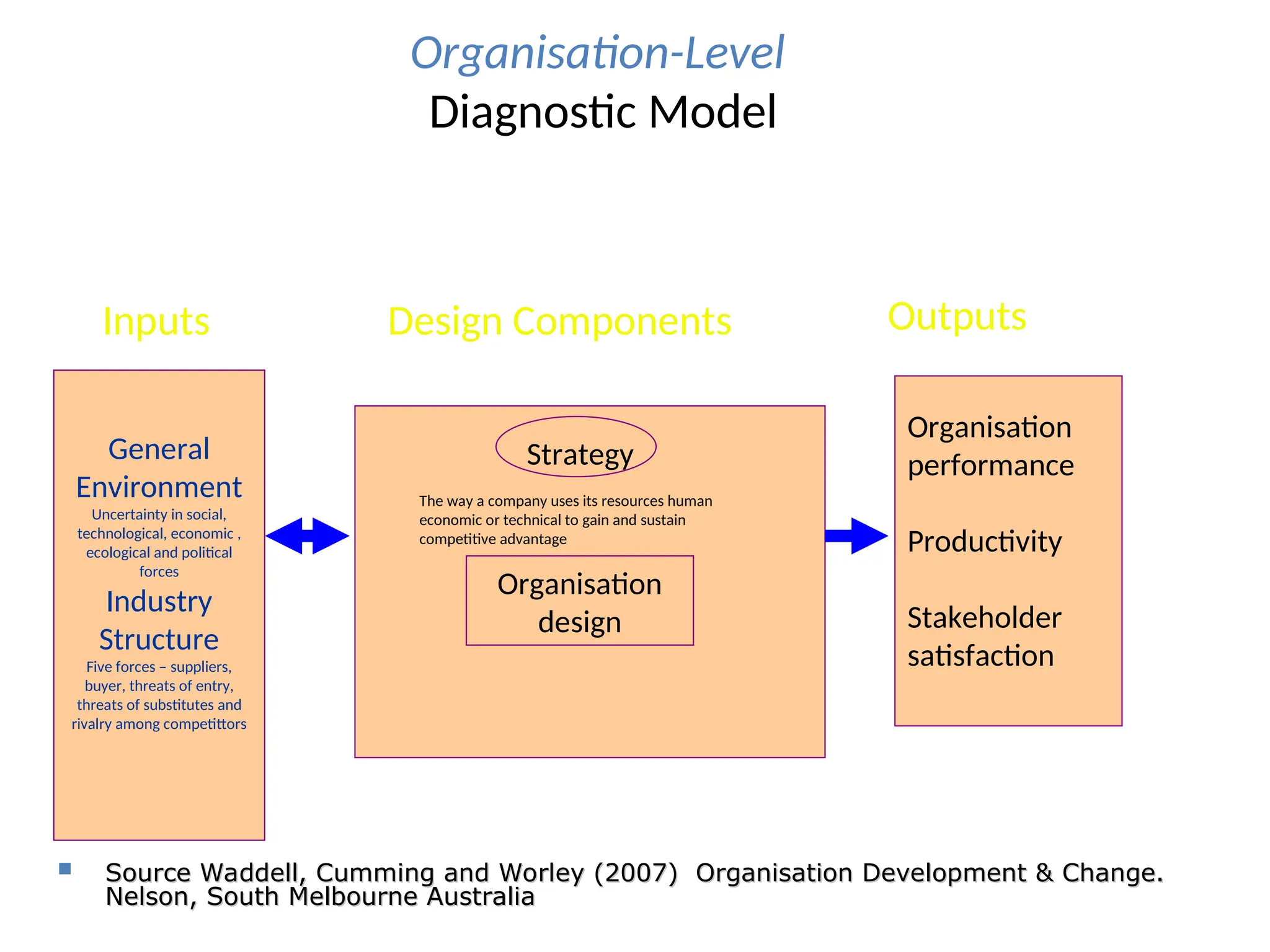
Organisation-Level
Diagnostic Model
Inputs
General
Environment
Uncertainty in social,
technological, economic ,
ecological and political
forces
Industry
Structure
Five forces – suppliers,
buyer, threats of entry,
threats of substitutes and
rivalry among competittors
Design Components Outputs
 Source Waddell, Cumming and Worley (2007) Organisation Development & Change.
Source Waddell, Cumming and Worley (2007) Organisation Development & Change.
Nelson, South Melbourne Australia
Strategy
The way a company uses its resources human
economic or technical to gain and sustain
competitive advantage
Organisation
design
Organisation
performance
Productivity
Stakeholder
satisfaction
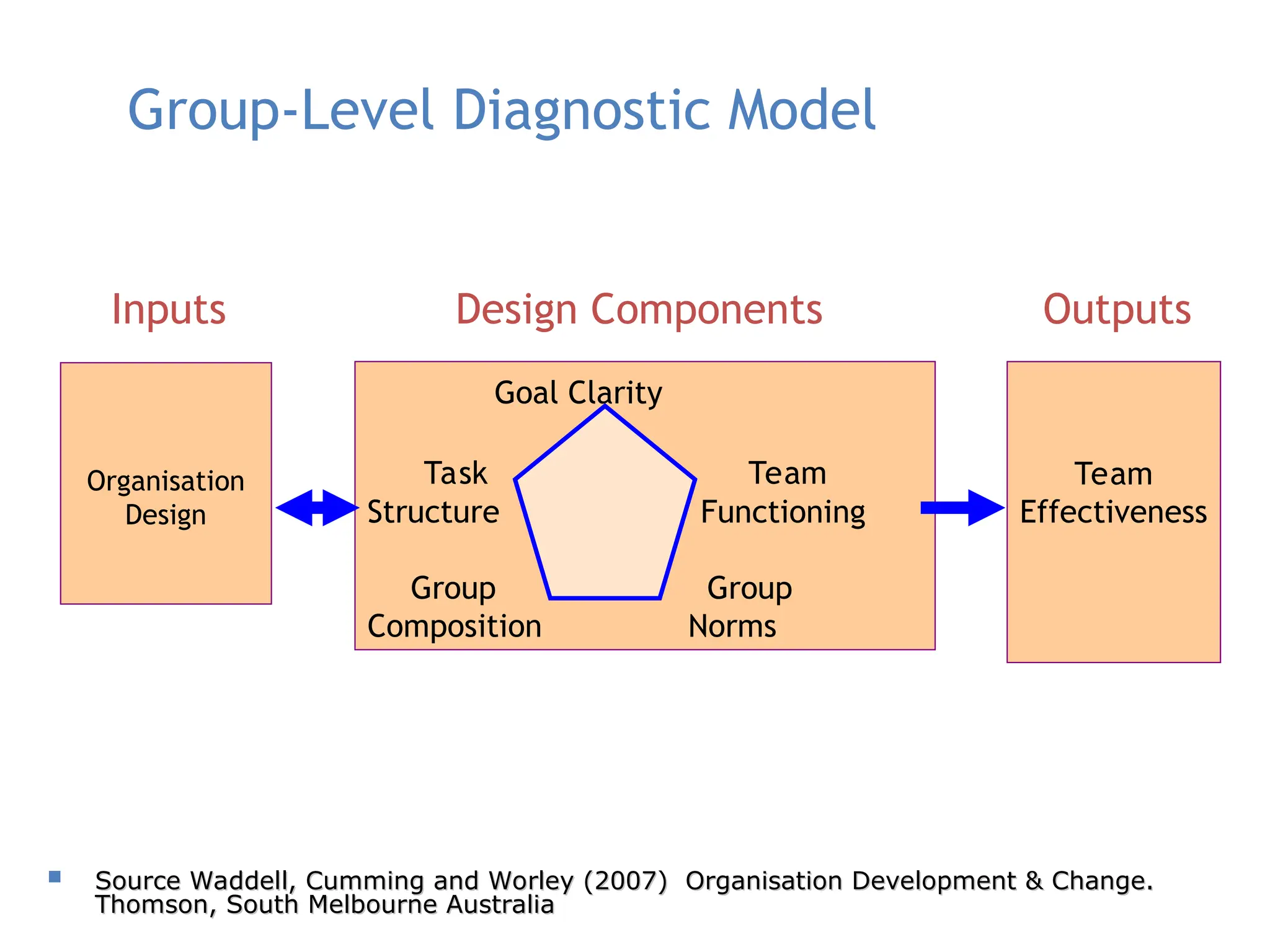
Goal Clarity
Task Team
Structure Functioning
Group Group
Composition Norms
Design Components Outputs
Organisation
Design
Team
Effectiveness
Group-Level Diagnostic Model
Inputs
 Source Waddell, Cumming and Worley (2007) Organisation Development & Change.
Source Waddell, Cumming and Worley (2007) Organisation Development & Change.
Thomson, South Melbourne Australia
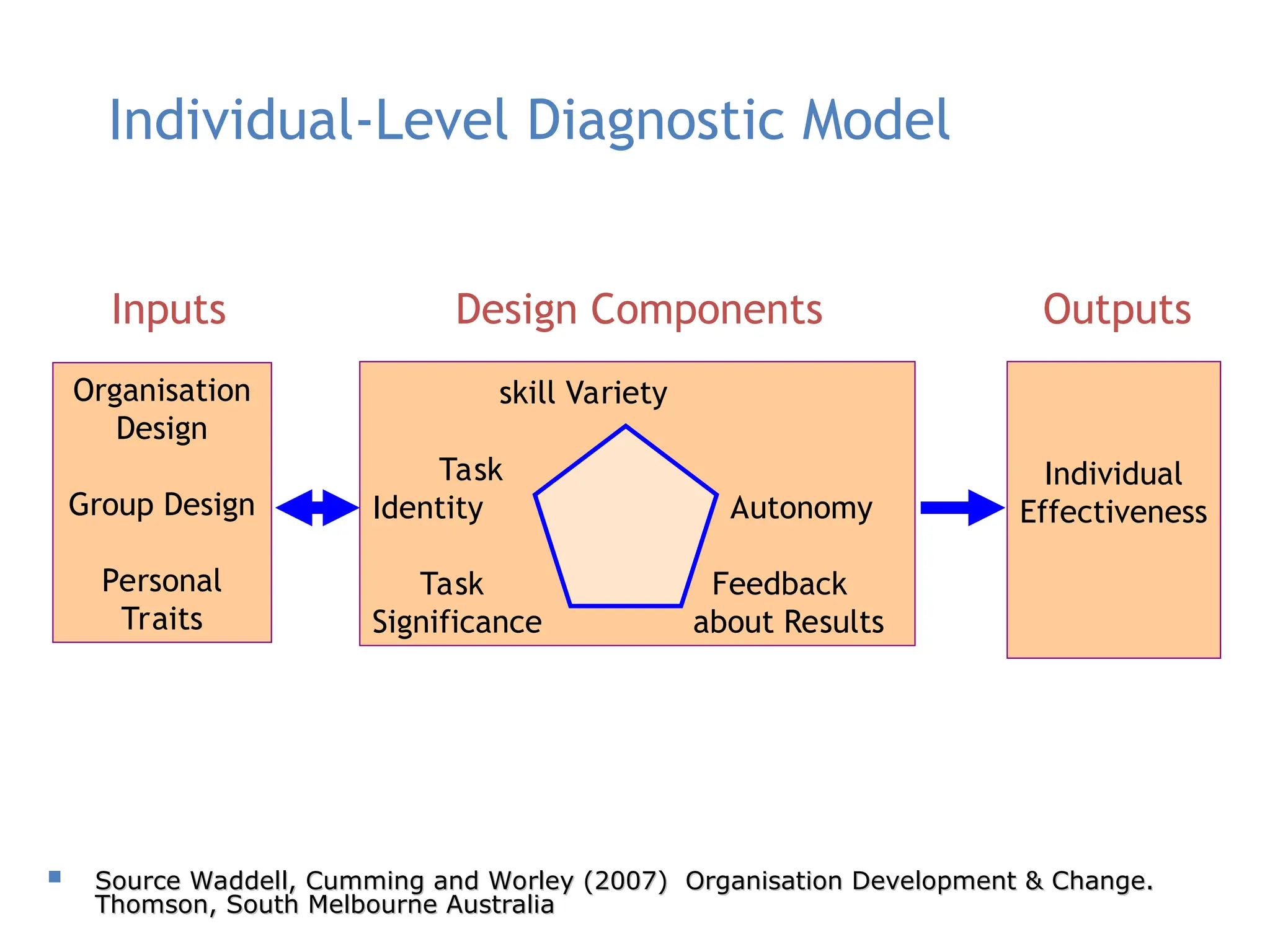
skill Variety
Task
Identity Autonomy
Task Feedback
Significance about Results
Individual-Level Diagnostic Model
Inputs Design Components Outputs
Organisation
Design
Group Design
Personal
Traits
Individual
Effectiveness
 Source Waddell, Cumming and Worley (2007) Organisation Development & Change.
Source Waddell, Cumming and Worley (2007) Organisation Development & Change.
Thomson, South Melbourne Australia
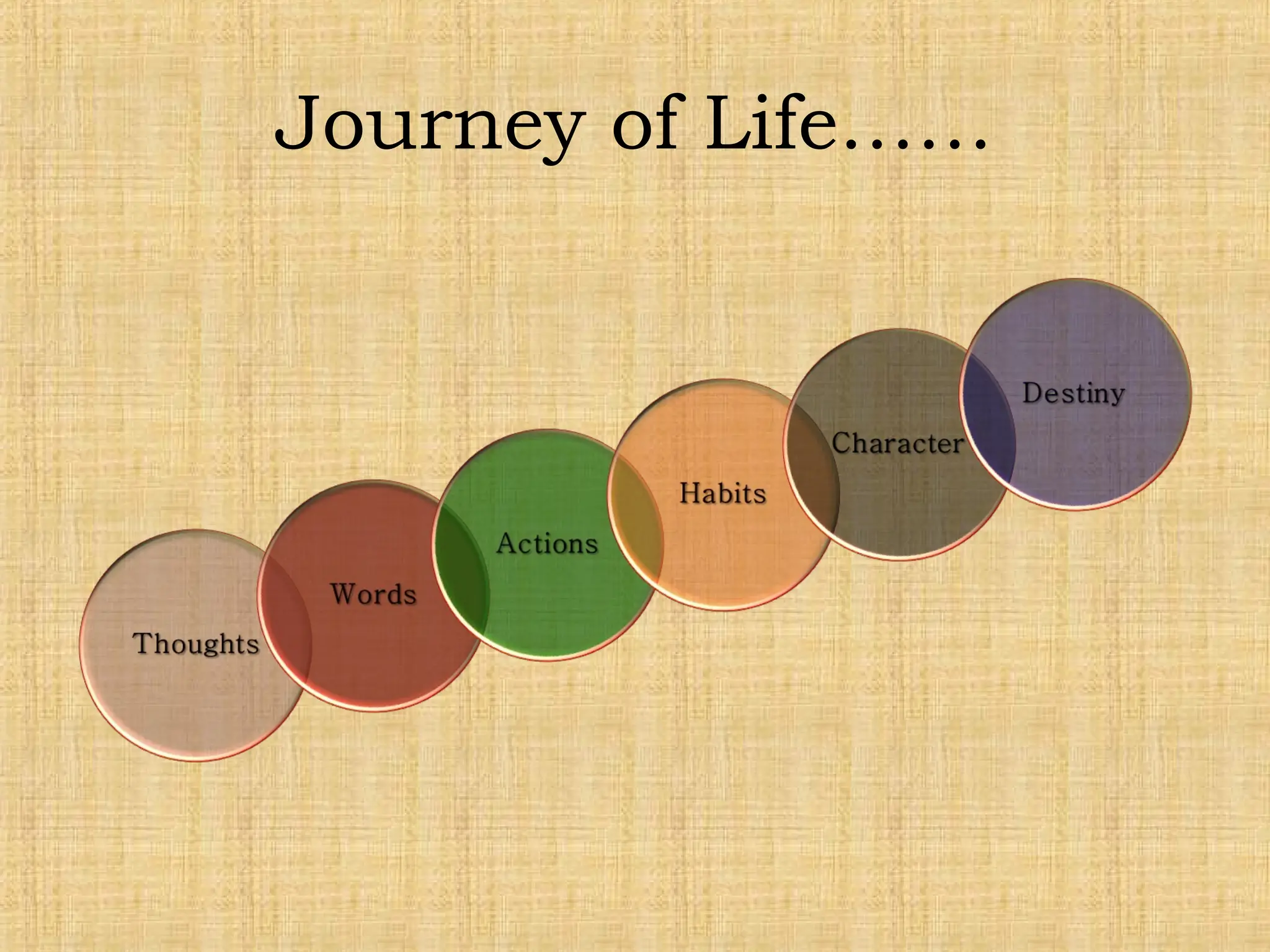
Journey of Life……
Employee development Enhancing employee skills through work process improvements, Competency enhancement, Training, and Learning programs

Employee development Enhancing employee skills through work process improvements, Competency enhancement, Training, and Learning programs

  • 1.
    Organization Development (OD) presentedby Meditha Karunatillaka Meditha Karunatillaka MBA, Dip in HRM, Dip in T & D, AMTD, MHRP MBA, Dip in HRM, Dip in T & D, AMTD, MHRP
  • 2.
    Definition-what is anorganization Definition-what is an organization An organization is the planned coordination An organization is the planned coordination of the activities of a number of people for of the activities of a number of people for the achievement of some common explicit the achievement of some common explicit purpose or goal, through division of labor purpose or goal, through division of labor and function, and through a hierarchy of and function, and through a hierarchy of authority and responsibility –(Edgar Shein) authority and responsibility –(Edgar Shein)
  • 3.
    Definition Definition Organization Development (OD) OrganizationDevelopment (OD) OD is an effort (1) planned (2) OD is an effort (1) planned (2) organization wide (3)managed from organization wide (3)managed from the top (4) increase organization the top (4) increase organization effectiveness and health through (5) effectiveness and health through (5) planned interventions in the planned interventions in the organization’s processes, using organization’s processes, using behavioral science knowledge. behavioral science knowledge. (Richard Beckhard) (Richard Beckhard)
  • 4.
    Why Study OD?  Can improve individual performance  Create better morale Increase organizational profitability
  • 5.
    Related to OD •Vision and Mission • Behavior of the Organization • Individual Behavior • Structure of the Organization • Culture of the Organization
  • 6.
    WHY DO OD? •Human resources • Changing nature of the workplace • Global markets • Accelerated rate of change
  • 7.
    Distinctive Features ofOD • an OD program is a long range, planned and sustained effort that is based on an overall strategy. • consultant establishes a unique relationship with the client system: the consultant seeks and maintains a collaborative relationship of relative equality with the organization members
  • 8.
    OD interventions are.......... •Unique in nature • Reflexive • Self-analytical • Self-skill building in nature
  • 9.
    Benefits • It mainlytries to deal with the changes throughout the organization or in any one of the major units. • It develops greater motivation. • It increases productivity. • A better quality of work. – It creates higher job satisfaction – Team work is improved and encouraged – It finds better solution for conflicts – Commitment to objectives – Increases the willingness to change – Absenteeism is reduced. – Turnover is lower
  • 10.
    Limitations • Organizational developmentis long-way process and requires more time. • It consists of substantial expense, delayed payoff periods • Failures are possible • Possibility for invasion of privacy • Possible for psychological harms • It emphasizes only in group process compared to performance • Conceptual ambiguity is possible.
  • 11.
    Elements of theOD process • Entering and contracting • Diagnosing ( Organization, groups and jobs) • Planning and implementing change • Evaluating and institutionalizing
  • 12.
    Entering and contracting •Entering & Contracting are the initial steps in the OD process • Entering and Contracting set the initial Para meters for carrying out the subsequent phases of OD : –Diagnosing the organization –Planning & Implementation changes –Evaluating and Institutionalizing them
  • 13.
    • Entering intoan OD relationship comprises of three (3) elements- i.e. - Clarifying the Organizational Issue - Determining the relevant Clients - Selecting the appropriate OD Practitioner
  • 14.
    Clarifying the OrganizationalIssues • An Organization generally starts an OD programme by presenting the problem. i.e. the issue that caused them to consider an OD process. It may be Specific,( e.g. :decrease in market share, increase in absenteeism, Increase in industrial disputes or General (eg: Organization growing too fast, needs a rapid change) • At this stage, presenting the problem is only a symptom of an underlined problem
  • 15.
    Determining the relevantclient • Generally the relevant client includes those organization members who can directly impact on the change issue. • Unless these Members are identified and included in the entering and contracting process, they may with hold their support for and commitment to the OD process. • E.g. In trying to improve the productivity of a unionized plant the relevant client may include union officials as well as Managers and staff personnel. • It is not unusual for an OD project to fail because the relevant client was inappropriately defined.
  • 16.
    Diagnosing Organization • Diagnosisis the process of understanding current functioning of the organization. It will provides the information necessary for designing change interventions. It generally follows from successful entry and contracting. • This is a collaborative process between organization members and OD consultants to collect pertinent information, analyze it and draw conclusions of action planning and interventions . • Diagnosis may be aim uncovering causes for specific problems or it may be directed at assessing the overall functioning of the organization / department to discover the areas for future development.
  • 17.
    Organizational Diagnosis 1. Thinkof visiting your health care, computer or auto mechanic professional. What is a diagnosis? 2. What does s/he do to diagnose (Dx) your condition? 3. What are the uses/purposes of a Dx; What does it allow you to do? 4. What, therefore, are the criteria for a sound Dx? 5. How is a diagnosis derived?
  • 18.
    Planning and implementingchange • In this stage ,organization members and practitioners jointly plan and implement OD interventions. • They design interventions to achieve the organization's vision or goals and make action plans to implement them. • There are several criteria for designing interventions ,including the organization's readiness for change ,its current change capability, its culture and power distributions and change agent’s kills and abilities . • Depending on the outcomes of diagnosis, there are four major types of interventions in OD
  • 19.
    Comparison of PlannedChange Model Problem identification Consultation with Behavioural Science Expert Data gathering and Preliminary Diagnosis Feedback to Key Client of Group Joint Diagnosis of Problem Joint Action Plan Action Data Gathering after Action Unfreezing Movement Refreezing Initiate the Inquiry Inquiry into Best Practices Discover Themes Envision a Preferred Future Design and Deliver Ways to Create the Future (A) Lewin’s Planned Change Model (B) Action Research Model (C) Positive Model
  • 20.
    Major Types ofInterventions in OD . • Human Process Interventions Human Process Interventions • Techno structural Interventions Techno structural Interventions • Human Resources Management Human Resources Management Interventions Interventions • Strategic Interventions Strategic Interventions
  • 21.
    Human Process Interventions HumanProcess Interventions • Coaching Coaching • Training and Development Training and Development • Process Consultation and Team Building Process Consultation and Team Building • Third-party Interventions (Conflict Resolution) Third-party Interventions (Conflict Resolution) • Organization Confrontation Meeting Organization Confrontation Meeting • Intergroup Relationships Intergroup Relationships • Large-group Interventions Large-group Interventions
  • 22.
    Techno structural Interventions Technostructural Interventions • Structural Design Structural Design • Downsizing Downsizing • Reengineering Reengineering • Employee Involvement Employee Involvement • Work Design Work Design
  • 23.
    Human Resources ManagementInterventions Human Resources Management Interventions • Goal Setting Goal Setting • Performance Appraisal Performance Appraisal • Reward Systems Reward Systems • Career Planning and Development Career Planning and Development • Managing Work Force Diversity Managing Work Force Diversity • Employee Stress and Wellness Employee Stress and Wellness
  • 24.
    Strategic Interventions Strategic Interventions •ntegrated Strategic Change ntegrated Strategic Change • Mergers and Acquisitions Mergers and Acquisitions • Alliances and Networks Alliances and Networks • Culture Change Culture Change • Self-designing Organizations Self-designing Organizations • Organization Learning and Knowledge Management Organization Learning and Knowledge Management
  • 25.
    Evaluating and Institutionalizing •The final stage in planned change involves evaluating the effects of the intervention and managing the institutionalization of successful change programs . • Feed back to organization members about the intervention’s results provide information about whether the changes should be continued ,modified or suspended. • There are several criteria for designing interventions ,including the organization's readiness for change ,its current change capability, its culture and power distributions and change agent’s kills and abilities . • Depending on the outcomes of diagnosis, there are four major types of interventions in OD
  • 26.
    Organizational Development Techniques Sensitivity Training Traininggroups (T-groups) that seek to change behavior through unstructured group interaction Provides increased awareness of others and self Increases empathy with others, improves listening skills, greater openness, and increased tolerance for others
  • 27.
    Organizational Development Techniques (cont’d) SurveyFeedback Approach The use of questionnaires to identify discrepancies among member perceptions; discussion follows and remedies are suggested
  • 28.
    Organizational Development Techniques (cont’d) ProcessConsultation (PC) A consultant gives a client insights into what is going on around the client, within the client, and between the client and other people; identifies processes that need improvement.
  • 29.
    Organizational Development Techniques (cont’d) TeamBuilding Activities • Goal and priority setting • Developing interpersonal relations • Role analysis to each member’s role and responsibilities • Team process analysis Team Building High interaction among team members to increase trust and openness
  • 30.
    Organizational Development Techniques (cont’d) IntergroupProblem Solving: • Groups independently develop lists of perceptions • Share and discuss lists • Look for causes of misperceptions • Work to develop integrative solutions Intergroup Development OD efforts to change the attitudes, stereotypes, and perceptions that groups have of each other
  • 31.
    Open Systems Model Inputs •Information • Energy • People Transformations • Social Component • Technological Component Outputs • Goods • Services • Ideas Environment Feedback  Source Waddell, Cumming and Worley (2007) Organisation Development & Change. Source Waddell, Cumming and Worley (2007) Organisation Development & Change. Thomson, South Melbourne Australia Thomson, South Melbourne Australia
  • 32.
    Organisation-Level Diagnostic Model Inputs General Environment Uncertainty insocial, technological, economic , ecological and political forces Industry Structure Five forces – suppliers, buyer, threats of entry, threats of substitutes and rivalry among competittors Design Components Outputs  Source Waddell, Cumming and Worley (2007) Organisation Development & Change. Source Waddell, Cumming and Worley (2007) Organisation Development & Change. Nelson, South Melbourne Australia Nelson, South Melbourne Australia Strategy The way a company uses its resources human economic or technical to gain and sustain competitive advantage Organisation design Organisation performance Productivity Stakeholder satisfaction
  • 33.
    Goal Clarity Task Team StructureFunctioning Group Group Composition Norms Design Components Outputs Organisation Design Team Effectiveness Group-Level Diagnostic Model Inputs  Source Waddell, Cumming and Worley (2007) Organisation Development & Change. Source Waddell, Cumming and Worley (2007) Organisation Development & Change. Thomson, South Melbourne Australia Thomson, South Melbourne Australia
  • 34.
    skill Variety Task Identity Autonomy TaskFeedback Significance about Results Individual-Level Diagnostic Model Inputs Design Components Outputs Organisation Design Group Design Personal Traits Individual Effectiveness  Source Waddell, Cumming and Worley (2007) Organisation Development & Change. Source Waddell, Cumming and Worley (2007) Organisation Development & Change. Thomson, South Melbourne Australia Thomson, South Melbourne Australia
  • 35.