HUMAN RESOURCE 
MANAGEMENT 
REWARD AND COMPENSATION
WHAT IS REWARD? 
• Literature Review 
• Reward is the ‘oil’ of the entire 
Human Resource process shields 
• Reward is = Is concerned with the 
formulation and implementation of 
strategies and policies that are to 
reward people fairly, equitably and 
consistently in accordance with their 
value in the organization. 
• From Oxford Definition 
1. A sum of money offered for the 
detection or capture of a criminal, 
the recovery of lost or stolen 
property. 
2. Something given or received in 
return or recompense for services, 
merit hardship 
3. To make return or requite.
• Other components of reward system including: 
a) Organization Strategy 
b) HR Strategy 
c) Pay and Grade Structure 
d) Performance Management 
e) Total Remuneration 
• The main objective organization give rewards to the employee is; 
• To attract, maintain and retain, good, efficient, motivated and high performing 
employees.
TYPES OF REWARDS 
• Money 
• Gift cards 
• Property 
• Medical coverage 
• Promotion to new position 
• Increment 
• Grades 
• Performance based incentives 
• Employee Recognition 
• Protection Programs 
• Profit sharing 
• Overtime and Holiday 
packages
PERFORMANCE REWARD AND COMPENSATION 
• The most effective reward and 
compensation systems align with 
objective, outcome-based 
evaluations of employee 
performance. 
• Each employee's performance 
measurement should reflect the 
organization's business strategy 
and financial goals. 
• Compensation should also reflect 
the employee's performance level 
and his or her contributions to the 
organization's success.
• Approaches to do including: 
1. Reflect an employee's performance 
and contributions 
2. Improve employee and customer 
engagement 
3. Increase productivity 
4. Focus employees on clear, objective, 
and measurable outcomes 
5. Link to the organization's strategic 
direction and business goals 
6. Reward employees who achieve 
results 
• With this approaches its expected 
the relationship between 
employees and employers to be 
stronger and maximization of 
employees performance.
WHAT IS COMPENSATION? 
• DEFINITION 
• Any form of payment made to an individual for services rendered as an 
employee for an employer; services performed as an employee 
representative; and any separation or subsistence allowance paid. 
• The money receive by an employee from an employer as a salary or wages. 
• Synonyms: Repayment, reimbursement, remuneration.
WHY COMPENSATION? 
• Attracting Staff 
• Retaining Staff 
• Motivating Staff 
• Driving Changes 
• Corporate Reputation 
• Affordability 
• Employee Objectives 
• Purchasing Power 
• Fairness 
• Recognition 
• Composition
WHY COMPENSATION? 
1. Attracting staff – benchmark with labour market to secure the good 
candidates. 
2. Retaining staff – competitive pay package will ensure that effective 
performers stay with you. 
3. Motivating staff – ‘necessary evil’ to motivate staff to work. 
4. Driving change – higher base-pay, bonuses, and promotion can tie to 
new behavior, attitude & skill gained by staff.
5. Corporate reputation – Good compensation packages may be 
perceived as good company in the eyes of public and industry hence 
establish positive image. 
6. Affordability – Compensation package must suit with company’s 
affordability. 
7. Employee objective – If company’s objective is to maximize profit, then 
the employee objective is to maximize earning or income. 
8. Purchasing Power – Total remuneration should meet the general 
standard of living of that particular area.
9. Fairness – Every employee had a strong feeling about the level of 
payment that was fair for the job so that he will not feel underpaid. 
10.Recognition – Employee feel that their contribution or expertise is 
recognised through pay package. 
11.Composition – Different group of employees have different priorities. 
• E.g. younger staff – opt for maximising cash earning; mid-career staff – 
opt for child care benefits, transport facility coz have family; older staff– 
opt for retiring benefits, golden hand- shake, etc.
HOW TO SET BASE PAY? 
1. External market comparison – i.e. ‘follow the market’ or ‘above the 
market’ rate. 
2. Job evaluation – i.e. each job is assigned with certain value which tie 
up with certain pay level e.g. Hay Job Evaluation Methods. 
3. Collective bargaining – i.e. employee union and employer mutual 
agreement on the type and amount of compensation to be given to 
staff.
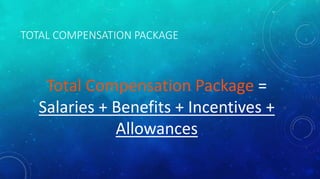
TOTAL COMPENSATION PACKAGE 
Total Compensation Package = 
Salaries + Benefits + Incentives + 
Allowances
REMUNERATION ELEMENTS 
1. Salaries 
• i.e. combination of monthly or frequent payments, annual increment, and 
annual or other infrequent bonuses. 
• 2 components – fixed pays (e.g. basic salary); and variable pays (e.g. overtime). 
2. Benefits 
• i.e. extras to the working conditions that have cash value e.g. lunch coupon, 
subsidized meal, staff discounts. 
• Can be classified into quantifiable (e.g. annual leave, sick leave, company car, 
further study sponsorship) and non-quantifiable (e.g. recognition for full 
attendance, long service awards, employee of the month, retirement benefits).
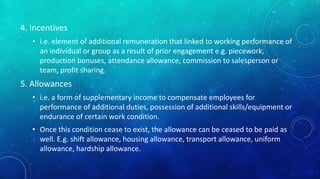
4. Incentives 
• i.e. element of additional remuneration that linked to working performance of 
an individual or group as a result of prior engagement e.g. piecework, 
production bonuses, attendance allowance, commission to salesperson or 
team, profit sharing. 
5. Allowances 
• i.e. a form of supplementary income to compensate employees for 
performance of additional duties, possession of additional skills/equipment or 
endurance of certain work condition. 
• Once this condition cease to exist, the allowance can be ceased to be paid as 
well. E.g. shift allowance, housing allowance, transport allowance, uniform 
allowance, hardship allowance.

Human Resource Management: Reward and compensation

  • 1.
    HUMAN RESOURCE MANAGEMENT REWARD AND COMPENSATION
  • 2.
    WHAT IS REWARD? • Literature Review • Reward is the ‘oil’ of the entire Human Resource process shields • Reward is = Is concerned with the formulation and implementation of strategies and policies that are to reward people fairly, equitably and consistently in accordance with their value in the organization. • From Oxford Definition 1. A sum of money offered for the detection or capture of a criminal, the recovery of lost or stolen property. 2. Something given or received in return or recompense for services, merit hardship 3. To make return or requite.
  • 3.
    • Other componentsof reward system including: a) Organization Strategy b) HR Strategy c) Pay and Grade Structure d) Performance Management e) Total Remuneration • The main objective organization give rewards to the employee is; • To attract, maintain and retain, good, efficient, motivated and high performing employees.
  • 4.
    TYPES OF REWARDS • Money • Gift cards • Property • Medical coverage • Promotion to new position • Increment • Grades • Performance based incentives • Employee Recognition • Protection Programs • Profit sharing • Overtime and Holiday packages
  • 5.
    PERFORMANCE REWARD ANDCOMPENSATION • The most effective reward and compensation systems align with objective, outcome-based evaluations of employee performance. • Each employee's performance measurement should reflect the organization's business strategy and financial goals. • Compensation should also reflect the employee's performance level and his or her contributions to the organization's success.
  • 6.
    • Approaches todo including: 1. Reflect an employee's performance and contributions 2. Improve employee and customer engagement 3. Increase productivity 4. Focus employees on clear, objective, and measurable outcomes 5. Link to the organization's strategic direction and business goals 6. Reward employees who achieve results • With this approaches its expected the relationship between employees and employers to be stronger and maximization of employees performance.
  • 7.
    WHAT IS COMPENSATION? • DEFINITION • Any form of payment made to an individual for services rendered as an employee for an employer; services performed as an employee representative; and any separation or subsistence allowance paid. • The money receive by an employee from an employer as a salary or wages. • Synonyms: Repayment, reimbursement, remuneration.
  • 8.
    WHY COMPENSATION? •Attracting Staff • Retaining Staff • Motivating Staff • Driving Changes • Corporate Reputation • Affordability • Employee Objectives • Purchasing Power • Fairness • Recognition • Composition
  • 9.
    WHY COMPENSATION? 1.Attracting staff – benchmark with labour market to secure the good candidates. 2. Retaining staff – competitive pay package will ensure that effective performers stay with you. 3. Motivating staff – ‘necessary evil’ to motivate staff to work. 4. Driving change – higher base-pay, bonuses, and promotion can tie to new behavior, attitude & skill gained by staff.
  • 10.
    5. Corporate reputation– Good compensation packages may be perceived as good company in the eyes of public and industry hence establish positive image. 6. Affordability – Compensation package must suit with company’s affordability. 7. Employee objective – If company’s objective is to maximize profit, then the employee objective is to maximize earning or income. 8. Purchasing Power – Total remuneration should meet the general standard of living of that particular area.
  • 11.
    9. Fairness –Every employee had a strong feeling about the level of payment that was fair for the job so that he will not feel underpaid. 10.Recognition – Employee feel that their contribution or expertise is recognised through pay package. 11.Composition – Different group of employees have different priorities. • E.g. younger staff – opt for maximising cash earning; mid-career staff – opt for child care benefits, transport facility coz have family; older staff– opt for retiring benefits, golden hand- shake, etc.
  • 12.
    HOW TO SETBASE PAY? 1. External market comparison – i.e. ‘follow the market’ or ‘above the market’ rate. 2. Job evaluation – i.e. each job is assigned with certain value which tie up with certain pay level e.g. Hay Job Evaluation Methods. 3. Collective bargaining – i.e. employee union and employer mutual agreement on the type and amount of compensation to be given to staff.
  • 13.
    TOTAL COMPENSATION PACKAGE Total Compensation Package = Salaries + Benefits + Incentives + Allowances
  • 14.
    REMUNERATION ELEMENTS 1.Salaries • i.e. combination of monthly or frequent payments, annual increment, and annual or other infrequent bonuses. • 2 components – fixed pays (e.g. basic salary); and variable pays (e.g. overtime). 2. Benefits • i.e. extras to the working conditions that have cash value e.g. lunch coupon, subsidized meal, staff discounts. • Can be classified into quantifiable (e.g. annual leave, sick leave, company car, further study sponsorship) and non-quantifiable (e.g. recognition for full attendance, long service awards, employee of the month, retirement benefits).
  • 15.
    4. Incentives •i.e. element of additional remuneration that linked to working performance of an individual or group as a result of prior engagement e.g. piecework, production bonuses, attendance allowance, commission to salesperson or team, profit sharing. 5. Allowances • i.e. a form of supplementary income to compensate employees for performance of additional duties, possession of additional skills/equipment or endurance of certain work condition. • Once this condition cease to exist, the allowance can be ceased to be paid as well. E.g. shift allowance, housing allowance, transport allowance, uniform allowance, hardship allowance.