Factors Influencing Organizational Change Faridah Norhazila Thiva
Last Week Change as an organizational process Lewin’s model, Action Research etc.
Factors Influencing Organizational Change 2 approaches Factors that affect the organization Factors that affect the way it changes
Factors that affect the organization First, we need a model of the organization We have chosen a long lived model…
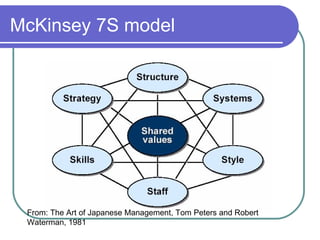
McKinsey 7S model  From: The Art of Japanese Management, Tom Peters and Robert Waterman, 1981
To Consider What factors can & do affect your team’s facet of the organization?
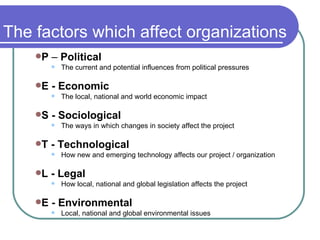
The factors which affect organizations P  –  Political   The current and potential influences from political pressures E - Economic   The local, national and world economic impact S - Sociological   The ways in which changes in society affect the project T - Technological   How new and emerging technology affects our project / organization L - Legal   How local, national and global legislation affects the project E - Environmental   Local, national and global environmental issues
Factors that affect the way organizations change Again we need a model, this time for organizational change Last week we saw Lewin’s model This week…
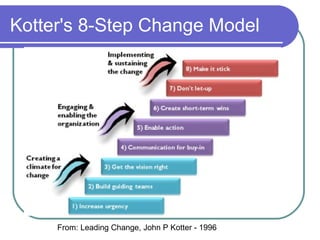
Kotter's 8-Step Change Model  From: Leading Change, John P Kotter - 1996
To Consider What are the factors that affect the steps in this change model?
Step 1: Create a sense of urgency For the change to happen, it needs the whole organization behind it – believing in it: Identify potential threats and develop potential scenarios showing what could happen in the future Examine the opportunities that should be exploited Start discussions, giving people convincing reasons to start thinking and talking and thinking about the change Rally support from your customers and outside investors to reinforce your argument
Step 2: Form a change coalition To help convince people that change needs to happen, find and fuel effective leaders in your organization: Identify true leaders in your organization Ask for emotional commitment from these people Check your team for weaknesses and make sure you have a good mix of people from different areas and levels
Step 3: Create a vision for change You need a clear vision so people can understand the purpose of what you’re asking them to do: Determine the values that are central to the change Develop a short summary that captures what you see as the future of the organization Create a strategy to execute the vision Practice your vision speech often
Step 4: Communicate the vision What you do with your vision will determine whether you are successful or not and you’ll find many other run of the day company communications competing against yours: At every opportunity, talk about your change vision Address people’s concerns – and there will be concerns Tie your vision to operations- training, reviews, hiring process … Lead by example
Step 5: Remove obstacles You need to remove obstacles to empower people to execute your vision: Identify change leaders Recognize and reward people for making change happen Identify those resisting change and help them see the need Remove barriers – human and other
Step 6: Create short-term wins Success motivates – give your team a taste for success: Pick a simple project you can implement with help from the die hard critics Choose inexpensive projects where you can justify the spend Reward the people the help you meet the goals
Step 7: Build on the change Real change runs deep – keep looking for improvements: After every win, analyze what went right and what went wrong Set goals to continue building on what you’ve achieved
Step 8: Anchor the changes in corporate culture Make the change stick! Talk about progress every chance you get Tell success stories Include values when hiring or training staff As key leaders of the change move on, be sure to replace them

Factors

  • 1.
    Factors Influencing OrganizationalChange Faridah Norhazila Thiva
  • 2.
    Last Week Changeas an organizational process Lewin’s model, Action Research etc.
  • 3.
    Factors Influencing OrganizationalChange 2 approaches Factors that affect the organization Factors that affect the way it changes
  • 4.
    Factors that affectthe organization First, we need a model of the organization We have chosen a long lived model…
  • 5.
    McKinsey 7S model From: The Art of Japanese Management, Tom Peters and Robert Waterman, 1981
  • 6.
    To Consider Whatfactors can & do affect your team’s facet of the organization?
  • 7.
    The factors whichaffect organizations P – Political The current and potential influences from political pressures E - Economic The local, national and world economic impact S - Sociological The ways in which changes in society affect the project T - Technological How new and emerging technology affects our project / organization L - Legal How local, national and global legislation affects the project E - Environmental Local, national and global environmental issues
  • 8.
    Factors that affectthe way organizations change Again we need a model, this time for organizational change Last week we saw Lewin’s model This week…
  • 9.
    Kotter's 8-Step ChangeModel From: Leading Change, John P Kotter - 1996
  • 10.
    To Consider Whatare the factors that affect the steps in this change model?
  • 11.
    Step 1: Createa sense of urgency For the change to happen, it needs the whole organization behind it – believing in it: Identify potential threats and develop potential scenarios showing what could happen in the future Examine the opportunities that should be exploited Start discussions, giving people convincing reasons to start thinking and talking and thinking about the change Rally support from your customers and outside investors to reinforce your argument
  • 12.
    Step 2: Forma change coalition To help convince people that change needs to happen, find and fuel effective leaders in your organization: Identify true leaders in your organization Ask for emotional commitment from these people Check your team for weaknesses and make sure you have a good mix of people from different areas and levels
  • 13.
    Step 3: Createa vision for change You need a clear vision so people can understand the purpose of what you’re asking them to do: Determine the values that are central to the change Develop a short summary that captures what you see as the future of the organization Create a strategy to execute the vision Practice your vision speech often
  • 14.
    Step 4: Communicatethe vision What you do with your vision will determine whether you are successful or not and you’ll find many other run of the day company communications competing against yours: At every opportunity, talk about your change vision Address people’s concerns – and there will be concerns Tie your vision to operations- training, reviews, hiring process … Lead by example
  • 15.
    Step 5: Removeobstacles You need to remove obstacles to empower people to execute your vision: Identify change leaders Recognize and reward people for making change happen Identify those resisting change and help them see the need Remove barriers – human and other
  • 16.
    Step 6: Createshort-term wins Success motivates – give your team a taste for success: Pick a simple project you can implement with help from the die hard critics Choose inexpensive projects where you can justify the spend Reward the people the help you meet the goals
  • 17.
    Step 7: Buildon the change Real change runs deep – keep looking for improvements: After every win, analyze what went right and what went wrong Set goals to continue building on what you’ve achieved
  • 18.
    Step 8: Anchorthe changes in corporate culture Make the change stick! Talk about progress every chance you get Tell success stories Include values when hiring or training staff As key leaders of the change move on, be sure to replace them

Editor's Notes

  • #8 The factors in a PESTLE analysis are: Political Environmental Social Technological Legal Economic