Organisation
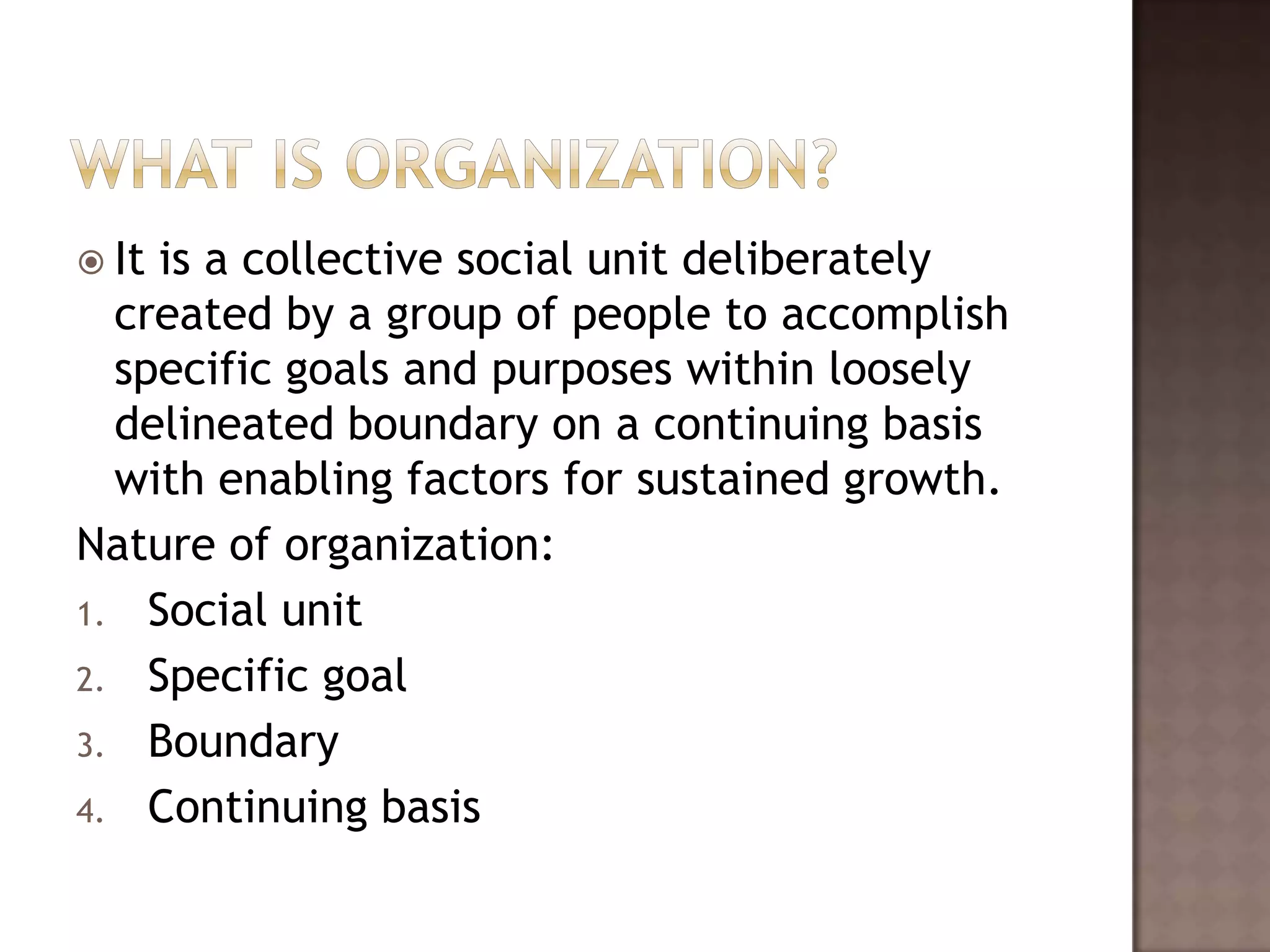
 Itis a collective social unit deliberately
  created by a group of people to accomplish
  specific goals and purposes within loosely
  delineated boundary on a continuing basis
  with enabling factors for sustained growth.
Nature of organization:
1. Social unit
2. Specific goal
3. Boundary
4. Continuing basis
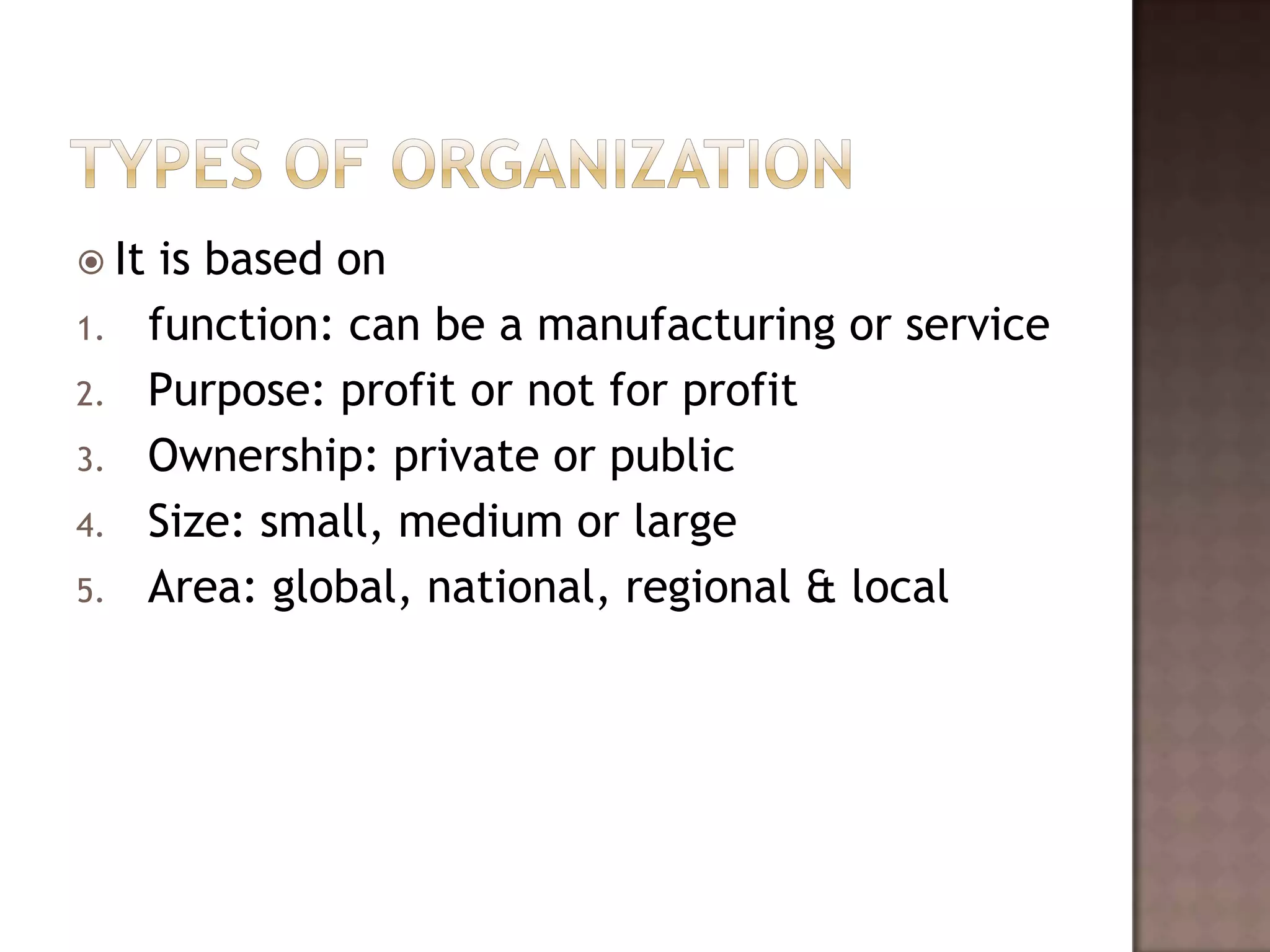
 It    is based on
1.     function: can be a manufacturing or service
2.     Purpose: profit or not for profit
3.     Ownership: private or public
4.     Size: small, medium or large
5.     Area: global, national, regional & local
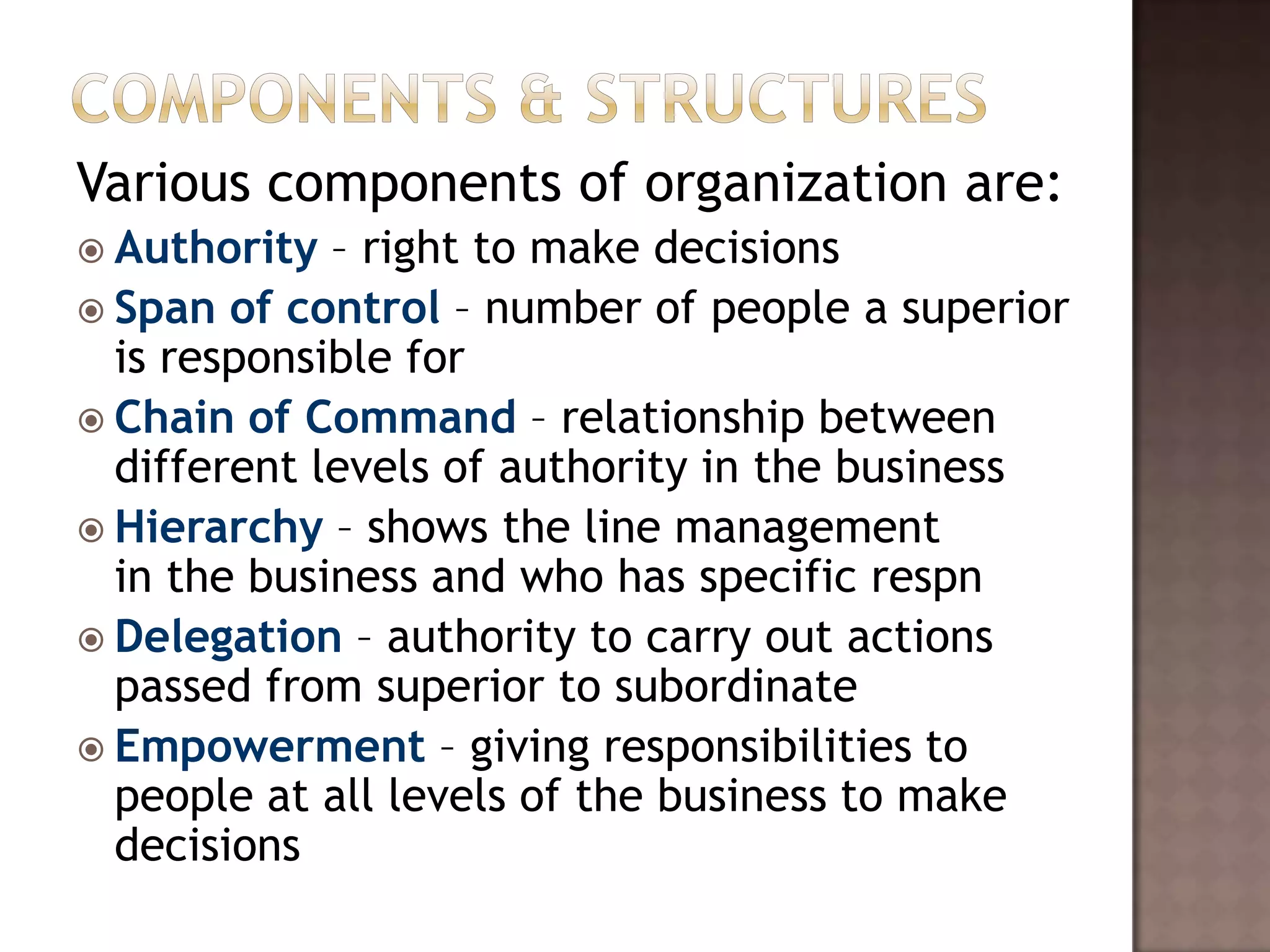
Various components of organization are:
 Authority  – right to make decisions
 Span of control – number of people a superior
  is responsible for
 Chain of Command – relationship between
  different levels of authority in the business
 Hierarchy – shows the line management
  in the business and who has specific respn
 Delegation – authority to carry out actions
  passed from superior to subordinate
 Empowerment – giving responsibilities to
  people at all levels of the business to make
  decisions
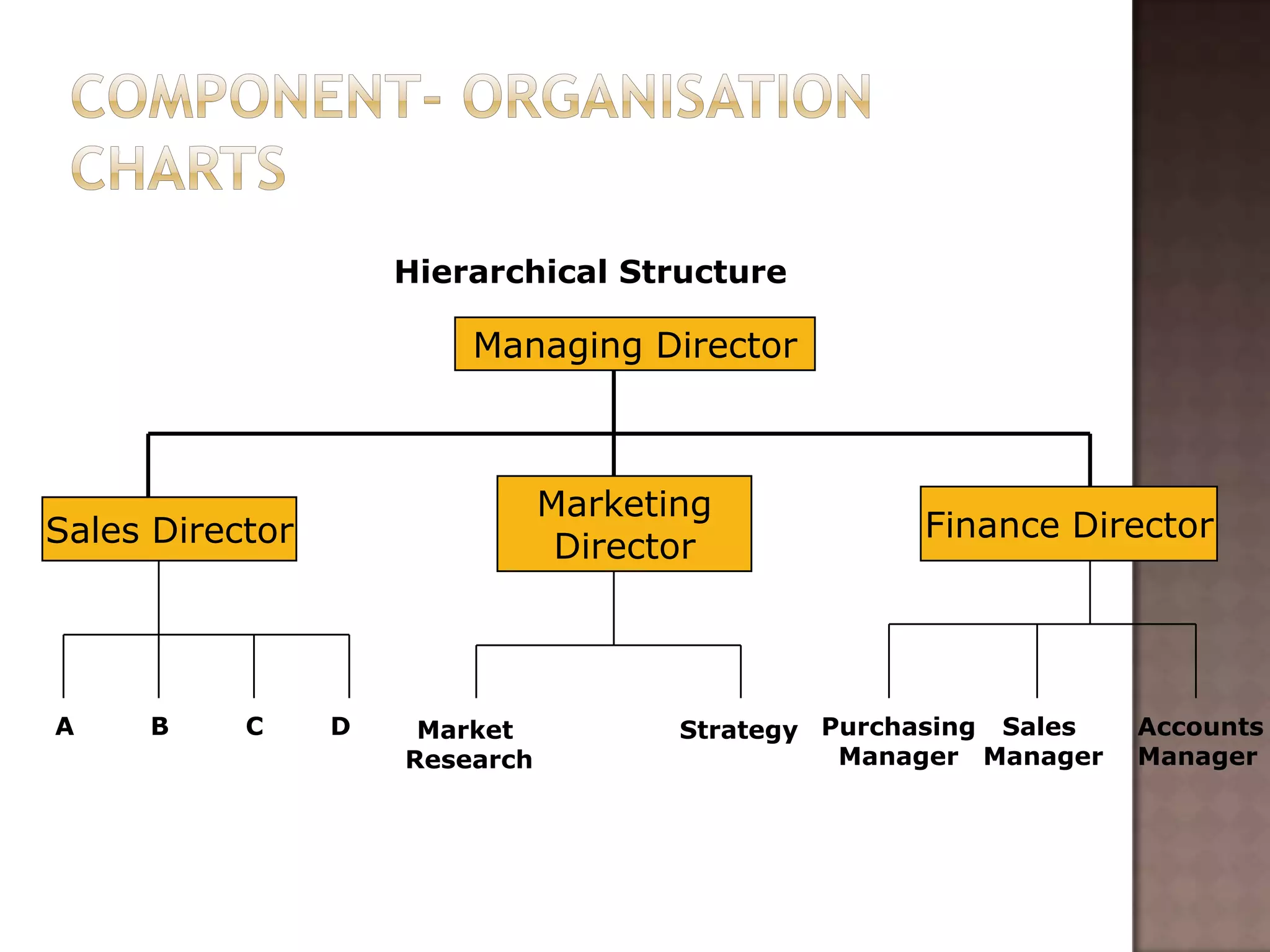
Hierarchical Structure

                         Managing Director


                                Marketing
Sales Director                                       Finance Director
                                 Director


A    B     C     D    Market           Strategy Purchasing Sales   Accounts
                     Research                    Manager Manager   Manager
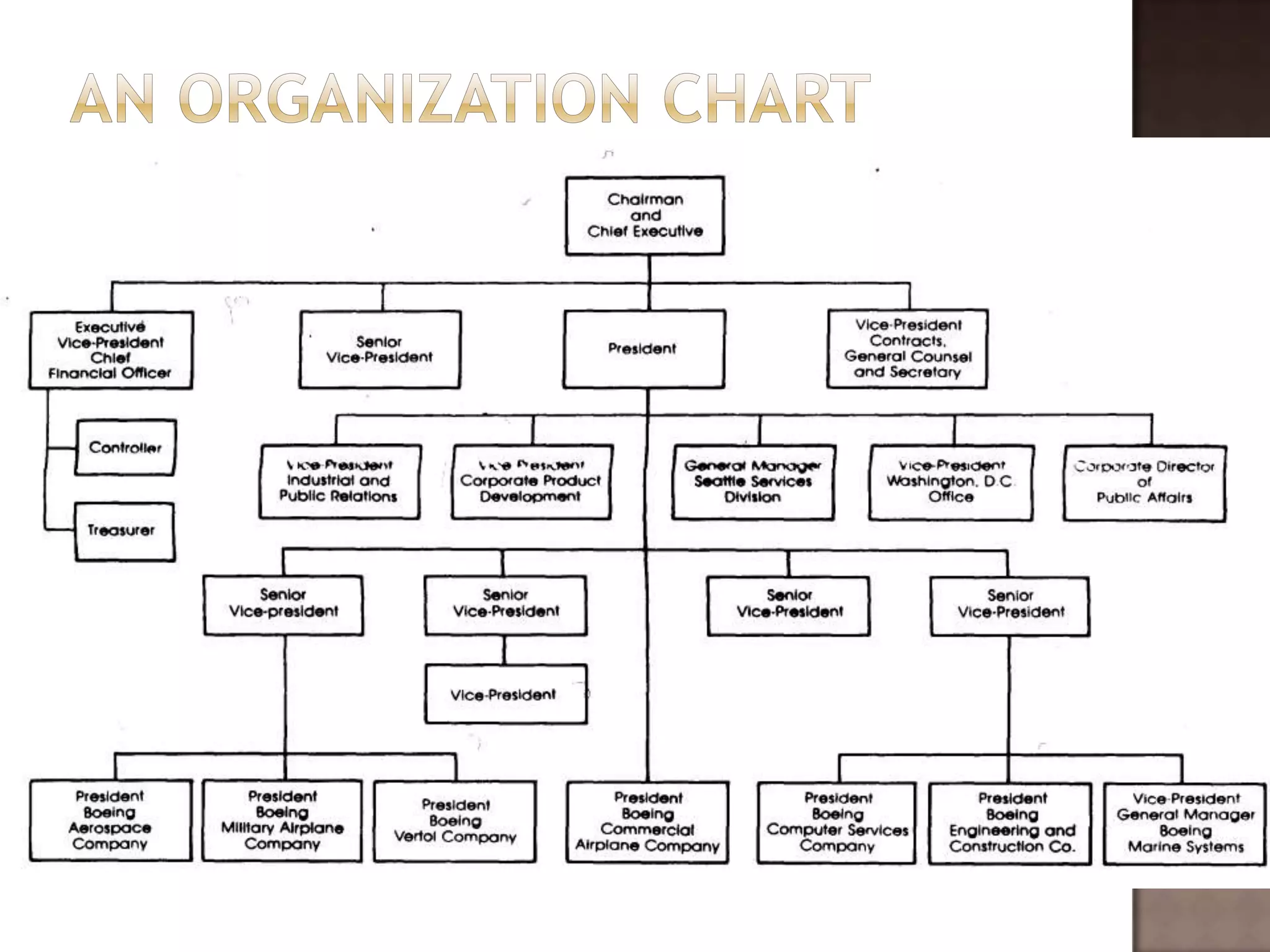
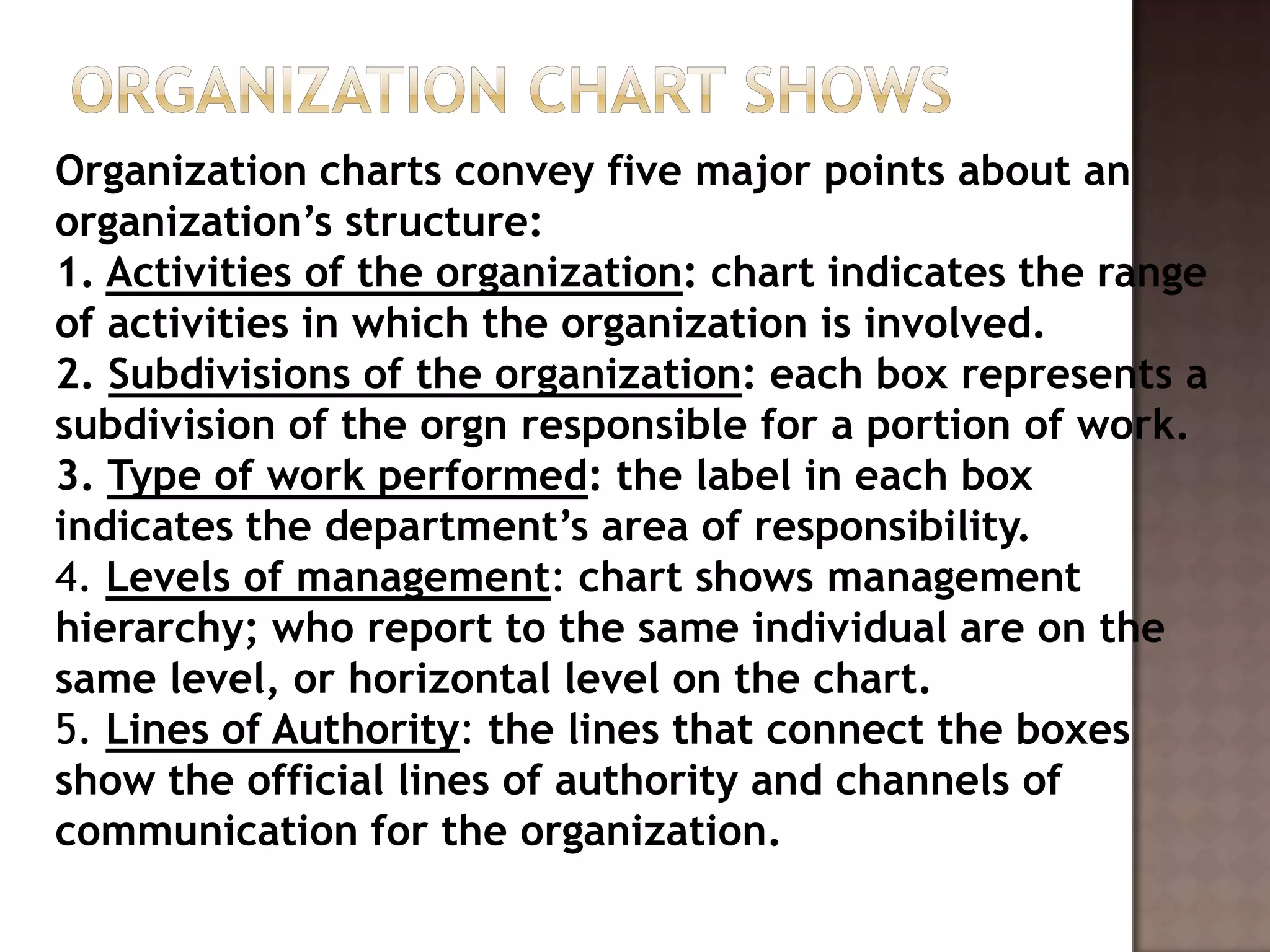
Organization charts convey five major points about an
organization’s structure:
1. Activities of the organization: chart indicates the range
of activities in which the organization is involved.
2. Subdivisions of the organization: each box represents a
subdivision of the orgn responsible for a portion of work.
3. Type of work performed: the label in each box
indicates the department’s area of responsibility.
4. Levels of management: chart shows management
hierarchy; who report to the same individual are on the
same level, or horizontal level on the chart.
5. Lines of Authority: the lines that connect the boxes
show the official lines of authority and channels of
communication for the organization.
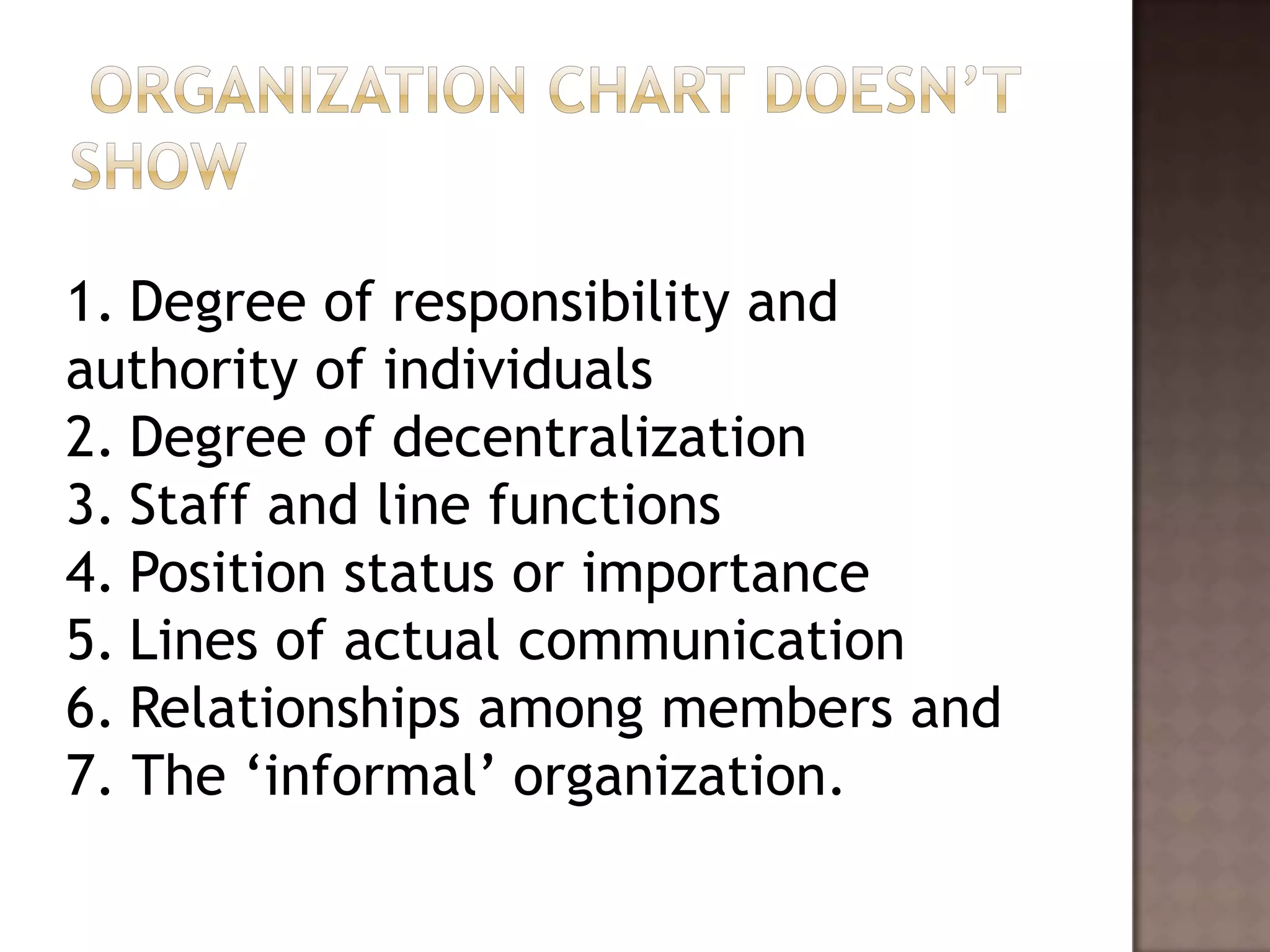
1. Degree of responsibility and
authority of individuals
2. Degree of decentralization
3. Staff and line functions
4. Position status or importance
5. Lines of actual communication
6. Relationships among members and
7. The ‘informal’ organization.
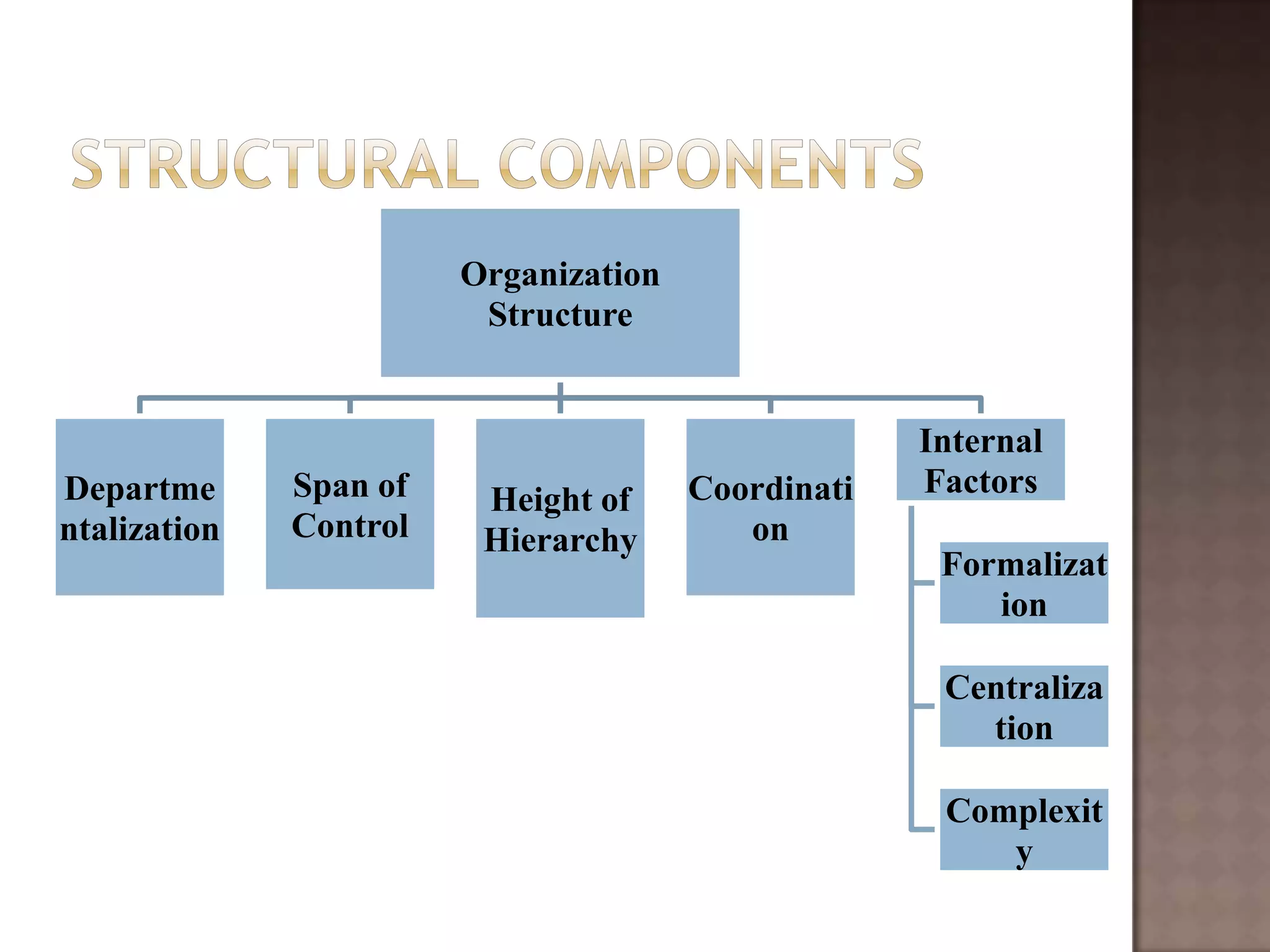
Organization
                         Structure


                                                    Internal
Departme      Span of                  Coordinati   Factors
                         Height of
ntalization   Control    Hierarchy        on
                                                     Formalizat
                                                        ion

                                                     Centraliza
                                                       tion

                                                     Complexit
                                                        y
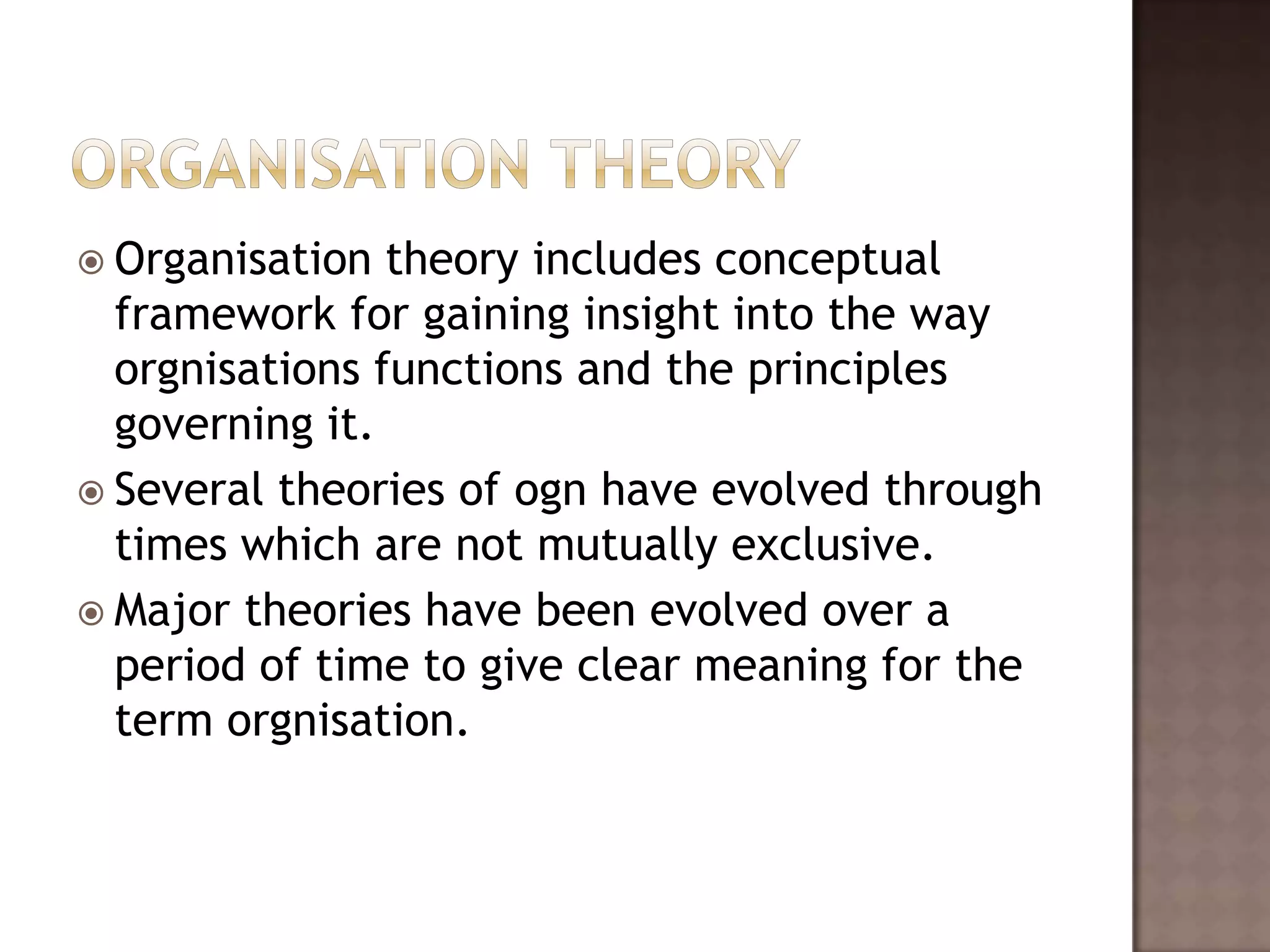
 Organisation  theory includes conceptual
  framework for gaining insight into the way
  orgnisations functions and the principles
  governing it.
 Several theories of ogn have evolved through
  times which are not mutually exclusive.
 Major theories have been evolved over a
  period of time to give clear meaning for the
  term orgnisation.
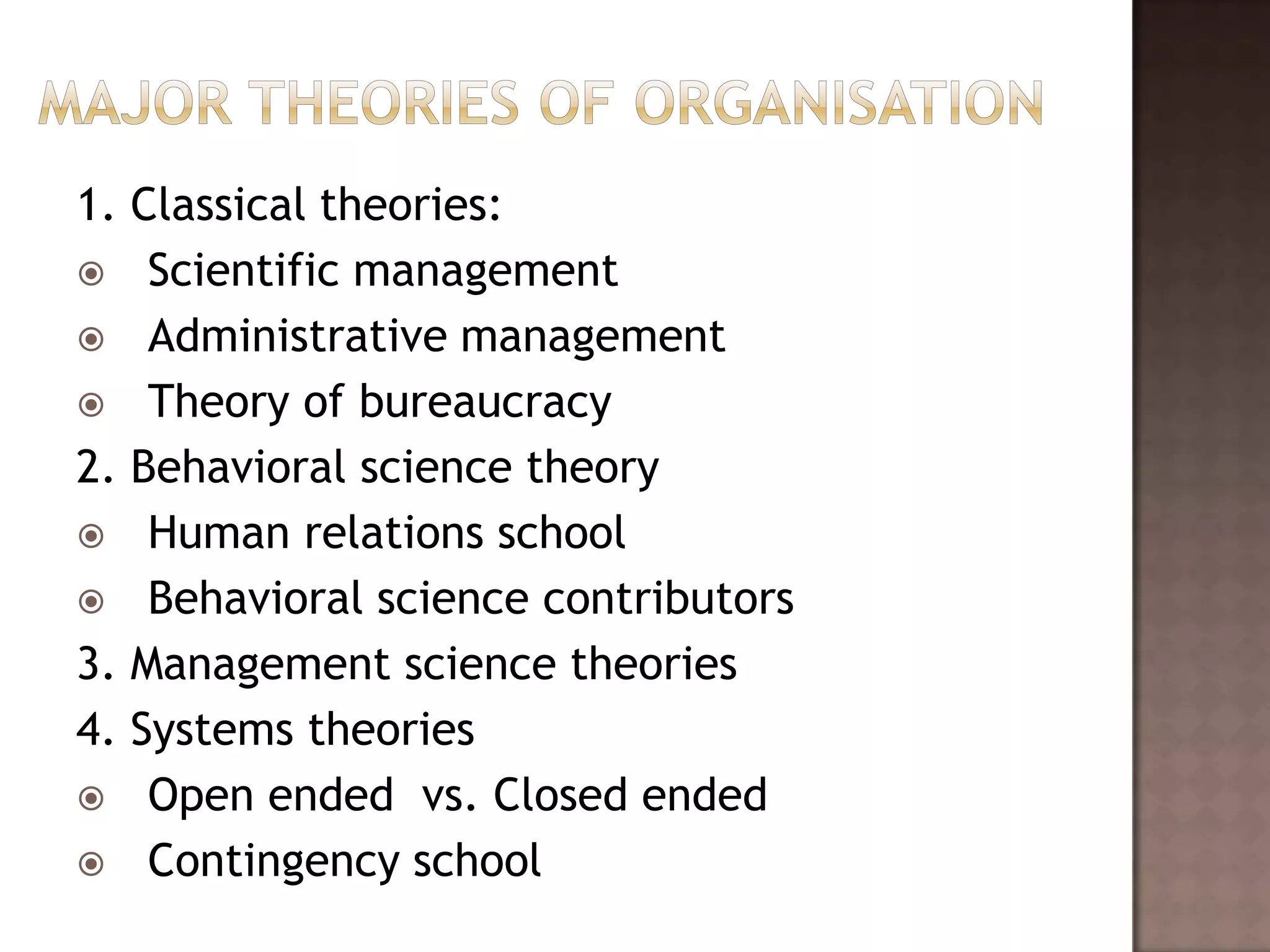
1. Classical theories:
 Scientific management
 Administrative management
 Theory of bureaucracy
2. Behavioral science theory
 Human relations school
 Behavioral science contributors
3. Management science theories
4. Systems theories
 Open ended vs. Closed ended
 Contingency school
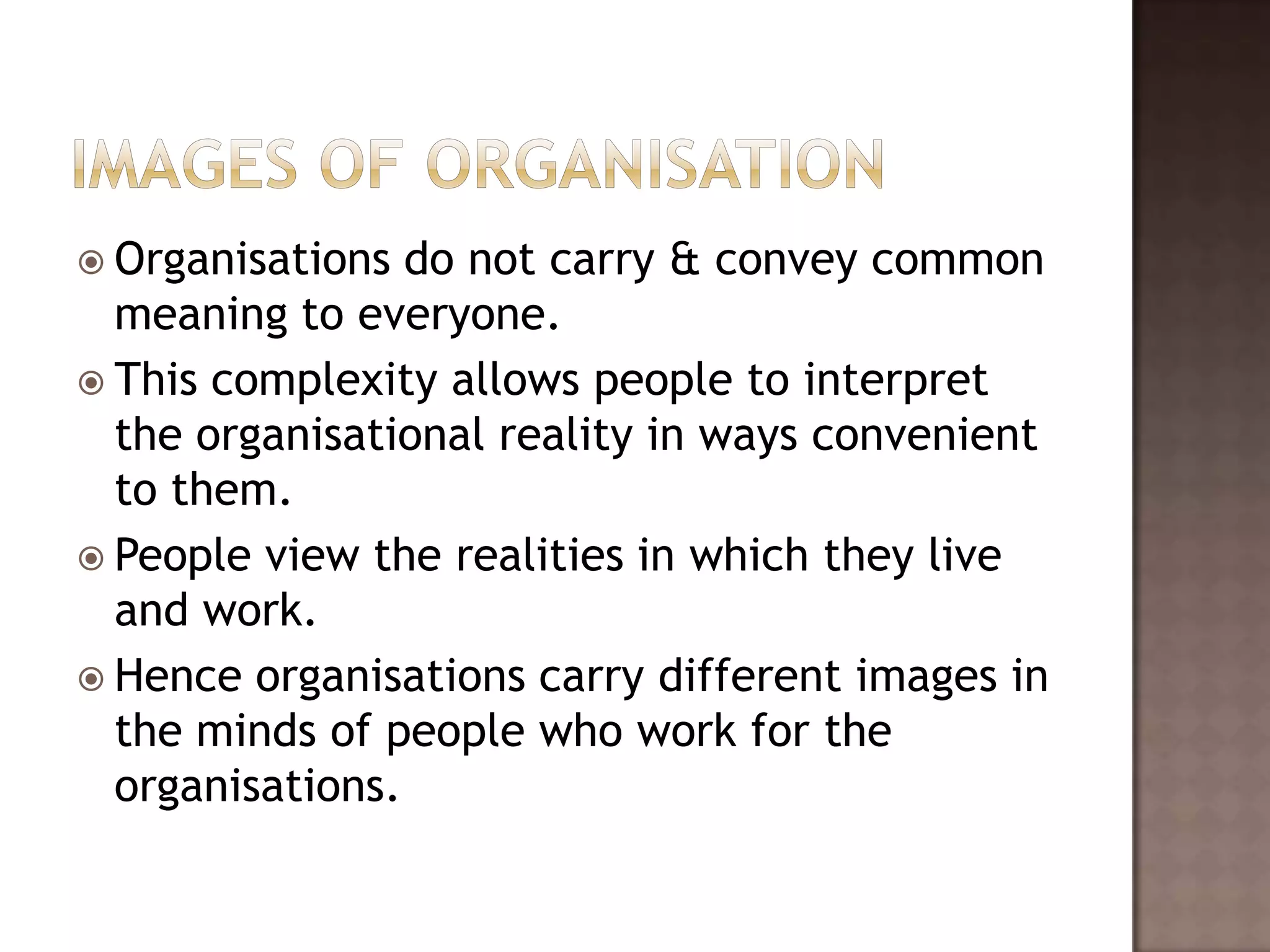
 Organisations  do not carry & convey common
  meaning to everyone.
 This complexity allows people to interpret
  the organisational reality in ways convenient
  to them.
 People view the realities in which they live
  and work.
 Hence organisations carry different images in
  the minds of people who work for the
  organisations.
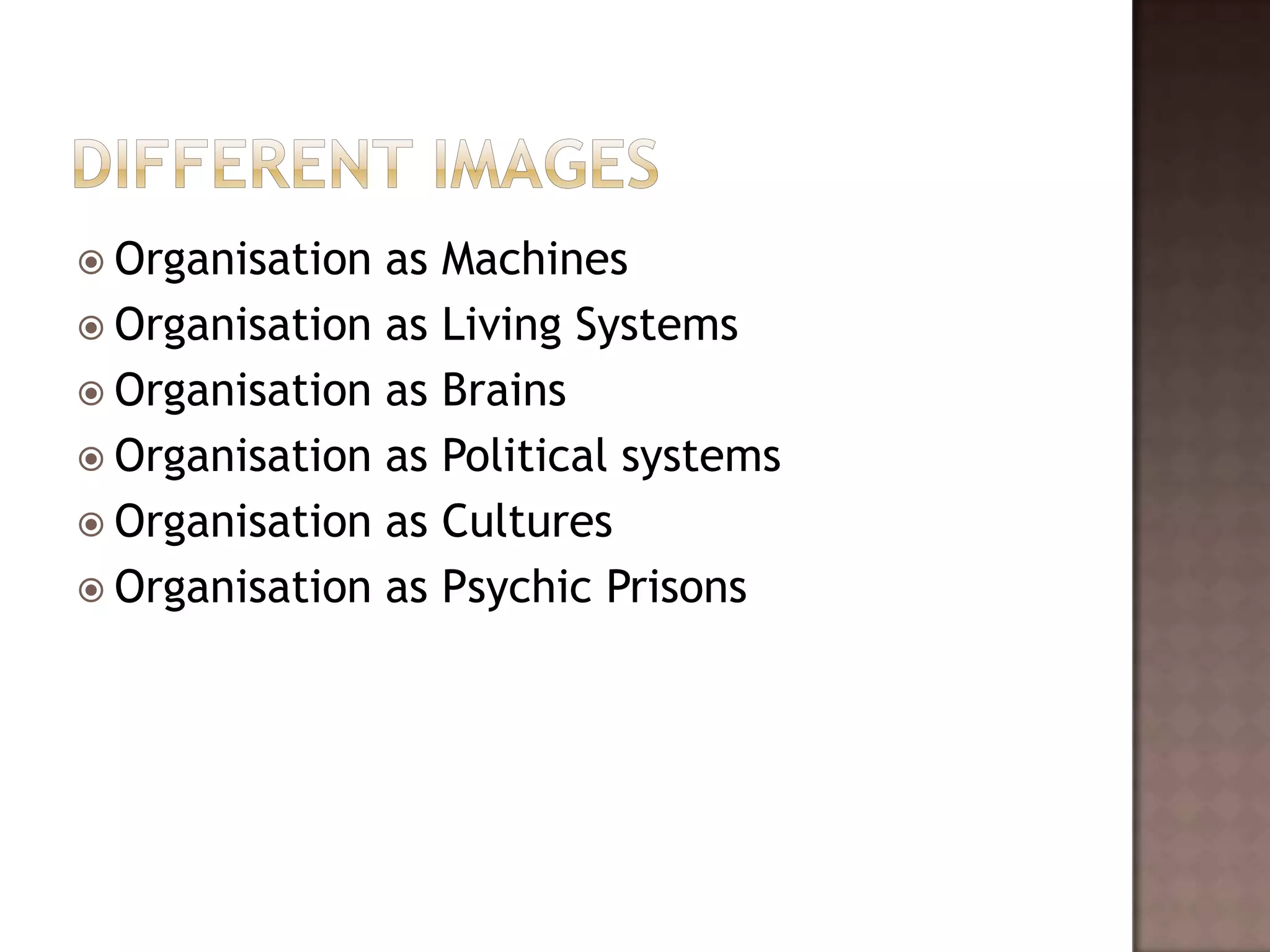
 Organisation as Machines
 Organisation as Living Systems
 Organisation as Brains
 Organisation as Political systems
 Organisation as Cultures
 Organisation as Psychic Prisons
 Term  organisation is derived from Greek
  word, Organon, meaning TOOL or INSTRUMENT.
 A good tool is one which has
  precision, efficiency, reliability &
  predictability.
 These are the most obvious features of an org.
 Orgn are built around systems, procedures and
  rules.
 This image is the most popular & widely
  perceived.
 It does suffer from being mechanistic
  organisation.
 Organisations   do not merely keep on
  repeating their activities in an identical
  manner overtime.
 That could be possible if org were insulted
  from external environment.
 But org cannot exist in vacuum, they have to
  change and adopt to the environment.
 This feature of the org makes them be
  similar to living systems.
 It makes the org to be an open system.
 Org are influenced by environment.
 Takes  inputs from the environment & transfer
  them into usable outputs.
 The throughput processes are cyclical in
  nature.
 They are differentiated.
 Provides feedback
 Tend to maintain the balance
 Dynamic in nature
 They tend to reach the same goal from
  differing conditions.
 Org are proactive in their stance as they
  select their operating environment.
 This indicates that the changes happening in
  the organisation is not automatic but
  depends on how org react to such changes.
 but it ascribes a certain conscious and
  deliberate rationality to the
  organizations, while ignoring its irrational
  human content.
 In a more realistic perspective, political view
  of org is not very surprising.
 Politics refers to the flow of power &
  influence the process within a social system.
 Hence org has built in political process with
  their hierarchy & authority relations.
 Org members enjoy power from various
  sources.
 In org, people differ widely in terms of their
  need for power & control.
 A modern manager also need to have
  political skills.
EFFECTIVENESS WAS
DETERMINED BY FACTORS SUCH AS
  PRODUCTION MAXIMIZATION,
    COST MINIMALIZATION,
 TECHNOLOGICAL EXCELLENCE,
            Etc.
EFFECTIVENESS IS A FUNCTION OF
     CLEAR AUTHORITY AND
      DISCIPLINE WITHIN AN
         ORGANIZATION
EFFECTIVENESS IS A FUNCTION OF
PRODUCTIVITY RESULTING FROM
    EMPLOYEE SATISFACTION
meeting organizational objectives and
 prevailing societal expectations in the
near future, adapting and developing in
the intermediate future, and surviving
          in the distant future.
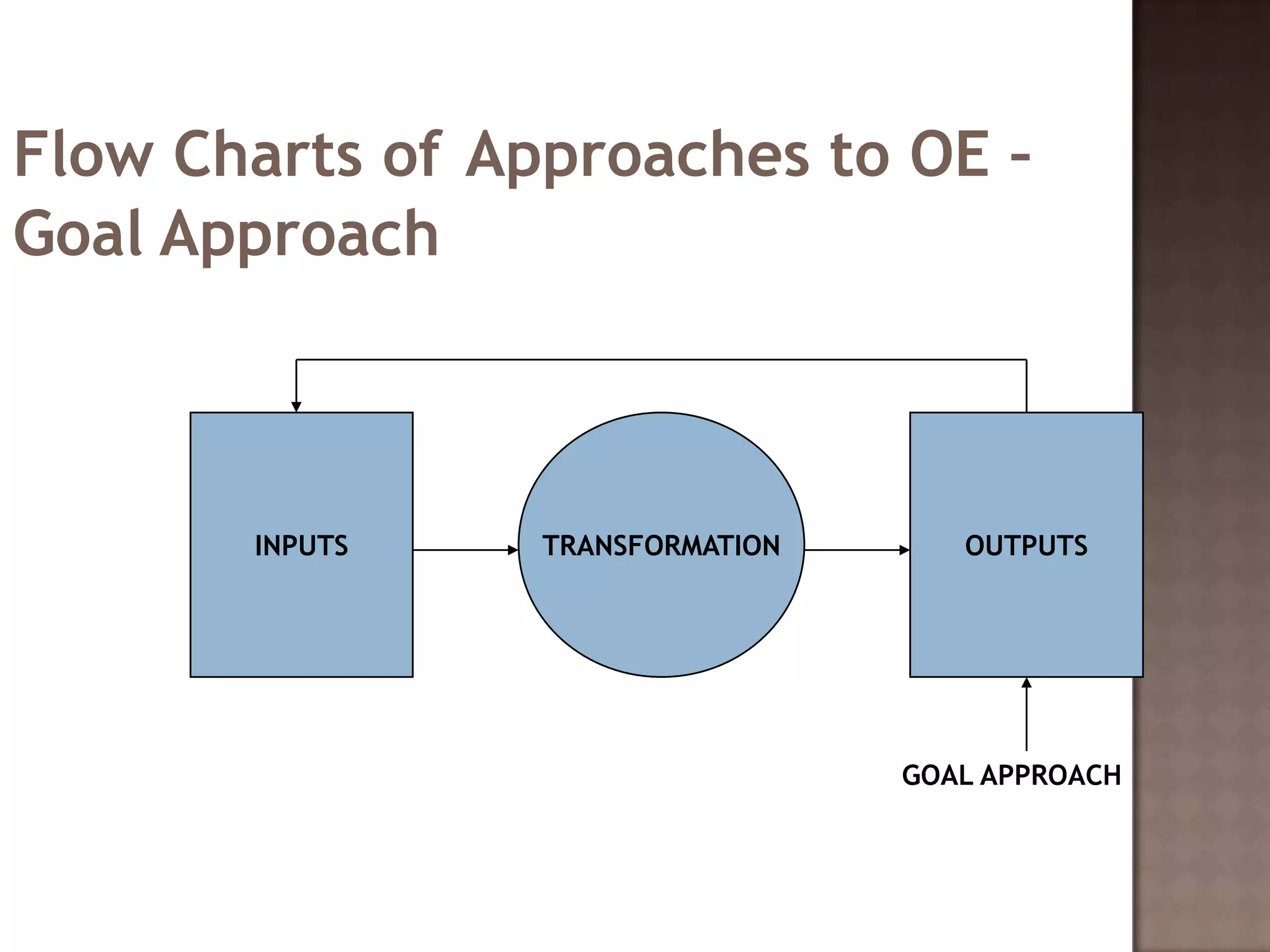
 Goal  Approach: Effectiveness is the ability
  to excel at one or more output goals.
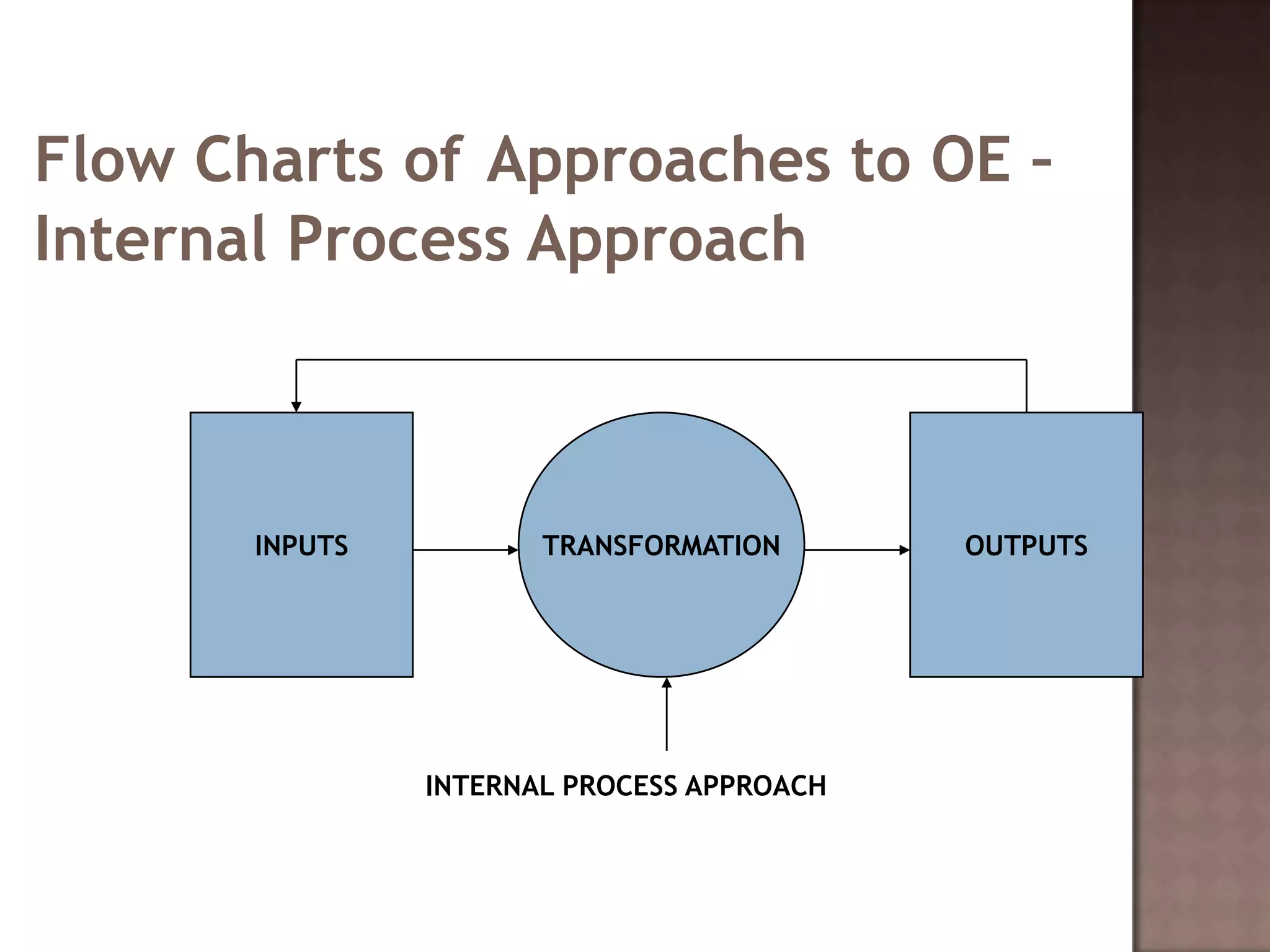
 Internal Process Approach: Effectiveness is
  the ability to excel at internal
  efficiency, coordination, motivation, and
  employee satisfaction.
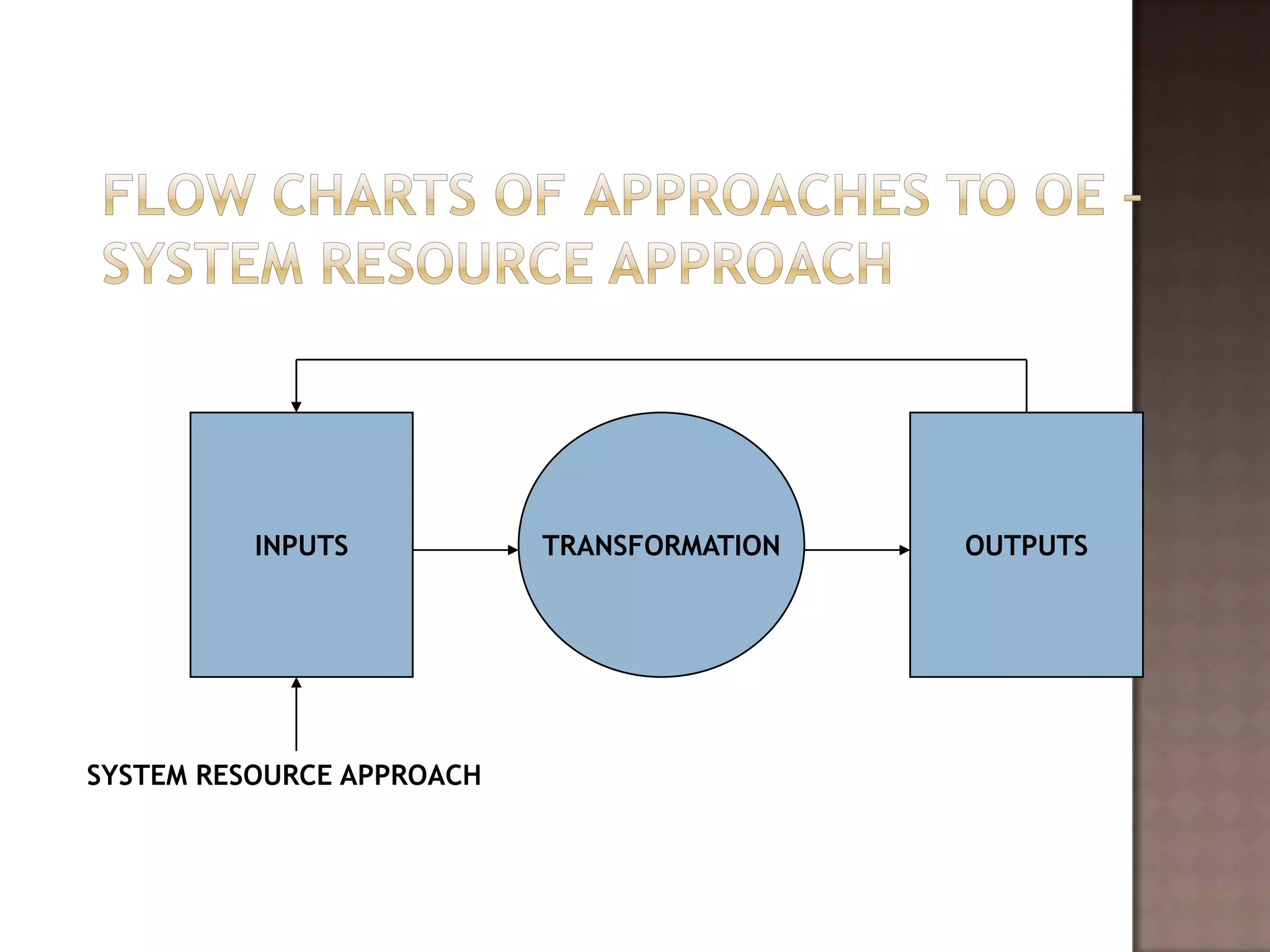
 System Resource Approach: Effectiveness is
  the ability to acquire scarce and valued
  resources from the environment.
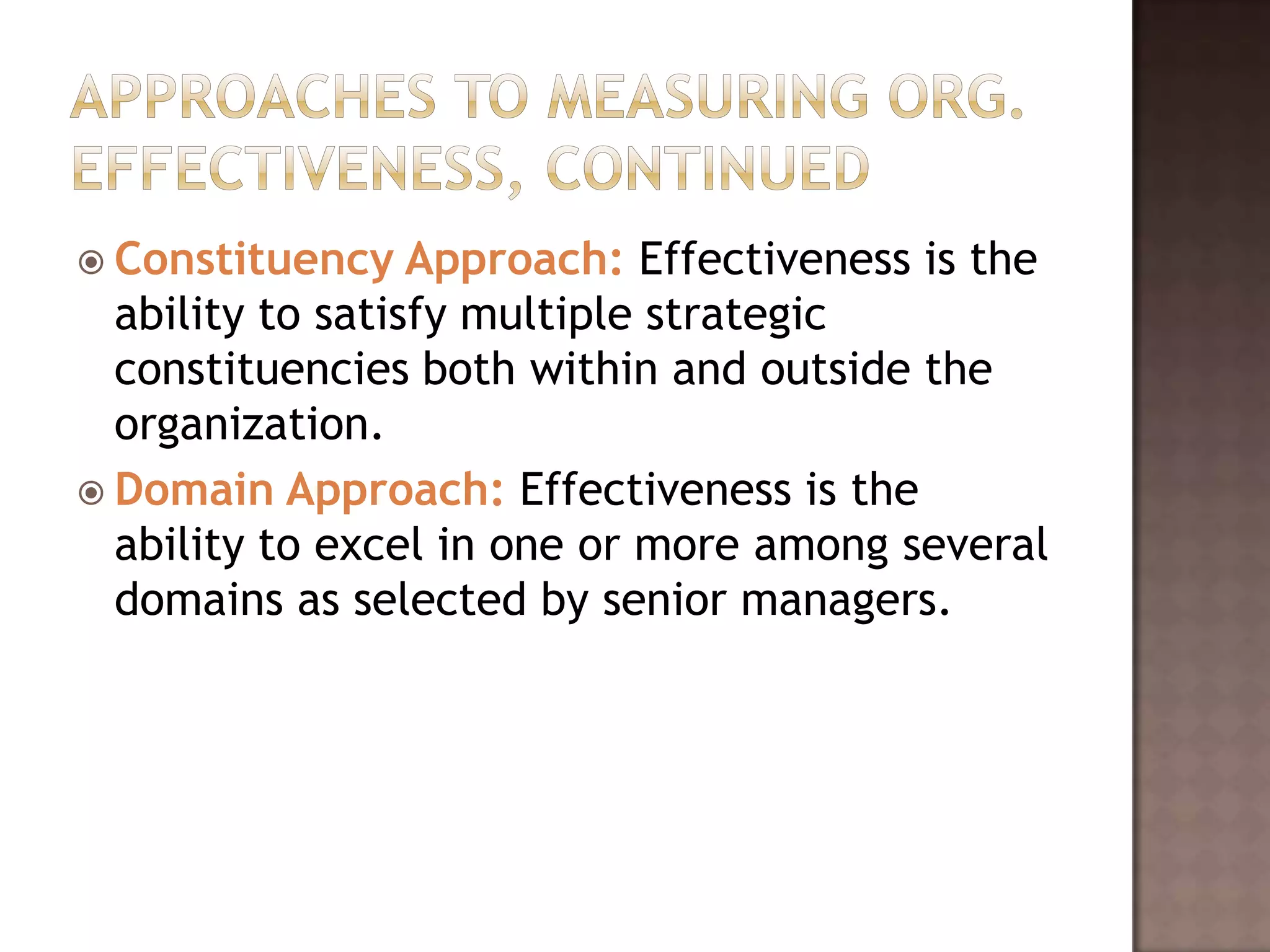
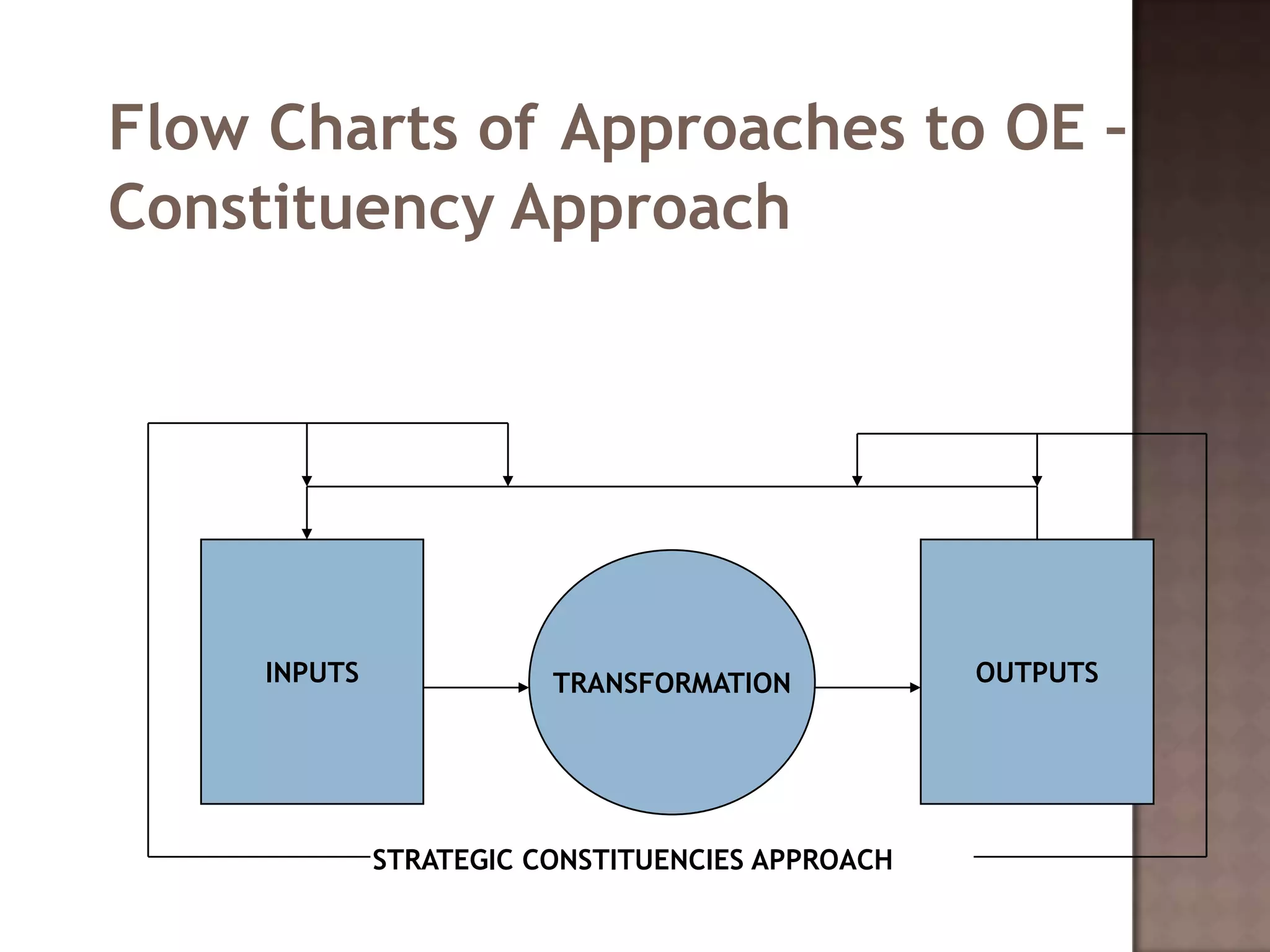
 Constituency    Approach: Effectiveness is the
  ability to satisfy multiple strategic
  constituencies both within and outside the
  organization.
 Domain Approach: Effectiveness is the
  ability to excel in one or more among several
  domains as selected by senior managers.
Flow Charts of Approaches to OE –
Goal Approach


       INPUTS    TRANSFORMATION      OUTPUTS


                                  GOAL APPROACH
Flow Charts of Approaches to OE –
Internal Process Approach


       INPUTS          TRANSFORMATION       OUTPUTS


                INTERNAL PROCESS APPROACH
INPUTS           TRANSFORMATION   OUTPUTS


SYSTEM RESOURCE APPROACH
Flow Charts of Approaches to OE –
Constituency Approach


     INPUTS              TRANSFORMATION           OUTPUTS


              STRATEGIC CONSTITUENCIES APPROACH
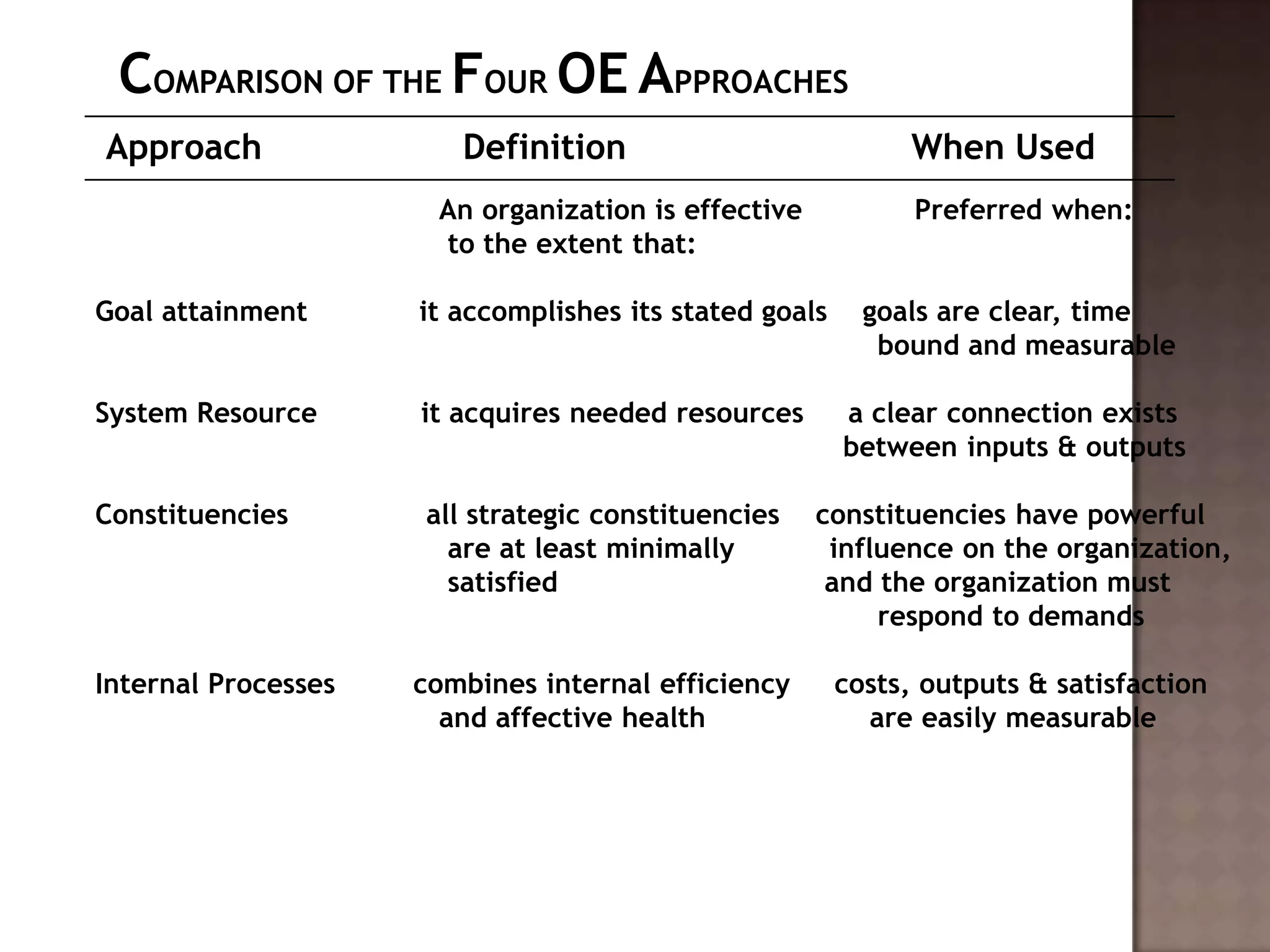
COMPARISON OF THE FOUR OE APPROACHES
Approach                Definition                           When Used
                      An organization is effective            Preferred when:
                      to the extent that:

Goal attainment      it accomplishes its stated goals     goals are clear, time
                                                           bound and measurable

System Resource      it acquires needed resources       a clear connection exists
                                                        between inputs & outputs

Constituencies       all strategic constituencies    constituencies have powerful
                       are at least minimally         influence on the organization,
                       satisfied                      and the organization must
                                                          respond to demands

Internal Processes   combines internal efficiency       costs, outputs & satisfaction
                       and affective health               are easily measurable
Od mod1

Od mod1

  • 1.
  • 2.
     Itis acollective social unit deliberately created by a group of people to accomplish specific goals and purposes within loosely delineated boundary on a continuing basis with enabling factors for sustained growth. Nature of organization: 1. Social unit 2. Specific goal 3. Boundary 4. Continuing basis
  • 3.
     It is based on 1. function: can be a manufacturing or service 2. Purpose: profit or not for profit 3. Ownership: private or public 4. Size: small, medium or large 5. Area: global, national, regional & local
  • 4.
    Various components oforganization are:  Authority – right to make decisions  Span of control – number of people a superior is responsible for  Chain of Command – relationship between different levels of authority in the business  Hierarchy – shows the line management in the business and who has specific respn  Delegation – authority to carry out actions passed from superior to subordinate  Empowerment – giving responsibilities to people at all levels of the business to make decisions
  • 5.
    Hierarchical Structure Managing Director Marketing Sales Director Finance Director Director A B C D Market Strategy Purchasing Sales Accounts Research Manager Manager Manager
  • 7.
    Organization charts conveyfive major points about an organization’s structure: 1. Activities of the organization: chart indicates the range of activities in which the organization is involved. 2. Subdivisions of the organization: each box represents a subdivision of the orgn responsible for a portion of work. 3. Type of work performed: the label in each box indicates the department’s area of responsibility. 4. Levels of management: chart shows management hierarchy; who report to the same individual are on the same level, or horizontal level on the chart. 5. Lines of Authority: the lines that connect the boxes show the official lines of authority and channels of communication for the organization.
  • 8.
    1. Degree ofresponsibility and authority of individuals 2. Degree of decentralization 3. Staff and line functions 4. Position status or importance 5. Lines of actual communication 6. Relationships among members and 7. The ‘informal’ organization.
  • 9.
    Organization Structure Internal Departme Span of Coordinati Factors Height of ntalization Control Hierarchy on Formalizat ion Centraliza tion Complexit y
  • 10.
     Organisation theory includes conceptual framework for gaining insight into the way orgnisations functions and the principles governing it.  Several theories of ogn have evolved through times which are not mutually exclusive.  Major theories have been evolved over a period of time to give clear meaning for the term orgnisation.
  • 11.
    1. Classical theories: Scientific management  Administrative management  Theory of bureaucracy 2. Behavioral science theory  Human relations school  Behavioral science contributors 3. Management science theories 4. Systems theories  Open ended vs. Closed ended  Contingency school
  • 12.
     Organisations do not carry & convey common meaning to everyone.  This complexity allows people to interpret the organisational reality in ways convenient to them.  People view the realities in which they live and work.  Hence organisations carry different images in the minds of people who work for the organisations.
  • 13.
     Organisation asMachines  Organisation as Living Systems  Organisation as Brains  Organisation as Political systems  Organisation as Cultures  Organisation as Psychic Prisons
  • 14.
     Term organisation is derived from Greek word, Organon, meaning TOOL or INSTRUMENT.  A good tool is one which has precision, efficiency, reliability & predictability.  These are the most obvious features of an org.  Orgn are built around systems, procedures and rules.  This image is the most popular & widely perceived.  It does suffer from being mechanistic organisation.
  • 15.
     Organisations do not merely keep on repeating their activities in an identical manner overtime.  That could be possible if org were insulted from external environment.  But org cannot exist in vacuum, they have to change and adopt to the environment.  This feature of the org makes them be similar to living systems.  It makes the org to be an open system.  Org are influenced by environment.
  • 16.
     Takes inputs from the environment & transfer them into usable outputs.  The throughput processes are cyclical in nature.  They are differentiated.  Provides feedback  Tend to maintain the balance  Dynamic in nature  They tend to reach the same goal from differing conditions.
  • 17.
     Org areproactive in their stance as they select their operating environment.  This indicates that the changes happening in the organisation is not automatic but depends on how org react to such changes.  but it ascribes a certain conscious and deliberate rationality to the organizations, while ignoring its irrational human content.
  • 18.
     In amore realistic perspective, political view of org is not very surprising.  Politics refers to the flow of power & influence the process within a social system.  Hence org has built in political process with their hierarchy & authority relations.  Org members enjoy power from various sources.  In org, people differ widely in terms of their need for power & control.  A modern manager also need to have political skills.
  • 20.
    EFFECTIVENESS WAS DETERMINED BYFACTORS SUCH AS PRODUCTION MAXIMIZATION, COST MINIMALIZATION, TECHNOLOGICAL EXCELLENCE, Etc.
  • 21.
    EFFECTIVENESS IS AFUNCTION OF CLEAR AUTHORITY AND DISCIPLINE WITHIN AN ORGANIZATION
  • 22.
    EFFECTIVENESS IS AFUNCTION OF PRODUCTIVITY RESULTING FROM EMPLOYEE SATISFACTION
  • 23.
    meeting organizational objectivesand prevailing societal expectations in the near future, adapting and developing in the intermediate future, and surviving in the distant future.
  • 24.
     Goal Approach: Effectiveness is the ability to excel at one or more output goals.  Internal Process Approach: Effectiveness is the ability to excel at internal efficiency, coordination, motivation, and employee satisfaction.  System Resource Approach: Effectiveness is the ability to acquire scarce and valued resources from the environment.
  • 25.
     Constituency Approach: Effectiveness is the ability to satisfy multiple strategic constituencies both within and outside the organization.  Domain Approach: Effectiveness is the ability to excel in one or more among several domains as selected by senior managers.
  • 26.
    Flow Charts ofApproaches to OE – Goal Approach INPUTS TRANSFORMATION OUTPUTS GOAL APPROACH
  • 27.
    Flow Charts ofApproaches to OE – Internal Process Approach INPUTS TRANSFORMATION OUTPUTS INTERNAL PROCESS APPROACH
  • 28.
    INPUTS TRANSFORMATION OUTPUTS SYSTEM RESOURCE APPROACH
  • 29.
    Flow Charts ofApproaches to OE – Constituency Approach INPUTS TRANSFORMATION OUTPUTS STRATEGIC CONSTITUENCIES APPROACH
  • 30.
    COMPARISON OF THEFOUR OE APPROACHES Approach Definition When Used An organization is effective Preferred when: to the extent that: Goal attainment it accomplishes its stated goals goals are clear, time bound and measurable System Resource it acquires needed resources a clear connection exists between inputs & outputs Constituencies all strategic constituencies constituencies have powerful are at least minimally influence on the organization, satisfied and the organization must respond to demands Internal Processes combines internal efficiency costs, outputs & satisfaction and affective health are easily measurable