Gathering Performance Information:
Overview
• Appraisal Forms
• Characteristics of Appraisal Forms
• Determining Overall Rating
• Appraisal Period and Number of Meetings
• Who Should Provide Performance Information?
• A Model of Rater Motivation
• Preventing Rating Distortion through Rater
Training Programs
Prentice Hall, Inc. © 2006
Major Components of Appraisal Forms (1)
• Basic Employee Information
• Accountabilities, Objectives, and Standards
• Competencies and Indicators
• Major Achievements and Contributions
• Stakeholder Input
• Employee Comments
• Signatures
Prentice Hall, Inc. © 2006
Major Components of Appraisal Forms (2)
(could be included in a separate form)
• Developmental Achievements
• Developmental
– Needs
– Plans
– Goals
Prentice Hall, Inc. © 2006
Desirable Features for All Appraisal Forms
1. Simplicity
2. Relevancy
3. Descriptiveness
4. Adaptability
1. Comprehensiveness
2. Definitional Clarity
3. Communication
4. Time Orientation
Prentice Hall, Inc. © 2006
Determining Overall Rating
• Judgmental strategy
• Mechanical strategy
Prentice Hall, Inc. © 2006
Appraisal period
Number of Meetings
• Annual
• Semi-annual
• Quarterly
Prentice Hall, Inc. © 2006
When Review Is Completed
• Anniversary date
– Supervisor doesn’t have to fill out forms at same
time
– Can’t tie rewards to fiscal year
• Fiscal year
– Rewards tied to fiscal year
– Goals tied to corporate goals
– May be burden to supervisor, depending on
implementation
Prentice Hall, Inc. © 2006
6 Types of Formal Meetings
(can be combined)
• System Inauguration
• Self-Appraisal
• Classical Performance Review
• Merit/Salary Review
• Development Plan
• Objective Setting
Prentice Hall, Inc. © 2006
Who Should Provide Performance
Information?
Employees should be involved in selecting
• Which sources evaluate
• Which performance dimensions
When employees are actively involved
• Higher acceptance of results
• Perception that system is fair
Prentice Hall, Inc. © 2006
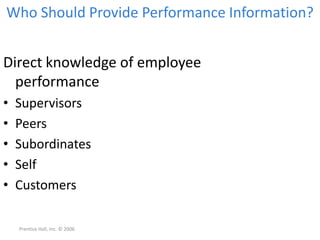
Who Should Provide Performance Information?
Direct knowledge of employee
performance
• Supervisors
• Peers
• Subordinates
• Self
• Customers
Prentice Hall, Inc. © 2006
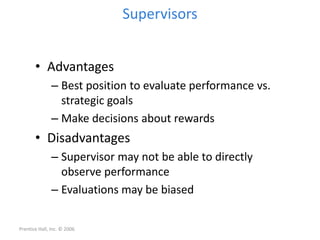
Supervisors
• Advantages
– Best position to evaluate performance vs.
strategic goals
– Make decisions about rewards
• Disadvantages
– Supervisor may not be able to directly
observe performance
– Evaluations may be biased
Prentice Hall, Inc. © 2006
Peers
• Advantages
– Assess teamwork
• Disadvantages
– Possible friendship bias
– May be less discriminating
Prentice Hall, Inc. © 2006
Subordinates
• Advantages
– Accurate when used for developmental
purposes
– Good position to assess some competencies
• Disadvantages
– Inflated when used for administrative purposes
– May fear retaliation (confidentiality is key)
Prentice Hall, Inc. © 2006
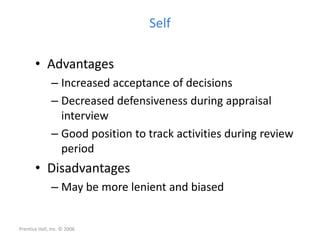
Self
• Advantages
– Increased acceptance of decisions
– Decreased defensiveness during appraisal
interview
– Good position to track activities during review
period
• Disadvantages
– May be more lenient and biased
Prentice Hall, Inc. © 2006
Customers (external and internal)
• Advantages
– Employees become more focused on
meeting customer expectations
• Disadvantages
– Time
– Money
Prentice Hall, Inc. © 2006
Disagreement Across Sources
• Expect disagreement
• Ensure employee receives feedback by
source
• Assign differential weights to scores by
source, depending on importance
Prentice Hall, Inc. © 2006
Types of Rating Errors
• Intentional errors
– Rating inflation
– Rating deflation
• Unintentional errors
– Due to complexity of task
Prentice Hall, Inc. © 2006
Expected Positive and
Negative Consequences
of Rating Accuracy
Probability of
Experiencing Positive &
Negative Consequences
Expected Positive and
Negative Consequences
of Rating Distortion
Probability of
Experiencing Positive &
Negative Consequences
Motivation to Provide
Accurate Ratings
Motivation to Distort
Ratings
Rating Behavior
A Model of Rater Motivation
Motivations for Rating Inflation
• Maximize merit raise/rewards
• Encourage employees
• Avoid creating written record
• Avoid confrontation with employees
• Promote undesired employees out of unit
• Make manager look good to his/her
supervisor
Prentice Hall, Inc. © 2006
Motivations for Rating Deflation
• Shock employees
• Teach a lesson
• Send a message to employee
• Build a written record of poor
performance
Prentice Hall, Inc. © 2006
Prevent Rating Distortion through
Rater Training Programs
Rater Training Programs should cover:
• Information
• Motivation
• Identifying, observing, recording and
evaluating performance
• How to interact with employees when
they receive performance information
Prentice Hall, Inc. © 2006
Information - how the system works
• Reasons for implementing the
performance management system
• Information on the appraisal form and
system mechanics
Prentice Hall, Inc. © 2006
Motivation – What’s in it for me?
• Benefits of providing accurate ratings
• Tools for providing accurate ratings
Prentice Hall, Inc. © 2006
Identifying, observing, recording, and evaluating
performance
• How to identify and rank job activities
• How to observe, record, measure
performance
• How to minimize rating errors
Prentice Hall, Inc. © 2006
How to interact with employees
when they receive performance information
• How to conduct an appraisal interview
• How to train, counsel, and coach
Prentice Hall, Inc. © 2006

Performance management

  • 1.
    Gathering Performance Information: Overview •Appraisal Forms • Characteristics of Appraisal Forms • Determining Overall Rating • Appraisal Period and Number of Meetings • Who Should Provide Performance Information? • A Model of Rater Motivation • Preventing Rating Distortion through Rater Training Programs Prentice Hall, Inc. © 2006
  • 2.
    Major Components ofAppraisal Forms (1) • Basic Employee Information • Accountabilities, Objectives, and Standards • Competencies and Indicators • Major Achievements and Contributions • Stakeholder Input • Employee Comments • Signatures Prentice Hall, Inc. © 2006
  • 3.
    Major Components ofAppraisal Forms (2) (could be included in a separate form) • Developmental Achievements • Developmental – Needs – Plans – Goals Prentice Hall, Inc. © 2006
  • 4.
    Desirable Features forAll Appraisal Forms 1. Simplicity 2. Relevancy 3. Descriptiveness 4. Adaptability 1. Comprehensiveness 2. Definitional Clarity 3. Communication 4. Time Orientation Prentice Hall, Inc. © 2006
  • 5.
    Determining Overall Rating •Judgmental strategy • Mechanical strategy Prentice Hall, Inc. © 2006
  • 6.
    Appraisal period Number ofMeetings • Annual • Semi-annual • Quarterly Prentice Hall, Inc. © 2006
  • 7.
    When Review IsCompleted • Anniversary date – Supervisor doesn’t have to fill out forms at same time – Can’t tie rewards to fiscal year • Fiscal year – Rewards tied to fiscal year – Goals tied to corporate goals – May be burden to supervisor, depending on implementation Prentice Hall, Inc. © 2006
  • 8.
    6 Types ofFormal Meetings (can be combined) • System Inauguration • Self-Appraisal • Classical Performance Review • Merit/Salary Review • Development Plan • Objective Setting Prentice Hall, Inc. © 2006
  • 9.
    Who Should ProvidePerformance Information? Employees should be involved in selecting • Which sources evaluate • Which performance dimensions When employees are actively involved • Higher acceptance of results • Perception that system is fair Prentice Hall, Inc. © 2006
  • 10.
    Who Should ProvidePerformance Information? Direct knowledge of employee performance • Supervisors • Peers • Subordinates • Self • Customers Prentice Hall, Inc. © 2006
  • 11.
    Supervisors • Advantages – Bestposition to evaluate performance vs. strategic goals – Make decisions about rewards • Disadvantages – Supervisor may not be able to directly observe performance – Evaluations may be biased Prentice Hall, Inc. © 2006
  • 12.
    Peers • Advantages – Assessteamwork • Disadvantages – Possible friendship bias – May be less discriminating Prentice Hall, Inc. © 2006
  • 13.
    Subordinates • Advantages – Accuratewhen used for developmental purposes – Good position to assess some competencies • Disadvantages – Inflated when used for administrative purposes – May fear retaliation (confidentiality is key) Prentice Hall, Inc. © 2006
  • 14.
    Self • Advantages – Increasedacceptance of decisions – Decreased defensiveness during appraisal interview – Good position to track activities during review period • Disadvantages – May be more lenient and biased Prentice Hall, Inc. © 2006
  • 15.
    Customers (external andinternal) • Advantages – Employees become more focused on meeting customer expectations • Disadvantages – Time – Money Prentice Hall, Inc. © 2006
  • 16.
    Disagreement Across Sources •Expect disagreement • Ensure employee receives feedback by source • Assign differential weights to scores by source, depending on importance Prentice Hall, Inc. © 2006
  • 17.
    Types of RatingErrors • Intentional errors – Rating inflation – Rating deflation • Unintentional errors – Due to complexity of task Prentice Hall, Inc. © 2006
  • 18.
    Expected Positive and NegativeConsequences of Rating Accuracy Probability of Experiencing Positive & Negative Consequences Expected Positive and Negative Consequences of Rating Distortion Probability of Experiencing Positive & Negative Consequences Motivation to Provide Accurate Ratings Motivation to Distort Ratings Rating Behavior A Model of Rater Motivation
  • 19.
    Motivations for RatingInflation • Maximize merit raise/rewards • Encourage employees • Avoid creating written record • Avoid confrontation with employees • Promote undesired employees out of unit • Make manager look good to his/her supervisor Prentice Hall, Inc. © 2006
  • 20.
    Motivations for RatingDeflation • Shock employees • Teach a lesson • Send a message to employee • Build a written record of poor performance Prentice Hall, Inc. © 2006
  • 21.
    Prentice Hall, Inc.© 2006 Prevent Rating Distortion through Rater Training Programs
  • 22.
    Rater Training Programsshould cover: • Information • Motivation • Identifying, observing, recording and evaluating performance • How to interact with employees when they receive performance information Prentice Hall, Inc. © 2006
  • 23.
    Information - howthe system works • Reasons for implementing the performance management system • Information on the appraisal form and system mechanics Prentice Hall, Inc. © 2006
  • 24.
    Motivation – What’sin it for me? • Benefits of providing accurate ratings • Tools for providing accurate ratings Prentice Hall, Inc. © 2006
  • 25.
    Identifying, observing, recording,and evaluating performance • How to identify and rank job activities • How to observe, record, measure performance • How to minimize rating errors Prentice Hall, Inc. © 2006
  • 26.
    How to interactwith employees when they receive performance information • How to conduct an appraisal interview • How to train, counsel, and coach Prentice Hall, Inc. © 2006