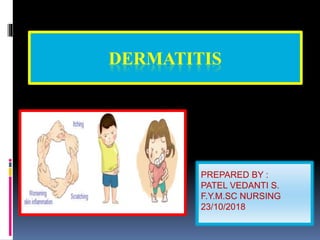
DERMATITIS
PREPARED BY :
PATEL VEDANTI S.
F.Y.M.SC NURSING
23/10/2018
THE INTEGUMENTARYSYSTEM
 ANATOMY AND PHYSIOLOGIC
OVERVIEW :
 The largest organ system of
the body, the skin, is
essential for human life. It
forms a barrier between the
internal organs and the
external environment and
participates in many vital
body functions. The skin is
contiguous with the mucous
membrane at the external
openings of the digestive,
respiratory and urogenital
systems.
 Skin is the largest organ of the body, and
serves to:
• Protect against injury
• Protect against the sun UV rays
• Prevent entry of harmful microorganisms
• Maintain the proper internal body temperature
• Excrete waste materials through perspiration
• Function as a sense organ
DEFINITION OF DERMATITIS
 Dermatitis, also known as eczema, is a group
of diseases that results in inflammation of
the skin .These diseases are characterized
by itchiness, red skin and a rash.
 Dermatitis is a group of skin conditions that
includes atopic dermatitis, allergic contact
dermatitis, irritant contact
dermatitis and stasis dermatitis.
TYPES OF DERAMATITIS:
Atopic dermatitis:
Contact dermatitis:
Seborrheic Dermatitis:
Perioral dermatitis:
Stasis dermatitis:
Neuro dermatitis:
Cont…
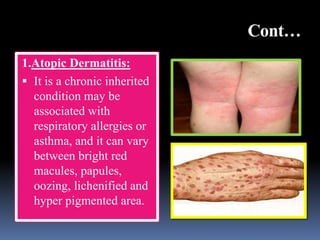
1.Atopic Dermatitis:
 It is a chronic inherited
condition may be
associated with
respiratory allergies or
asthma, and it can vary
between bright red
macules, papules,
oozing, lichenified and
hyper pigmented area.
Cont…
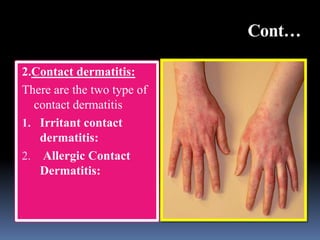
2.Contact dermatitis:
There are the two type of
contact dermatitis
1. Irritant contact
dermatitis:
2. Allergic Contact
Dermatitis:
Cont…
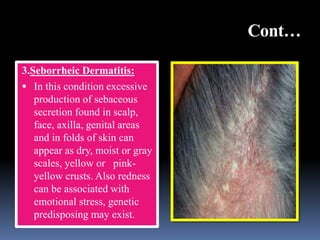
3.Seborrheic Dermatitis:
 In this condition excessive
production of sebaceous
secretion found in scalp,
face, axilla, genital areas
and in folds of skin can
appear as dry, moist or gray
scales, yellow or pink-
yellow crusts. Also redness
can be associated with
emotional stress, genetic
predisposing may exist.
Cont…
4.Neuro
dermatitis:
 A chronic itchy skin
condition localized to
certain areas of the skin
Cont…
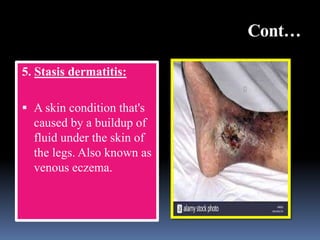
5. Stasis dermatitis:
 A skin condition that's
caused by a buildup of
fluid under the skin of
the legs. Also known as
venous eczema.
Cont…
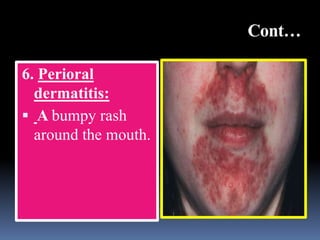
6. Perioral
dermatitis:
 A bumpy rash
around the mouth.
CAUSES:
ATOPIC
DERMATITIS
(ECZEMA):
• Xerosis (Dry
Skin)
• Bacteria On
The Skin
• Environmental
Conditions.
• Immune
System
Dysfunction
CONTACT:
• Jewelry
Containing
Nickel
• Cleaning
Products
• Perfumes
• Cosmetics
• Preservatives
In Many
Creams And
Lotions.
SEBORRHEIC
DERMATITIS:
• Yeast ( Fungus)
RISK FACTORS:
Age.
Allergies and asthma
Occupation
Health conditions.
SIGNAND SYMPTOMS:
 Atopic dermatitis
(eczema).
 Usually beginning in
infancy red
 Itchy rash
 Inside the elbows
 Behind the knees
 Front of the neck
Cont…
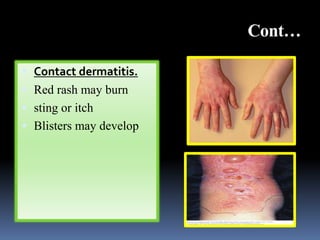
 Contact dermatitis.
 Red rash may burn
 sting or itch
 Blisters may develop
Cont…
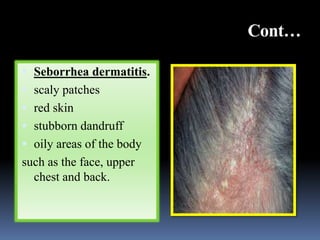
 Seborrhea dermatitis.
 scaly patches
 red skin
 stubborn dandruff
 oily areas of the body
such as the face, upper
chest and back.
Common SignAnd Symptoms:
 Hives
 Blister
 Skin Redness
 Swelling especially eyes,face,groin area
 blistering
 cracking skin due to extreme dryness
 skin that feels stiff or tight
 open sores that form crusts
 Ulceration
DIAGNOSTIC TEST:
History
Collection
Physical
Examination
Signs and
symptoms
suspected
culture
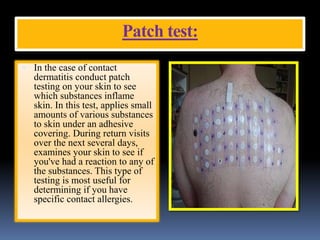
Patch Test
 In the case of contact
dermatitis conduct patch
testing on your skin to see
which substances inflame
skin. In this test, applies small
amounts of various substances
to skin under an adhesive
covering. During return visits
over the next several days,
examines your skin to see if
you've had a reaction to any of
the substances. This type of
testing is most useful for
determining if you have
specific contact allergies.
Patch test:
MEDICATION:
Analgesic
Drugs to
relieve pain,
inflammation
and
discomfort.
Antihistamines
Like avil,
cetrizine to
relieve itching
and skin rashes
Steroid
Such as
hydrocortisone
or methyl -
prednisolone
may be used to
suppress
inflammation
Topical
administration
Is preferred if
possible because
systemic steroid
can cause serious
systemic side
effects, including
adrenal
suppression.
PREVENTION:
 Avoiding dry skin may be one factor in helping you prevent
dermatitis. These tips can help you minimize the drying effects of
bathing on your skin:
 Take shorter baths or showers. Limit your baths and showers to
5 to 10 minutes. And use warm, rather than hot, water. Bath oil
also may be helpful.
 Use non soap cleansers or gentle soaps. Choose fragrance-free
non soap cleansers or mild soaps. Some soaps can dry your skin.
 Dry yourself carefully. After bathing, brush your skin rapidly
with the palms of your hands, or gently pat your skin dry with a
soft towel.
 Moisturize your skin. While your skin is still damp, seal in
moisture with an oil or a cream. Try different products to find one
that works for you. Ideally, the best one for you will be safe,
effective, affordable and unscented.
NURSING MANAGEMENT:
 1. Monitor skin condition regularly to determine of
treatment is working.
 2. Cleanse the area as ordered by the physician, taking
care not to further irritate the skin to keep area clean
and prevent infection.
 3. Provide cool moist compresses, dressings or tepid
tub baths to help relieve inflammation and itching,
debride lesions and soften crusts and scales.
 4. Pat the skin dry rather than rubbing to prevent
further trauma.
 5. Apply topical agents as per ordered to help
suppress inflammation.
Cont…
 6. Provide skin care at bed time to help promote
comfortable sleep. Many antihistamines also have
a sedative effect.
 7. Encourage patient to eat a high protein diet to
promote healing and replace lost protein.
 8. Encourage use of gloves especially at night to
help prevent scratching.
 9. Advise the patient to keep finger nail short to
prevent scratching.
 10. Teach the patient that application of slight
pressure with a clean cloth may help relieve
itching.
Cont…
 11. Allow patients to verbalize concerns only if they
wish to do so.
 12. Refer to a support group, if available, to receive
support from others in similar circumstances.
 13. Encourage to participate in skin care.
 14. Encourage the patient to wear long sleeves or
other appropriate covering if the patient desired to
make the lesions less noticeable and the patient more
comfortable.
 15. Assess patient’s baseline knowledge of condition
and treatment. Teaching should build on baseline
understanding.
Dermatitis
Dermatitis

Dermatitis

  • 1.
    DERMATITIS PREPARED BY : PATELVEDANTI S. F.Y.M.SC NURSING 23/10/2018
  • 2.
    THE INTEGUMENTARYSYSTEM  ANATOMYAND PHYSIOLOGIC OVERVIEW :  The largest organ system of the body, the skin, is essential for human life. It forms a barrier between the internal organs and the external environment and participates in many vital body functions. The skin is contiguous with the mucous membrane at the external openings of the digestive, respiratory and urogenital systems.
  • 3.
     Skin isthe largest organ of the body, and serves to: • Protect against injury • Protect against the sun UV rays • Prevent entry of harmful microorganisms • Maintain the proper internal body temperature • Excrete waste materials through perspiration • Function as a sense organ
  • 4.
    DEFINITION OF DERMATITIS Dermatitis, also known as eczema, is a group of diseases that results in inflammation of the skin .These diseases are characterized by itchiness, red skin and a rash.  Dermatitis is a group of skin conditions that includes atopic dermatitis, allergic contact dermatitis, irritant contact dermatitis and stasis dermatitis.
  • 5.
    TYPES OF DERAMATITIS: Atopicdermatitis: Contact dermatitis: Seborrheic Dermatitis: Perioral dermatitis: Stasis dermatitis: Neuro dermatitis:
  • 6.
    Cont… 1.Atopic Dermatitis:  Itis a chronic inherited condition may be associated with respiratory allergies or asthma, and it can vary between bright red macules, papules, oozing, lichenified and hyper pigmented area.
  • 7.
    Cont… 2.Contact dermatitis: There arethe two type of contact dermatitis 1. Irritant contact dermatitis: 2. Allergic Contact Dermatitis:
  • 8.
    Cont… 3.Seborrheic Dermatitis:  Inthis condition excessive production of sebaceous secretion found in scalp, face, axilla, genital areas and in folds of skin can appear as dry, moist or gray scales, yellow or pink- yellow crusts. Also redness can be associated with emotional stress, genetic predisposing may exist.
  • 9.
    Cont… 4.Neuro dermatitis:  A chronicitchy skin condition localized to certain areas of the skin
  • 10.
    Cont… 5. Stasis dermatitis: A skin condition that's caused by a buildup of fluid under the skin of the legs. Also known as venous eczema.
  • 11.
    Cont… 6. Perioral dermatitis:  Abumpy rash around the mouth.
  • 12.
    CAUSES: ATOPIC DERMATITIS (ECZEMA): • Xerosis (Dry Skin) •Bacteria On The Skin • Environmental Conditions. • Immune System Dysfunction CONTACT: • Jewelry Containing Nickel • Cleaning Products • Perfumes • Cosmetics • Preservatives In Many Creams And Lotions. SEBORRHEIC DERMATITIS: • Yeast ( Fungus)
  • 13.
    RISK FACTORS: Age. Allergies andasthma Occupation Health conditions.
  • 14.
    SIGNAND SYMPTOMS:  Atopicdermatitis (eczema).  Usually beginning in infancy red  Itchy rash  Inside the elbows  Behind the knees  Front of the neck
  • 15.
    Cont…  Contact dermatitis. Red rash may burn  sting or itch  Blisters may develop
  • 16.
    Cont…  Seborrhea dermatitis. scaly patches  red skin  stubborn dandruff  oily areas of the body such as the face, upper chest and back.
  • 17.
    Common SignAnd Symptoms: Hives  Blister  Skin Redness  Swelling especially eyes,face,groin area  blistering  cracking skin due to extreme dryness  skin that feels stiff or tight  open sores that form crusts  Ulceration
  • 18.
  • 19.
     In thecase of contact dermatitis conduct patch testing on your skin to see which substances inflame skin. In this test, applies small amounts of various substances to skin under an adhesive covering. During return visits over the next several days, examines your skin to see if you've had a reaction to any of the substances. This type of testing is most useful for determining if you have specific contact allergies. Patch test:
  • 20.
    MEDICATION: Analgesic Drugs to relieve pain, inflammation and discomfort. Antihistamines Likeavil, cetrizine to relieve itching and skin rashes Steroid Such as hydrocortisone or methyl - prednisolone may be used to suppress inflammation Topical administration Is preferred if possible because systemic steroid can cause serious systemic side effects, including adrenal suppression.
  • 21.
    PREVENTION:  Avoiding dryskin may be one factor in helping you prevent dermatitis. These tips can help you minimize the drying effects of bathing on your skin:  Take shorter baths or showers. Limit your baths and showers to 5 to 10 minutes. And use warm, rather than hot, water. Bath oil also may be helpful.  Use non soap cleansers or gentle soaps. Choose fragrance-free non soap cleansers or mild soaps. Some soaps can dry your skin.  Dry yourself carefully. After bathing, brush your skin rapidly with the palms of your hands, or gently pat your skin dry with a soft towel.  Moisturize your skin. While your skin is still damp, seal in moisture with an oil or a cream. Try different products to find one that works for you. Ideally, the best one for you will be safe, effective, affordable and unscented.
  • 22.
    NURSING MANAGEMENT:  1.Monitor skin condition regularly to determine of treatment is working.  2. Cleanse the area as ordered by the physician, taking care not to further irritate the skin to keep area clean and prevent infection.  3. Provide cool moist compresses, dressings or tepid tub baths to help relieve inflammation and itching, debride lesions and soften crusts and scales.  4. Pat the skin dry rather than rubbing to prevent further trauma.  5. Apply topical agents as per ordered to help suppress inflammation.
  • 23.
    Cont…  6. Provideskin care at bed time to help promote comfortable sleep. Many antihistamines also have a sedative effect.  7. Encourage patient to eat a high protein diet to promote healing and replace lost protein.  8. Encourage use of gloves especially at night to help prevent scratching.  9. Advise the patient to keep finger nail short to prevent scratching.  10. Teach the patient that application of slight pressure with a clean cloth may help relieve itching.
  • 24.
    Cont…  11. Allowpatients to verbalize concerns only if they wish to do so.  12. Refer to a support group, if available, to receive support from others in similar circumstances.  13. Encourage to participate in skin care.  14. Encourage the patient to wear long sleeves or other appropriate covering if the patient desired to make the lesions less noticeable and the patient more comfortable.  15. Assess patient’s baseline knowledge of condition and treatment. Teaching should build on baseline understanding.