CONTACT
DERMTITIS
Done by : Ammar Alsabae
Dermatitis:-
Simply means inflammation of skin.
Classification
of dermatitis:-
.
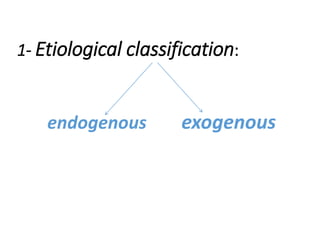
1- Etiological classification:
endogenous exogenous
Endogenous cause:
-Atopic dermatitis
-Seborrheic dermatitis
-Nummular eczema
-Dyshidrosis
-Asteatotic dermatitis
-Pityriasis alba
-Stasis eczema
-Juvenile plantar dermatitis
Exogenous cause:
-Irritant contact dermatitis
-Allergic contact dermatitis
-Photosensitive dermattitis
-Dermatophytid (Infective
eczematoid dermatitis).
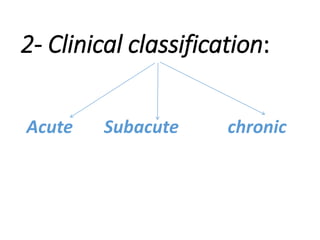
2- Clinical classification:
Acute Subacute chronic
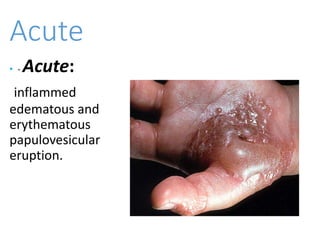
Acute
• - Acute:
inflammed
edematous and
erythematous
papulovesicular
eruption.
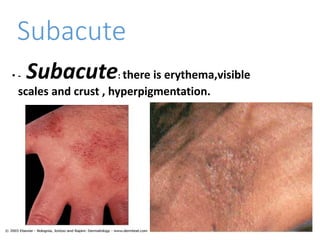
Subacute
• - Subacute: there is erythema,visible
scales and crust , hyperpigmentation.
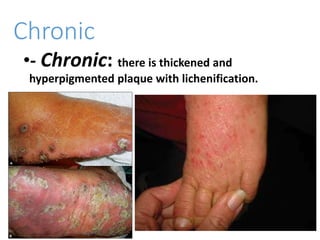
Chronic
•- Chronic: there is thickened and
hyperpigmented plaque with lichenification.
CONTACTDERMATITIS
CONTACT DERMATITIS
is a term for a skin reaction or inflammation resulting
from exposure to harmful external 0influences
- As allergens (allergic contact dermatitis)
- or irritants (irritant contact dermatitis)
- Or sunlight (Phototoxic dermatitis) occurs when the
allergen or irritant is activated by sunlight.
Note:-
1- Inflammation of the affected tissue is present in
the epidermis (the outermost layer of skin) and
the outer dermis (the layer beneath the
epidermis)
Types of contact dermatitis
-IRRITANT CONTACT DERMATITIS.
-ALLERGIC CONTACT DERMATITIS.
-PHOTO-SENEITIVITY
IRRITANT CONTACT
DERMATITIS
Definition
•-Non immunological localized inflammatory reaction
of the skin resulting from exposure to substance that
cause irritation or eruption in
most people who come in contact with it.
it accounts for 80% of all contact dermatitis.
SO:
• Every one is susceptible for I.C.D.
• Irritant contact dermatitis is a major occupational disease.
No requirement for prior exposure.
The lesion develop at first exposure.
More common in women than in men due to
environmental factors, not genetic factors.
Causes:-
•Chemichal irritants .
•Physical irritants .
 Causes:-
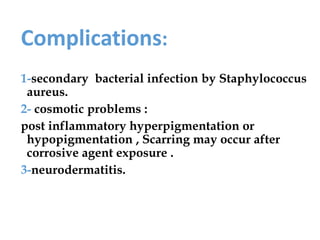
Chemichal irritants:
1-Solvents: as alcohol , acetone or ketones
2- Acids: as hydrochloric acid, nitric acid,sulfuric acid.
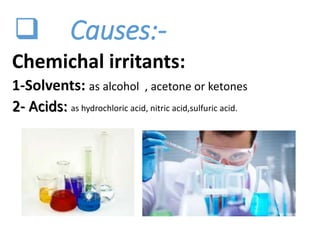
3- Soaps and detergents (alkalis) : causes
what called hand dermatitis
Cumulative irritant contact dermatitis: common in
Health care workers , house wife which wash their
hands 20-40 times a day.
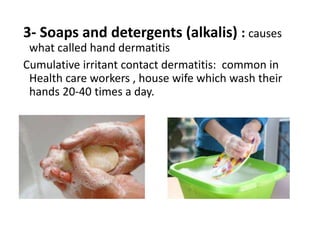
4- Rubber gloves:
has tiny quantities of chemicals which cause a direct
irritant action on hands.
More common in a medical health workers .
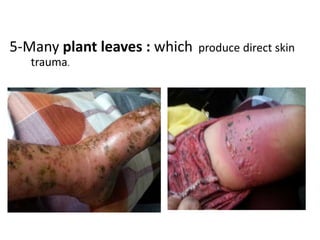
5-Many plant leaves : which produce direct skin
trauma.
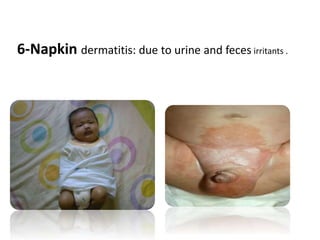
6-Napkin dermatitis: due to urine and feces irritants .
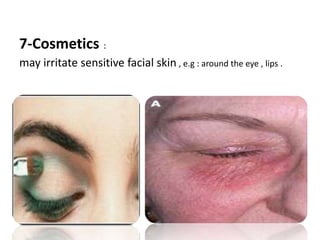
7-Cosmetics :
may irritate sensitive facial skin , e.g : around the eye , lips .
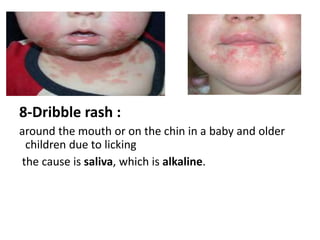
8-Dribble rash :
around the mouth or on the chin in a baby and older
children due to licking
the cause is saliva, which is alkaline.
Physical irritants:-
1-Dry cold air (low humidity ) from air condition
may cause dry irritable skin, the most common
cause of PICD .
2-Temperature variation: An increase in
temperature (up to 43ºC from 20ºC).
3-Water: Continual exposure to water may produce
maceration or repeated evaporation of water
from the skin.
4-Dusts and gases: may irritate the skin. As Wood
dust, tobacco dust in cigar factories.
5- Plants : many plants can cause PICD .
Severity of irritant contact dermatitis depend
on:-
1- Amount and strength of the irritant.
2- Length and frequency of exposure.
3- Skin susceptibility (eg. thick, thin, oily, dry,
previously damaged skin).
4- Environmental factors (eg. high or low temperature
or humidity).
Pathophysiology:-
Irritants damage of the skin surface faster than the
skin is able to repair the damage .
• Detergents, surfactants, extremes of pH, and organic
solvents all directly affecting the barrier properties of
the epidermis , and lead to pathophysiological change .
The 4 main pathophysiological changes are:
1- skin barrier disruption,
2-removing fat from skin allowing the irritants to
penetrate more deeply and cause damage.
3- epidermal cellular changes,
4- cytokine release.
Types of ICD
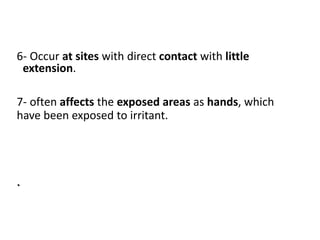
1- Acute ICD:
A single exposure to strong irritant substance causes an acute dermatitis,
within minutes to hours after exposure.
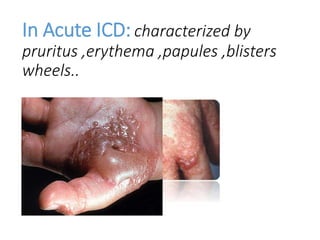
2-Sub acute ICD:
Repeated exposure of small area as in napkin dermatitis.
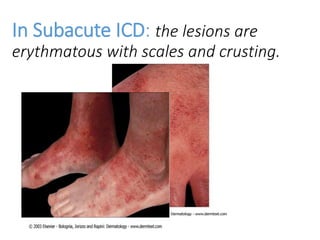
3- Chronic ICD: ( cumulative)
This is due to multiple exposures, often to several irritants at low levels
over time. This dermatitis can take many months or years to appear
Clinical picture
1- Red rash (erythema): This is the usual reaction. The rash appears
immediately in irritant contact dermatitis.
2- Dryness of skin.
3- Itchy, burning skin: it tends to be more painful than itchy, while
allergic contact dermatitis often itches.
4- Blisters or wheals: forms where skin was directly
exposed to the allergen or irritant.
5- Rapid onset 4-12 hours after expoure; whereas
in allergic contact dermatitis, the rash sometimes
does not appear until 24–72 hours after exposure to the
allergen.
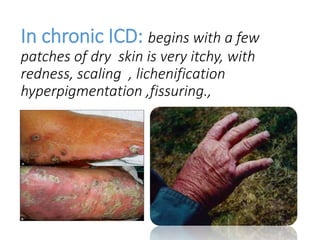
6- Occur at sites with direct contact with little
extension.
7- often affects the exposed areas as hands, which
have been exposed to irritant.
.
In Acute ICD: characterized by
pruritus ,erythema ,papules ,blisters
wheels..
In Subacute ICD: the lesions are
erythmatous with scales and crusting.
In chronic ICD: begins with a few
patches of dry skin is very itchy, with
redness, scaling , lichenification
hyperpigmentation ,fissuring.,
•Diagnosis:-
1- From detailed history which required to identify
the causative agent.
2- From clinical picture of affected sites.
3-Patch tests :
Patch tests are used to confirm or exclude allergic
contact dermatitis and identify the allergen.
They do not exclude irritant contact dermatitis as
the two may coexist.
Deferential diagnosis:
-AIlergic dermatitis
-drug eruption dermatits
-atopic dermatitis
-seborrhoeic eczema
-discoid eczema
-asteatotic eczema
-stasis or venous eczema
Prevention
and
Treatment
Prevention:
-Avoid the suspected irritant, By use of
protective clothing, and gloves.
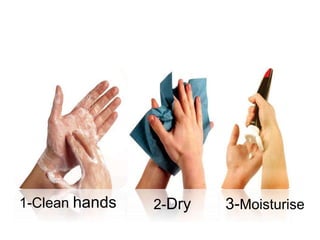
1-Clean hands 2-Dry 3-Moisturise
-Always keep your hands
moister after washing .
Treatment:
1-Chemical burns are usually flushed with water
followed by use of antidote against the particular toxic
chemical.
2- Emollints cream , They are used to correct
dryness and scaling of the skin, and mild irritant contact
dermatitis.
3-topical corticosteroids, which suppress the
inflammatory reaction so should reduce redness,
swelling and pain.
4-Antihistamine treatments for itching.
5-Antibiotic, for secondary bacterial infection ,
(usually flucloxacillin or erythromycin)
Complications:
1-secondary bacterial infection by Staphylococcus
aureus.
2- cosmotic problems :
post inflammatory hyperpigmentation or
hypopigmentation , Scarring may occur after
corrosive agent exposure .
3-neurodermatitis.
Thanks

Irritant contact dermatitis

  • 1.
  • 2.
  • 3.
  • 4.
  • 5.
    Endogenous cause: -Atopic dermatitis -Seborrheicdermatitis -Nummular eczema -Dyshidrosis -Asteatotic dermatitis -Pityriasis alba -Stasis eczema -Juvenile plantar dermatitis
  • 6.
    Exogenous cause: -Irritant contactdermatitis -Allergic contact dermatitis -Photosensitive dermattitis -Dermatophytid (Infective eczematoid dermatitis).
  • 7.
  • 8.
    Acute • - Acute: inflammed edematousand erythematous papulovesicular eruption.
  • 9.
    Subacute • - Subacute:there is erythema,visible scales and crust , hyperpigmentation.
  • 10.
    Chronic •- Chronic: thereis thickened and hyperpigmented plaque with lichenification.
  • 11.
  • 12.
    CONTACT DERMATITIS is aterm for a skin reaction or inflammation resulting from exposure to harmful external 0influences - As allergens (allergic contact dermatitis) - or irritants (irritant contact dermatitis) - Or sunlight (Phototoxic dermatitis) occurs when the allergen or irritant is activated by sunlight.
  • 13.
    Note:- 1- Inflammation ofthe affected tissue is present in the epidermis (the outermost layer of skin) and the outer dermis (the layer beneath the epidermis)
  • 14.
    Types of contactdermatitis -IRRITANT CONTACT DERMATITIS. -ALLERGIC CONTACT DERMATITIS. -PHOTO-SENEITIVITY
  • 15.
  • 16.
    Definition •-Non immunological localizedinflammatory reaction of the skin resulting from exposure to substance that cause irritation or eruption in most people who come in contact with it. it accounts for 80% of all contact dermatitis.
  • 17.
    SO: • Every oneis susceptible for I.C.D. • Irritant contact dermatitis is a major occupational disease. No requirement for prior exposure. The lesion develop at first exposure. More common in women than in men due to environmental factors, not genetic factors.
  • 18.
  • 19.
     Causes:- Chemichal irritants: 1-Solvents:as alcohol , acetone or ketones 2- Acids: as hydrochloric acid, nitric acid,sulfuric acid.
  • 20.
    3- Soaps anddetergents (alkalis) : causes what called hand dermatitis Cumulative irritant contact dermatitis: common in Health care workers , house wife which wash their hands 20-40 times a day.
  • 21.
    4- Rubber gloves: hastiny quantities of chemicals which cause a direct irritant action on hands. More common in a medical health workers .
  • 22.
    5-Many plant leaves: which produce direct skin trauma.
  • 23.
    6-Napkin dermatitis: dueto urine and feces irritants .
  • 24.
    7-Cosmetics : may irritatesensitive facial skin , e.g : around the eye , lips .
  • 25.
    8-Dribble rash : aroundthe mouth or on the chin in a baby and older children due to licking the cause is saliva, which is alkaline.
  • 26.
    Physical irritants:- 1-Dry coldair (low humidity ) from air condition may cause dry irritable skin, the most common cause of PICD . 2-Temperature variation: An increase in temperature (up to 43ºC from 20ºC). 3-Water: Continual exposure to water may produce maceration or repeated evaporation of water from the skin. 4-Dusts and gases: may irritate the skin. As Wood dust, tobacco dust in cigar factories. 5- Plants : many plants can cause PICD .
  • 27.
    Severity of irritantcontact dermatitis depend on:- 1- Amount and strength of the irritant. 2- Length and frequency of exposure. 3- Skin susceptibility (eg. thick, thin, oily, dry, previously damaged skin). 4- Environmental factors (eg. high or low temperature or humidity).
  • 28.
    Pathophysiology:- Irritants damage ofthe skin surface faster than the skin is able to repair the damage . • Detergents, surfactants, extremes of pH, and organic solvents all directly affecting the barrier properties of the epidermis , and lead to pathophysiological change . The 4 main pathophysiological changes are: 1- skin barrier disruption, 2-removing fat from skin allowing the irritants to penetrate more deeply and cause damage. 3- epidermal cellular changes, 4- cytokine release.
  • 29.
    Types of ICD 1-Acute ICD: A single exposure to strong irritant substance causes an acute dermatitis, within minutes to hours after exposure. 2-Sub acute ICD: Repeated exposure of small area as in napkin dermatitis. 3- Chronic ICD: ( cumulative) This is due to multiple exposures, often to several irritants at low levels over time. This dermatitis can take many months or years to appear
  • 30.
    Clinical picture 1- Redrash (erythema): This is the usual reaction. The rash appears immediately in irritant contact dermatitis. 2- Dryness of skin. 3- Itchy, burning skin: it tends to be more painful than itchy, while allergic contact dermatitis often itches. 4- Blisters or wheals: forms where skin was directly exposed to the allergen or irritant. 5- Rapid onset 4-12 hours after expoure; whereas in allergic contact dermatitis, the rash sometimes does not appear until 24–72 hours after exposure to the allergen.
  • 31.
    6- Occur atsites with direct contact with little extension. 7- often affects the exposed areas as hands, which have been exposed to irritant. .
  • 32.
    In Acute ICD:characterized by pruritus ,erythema ,papules ,blisters wheels..
  • 33.
    In Subacute ICD:the lesions are erythmatous with scales and crusting.
  • 34.
    In chronic ICD:begins with a few patches of dry skin is very itchy, with redness, scaling , lichenification hyperpigmentation ,fissuring.,
  • 35.
    •Diagnosis:- 1- From detailedhistory which required to identify the causative agent. 2- From clinical picture of affected sites. 3-Patch tests : Patch tests are used to confirm or exclude allergic contact dermatitis and identify the allergen. They do not exclude irritant contact dermatitis as the two may coexist.
  • 36.
    Deferential diagnosis: -AIlergic dermatitis -drugeruption dermatits -atopic dermatitis -seborrhoeic eczema -discoid eczema -asteatotic eczema -stasis or venous eczema
  • 37.
  • 38.
  • 39.
    -Avoid the suspectedirritant, By use of protective clothing, and gloves.
  • 40.
    1-Clean hands 2-Dry3-Moisturise -Always keep your hands moister after washing .
  • 41.
    Treatment: 1-Chemical burns areusually flushed with water followed by use of antidote against the particular toxic chemical. 2- Emollints cream , They are used to correct dryness and scaling of the skin, and mild irritant contact dermatitis. 3-topical corticosteroids, which suppress the inflammatory reaction so should reduce redness, swelling and pain. 4-Antihistamine treatments for itching. 5-Antibiotic, for secondary bacterial infection , (usually flucloxacillin or erythromycin)
  • 42.
    Complications: 1-secondary bacterial infectionby Staphylococcus aureus. 2- cosmotic problems : post inflammatory hyperpigmentation or hypopigmentation , Scarring may occur after corrosive agent exposure . 3-neurodermatitis.
  • 43.