BURNS
PRESENTED BY
GRACE SMITHA SAMUEL
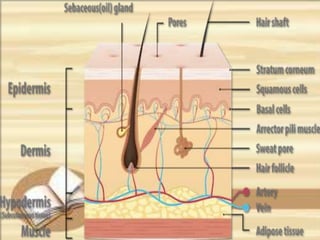
STRUCTURE OF SKIN
• Surface area of about 1.5 to 2m2
• It contains glands, hair and nails.
• Two main layers : Epidermis and Dermis
• Subcutaneous fat
EPIDERMIS:
• Superficial layer of the skin
• Thickest on the palms and soles
• No blood vessels or nerve endings but deepest layers are
bathed in interstitial fluid from the dermis.
• This fluid provides oxygen and nutrients
• Complete replacement of epidermis takes about a month
• Blisters develop when trauma causes the separation of the
dermis and epidermis and serous fluid collects between the
two layers.
DERMIS
 Tough and elastic formed from connective tissue.
 It also contains collagen and elastic fibres
 It contains blood vessels lymph vessels, sensory nerve
endings, sweat glands and their ducts, hairs and sweat glands
FUNCTIONS
• Protection
• Regulation of body temperatutre
• Formation of Vitamin D
• Absorption
• Secretion
DEFINITION
• Injury to the body tissues caused by heat, chemicals, radiation
or electricity.
INCIDENCE
• An estimated 1,80,000 deaths every year are caused by burns.
• In India, over 1,00,000 people are moderately or severely burnt
every year.
• In United States, between 2013 and 2017, more than 4,00,000
people were seen in Emergency rooms for treatment of non-fatal
burn injuries.
• In 2016 alone, there were 3280 deaths from fire and smoke
inhalation and another 40,000 people were treated in hospitals for
burn related injuries.
• The theme of 2019 Burn Awareness Week Campaign is “SCALD”
CAUSES
1. Thermal Burns:
It is caused by flame, flash, scald or contact with hot objects.
2. Chemical Burns:
It is caused due to acids, alkalis or organic compounds. Alkali
burns are more dangerous than acid burns.
3. Inhalation Injury:
Injuries resulting from the inhalation of air or noxious chemicals and
can cause damage to the tissues of respiratory tract.
Types:
 Carbon monoxide poisoning
 Inhalation injury above the glottis
 Inhalation injury below the glottis
4. Electric Current:
Burns caused due to the result of intense heat generated from
an electric current.
5. Cold Thermal Injury:
It is caused by freezing of the skin and underlying tissues.
6. Radiation Burns:
A radiation burn is damage to the skin or other biological tissue
as an effect of radiation
CLASSIFICATION
A. Depth of Burn:
Partial thickness burns Full thickness burns
Superficial Deep
B. Extent of Burns
Rule of Nine
Lund-Browder Chart
A. 3.5
B. 4.75
C. 3.5
C. Location of Burns:
• Burns to the face and neck and circumferential burns to the
chest/back may inhibit respiratory function due to mechanical
obstruction
• Burns of the hands, feet, joints and eyes are of concern
because they make self – care very difficult and may
jeopardize future function.
• Burns to the ears and the nose are susceptible to infection.
• Burns to the buttocks or genitalia are highly susceptible to
infection.
• Clients may also develop compartment syndrome from direct
heat damage to the muscles or pre-burn vascular problems.
D. Patient Risk Factors:
• Older adult heals more slowly and usually experiences more
difficulty with rehabilitation than a younger adult.
• Client with pre-existing cardiovascular, respiratory or renal disease
has a poorer prognosis
• Client with diabetes mellitus or peripheral vascular disease is at high
risk for poor healing and gangrene, especially with foot and leg
burns.
• General physical debilitation from any chronic disease including
alcoholism, drug abuse, or malnutrition, renders the client less
physiologically able to recover from a burn injury.
• Burn client concurrently sustained fractures, head injuries or other
trauma has a poorer prognosis for recovery.
PATHOPHYSIOLOGY
Due to etiological factors
Necrosis of skin
Release of vasoactive peptides
Altered capillary permeability
Loss of fluid Severe Hypovolaemia
Decreased cardiac output
Decreased myocardial function
Decreased renal blood flow Oliguria
Altered pulmonary resistance causing pulmonary edema
Infection
Systemic inflammatory response syndrome
Multi organ dysfunction syndrome
CLINICAL MANIFESTATIONS
Superficial 1st degree:
• Red appearance without blister with dry texture
Superficial partial thickness 2nd degree:
• Redness with clear blister, blanches with pressure, moist texture.
Deep partial thickness 3rd degree:
• Yellow or white, less blanching, may be blistering
Full thickness 3rd degree:
• Stiff and white / brown, no blanching, leathery texture
4th degree:
• Black, charred with eschar, dry texture
General Symptoms:
• Skin peeling
• Pain
• Blisters
• Superficial burns are typically red in colour. Severe burns may
be pink, white or black.
• Shortness of breath
• Hoarseness
• Stridor or wheezing
• Itchiness
• Emotional and psychological distress
PHASES OF BURNS MANAGEMENT
• Begins with pre-hospital phase
• Mainly divided into 3 phases.
– Emergent Phase (Resuscitative)
– Acute Phase (Wound Healing)
– Rehabilitative (Restorative )phase
Pre-hospital phase:
• Cool the burn under running water for atleast 10 minutes.
• Protect the burn with sterile, non-adhesive bandage.
• Do not apply butter or ointments.
• Don’t break blisters.
• Take counter pain relievers.
• Remove the person from source of burn and stop the burn
process.
• In electrical injuries, initial management involves removal of
the client from contact with current source by trained
individuals.
• Chemical burns are best treated by brushing solid particles off
the skin, followed by thorough lavage with water.
• Small thermal burns ≤ 10% TBSA may be covered with a
clean, cool, tap water- dampened towel for the client’s comfort
and protection.
• If the thermal burn area is large, should check for airway,
breathing and circulation.
• Cooling the burnt part in 1 minute of burn injury will help to
reduce the depth of burn.
• Never cool burns with ice because it may lead to frostbite.
• Remove the burnt clothes to prevent adherence.
• Client should be wrapped in a dry clean cloth or blanket to
avoid further contamination while shifting to hospital.
Emergent Phase:
• Management for 24-48 hours upto 3 or more days.
• It starts from the period of initial medical support till fluid
mobilization and dieresis begins.
• This phase includes:
– Airway management
– Intravenous fluid therapy
– Wound care
– Drug therapy
– Nutritional supplementation
a)Airway management:
• Check for patency.
• Within 1-2 hours of burns, intubate the client endo-tracheally
and provide mechanical ventilator support
• Do fibre-optic bronchoscopy to assess the lower respiratory
tract.
• If not intubated, administer humidified air and oxygen
supplementation.
• Provide high Fowler’s position to improve breathing unless
contraindicated with spinal cord injuries.
• If there is spinal cord injury, reverse trendlenburg position is
advisable.
• Position change in every 1-2 hours.
• Chest physiotherapy is required.
• In carbon monoxide poisoning , administer 100% O2 until
carboxyhemoglobin levels returns to normal.
b) Intra-Venous Fluid Therapy:
• For clients with >15% TBSA burn, 2 large bore IV canulas are
to accessed
• For >30%TBSA , central line or an arterial line should be
assessed for fluid/blood and medication administration.
• IV fluid is recommended for >15%TBSA burns.
• Crystalloids (commonly RL) and colloids (albumin) are
administered.
• Brooks and Parklands formula are commonly used for fluid
resuscitation.
• Evan’s Formula:
For 1st 24 hours:
Normal saline (NS) at 1 ml/kg/%TBSA
Colloids: 1ml/kg/%TBSA
Glucose in water: 2000 ml
For 2nd 24 hours:
Half of first hour requirement
• Brooke Formula:
• First 24 hours: Ringer Lactate (RL) at 1.5 ml/kg/%burn,
Colloids at 0.5 ml/kg/%burn
Glucose in water.
• Next 24 hours: RL in amount of 0.5 ml/kg/%burn
Colloids at 0.25 ml/kg/%burn
Glucose in water: 2000ml
Modified Brooke Formula:
• First 24 hours: No colloids
Crystalloids (RL) in amount of 2ml/kg/%burn
• Next 24 hours: Colloids in amount of 0.3-0.5 ml/kg/%burn
No crystalloids.
Glucose in water: 2000 ml
Wound Care:
• Wound care is started only after fluid resuscitation.
• Cleaning and debridement of wound with scissors and forceps
can be done with hydrotherapy in a tub or cart shower.
• Electrolyte loss can occur if dipped in tub for more than 20-30
minutes. So cart shower is advisable.
Open dressing:
• A topical antimicrobial agent is applied over the wound and is
left open.
Multiple dressing:
• An anti microbial impregnated gauze is applied over the burnt
area. It is changed in 12-24 hours or upto 3 days as per the
agent used and doctor’s order.
• Escharotomies and fasciotomies are done by burns physician
in emergency phase to improve blood supply.
Escharotomy Fasciotomy
Types of Grafts:
• Heterografts:
From other species.
• Allografts:
From cadeaver of same species.
• Autografts:
From clients own skin.
Drug Therapy:
• For pain:
– Morphine, fentanyl, NSAID’S.
• Topical anti-microbial agents:
Silver sulfadiazepine or Mafenide acetate helps to penetrate the
eschar and inhibit the growth of flora.
• IM injections are not adviced in burns because they will not be
absorbed and they will not be absorbed and will pool in the adjacent
tissues.
• TT immunization has to be administered.
• If the client has not taken TT in the last 10 years, then TT
immunoglobulin is to be administered.
• Systemic antibiotics are provided when there is burns associated
systemic sepsis leading to multisystem dysfunction.
• Fungal infections like candida albicans develops in the mucous
membrane of mouth and perineum.
• Nystatin mouth wash is prescribed for oral infection.
• Lactobacillus (yoghurt) is administered to restore the normal flora
of intestine, when a normal diet is resumed.
Nutritional Therapy:
• Provide Vitamin supplements A,C and E.
• High protein and calorie rich diet to be provided if tolerated.
• Zinc and iron supplements should be provided.
2. ACUTE PHASE
• This phase begins with mobilization of extracellular fluids and
dieresis and stops with complete wound healing or wound
closure with a graft.
• This phase consists of:
– Wound care
– Excision and grafting
– Pain management
– Physical and occupational therapy
– Nutritional therapy
– Psychosocial care
a) Wound care:
Aims of wound care:
– Cleaning and debridement
– Promoting re-epithelialization
b) Excision and Grafting:
• Early harvesting of donor skin and grafting is required.
• Skin from donor site is harvested with a dermatone. A split thickness
layer of superficial skin is removed and it can be meshed to be used
for layer areas.
• Before grafting excision of eschar upto subcutaneous tissue or to
fascia is done and above this viable tissue, healthy graft is placed.
• Hemostasis is maintained by applying epinephrine or topical
thrombin. Over it graft layer is placed and pressure is applied over
the wound.
• Continuous monitoring and care should be provided to protect the
graft.
Burns client experiences two types of pain:
– A continuous, background pain day and night.
– Treatment induced pain which starts with
procedures, ambulation or dressing change.
• For background pain: Continuous IV infusion of
morphine or hydromorphine.
• Then anxiolytics like midazolam or lorazepam can be
administered.
• For procedure induced pain, continuous infusion, short
acting pre medications can be given.
• Eg., fentanyl, anxiolytics
• Non pharmacological measures:
Relaxation therapies, hypnosis, guided imagery, bio
feedback and meditation.
d) Physical and occupational therapy:
• Best time for exercise is during and after wound cleansing
when the wound is soft and bulky and the dressing is removed.
• All ROM active and passive exercises are to be allowed.
• Clients with neck burns should sleep without pillows and neck
extended.
• Head should hang slightly over the top of the mattress.
e) Nutritional Therapy:
• High protein and calorie diet for wound healing.
• Early enteral feeding.
• If calorie requirement are not met with NG feeds, start TPN
too.
• Weight loss should not be more than 10% of pre-burn weight.
• Protein powder supplements could be added.
f) Psychosocial Care:
– Counselling
– Pastoral care
3. REHABILITATIVE PHASE
This phase begins when the client’s burn wounds have healed
and the client is able to resume a level of self-care activity.
This can occur as early as 2 weeks or long as 7-8 months after
the burn injury.
Goal:
– To help client to resume a functional role in the family and
society.
– To accomplish cosmetic and functional reconstruction.
NURSING MANAGEMENT
EMERGENT PHASE:
• Focus on major priorities of any trauma client.
• Assess circumstances surrounding the injury.
• Monitor vital signs frequently.
• Start cardiac monitoring if indicated.
• Monitor fluid intake and output and measure hourly.
• Obtain history.
• Arrange for clients with facial burns to be assessed for corneal
injury.
• Continue to assess the extent of burn, depth of wound, identify
areas of full and partial thickness injury.
• Assess neurologic status.
• Assess client’s and family’s understanding of injury and
treatment.
ACUTE PHASE:
• Focus on hemodynamic alterations, wound healing, pain and
psychosocial responses and early detection of complications.
• Measure vital signs frequently.
• Assess peripheral pulses frequently for first few days after the
burn for restricted blood flow.
• Closely observe hourly fluid intake and urinary output.
• In inhalation injury, monitor level of consciousness,
pulmonary function and ability to ventilate.
NURSING DIAGNOSIS
• Risk for fluid volume imbalance related to evaporative fluid loss as
evidenced by oliguria.
• Acute pain related to burn injury as evidenced by non-verbal
behaviour.
• Imbalanced nutrition less than body requirements related to hyper
metabolic state as evidenced by weight loss.
• Risk for infection related to altered skin integrity as evidenced by
necrosis.
• Disturbed body image related to disfigurement secondary to burn as
evidenced by verbalized negative comments about appearance and
unwillingness to look at self.
REHABILITATIVE PHASE:
• Maintain fluid and electrolyte balance.
• Improve nutritional status.
• Obtain information about client’s educational level,
occupation, leisure activities, cultural background, religion and
family interactions.
• Assess self-concept, mental status, emotional response to
injury and hospitalization, pain relief measures and sleep
pattern.
• Perform ongoing assessment including range of motion of
affected joints, quality or condition of healthy skin, early signs
of skin breakdown from splints or positioning devices.
Burns

Burns

  • 1.
  • 3.
    STRUCTURE OF SKIN •Surface area of about 1.5 to 2m2 • It contains glands, hair and nails. • Two main layers : Epidermis and Dermis • Subcutaneous fat
  • 4.
    EPIDERMIS: • Superficial layerof the skin • Thickest on the palms and soles • No blood vessels or nerve endings but deepest layers are bathed in interstitial fluid from the dermis. • This fluid provides oxygen and nutrients • Complete replacement of epidermis takes about a month • Blisters develop when trauma causes the separation of the dermis and epidermis and serous fluid collects between the two layers.
  • 5.
    DERMIS  Tough andelastic formed from connective tissue.  It also contains collagen and elastic fibres  It contains blood vessels lymph vessels, sensory nerve endings, sweat glands and their ducts, hairs and sweat glands
  • 6.
    FUNCTIONS • Protection • Regulationof body temperatutre • Formation of Vitamin D • Absorption • Secretion
  • 7.
    DEFINITION • Injury tothe body tissues caused by heat, chemicals, radiation or electricity.
  • 8.
    INCIDENCE • An estimated1,80,000 deaths every year are caused by burns. • In India, over 1,00,000 people are moderately or severely burnt every year. • In United States, between 2013 and 2017, more than 4,00,000 people were seen in Emergency rooms for treatment of non-fatal burn injuries. • In 2016 alone, there were 3280 deaths from fire and smoke inhalation and another 40,000 people were treated in hospitals for burn related injuries. • The theme of 2019 Burn Awareness Week Campaign is “SCALD”
  • 9.
    CAUSES 1. Thermal Burns: Itis caused by flame, flash, scald or contact with hot objects.
  • 10.
    2. Chemical Burns: Itis caused due to acids, alkalis or organic compounds. Alkali burns are more dangerous than acid burns.
  • 11.
    3. Inhalation Injury: Injuriesresulting from the inhalation of air or noxious chemicals and can cause damage to the tissues of respiratory tract. Types:  Carbon monoxide poisoning  Inhalation injury above the glottis  Inhalation injury below the glottis
  • 12.
    4. Electric Current: Burnscaused due to the result of intense heat generated from an electric current.
  • 13.
    5. Cold ThermalInjury: It is caused by freezing of the skin and underlying tissues.
  • 14.
    6. Radiation Burns: Aradiation burn is damage to the skin or other biological tissue as an effect of radiation
  • 15.
    CLASSIFICATION A. Depth ofBurn: Partial thickness burns Full thickness burns Superficial Deep
  • 16.
    B. Extent ofBurns Rule of Nine
  • 17.
  • 18.
    C. Location ofBurns: • Burns to the face and neck and circumferential burns to the chest/back may inhibit respiratory function due to mechanical obstruction • Burns of the hands, feet, joints and eyes are of concern because they make self – care very difficult and may jeopardize future function. • Burns to the ears and the nose are susceptible to infection. • Burns to the buttocks or genitalia are highly susceptible to infection. • Clients may also develop compartment syndrome from direct heat damage to the muscles or pre-burn vascular problems.
  • 19.
    D. Patient RiskFactors: • Older adult heals more slowly and usually experiences more difficulty with rehabilitation than a younger adult. • Client with pre-existing cardiovascular, respiratory or renal disease has a poorer prognosis • Client with diabetes mellitus or peripheral vascular disease is at high risk for poor healing and gangrene, especially with foot and leg burns. • General physical debilitation from any chronic disease including alcoholism, drug abuse, or malnutrition, renders the client less physiologically able to recover from a burn injury. • Burn client concurrently sustained fractures, head injuries or other trauma has a poorer prognosis for recovery.
  • 20.
    PATHOPHYSIOLOGY Due to etiologicalfactors Necrosis of skin Release of vasoactive peptides Altered capillary permeability Loss of fluid Severe Hypovolaemia Decreased cardiac output Decreased myocardial function
  • 21.
    Decreased renal bloodflow Oliguria Altered pulmonary resistance causing pulmonary edema Infection Systemic inflammatory response syndrome Multi organ dysfunction syndrome
  • 22.
    CLINICAL MANIFESTATIONS Superficial 1stdegree: • Red appearance without blister with dry texture Superficial partial thickness 2nd degree: • Redness with clear blister, blanches with pressure, moist texture. Deep partial thickness 3rd degree: • Yellow or white, less blanching, may be blistering Full thickness 3rd degree: • Stiff and white / brown, no blanching, leathery texture 4th degree: • Black, charred with eschar, dry texture
  • 23.
    General Symptoms: • Skinpeeling • Pain • Blisters • Superficial burns are typically red in colour. Severe burns may be pink, white or black. • Shortness of breath • Hoarseness • Stridor or wheezing • Itchiness • Emotional and psychological distress
  • 24.
    PHASES OF BURNSMANAGEMENT • Begins with pre-hospital phase • Mainly divided into 3 phases. – Emergent Phase (Resuscitative) – Acute Phase (Wound Healing) – Rehabilitative (Restorative )phase
  • 25.
    Pre-hospital phase: • Coolthe burn under running water for atleast 10 minutes. • Protect the burn with sterile, non-adhesive bandage. • Do not apply butter or ointments. • Don’t break blisters. • Take counter pain relievers. • Remove the person from source of burn and stop the burn process. • In electrical injuries, initial management involves removal of the client from contact with current source by trained individuals.
  • 26.
    • Chemical burnsare best treated by brushing solid particles off the skin, followed by thorough lavage with water. • Small thermal burns ≤ 10% TBSA may be covered with a clean, cool, tap water- dampened towel for the client’s comfort and protection. • If the thermal burn area is large, should check for airway, breathing and circulation. • Cooling the burnt part in 1 minute of burn injury will help to reduce the depth of burn.
  • 27.
    • Never coolburns with ice because it may lead to frostbite. • Remove the burnt clothes to prevent adherence. • Client should be wrapped in a dry clean cloth or blanket to avoid further contamination while shifting to hospital.
  • 28.
    Emergent Phase: • Managementfor 24-48 hours upto 3 or more days. • It starts from the period of initial medical support till fluid mobilization and dieresis begins. • This phase includes: – Airway management – Intravenous fluid therapy – Wound care – Drug therapy – Nutritional supplementation
  • 29.
    a)Airway management: • Checkfor patency. • Within 1-2 hours of burns, intubate the client endo-tracheally and provide mechanical ventilator support • Do fibre-optic bronchoscopy to assess the lower respiratory tract. • If not intubated, administer humidified air and oxygen supplementation. • Provide high Fowler’s position to improve breathing unless contraindicated with spinal cord injuries. • If there is spinal cord injury, reverse trendlenburg position is advisable. • Position change in every 1-2 hours. • Chest physiotherapy is required. • In carbon monoxide poisoning , administer 100% O2 until carboxyhemoglobin levels returns to normal.
  • 30.
    b) Intra-Venous FluidTherapy: • For clients with >15% TBSA burn, 2 large bore IV canulas are to accessed • For >30%TBSA , central line or an arterial line should be assessed for fluid/blood and medication administration. • IV fluid is recommended for >15%TBSA burns. • Crystalloids (commonly RL) and colloids (albumin) are administered. • Brooks and Parklands formula are commonly used for fluid resuscitation.
  • 31.
    • Evan’s Formula: For1st 24 hours: Normal saline (NS) at 1 ml/kg/%TBSA Colloids: 1ml/kg/%TBSA Glucose in water: 2000 ml For 2nd 24 hours: Half of first hour requirement
  • 32.
    • Brooke Formula: •First 24 hours: Ringer Lactate (RL) at 1.5 ml/kg/%burn, Colloids at 0.5 ml/kg/%burn Glucose in water. • Next 24 hours: RL in amount of 0.5 ml/kg/%burn Colloids at 0.25 ml/kg/%burn Glucose in water: 2000ml Modified Brooke Formula: • First 24 hours: No colloids Crystalloids (RL) in amount of 2ml/kg/%burn • Next 24 hours: Colloids in amount of 0.3-0.5 ml/kg/%burn No crystalloids. Glucose in water: 2000 ml
  • 34.
    Wound Care: • Woundcare is started only after fluid resuscitation. • Cleaning and debridement of wound with scissors and forceps can be done with hydrotherapy in a tub or cart shower. • Electrolyte loss can occur if dipped in tub for more than 20-30 minutes. So cart shower is advisable. Open dressing: • A topical antimicrobial agent is applied over the wound and is left open. Multiple dressing: • An anti microbial impregnated gauze is applied over the burnt area. It is changed in 12-24 hours or upto 3 days as per the agent used and doctor’s order. • Escharotomies and fasciotomies are done by burns physician in emergency phase to improve blood supply.
  • 35.
  • 36.
    Types of Grafts: •Heterografts: From other species. • Allografts: From cadeaver of same species. • Autografts: From clients own skin.
  • 37.
    Drug Therapy: • Forpain: – Morphine, fentanyl, NSAID’S. • Topical anti-microbial agents: Silver sulfadiazepine or Mafenide acetate helps to penetrate the eschar and inhibit the growth of flora. • IM injections are not adviced in burns because they will not be absorbed and they will not be absorbed and will pool in the adjacent tissues. • TT immunization has to be administered. • If the client has not taken TT in the last 10 years, then TT immunoglobulin is to be administered. • Systemic antibiotics are provided when there is burns associated systemic sepsis leading to multisystem dysfunction. • Fungal infections like candida albicans develops in the mucous membrane of mouth and perineum. • Nystatin mouth wash is prescribed for oral infection. • Lactobacillus (yoghurt) is administered to restore the normal flora of intestine, when a normal diet is resumed.
  • 38.
    Nutritional Therapy: • ProvideVitamin supplements A,C and E. • High protein and calorie rich diet to be provided if tolerated. • Zinc and iron supplements should be provided.
  • 39.
    2. ACUTE PHASE •This phase begins with mobilization of extracellular fluids and dieresis and stops with complete wound healing or wound closure with a graft. • This phase consists of: – Wound care – Excision and grafting – Pain management – Physical and occupational therapy – Nutritional therapy – Psychosocial care
  • 40.
    a) Wound care: Aimsof wound care: – Cleaning and debridement – Promoting re-epithelialization b) Excision and Grafting: • Early harvesting of donor skin and grafting is required. • Skin from donor site is harvested with a dermatone. A split thickness layer of superficial skin is removed and it can be meshed to be used for layer areas. • Before grafting excision of eschar upto subcutaneous tissue or to fascia is done and above this viable tissue, healthy graft is placed. • Hemostasis is maintained by applying epinephrine or topical thrombin. Over it graft layer is placed and pressure is applied over the wound. • Continuous monitoring and care should be provided to protect the graft.
  • 41.
    Burns client experiencestwo types of pain: – A continuous, background pain day and night. – Treatment induced pain which starts with procedures, ambulation or dressing change. • For background pain: Continuous IV infusion of morphine or hydromorphine. • Then anxiolytics like midazolam or lorazepam can be administered. • For procedure induced pain, continuous infusion, short acting pre medications can be given. • Eg., fentanyl, anxiolytics • Non pharmacological measures: Relaxation therapies, hypnosis, guided imagery, bio feedback and meditation.
  • 42.
    d) Physical andoccupational therapy: • Best time for exercise is during and after wound cleansing when the wound is soft and bulky and the dressing is removed. • All ROM active and passive exercises are to be allowed. • Clients with neck burns should sleep without pillows and neck extended. • Head should hang slightly over the top of the mattress. e) Nutritional Therapy: • High protein and calorie diet for wound healing. • Early enteral feeding. • If calorie requirement are not met with NG feeds, start TPN too. • Weight loss should not be more than 10% of pre-burn weight. • Protein powder supplements could be added.
  • 43.
    f) Psychosocial Care: –Counselling – Pastoral care
  • 44.
    3. REHABILITATIVE PHASE Thisphase begins when the client’s burn wounds have healed and the client is able to resume a level of self-care activity. This can occur as early as 2 weeks or long as 7-8 months after the burn injury. Goal: – To help client to resume a functional role in the family and society. – To accomplish cosmetic and functional reconstruction.
  • 45.
    NURSING MANAGEMENT EMERGENT PHASE: •Focus on major priorities of any trauma client. • Assess circumstances surrounding the injury. • Monitor vital signs frequently. • Start cardiac monitoring if indicated. • Monitor fluid intake and output and measure hourly. • Obtain history. • Arrange for clients with facial burns to be assessed for corneal injury. • Continue to assess the extent of burn, depth of wound, identify areas of full and partial thickness injury. • Assess neurologic status. • Assess client’s and family’s understanding of injury and treatment.
  • 46.
    ACUTE PHASE: • Focuson hemodynamic alterations, wound healing, pain and psychosocial responses and early detection of complications. • Measure vital signs frequently. • Assess peripheral pulses frequently for first few days after the burn for restricted blood flow. • Closely observe hourly fluid intake and urinary output. • In inhalation injury, monitor level of consciousness, pulmonary function and ability to ventilate.
  • 47.
    NURSING DIAGNOSIS • Riskfor fluid volume imbalance related to evaporative fluid loss as evidenced by oliguria. • Acute pain related to burn injury as evidenced by non-verbal behaviour. • Imbalanced nutrition less than body requirements related to hyper metabolic state as evidenced by weight loss. • Risk for infection related to altered skin integrity as evidenced by necrosis. • Disturbed body image related to disfigurement secondary to burn as evidenced by verbalized negative comments about appearance and unwillingness to look at self.
  • 48.
    REHABILITATIVE PHASE: • Maintainfluid and electrolyte balance. • Improve nutritional status. • Obtain information about client’s educational level, occupation, leisure activities, cultural background, religion and family interactions. • Assess self-concept, mental status, emotional response to injury and hospitalization, pain relief measures and sleep pattern. • Perform ongoing assessment including range of motion of affected joints, quality or condition of healthy skin, early signs of skin breakdown from splints or positioning devices.