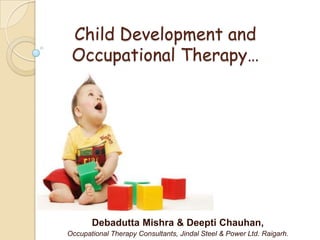
Child Development and
 Occupational Therapy…


       Debadutta Mishra & Deepti Chauhan,
Occupational Therapy Consultants, Jindal Steel & Power Ltd. Raigarh.
What is Child
Development???
   Child development is a
    process every child goes
    through.

   This process involves learning
    and mastering skills like
    sitting, walking, talking, skippi
    ng, and tying shoes.

   Children learn these
    skills, called developmental
    milestones, during predictable
    time periods.
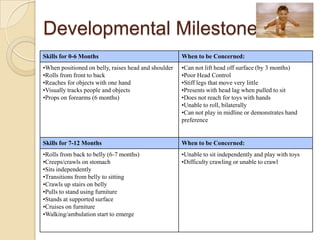
Developmental Milestones
Skills for 0-6 Months                                 When to be Concerned:
•When positioned on belly, raises head and shoulder   •Can not lift head off surface (by 3 months)
•Rolls from front to back                             •Poor Head Control
•Reaches for objects with one hand                    •Stiff legs that move very little
•Visually tracks people and objects                   •Presents with head lag when pulled to sit
•Props on forearms (6 months)                         •Does not reach for toys with hands
                                                      •Unable to roll, bilaterally
                                                      •Can not play in midline or demonstrates hand
                                                      preference


Skills for 7-12 Months                                When to be Concerned:
•Rolls from back to belly (6-7 months)                •Unable to sit independently and play with toys
•Creeps/crawls on stomach                             •Difficulty crawling or unable to crawl
•Sits independently
•Transitions from belly to sitting
•Crawls up stairs on belly
•Pulls to stand using furniture
•Stands at supported surface
•Cruises on furniture
•Walking/ambulation start to emerge
Skills for 13-18 months                                       When to be Concerned:
• Independent with ambulation                                 • Walks on toes or legs are very stiff
• Pushes to stand by going through 4 point                      and straight
• Stoops and recovers                                         • Can’t stand independently
• Walks backwards                                             • Can’t walk independently
• Walks sideways                                              • Falls frequently
• Starts running but may fall frequently                      • By 15-18 months:
• Ascends stairs using step-to pattern with railing/support   • Lowers to use hands or crawl up the
• Throwing a small ball overhead                                stairs
• Kicking a ball forward, with decreased control
• Seats self in small chair
• Climbs into adult chair
• Walks up/down stairs holding on to railing, with 2 feet
per
  step (18 months)
Skills for 19-24 months                                       When to be Concerned:
• Running becomes more controlled                             • Falls frequently when running
• Stands on one foot briefly                                  • Not able to clear the floor when
• Walks on line/balance beam with 1 foot on the line            jumping up
• Lowers to pick up objects from floor without falling        • Can’t jump up keeping feet together
• Jumping up with both feet
• Jumping down from objects
• Walks up stairs, both feet per step without rail
• Walking backwards emerges
Skills for 2-3 years                                            When to be Concerned:
• Ascends/descends stairs independently using step to pattern   • Requires railing for
• Walking on a line/balance beam with improved balance            ascending/descending stairs or uses
• Walking on tiptoes                                              a step to pattern
• Jumping forward
• Rides a tricycle
• Catches playground ball, securing ball by bending arms
towards chest
• Throws ball overhand 3-7 feet
• Kicks ball forward 3-6 feet using opposing arm/leg
movements
Skills for 3-4 years                                            When to be Concerned:
• Can sustain single leg stance for 5 seconds
• Can sustain static tiptoes for 3 seconds
• Kicks ball forward with control
• Catches ball with hands, without pulling ball to chest
• Throws ball at target
Skills for Ages 4+                                              When to be Concerned:
• Hopping on one foot
• Galloping and skipping start to emerge
• Jumps over objects
• Jumping-Jacks start to emerge
• Bounces and catches ball
Developmental delay

   Developmental delay occurs when
    children have not reached these
    milestones by the expected time period.
    For example, if the normal range for
    learning to walk is between 9 and 15
    months, and a 20-month-old child has
    still not begun walking, this would be
    considered a developmental delay.
What Occupational Therapists
Do???


Help children reach their maximal functional level of
     independence by facilitating development
 When skill and strength cannot be developed or
 improved, occupational therapy offers creative solutions
 and alternatives for carrying out daily activities.
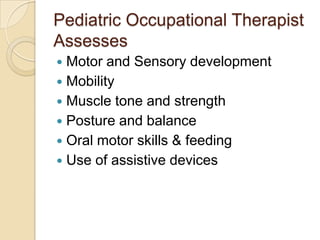
Pediatric Occupational Therapist
Assesses
 Motor and Sensory development
 Mobility
 Muscle tone and strength
 Posture and balance
 Oral motor skills & feeding
 Use of assistive devices
Setting the Goals
 Occupational Therapist sets two type of
  Goals, known as Short term goals and
  Long term goals.
 Short term goals are based of the
  present functional level of the child
  according to his age.
 Long term goals are based on the
  predicted functional level of the child and
  expectation of the parents.
Things to take care…
    Development occurs in a sequential fashion.
     This means that a child will need to develop
     some skills before he or she can develop new
     skills.

    For example, children must first learn to crawl
     and to pull up to a standing position before
     they are able to walk.

    Each milestone that a child acquires builds on
     the last milestone developed.
Development of plan
   According to the goals been set, OT
    Plans out the Treatment Approaches
    and Intervention
Implementation
Implementation
SENSORY
INTEGRATION
THERAPY
 SI theory is based on the hypothesis that in
  order to develop a normal adaptive
  response, the child must be able to
  optimally receive, modulate, integrate and
  process the sensory information.
 Many children with cerebral palsy and
  other neurological conditions have
  associated sensory difficulties.
 The SI approach attempts to facilitate the
  normal development and improve the
  child’s ability to process and integrate
  sensory information.
 The objective of SI approach is not to
  teach specific skills but to enhance the
  brain’s capacities to perceive,
  remember and motor plan.
 A therapeutic environment is created in
  which the child gains rich sensory
  motor experiences and engages the
  child in challenging play activities in
  such a way that the child is able to
  overcome the challenge and adapts to
  subsequently face more challenging
  stimulus.
Sensory Integration Activities
Combination of these therapies
can….
 Promotes independence
 Increases participation
 Facilitates motor development &
  function
 Improves strength
 Enhances learning opportunities
 Eases caregiving
 Promotes health & wellness
We can achieve our
goals only with the
help and support of
the family member
and care taker….
The Critical Role of the
Family
   Parents and families have the primary
    role in children's development.

   Pediatric Occupational Therapists can
    assist the family with enhancing the
    child’s development through:
    ◦ Positioning during daily routines and
      activities
    ◦ Adapting toys for play
    ◦ Expanding mobility options
    ◦ Using equipment effectively
Family Support
   Pediatric Occupational Therapists…

    ◦ Teach families about safety in the home
      and community
    ◦ Provide information on the child’s physical
      and health care needs
    ◦ Assist the child & family with transitioning
      from early childhood to school, and into
      adult life

Child Development & Occupational therapy

  • 1.
    Child Development and Occupational Therapy… Debadutta Mishra & Deepti Chauhan, Occupational Therapy Consultants, Jindal Steel & Power Ltd. Raigarh.
  • 2.
    What is Child Development???  Child development is a process every child goes through.  This process involves learning and mastering skills like sitting, walking, talking, skippi ng, and tying shoes.  Children learn these skills, called developmental milestones, during predictable time periods.
  • 3.
    Developmental Milestones Skills for0-6 Months When to be Concerned: •When positioned on belly, raises head and shoulder •Can not lift head off surface (by 3 months) •Rolls from front to back •Poor Head Control •Reaches for objects with one hand •Stiff legs that move very little •Visually tracks people and objects •Presents with head lag when pulled to sit •Props on forearms (6 months) •Does not reach for toys with hands •Unable to roll, bilaterally •Can not play in midline or demonstrates hand preference Skills for 7-12 Months When to be Concerned: •Rolls from back to belly (6-7 months) •Unable to sit independently and play with toys •Creeps/crawls on stomach •Difficulty crawling or unable to crawl •Sits independently •Transitions from belly to sitting •Crawls up stairs on belly •Pulls to stand using furniture •Stands at supported surface •Cruises on furniture •Walking/ambulation start to emerge
  • 4.
    Skills for 13-18months When to be Concerned: • Independent with ambulation • Walks on toes or legs are very stiff • Pushes to stand by going through 4 point and straight • Stoops and recovers • Can’t stand independently • Walks backwards • Can’t walk independently • Walks sideways • Falls frequently • Starts running but may fall frequently • By 15-18 months: • Ascends stairs using step-to pattern with railing/support • Lowers to use hands or crawl up the • Throwing a small ball overhead stairs • Kicking a ball forward, with decreased control • Seats self in small chair • Climbs into adult chair • Walks up/down stairs holding on to railing, with 2 feet per step (18 months) Skills for 19-24 months When to be Concerned: • Running becomes more controlled • Falls frequently when running • Stands on one foot briefly • Not able to clear the floor when • Walks on line/balance beam with 1 foot on the line jumping up • Lowers to pick up objects from floor without falling • Can’t jump up keeping feet together • Jumping up with both feet • Jumping down from objects • Walks up stairs, both feet per step without rail • Walking backwards emerges
  • 5.
    Skills for 2-3years When to be Concerned: • Ascends/descends stairs independently using step to pattern • Requires railing for • Walking on a line/balance beam with improved balance ascending/descending stairs or uses • Walking on tiptoes a step to pattern • Jumping forward • Rides a tricycle • Catches playground ball, securing ball by bending arms towards chest • Throws ball overhand 3-7 feet • Kicks ball forward 3-6 feet using opposing arm/leg movements Skills for 3-4 years When to be Concerned: • Can sustain single leg stance for 5 seconds • Can sustain static tiptoes for 3 seconds • Kicks ball forward with control • Catches ball with hands, without pulling ball to chest • Throws ball at target Skills for Ages 4+ When to be Concerned: • Hopping on one foot • Galloping and skipping start to emerge • Jumps over objects • Jumping-Jacks start to emerge • Bounces and catches ball
  • 6.
    Developmental delay  Developmental delay occurs when children have not reached these milestones by the expected time period. For example, if the normal range for learning to walk is between 9 and 15 months, and a 20-month-old child has still not begun walking, this would be considered a developmental delay.
  • 7.
    What Occupational Therapists Do??? Helpchildren reach their maximal functional level of independence by facilitating development When skill and strength cannot be developed or improved, occupational therapy offers creative solutions and alternatives for carrying out daily activities.
  • 8.
    Pediatric Occupational Therapist Assesses Motor and Sensory development  Mobility  Muscle tone and strength  Posture and balance  Oral motor skills & feeding  Use of assistive devices
  • 9.
    Setting the Goals Occupational Therapist sets two type of Goals, known as Short term goals and Long term goals.  Short term goals are based of the present functional level of the child according to his age.  Long term goals are based on the predicted functional level of the child and expectation of the parents.
  • 10.
    Things to takecare…  Development occurs in a sequential fashion. This means that a child will need to develop some skills before he or she can develop new skills.  For example, children must first learn to crawl and to pull up to a standing position before they are able to walk.  Each milestone that a child acquires builds on the last milestone developed.
  • 11.
    Development of plan  According to the goals been set, OT Plans out the Treatment Approaches and Intervention
  • 12.
  • 13.
  • 14.
  • 15.
     SI theoryis based on the hypothesis that in order to develop a normal adaptive response, the child must be able to optimally receive, modulate, integrate and process the sensory information.  Many children with cerebral palsy and other neurological conditions have associated sensory difficulties.  The SI approach attempts to facilitate the normal development and improve the child’s ability to process and integrate sensory information.
  • 16.
     The objectiveof SI approach is not to teach specific skills but to enhance the brain’s capacities to perceive, remember and motor plan.  A therapeutic environment is created in which the child gains rich sensory motor experiences and engages the child in challenging play activities in such a way that the child is able to overcome the challenge and adapts to subsequently face more challenging stimulus.
  • 17.
  • 20.
    Combination of thesetherapies can….  Promotes independence  Increases participation  Facilitates motor development & function  Improves strength  Enhances learning opportunities  Eases caregiving  Promotes health & wellness
  • 21.
    We can achieveour goals only with the help and support of the family member and care taker….
  • 22.
    The Critical Roleof the Family  Parents and families have the primary role in children's development.  Pediatric Occupational Therapists can assist the family with enhancing the child’s development through: ◦ Positioning during daily routines and activities ◦ Adapting toys for play ◦ Expanding mobility options ◦ Using equipment effectively
  • 23.
    Family Support  Pediatric Occupational Therapists… ◦ Teach families about safety in the home and community ◦ Provide information on the child’s physical and health care needs ◦ Assist the child & family with transitioning from early childhood to school, and into adult life