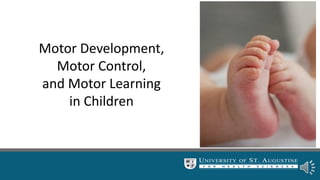
Motor Development,
Motor Control,
and Motor Learning
in Children
Unit Objectives
• Discuss importance of providing family-centered care, as
well as possible barriers.
• Describe variation and variability of typical and atypical
human development.
• Identify various developmental theories.
• Describe the presentation of a normal newborn vs a
preterm infant.
• Describe motor developmental progression in normal
children.
• Describe typical pediatric reflexes.
Motor Development and Control
Motor Control
– Control & organization of processes underlying movement
– Milliseconds
Motor Learning
– Acquisition of skill through practice & experience
– Hours, days, weeks
Motor Development
– Age related process of change in motor development
– Months, years, decades
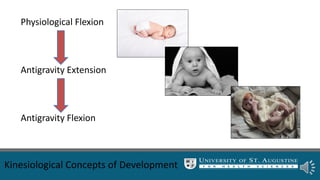
Kinesiological Concepts of Development
Physiological Flexion
Antigravity Extension
Antigravity Flexion
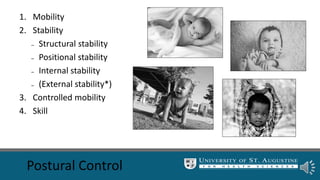
Postural Control
1. Mobility
2. Stability
– Structural stability
– Positional stability
– Internal stability
– (External stability*)
3. Controlled mobility
4. Skill
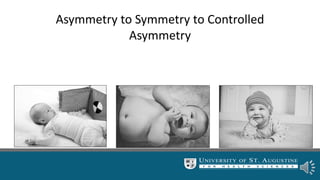
Asymmetry to Symmetry to Controlled
Asymmetry
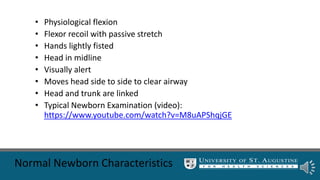
Normal Newborn Characteristics
• Physiological flexion
• Flexor recoil with passive stretch
• Hands lightly fisted
• Head in midline
• Visually alert
• Moves head side to side to clear airway
• Head and trunk are linked
• Typical Newborn Examination (video):
https://www.youtube.com/watch?v=M8uAPShqjGE
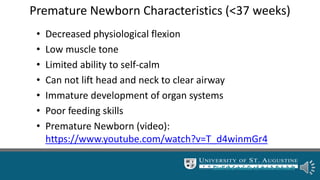
Premature Newborn Characteristics (<37 weeks)
• Decreased physiological flexion
• Low muscle tone
• Limited ability to self-calm
• Can not lift head and neck to clear airway
• Immature development of organ systems
• Poor feeding skills
• Premature Newborn (video):
https://www.youtube.com/watch?v=T_d4winmGr4
Click the mouse to move forward.
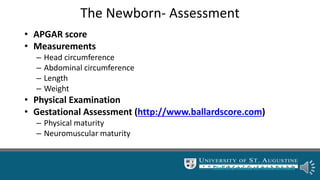
The Newborn- Assessment
• APGAR score
• Measurements
– Head circumference
– Abdominal circumference
– Length
– Weight
• Physical Examination
• Gestational Assessment (http://www.ballardscore.com)
– Physical maturity
– Neuromuscular maturity
Click the mouse to move forward.
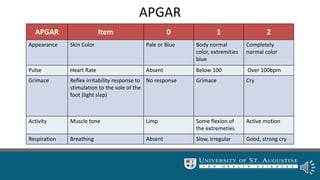
APGAR
APGAR Item 0 1 2
Appearance Skin Color Pale or Blue Body normal
color, extremities
blue
Completely
normal color
Pulse Heart Rate Absent Below 100 Over 100bpm
Grimace Reflex irritability response to
stimulation to the sole of the
foot (light slap)
No response Grimace Cry
Activity Muscle tone Limp Some flexion of
the extremeties
Active motion
Respiration Breathing Absent Slow, irregular Good, strong cry
Neonatal/Primitive Reflexes
• Part of intrauterine development
– Usually appear at end of second trimester
– Integrated during first year of life
• Developmental trajectory
– Deviations indicate abnormal neuromuscular development
• Need to observe:
– Presence/absence of reflex
– Quality of reflex
– Symmetry of reflex
Neonatal/Primitive Reflexes
• Needed for survival and development
• Used to assess newborn alertness
• Many are present in utero but emerge and fade (integrate)
gradually
• Can be tested through specific procedures
• May be elicited passively or actively
• Not normally obligatory
• Influenced by factors such as body position, behavioral
state, time since last feeding, etc…
Videos of Typical Developmental Reflexes
• Rooting Reflex: https://www.youtube.com/watch?v=v7_Y_jg2soc
• Moro Reflex: https://www.youtube.com/watch?v=PTz-iVI2mf4
• Plantar Grasp Reflex: https://www.youtube.com/watch?v=6Ch48Sg9mVE
• Palmar Grasp Reflex: https://www.youtube.com/watch?v=tZa9XxRthdA
• Stepping Reflex: https://www.youtube.com/watch?v=CkGjOwPXsvo
• ATNR: https://www.youtube.com/watch?v=pxrnFKwKJUc
• Landau Reflex: https://www.youtube.com/watch?v=jEDixMrg1nw
• Babinski Reflex: https://www.youtube.com/watch?v=8sbFQQYbYLk
• Protective Extension Forward: https://www.youtube.com/watch?v=6fIIbY0WD_M
• Protective Extension Sideways: https://www.youtube.com/watch?v=B6ylrJsIzVU
Click the mouse to move forward.
Test Your Knowledge: Reflexes
What is reaction that occurs with a stretch to a muscle called?
A
B
C
D
Deep Tendon Reflex
Equilibrium Reaction
Neonatal Reflex / Primitive Reflex
Righting Reactions
Select the correct letter.
Equilibrium Reactions
• Fully developed equilibrium reactions are complex
• Function to maintain postural control
– Static
– Active
– Reactive
• Described according to neck, trunk and extremity movements
• Normally appear at 4-6 months of age in prone & supine
• Mature at 4-6 years of age
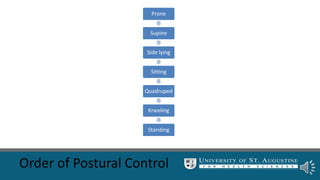
Order of Postural Control
Prone
Supine
Side lying
Sitting
Quadruped
Kneeling
Standing
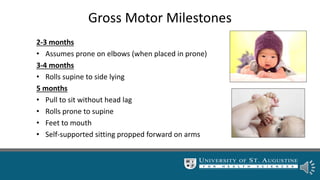
Gross Motor Milestones
2-3 months
• Assumes prone on elbows (when placed in prone)
3-4 months
• Rolls supine to side lying
5 months
• Pull to sit without head lag
• Rolls prone to supine
• Feet to mouth
• Self-supported sitting propped forward on arms
Gross Motor Milestones
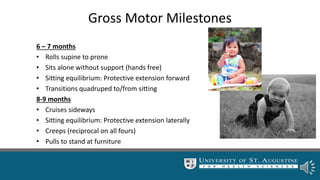
6 – 7 months
• Rolls supine to prone
• Sits alone without support (hands free)
• Sitting equilibrium: Protective extension forward
• Transitions quadruped to/from sitting
8-9 months
• Cruises sideways
• Sitting equilibrium: Protective extension laterally
• Creeps (reciprocal on all fours)
• Pulls to stand at furniture
Gross Motor Milestones
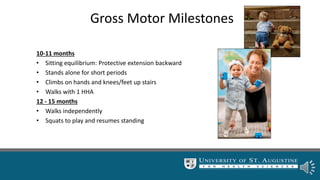
10-11 months
• Sitting equilibrium: Protective extension backward
• Stands alone for short periods
• Climbs on hands and knees/feet up stairs
• Walks with 1 HHA
12 - 15 months
• Walks independently
• Squats to play and resumes standing
Gross Motor Milestones
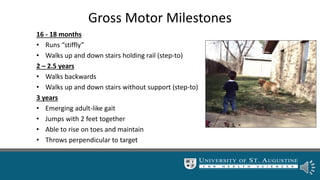
16 - 18 months
• Runs “stiffly”
• Walks up and down stairs holding rail (step-to)
2 – 2.5 years
• Walks backwards
• Walks up and down stairs without support (step-to)
3 years
• Emerging adult-like gait
• Jumps with 2 feet together
• Able to rise on toes and maintain
• Throws perpendicular to target
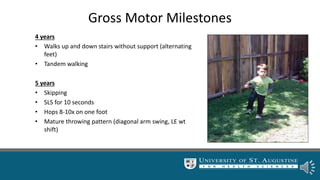
4 years
• Walks up and down stairs without support (alternating
feet)
• Tandem walking
5 years
• Skipping
• SLS for 10 seconds
• Hops 8-10x on one foot
• Mature throwing pattern (diagonal arm swing, LE wt
shift)
Gross Motor Milestones
Resource for Developmental Milestones
https://pathways.org/
Click the mouse to move forward.
Motor Development - Summary
• Motor development for typically developing children has a generally
predictable sequence.
• With deviations in muscle tone, poor quality of movement can be
expected.
• An assessment should help define if the problem relates to a decreased
range of strategies available to the system or an inability to match an
appropriate strategy to the motor function
Typical Motor Development Includes Variability
• Motor development is viewed as an innate maturational process that is largely
affected by experience
• Variability within and between individuals is an essential element in the
developmental process
• Used for exploration and selection
• Provides flexibility in motor performance and motor strategies
• More stereotyped motor behavior
• Delay in achievement of milestones (impaired selection)
• Mild or major deviation in muscle tone
• Persistence of infantile reflexes
• Repertoire of motor strategies is reduced
Less Variability in Atypical Development
Focus of Intervention
• Increase amount and variability of experiences
• There is not one correct postural control strategy
• Design activities that are based on the requirement for the
action you are trying to advance
• Readiness for new skills
• Expand activities for the right challenge
• Variable practice
References
• Palisano R, Orlin M, Schreiber J. Campbell’s Physical
Therapy for Children, 5th Edition. St. Louis, MO:
Saunders/Elsevier; 2017.
• Plack, M. Management of the Pediatric Patient
Handout. The George Washington University Program
in Physical Therapy. 2014
• www.pathways.org

Unit 1 Motor Development

  • 1.
    Motor Development, Motor Control, andMotor Learning in Children
  • 2.
    Unit Objectives • Discussimportance of providing family-centered care, as well as possible barriers. • Describe variation and variability of typical and atypical human development. • Identify various developmental theories. • Describe the presentation of a normal newborn vs a preterm infant. • Describe motor developmental progression in normal children. • Describe typical pediatric reflexes.
  • 3.
    Motor Development andControl Motor Control – Control & organization of processes underlying movement – Milliseconds Motor Learning – Acquisition of skill through practice & experience – Hours, days, weeks Motor Development – Age related process of change in motor development – Months, years, decades
  • 4.
    Kinesiological Concepts ofDevelopment Physiological Flexion Antigravity Extension Antigravity Flexion
  • 5.
    Postural Control 1. Mobility 2.Stability – Structural stability – Positional stability – Internal stability – (External stability*) 3. Controlled mobility 4. Skill
  • 6.
    Asymmetry to Symmetryto Controlled Asymmetry
  • 7.
    Normal Newborn Characteristics •Physiological flexion • Flexor recoil with passive stretch • Hands lightly fisted • Head in midline • Visually alert • Moves head side to side to clear airway • Head and trunk are linked • Typical Newborn Examination (video): https://www.youtube.com/watch?v=M8uAPShqjGE
  • 8.
    Premature Newborn Characteristics(<37 weeks) • Decreased physiological flexion • Low muscle tone • Limited ability to self-calm • Can not lift head and neck to clear airway • Immature development of organ systems • Poor feeding skills • Premature Newborn (video): https://www.youtube.com/watch?v=T_d4winmGr4 Click the mouse to move forward.
  • 9.
    The Newborn- Assessment •APGAR score • Measurements – Head circumference – Abdominal circumference – Length – Weight • Physical Examination • Gestational Assessment (http://www.ballardscore.com) – Physical maturity – Neuromuscular maturity Click the mouse to move forward.
  • 10.
    APGAR APGAR Item 01 2 Appearance Skin Color Pale or Blue Body normal color, extremities blue Completely normal color Pulse Heart Rate Absent Below 100 Over 100bpm Grimace Reflex irritability response to stimulation to the sole of the foot (light slap) No response Grimace Cry Activity Muscle tone Limp Some flexion of the extremeties Active motion Respiration Breathing Absent Slow, irregular Good, strong cry
  • 11.
    Neonatal/Primitive Reflexes • Partof intrauterine development – Usually appear at end of second trimester – Integrated during first year of life • Developmental trajectory – Deviations indicate abnormal neuromuscular development • Need to observe: – Presence/absence of reflex – Quality of reflex – Symmetry of reflex
  • 12.
    Neonatal/Primitive Reflexes • Neededfor survival and development • Used to assess newborn alertness • Many are present in utero but emerge and fade (integrate) gradually • Can be tested through specific procedures • May be elicited passively or actively • Not normally obligatory • Influenced by factors such as body position, behavioral state, time since last feeding, etc…
  • 13.
    Videos of TypicalDevelopmental Reflexes • Rooting Reflex: https://www.youtube.com/watch?v=v7_Y_jg2soc • Moro Reflex: https://www.youtube.com/watch?v=PTz-iVI2mf4 • Plantar Grasp Reflex: https://www.youtube.com/watch?v=6Ch48Sg9mVE • Palmar Grasp Reflex: https://www.youtube.com/watch?v=tZa9XxRthdA • Stepping Reflex: https://www.youtube.com/watch?v=CkGjOwPXsvo • ATNR: https://www.youtube.com/watch?v=pxrnFKwKJUc • Landau Reflex: https://www.youtube.com/watch?v=jEDixMrg1nw • Babinski Reflex: https://www.youtube.com/watch?v=8sbFQQYbYLk • Protective Extension Forward: https://www.youtube.com/watch?v=6fIIbY0WD_M • Protective Extension Sideways: https://www.youtube.com/watch?v=B6ylrJsIzVU Click the mouse to move forward.
  • 14.
    Test Your Knowledge:Reflexes What is reaction that occurs with a stretch to a muscle called? A B C D Deep Tendon Reflex Equilibrium Reaction Neonatal Reflex / Primitive Reflex Righting Reactions Select the correct letter.
  • 15.
    Equilibrium Reactions • Fullydeveloped equilibrium reactions are complex • Function to maintain postural control – Static – Active – Reactive • Described according to neck, trunk and extremity movements • Normally appear at 4-6 months of age in prone & supine • Mature at 4-6 years of age
  • 16.
    Order of PosturalControl Prone Supine Side lying Sitting Quadruped Kneeling Standing
  • 17.
    Gross Motor Milestones 2-3months • Assumes prone on elbows (when placed in prone) 3-4 months • Rolls supine to side lying 5 months • Pull to sit without head lag • Rolls prone to supine • Feet to mouth • Self-supported sitting propped forward on arms
  • 18.
    Gross Motor Milestones 6– 7 months • Rolls supine to prone • Sits alone without support (hands free) • Sitting equilibrium: Protective extension forward • Transitions quadruped to/from sitting 8-9 months • Cruises sideways • Sitting equilibrium: Protective extension laterally • Creeps (reciprocal on all fours) • Pulls to stand at furniture
  • 19.
    Gross Motor Milestones 10-11months • Sitting equilibrium: Protective extension backward • Stands alone for short periods • Climbs on hands and knees/feet up stairs • Walks with 1 HHA 12 - 15 months • Walks independently • Squats to play and resumes standing
  • 20.
    Gross Motor Milestones 16- 18 months • Runs “stiffly” • Walks up and down stairs holding rail (step-to) 2 – 2.5 years • Walks backwards • Walks up and down stairs without support (step-to) 3 years • Emerging adult-like gait • Jumps with 2 feet together • Able to rise on toes and maintain • Throws perpendicular to target
  • 21.
    4 years • Walksup and down stairs without support (alternating feet) • Tandem walking 5 years • Skipping • SLS for 10 seconds • Hops 8-10x on one foot • Mature throwing pattern (diagonal arm swing, LE wt shift) Gross Motor Milestones
  • 22.
    Resource for DevelopmentalMilestones https://pathways.org/ Click the mouse to move forward.
  • 23.
    Motor Development -Summary • Motor development for typically developing children has a generally predictable sequence. • With deviations in muscle tone, poor quality of movement can be expected. • An assessment should help define if the problem relates to a decreased range of strategies available to the system or an inability to match an appropriate strategy to the motor function
  • 24.
    Typical Motor DevelopmentIncludes Variability • Motor development is viewed as an innate maturational process that is largely affected by experience • Variability within and between individuals is an essential element in the developmental process • Used for exploration and selection • Provides flexibility in motor performance and motor strategies
  • 25.
    • More stereotypedmotor behavior • Delay in achievement of milestones (impaired selection) • Mild or major deviation in muscle tone • Persistence of infantile reflexes • Repertoire of motor strategies is reduced Less Variability in Atypical Development
  • 26.
    Focus of Intervention •Increase amount and variability of experiences • There is not one correct postural control strategy • Design activities that are based on the requirement for the action you are trying to advance • Readiness for new skills • Expand activities for the right challenge • Variable practice
  • 27.
    References • Palisano R,Orlin M, Schreiber J. Campbell’s Physical Therapy for Children, 5th Edition. St. Louis, MO: Saunders/Elsevier; 2017. • Plack, M. Management of the Pediatric Patient Handout. The George Washington University Program in Physical Therapy. 2014 • www.pathways.org