Occupational Therapy and Intellectual Disability
What is intelligence?
- It relates to general capacity to engage in cognitive functions such as
learning, reasoning, manipulating information, identifying patterns and
relationships, solving problems, recall, planning.
- It is complex and multifaceted.
- It is assessed using one of several standardized tests for which the average
population score (Intelligence Quotient or IQ) is 100, and one standard
deviation is 15 points.
What influences a person’s answers to any question?
- Obviously this is complex, and can include motivation, ability, alertness,
level of comfort, concentration level, prior exposure/familiarity, and so on.
Most of these vary significantly over time
- Intellectual disability involves more than just below average IQ.
Intellectual disability means a person also experiences difficulties in
various domains of functioning, and has begun to experience these
characteristics before the age of 18.
- Intellectual disability is a complex disability that can affect a person in
many different ways, and specific patterns of ability and disability vary
widely between people with intellectual disability.
- it’s important to be aware that even someone with a borderline intellectual
disability with no immediately apparent deficits in adaptive functioning may
need additional support to engage in health assessment and treatment.
For example:
. It may take more time to build rapport
. Treatment steps may need to be broken down with a clear sequence
. Communication may need to be simpler and clearer.
Implications of intellectual disability
People with intellectual disability:
- Learn and process information more slowly.
- Have difficulty with abstract concepts such as money, time and the
subtleties of interpersonal interactions.
The kind of support and assistance they require depends on:
- Their cognitive ability.
- Expectations on them within particular environments.
- Whether they have other associated developmental disabilities such as
cerebral palsy, autism or sensory impairments
- Each one of us is unique. Our IQ provides a guide as to how quickly we are
able to process new information, grasp abstract concepts and manipulate ideas.
It reflects a part of our ability profile, but does not reflect our personality, our
emotional or musical intelligence, our artistic ability, our interests and many
other facets of who we are and how we engage with our world.
- Each one of us has areas of ability and other areas of function that we find
difficult. Arbitrary categories of mild, moderate, severe and profound levels of
intellectual disability, defined on the basis of IQ ‘scores’, provide a guide to the
level and type of support an individual may need, but the way that person
functions in his/her life will also depend on many other factors.
- Individual factors include personality, social and communication abilities,
coping strategies and the presence of other disabilities (motor, social or
sensory).
- The supports provided by family and friends are also crucial aspects of people’s
lives and have a profound influence on confidence and function. Issues of
access (physical, social, communication, cognitive) to community based
facilities and services also play a powerful role in either enabling or inhibiting
opportunities for inclusion, participation and contribution and the ability of the
individual to fulfil their community roles.
Someone with a severe (IQ 20 – 35) or profound (IQ <20) intellectual disability
- Usually recognizes familiar people and has strong relationships with key
people in their lives.
- Most will have little or no speech and will rely on facial expression and
body language and gestures to express their needs or feelings and those
interacting with and supporting them must be active and keen observers in
interpreting changes in a person’s demeanor or behavior.
- Communication systems for people with this level of disability generally rely
on photographs or objects to facilitate understanding, e.g. a picture of a
cup, or the cup itself, may be used in conjunction with the spoken question,
“Would you like a drink?”.
- People with severe/profound disabilities will require lifelong assistance in
personal care tasks, communication and support in accessing community
facilities/services.
Someone with a moderate intellectual disability (IQ 35 – 50)
- Will have important relationships in his/her life and will usually enjoy a range of
activities with families, friends and paid support workers and form valued and
lasting friendships.
- With specific travel training many people learn to use public transport on familiar
routes, but may have difficulty handling money and problem solving when
unexpected events occur.
- Most people can learn to recognize some words in context (such as
Ladies/Gents/Exit).
- People with adequate vision will benefit from visual prompts to clarify meaning,
such as daily timetables and pictures used in communication systems.
- People with a moderate intellectual disability will need lifelong support in
managing finances, and planning and organizing their lives and activities. Their
ability to be independent in personal care tasks, such as toilet hygiene, dressing
and bathing, will depend on opportunities to learn and practice these tasks, their
level of cognitive ability, and the presence or absence of other developmental
disabilities such as cerebral palsy.
Someone with a mild intellectual disability (IQ 50-70)
- May learn to read and write (depending on educational opportunities). Most
people have important relationships in their lives and participate in a range of
activities and contribute to their families and their communities.
- Some people live and travel independently while others require support and
assistance in using public transport, handling money, and planning and
organizing their lives.
- Most people can work, and some have a job, with or without a level of personal
or employment support. Many people will form intimate relationships and some
will marry and raise children with various levels of support from family, friends
and the service system.
- People with mild intellectual disability will have trouble with academic learning
and so reading, writing and numeracy may remain at a basic level. Some people
have not learnt to read or write; many are self conscious about this and sensitivity
is required when requesting people read information or complete written forms.
- Many people find the subtleties of interpersonal relationships and social rules
difficult to understand (particularly as adolescents) and may inadvertently
transgress social boundaries.
Recognizing that someone has intellectual disability
- Ability to identify signs that a person may have intellectual disability.
- Awareness that intellectual disability affects different people in different ways.
- Ability to seek information to understand each person’s unique support needs
Intellectual disability varies widely in its severity and its causes, and sometimes it is
not obvious that a person has intellectual disability.
In a health care setting, it’s helpful to recognize that someone has intellectual
disability as soon as possible. People with a more severe disability will usually be
accompanied by a support person.
The majority of people with intellectual disability have a mild level of impairment,
and often their disability is not obvious. You could ask the person directly if they have
a disability.
Activities
Do they:
- Read
- Write
- Manage own money on a day-to-day basis
- Look after own personal care
- Cook
- Tell the time
- Have difficulty communicating (expression/comprehension)
Recall
Can they remember:
- What you have said
- Significant things about themselves (such as their date of birth)
- Significant things about own environment (such as their home
address)
- When to do things (what time to get up, what time dinner is)whether
they struggled with school work
Life experience
Do they:
- Attend a day center
- Live(d) in an institution or a disability support service
- Have people who provide support (such as support/care workers,
advocates, family members)
- Manage in social situations
- Receive a disability support pension
- Attend a special school or special class within a mainstream school,
or did they used to attend one
Recognizing that a person has intellectual disability will prompt you
to investigate the specific support needs they may have. Some support
needs aren’t always obvious, especially when the level of disability is
mild-borderline, but identifying them is always important to enable the
best possible care and support.
It is important to consider other factors that may affect a person’s
ability to perform such tasks or give detail – such as a person’s cultural
background, which could influence how they communicate.
Causes of intellectual disability
There are many and diverse causes of intellectual disability, and
sometimes more than one factor contributes to causing the intellectual
disability. Many causes of intellectual disability also cause other
significant disabilities or health problems.
Some causes of intellectual disability such as Down syndrome are
associated with characteristic physical features, but many are not.
One way of classifying the causes of intellectual disability is according
to whether they occurred before, during, or after, birth. You could also
classify according to whether the cause is environmental or genetic.
- Intellectual disability means more than just below average IQ. It also involves
difficulties in different domains of functioning. Intellectual disability is a complex
disability that can affect a person in many different ways.
- It is essential to go beyond the classification of disability to establish a deeper
understanding of an individual, their circumstances and the kinds of specific
support you can offer.
- Providing optimal care involves taking into account the presence intellectual
disability and considering associated specific support needs, even when these are
not immediately obvious.
- Terminology is important, and the most appropriate term to use for someone who
has an intellectual disability is 'a person with intellectual disability'.
- Causes of intellectual disability are highly diverse. It can be the result of various
interacting factors, and sometimes it is impossible to say with certainty what the
cause is.
Barriers to good health care
People with an intellectual disability encounter a number of specific barriers to
good health care. Examples include:
- Limited literacy may mean they miss out on health information in magazines,
books and public health campaigns.
- Cognitive difficulties may lead to difficulties understanding the importance and
long term implications of healthy diet, lifestyle choices, and disease screening.
- Social/financial circumstances may lead to difficulty implementing strategies to
achieve and maintain a healthy diet, exercise regime and health monitoring.
- Communication difficulties between patient and health professionals may lead to
inaccuracies in the reporting or understanding of concerns, symptoms and past
history.
- Sensory sensitivity (auditory, visual, olfactory, tactile) may make attending the
consultation/waiting in waiting room/complying with procedures
Barriers to good health care
- Communication, cognitive, financial and practical concerns such as availability
of transport may lead to difficulty accessing health services and/or following
through on management recommendations.
- Reliance on others to communicate may lead to feelings of dependence and
powerlessness in health care settings
- Carers may not know, or be able to provide, an accurate and reliable history of
the person’s symptoms or previous medical care
- Carers may misinterpret or fail to implement management strategies suggested by
health professionals – including arranging appropriate follow up and review;
- Health professionals and carers may overlook the need for, or assume others will
arrange, regular health checks and reviews.
People with an intellectual disability have the right to:
- Have the best mental health care attainable
- Be treated with respect and dignity
- Have effective communication with others; and
make choices about their mental health.
Good communication is fundamental to quality mental health care
Skills in communication
- The capacity to communicate effectively with people who have an
intellectual disability, have a range of communication difficulties and use a
variety of communication methods
- An appreciation of the diverse range of communication abilities and
strategies used by different people and of the value of communication as a
multifaceted exchange of information
- A reflective approach, which includes monitoring and adapting to different
situations
- An appreciation of the diverse range of communication abilities and
strategies used by different people and of the value of communication as a
multifaceted exchange of information
- A reflective approach, which includes monitoring and adapting to different
situation
General strategies
- When you are communicating with someone with an intellectual disability,
it is important to frequently check that you have understood correctly, that
the person you are speaking to has understood, and whether you need to
adapt your style.
- Imagine a continual cycle of checking and adapting, throughout the
conversation.
Preparation
- Spending some time preparing for a meeting or consultation with a person
with an intellectual disability is a helpful way of improving communication.
- Make use of data collection, communication charts, case histories, speech
pathology reports or any other information you can gather from people who
know the person’s communication methods well.
Communication partners
- Communication can occur between two people, or amongst a group of
people. The role of each person (each ‘communication partner’) can vary.
It varies depending on the communicative abilities and techniques of each
person, as well as what is being said and what is being understood.
- For example, if someone is communicating to you using their own signing
system, you might have to work harder to understand the meaning, or use
an interpreter. Other times, someone may be use a method of
communication where the meaning is much more obvious. The
communication may be very direct and clearly convey the meaning
Communicate directly with the person with the intellectual disability
- Speak directly to the person who has the intellectual disability – they are the
focus of your interaction. Even if the person has very little expressive
communication to indicate that they understand you, and you need to
engage their support person, addressing the person with the intellectual
disability throughout the consultation is an important way of showing
respect and building the relationship.
- Tell the person what it going to happen during the consultation and ask
their permission to go ahead.
- Allow more time for someone who has an intellectual disability to
understand information and to express themselves, or to make use of a
communication system.
- Aim to establish trust and rapport. You may need longer consultations or
more than one consultation, to get to know the person.
- Take responsibility for making the interaction a positive one
Tailor your communication
- Make use of non-verbal communication techniques of all kinds, especially
if the person is already using a system of their own.
- Use pictures, models and real objects to demonstrate what you are saying.
- Use simple, short sentences and simple vocabulary. Break down complex
concepts into simple ‘chunks’.
- If you need to, clarify with a carer or support worker. But make sure you
stay focused on the person with the intellectual disability.
- Ask them if it is ok to check with someone else, and check whether the
correct information has been relayed by the supporter
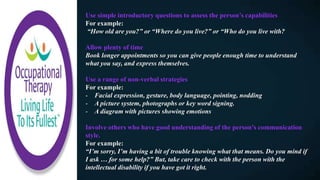
Use simple introductory questions to assess the person’s capabilities​
For example:
“How old are you?” or “Where do you live?” or “Who do you live with?
Allow plenty of time
Book longer appointments so you can give people enough time to understand
what you say, and express themselves.
Use a range of non-verbal strategies​
For example:
- Facial expression, gesture, body language, pointing, nodding
- A picture system, photographs or key word signing.
- A diagram with pictures showing emotions
Involve others who have good understanding of the person’s communication
style.​
For example:
“I’m sorry, I’m having a bit of trouble knowing what that means. Do you mind if
I ask … for some help?” But, take care to check with the person with the
intellectual disability if you have got it right.
Poor communication is a barrier
Better communication could increase your ability to understand
and improve the mental health of your patients who have an
intellectual disability.
The significance of good communication
An understanding that good communication is important when
supporting someone who has an intellectual disability
An understanding that difficulties in communication arise due to
the interaction of disability, psychological function and social
context
Mental health clinician has elicited a comprehensive description
of the presenting problem
- More accurate diagnosis
Person with an intellectual disability understands and agrees to a
course of treatment
- Compliance with treatment is more likely
Person with an intellectual disability is not spoken to during a
consultation
- Frustration and disengagement from treatment
Why do communication difficulties arise?
People with an intellectual disability commonly experience
problems with communication .
Social communication relates to when, how and for what purpose
communication is used.​
It includes knowing how to communicate with different audiences,
connecting and developing rapport with others. It also includes
interpreting cultural norms, for example whether to make eye
contact, and negotiating personal space.
The basic principles of Key Word Signing are:
- Always use speech together with the sign
- Speak in normal, grammatical sentences
- Sign only the key words in the sentence
- Use facial expression and body language to help support your
message
Why do communication difficulties arise?
To have good communication with someone, you need to
understand them individually, so you can adapt and respond. This
happens all the time in conversation. Think about times when
someone has asked you to speak more slowly, explain what you
mean with a diagram, or clarify what a word means.
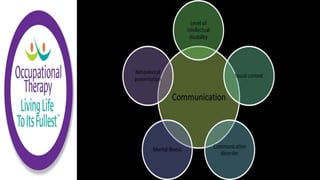
Different aspects of disability, mental health and social situation
influence each person’s communication abilities.
Level of intellectual disability
People who have a mild level of intellectual disability are more likely to use
speech. However, someone who speaks eloquently may still have trouble
understanding things – the level of their expressive and receptive language
abilities may differ .
People with moderate to severe levels of intellectual disability are likely to better
at understanding speech than at speaking. They may also use speech, but to a
lesser degree, for example by using an incomplete sentence, or certain familiar
words .
People who have a severe to profound intellectual disability have more limited
communication skills. They rely more heavily on people around them to assist
with communication, for example by using visual information, or by interpreting
their communication methods or behaviors.
In general, people who have poor receptive communication tend to rely on
routines and environmental cues to know what to expect, or understand what is
being said
Communication disorders
There is a higher rate of sensory, physical and neurological disabilities amongst
people with an intellectual disability . These can all have an impact on
communication.
For example, communication difficulties are commonly associated with autism
spectrum disorders. Some features of this could be:
- Not speaking
- Difficulty with social aspects of communication
- Use of idiosyncratic (personally developed) language.
In other cases, the physical aspects of a developmental disability may have an
impact on expressive communication. For example, people with cerebral palsy
may not have enough neuromuscular control to speak or articulate words [2].
Having an intellectual disability is associated with higher risk of hearing
impairment and vision impairment , adding an additional barrier to
communication. It’s important to remember that, having difficulties with
communication does not mean that someone does not have the capacity to
understand and make decisions
Mental illness
Anxiety, depression, other mood disorders, schizophrenia and other
psychoses can all have an impact on communication.
For example, consider the association of disorganized speech with
schizophrenia, of slow speech with depression.
Anxiety disorders may cause agitation, concentration problems or
repetitive questioning, all of which have an impact on
communication.
Behavioral presentation
Someone’s behavior can communicate an issue or need, and be a valuable source
of information about their condition. The important thing is to think about what
the behavior is telling you – how can you analyze the behavior and its possible
causes or meanings?.
For example, behavior which is aggressive or self-injurious may be a substitute
for communication about psychological symptoms, emotions, or other
troublesome situations, like a health problem or pain.
It can also be a reaction to a situation which is currently occurring. For example,
someone who feels anxious in unfamiliar situations may express this anxiety
through agitated behavior.
Behavioral presentation
Someone’s level of intellectual disability has a significant impact on their
expression of underlying emotional states or psychiatric symptoms. As the level of
intellectual disability becomes more severe, atypical presentations of symptoms
become increasingly common and the clinician is more likely to encounter
"behavioral equivalents" of psychiatric symptoms.
Behavioral equivalents are the expression of signs and symptoms of mental
illness through behavior, rather than through verbal description
.
There will be more information about the relationship between disability, mental
disorders and behavior in a later module.
People who use Alternative or Augmentative Communication
(AAC) systems to help them communicate are less likely to initiate
conversation topics compared to people who use speech. This
means you may need to take a more active role in the
communication to find out all the matters of concern. In general,
learning to communicate with someone using their AAC system
might take some training.
Try to find out whether the person uses AAC to talk about only a
specific range of topics, or whether their system is unlimited.
Especially for uncommon or new topics, you may need to
coordinate with others to prepare new visual materials (such as
someone's speech pathologist, if there is one)
Making eye contact​
- Maybe. It’s important to initially make eye contact with the person with the
intellectual disability – to show that you are interested in them. But be aware
that people have different sensitivities and cultural practices about eye
contact.
- For example, people with autism may be less likely to maintain eye contact or
might find it difficult.
- Also, there are different cultural norms when it comes to eye contact. For
example, some Aboriginal or Torres Strait Islander people may find direct eye
contact disrespectful in certain contexts. Don’t be offended if someone doesn’t
make eye contact with you, it is an opportunity to learn more about them.
- You can learn about the different verbal and non-verbal communication
patterns that each person uses. You could also look for opportunities to
undertake specific training in inter-cultural communication
Using someone's first name​
- Maybe. To start with you could use an age-appropriate form of address such
as Ms, Mrs or Mr and the person’s last name.
- You can then ask someone’s permission to call them by their first name.
Remember to be respectful and that there’s a risk of sounding patronizing if
you’re over-friendly.
Asking yes/no questions​
- No. In general, it’s better to ask open ended questions, and try re-phrasing the
questions to check for understanding or consistency of response. However, it
is also helpful to find out if the person has a specific way they communicate
yes or no.
Listening closely​
- Yes! Pay careful attention to what the person is saying to you and listen for
opportunities to build rapport and gather more information.
Remember skills like re-phrasing, summarizing, and minimal encouragers,
which are all part of active listening.
Standing close to the person​
- Maybe. If the person you are speaking to is seated, then it’s
probably best to sit down at their level.
- Sitting or standing, you should maintain a level of closeness that
reinforces rapport, but does not intrude into someone’s personal
space. This includes handling the wheelchair of a wheelchair
user, as it is part of their personal space.
- Respecting personal space could be particularly important for
someone who has autism, if they are sensitive to touch
sensations.
Decision-making
- Collaborating with others is an important part of good communication and is
significant when it comes to decision-making. This is especially the case when
someone else makes decisions on behalf of a person who has an intellectual
disability.
- In Australia, there are different state and territory laws which cover
guardianship and substitute decision-making.
- The overriding framework when considering issues of capacity to make
decisions is the United Nations Convention on the Rights of Persons with
Disabilities, to which Australia is signatory.
- The relevant section is Article 12 – Equal recognition before the law. It states
that “all measures related to the exercise of legal capacity are proportional
and tailored to the person’s circumstances, and apply for the shortest time
possible”
As a health care professional, it is your responsibility to understand
the relevant state or territory laws that relate to decision-making for
people with a disability, and what process applies to decide if
someone has capacity to consent for treatment or whether a
substitute decision-maker is needed.
Interviewing and assessments
- Many standard diagnostic criteria for mental disorders are
problematic when applied to people with an intellectual
disability, particularly as the disability becomes more severe .
-
- Diagnostic testing generally requires language skills, for
answering questions and describing feelings.
- There are adapted assessments, with modified diagnostic criteria,
which you can use if they are available.
- You can modify your interviewing techniques by using simple
language.
1. Ensure you have the person’s attention Address the person by name, use
eye contact and/or touch.
2. Be aware of known communication difficulties
i. Receptive (e.g. deafness, cognitive impairment, autism spectrum disorder)
and/or
ii. Expressive (e.g. cerebral palsy, autism spectrum disorder)
3. When unsure of ability to understand assume competence and adjust
accordingly. It is more appropriate and respectful to assume competence
than assuming a lack of understanding.
4. If uncertain ask about communication preferences/style/techniques
i. How does s/he say yes/no?
ii. Does s/he use a communication device or aid?
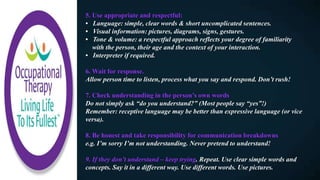
5. Use appropriate and respectful:
• Language: simple, clear words & short uncomplicated sentences.
• Visual information: pictures, diagrams, signs, gestures.
• Tone & volume: a respectful approach reflects your degree of familiarity
with the person, their age and the context of your interaction.
• Interpreter if required.
6. Wait for response.
Allow person time to listen, process what you say and respond. Don’t rush!
7. Check understanding in the person’s own words
Do not simply ask “do you understand?” (Most people say “yes”!)
Remember: receptive language may be better than expressive language (or vice
versa).
8. Be honest and take responsibility for communication breakdowns
e.g. I’m sorry I’m not understanding. Never pretend to understand!
9. If they don’t understand – keep trying. Repeat. Use clear simple words and
concepts. Say it in a different way. Use different words. Use pictures.
10. If you don’t understand – keep trying. Try alternative strategies.
i. Would you say that again please?
ii. Is there another way you can think of saying it? Could you use another
word? Could you show me?
iii. Is there someone who could help us? Involve family member/carer/support
worker if appropriate – remember to ask first!
The impact of intellectual disability
Impact on health and mental health
At a population level, people with intellectual disability experience
serious health challenges. Although life expectancy is increasing, it
is significantly lower than for the general population. Life
expectancy is related to the severity of intellectual disability – and
could be 10 to 20 years lower for those with severe intellectual
disability
People with intellectual disability also have higher rates of a range
of medical conditions and mental disorders and these are
frequently undetected and untreated
The impact of intellectual disability
Impact on health and mental health
Epilepsy, sensory impairments, and mobility limitations are the
most common health challenges associated with intellectual
disability . Many syndromes that cause intellectual disability also
cause specific health problems, eg Down syndrome is associated
with increased risk of cataracts, thyroid disorders, seizures, coeliac
disease, and cardiovascular disease
In general, having an intellectual disability is associated with
increased risk of:
- Mental illness (at least three-four times more common, and poor
rate of treatment)
- Maltreatment, bullying, and sexual assault
- Lower rates of physical activity
- Hospitalization (twice as common)
- Dental disease (up to 8.5 times more common, and poor rate of
treatment)
- Vision impairment and eye disorders (up to 20 times more
common, and poor rate of treatment)
- Hearing impairment
- Thyroid problems
- Epilepsy (15 times more common)
- Heart disease
- Osteoporosis
In general, having an intellectual disability is associated with
increased risk of:
- Gastroesophageal reflux disease (GORD) incontinence
- Multiple disabilities (14 times more common)
- Sexually transmitted diseases (eight times more common)
- Multiple chronic complex disorders
- Overweight and obesity
- Polypharmacy
- Serious Injury
- Constipation
Reasons for increased vulnerability to medical problems
There are many factors that might contribute to the increased risk of
medical problems experienced by people with intellectual disability.
These include:
- Genetic/neurological/medical factors associated with the disability
- Making poor lifestyle and health care choices due to limitations in
-Appreciating longer term impact of choices
-Balancing short- and long-term interests
-Developing alternative strategies to manage motivations and
impulses.
People with intellectual disability are generally more likely to have
multiple health conditions which are poorly managed due to:
- Reduced ability to monitor own health and attribute changes,
discomfort and pain to symptoms requiring medical attention
- Greater reliance on assistance from others to seek optimal
medical care
- Problems escalating due to late or absent detection and treatment
- Having fewer financial resources
- Having fewer social supports
- The difficulty of communicating symptoms.
Risk factors for mental illness associated with intellectual
disability include:
- Low self esteem
- Lower autonomy and less freedom to make own decisions
- Poorer communication skills
- Fewer coping and emotional regulation skills
- Higher levels of frustration
- Greater difficulty complying with treatments
- Increased risk taking behavior
- Higher levels of illness and other disabilities
- Having fewer interpersonal and social relationships poverty.
All these factors increase the risk of developing a mental disorder,
and the risk of a poorer outcome..
There are many reasons why people with intellectual disability
often don’t get the treatment they need.
People with intellectual disability are more likely to have more
difficulty in identifying and isolating the subjective changes that
occur in a mental disorder, and recognizing that these are symptoms
for which treatment and support is available.
When a person with an intellectual disability and a mental disorder
does come to the attention of a health professional, it is more often
because of behavior that is concerning to others, or because a carer
or family member has noticed a change that is causing concern –
such as tearfulness, loss of appetite, refusal to engage with usual
activities, oversleeping, withdrawal, disruptive or destructive
behavior, or hyperactivity.
Impact on behavior
Having an intellectual disability makes it more likely that a person
will experience behavioral problems – behavior that causes the
person direct discomfort or harm, or which is problematic or
harmful to others. The behavior may simply be unusual, socially
unacceptable or undesirable, or it may be self-injurious or
aggressive.
Behavior problems can have serious consequences for the person's
quality of life, both immediately (such as pain or serious injury) and
in the longer term (such as ostracism, exclusion from services, and
reduced freedom and social opportunities).
Sometimes the term "challenging behavior" is used to refer to
behavioral problems. This definition of "challenging behavior" is
widely used:
"Behavior of such intensity, frequency or duration that the physical
safety of the person or others is placed in serious jeopardy, or
behavior which is likely to seriously limit or deny access to the use of
ordinary community facilities.“
Challenging Behavior is a term often used to denote behavior that is
viewed as problematic.
Consider the definition of behavior:
"The physical activity of an organism, including overt bodily
movements and internal glandular and other physiological
processes, constituting the sum total of the organism's physical
responses to its environment. The term also denotes the specific
physical responses of an organism to particular stimuli or classes of
stimuli (emphasis in original).“
There is always a reason for the behavior it is always in response to
a stimulus of some kind. Behavior is, by definition, a process, and
dependant on interacting factors. It is important to remember this
when deciding how to respond to behavior that is challenging in
some way.
Consider the definition of behavior:
Often the first impulse is simply to try to stop the challenging
behavior from occurring, resulting in actions that make it harder for
the person to engage in a behavior. But this approach does nothing
to address the situation that the behavior is a part of. It is important
to address the entire situation..
One of the reasons it is important to examine the entire situation
closely is that the behavior may be a response to pain or other
symptom of a health or mental health problem appropriate response
to such behavior is obviously treatment for the health or mental
health problem, rather than imposing restrictions that make it
harder for the behavior to occur and leave the underlying cause
untreated.
Behavior as communication
Sometimes the ability to communicate is severely limited. But a
person's ability to communicate says nothing about the extent to
which they experience the feelings that often cause us to
communicate, such as feeling happy, excited, wanting something,
sad, frustrated, bored or in pain. People at any level of intellectual
ability or disability experience these feelings. But often when
someone doesn't have access to verbal communication, these feelings
are expressed through behavior instead.
Of course this doesn't apply just to people with a disability or limited
communication ability. Using behavior to express feelings and
desires is a universal human experience. For example, we might hug
someone, slam a door, avoid eye contact or be irritable. Even if these
behaviors are not used to deliberately communicate, they
nevertheless reveal something of our internal state, and thus have a
communicative function.
Instrumental behavior
As well as providing a communicative outlet, behavior can be shaped
by the way it impacts on the environment, through reinforcement.
If a behavior results in something rewarding, it has been positively
reinforced, and if it stops something unpleasant from occurring it
has been negatively reinforced. This kind of behavior is called
instrumental behavior, and various approaches can be used to help
someone to change instrumental behavior, as long as the positive or
negative rein-forcer is known
Psychosocial impact
Family
Sometimes families may know that their child is at high risk of
having intellectual disability before birth, and will have access to
relatively comprehensive information about the child’s disability and
its likely impact on health and development.
In other cases a diagnosis of intellectual disability may come much
later, and families may have to cope with ambiguity and limited
information resources.
But whenever the diagnosis is made, finding out that a child has an
intellectual disability usually comes as a shock and takes significant
emotional adjustment.
Psychosocial impact
Family
Having a child with intellectual disability means significant
emotional and practical adjustments need to be made – from the time
of diagnosis and throughout the lifespan.
Families are the backbone of care for people with an intellectual
disability in Australia, and experience a range of challenges and
rewards as a result
Psychosocial impact
Emotional adjustment
No matter when the diagnosis is made, finding out that a child has
an intellectual disability usually comes as a shock.
Think about the assumptions, expectations and hopes that families
hold for a new child and their life together. Each family undergoes
its own process of grieving as members adjust their expectations for
their child and family life.
As they adjust, many families also discover the experience holds
unexpected gifts. It is often an empowering and strengthening
process as families develop a profound love for their child despite
initial anxiety, fear or prejudices they may have consciously or
unconsciously held. As they resolve some of these concerns families
usually experience a rich appreciation and love for their child.
Psychosocial impact
Practical adjustment
Families undergo significant financial adjustment to care for a child
with an intellectual disability, and the considerable cost that can be
involved in accessing optimal medical care and services can be an
ongoing challenge.
Families also need to learn a lot of new information about:
- Their child’s condition and needs, and the implications for their
child’s health and future independence
- Appropriate services and their various eligibility requirements
- New and alternative ways to meet their child’s needs, such as
communication, mobility, or self care
Psychosocial impact
Practical adjustment
For many parents the carer role is life-long, and many adults with
intellectual disability stay living in the family home. Even when an
adult child with intellectual disability does move out of home,
parents often remain heavily involved in their care and advocacy.
The pressure on parents who are carers for adults with intellectual
disability can increase over time. For example, because of:
- The ageing parent’s own health problems
- An increase in health problems for the person with intellectual
disability, including the onset of dementia
- Possible competing care needs between parents and the person
with intellectual disability.
Psychosocial impact
Social
Western social values include being close to or above average on
various dimensions such as athletic abilities, beauty, intelligence,
musical abilities, and so on. Falling below average is often seen as
reason for shame and corrective efforts. Doing well compared to
others is celebrated.
Implicit in this attitude is the idea that an individual or group’s
worth is determined by their relative achievement on a collection of
attributes, skills and abilities – rather than existing independently of
these. As a result, people with an intellectual disability often face
prejudice, stigma and stereotyping, and experience fewer
opportunities for active participation in society.
Psychosocial impact
Social
For example having an intellectual disability may reduce the
likelihood of:
- Social contact and establishing a wide variety of relationships
- Having leisure and other interests
- Moving around independently
- Experiencing social milestones such as gaining employment or
getting a driver's license
Psychosocial impact
Social
Another important thing to understand about the experience of
intellectual disability is that it is as varied as the range of abilities
and limitations that can be associated with intellectual disability. For
example, some people with intellectual disability live alone and are
relatively independent, some may share a house with others with an
intellectual disability, and be supported by staff; while others may
live with their families or in institutions. Each of these living
situations has different social implications for the person.
Like for everyone else, cultural and language background are also
an important aspect of the social experiences of people who have
intellectual disability.
Psychosocial impact
Psychological
People with intellectual disability, especially in the mild-moderate
range, can experience all the same difficulties, insecurities,
uncertainties, excitement and pleasures in life as their non-disabled
peers. However, having intellectual disability can mean having to
deal with additional sources of frustration and low self esteem,
such as:
- Fewer opportunities or less success in establishing the kind of
relationship sought
- Comparing self unfavorably to peers
- Encountering prejudice and rejection when attempting to express
self or engage with others
- Confusion or naïvety about appropriate behavior
Psychosocial impact
Psychological
People with intellectual disability may experience less choice and
power in decision making and independence, being limited from
fully participating in common life decisions that others take for
granted, such as:
- Where to live
- Who to live with
- What to eat
- How to spend your money
- How free times is spent
- When to engage in leisure activities.
This can have a profound impact on a person’s satisfaction with life,
self esteem, and sense of wellbeing.
The diversity of disability means that some people with intellectual
disability are able to participate much more fully in society than
others
Skills
- Ability to analyze the policies of your health service from a human
rights perspective and consider the barriers to delivering optimal
mental health services to people with an intellectual disability
- Ability to reflect on your personal understanding of intellectual
disability
- Ability to evaluate your practice from a human rights perspective
Medical Model
Focus = affliction, and provision of cure/ treatment, care and
protection.
Disability viewed as deficiency or deviation from the norm: care aims
to change the person, assimilating to the social norm.
Impairment itself causes the limitation
Social Model
Focus = acceptance of impairment as a positive dimension of human
diversity.
The problem lies in the social norms that results in exclusion.
Experience of disability is located within the social environment, and
is not part of the impairment itself.
Universalism
Focus = respect for difference, widening the range of ‘normal’.
Ability-disability as a continuum, reflecting human diversity.
Boundary of ‘disabled’ vs ‘non-disabled’ is drawn for social and
political purposes, not based on scientific fact.
Impairment = an infinitely various but universal feature of the
human condition.
The medical model reflects the dominant way that intellectual
disability was understood in the past. It continues to inform much of
clinical practice and service delivery in the field to this day, both in
health and other areas of disability support. However in some areas
there have also been important shifts towards the social model and
universalism.
Moving from institutional care to community living is a good
example of the influence of the social model, and reflects an attempt
to enhance social inclusion and other opportunities for people with
an intellectual disability to enjoy fuller and richer lives.
All around the world, people with disabilities (including intellectual
disability) are socially marginalized and continue to face numerous
social, cultural and physical barriers to full enjoyment of health and
the freedoms and quality of life enjoyed by people without
disabilities.
In 2006, the UN drafted the Convention on the Rights of Persons
with Disabilities (known as the CRPD) as an element of its work to
reduce the differences in status of people with and without disability,
including intellectual disability. Both the social model and
universalism have influenced the CRPD – such as the preamble,
point 5, which recommends “(r)ecognizing that disability is an
evolving concept and that disability results from the interaction
between persons with impairments and attitudinal and
environmental barriers that hinders their full and effective
participation in society on an equal basis with others
Describing the evolution of the CRPD, the UN states that it "follows
decades of work by the United Nations to change attitudes and
approaches to persons with disabilities. It takes to a new height the
movement from viewing persons with disabilities as "objects" of
charity, medical treatment and social protection towards viewing
persons with disabilities as people with rights, who are capable of
claiming those rights and making decisions for their lives based on
their free and informed consent as well as being active members of
society.
Barriers to effective mental health care
Various factors interact to undermine the delivery of mental health
services to Australians with intellectual disability. The impact of
having an intellectual disability is complex and different for each
individual.
Having an intellectual disability means being more vulnerable to
mental health problems. Often it also means having additional needs
for support with communication, behavior, learning and
independence. Because of these factors, mental health problems
often present in a different or more complex way when someone has
an intellectual disability.
Having an intellectual disability also often means that the treatment
of mental health or behavioral problems is more complex.
Barriers to effective mental health care
To respond to this increased complexity, mental health services need
to have adequate resources, and staff need to have the appropriate
skills and knowledge. But in Australia this is usually not the case.
Health professionals feel less confident treating people with
intellectual disability
Often, the professionals whose role it is to respond to the mental
health needs of people with intellectual disability say they don’t feel
confident with this group. They say they haven’t had enough
training, and need more information about how to care for people
with intellectual disability. Surveys of GPs and psychiatrists have
shown that they believe people with intellectual disability receive only
a poor standard of care, and that mental health supports are
inadequate
Disability-specific focus in care is lacking
England, a country with significant social, cultural and political
similarities to Australia, has well resourced specialized intellectual
disability mental health teams and specialized intellectual disability
mental health beds.
Australia has only few and poorly resourced specialized intellectual
disability mental health teams, and there are no specialized mental
health beds.
Separation between mental health and disability services
As we moved from medical model to the social model and towards
universalism, and people with an intellectual disability moved out of
institutions to live in the community, the responsibility for meeting
the needs of people with intellectual disability was delegated to two
separate agencies – health and disability.
With this separation there was a significant loss of expertise in
intellectual disability mental health, and the distribution of
responsibilities between departments became ambiguous. As a result,
questions about allocating resources to the care of people with
intellectual disability and mental health problems – such as
assignment of case managers and access to mental health and
inpatient support – often remain unresolved.
These difficulties are exacerbated by the separated triage, assessment
and record-keeping capacity of health and disability services in many
states.
What is the National Disability Strategy?
The National Disability Strategy (the Strategy) is an agreement to guide policy
across Australian, state and territory and local governments from 2010-2020.
Extensive community consultations were undertaken in 2008-09, resulting in
Shut Out: The Experience of People with Disabilities and their Families in
Australia (2009) (Shut Out). The Strategy was informed by the findings of Shut
Out and developed in partnership with Commonwealth, state and territory, and
local government representatives.
The Strategy also plays an important role in protecting, promoting and fulfilling
the principles that underpin the United Nations Convention on the Rights of
Persons with Disabilities (the Convention), ratified by Australia in 2008. The
Strategy ensures that the Convention’s principles are incorporated into all
policies and programs affecting people with disability, their families and carers.
The Strategy is the first time in Australia’s history that all governments have
committed to a unified, national approach to improving the lives of people with
disability, their families and carers.
2. Rights protection, justice and legislation
Ensuring that people with disability have their rights promoted,
upheld and protected.
This includes things like:
- Increasing awareness of the rights of people with disability
- Developing strategies to reduce violence, abuse and neglect of
people with disability
- Providing greater support for people with disability in the legal
system.
3. Economic security
Ensuring that people with disability, their families and carers have
economic security so they can plan for the future and have choice
and control over their lives.
This includes things like:
- Reducing barriers to the employment of people with disability
- Encouraging new approaches to the employment of people with
disability
- Making sure housing is affordable
- Future financial planning
4. Personal and community support
Ensuring that people with disability, their families and carers have
access to a range of supports to assist them to live independently in
their communities.
This includes things like:
- Making sure services give information, choice and control to
people with disability
- Developing flexible supports for people with high needs
- Improving access for people with disability in community
support services
- Making sure community support networks are available to
provide information and support to families and carers
5. Learning and skills
Ensuring that people with disability can participate in a high
quality education system and have opportunity to continue learning
throughout their lives.
This includes things like:
- Reducing barriers, and simplifying access, to the education
system for people with disability
- Ensuring the needs of students with disability are incorporated
into government policies
- Developing learning strategies and supports for students with
disability to enable them to reach their full potential
- Making sure people with disability have support through all
stages of learning from education to employment.
6. Health and wellbeing
Ensuring that people with disability have the highest possible
health and wellbeing throughout their lives.
This includes things like:
- Improving the links between disability services and health
services in local communities
- Addressing issues specific to people with disability in national
policies, such as dental, nutrition, mental health, and sexual and
reproductive health programs
- Ensuring the rights of the individual are respected in informal
and supported decision making
The Disability Discrimination Act 1992 (DDA) is part of
Australia’s commitment to eliminating all discrimination against
people with disability. The DDA prohibits discrimination on the
grounds of a person’s disability in many areas of public life
including employment, education, access to premises and access to
goods, services and facilities.
The Australian Human Rights Commission (AHRC) has the
power to investigate and attempt to resolve complaints of
discrimination. Complaints may be lodged by anyone who considers
that they have been unlawfully discriminated against. If the
resolution process is unsuccessful, they may commence legal
proceedings regarding the complaint in the Federal Magistrates
Court or the Federal Court.
The United Nations Convention on the Rights of Persons with Disabilities (the
Convention) aims to enhance opportunities for people with disability to
participate in all aspects of social and political life including access to
employment, education, health care, information, justice, public transport and
the built environment.
There are eight guiding principles that underline the Convention. They are:
- Respect for inherent dignity, individual autonomy including the freedom to
make one's own choices, and independence of persons
- Non-discrimination
- Full and effective participation and inclusion in society
- Respect for difference and acceptance of persons with disabilities as part of
human diversity and humanity
- Equality of opportunity
- Accessibility
- Equality between men and women
- Respect for the evolving capacities of children with disabilities and respect for
the right of children with disabilities to preserve their identities
The United Nations Convention on the Rights of Persons with Disabilities (the
Convention) aims to enhance opportunities for people with disability to
participate in all aspects of social and political life including access to
employment, education, health care, information, justice, public transport and
the built environment.
There are eight guiding principles that underline the Convention. They are:
- Respect for inherent dignity, individual autonomy including the freedom to
make one's own choices, and independence of persons
- Non-discrimination
- Full and effective participation and inclusion in society
- Respect for difference and acceptance of persons with disabilities as part of
human diversity and humanity
- Equality of opportunity
- Accessibility
- Equality between men and women
- Respect for the evolving capacities of children with disabilities and respect for
the right of children with disabilities to preserve their identities
“States Parties recognize that persons with disabilities have the right to the
enjoyment of the highest attainable standard of health without discrimination on
the basis of disability. States Parties shall take all appropriate measures to ensure
access for persons with disabilities to health services that are gender-sensitive,
including health-related rehabilitation. In particular, States Parties shall:
a) Provide persons with disabilities with the same range, quality and standard of
free or affordable health care and programmes as provided to other persons,
including in the area of sexual and reproductive health and population-based
public health programmes;
b) Provide those health services needed by persons with disabilities specifically
because of their disabilities, including early identification and intervention as
appropriate, and services designed to minimize and prevent further disabilities,
including among children and older persons;
c) Provide these health services as close as possible to people's own communities,
including in rural areas;
d) Require health professionals to provide care of the same quality to persons
with disabilities as to others, including on the basis of free and informed consent
by, inter alia, raising awareness of the human rights, dignity, autonomy and
needs of persons with disabilities through training and the promulgation of
ethical standards for public and private health care;
e) Prohibit discrimination against persons with disabilities in the provision of
health insurance, and life insurance where such insurance is permitted by
national law, which shall be provided in a fair and reasonable manner;
f) Prevent discriminatory denial of health care or health services or food and
fluids on the basis of disability.”
In order for people with an intellectual disability to be able to exercise their
“right to the enjoyment of the highest attainable standard of health without
discrimination on the basis of disability” (Article 25), there are certain abilities
and support needs you must take into account. Failure to respond to these can
mean that the person is unable to exercise their right to the highest attainable
standard of health, but also that other fundamental rights may be violated, in
particular
- The right to equality and freedom from discrimination
- The right to respect for physical and mental integrity
- The right to privacy.
The extent to which your practice responds to the individual’s unique abilities
and support needs can determine the extent to which they may exercise these
rights.
Article 26 – Habilitation and rehabilitation
1. States Parties shall take effective and appropriate measures, including through
peer support, to enable persons with disabilities to attain and maintain maximum
independence, full physical, mental, social and vocational ability, and full inclusion
and participation in all aspects of life. To that end, States Parties shall organize,
strengthen and extend comprehensive habilitation and rehabilitation services and
programmes, particularly in the areas of health, employment, education and social
services, in such a way that these services and programmes:
a) Begin at the earliest possible stage, and are based on the multidisciplinary
assessment of individual needs and strengths;
b) Support participation and inclusion in the community and all aspects of society,
are voluntary, and are available to persons with disabilities as close as possible to
their own communities, including in rural areas.
2. States Parties shall promote the development of initial and continuing training
for professionals and staff working in habilitation and rehabilitation services.
3. States Parties shall promote the availability, knowledge and use of assistive
devices and technologies, designed for persons with disabilities, as they relate to
habilitation and rehabilitation.
Equality and freedom from discrimination
Adjustments that support the person's communication
Eg Finding out the person's communication support needs in advance so they have
the same opportunity to communicate as others
Respect for physical and mental integrity
Adjustments that support the person's cognition
Eg presenting information related to different options in a way that supports the
person to make their own decision.
Privacy
Adjustments that allow for carer involvement and daily living support
Eg Sharing only essential information with carers who are involved, preserving as
much of the person's privacy as possible.
Protecting the individual's rights in the mental health setting may involve
providing support and making adjustments in the following ways:
Communication
Intellectual disability is associated with communication ability –
- Expressive, in sharing problems, concerns, needs, preferences and decisions;
- Receptive, in perceiving and comprehending the relevant information.
- There is an enormous range, and communication ability needs to be carefully
assessed for the individual.
- The person’s ability level, their preferences, and their personal augmentative
and alternative communication methods all inform their communication support
needs.
- Communication is an important part of engaging with mental health services,
and the extent to which your practice responds to the individual’s
communication ability and support needs can determine the extent to which they
are free to exercise their rights.
Communication adjustments that may be necessary
Service quality
A large component of mental health care is delivered via communication. To ensure
the person isn’t discriminated against and enjoys the same level of service as others,
their communication support needs must be met.
Equality and freedom from discrimination
Supporting decision-making
In order to ensure informed consent and freedom of choice, there must be a way to
give the person information they require to make their decision, and to understand
their decision.
Respect for physical and mental integrity
Information sharing
If the person relies on a carer or a support worker to assist with communication, it
is important to recognize that they still have a right to privacy, and to respect this as
far as possible.
Privacy
Cognition
The ability to process information varies across a wide range in people with an
intellectual disability, and is separate from the person’s ability to communicate,
though it can be related.
For example, the person’s ability to express themselves and to understand and
perceive information you are sharing is affected by their ability to process and
manipulate the information.
Processing information is an important part of engaging with mental health
services, and the extent to which your practice responds to the individual’s cognitive
ability and support needs can determine the extent to which they are free to exercise
their rights
Service quality
When service delivery involves imparting information, it’s important to break the
information down and allow sufficient time to support the person’s understanding.
To ensure that the person can exercise their right to quality health care on the same
basis as others, their cognitive support needs must be met – eg by using a family
member or carer to assist with “translating” complex information into terms that
the person is most familiar with, or reducing the emotional impact of information
by providing support while the person is processing the information
Equality and freedom from discrimination
Supporting decision-making
The person’s cognitive ability affects the support they may need in order to provide
informed consent, and their capacity to do so. To ensure that the person’s right to
make their own decisions is respected, their cognitive support needs must be met, or
alternative legally authorized decision-making procedures must be followed.
Respect for physical and mental integrity
Information sharing
The person may require support in order to adhere to treatment, or may require
another person to provide information about the situation and monitor it. This must
be arranged in a way that preserves the person’s right to privacy. The intrusion into
a person’s privacy will vary according to the type and extent of disability, the
information being shared and the treatment being proposed. However, any such
intrusion should be kept to a minimum amount and duration in order to support the
needs of the person.
Privacy
Daily living & carer involvement
Depending on the individual’s unique abilities and support needs, a paid carer or a
family/other informal carer may be involved in your interactions. The level of
involvement could range all the way from providing emotional support when asked,
to taking responsibility for administering medication. Even if the carer is not
present in the consultation, it’s possible that you will engage at another time.
Responding and adapting your practice to involve any carer who is a part of the
person's life is important to ensure the person may exercise their rights.
Service quality
If a person relies on a carer or other types of support (such as an interpreter or a
form of Augmentative and Alternative Communication), it is important to find out
how they want to incorporate this into their interaction with you, and to
accommodate this in your practice.
Equality and freedom from discrimination
Supporting decision-making
An informal carer may be involved either as a substitute decision maker if the
person cannot make their own decisions, or as a factor to be considered in decisions
the individual makes themselves (NB paid carers are specifically excluded from
making substitute decisions in most states/territories )
Respect for physical and mental integrity
Information sharing
Carers may be involved in providing information to the health practitioner; or part
of arranging the individual’s care may involve giving the carer information about
the individual.
Privacy
The basic concepts will be the same for all practitioners, and include the ethical
principles of:
- Making decisions that are free from bias and discrimination
- Freedom of choice
- Consent
- Privacy and sharing information
- Confidentiality
- Communication and disclosure
- Professional conduct
The principle of non-discrimination is fundamental to all human rights, which are
held to be “universal and inalienable” – “inherent to all human beings, whatever
our nationality, place of residence, sex, national or ethnic origin, colour, religion,
language, or any other status” . All people should have equal opportunity to
exercise their human rights, and it is particularly important to consider this
principle in relation to people with an intellectual disability in the field of mental
health.
The ideal of equality between people is held in very high regard in Australian
society. This ideal is so important that there are several laws and organizations
developed to uphold and protect this ideal. Equality between people means “respect
for (the) equal worth, dignity and freedom of the individual” , for every individual.
The person’s sex, race, economic status, health status, disability status, sexuality,
religion, marital status and a variety of other personal characteristics do not affect
their equal worth, dignity and freedom. You could say that the person’s equal worth,
dignity and freedom are something they are born with and which are unaffected by
their disability status or other aspects of their identity. In most cases it is illegal to
discriminate against someone because of their disability or other characteristic.
Discrimination on the basis of disability "means any distinction, exclusion or restriction on
the basis of disability which has the purpose or effect of impairing or nullifying the
recognition, enjoyment or exercise, on an equal basis with others, of all human rights and
fundamental freedoms in the political, economic, social, cultural, civil or any other field. It
includes all forms of discrimination, including denial of reasonable accommodation”
Reasonable accommodation
"Reasonable accommodation” is the term used by the United Nations to mean
“necessary and appropriate modification and adjustments not imposing a
disproportionate or undue burden, where needed in a particular case, to ensure to
persons with disabilities the enjoyment or exercise on an equal basis with others of
all human rights and fundamental freedoms.”
In Australia the term "reasonable adjustment" is used instead of reasonable
accommodation. Reasonable adjustment is a legal term as well as a practical
concept to guide your clinical practice.
In the present context, discrimination is treating someone with intellectual disability
in a way that actually reduces that person's access to the same rights and freedoms
as others, or in a way that intends to have this effect.
In most cases discrimination is illegal in Australia according to federal and state
laws. Federal and state laws outline two kinds of discrimination that are illegal:
Direct discrimination, which involves “treat(ing) a person less favorably, because of
his or her disability, than a person without that disability would be treated in the
same or similar circumstances” .
An example of direct discrimination would be to deny a person with an intellectual
disability and a mental disorder access to mental health services when another
person in the same circumstances would be given access to mental health services.
Indirect discrimination, which involves “(applying) the same treatment … to people
with and without a disability but the impact is to disadvantage or exclude people
with a disability in a way which is not reasonable”.
An example of indirect discrimination would be to deliver CBT to someone with an
intellectual disability using the same language and materials as for someone
without an ID, without adapting these to meet the individual’s communication
needs and cognitive abilities. This is indirect discrimination because the un-adapted
material is inaccessible to the person and has no therapeutic effect, while adapting
the material would make the same therapeutic effect more likely for the person with
an ID. In this case, treating the person with an intellectual disability the same as the
person without an intellectual disability is discriminatory.
.
Indirect discrimination, which involves “(applying) the same treatment … to people

with and without a disability but the impact is to disadvantage or exclude people
with a disability in a way which is not reasonable”.
An example of indirect discrimination would be to deliver CBT to someone with an
intellectual disability using the same language and materials as for someone
without an ID, without adapting these to meet the individual’s communication
needs and cognitive abilities. This is indirect discrimination because the un-adapted
material is inaccessible to the person and has no therapeutic effect, while adapting
the material would make the same therapeutic effect more likely for the person with
an ID. In this case, treating the person with an intellectual disability the same as the
person without an intellectual disability is discriminatory.
Direct discrimination has become far less frequent because legal sanctions (or the
threat thereof) are generally more effective in such areas. However indirect
discrimination is still highly prevalent. It is very difficult to detect and monitor, and
because of the effort and burden in proving the case legal sanction is often
ineffective.
To avoid treating someone in a discriminatory way, it is often necessary to make
reasonable adjustments to your practice. Making reasonable adjustments means
applying the UN's concept of “reasonable accommodation”
UNCRPD Article 25 – Health
“States Parties recognize that persons with intellectual disabilities have the right to
the enjoyment of the highest attainable standard of mental health without
discrimination on the basis of disability.
States Parties shall take all appropriate measures to ensure access for persons with
intellectual disabilities to mental health services that are gender-sensitive, including
mental health-related rehabilitation. In particular, States Parties shall:
a) Provide persons with intellectual disabilities with the same range, quality and
standard of free or affordable mental health care and programmes as provided to
other persons, including in the area of sexual and reproductive health and
population-based public health programmes;
b) Provide those mental health services needed by persons with intellectual
disabilities specifically because of their disabilities, including early identification
and intervention as appropriate, and services designed to minimize and prevent
further disabilities, including among children and older persons;
UNCRPD Article 25 – Health
c) Provide these mental health services as close as possible to people's own
communities, including in rural areas;
d) Require mental health professionals to provide care of the same quality to
persons with intellectual disabilities as to others, including on the basis of free and
informed consent by, inter alia, raising awareness of the human rights, dignity,
autonomy and needs of persons with intellectual disabilities through training and
the promulgation of ethical standards for public and private mental health care;
f) Prevent discriminatory denial of mental health care or mental health services or
food and fluids on the basis of intellectual disability.”
It is likely that you will need to make reasonable adjustments in your professional
practice in order to give people with intellectual disability the same kind of access as
people without intellectual disability, and so that you don’t inadvertently
discriminate against people with an intellectual disability
Reasonable adjustments for people with intellectual disability
People with an ID may have a lower level of communication, cognitive ability,
and/or adaptive functioning than people without ID. They may also experience
other disabilities and other health issues , or rely on a carer for assistance with a
range of functions. Without reasonable adjustments, all of these factors can affect
their ability to access mental health services – from seeking assistance to engaging
with assessment and treatment. This then has a cascading impact on their actual
health status .
The person’s communication, cognitive ability, adaptive functioning, and carer
involvement are also things you have to take into account when you ensure that you
are respecting the person’s right to freedom of choice and informed consent, and
their right to privacy.
You could:
- Provide a longer appointment time to allow for possible complexity
- Enquire about and prepare for any communication needs, eg ensuring that his
preferred communication system is available, and if necessary arranging an
interpreter
- Make the appointment first thing in the morning to accommodate patients
additional communication needs and likelihood of fatigue
- Try to avoid leaving him waiting in a high-stimulation environment
- Find out whether the patient has a key carer or other source of support he wants
to use, and make sure this support-person is available to help him go through
consultation
- Accommodate the carer in the consultation
- Arrange the appointment to accommodate the patients preferences and facilitate
accessibility, such as time, location, or any other health-related considerations
You could:
- Identify and communicate with those who can provide an accurate history,
further information, or data related to the presenting problem
- With consent, obtain and review detailed background health and mental health
information from a range of relevant sources
- Identify and accommodate any physical support needs the patient may have,
such as those arising from mobility and sensory impairments
- Provide information using easy-to-read and/or translated materials
- Avoid cancelling appointments at short notice, and where possible prepare the
patient for any change.
The right to respect for physical and mental integrity
The ethical principle of individual autonomy and freedom is fundamental to
Australian culture. Respect for a person’s physical and mental integrity is a right,
which is exercised in the individual’s freedom to think, speak, act, and move about
as they choose.
This right includes the individual's freedom to choose what to do with their own
body, and it is protected in a number of Australian laws. These laws outline the
limits to the freedoms that define respect for individual physical and mental
integrity.
Restricting another adult’s freedom may fall under a category of actions which are
illegal, such as assault or imprisonment.
The right to respect for physical and mental integrity in mental health care
In mental health care, this right means that any mental health intervention or
assessment can only be carried out with the individual’s informed consent.
Decisions about mental health care are personal and different for each individual.
Only the individual or a legally authorized substitute decision-maker can make
these decisions.
Clinicians provide advice, support and information, but they do not make decisions
on behalf of the individual. There are only a few exceptions to this, and these are
guided by ethical considerations and legislation
Respect for the physical and mental integrity of people with an intellectual
disability
People with an intellectual disability have the same right to respect for their
physical and mental integrity as all other Australians. This means people with an
intellectual disability also have the right to make their own decisions, including
about their mental health care.
Failing to respect the person’s decision and to seek legal consent could be
interpreted legally as assault, just as it could be for people without an intellectual
disability. And if you fail to seek legal consent or respect their decision on the
grounds of their intellectual disability alone, it is discrimination.
Acting against the person’s wishes or without their consent is only legally and
ethically permissible under certain limited circumstances, such as when they lack
the capacity to make decisions. In such cases, consent from a legally authorized
substitute decision-maker is required.
The United Nations Convention on the Rights of Persons Disabilities expresses
this right in several places. As a signatory to the convention, Australia agrees to:
Recognize “… the importance for persons with disabilities of their individual
autonomy and independence, including the freedom to make their own choices.”
(Item n. in the preamble)
Recognize the principle of “Respect for inherent dignity, individual autonomy
including the freedom to make one's own choices, and independence of persons;”
(Article 3)
Recognize the principle that “(e)very person with disabilities has a right to respect
for his or her physical and mental integrity on an equal basis with others.” (Article
17)
The United Nations Convention on the Rights of Persons Disabilities expresses
this right in several places. As a signatory to the convention, Australia agrees to:
“Ensure that persons with disabilities, on an equal basis with others:
a) (e)njoy the right to liberty and security of person;
b) (a)re not deprived of their liberty unlawfully or arbitrarily, and that any
deprivation of liberty is in conformity with the law, and that the existence of a
disability shall in no case justify a deprivation of liberty.” (Article 14)
“(r)equire health professionals to provide care of the same quality to persons with
disabilities as to others, including on the basis of free and informed consent ... ”
Respecting the person’s physical and mental integrity requires that you obtain
their informed consent before proceeding with any aspect of their mental health
care. If a person is unable to provide informed consent, then a legally authorised
substitute decision-maker, such as a legal guardian or a ‘person responsible’ must
provide informed consent before treatment may proceed.
Informed consent is defined in the National Standards for Mental Health
Services as being
“… consent obtained freely, without coercion, threats or improper inducements,
after questions asked by the consumer have been answered, after appropriate
disclosure to the patient, adequate and understandable information in a form and
language demonstrably understood by the patient. Such answers and disclosures
must be sufficient to enable the consumer to make a fully informed decision based
on all relevant factors including the nature of treatment involved, the range of other
options and the possible outcomes and implications for the consumer and others.”
Informed consent means that the person is given enough information so that they
can weigh up all foreseeable consequences of the option being considered, and are
given the freedom to make their decision without undue pressure from others .
An individual must give you their informed consent before you may proceed with
any aspect of their mental health care. For some major medical procedures, such as
surgery, informed consent must be given formally in writing.
In mental health, people usually give their informed consent verbally by telling the
clinician what their decision is after going through a supported decision-making
process.
The requirement for informed consent before proceeding with mental health care
exists for all people, including those with an intellectual disability. As a mental
health practitioner, you will have experienced situations where a person might not
be able to make a particular decision for themselves, and therefore cannot give
informed consent. Someone may, for example, be experiencing delusions or mania,
have no insight, and be at risk of harming themselves or others, or placing
themselves in harm’s way (e.g. through misadventure) without receiving appropriate
care and treatment. In such cases, mental health legislation exists that outlines who
is authorized to make decisions about care and treatment on their behalf, and in
what circumstances. In these situations, intervention is allowed even without the
individual’s informed consent. This is allowed by society and sanctioned by the law
because the individual is seen as facing or posing a significant risk of harm, and/or
lacking the capacity to make a decision about their mental health care, at that point
in time.
Sometimes, a person with an intellectual disability may not have the capacity to
make a particular decision about their mental health care, and therefore be unable
to give informed consent.
In deciding whether a person has capacity to make a decision about healthcare,
The question is whether the person has an impairment or disturbance of mental
functioning that makes them incapable of making the relevant decision. This will be
the case if the person:
- Is unable to comprehend and retain the information which is material to the
decision, in particular as to the consequences of the decision;
- Is unable to use and weigh the information as part of the process of making the
decision.
In order to make a given decision, the person must be able to
- Understand the facts involved
- Understand the main choices
- Weigh up the consequences of the choices
- Understand how the consequences affect them
- Communicate their decision.
Taken together, these abilities define the person’s decision-making capacity. A
person’s ability to do all of these things isn’t always obvious, and often changes. It
depends on these factors
The decision the person has to make
The amount of information involved, the consequences of the choices, and the
particular implications of the consequences for the individual vary significantly in
complexity and gravity. It is easier, for example, to understand all these aspects
pertaining to a decision about whether to wait outside in the sun or inside on the
couch, than a decision about whether to accept psychotropic medication.
The person's state at the time of making the decision​
Tiredness, pain, hunger, anxiety, agitation, distress, alertness and other kinds of
subjective psychological or physical states can affect the person’s motivation and
cognitive capacity to attend to, process, and manipulate information. If possible, the
decision should be made when the person is calm, comfortable and alert.
The environment​
The amount of noise and activity, level of privacy, temperature, and other variable
aspects within the environment can affect a person’s level of ease and comfort, and
can interfere with their ability to process information. If possible, the decision
should be made in an environment that is most comfortable for the person.
The extent to which reasonable adjustments have been made​
The reasonable adjustments you make to support the individual to make their own
decision should address each of these factors. If you have made all the reasonable
adjustments possible to support the person, you may still have concerns about
whether they have the capacity to make that particular decision.
When you think that a person may lack capacity
If you have any doubt that a person is able to understand the facts involved,
understand the main choices, weigh up the consequences of the choices, understand
how the consequences affect them, and communicate their decision, then it is
important to investigate this further and assess their capacity more formally.
If the person lacks capacity to make a particular decision,
An authorized substitute decision-maker must give their informed consent for the
proposed mental health care except in an emergency. It would be unethical to
follow the individual’s choice if they lack capacity to make that particular decision.
If the person lacks capacity, they are unable to decide for their own best interests
and may suffer harm or misadventure as a result
Signs that a person may not be able to make the decision at hand
- Making a decision that places them at risk of harm or serious misadventure
- Appearing confused
- Problems with memory or recall of recent events which impact the person’s daily
functioning
- Having extremely limited communication, even after making all adjustments
possible to support communication
- “Having difficulty expressing emotions appropriately, such as inappropriate
anger, sexual expression, humor or tears without actual sadness”
- “Displaying sudden changes in personality. For example, excessive irritability,
anxiety, mood swings, aggression, overreaction, impulsiveness, depression,
paranoia or the onset of repetitive behaviors”
-
- “Declining reading and writing skills”
- “Having difficulty judging distance or direction, for example when driving a car”
- “Having been diagnosed with a condition that may affect their capacity”
Signs that a person may not be able to make the decision at hand
These are the signs that should prompt you to assess the person’s capacity – not
signs that mean a person necessarily lacks capacity. You should always assume that
the person before you has the capacity to make their own decision. Even if they have
lacked the ability to make decisions in the past, capacity fluctuates and can increase
or decrease with time, in different circumstances, and for different decisions. But if
any of these signs make you think that a person may not be able to make the
decision at hand, then their capacity must be assessed.
The following six principles are fundamental to a capacity assessment
1. Always presume a person has capacity
Every adult has the freedom to make their own decisions if they have the capacity to
do so. You should assume that the person has capacity unless the signs above
indicate they may not, in which case you should formally assess their capacity.
There have to be good reasons to claim that a person doesn’t have capacity, so you
must document them thoroughly. You should summarize the questions that you
asked and explain how you reached your conclusion.
It is important that the person’s freedom to make their own decisions is protected, if
they have the capacity to make those decisions. It is also important to identify when
someone isn’t able to make the decision. If a person lacks capacity it means they’re
unable to understand or weigh up the situation sufficiently to work out which option
best suits their own needs and preferences. In this case, it would be poor
professional practice to allow the person to decide.
2. Capacity is decision-specific
Decisions vary widely in their complexity. A person may be able to understand,
consider and communicate about some decisions but not about others. A person
should be supported to make as many decisions as they can, and capacity should be
assessed separately for each decision.
The NSW Capacity Toolkit advises that “every time a decision needs to be made, you
should ask the question ‘does the person have the capacity to make this decision
now?’” .
Capacity can change, and if a person is more likely to have capacity after a delay
(for example, after they have relaxed, or when they have recovered from an illness)
then they should be given another opportunity later, if possible. The aim should be
to maximize the number of decisions a person makes for themselves.
3. Don’t assume a person lacks capacity based on appearances
It can be easy to make assumptions about a person’s capacity because of how they
look. But details such as the person’s presentation (such as attention to hygiene,
tattoos, clothing), their physical appearance, disabilities, impairments, disorders or
illnesses, or their behavior (such as extreme extraversion or introversion) do not of
themselves affect or provide a reliable indication of the person’s capacity to make
decisions, which involves the ability to understand, weigh up, and communicate
4. Assess the person’s decision-making ability -not the decision they make
You might disagree with a decision made by someone who has decision-making
capacity. People have unique priorities, preferences and values, which is why it is so
important to respect their freedom to make decisions. The individual is seen as the
best authority on their own preferences, priorities and values.
If a person makes a choice which may have negative personal consequences, it is
possible that they haven’t understood all of the information related to making the
decision, such as the consequences of different options. However we’ve all made
“bad” decisions, and everyone is entitled to take risks that others wouldn’t
necessarily take, provided they have the capacity to make an informed decision.
The person’s understanding and ability to weigh up different scenarios should be
assessed, rather than their decision
5. Respect a person’s privacy
Assessing the person’s decision-making capacity will involve collecting and
documenting their personal information. It’s very important that you respect the
person’s privacy by
- Obtaining the information directly from the person wherever possible
- Asking for the person’s permission if you need to ask someone else for
information
- Asking for the person’s permission if you need to share their information with
anyone else
- Using the information only for the capacity assessment. If you want to use it for
another purpose, you must seek the person’s permission first
6. Substitute decision-making is a last resort
How do you assess capacity?
The legal purpose of the capacity assessment is to determine whether the person is
able to understand “the nature and effect of the actual treatment being proposed at
the time the consent is required”
You do this by asking the person questions that aim to establish their level of
understanding.
Your questions should be:
- Answered by the person being assessed. (If they need support from an advocate
or an interpreter, this person should be a professional, rather than a family
member, carer or friend, wherever possible)
- Open-ended (“what”/”how”/”why” questions rather than closed “yes”/“no”
questions)
- Neutral – take care that your questions don’t lead the person to a particular
response, and don’t assume what their answer will be – eg “you’re not really sure
what this means, are you” is a leading question
- Framed so that you identify areas where a person may need further
assistance/support early on in the process
This checklist* should guide your assessment
Before assessing the person’s capacity, you should explain what you are doing.
You could say something like
“I want to find out about how you decided. I need to understand how much you
know about the different choices you have. I am trying to find out whether you can
make this decision. Another way of saying this is that I need to find out whether you
have the capacity to make this decision. I am going to ask you some questions.
Please tell me as much as you can, so I can understand better. I want to help you to
make this decision yourself”.
Questions you could ask in a capacity assessment:
- What do you want to do?
- Why do you want to do this?
- Why don’t you want to do <alternative>?
- What would you do if <this possible consequence of the decision you’ve chosen>
happens?
- What do you think will happen if you <choose this alternative>?
- It is often worth waiting a bit, then asking the questions again in a slightly
different way to see if you get a consistent response
After the capacity assessment
Does the assessment show that the person has the capacity to make the decision at
hand?
Yes
Then you should adopt reasonable adjustments to support the person to exercise
their right to freely make their own decisions.
No​
Then you must seek a valid decision from an authorized substitute decision-maker.
This is examined later under “Substitute decision making”.
Supporting decision-making
People with intellectual disability may have experienced frequent disrespect,
bullying and ostracism and may have been denied the freedom to make significant
decisions, such as where to live and work. It is very important that health
practitioners, as service providers and as figures of authority, make every effort to
show genuine respect for the person, particularly when it comes to supporting their
power of choice.
“Assisting, or supporting, someone to make a decision means giving them the tools
they need to make the decision for themselves. It is about supporting them to make
their own decision, and in doing so, safeguarding their autonomy. It does not mean
making the decision for them. A person’s right to make decisions is fundamental to
their independence and dignity.”
Supporting someone with an intellectual disability to make a decision will mean
making reasonable adjustments to adapt your existing skills to the person’s unique
abilities and support needs, but exactly the same principles apply. The reasonable
adjustments or support strategies you choose, and how you apply them, will depend
on the individual, their circumstances, and the complexity and nature of the decision
the person needs to make
Reasonable adjustment: Find the most effective method of communication*
Communication is the cornerstone of supporting someone to make decisions. It’s
important to do everything you can to support the effective exchange of information
with the person – to make it more likely that they will understand you, and so that
you can understand their information and support needs
Some ways to enhance your communication include:
Adapt your verbal communication
- Break concepts down. This will involve using more words, simpler words, and
shorter sentences. Explain the connections between concepts.
- Adapt your volume and speed to a level that is comfortable for the person.
- Ask questions to check the person’s understanding.
- Pay attention to the person’s non-verbal communication, such as changes in
their level of agitation, for information about how they are feeling.
- Use visual aids and actions to augment your verbal communication, eg using
diagrams and symbols to show concepts or actions and relationships between
concepts or actions.
Reasonable adjustment: Find the most effective method of communication*
Find out what existing communication supports the person has in place and use
them
These may involve various Augmentative and Alternative Communication methods,
such as a Talking Mat app, or it may be an informal system that they have
developed. If the person has difficulty communicating and has no usual
communication aids or systems in place, it may be helpful to arrange a referral for
assessment with a speech pathologist first
Involve others
It may help to involve a neutral third party, such as an advocate, or an interpreter if
the person is hearing impaired or speaks English as a second language.
Reasonable adjustment: Provide relevant information*
Consider all the information that the person needs in order to make the decision.
This will include detail about:
- The decision-making process – sometimes the person may not be used to being
given a choice. It might be helpful to explain to the person that they are facing
some options, that they have a choice about what to do, and that they are free to
change their mind at any time after making their decision.
- It can help their understanding if you explain how you are going to support them
to make the decision
- What the options are, and what is involved in each option
- The possible benefits, risks, and other consequences of choosing a certain option
- The possible benefits, risks, and other consequences of not choosing that option.
Reasonable adjustment: Provide relevant information*
Information that you provide will need to take into account the person’s unique
situation, which may involve carers or living in supported accommodation. Consider
how you can give this information in a way that supports the person to make their
choice. This might mean adjusting how much detail you give the person – giving
more detail than necessary can be overwhelming, and undermine the person’s
decision-making.
It may be important to explain aspects of the situation that you would assume that
other people understand. For example, it may not be clear to the person that they
have a choice, and they may be more vulnerable to acquiescence – agreeing to
something because it feels like saying “no” isn’t allowed. You might want to say
something like “there are different things we can do, and you get to decide. I’m
going to give you information about the different things we can do. I want to help
you to think about the different things we can do. I want to help you decide which
thing you want to do”.
Make it easy for the person to share their concerns or any confusion with you, and
take these as a sign indicating where the person may need clarification or additional
information. Encourage the person to ask you for more information or clarification.
Reasonable adjustment: Provide cognitive support
As well as adjusting the way you communicate with the person, consider ways that
you can support them to process the information involved in making the decision.
Strategies might include:
- Allowing more time for the person to process the information you’re providing
- Using visual aids to illustrate the consequences of each decision – eg using pecs
cards (picture cards) to augment your verbal explanation by grouping different
consequences according to the different options
- Using visual aids to list the person’s perception of the pros and cons of each
scenario in the decision
Reasonable adjustment: Help the person feel at ease*​
Helping the person to feel comfortable makes it more likely that they’ll feel relaxed
and confident enough to consider their options and reach a decision that is best for
them. The location and timing of the decision making process can have a significant
influence on the person’s level of comfort.
Location
- Find out whether the person feels more comfortable in certain environments, or
if there are places where they feel especially at ease. Accommodate these
preferences wherever possible.
- Choose a setting where you be able to give the person your full attention, and
where you won’t be interrupted.
- Eliminate background noise and activity as much as possible.
- Choose a setting where the person’s privacy and dignity can be preserved.
Reasonable adjustment: Help the person feel at ease*​
Timing
- Find out whether a particular time of the day is better for the person. Some
people are more alert and able to process information in the mornings, others
later in the day.
- Take time to establish rapport with the person and get them relaxed – eg start
with a chat about one of their interests.
- Give the person time to comfortably consider the information, ask questions, and
get a feeling about their own preferences. The person may need more time than
other people to make a decision.
- The person may need more than one appointment to reach a decision.
- If there are several decisions the person needs to make, try to make a different
time for each decision.
Reasonable adjustment: Involve others*​
- Find out if there is someone the person would like present to support them and
help them feel more at ease. Some people may feel more comfortable with family,
a friend or an advocate present.
- Others may feel pressure in the presence of others and feel less able to make
their own decision. Be mindful that others may have an interest in influencing
the person to make a certain choice.
- Assist the person to reach out to other services where these might enhance the
person’s ability to make a decision. For example, a person may benefit from the
services of a speech pathologist to facilitate better communication and enhance
their future decision-making capacity.
- Seek support in achieving optimal communication with the person from others
who may know the person well, such as support workers, family and friends, or
advocates.
- Use an interpreter if the person is more comfortable in another language, or if
they are hearing-impaired.
If your assessment finds that the person lacks the capacity to make a particular
decision, then a substitute decision-maker must make the decision on their behalf.
The substitute decision-maker can only be someone who has the legal authority to
make a decision for the person. In this section we will examine:
- a) authorized substitute decision-makers – who may make decisions on the
person's behalf
- b) principles of substitute decision-making - how to make a decision on
someone's behalf
Authorized substitute decision-makers
A variety of substitute decision-makers may have legal authority to consent to an
intervention on the person’s behalf, under certain conditions. Each state and
territory has its own guardianship and mental health legislation which governs
substitute decision-making and identifies who has the legal authority to make a
given decision on the individual’s behalf.
Possible substitute decision-makers are:
1. Those authorized by a mental health act, such as a court, tribunal or other
authorized professional
Each state has its own mental health act which lays out specifically the conditions
for detaining and/or treating someone with a mental disorder in the absence of that
person’s consent. Some acts, such as Tasmania’s and Western Australia’s, explicitly
recognize an individual’s decision making capacity as a criteria for authorizing
treatment for a mental disorder without consent, while in others it is absent or only
implied. Even though some states do not use a test of decision-making capacity to
determine whether the mental health act applies, it is useful to consider the mental
health act while we are examining substitute decision-making.
Authorized substitute decision-makers
The mental health act authorises substitute decision-making in specific
circumstances, and against the person’s will. In situations where the mental health
act applies, the authorised substitute decision makers are usually a health
professional, a law enforcement professional, or a court or mental health tribunal.
Generally, when mental health legislation applies to a situation, it overrides the
relevant guardianship legislation. This means that decisions made under the mental
health act will generally apply, even if a substitute decision-maker with authority
under the guardianship act disagrees with the decision
As a mental health practitioner, you should already have a detailed understanding of
the provisions of the mental health act in your state, including*
- The circumstances in which the mental health act applies (when a person meets
the criteria of mental illness or disorder as defined by the act, and, because of
that illness/disorder, is facing or posing a risk to themselves or others, or has a
history of refusing treatment leading to relapse)
- Who can make decisions on the person’s behalf (an “authorized person”, who
may be a clinician, an emergency services professional, or a court)
- Decisions that an authorized person can make on the person’s behalf (e.g. to
administer psychiatric medication without the person’s consent, including in the
face of the person’s objection), and decisions that cannot be made on the
person’s behalf
- The principle of the least restrictive care required to manage the risks faced or
posed by the person, and maximizing respect for the individual’s autonomy and
integrity.
- The provisions of the mental health act apply equally to people with an
intellectual disability as they do to people without an intellectual disability.
2. Decision-makers authorized by a guardianship act
Substitute decision-makers with authority under a guardianship act or similar may
be
- a tribunal, board, or court
- a guardian or other person specifically authorized to make decisions about
mental health care on the person’s behalf
- an adult with a significant personal relationship with the person, and who is
available and willing, may be authorized to act as a substitute decision maker on
an ad hoc basis in some states. The nature of their relationship with the
individual makes them a “person responsible” (in NSW, Tasmania, South
Australia, and Victoria) or a “health attorney” (ACT; QLD).
- Each state and territory has its own legislative framework that governs substitute
decision making in situations where the mental health act doesn’t apply and the
person doesn’t have capacity to make the decision at hand.
In Queensland the Guardianship and Administration Act 2000 authorizes those who may
consent on a person’s behalf when they lack capacity. These are, in order of authority:
1. The person indicated in the individual’s advance health directive; if they do not have one,
then:
2. An attorney appointed for personal matters by the individual, either under an enduring
power of attorney or an advance health directive;
3. A guardian appointed for health matters by the Queensland Civil and Administrative
Tribunal (QCAT);
4. A statutory health attorney, which is the first available and culturally appropriate adult of
the following:
a) a spouse or de facto partner (as long as the relationship is close and continuing)
b) a person who is responsible for the adult’s primary care (but is not a paid carer, although
they can receive a carer’s pension); or
c) a close friend or relative over the age of 18.
If there is no one suitable or available, the Adult Guardian acts as the statutory health
attorney as a last resort.
Paid carers are not authorized substitute decision-makers
It is very important that you are aware that in most Australian states paid carers are
specifically excluded from making substitute decisions. In order to act as a substitute
decision maker for the person, the carer must have a personal, non-professional
relationship with the person.
The exception to this is in Western Australia, where the hierarchy of possible
authorized substitute decision makers includes “an adult who is charged with
overseeing the ongoing day-to-day supervision, care and well-being of the patient is
available and willing” . Persons in this category may include a senior care
professional “such as a Director of Care in aged or supported care”
Next of kin are not authorized substitute decision-makers
The next of kin is not the same as the person responsible. A person’s next of kin is
their closest living blood relative, or in some cases, closest living relative by
marriage. The person’s next of kin does not have the authority to make decisions on
behalf of a person who is lacking capacity. When it comes to substitute decision
making, the close personal nature of the relationship is more important than
kinship. However the person responsible may also happen to be the person’s next of
kin, that is, the next of kin might also meet the criteria for being the person
responsible
Powers of Attorney are not authorized substitute decision-makers
A “financial manager” (court-appointed) or someone with power of attorney
(appointed by the individual) has legal authority to make decisions over a person’s
finances when they lack capacity. Being a financial manager, or holding a power of
attorney, does not give the person the authority to make health decisions, even
though such a person may believe it does.
Limits to the legal authority of the person responsible
Which substitute decision-maker can give consent depends on which act applies.
This in turn depends on the individual’s situation, and on the decision that needs to
be made. More than one act may apply to a situation. When this is the case, the
mental health act will generally take precedence.
All decisions made by a substitute decision-maker must be guided by these
considerations and principles:
- Maintaining or promoting the individual’s health and wellbeing
- Promoting the individual’s best interests.
This means that when making any decision, a substitute decision-maker must:
- Choose the least intrusive treatment if options are available
- Take the person's views and wishes into account as much as possible
- Consider the opinions of doctors and other health professionals, where relevant
Supporting substitute decision-makers
The person responsible has to give informed consent for any intervention that the individual
can’t consent to. As a clinician it is important to give the person responsible all the same
information and support that you would give to an individual who is making the decision for
themselves, and if necessary to get written consent wherever you would seek written consent
for a service/treatment from someone making the decision themselves.
The person responsible has to make the decision based on the best interests of the person, and
taking into account that person’s views and preferences. This involves understanding all the
facts involved and weighing up the options
Right to privacy
1. Privacy in mental health
People with intellectual disability have the same right to privacy as people without
intellectual disability
2. People with intellectual disability have the same right to privacy as people
without an intellectual disability
A person’s right to privacy shouldn’t be waived simply because they have a disability.
Maintaining confidentiality and respecting the individual’s personal and health
information is central to respecting their dignity and integrity as an individual on an
equal basis with other adults.
It would be unlawful discrimination to break the person’s confidentiality on the
grounds of their intellectual disability alone. The national and state legislation
which authorizes the sharing of information applies equally when the person has an
intellectual disability.
Right to privacy
3. Complexities related to intellectual disability
The situation can be more complicated when you are providing a service to someone
with intellectual disability. The individual’s cognitive ability, communication ability,
and level of functioning can mean that:
You may question their capacity to give consent to sharing their information
Recall that capacity to give consent involves
- Understanding the information at hand, including the relevant facts and the
different choices
- The ability to consider the information and evaluate consequences of the
different choices
- Understanding how the different consequences affect them
- The ability to communicate the decision.
A person's ability to do these things may fluctuate at different times and for different
decisions. Or, if they have severe or profound intellectual disability they may have
no capacity to consent to abstract decisions such as whether or not to share their
information.
Right to privacy
A third party may be involved
In order to effectively support the individual, you may be required to breach the
person’s confidentiality in order to provide the third party with required information.
Third parties may be professional service providers or informal supports such as
families and friends. For example, a carer, friend or family member may need to
contribute information to the assessment of the person and therefore be given
information about specific situations you need more information about. A carer,
friend or family member may be involved in supporting the person with their
treatment, in which case they will need relevant information about how the
treatment relates to the person.
When the person receives a high level of support from a carer, for example if they
have a moderate, severe or profound level of intellectual disability, the carer may
need comprehensive information about the person’s situation in order to continue to
provide a high standard of support, and to assist with the carer’s own coping in the
situation
4. Balancing respect for privacy with duty of care
There may be situations where sharing the individual’s information with a third
party is an important part of delivering the highest quality service possible. These
principles should guide you in such situations:
Capacity to consent to sharing sensitive information
Informed consent is required for all decisions in the healthcare context - this
includes decisions about sharing information. When you require consent to share an
individual’s information with others, consent, capacity, and supporting decision
making apply:
- You must assess the person's capacity to make the decision at hand, if you have
doubts about their capacity to give consent
- If the person lacks the capacity to make the decision, then an authorized
substitute decision-maker must provide informed consent instead
4. Balancing respect for privacy with duty of care
Sharing information with third parties
If the person lacks the capacity to consent to their information being shared with
others, there are several principles that you should consider. The (national) Privacy
Act 1988 allows mental health professionals to share information with family, a
partner or carers, provided:
The person doesn't object to the sharing of the information
Sharing the information is necessary to provide optimal care or treatment
There are compassionate reasons for sharing the information
What information may be disclosed
If you decide to disclose the person’s information without their consent and within
the circumstances outlined above, you must consider carefully which information to
disclose.
You should preserve the individual’s privacy to the greatest extent possible. This
means that information should be limited to what is necessary in order to:
- Ensure the person receives appropriate care or treatment
- Ensure the safety of the person or other persons
- Satisfy a compassionate reason for sharing the information.
You should not share any of the individual’s information that doesn’t serve one of
these purposes

Occupational Therapy and Intellectual Disability

  • 1.
    Occupational Therapy andIntellectual Disability
  • 2.
    What is intelligence? -It relates to general capacity to engage in cognitive functions such as learning, reasoning, manipulating information, identifying patterns and relationships, solving problems, recall, planning. - It is complex and multifaceted. - It is assessed using one of several standardized tests for which the average population score (Intelligence Quotient or IQ) is 100, and one standard deviation is 15 points. What influences a person’s answers to any question? - Obviously this is complex, and can include motivation, ability, alertness, level of comfort, concentration level, prior exposure/familiarity, and so on. Most of these vary significantly over time
  • 3.
    - Intellectual disabilityinvolves more than just below average IQ. Intellectual disability means a person also experiences difficulties in various domains of functioning, and has begun to experience these characteristics before the age of 18. - Intellectual disability is a complex disability that can affect a person in many different ways, and specific patterns of ability and disability vary widely between people with intellectual disability. - it’s important to be aware that even someone with a borderline intellectual disability with no immediately apparent deficits in adaptive functioning may need additional support to engage in health assessment and treatment. For example: . It may take more time to build rapport . Treatment steps may need to be broken down with a clear sequence . Communication may need to be simpler and clearer.
  • 4.
    Implications of intellectualdisability People with intellectual disability: - Learn and process information more slowly. - Have difficulty with abstract concepts such as money, time and the subtleties of interpersonal interactions. The kind of support and assistance they require depends on: - Their cognitive ability. - Expectations on them within particular environments. - Whether they have other associated developmental disabilities such as cerebral palsy, autism or sensory impairments
  • 5.
    - Each oneof us is unique. Our IQ provides a guide as to how quickly we are able to process new information, grasp abstract concepts and manipulate ideas. It reflects a part of our ability profile, but does not reflect our personality, our emotional or musical intelligence, our artistic ability, our interests and many other facets of who we are and how we engage with our world. - Each one of us has areas of ability and other areas of function that we find difficult. Arbitrary categories of mild, moderate, severe and profound levels of intellectual disability, defined on the basis of IQ ‘scores’, provide a guide to the level and type of support an individual may need, but the way that person functions in his/her life will also depend on many other factors. - Individual factors include personality, social and communication abilities, coping strategies and the presence of other disabilities (motor, social or sensory). - The supports provided by family and friends are also crucial aspects of people’s lives and have a profound influence on confidence and function. Issues of access (physical, social, communication, cognitive) to community based facilities and services also play a powerful role in either enabling or inhibiting opportunities for inclusion, participation and contribution and the ability of the individual to fulfil their community roles.
  • 6.
    Someone with asevere (IQ 20 – 35) or profound (IQ <20) intellectual disability - Usually recognizes familiar people and has strong relationships with key people in their lives. - Most will have little or no speech and will rely on facial expression and body language and gestures to express their needs or feelings and those interacting with and supporting them must be active and keen observers in interpreting changes in a person’s demeanor or behavior. - Communication systems for people with this level of disability generally rely on photographs or objects to facilitate understanding, e.g. a picture of a cup, or the cup itself, may be used in conjunction with the spoken question, “Would you like a drink?”. - People with severe/profound disabilities will require lifelong assistance in personal care tasks, communication and support in accessing community facilities/services.
  • 7.
    Someone with amoderate intellectual disability (IQ 35 – 50) - Will have important relationships in his/her life and will usually enjoy a range of activities with families, friends and paid support workers and form valued and lasting friendships. - With specific travel training many people learn to use public transport on familiar routes, but may have difficulty handling money and problem solving when unexpected events occur. - Most people can learn to recognize some words in context (such as Ladies/Gents/Exit). - People with adequate vision will benefit from visual prompts to clarify meaning, such as daily timetables and pictures used in communication systems. - People with a moderate intellectual disability will need lifelong support in managing finances, and planning and organizing their lives and activities. Their ability to be independent in personal care tasks, such as toilet hygiene, dressing and bathing, will depend on opportunities to learn and practice these tasks, their level of cognitive ability, and the presence or absence of other developmental disabilities such as cerebral palsy.
  • 8.
    Someone with amild intellectual disability (IQ 50-70) - May learn to read and write (depending on educational opportunities). Most people have important relationships in their lives and participate in a range of activities and contribute to their families and their communities. - Some people live and travel independently while others require support and assistance in using public transport, handling money, and planning and organizing their lives. - Most people can work, and some have a job, with or without a level of personal or employment support. Many people will form intimate relationships and some will marry and raise children with various levels of support from family, friends and the service system. - People with mild intellectual disability will have trouble with academic learning and so reading, writing and numeracy may remain at a basic level. Some people have not learnt to read or write; many are self conscious about this and sensitivity is required when requesting people read information or complete written forms. - Many people find the subtleties of interpersonal relationships and social rules difficult to understand (particularly as adolescents) and may inadvertently transgress social boundaries.
  • 9.
    Recognizing that someonehas intellectual disability - Ability to identify signs that a person may have intellectual disability. - Awareness that intellectual disability affects different people in different ways. - Ability to seek information to understand each person’s unique support needs Intellectual disability varies widely in its severity and its causes, and sometimes it is not obvious that a person has intellectual disability. In a health care setting, it’s helpful to recognize that someone has intellectual disability as soon as possible. People with a more severe disability will usually be accompanied by a support person. The majority of people with intellectual disability have a mild level of impairment, and often their disability is not obvious. You could ask the person directly if they have a disability.
  • 10.
    Activities Do they: - Read -Write - Manage own money on a day-to-day basis - Look after own personal care - Cook - Tell the time - Have difficulty communicating (expression/comprehension)
  • 11.
    Recall Can they remember: -What you have said - Significant things about themselves (such as their date of birth) - Significant things about own environment (such as their home address) - When to do things (what time to get up, what time dinner is)whether they struggled with school work
  • 12.
    Life experience Do they: -Attend a day center - Live(d) in an institution or a disability support service - Have people who provide support (such as support/care workers, advocates, family members) - Manage in social situations - Receive a disability support pension - Attend a special school or special class within a mainstream school, or did they used to attend one
  • 13.
    Recognizing that aperson has intellectual disability will prompt you to investigate the specific support needs they may have. Some support needs aren’t always obvious, especially when the level of disability is mild-borderline, but identifying them is always important to enable the best possible care and support. It is important to consider other factors that may affect a person’s ability to perform such tasks or give detail – such as a person’s cultural background, which could influence how they communicate.
  • 14.
    Causes of intellectualdisability There are many and diverse causes of intellectual disability, and sometimes more than one factor contributes to causing the intellectual disability. Many causes of intellectual disability also cause other significant disabilities or health problems. Some causes of intellectual disability such as Down syndrome are associated with characteristic physical features, but many are not. One way of classifying the causes of intellectual disability is according to whether they occurred before, during, or after, birth. You could also classify according to whether the cause is environmental or genetic.
  • 15.
    - Intellectual disabilitymeans more than just below average IQ. It also involves difficulties in different domains of functioning. Intellectual disability is a complex disability that can affect a person in many different ways. - It is essential to go beyond the classification of disability to establish a deeper understanding of an individual, their circumstances and the kinds of specific support you can offer. - Providing optimal care involves taking into account the presence intellectual disability and considering associated specific support needs, even when these are not immediately obvious. - Terminology is important, and the most appropriate term to use for someone who has an intellectual disability is 'a person with intellectual disability'. - Causes of intellectual disability are highly diverse. It can be the result of various interacting factors, and sometimes it is impossible to say with certainty what the cause is.
  • 16.
    Barriers to goodhealth care People with an intellectual disability encounter a number of specific barriers to good health care. Examples include: - Limited literacy may mean they miss out on health information in magazines, books and public health campaigns. - Cognitive difficulties may lead to difficulties understanding the importance and long term implications of healthy diet, lifestyle choices, and disease screening. - Social/financial circumstances may lead to difficulty implementing strategies to achieve and maintain a healthy diet, exercise regime and health monitoring. - Communication difficulties between patient and health professionals may lead to inaccuracies in the reporting or understanding of concerns, symptoms and past history. - Sensory sensitivity (auditory, visual, olfactory, tactile) may make attending the consultation/waiting in waiting room/complying with procedures
  • 17.
    Barriers to goodhealth care - Communication, cognitive, financial and practical concerns such as availability of transport may lead to difficulty accessing health services and/or following through on management recommendations. - Reliance on others to communicate may lead to feelings of dependence and powerlessness in health care settings - Carers may not know, or be able to provide, an accurate and reliable history of the person’s symptoms or previous medical care - Carers may misinterpret or fail to implement management strategies suggested by health professionals – including arranging appropriate follow up and review; - Health professionals and carers may overlook the need for, or assume others will arrange, regular health checks and reviews.
  • 18.
    People with anintellectual disability have the right to: - Have the best mental health care attainable - Be treated with respect and dignity - Have effective communication with others; and make choices about their mental health. Good communication is fundamental to quality mental health care
  • 19.
    Skills in communication -The capacity to communicate effectively with people who have an intellectual disability, have a range of communication difficulties and use a variety of communication methods - An appreciation of the diverse range of communication abilities and strategies used by different people and of the value of communication as a multifaceted exchange of information - A reflective approach, which includes monitoring and adapting to different situations - An appreciation of the diverse range of communication abilities and strategies used by different people and of the value of communication as a multifaceted exchange of information - A reflective approach, which includes monitoring and adapting to different situation
  • 20.
    General strategies - Whenyou are communicating with someone with an intellectual disability, it is important to frequently check that you have understood correctly, that the person you are speaking to has understood, and whether you need to adapt your style. - Imagine a continual cycle of checking and adapting, throughout the conversation. Preparation - Spending some time preparing for a meeting or consultation with a person with an intellectual disability is a helpful way of improving communication. - Make use of data collection, communication charts, case histories, speech pathology reports or any other information you can gather from people who know the person’s communication methods well.
  • 21.
    Communication partners - Communicationcan occur between two people, or amongst a group of people. The role of each person (each ‘communication partner’) can vary. It varies depending on the communicative abilities and techniques of each person, as well as what is being said and what is being understood. - For example, if someone is communicating to you using their own signing system, you might have to work harder to understand the meaning, or use an interpreter. Other times, someone may be use a method of communication where the meaning is much more obvious. The communication may be very direct and clearly convey the meaning
  • 22.
    Communicate directly withthe person with the intellectual disability - Speak directly to the person who has the intellectual disability – they are the focus of your interaction. Even if the person has very little expressive communication to indicate that they understand you, and you need to engage their support person, addressing the person with the intellectual disability throughout the consultation is an important way of showing respect and building the relationship. - Tell the person what it going to happen during the consultation and ask their permission to go ahead. - Allow more time for someone who has an intellectual disability to understand information and to express themselves, or to make use of a communication system. - Aim to establish trust and rapport. You may need longer consultations or more than one consultation, to get to know the person. - Take responsibility for making the interaction a positive one
  • 23.
    Tailor your communication -Make use of non-verbal communication techniques of all kinds, especially if the person is already using a system of their own. - Use pictures, models and real objects to demonstrate what you are saying. - Use simple, short sentences and simple vocabulary. Break down complex concepts into simple ‘chunks’. - If you need to, clarify with a carer or support worker. But make sure you stay focused on the person with the intellectual disability. - Ask them if it is ok to check with someone else, and check whether the correct information has been relayed by the supporter
  • 24.
    Use simple introductoryquestions to assess the person’s capabilities​ For example: “How old are you?” or “Where do you live?” or “Who do you live with? Allow plenty of time Book longer appointments so you can give people enough time to understand what you say, and express themselves. Use a range of non-verbal strategies​ For example: - Facial expression, gesture, body language, pointing, nodding - A picture system, photographs or key word signing. - A diagram with pictures showing emotions Involve others who have good understanding of the person’s communication style.​ For example: “I’m sorry, I’m having a bit of trouble knowing what that means. Do you mind if I ask … for some help?” But, take care to check with the person with the intellectual disability if you have got it right.
  • 25.
    Poor communication isa barrier Better communication could increase your ability to understand and improve the mental health of your patients who have an intellectual disability. The significance of good communication An understanding that good communication is important when supporting someone who has an intellectual disability An understanding that difficulties in communication arise due to the interaction of disability, psychological function and social context
  • 26.
    Mental health clinicianhas elicited a comprehensive description of the presenting problem - More accurate diagnosis Person with an intellectual disability understands and agrees to a course of treatment - Compliance with treatment is more likely Person with an intellectual disability is not spoken to during a consultation - Frustration and disengagement from treatment
  • 27.
    Why do communicationdifficulties arise? People with an intellectual disability commonly experience problems with communication . Social communication relates to when, how and for what purpose communication is used.​ It includes knowing how to communicate with different audiences, connecting and developing rapport with others. It also includes interpreting cultural norms, for example whether to make eye contact, and negotiating personal space.
  • 28.
    The basic principlesof Key Word Signing are: - Always use speech together with the sign - Speak in normal, grammatical sentences - Sign only the key words in the sentence - Use facial expression and body language to help support your message
  • 29.
    Why do communicationdifficulties arise? To have good communication with someone, you need to understand them individually, so you can adapt and respond. This happens all the time in conversation. Think about times when someone has asked you to speak more slowly, explain what you mean with a diagram, or clarify what a word means. Different aspects of disability, mental health and social situation influence each person’s communication abilities.
  • 31.
    Level of intellectualdisability People who have a mild level of intellectual disability are more likely to use speech. However, someone who speaks eloquently may still have trouble understanding things – the level of their expressive and receptive language abilities may differ . People with moderate to severe levels of intellectual disability are likely to better at understanding speech than at speaking. They may also use speech, but to a lesser degree, for example by using an incomplete sentence, or certain familiar words . People who have a severe to profound intellectual disability have more limited communication skills. They rely more heavily on people around them to assist with communication, for example by using visual information, or by interpreting their communication methods or behaviors. In general, people who have poor receptive communication tend to rely on routines and environmental cues to know what to expect, or understand what is being said
  • 32.
    Communication disorders There isa higher rate of sensory, physical and neurological disabilities amongst people with an intellectual disability . These can all have an impact on communication. For example, communication difficulties are commonly associated with autism spectrum disorders. Some features of this could be: - Not speaking - Difficulty with social aspects of communication - Use of idiosyncratic (personally developed) language. In other cases, the physical aspects of a developmental disability may have an impact on expressive communication. For example, people with cerebral palsy may not have enough neuromuscular control to speak or articulate words [2]. Having an intellectual disability is associated with higher risk of hearing impairment and vision impairment , adding an additional barrier to communication. It’s important to remember that, having difficulties with communication does not mean that someone does not have the capacity to understand and make decisions
  • 33.
    Mental illness Anxiety, depression,other mood disorders, schizophrenia and other psychoses can all have an impact on communication. For example, consider the association of disorganized speech with schizophrenia, of slow speech with depression. Anxiety disorders may cause agitation, concentration problems or repetitive questioning, all of which have an impact on communication.
  • 34.
    Behavioral presentation Someone’s behaviorcan communicate an issue or need, and be a valuable source of information about their condition. The important thing is to think about what the behavior is telling you – how can you analyze the behavior and its possible causes or meanings?. For example, behavior which is aggressive or self-injurious may be a substitute for communication about psychological symptoms, emotions, or other troublesome situations, like a health problem or pain. It can also be a reaction to a situation which is currently occurring. For example, someone who feels anxious in unfamiliar situations may express this anxiety through agitated behavior.
  • 35.
    Behavioral presentation Someone’s levelof intellectual disability has a significant impact on their expression of underlying emotional states or psychiatric symptoms. As the level of intellectual disability becomes more severe, atypical presentations of symptoms become increasingly common and the clinician is more likely to encounter "behavioral equivalents" of psychiatric symptoms. Behavioral equivalents are the expression of signs and symptoms of mental illness through behavior, rather than through verbal description . There will be more information about the relationship between disability, mental disorders and behavior in a later module.
  • 36.
    People who useAlternative or Augmentative Communication (AAC) systems to help them communicate are less likely to initiate conversation topics compared to people who use speech. This means you may need to take a more active role in the communication to find out all the matters of concern. In general, learning to communicate with someone using their AAC system might take some training. Try to find out whether the person uses AAC to talk about only a specific range of topics, or whether their system is unlimited. Especially for uncommon or new topics, you may need to coordinate with others to prepare new visual materials (such as someone's speech pathologist, if there is one)
  • 37.
    Making eye contact​ -Maybe. It’s important to initially make eye contact with the person with the intellectual disability – to show that you are interested in them. But be aware that people have different sensitivities and cultural practices about eye contact. - For example, people with autism may be less likely to maintain eye contact or might find it difficult. - Also, there are different cultural norms when it comes to eye contact. For example, some Aboriginal or Torres Strait Islander people may find direct eye contact disrespectful in certain contexts. Don’t be offended if someone doesn’t make eye contact with you, it is an opportunity to learn more about them. - You can learn about the different verbal and non-verbal communication patterns that each person uses. You could also look for opportunities to undertake specific training in inter-cultural communication
  • 38.
    Using someone's firstname​ - Maybe. To start with you could use an age-appropriate form of address such as Ms, Mrs or Mr and the person’s last name. - You can then ask someone’s permission to call them by their first name. Remember to be respectful and that there’s a risk of sounding patronizing if you’re over-friendly. Asking yes/no questions​ - No. In general, it’s better to ask open ended questions, and try re-phrasing the questions to check for understanding or consistency of response. However, it is also helpful to find out if the person has a specific way they communicate yes or no. Listening closely​ - Yes! Pay careful attention to what the person is saying to you and listen for opportunities to build rapport and gather more information. Remember skills like re-phrasing, summarizing, and minimal encouragers, which are all part of active listening.
  • 39.
    Standing close tothe person​ - Maybe. If the person you are speaking to is seated, then it’s probably best to sit down at their level. - Sitting or standing, you should maintain a level of closeness that reinforces rapport, but does not intrude into someone’s personal space. This includes handling the wheelchair of a wheelchair user, as it is part of their personal space. - Respecting personal space could be particularly important for someone who has autism, if they are sensitive to touch sensations.
  • 40.
    Decision-making - Collaborating withothers is an important part of good communication and is significant when it comes to decision-making. This is especially the case when someone else makes decisions on behalf of a person who has an intellectual disability. - In Australia, there are different state and territory laws which cover guardianship and substitute decision-making. - The overriding framework when considering issues of capacity to make decisions is the United Nations Convention on the Rights of Persons with Disabilities, to which Australia is signatory. - The relevant section is Article 12 – Equal recognition before the law. It states that “all measures related to the exercise of legal capacity are proportional and tailored to the person’s circumstances, and apply for the shortest time possible”
  • 41.
    As a healthcare professional, it is your responsibility to understand the relevant state or territory laws that relate to decision-making for people with a disability, and what process applies to decide if someone has capacity to consent for treatment or whether a substitute decision-maker is needed.
  • 42.
    Interviewing and assessments -Many standard diagnostic criteria for mental disorders are problematic when applied to people with an intellectual disability, particularly as the disability becomes more severe . - - Diagnostic testing generally requires language skills, for answering questions and describing feelings. - There are adapted assessments, with modified diagnostic criteria, which you can use if they are available. - You can modify your interviewing techniques by using simple language.
  • 43.
    1. Ensure youhave the person’s attention Address the person by name, use eye contact and/or touch. 2. Be aware of known communication difficulties i. Receptive (e.g. deafness, cognitive impairment, autism spectrum disorder) and/or ii. Expressive (e.g. cerebral palsy, autism spectrum disorder) 3. When unsure of ability to understand assume competence and adjust accordingly. It is more appropriate and respectful to assume competence than assuming a lack of understanding. 4. If uncertain ask about communication preferences/style/techniques i. How does s/he say yes/no? ii. Does s/he use a communication device or aid?
  • 44.
    5. Use appropriateand respectful: • Language: simple, clear words & short uncomplicated sentences. • Visual information: pictures, diagrams, signs, gestures. • Tone & volume: a respectful approach reflects your degree of familiarity with the person, their age and the context of your interaction. • Interpreter if required. 6. Wait for response. Allow person time to listen, process what you say and respond. Don’t rush! 7. Check understanding in the person’s own words Do not simply ask “do you understand?” (Most people say “yes”!) Remember: receptive language may be better than expressive language (or vice versa). 8. Be honest and take responsibility for communication breakdowns e.g. I’m sorry I’m not understanding. Never pretend to understand! 9. If they don’t understand – keep trying. Repeat. Use clear simple words and concepts. Say it in a different way. Use different words. Use pictures.
  • 45.
    10. If youdon’t understand – keep trying. Try alternative strategies. i. Would you say that again please? ii. Is there another way you can think of saying it? Could you use another word? Could you show me? iii. Is there someone who could help us? Involve family member/carer/support worker if appropriate – remember to ask first!
  • 46.
    The impact ofintellectual disability Impact on health and mental health At a population level, people with intellectual disability experience serious health challenges. Although life expectancy is increasing, it is significantly lower than for the general population. Life expectancy is related to the severity of intellectual disability – and could be 10 to 20 years lower for those with severe intellectual disability People with intellectual disability also have higher rates of a range of medical conditions and mental disorders and these are frequently undetected and untreated
  • 47.
    The impact ofintellectual disability Impact on health and mental health Epilepsy, sensory impairments, and mobility limitations are the most common health challenges associated with intellectual disability . Many syndromes that cause intellectual disability also cause specific health problems, eg Down syndrome is associated with increased risk of cataracts, thyroid disorders, seizures, coeliac disease, and cardiovascular disease
  • 48.
    In general, havingan intellectual disability is associated with increased risk of: - Mental illness (at least three-four times more common, and poor rate of treatment) - Maltreatment, bullying, and sexual assault - Lower rates of physical activity - Hospitalization (twice as common) - Dental disease (up to 8.5 times more common, and poor rate of treatment) - Vision impairment and eye disorders (up to 20 times more common, and poor rate of treatment) - Hearing impairment - Thyroid problems - Epilepsy (15 times more common) - Heart disease - Osteoporosis
  • 49.
    In general, havingan intellectual disability is associated with increased risk of: - Gastroesophageal reflux disease (GORD) incontinence - Multiple disabilities (14 times more common) - Sexually transmitted diseases (eight times more common) - Multiple chronic complex disorders - Overweight and obesity - Polypharmacy - Serious Injury - Constipation
  • 50.
    Reasons for increasedvulnerability to medical problems There are many factors that might contribute to the increased risk of medical problems experienced by people with intellectual disability. These include: - Genetic/neurological/medical factors associated with the disability - Making poor lifestyle and health care choices due to limitations in -Appreciating longer term impact of choices -Balancing short- and long-term interests -Developing alternative strategies to manage motivations and impulses.
  • 51.
    People with intellectualdisability are generally more likely to have multiple health conditions which are poorly managed due to: - Reduced ability to monitor own health and attribute changes, discomfort and pain to symptoms requiring medical attention - Greater reliance on assistance from others to seek optimal medical care - Problems escalating due to late or absent detection and treatment - Having fewer financial resources - Having fewer social supports - The difficulty of communicating symptoms.
  • 52.
    Risk factors formental illness associated with intellectual disability include: - Low self esteem - Lower autonomy and less freedom to make own decisions - Poorer communication skills - Fewer coping and emotional regulation skills - Higher levels of frustration - Greater difficulty complying with treatments - Increased risk taking behavior - Higher levels of illness and other disabilities - Having fewer interpersonal and social relationships poverty. All these factors increase the risk of developing a mental disorder, and the risk of a poorer outcome..
  • 53.
    There are manyreasons why people with intellectual disability often don’t get the treatment they need. People with intellectual disability are more likely to have more difficulty in identifying and isolating the subjective changes that occur in a mental disorder, and recognizing that these are symptoms for which treatment and support is available. When a person with an intellectual disability and a mental disorder does come to the attention of a health professional, it is more often because of behavior that is concerning to others, or because a carer or family member has noticed a change that is causing concern – such as tearfulness, loss of appetite, refusal to engage with usual activities, oversleeping, withdrawal, disruptive or destructive behavior, or hyperactivity.
  • 54.
    Impact on behavior Havingan intellectual disability makes it more likely that a person will experience behavioral problems – behavior that causes the person direct discomfort or harm, or which is problematic or harmful to others. The behavior may simply be unusual, socially unacceptable or undesirable, or it may be self-injurious or aggressive. Behavior problems can have serious consequences for the person's quality of life, both immediately (such as pain or serious injury) and in the longer term (such as ostracism, exclusion from services, and reduced freedom and social opportunities).
  • 55.
    Sometimes the term"challenging behavior" is used to refer to behavioral problems. This definition of "challenging behavior" is widely used: "Behavior of such intensity, frequency or duration that the physical safety of the person or others is placed in serious jeopardy, or behavior which is likely to seriously limit or deny access to the use of ordinary community facilities.“ Challenging Behavior is a term often used to denote behavior that is viewed as problematic.
  • 56.
    Consider the definitionof behavior: "The physical activity of an organism, including overt bodily movements and internal glandular and other physiological processes, constituting the sum total of the organism's physical responses to its environment. The term also denotes the specific physical responses of an organism to particular stimuli or classes of stimuli (emphasis in original).“ There is always a reason for the behavior it is always in response to a stimulus of some kind. Behavior is, by definition, a process, and dependant on interacting factors. It is important to remember this when deciding how to respond to behavior that is challenging in some way.
  • 57.
    Consider the definitionof behavior: Often the first impulse is simply to try to stop the challenging behavior from occurring, resulting in actions that make it harder for the person to engage in a behavior. But this approach does nothing to address the situation that the behavior is a part of. It is important to address the entire situation.. One of the reasons it is important to examine the entire situation closely is that the behavior may be a response to pain or other symptom of a health or mental health problem appropriate response to such behavior is obviously treatment for the health or mental health problem, rather than imposing restrictions that make it harder for the behavior to occur and leave the underlying cause untreated.
  • 58.
    Behavior as communication Sometimesthe ability to communicate is severely limited. But a person's ability to communicate says nothing about the extent to which they experience the feelings that often cause us to communicate, such as feeling happy, excited, wanting something, sad, frustrated, bored or in pain. People at any level of intellectual ability or disability experience these feelings. But often when someone doesn't have access to verbal communication, these feelings are expressed through behavior instead. Of course this doesn't apply just to people with a disability or limited communication ability. Using behavior to express feelings and desires is a universal human experience. For example, we might hug someone, slam a door, avoid eye contact or be irritable. Even if these behaviors are not used to deliberately communicate, they nevertheless reveal something of our internal state, and thus have a communicative function.
  • 59.
    Instrumental behavior As wellas providing a communicative outlet, behavior can be shaped by the way it impacts on the environment, through reinforcement. If a behavior results in something rewarding, it has been positively reinforced, and if it stops something unpleasant from occurring it has been negatively reinforced. This kind of behavior is called instrumental behavior, and various approaches can be used to help someone to change instrumental behavior, as long as the positive or negative rein-forcer is known
  • 60.
    Psychosocial impact Family Sometimes familiesmay know that their child is at high risk of having intellectual disability before birth, and will have access to relatively comprehensive information about the child’s disability and its likely impact on health and development. In other cases a diagnosis of intellectual disability may come much later, and families may have to cope with ambiguity and limited information resources. But whenever the diagnosis is made, finding out that a child has an intellectual disability usually comes as a shock and takes significant emotional adjustment.
  • 61.
    Psychosocial impact Family Having achild with intellectual disability means significant emotional and practical adjustments need to be made – from the time of diagnosis and throughout the lifespan. Families are the backbone of care for people with an intellectual disability in Australia, and experience a range of challenges and rewards as a result
  • 62.
    Psychosocial impact Emotional adjustment Nomatter when the diagnosis is made, finding out that a child has an intellectual disability usually comes as a shock. Think about the assumptions, expectations and hopes that families hold for a new child and their life together. Each family undergoes its own process of grieving as members adjust their expectations for their child and family life. As they adjust, many families also discover the experience holds unexpected gifts. It is often an empowering and strengthening process as families develop a profound love for their child despite initial anxiety, fear or prejudices they may have consciously or unconsciously held. As they resolve some of these concerns families usually experience a rich appreciation and love for their child.
  • 63.
    Psychosocial impact Practical adjustment Familiesundergo significant financial adjustment to care for a child with an intellectual disability, and the considerable cost that can be involved in accessing optimal medical care and services can be an ongoing challenge. Families also need to learn a lot of new information about: - Their child’s condition and needs, and the implications for their child’s health and future independence - Appropriate services and their various eligibility requirements - New and alternative ways to meet their child’s needs, such as communication, mobility, or self care
  • 64.
    Psychosocial impact Practical adjustment Formany parents the carer role is life-long, and many adults with intellectual disability stay living in the family home. Even when an adult child with intellectual disability does move out of home, parents often remain heavily involved in their care and advocacy. The pressure on parents who are carers for adults with intellectual disability can increase over time. For example, because of: - The ageing parent’s own health problems - An increase in health problems for the person with intellectual disability, including the onset of dementia - Possible competing care needs between parents and the person with intellectual disability.
  • 65.
    Psychosocial impact Social Western socialvalues include being close to or above average on various dimensions such as athletic abilities, beauty, intelligence, musical abilities, and so on. Falling below average is often seen as reason for shame and corrective efforts. Doing well compared to others is celebrated. Implicit in this attitude is the idea that an individual or group’s worth is determined by their relative achievement on a collection of attributes, skills and abilities – rather than existing independently of these. As a result, people with an intellectual disability often face prejudice, stigma and stereotyping, and experience fewer opportunities for active participation in society.
  • 66.
    Psychosocial impact Social For examplehaving an intellectual disability may reduce the likelihood of: - Social contact and establishing a wide variety of relationships - Having leisure and other interests - Moving around independently - Experiencing social milestones such as gaining employment or getting a driver's license
  • 67.
    Psychosocial impact Social Another importantthing to understand about the experience of intellectual disability is that it is as varied as the range of abilities and limitations that can be associated with intellectual disability. For example, some people with intellectual disability live alone and are relatively independent, some may share a house with others with an intellectual disability, and be supported by staff; while others may live with their families or in institutions. Each of these living situations has different social implications for the person. Like for everyone else, cultural and language background are also an important aspect of the social experiences of people who have intellectual disability.
  • 68.
    Psychosocial impact Psychological People withintellectual disability, especially in the mild-moderate range, can experience all the same difficulties, insecurities, uncertainties, excitement and pleasures in life as their non-disabled peers. However, having intellectual disability can mean having to deal with additional sources of frustration and low self esteem, such as: - Fewer opportunities or less success in establishing the kind of relationship sought - Comparing self unfavorably to peers - Encountering prejudice and rejection when attempting to express self or engage with others - Confusion or naïvety about appropriate behavior
  • 69.
    Psychosocial impact Psychological People withintellectual disability may experience less choice and power in decision making and independence, being limited from fully participating in common life decisions that others take for granted, such as: - Where to live - Who to live with - What to eat - How to spend your money - How free times is spent - When to engage in leisure activities. This can have a profound impact on a person’s satisfaction with life, self esteem, and sense of wellbeing.
  • 70.
    The diversity ofdisability means that some people with intellectual disability are able to participate much more fully in society than others Skills - Ability to analyze the policies of your health service from a human rights perspective and consider the barriers to delivering optimal mental health services to people with an intellectual disability - Ability to reflect on your personal understanding of intellectual disability - Ability to evaluate your practice from a human rights perspective
  • 71.
    Medical Model Focus =affliction, and provision of cure/ treatment, care and protection. Disability viewed as deficiency or deviation from the norm: care aims to change the person, assimilating to the social norm. Impairment itself causes the limitation Social Model Focus = acceptance of impairment as a positive dimension of human diversity. The problem lies in the social norms that results in exclusion. Experience of disability is located within the social environment, and is not part of the impairment itself.
  • 72.
    Universalism Focus = respectfor difference, widening the range of ‘normal’. Ability-disability as a continuum, reflecting human diversity. Boundary of ‘disabled’ vs ‘non-disabled’ is drawn for social and political purposes, not based on scientific fact. Impairment = an infinitely various but universal feature of the human condition.
  • 73.
    The medical modelreflects the dominant way that intellectual disability was understood in the past. It continues to inform much of clinical practice and service delivery in the field to this day, both in health and other areas of disability support. However in some areas there have also been important shifts towards the social model and universalism. Moving from institutional care to community living is a good example of the influence of the social model, and reflects an attempt to enhance social inclusion and other opportunities for people with an intellectual disability to enjoy fuller and richer lives.
  • 74.
    All around theworld, people with disabilities (including intellectual disability) are socially marginalized and continue to face numerous social, cultural and physical barriers to full enjoyment of health and the freedoms and quality of life enjoyed by people without disabilities. In 2006, the UN drafted the Convention on the Rights of Persons with Disabilities (known as the CRPD) as an element of its work to reduce the differences in status of people with and without disability, including intellectual disability. Both the social model and universalism have influenced the CRPD – such as the preamble, point 5, which recommends “(r)ecognizing that disability is an evolving concept and that disability results from the interaction between persons with impairments and attitudinal and environmental barriers that hinders their full and effective participation in society on an equal basis with others
  • 75.
    Describing the evolutionof the CRPD, the UN states that it "follows decades of work by the United Nations to change attitudes and approaches to persons with disabilities. It takes to a new height the movement from viewing persons with disabilities as "objects" of charity, medical treatment and social protection towards viewing persons with disabilities as people with rights, who are capable of claiming those rights and making decisions for their lives based on their free and informed consent as well as being active members of society.
  • 76.
    Barriers to effectivemental health care Various factors interact to undermine the delivery of mental health services to Australians with intellectual disability. The impact of having an intellectual disability is complex and different for each individual. Having an intellectual disability means being more vulnerable to mental health problems. Often it also means having additional needs for support with communication, behavior, learning and independence. Because of these factors, mental health problems often present in a different or more complex way when someone has an intellectual disability. Having an intellectual disability also often means that the treatment of mental health or behavioral problems is more complex.
  • 77.
    Barriers to effectivemental health care To respond to this increased complexity, mental health services need to have adequate resources, and staff need to have the appropriate skills and knowledge. But in Australia this is usually not the case. Health professionals feel less confident treating people with intellectual disability Often, the professionals whose role it is to respond to the mental health needs of people with intellectual disability say they don’t feel confident with this group. They say they haven’t had enough training, and need more information about how to care for people with intellectual disability. Surveys of GPs and psychiatrists have shown that they believe people with intellectual disability receive only a poor standard of care, and that mental health supports are inadequate
  • 78.
    Disability-specific focus incare is lacking England, a country with significant social, cultural and political similarities to Australia, has well resourced specialized intellectual disability mental health teams and specialized intellectual disability mental health beds. Australia has only few and poorly resourced specialized intellectual disability mental health teams, and there are no specialized mental health beds.
  • 79.
    Separation between mentalhealth and disability services As we moved from medical model to the social model and towards universalism, and people with an intellectual disability moved out of institutions to live in the community, the responsibility for meeting the needs of people with intellectual disability was delegated to two separate agencies – health and disability. With this separation there was a significant loss of expertise in intellectual disability mental health, and the distribution of responsibilities between departments became ambiguous. As a result, questions about allocating resources to the care of people with intellectual disability and mental health problems – such as assignment of case managers and access to mental health and inpatient support – often remain unresolved. These difficulties are exacerbated by the separated triage, assessment and record-keeping capacity of health and disability services in many states.
  • 80.
    What is theNational Disability Strategy? The National Disability Strategy (the Strategy) is an agreement to guide policy across Australian, state and territory and local governments from 2010-2020. Extensive community consultations were undertaken in 2008-09, resulting in Shut Out: The Experience of People with Disabilities and their Families in Australia (2009) (Shut Out). The Strategy was informed by the findings of Shut Out and developed in partnership with Commonwealth, state and territory, and local government representatives. The Strategy also plays an important role in protecting, promoting and fulfilling the principles that underpin the United Nations Convention on the Rights of Persons with Disabilities (the Convention), ratified by Australia in 2008. The Strategy ensures that the Convention’s principles are incorporated into all policies and programs affecting people with disability, their families and carers. The Strategy is the first time in Australia’s history that all governments have committed to a unified, national approach to improving the lives of people with disability, their families and carers.
  • 81.
    2. Rights protection,justice and legislation Ensuring that people with disability have their rights promoted, upheld and protected. This includes things like: - Increasing awareness of the rights of people with disability - Developing strategies to reduce violence, abuse and neglect of people with disability - Providing greater support for people with disability in the legal system.
  • 82.
    3. Economic security Ensuringthat people with disability, their families and carers have economic security so they can plan for the future and have choice and control over their lives. This includes things like: - Reducing barriers to the employment of people with disability - Encouraging new approaches to the employment of people with disability - Making sure housing is affordable - Future financial planning
  • 83.
    4. Personal andcommunity support Ensuring that people with disability, their families and carers have access to a range of supports to assist them to live independently in their communities. This includes things like: - Making sure services give information, choice and control to people with disability - Developing flexible supports for people with high needs - Improving access for people with disability in community support services - Making sure community support networks are available to provide information and support to families and carers
  • 84.
    5. Learning andskills Ensuring that people with disability can participate in a high quality education system and have opportunity to continue learning throughout their lives. This includes things like: - Reducing barriers, and simplifying access, to the education system for people with disability - Ensuring the needs of students with disability are incorporated into government policies - Developing learning strategies and supports for students with disability to enable them to reach their full potential - Making sure people with disability have support through all stages of learning from education to employment.
  • 85.
    6. Health andwellbeing Ensuring that people with disability have the highest possible health and wellbeing throughout their lives. This includes things like: - Improving the links between disability services and health services in local communities - Addressing issues specific to people with disability in national policies, such as dental, nutrition, mental health, and sexual and reproductive health programs - Ensuring the rights of the individual are respected in informal and supported decision making
  • 86.
    The Disability DiscriminationAct 1992 (DDA) is part of Australia’s commitment to eliminating all discrimination against people with disability. The DDA prohibits discrimination on the grounds of a person’s disability in many areas of public life including employment, education, access to premises and access to goods, services and facilities. The Australian Human Rights Commission (AHRC) has the power to investigate and attempt to resolve complaints of discrimination. Complaints may be lodged by anyone who considers that they have been unlawfully discriminated against. If the resolution process is unsuccessful, they may commence legal proceedings regarding the complaint in the Federal Magistrates Court or the Federal Court.
  • 87.
    The United NationsConvention on the Rights of Persons with Disabilities (the Convention) aims to enhance opportunities for people with disability to participate in all aspects of social and political life including access to employment, education, health care, information, justice, public transport and the built environment. There are eight guiding principles that underline the Convention. They are: - Respect for inherent dignity, individual autonomy including the freedom to make one's own choices, and independence of persons - Non-discrimination - Full and effective participation and inclusion in society - Respect for difference and acceptance of persons with disabilities as part of human diversity and humanity - Equality of opportunity - Accessibility - Equality between men and women - Respect for the evolving capacities of children with disabilities and respect for the right of children with disabilities to preserve their identities
  • 88.
    The United NationsConvention on the Rights of Persons with Disabilities (the Convention) aims to enhance opportunities for people with disability to participate in all aspects of social and political life including access to employment, education, health care, information, justice, public transport and the built environment. There are eight guiding principles that underline the Convention. They are: - Respect for inherent dignity, individual autonomy including the freedom to make one's own choices, and independence of persons - Non-discrimination - Full and effective participation and inclusion in society - Respect for difference and acceptance of persons with disabilities as part of human diversity and humanity - Equality of opportunity - Accessibility - Equality between men and women - Respect for the evolving capacities of children with disabilities and respect for the right of children with disabilities to preserve their identities
  • 89.
    “States Parties recognizethat persons with disabilities have the right to the enjoyment of the highest attainable standard of health without discrimination on the basis of disability. States Parties shall take all appropriate measures to ensure access for persons with disabilities to health services that are gender-sensitive, including health-related rehabilitation. In particular, States Parties shall: a) Provide persons with disabilities with the same range, quality and standard of free or affordable health care and programmes as provided to other persons, including in the area of sexual and reproductive health and population-based public health programmes; b) Provide those health services needed by persons with disabilities specifically because of their disabilities, including early identification and intervention as appropriate, and services designed to minimize and prevent further disabilities, including among children and older persons; c) Provide these health services as close as possible to people's own communities, including in rural areas;
  • 90.
    d) Require healthprofessionals to provide care of the same quality to persons with disabilities as to others, including on the basis of free and informed consent by, inter alia, raising awareness of the human rights, dignity, autonomy and needs of persons with disabilities through training and the promulgation of ethical standards for public and private health care; e) Prohibit discrimination against persons with disabilities in the provision of health insurance, and life insurance where such insurance is permitted by national law, which shall be provided in a fair and reasonable manner; f) Prevent discriminatory denial of health care or health services or food and fluids on the basis of disability.”
  • 91.
    In order forpeople with an intellectual disability to be able to exercise their “right to the enjoyment of the highest attainable standard of health without discrimination on the basis of disability” (Article 25), there are certain abilities and support needs you must take into account. Failure to respond to these can mean that the person is unable to exercise their right to the highest attainable standard of health, but also that other fundamental rights may be violated, in particular - The right to equality and freedom from discrimination - The right to respect for physical and mental integrity - The right to privacy. The extent to which your practice responds to the individual’s unique abilities and support needs can determine the extent to which they may exercise these rights.
  • 92.
    Article 26 –Habilitation and rehabilitation 1. States Parties shall take effective and appropriate measures, including through peer support, to enable persons with disabilities to attain and maintain maximum independence, full physical, mental, social and vocational ability, and full inclusion and participation in all aspects of life. To that end, States Parties shall organize, strengthen and extend comprehensive habilitation and rehabilitation services and programmes, particularly in the areas of health, employment, education and social services, in such a way that these services and programmes: a) Begin at the earliest possible stage, and are based on the multidisciplinary assessment of individual needs and strengths; b) Support participation and inclusion in the community and all aspects of society, are voluntary, and are available to persons with disabilities as close as possible to their own communities, including in rural areas. 2. States Parties shall promote the development of initial and continuing training for professionals and staff working in habilitation and rehabilitation services. 3. States Parties shall promote the availability, knowledge and use of assistive devices and technologies, designed for persons with disabilities, as they relate to habilitation and rehabilitation.
  • 93.
    Equality and freedomfrom discrimination Adjustments that support the person's communication Eg Finding out the person's communication support needs in advance so they have the same opportunity to communicate as others Respect for physical and mental integrity Adjustments that support the person's cognition Eg presenting information related to different options in a way that supports the person to make their own decision. Privacy Adjustments that allow for carer involvement and daily living support Eg Sharing only essential information with carers who are involved, preserving as much of the person's privacy as possible.
  • 94.
    Protecting the individual'srights in the mental health setting may involve providing support and making adjustments in the following ways: Communication Intellectual disability is associated with communication ability – - Expressive, in sharing problems, concerns, needs, preferences and decisions; - Receptive, in perceiving and comprehending the relevant information. - There is an enormous range, and communication ability needs to be carefully assessed for the individual. - The person’s ability level, their preferences, and their personal augmentative and alternative communication methods all inform their communication support needs. - Communication is an important part of engaging with mental health services, and the extent to which your practice responds to the individual’s communication ability and support needs can determine the extent to which they are free to exercise their rights.
  • 95.
    Communication adjustments thatmay be necessary Service quality A large component of mental health care is delivered via communication. To ensure the person isn’t discriminated against and enjoys the same level of service as others, their communication support needs must be met. Equality and freedom from discrimination Supporting decision-making In order to ensure informed consent and freedom of choice, there must be a way to give the person information they require to make their decision, and to understand their decision. Respect for physical and mental integrity Information sharing If the person relies on a carer or a support worker to assist with communication, it is important to recognize that they still have a right to privacy, and to respect this as far as possible. Privacy
  • 96.
    Cognition The ability toprocess information varies across a wide range in people with an intellectual disability, and is separate from the person’s ability to communicate, though it can be related. For example, the person’s ability to express themselves and to understand and perceive information you are sharing is affected by their ability to process and manipulate the information. Processing information is an important part of engaging with mental health services, and the extent to which your practice responds to the individual’s cognitive ability and support needs can determine the extent to which they are free to exercise their rights
  • 97.
    Service quality When servicedelivery involves imparting information, it’s important to break the information down and allow sufficient time to support the person’s understanding. To ensure that the person can exercise their right to quality health care on the same basis as others, their cognitive support needs must be met – eg by using a family member or carer to assist with “translating” complex information into terms that the person is most familiar with, or reducing the emotional impact of information by providing support while the person is processing the information Equality and freedom from discrimination Supporting decision-making The person’s cognitive ability affects the support they may need in order to provide informed consent, and their capacity to do so. To ensure that the person’s right to make their own decisions is respected, their cognitive support needs must be met, or alternative legally authorized decision-making procedures must be followed. Respect for physical and mental integrity
  • 98.
    Information sharing The personmay require support in order to adhere to treatment, or may require another person to provide information about the situation and monitor it. This must be arranged in a way that preserves the person’s right to privacy. The intrusion into a person’s privacy will vary according to the type and extent of disability, the information being shared and the treatment being proposed. However, any such intrusion should be kept to a minimum amount and duration in order to support the needs of the person. Privacy
  • 99.
    Daily living &carer involvement Depending on the individual’s unique abilities and support needs, a paid carer or a family/other informal carer may be involved in your interactions. The level of involvement could range all the way from providing emotional support when asked, to taking responsibility for administering medication. Even if the carer is not present in the consultation, it’s possible that you will engage at another time. Responding and adapting your practice to involve any carer who is a part of the person's life is important to ensure the person may exercise their rights.
  • 100.
    Service quality If aperson relies on a carer or other types of support (such as an interpreter or a form of Augmentative and Alternative Communication), it is important to find out how they want to incorporate this into their interaction with you, and to accommodate this in your practice. Equality and freedom from discrimination Supporting decision-making An informal carer may be involved either as a substitute decision maker if the person cannot make their own decisions, or as a factor to be considered in decisions the individual makes themselves (NB paid carers are specifically excluded from making substitute decisions in most states/territories ) Respect for physical and mental integrity Information sharing Carers may be involved in providing information to the health practitioner; or part of arranging the individual’s care may involve giving the carer information about the individual. Privacy
  • 101.
    The basic conceptswill be the same for all practitioners, and include the ethical principles of: - Making decisions that are free from bias and discrimination - Freedom of choice - Consent - Privacy and sharing information - Confidentiality - Communication and disclosure - Professional conduct
  • 102.
    The principle ofnon-discrimination is fundamental to all human rights, which are held to be “universal and inalienable” – “inherent to all human beings, whatever our nationality, place of residence, sex, national or ethnic origin, colour, religion, language, or any other status” . All people should have equal opportunity to exercise their human rights, and it is particularly important to consider this principle in relation to people with an intellectual disability in the field of mental health. The ideal of equality between people is held in very high regard in Australian society. This ideal is so important that there are several laws and organizations developed to uphold and protect this ideal. Equality between people means “respect for (the) equal worth, dignity and freedom of the individual” , for every individual. The person’s sex, race, economic status, health status, disability status, sexuality, religion, marital status and a variety of other personal characteristics do not affect their equal worth, dignity and freedom. You could say that the person’s equal worth, dignity and freedom are something they are born with and which are unaffected by their disability status or other aspects of their identity. In most cases it is illegal to discriminate against someone because of their disability or other characteristic.
  • 103.
    Discrimination on thebasis of disability "means any distinction, exclusion or restriction on the basis of disability which has the purpose or effect of impairing or nullifying the recognition, enjoyment or exercise, on an equal basis with others, of all human rights and fundamental freedoms in the political, economic, social, cultural, civil or any other field. It includes all forms of discrimination, including denial of reasonable accommodation”
  • 104.
    Reasonable accommodation "Reasonable accommodation”is the term used by the United Nations to mean “necessary and appropriate modification and adjustments not imposing a disproportionate or undue burden, where needed in a particular case, to ensure to persons with disabilities the enjoyment or exercise on an equal basis with others of all human rights and fundamental freedoms.” In Australia the term "reasonable adjustment" is used instead of reasonable accommodation. Reasonable adjustment is a legal term as well as a practical concept to guide your clinical practice.
  • 105.
    In the presentcontext, discrimination is treating someone with intellectual disability in a way that actually reduces that person's access to the same rights and freedoms as others, or in a way that intends to have this effect. In most cases discrimination is illegal in Australia according to federal and state laws. Federal and state laws outline two kinds of discrimination that are illegal: Direct discrimination, which involves “treat(ing) a person less favorably, because of his or her disability, than a person without that disability would be treated in the same or similar circumstances” . An example of direct discrimination would be to deny a person with an intellectual disability and a mental disorder access to mental health services when another person in the same circumstances would be given access to mental health services.
  • 106.
    Indirect discrimination, whichinvolves “(applying) the same treatment … to people with and without a disability but the impact is to disadvantage or exclude people with a disability in a way which is not reasonable”. An example of indirect discrimination would be to deliver CBT to someone with an intellectual disability using the same language and materials as for someone without an ID, without adapting these to meet the individual’s communication needs and cognitive abilities. This is indirect discrimination because the un-adapted material is inaccessible to the person and has no therapeutic effect, while adapting the material would make the same therapeutic effect more likely for the person with an ID. In this case, treating the person with an intellectual disability the same as the person without an intellectual disability is discriminatory. .
  • 107.
    Indirect discrimination, whichinvolves “(applying) the same treatment … to people with and without a disability but the impact is to disadvantage or exclude people with a disability in a way which is not reasonable”. An example of indirect discrimination would be to deliver CBT to someone with an intellectual disability using the same language and materials as for someone without an ID, without adapting these to meet the individual’s communication needs and cognitive abilities. This is indirect discrimination because the un-adapted material is inaccessible to the person and has no therapeutic effect, while adapting the material would make the same therapeutic effect more likely for the person with an ID. In this case, treating the person with an intellectual disability the same as the person without an intellectual disability is discriminatory. Direct discrimination has become far less frequent because legal sanctions (or the threat thereof) are generally more effective in such areas. However indirect discrimination is still highly prevalent. It is very difficult to detect and monitor, and because of the effort and burden in proving the case legal sanction is often ineffective. To avoid treating someone in a discriminatory way, it is often necessary to make reasonable adjustments to your practice. Making reasonable adjustments means applying the UN's concept of “reasonable accommodation”
  • 108.
    UNCRPD Article 25– Health “States Parties recognize that persons with intellectual disabilities have the right to the enjoyment of the highest attainable standard of mental health without discrimination on the basis of disability. States Parties shall take all appropriate measures to ensure access for persons with intellectual disabilities to mental health services that are gender-sensitive, including mental health-related rehabilitation. In particular, States Parties shall: a) Provide persons with intellectual disabilities with the same range, quality and standard of free or affordable mental health care and programmes as provided to other persons, including in the area of sexual and reproductive health and population-based public health programmes; b) Provide those mental health services needed by persons with intellectual disabilities specifically because of their disabilities, including early identification and intervention as appropriate, and services designed to minimize and prevent further disabilities, including among children and older persons;
  • 109.
    UNCRPD Article 25– Health c) Provide these mental health services as close as possible to people's own communities, including in rural areas; d) Require mental health professionals to provide care of the same quality to persons with intellectual disabilities as to others, including on the basis of free and informed consent by, inter alia, raising awareness of the human rights, dignity, autonomy and needs of persons with intellectual disabilities through training and the promulgation of ethical standards for public and private mental health care; f) Prevent discriminatory denial of mental health care or mental health services or food and fluids on the basis of intellectual disability.” It is likely that you will need to make reasonable adjustments in your professional practice in order to give people with intellectual disability the same kind of access as people without intellectual disability, and so that you don’t inadvertently discriminate against people with an intellectual disability
  • 110.
    Reasonable adjustments forpeople with intellectual disability People with an ID may have a lower level of communication, cognitive ability, and/or adaptive functioning than people without ID. They may also experience other disabilities and other health issues , or rely on a carer for assistance with a range of functions. Without reasonable adjustments, all of these factors can affect their ability to access mental health services – from seeking assistance to engaging with assessment and treatment. This then has a cascading impact on their actual health status . The person’s communication, cognitive ability, adaptive functioning, and carer involvement are also things you have to take into account when you ensure that you are respecting the person’s right to freedom of choice and informed consent, and their right to privacy.
  • 111.
    You could: - Providea longer appointment time to allow for possible complexity - Enquire about and prepare for any communication needs, eg ensuring that his preferred communication system is available, and if necessary arranging an interpreter - Make the appointment first thing in the morning to accommodate patients additional communication needs and likelihood of fatigue - Try to avoid leaving him waiting in a high-stimulation environment - Find out whether the patient has a key carer or other source of support he wants to use, and make sure this support-person is available to help him go through consultation - Accommodate the carer in the consultation - Arrange the appointment to accommodate the patients preferences and facilitate accessibility, such as time, location, or any other health-related considerations
  • 112.
    You could: - Identifyand communicate with those who can provide an accurate history, further information, or data related to the presenting problem - With consent, obtain and review detailed background health and mental health information from a range of relevant sources - Identify and accommodate any physical support needs the patient may have, such as those arising from mobility and sensory impairments - Provide information using easy-to-read and/or translated materials - Avoid cancelling appointments at short notice, and where possible prepare the patient for any change.
  • 113.
    The right torespect for physical and mental integrity The ethical principle of individual autonomy and freedom is fundamental to Australian culture. Respect for a person’s physical and mental integrity is a right, which is exercised in the individual’s freedom to think, speak, act, and move about as they choose. This right includes the individual's freedom to choose what to do with their own body, and it is protected in a number of Australian laws. These laws outline the limits to the freedoms that define respect for individual physical and mental integrity. Restricting another adult’s freedom may fall under a category of actions which are illegal, such as assault or imprisonment.
  • 114.
    The right torespect for physical and mental integrity in mental health care In mental health care, this right means that any mental health intervention or assessment can only be carried out with the individual’s informed consent. Decisions about mental health care are personal and different for each individual. Only the individual or a legally authorized substitute decision-maker can make these decisions. Clinicians provide advice, support and information, but they do not make decisions on behalf of the individual. There are only a few exceptions to this, and these are guided by ethical considerations and legislation
  • 115.
    Respect for thephysical and mental integrity of people with an intellectual disability People with an intellectual disability have the same right to respect for their physical and mental integrity as all other Australians. This means people with an intellectual disability also have the right to make their own decisions, including about their mental health care. Failing to respect the person’s decision and to seek legal consent could be interpreted legally as assault, just as it could be for people without an intellectual disability. And if you fail to seek legal consent or respect their decision on the grounds of their intellectual disability alone, it is discrimination. Acting against the person’s wishes or without their consent is only legally and ethically permissible under certain limited circumstances, such as when they lack the capacity to make decisions. In such cases, consent from a legally authorized substitute decision-maker is required.
  • 116.
    The United NationsConvention on the Rights of Persons Disabilities expresses this right in several places. As a signatory to the convention, Australia agrees to: Recognize “… the importance for persons with disabilities of their individual autonomy and independence, including the freedom to make their own choices.” (Item n. in the preamble) Recognize the principle of “Respect for inherent dignity, individual autonomy including the freedom to make one's own choices, and independence of persons;” (Article 3) Recognize the principle that “(e)very person with disabilities has a right to respect for his or her physical and mental integrity on an equal basis with others.” (Article 17)
  • 117.
    The United NationsConvention on the Rights of Persons Disabilities expresses this right in several places. As a signatory to the convention, Australia agrees to: “Ensure that persons with disabilities, on an equal basis with others: a) (e)njoy the right to liberty and security of person; b) (a)re not deprived of their liberty unlawfully or arbitrarily, and that any deprivation of liberty is in conformity with the law, and that the existence of a disability shall in no case justify a deprivation of liberty.” (Article 14) “(r)equire health professionals to provide care of the same quality to persons with disabilities as to others, including on the basis of free and informed consent ... ”
  • 118.
    Respecting the person’sphysical and mental integrity requires that you obtain their informed consent before proceeding with any aspect of their mental health care. If a person is unable to provide informed consent, then a legally authorised substitute decision-maker, such as a legal guardian or a ‘person responsible’ must provide informed consent before treatment may proceed. Informed consent is defined in the National Standards for Mental Health Services as being “… consent obtained freely, without coercion, threats or improper inducements, after questions asked by the consumer have been answered, after appropriate disclosure to the patient, adequate and understandable information in a form and language demonstrably understood by the patient. Such answers and disclosures must be sufficient to enable the consumer to make a fully informed decision based on all relevant factors including the nature of treatment involved, the range of other options and the possible outcomes and implications for the consumer and others.”
  • 119.
    Informed consent meansthat the person is given enough information so that they can weigh up all foreseeable consequences of the option being considered, and are given the freedom to make their decision without undue pressure from others . An individual must give you their informed consent before you may proceed with any aspect of their mental health care. For some major medical procedures, such as surgery, informed consent must be given formally in writing. In mental health, people usually give their informed consent verbally by telling the clinician what their decision is after going through a supported decision-making process.
  • 120.
    The requirement forinformed consent before proceeding with mental health care exists for all people, including those with an intellectual disability. As a mental health practitioner, you will have experienced situations where a person might not be able to make a particular decision for themselves, and therefore cannot give informed consent. Someone may, for example, be experiencing delusions or mania, have no insight, and be at risk of harming themselves or others, or placing themselves in harm’s way (e.g. through misadventure) without receiving appropriate care and treatment. In such cases, mental health legislation exists that outlines who is authorized to make decisions about care and treatment on their behalf, and in what circumstances. In these situations, intervention is allowed even without the individual’s informed consent. This is allowed by society and sanctioned by the law because the individual is seen as facing or posing a significant risk of harm, and/or lacking the capacity to make a decision about their mental health care, at that point in time. Sometimes, a person with an intellectual disability may not have the capacity to make a particular decision about their mental health care, and therefore be unable to give informed consent.
  • 121.
    In deciding whethera person has capacity to make a decision about healthcare, The question is whether the person has an impairment or disturbance of mental functioning that makes them incapable of making the relevant decision. This will be the case if the person: - Is unable to comprehend and retain the information which is material to the decision, in particular as to the consequences of the decision; - Is unable to use and weigh the information as part of the process of making the decision. In order to make a given decision, the person must be able to - Understand the facts involved - Understand the main choices - Weigh up the consequences of the choices - Understand how the consequences affect them - Communicate their decision. Taken together, these abilities define the person’s decision-making capacity. A person’s ability to do all of these things isn’t always obvious, and often changes. It depends on these factors
  • 122.
    The decision theperson has to make The amount of information involved, the consequences of the choices, and the particular implications of the consequences for the individual vary significantly in complexity and gravity. It is easier, for example, to understand all these aspects pertaining to a decision about whether to wait outside in the sun or inside on the couch, than a decision about whether to accept psychotropic medication. The person's state at the time of making the decision​ Tiredness, pain, hunger, anxiety, agitation, distress, alertness and other kinds of subjective psychological or physical states can affect the person’s motivation and cognitive capacity to attend to, process, and manipulate information. If possible, the decision should be made when the person is calm, comfortable and alert. The environment​ The amount of noise and activity, level of privacy, temperature, and other variable aspects within the environment can affect a person’s level of ease and comfort, and can interfere with their ability to process information. If possible, the decision should be made in an environment that is most comfortable for the person.
  • 123.
    The extent towhich reasonable adjustments have been made​ The reasonable adjustments you make to support the individual to make their own decision should address each of these factors. If you have made all the reasonable adjustments possible to support the person, you may still have concerns about whether they have the capacity to make that particular decision. When you think that a person may lack capacity If you have any doubt that a person is able to understand the facts involved, understand the main choices, weigh up the consequences of the choices, understand how the consequences affect them, and communicate their decision, then it is important to investigate this further and assess their capacity more formally. If the person lacks capacity to make a particular decision, An authorized substitute decision-maker must give their informed consent for the proposed mental health care except in an emergency. It would be unethical to follow the individual’s choice if they lack capacity to make that particular decision. If the person lacks capacity, they are unable to decide for their own best interests and may suffer harm or misadventure as a result
  • 124.
    Signs that aperson may not be able to make the decision at hand - Making a decision that places them at risk of harm or serious misadventure - Appearing confused - Problems with memory or recall of recent events which impact the person’s daily functioning - Having extremely limited communication, even after making all adjustments possible to support communication - “Having difficulty expressing emotions appropriately, such as inappropriate anger, sexual expression, humor or tears without actual sadness” - “Displaying sudden changes in personality. For example, excessive irritability, anxiety, mood swings, aggression, overreaction, impulsiveness, depression, paranoia or the onset of repetitive behaviors” - - “Declining reading and writing skills” - “Having difficulty judging distance or direction, for example when driving a car” - “Having been diagnosed with a condition that may affect their capacity”
  • 125.
    Signs that aperson may not be able to make the decision at hand These are the signs that should prompt you to assess the person’s capacity – not signs that mean a person necessarily lacks capacity. You should always assume that the person before you has the capacity to make their own decision. Even if they have lacked the ability to make decisions in the past, capacity fluctuates and can increase or decrease with time, in different circumstances, and for different decisions. But if any of these signs make you think that a person may not be able to make the decision at hand, then their capacity must be assessed.
  • 126.
    The following sixprinciples are fundamental to a capacity assessment 1. Always presume a person has capacity Every adult has the freedom to make their own decisions if they have the capacity to do so. You should assume that the person has capacity unless the signs above indicate they may not, in which case you should formally assess their capacity. There have to be good reasons to claim that a person doesn’t have capacity, so you must document them thoroughly. You should summarize the questions that you asked and explain how you reached your conclusion. It is important that the person’s freedom to make their own decisions is protected, if they have the capacity to make those decisions. It is also important to identify when someone isn’t able to make the decision. If a person lacks capacity it means they’re unable to understand or weigh up the situation sufficiently to work out which option best suits their own needs and preferences. In this case, it would be poor professional practice to allow the person to decide.
  • 127.
    2. Capacity isdecision-specific Decisions vary widely in their complexity. A person may be able to understand, consider and communicate about some decisions but not about others. A person should be supported to make as many decisions as they can, and capacity should be assessed separately for each decision. The NSW Capacity Toolkit advises that “every time a decision needs to be made, you should ask the question ‘does the person have the capacity to make this decision now?’” . Capacity can change, and if a person is more likely to have capacity after a delay (for example, after they have relaxed, or when they have recovered from an illness) then they should be given another opportunity later, if possible. The aim should be to maximize the number of decisions a person makes for themselves.
  • 128.
    3. Don’t assumea person lacks capacity based on appearances It can be easy to make assumptions about a person’s capacity because of how they look. But details such as the person’s presentation (such as attention to hygiene, tattoos, clothing), their physical appearance, disabilities, impairments, disorders or illnesses, or their behavior (such as extreme extraversion or introversion) do not of themselves affect or provide a reliable indication of the person’s capacity to make decisions, which involves the ability to understand, weigh up, and communicate
  • 129.
    4. Assess theperson’s decision-making ability -not the decision they make You might disagree with a decision made by someone who has decision-making capacity. People have unique priorities, preferences and values, which is why it is so important to respect their freedom to make decisions. The individual is seen as the best authority on their own preferences, priorities and values. If a person makes a choice which may have negative personal consequences, it is possible that they haven’t understood all of the information related to making the decision, such as the consequences of different options. However we’ve all made “bad” decisions, and everyone is entitled to take risks that others wouldn’t necessarily take, provided they have the capacity to make an informed decision. The person’s understanding and ability to weigh up different scenarios should be assessed, rather than their decision
  • 130.
    5. Respect aperson’s privacy Assessing the person’s decision-making capacity will involve collecting and documenting their personal information. It’s very important that you respect the person’s privacy by - Obtaining the information directly from the person wherever possible - Asking for the person’s permission if you need to ask someone else for information - Asking for the person’s permission if you need to share their information with anyone else - Using the information only for the capacity assessment. If you want to use it for another purpose, you must seek the person’s permission first
  • 131.
    6. Substitute decision-makingis a last resort How do you assess capacity? The legal purpose of the capacity assessment is to determine whether the person is able to understand “the nature and effect of the actual treatment being proposed at the time the consent is required” You do this by asking the person questions that aim to establish their level of understanding. Your questions should be: - Answered by the person being assessed. (If they need support from an advocate or an interpreter, this person should be a professional, rather than a family member, carer or friend, wherever possible) - Open-ended (“what”/”how”/”why” questions rather than closed “yes”/“no” questions) - Neutral – take care that your questions don’t lead the person to a particular response, and don’t assume what their answer will be – eg “you’re not really sure what this means, are you” is a leading question - Framed so that you identify areas where a person may need further assistance/support early on in the process
  • 132.
    This checklist* shouldguide your assessment Before assessing the person’s capacity, you should explain what you are doing. You could say something like “I want to find out about how you decided. I need to understand how much you know about the different choices you have. I am trying to find out whether you can make this decision. Another way of saying this is that I need to find out whether you have the capacity to make this decision. I am going to ask you some questions. Please tell me as much as you can, so I can understand better. I want to help you to make this decision yourself”. Questions you could ask in a capacity assessment: - What do you want to do? - Why do you want to do this? - Why don’t you want to do <alternative>? - What would you do if <this possible consequence of the decision you’ve chosen> happens? - What do you think will happen if you <choose this alternative>? - It is often worth waiting a bit, then asking the questions again in a slightly different way to see if you get a consistent response
  • 133.
    After the capacityassessment Does the assessment show that the person has the capacity to make the decision at hand? Yes Then you should adopt reasonable adjustments to support the person to exercise their right to freely make their own decisions. No​ Then you must seek a valid decision from an authorized substitute decision-maker. This is examined later under “Substitute decision making”.
  • 134.
    Supporting decision-making People withintellectual disability may have experienced frequent disrespect, bullying and ostracism and may have been denied the freedom to make significant decisions, such as where to live and work. It is very important that health practitioners, as service providers and as figures of authority, make every effort to show genuine respect for the person, particularly when it comes to supporting their power of choice. “Assisting, or supporting, someone to make a decision means giving them the tools they need to make the decision for themselves. It is about supporting them to make their own decision, and in doing so, safeguarding their autonomy. It does not mean making the decision for them. A person’s right to make decisions is fundamental to their independence and dignity.” Supporting someone with an intellectual disability to make a decision will mean making reasonable adjustments to adapt your existing skills to the person’s unique abilities and support needs, but exactly the same principles apply. The reasonable adjustments or support strategies you choose, and how you apply them, will depend on the individual, their circumstances, and the complexity and nature of the decision the person needs to make
  • 135.
    Reasonable adjustment: Findthe most effective method of communication* Communication is the cornerstone of supporting someone to make decisions. It’s important to do everything you can to support the effective exchange of information with the person – to make it more likely that they will understand you, and so that you can understand their information and support needs Some ways to enhance your communication include: Adapt your verbal communication - Break concepts down. This will involve using more words, simpler words, and shorter sentences. Explain the connections between concepts. - Adapt your volume and speed to a level that is comfortable for the person. - Ask questions to check the person’s understanding. - Pay attention to the person’s non-verbal communication, such as changes in their level of agitation, for information about how they are feeling. - Use visual aids and actions to augment your verbal communication, eg using diagrams and symbols to show concepts or actions and relationships between concepts or actions.
  • 136.
    Reasonable adjustment: Findthe most effective method of communication* Find out what existing communication supports the person has in place and use them These may involve various Augmentative and Alternative Communication methods, such as a Talking Mat app, or it may be an informal system that they have developed. If the person has difficulty communicating and has no usual communication aids or systems in place, it may be helpful to arrange a referral for assessment with a speech pathologist first Involve others It may help to involve a neutral third party, such as an advocate, or an interpreter if the person is hearing impaired or speaks English as a second language.
  • 137.
    Reasonable adjustment: Providerelevant information* Consider all the information that the person needs in order to make the decision. This will include detail about: - The decision-making process – sometimes the person may not be used to being given a choice. It might be helpful to explain to the person that they are facing some options, that they have a choice about what to do, and that they are free to change their mind at any time after making their decision. - It can help their understanding if you explain how you are going to support them to make the decision - What the options are, and what is involved in each option - The possible benefits, risks, and other consequences of choosing a certain option - The possible benefits, risks, and other consequences of not choosing that option.
  • 138.
    Reasonable adjustment: Providerelevant information* Information that you provide will need to take into account the person’s unique situation, which may involve carers or living in supported accommodation. Consider how you can give this information in a way that supports the person to make their choice. This might mean adjusting how much detail you give the person – giving more detail than necessary can be overwhelming, and undermine the person’s decision-making. It may be important to explain aspects of the situation that you would assume that other people understand. For example, it may not be clear to the person that they have a choice, and they may be more vulnerable to acquiescence – agreeing to something because it feels like saying “no” isn’t allowed. You might want to say something like “there are different things we can do, and you get to decide. I’m going to give you information about the different things we can do. I want to help you to think about the different things we can do. I want to help you decide which thing you want to do”. Make it easy for the person to share their concerns or any confusion with you, and take these as a sign indicating where the person may need clarification or additional information. Encourage the person to ask you for more information or clarification.
  • 139.
    Reasonable adjustment: Providecognitive support As well as adjusting the way you communicate with the person, consider ways that you can support them to process the information involved in making the decision. Strategies might include: - Allowing more time for the person to process the information you’re providing - Using visual aids to illustrate the consequences of each decision – eg using pecs cards (picture cards) to augment your verbal explanation by grouping different consequences according to the different options - Using visual aids to list the person’s perception of the pros and cons of each scenario in the decision
  • 140.
    Reasonable adjustment: Helpthe person feel at ease*​ Helping the person to feel comfortable makes it more likely that they’ll feel relaxed and confident enough to consider their options and reach a decision that is best for them. The location and timing of the decision making process can have a significant influence on the person’s level of comfort. Location - Find out whether the person feels more comfortable in certain environments, or if there are places where they feel especially at ease. Accommodate these preferences wherever possible. - Choose a setting where you be able to give the person your full attention, and where you won’t be interrupted. - Eliminate background noise and activity as much as possible. - Choose a setting where the person’s privacy and dignity can be preserved.
  • 141.
    Reasonable adjustment: Helpthe person feel at ease*​ Timing - Find out whether a particular time of the day is better for the person. Some people are more alert and able to process information in the mornings, others later in the day. - Take time to establish rapport with the person and get them relaxed – eg start with a chat about one of their interests. - Give the person time to comfortably consider the information, ask questions, and get a feeling about their own preferences. The person may need more time than other people to make a decision. - The person may need more than one appointment to reach a decision. - If there are several decisions the person needs to make, try to make a different time for each decision.
  • 142.
    Reasonable adjustment: Involveothers*​ - Find out if there is someone the person would like present to support them and help them feel more at ease. Some people may feel more comfortable with family, a friend or an advocate present. - Others may feel pressure in the presence of others and feel less able to make their own decision. Be mindful that others may have an interest in influencing the person to make a certain choice. - Assist the person to reach out to other services where these might enhance the person’s ability to make a decision. For example, a person may benefit from the services of a speech pathologist to facilitate better communication and enhance their future decision-making capacity. - Seek support in achieving optimal communication with the person from others who may know the person well, such as support workers, family and friends, or advocates. - Use an interpreter if the person is more comfortable in another language, or if they are hearing-impaired.
  • 143.
    If your assessmentfinds that the person lacks the capacity to make a particular decision, then a substitute decision-maker must make the decision on their behalf. The substitute decision-maker can only be someone who has the legal authority to make a decision for the person. In this section we will examine: - a) authorized substitute decision-makers – who may make decisions on the person's behalf - b) principles of substitute decision-making - how to make a decision on someone's behalf
  • 144.
    Authorized substitute decision-makers Avariety of substitute decision-makers may have legal authority to consent to an intervention on the person’s behalf, under certain conditions. Each state and territory has its own guardianship and mental health legislation which governs substitute decision-making and identifies who has the legal authority to make a given decision on the individual’s behalf. Possible substitute decision-makers are: 1. Those authorized by a mental health act, such as a court, tribunal or other authorized professional Each state has its own mental health act which lays out specifically the conditions for detaining and/or treating someone with a mental disorder in the absence of that person’s consent. Some acts, such as Tasmania’s and Western Australia’s, explicitly recognize an individual’s decision making capacity as a criteria for authorizing treatment for a mental disorder without consent, while in others it is absent or only implied. Even though some states do not use a test of decision-making capacity to determine whether the mental health act applies, it is useful to consider the mental health act while we are examining substitute decision-making.
  • 145.
    Authorized substitute decision-makers Themental health act authorises substitute decision-making in specific circumstances, and against the person’s will. In situations where the mental health act applies, the authorised substitute decision makers are usually a health professional, a law enforcement professional, or a court or mental health tribunal. Generally, when mental health legislation applies to a situation, it overrides the relevant guardianship legislation. This means that decisions made under the mental health act will generally apply, even if a substitute decision-maker with authority under the guardianship act disagrees with the decision
  • 146.
    As a mentalhealth practitioner, you should already have a detailed understanding of the provisions of the mental health act in your state, including* - The circumstances in which the mental health act applies (when a person meets the criteria of mental illness or disorder as defined by the act, and, because of that illness/disorder, is facing or posing a risk to themselves or others, or has a history of refusing treatment leading to relapse) - Who can make decisions on the person’s behalf (an “authorized person”, who may be a clinician, an emergency services professional, or a court) - Decisions that an authorized person can make on the person’s behalf (e.g. to administer psychiatric medication without the person’s consent, including in the face of the person’s objection), and decisions that cannot be made on the person’s behalf - The principle of the least restrictive care required to manage the risks faced or posed by the person, and maximizing respect for the individual’s autonomy and integrity. - The provisions of the mental health act apply equally to people with an intellectual disability as they do to people without an intellectual disability.
  • 147.
    2. Decision-makers authorizedby a guardianship act Substitute decision-makers with authority under a guardianship act or similar may be - a tribunal, board, or court - a guardian or other person specifically authorized to make decisions about mental health care on the person’s behalf - an adult with a significant personal relationship with the person, and who is available and willing, may be authorized to act as a substitute decision maker on an ad hoc basis in some states. The nature of their relationship with the individual makes them a “person responsible” (in NSW, Tasmania, South Australia, and Victoria) or a “health attorney” (ACT; QLD). - Each state and territory has its own legislative framework that governs substitute decision making in situations where the mental health act doesn’t apply and the person doesn’t have capacity to make the decision at hand.
  • 148.
    In Queensland theGuardianship and Administration Act 2000 authorizes those who may consent on a person’s behalf when they lack capacity. These are, in order of authority: 1. The person indicated in the individual’s advance health directive; if they do not have one, then: 2. An attorney appointed for personal matters by the individual, either under an enduring power of attorney or an advance health directive; 3. A guardian appointed for health matters by the Queensland Civil and Administrative Tribunal (QCAT); 4. A statutory health attorney, which is the first available and culturally appropriate adult of the following: a) a spouse or de facto partner (as long as the relationship is close and continuing) b) a person who is responsible for the adult’s primary care (but is not a paid carer, although they can receive a carer’s pension); or c) a close friend or relative over the age of 18. If there is no one suitable or available, the Adult Guardian acts as the statutory health attorney as a last resort.
  • 149.
    Paid carers arenot authorized substitute decision-makers It is very important that you are aware that in most Australian states paid carers are specifically excluded from making substitute decisions. In order to act as a substitute decision maker for the person, the carer must have a personal, non-professional relationship with the person. The exception to this is in Western Australia, where the hierarchy of possible authorized substitute decision makers includes “an adult who is charged with overseeing the ongoing day-to-day supervision, care and well-being of the patient is available and willing” . Persons in this category may include a senior care professional “such as a Director of Care in aged or supported care”
  • 150.
    Next of kinare not authorized substitute decision-makers The next of kin is not the same as the person responsible. A person’s next of kin is their closest living blood relative, or in some cases, closest living relative by marriage. The person’s next of kin does not have the authority to make decisions on behalf of a person who is lacking capacity. When it comes to substitute decision making, the close personal nature of the relationship is more important than kinship. However the person responsible may also happen to be the person’s next of kin, that is, the next of kin might also meet the criteria for being the person responsible
  • 151.
    Powers of Attorneyare not authorized substitute decision-makers A “financial manager” (court-appointed) or someone with power of attorney (appointed by the individual) has legal authority to make decisions over a person’s finances when they lack capacity. Being a financial manager, or holding a power of attorney, does not give the person the authority to make health decisions, even though such a person may believe it does. Limits to the legal authority of the person responsible Which substitute decision-maker can give consent depends on which act applies. This in turn depends on the individual’s situation, and on the decision that needs to be made. More than one act may apply to a situation. When this is the case, the mental health act will generally take precedence.
  • 152.
    All decisions madeby a substitute decision-maker must be guided by these considerations and principles: - Maintaining or promoting the individual’s health and wellbeing - Promoting the individual’s best interests. This means that when making any decision, a substitute decision-maker must: - Choose the least intrusive treatment if options are available - Take the person's views and wishes into account as much as possible - Consider the opinions of doctors and other health professionals, where relevant
  • 153.
    Supporting substitute decision-makers Theperson responsible has to give informed consent for any intervention that the individual can’t consent to. As a clinician it is important to give the person responsible all the same information and support that you would give to an individual who is making the decision for themselves, and if necessary to get written consent wherever you would seek written consent for a service/treatment from someone making the decision themselves. The person responsible has to make the decision based on the best interests of the person, and taking into account that person’s views and preferences. This involves understanding all the facts involved and weighing up the options
  • 154.
    Right to privacy 1.Privacy in mental health People with intellectual disability have the same right to privacy as people without intellectual disability 2. People with intellectual disability have the same right to privacy as people without an intellectual disability A person’s right to privacy shouldn’t be waived simply because they have a disability. Maintaining confidentiality and respecting the individual’s personal and health information is central to respecting their dignity and integrity as an individual on an equal basis with other adults. It would be unlawful discrimination to break the person’s confidentiality on the grounds of their intellectual disability alone. The national and state legislation which authorizes the sharing of information applies equally when the person has an intellectual disability.
  • 155.
    Right to privacy 3.Complexities related to intellectual disability The situation can be more complicated when you are providing a service to someone with intellectual disability. The individual’s cognitive ability, communication ability, and level of functioning can mean that: You may question their capacity to give consent to sharing their information Recall that capacity to give consent involves - Understanding the information at hand, including the relevant facts and the different choices - The ability to consider the information and evaluate consequences of the different choices - Understanding how the different consequences affect them - The ability to communicate the decision. A person's ability to do these things may fluctuate at different times and for different decisions. Or, if they have severe or profound intellectual disability they may have no capacity to consent to abstract decisions such as whether or not to share their information.
  • 156.
    Right to privacy Athird party may be involved In order to effectively support the individual, you may be required to breach the person’s confidentiality in order to provide the third party with required information. Third parties may be professional service providers or informal supports such as families and friends. For example, a carer, friend or family member may need to contribute information to the assessment of the person and therefore be given information about specific situations you need more information about. A carer, friend or family member may be involved in supporting the person with their treatment, in which case they will need relevant information about how the treatment relates to the person. When the person receives a high level of support from a carer, for example if they have a moderate, severe or profound level of intellectual disability, the carer may need comprehensive information about the person’s situation in order to continue to provide a high standard of support, and to assist with the carer’s own coping in the situation
  • 157.
    4. Balancing respectfor privacy with duty of care There may be situations where sharing the individual’s information with a third party is an important part of delivering the highest quality service possible. These principles should guide you in such situations: Capacity to consent to sharing sensitive information Informed consent is required for all decisions in the healthcare context - this includes decisions about sharing information. When you require consent to share an individual’s information with others, consent, capacity, and supporting decision making apply: - You must assess the person's capacity to make the decision at hand, if you have doubts about their capacity to give consent - If the person lacks the capacity to make the decision, then an authorized substitute decision-maker must provide informed consent instead
  • 158.
    4. Balancing respectfor privacy with duty of care Sharing information with third parties If the person lacks the capacity to consent to their information being shared with others, there are several principles that you should consider. The (national) Privacy Act 1988 allows mental health professionals to share information with family, a partner or carers, provided: The person doesn't object to the sharing of the information Sharing the information is necessary to provide optimal care or treatment There are compassionate reasons for sharing the information
  • 159.
    What information maybe disclosed If you decide to disclose the person’s information without their consent and within the circumstances outlined above, you must consider carefully which information to disclose. You should preserve the individual’s privacy to the greatest extent possible. This means that information should be limited to what is necessary in order to: - Ensure the person receives appropriate care or treatment - Ensure the safety of the person or other persons - Satisfy a compassionate reason for sharing the information. You should not share any of the individual’s information that doesn’t serve one of these purposes