Intervention Why intervene When intervene How long  What to do Teach a task or teach a skill
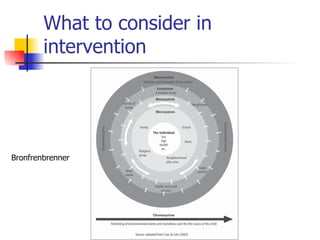
What to consider in intervention Bronfrenbrenner
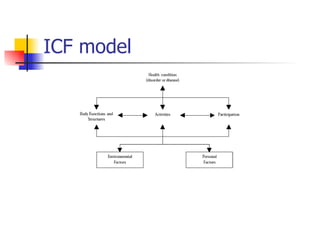
ICF model
Who is disabled? What is disabled? Dyspraxic or a child with dyspraxia Disability Student Allowance.. Who is disabled?
Approaches used in DCD Top down Task specific Cognitive Orientation to Occupational Performance (CO-OP) Verbal self-guidance  Neuromotor task training Cognitive-motor Ecological Bottom up Sensory integration Kinaesthetic training  Perceptual motor
Intervention Traditional approaches to intervention have aimed at remediating the motor deficit using “bottom up” approaches Sensory integration Perceptual-motor Kinaesthetic training
Sensory integration (SI) Empirical evidence does not support SI as an effective intervention At  best  SI is as effective as any other intervention in improving motor skills SI is most costly intervention Lacks a functional approach Mandich, Polatajko, Macnab, Miller 2001
Sensory integration (SI) Theoretical basis of sensory integration therapy is not supported by our current knowledge of motor development, learning and control.  Wilson PH 2006, Sugden & Dunford 2006 Move to task orientated approach is supported by the literature.  Polatajko & Cantin 2006
If  SI is chosen as an approach Should always be approached as a trial with clear, measurable, functional outcomes Education of families, teachers & others should accompany intervention Attention should be given to adapting environment as well Re-assessment using outcomes after 8-10 weeks intervention – if no benefits another approach should be considered CanChild website, Keeping Current/SI
Process-orientated/kinaesthesia Some results show it to be equally as effective as other approaches Some results indicate it is no better than no treatment Evidence in support of the process orientated approach is inconclusive  Mandich, Polatajko, Macnab, Miller 2001
Perceptual-motor Meta-analysis of 180 studies: results showed perceptual motor intervention was not effective in remediating the motor difficulties of children with (specific) learning disabilities  Mandich, Polatajko, Macnab, Miller 2001
Conclusions from intervention literature Bottom up approaches – no support for one approach over another, no evidence of impact on functional everyday tasks Top down approaches Task specific - effective in teaching task but not sure about transfer & generalisation Cognitive – improves performance of activity, some evidence of transfer & generalisation ? Evidence of increased participation Polatajko & Cantin 2005
Intervention: Leeds Consensus Should contain activities that are  functional  and are based on those that are relevant to daily living and meaningful to the child, parents, teachers and others. These should be based on accurate assessment and aim to improve the child’s motor functions plus other attributes such as self esteem and confidence.
Intervention: Leeds Consensus Involve the  child’s wishes  as key parts of the intervention process. This will usually include identifying functional tasks, choosing priorities, establishing targets for success and engaging in monitoring their own progress.
Intervention: Leeds Consensus Involve a  number of individuals who can contribute  - parents, teachers, health professionals, coaches and other family members – to enhance generalization and application in the context of everyday life. Accommodate the  contextual life of the family  taking into account family circumstances such as routines, siblings, finance, etc.
Intervention: Leeds Consensus Be  evidence-based and grounded in theories  that are applicable to understanding children with DCD. These theories should take into account the nature of the learning process in the developing child, the structure of the task and the environmental conditions that support skill acquisition.
Top down functional approaches Task specific  Cognitive-motor Ecological intervention Cognitive orientation to occupational performance (CO-OP)
Task specific Child works on specific task while also learning underlying movement principles (implicit learning) that may transfer to other related tasks   Acknowledges the unique set of movement skills required for a particular task The child is given the opportunity to practice the task  Clinician uses skills of task analysis, modification and adaptation to enable the child to achieve the task   Beneficial to children with DCD if conducted 3 to 5 times a week in a group or home setting. Pless & Carlsson 2000
Cognitive motor approach Emphasis on child performing functional tasks in everyday life settings Movement competence is a problem solving exercise involving action planning, execution & evaluation Interaction of cognitive, affective & motor competencies Derived from motor learning & motor development literature
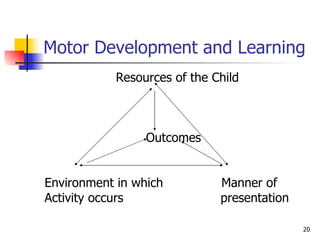
Motor Development and Learning Resources of the Child Outcomes  Environment in which  Manner of  Activity occurs  presentation
Ecological intervention Tasks taught in groups representing classes of activities to facilitate generalisation Consider the child’s wishes & priorities Involve a number of individuals – parents, teachers, health professionals Evidence based & grounded in theories applicable to DCD
CO-OP Client centred approach focused on strategy based skill acquisition 4 objectives  skill acquisition (primary aim)  cognitive strategy use  generalisation  transfer  Early evidence suggests this is an effective approach to improving functional performance in children with DCD
Family centred functional therapy Family-centred functional therapy (FCFT) has been developed by the McMaster team in Canada.  FCFT is based on concepts from family centred services and uses a systems approach to motor development.  Addresses not just the individual capacities of the child but considers the task and environment as potential vehicles for change.  It is still an emerging clinical model for children and so far has only been applied to children with cerebral palsy
4 clinical principles  Promoting functional performance Identifying periods of change Identifying  and changing the primary constraints in the task, child and/or environment that prevent achievement of the task Encouraging practice
Individual or group? Individual – tailored to specific needs of the child but ? Context. Also resource intense Group harder to tailor to individual but peer group benefits & resource efficient. Opportunity for children to meet others like them, can run parent groups alongside
Results: Clinical judgement Coordination improved – MABC, camp Writing improved - sitting position, hand on paper, mum says she can now understand writing in homework book. Can now do own laces (occasionally come undone)  Ball skills - no change on MABC but improvement in football skills noted by parents, child and OT Running & trying new things on the playground – he says no longer an issue
Conclusions Task specific approach effective beyond just teaching the task Intensive scheduling effective plus satisfying way of working – get to know children well Group has effect on child’s perceptions/beliefs Outcomes are complex and hard to measure COPM useful tool for measuring goal attainment
The evidence - Summary “ If a clear message has come from research over the past decade, it is that performance of an activity is best learned by practising the activity itself.”  Mary Law 2002

Intervention and DCD- considerations for practice

  • 1.
    Intervention Why interveneWhen intervene How long What to do Teach a task or teach a skill
  • 2.
    What to considerin intervention Bronfrenbrenner
  • 3.
  • 4.
    Who is disabled?What is disabled? Dyspraxic or a child with dyspraxia Disability Student Allowance.. Who is disabled?
  • 5.
    Approaches used inDCD Top down Task specific Cognitive Orientation to Occupational Performance (CO-OP) Verbal self-guidance Neuromotor task training Cognitive-motor Ecological Bottom up Sensory integration Kinaesthetic training Perceptual motor
  • 6.
    Intervention Traditional approachesto intervention have aimed at remediating the motor deficit using “bottom up” approaches Sensory integration Perceptual-motor Kinaesthetic training
  • 7.
    Sensory integration (SI)Empirical evidence does not support SI as an effective intervention At best SI is as effective as any other intervention in improving motor skills SI is most costly intervention Lacks a functional approach Mandich, Polatajko, Macnab, Miller 2001
  • 8.
    Sensory integration (SI)Theoretical basis of sensory integration therapy is not supported by our current knowledge of motor development, learning and control. Wilson PH 2006, Sugden & Dunford 2006 Move to task orientated approach is supported by the literature. Polatajko & Cantin 2006
  • 9.
    If SIis chosen as an approach Should always be approached as a trial with clear, measurable, functional outcomes Education of families, teachers & others should accompany intervention Attention should be given to adapting environment as well Re-assessment using outcomes after 8-10 weeks intervention – if no benefits another approach should be considered CanChild website, Keeping Current/SI
  • 10.
    Process-orientated/kinaesthesia Some resultsshow it to be equally as effective as other approaches Some results indicate it is no better than no treatment Evidence in support of the process orientated approach is inconclusive Mandich, Polatajko, Macnab, Miller 2001
  • 11.
    Perceptual-motor Meta-analysis of180 studies: results showed perceptual motor intervention was not effective in remediating the motor difficulties of children with (specific) learning disabilities Mandich, Polatajko, Macnab, Miller 2001
  • 12.
    Conclusions from interventionliterature Bottom up approaches – no support for one approach over another, no evidence of impact on functional everyday tasks Top down approaches Task specific - effective in teaching task but not sure about transfer & generalisation Cognitive – improves performance of activity, some evidence of transfer & generalisation ? Evidence of increased participation Polatajko & Cantin 2005
  • 13.
    Intervention: Leeds ConsensusShould contain activities that are functional and are based on those that are relevant to daily living and meaningful to the child, parents, teachers and others. These should be based on accurate assessment and aim to improve the child’s motor functions plus other attributes such as self esteem and confidence.
  • 14.
    Intervention: Leeds ConsensusInvolve the child’s wishes as key parts of the intervention process. This will usually include identifying functional tasks, choosing priorities, establishing targets for success and engaging in monitoring their own progress.
  • 15.
    Intervention: Leeds ConsensusInvolve a number of individuals who can contribute - parents, teachers, health professionals, coaches and other family members – to enhance generalization and application in the context of everyday life. Accommodate the contextual life of the family taking into account family circumstances such as routines, siblings, finance, etc.
  • 16.
    Intervention: Leeds ConsensusBe evidence-based and grounded in theories that are applicable to understanding children with DCD. These theories should take into account the nature of the learning process in the developing child, the structure of the task and the environmental conditions that support skill acquisition.
  • 17.
    Top down functionalapproaches Task specific Cognitive-motor Ecological intervention Cognitive orientation to occupational performance (CO-OP)
  • 18.
    Task specific Childworks on specific task while also learning underlying movement principles (implicit learning) that may transfer to other related tasks Acknowledges the unique set of movement skills required for a particular task The child is given the opportunity to practice the task Clinician uses skills of task analysis, modification and adaptation to enable the child to achieve the task Beneficial to children with DCD if conducted 3 to 5 times a week in a group or home setting. Pless & Carlsson 2000
  • 19.
    Cognitive motor approachEmphasis on child performing functional tasks in everyday life settings Movement competence is a problem solving exercise involving action planning, execution & evaluation Interaction of cognitive, affective & motor competencies Derived from motor learning & motor development literature
  • 20.
    Motor Development andLearning Resources of the Child Outcomes Environment in which Manner of Activity occurs presentation
  • 21.
    Ecological intervention Taskstaught in groups representing classes of activities to facilitate generalisation Consider the child’s wishes & priorities Involve a number of individuals – parents, teachers, health professionals Evidence based & grounded in theories applicable to DCD
  • 22.
    CO-OP Client centredapproach focused on strategy based skill acquisition 4 objectives skill acquisition (primary aim) cognitive strategy use generalisation transfer Early evidence suggests this is an effective approach to improving functional performance in children with DCD
  • 23.
    Family centred functionaltherapy Family-centred functional therapy (FCFT) has been developed by the McMaster team in Canada. FCFT is based on concepts from family centred services and uses a systems approach to motor development. Addresses not just the individual capacities of the child but considers the task and environment as potential vehicles for change. It is still an emerging clinical model for children and so far has only been applied to children with cerebral palsy
  • 24.
    4 clinical principles Promoting functional performance Identifying periods of change Identifying and changing the primary constraints in the task, child and/or environment that prevent achievement of the task Encouraging practice
  • 25.
    Individual or group?Individual – tailored to specific needs of the child but ? Context. Also resource intense Group harder to tailor to individual but peer group benefits & resource efficient. Opportunity for children to meet others like them, can run parent groups alongside
  • 26.
    Results: Clinical judgementCoordination improved – MABC, camp Writing improved - sitting position, hand on paper, mum says she can now understand writing in homework book. Can now do own laces (occasionally come undone) Ball skills - no change on MABC but improvement in football skills noted by parents, child and OT Running & trying new things on the playground – he says no longer an issue
  • 27.
    Conclusions Task specificapproach effective beyond just teaching the task Intensive scheduling effective plus satisfying way of working – get to know children well Group has effect on child’s perceptions/beliefs Outcomes are complex and hard to measure COPM useful tool for measuring goal attainment
  • 28.
    The evidence -Summary “ If a clear message has come from research over the past decade, it is that performance of an activity is best learned by practising the activity itself.” Mary Law 2002