Presenter: Amy Carroll, OTR/L
 LEAP Occupational Therapy
  Carroll.amyp@gmail.com

   OTICON 2012, Goa, India
       16 January 2012
About Amy Carroll

    OTR/L
    NBCOT

    25+ years experience working in public schools
     (government schools)
    20+ years experience as private practitioner
    Advanced training in Sensory Integration &
     Interactive Metronome
    O.T. Doctorate student at Thomas Jefferson
     University in Philadelphia, U.S.
Presentation Overview
   Occupational Therapy in School Settings
     Guidelines for my practice (AOTA & U.S. Law)

     O.T. Role in U.S. Schools

     OT Process in schools


   Intervention for Children with Learning Disabilities
      Evaluations

      Common Issues

      Specific Intervention Activities & Tools
Guides to my practice
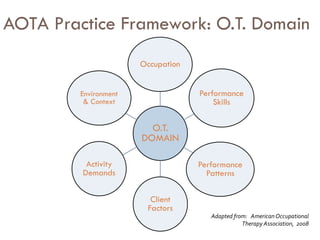
AOTA Practice Framework: O.T. Domain
                       Occupation


         Environment                Performance
          & Context                     Skills

                         O.T.
                       DOMAIN

          Activity                  Performance
         Demands                      Patterns

                         Client
                        Factors
                                       Adapted from: American Occupational
                                                  Therapy Association, 2008
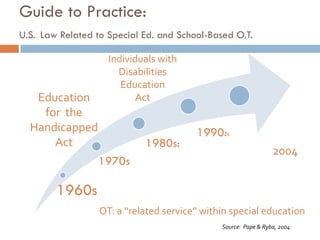
Guide to Practice:
U.S. Law Related to Special Ed. and School-Based O.T.

                    Individuals with
                      Disabilities
                       Education
   Education               Act
    for the
  Handicapped                           1990:s
      Act                   1980s:
                                                                2004
                 1970s

        1960s
                  OT: a “related service” within special education
                                              Source: Pape & Ryba, 2004
:
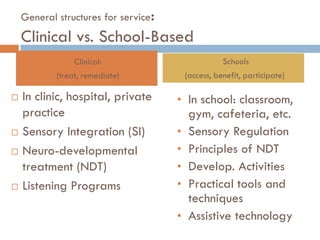
    General structures for service
    Clinical vs. School-Based
                 Clinical:                          Schools
            (treat, remediate)           (access, benefit, participate)

   In clinic, hospital, private     • In school: classroom,
    practice                              gym, cafeteria, etc.
   Sensory Integration (SI)         •    Sensory Regulation
   Neuro-developmental              •    Principles of NDT
    treatment (NDT)                  •    Develop. Activities
   Listening Programs               •    Practical tools and
                                          techniques
                                     •    Assistive technology
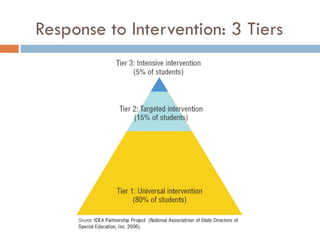
Response to Intervention: 3 Tiers
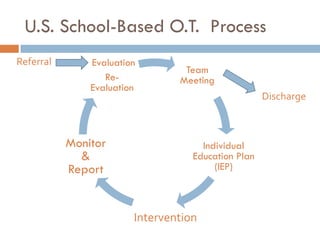
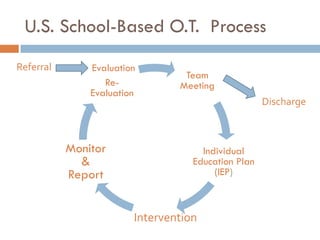
U.S. School-Based O.T. Process
Referral       Evaluation
                                 Team
                  Re-           Meeting
               Evaluation
                                                    Discharge


           Monitor                   Individual
             &                     Education Plan
           Report                       (IEP)


                        Intervention
Tools & Techniques
U.S. School-Based O.T. Process
Referral       Evaluation
                                 Team
                  Re-           Meeting
               Evaluation
                                                    Discharge


           Monitor                   Individual
             &                     Education Plan
           Report                       (IEP)


                        Intervention
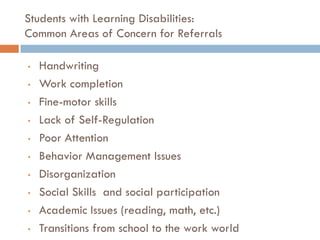
Students with Learning Disabilities:
Common Areas of Concern for Referrals

•   Handwriting
•   Work completion
•   Fine-motor skills
•   Lack of Self-Regulation
•   Poor Attention
•   Behavior Management Issues
•   Disorganization
•   Social Skills and social participation
•   Academic Issues (reading, math, etc.)
•   Transitions from school to the work world
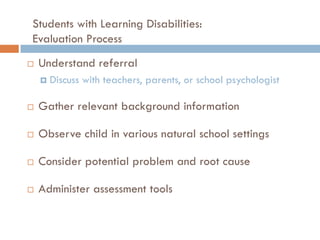
Students with Learning Disabilities:
Evaluation Process
   Understand referral
       Discuss with teachers, parents, or school psychologist

   Gather relevant background information

   Observe child in various natural school settings

   Consider potential problem and root cause

   Administer assessment tools
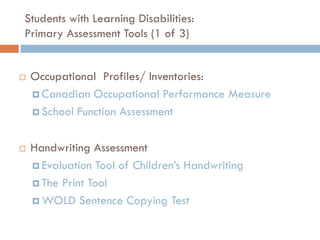
Students with Learning Disabilities:
Primary Assessment Tools (1 of 3)


   Occupational Profiles/ Inventories:
     Canadian Occupational Performance Measure

     School Function Assessment


   Handwriting Assessment
     Evaluation Tool of Children’s Handwriting

     The Print Tool

     WOLD Sentence Copying Test
Students with Learning Disabilities:
Primary Assessment Tools (2 of 3)


     Visual Perception
       Motor-Free Visual Perception Test 3

       Test of Visual Perceptual Skills, Revised


     Visual Motor/Visual Perception
       Beery VMI 5th edition

       The Developmental Test of Visual Perception 2
Students with Learning Disabilities:
    Primary Assessment Tools (3 of 3)

•   Fine Motor / Visual Motor
    • Bruininks- Oseretsky Test of Motor Proficiency 2

    • PDMS-2: Peabody Developmental Motor Scales,
       Second Edition

•   Sensory Processing / Sensory Modulation
    • Sensory Profile

    • Sensory Profile School Companion

    • Adolescent/Adult Sensory Profile

    • Sensory Processing Measure
The Student’s Educational Team

   Parents                 Therapist(s)


                                   Teachers

Student

                              Para-Educators

              Administrator
Students with L.D.:
Common Issues Requiring Intervention

   Stability and motor control
    posture, shoulder, wrist, grasp

   Bilateral integration
   Visual skills
   Sensory regulation/modulation
   Praxis
   Organization
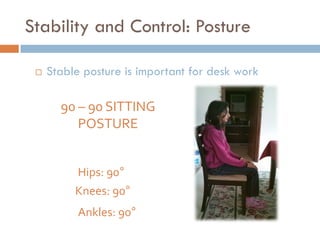
Stability and Control: Posture

    Stable posture is important for desk work

       90 – 90 SITTING
          POSTURE


           Hips: 90°
          Knees: 90°
           Ankles: 90°
Posture Intervention: Key Concepts
Do seatwork after ―heavy work‖ (gym, playground,
  etc.) and movement experiences

Work for brief periods, and in different positions
 • Sit at desk, bean bag chair, on a therapy ball

 • Standing at the blackboard or an easel

 • Prone with pillow under chest
   • short periods initially (i.e. 5 min)
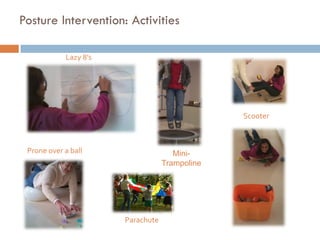
Posture Intervention: Activities

            Lazy 8’s


                                                Scooter


 Prone over a ball                    Mini-
                                   Trampoline


                       Parachute
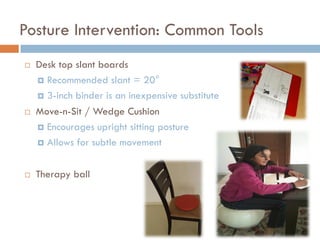
Posture Intervention: Common Tools
   Desk top slant boards
     Recommended slant = 20°

     3-inch binder is an inexpensive substitute

   Move-n-Sit / Wedge Cushion
     Encourages upright sitting posture

     Allows for subtle movement


   Therapy ball
Stability and Control: Shoulder
   Shoulder stability is needed for fine-motor
    control

   Signs of decreased shoulder stability:
     Shoulder hiking
     Scapula winging
     Arms and wrists not grounded when writing
Shoulder Intervention
 Key Concepts
  Same as many postural intervention activities

  Use activities requiring heavy work in the shoulder
   area
    Animal walks, wheelbarrow walking, etc.
    Chair pushups
    Prone on elbows (lying on stomach)
    Writing on the chalkboard –vertical surface


 Common Tools
  Slant board

  Desktop easel
Stability and Control: Wrist

  Wrist should be in slightly extended or
   neutral position
  Good wrist position supports mature grasp

  Stable wrist position necessary for speed &
   precision
  Flexed wrist position is not functional


                  (Benbow, 2000)
Wrist Intervention: Key Concepts
   Use vertical work surfaces
     chalkboard or easels
     Slant board
   Lean forearm and wrist against the blackboard
   Keep activity at the child’s eye level

   Paper position affects wrist position
     Paper parallel (~ 30° angle) to the writing forearm's
      natural position
     Beginner printers can start with the paper on a
      horizontal plane

               (Sources: Pape &Ryba, 2004 and Olsen, 1994)
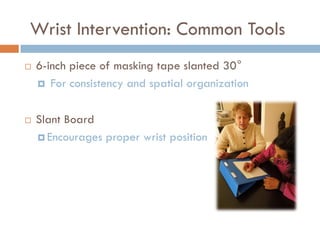
Wrist Intervention: Common Tools
   6-inch piece of masking tape slanted 30°
     For consistency and spatial organization


   Slant Board
     Encourages proper wrist position
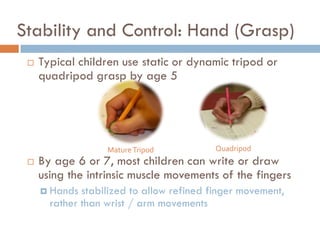
Stability and Control: Hand (Grasp)
    Typical children use static or dynamic tripod or
     quadripod grasp by age 5


                   Mature Tripod           Quadripod
    By age 6 or 7, most children can write or draw
     using the intrinsic muscle movements of the fingers
      Hands  stabilized to allow refined finger movement,
       rather than wrist / arm movements
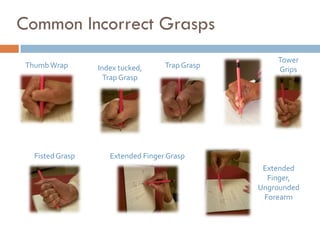
Common Incorrect Grasps
                                                     Tower
 Thumb Wrap       Index tucked,     Trap Grasp
                                                     Grips
                    Trap Grasp


   Fisted Grasp      Extended Finger Grasp
                                                  Extended
                                                   Finger,
                                                 Ungrounded
                                                  Forearm
Grasp Intervention: Key Concepts
    Look for the open circle web space to quickly identify the
     quality of a grasp

    Allow preschool children to explore
      Different patterns of grasping
      Different drawing & writing tools


    Encourage achievement of milestones to develop hand
      Arches
      Wrist extension
      Skilled vs. stable sides of hand (A-OK grasp)
      Finger muscle movement


                (Case-Smith & Pehoski, 1992; Benbow 2000; Olsen, 2003)
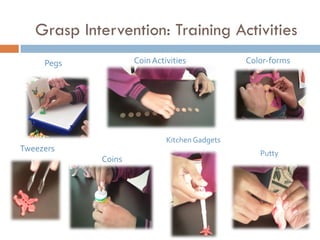
Grasp Intervention: Training Activities
     Pegs           Coin Activities            Color-forms


                             Kitchen Gadgets
Tweezers
                                                  Putty
            Coins
Grasp Intervention: Grip Pressure
   Focus on:
       Stability and control more proximally
       Fine motor control and quality of the grip


   Intervention Activities:
     Open non-dominant hand on the desk

     Squeeze a ball in non-dominant hand

     Line-up dominoes

     Pick-up fragile objects with fingers or tweezers

     Drop a specific number of drops from an eyedropper

          (Case-Smith & Pehoski, 1992; Benbow 2000; Olsen, 2003)
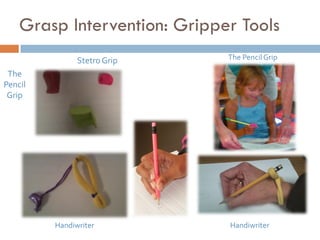
Grasp Intervention: Gripper Tools
               Stetro Grip    The Pencil Grip

 The
Pencil
 Grip


         Handiwriter          Handiwriter
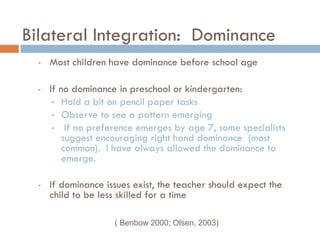
Bilateral Integration: Dominance
  •   Most children have dominance before school age

  •   If no dominance in preschool or kindergarten:
       • Hold a bit on pencil paper tasks
       • Observe to see a pattern emerging
       • If no preference emerges by age 7, some specialists
          suggest encouraging right hand dominance (most
          common). I have always allowed the dominance to
          emerge.

  •   If dominance issues exist, the teacher should expect the
      child to be less skilled for a time

                     ( Benbow 2000; Olsen, 2003)
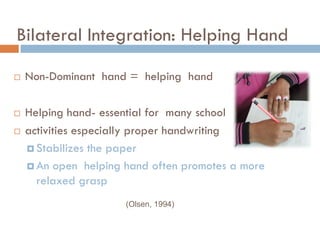
Bilateral Integration: Helping Hand

   Non-Dominant hand = helping hand

   Helping hand- essential for many school
   activities especially proper handwriting
     Stabilizes the paper

     An open helping hand often promotes a more
      relaxed grasp
                      (Olsen, 1994)
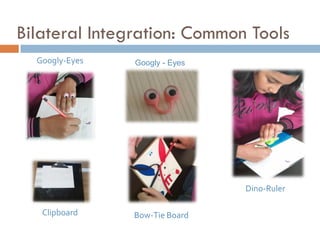
Bilateral Integration: Common Tools
  Googly-Eyes   Googly - Eyes


                                Dino-Ruler

   Clipboard    Bow-Tie Board
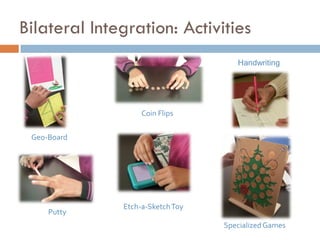
Bilateral Integration: Activities
                                     Handwriting


                   Coin Flips


 Geo-Board


              Etch-a-Sketch Toy
     Putty
                                  Specialized Games
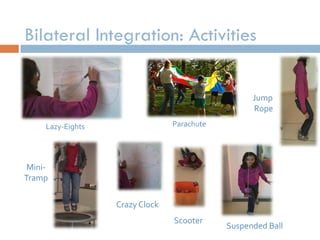
Bilateral Integration: Activities


                                                   Jump
                                                   Rope

     Lazy-Eights                 Parachute


 Mini-
Tramp

                   Crazy Clock
                                 Scooter
                                             Suspended Ball
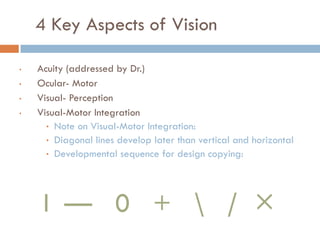
4 Key Aspects of Vision

•   Acuity (addressed by Dr.)
•   Ocular- Motor
•   Visual- Perception
•   Visual-Motor Integration
       Note on Visual-Motor Integration:
       Diagonal lines develop later than vertical and horizontal
       Developmental sequence for design copying:


     l — 0 +  / 
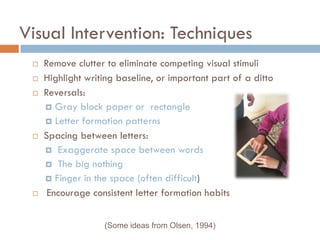
Visual Intervention: Techniques
    Remove clutter to eliminate competing visual stimuli
    Highlight writing baseline, or important part of a ditto
    Reversals:
      Gray block paper or rectangle
      Letter formation patterns
    Spacing between letters:
      Exaggerate space between words
      The big nothing
      Finger in the space (often difficult)
     Encourage consistent letter formation habits


                   (Some ideas from Olsen, 1994)
Visual Intervention: Techniques
      Vertical and horizontal skills develop earlier than
       diagonal skills
      Sometimes children do better when they learn
       cursive
        continuous movement

        more developed foundation skills

        fresh start


         Visual skills develop through movement
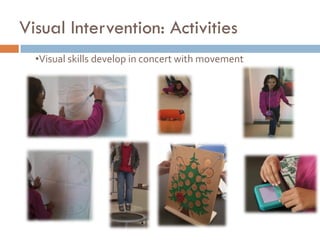
Visual Intervention: Activities
  •Visual skills develop in concert with movement
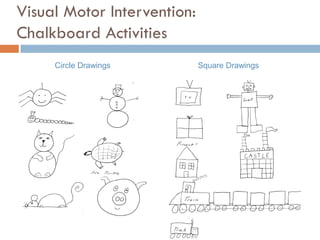
Visual Motor Intervention:
Chalkboard Activities
     Circle Drawings         Square Drawings
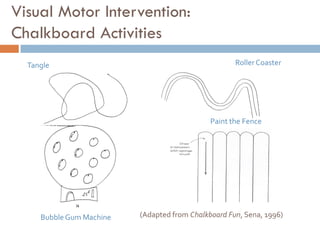
Visual Motor Intervention:
Chalkboard Activities
  Tangle                                             Roller Coaster


                                              Paint the Fence


     Bubble Gum Machine   (Adapted from Chalkboard Fun, Sena, 1996)
Visual Motor Intervention: Chalkboard
Activities
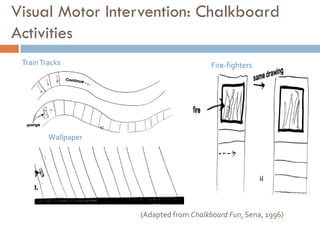
 Train Tracks                            Fire-fighters


         Wallpaper


                     (Adapted from Chalkboard Fun, Sena, 1996)
Visual Motor Intervention: Activities

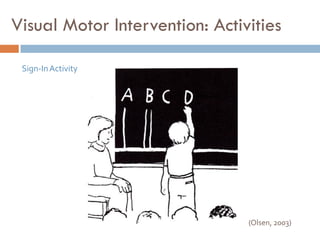
 Sign-In Activity


                                (Olsen, 2003)
Visual Intervention: Tools
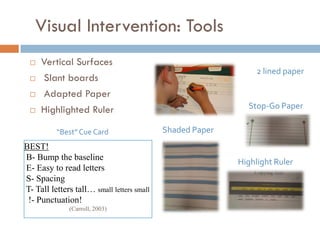
    Vertical Surfaces
                                                                2 lined paper
    Slant boards
    Adapted Paper
    Highlighted Ruler                                       Stop-Go Paper

          “Best” Cue Card                   Shaded Paper
BEST!
B- Bump the baseline
                                                           Highlight Ruler
E- Easy to read letters
S- Spacing
T- Tall letters tall… small letters small
 !- Punctuation!
              (Carroll, 2003)
Sensory Regulation / Modulation
   States of Alertness / States of Arousal
     Too High, Too Low, or Just Right

     ―Just Right‖ = settled and focused for learning

   Sensory regulation strategies = ―Sensory Diet‖
   Many times less stimulation is needed
     Allow quiet time-maybe a book or music in a bean bag

     Cubby or cave with comforting items

   Also Important to consider:
       Establish routines
       Warn of changes in routine

                        (Williams & Shellenberger, 1996)
Sensory Regulation Strategies & Tools

 Sensory regulation strategies = “Sensory Diet”
        ―As needed‖ or at scheduled times
        Older children learn when and how to use strategies
    Heavy Work (see posture activities)
      Pushing & pulling activities

      Jumping & hopscotch, animal walks, obstacle course

      Squeezing foam ball , putty, clay

      Thumb-Wrestling

      ―Spiders on a mirror‖ / resistive toys

    Deep Pressure
      Compression clothing / lycra clothing

      Hot dog, massage, brushing
Sensory Regulation Strategies & Tools
      Heavy Oral Activities
        Sucking or mints or sour hard candy.
        Chewy candy (licorice, gummy bears), dried fruit,
         gum
        Sipping from water bottles.

      Movement / Physical Activities
        Swings  and scooter board, obstacle course
        Move’n Sit cushions
        Varying positions
        Sitting on a ball or small rocker
        ―Fidget‖ tools (plastic coils, squeeze balls, silly putty)
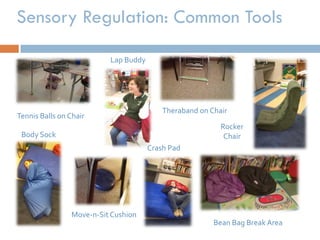
Sensory Regulation: Common Tools

                          Lap Buddy


                                          Theraband on Chair
Tennis Balls on Chair
                                                          Rocker
 Body Sock                                                 Chair
                                      Crash Pad


                Move-n-Sit Cushion
                                                        Bean Bag Break Area
Praxis: Key Concepts
   Praxis = The ability to plan and execute new or
    novel motor sequences
   Children with poor praxis commonly display:
     Difficulty establishing routines
     Difficulty with self care tasks (open locker
      combination, managing belongings)
     Labored handwriting
     Difficulty or reluctance in gym and recess
     Requires more time to complete tasks
     Can be resistant to new activities
Praxis: Interventions
   Tactile and Proprioceptive activities (heavy work)
       Obstacle courses
       Play on playground equipment
       Scooter board activities
       Working with clay or putty, resistive mediums


   Multi-step projects
       Crafts
       Constructional toys (Lego's etc.)
Praxis: Tools & Techniques
   Break down instruction into steps
   Repeat directions and provide additional visual cues
   Demonstrate
   Desk Map
   Teach student to ―self talk‖ through a task
   Checklists for routines
   Social stories for routines
   Multisensory handwriting instruction for stroke sequences
   Consider early keyboarding
   Practice self care fasteners
   Lunch packages: parents can cut small hole to help child
    open
   Pre-teach gross motor activities
                 (input from Pape & Ryba, 2004)
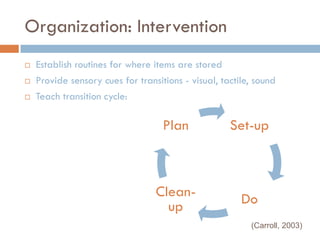
Organization: Intervention
   Establish routines for where items are stored
   Provide sensory cues for transitions - visual, tactile, sound
   Teach transition cycle:

                                    Plan             Set-up


                                  Clean-                Do
                                    up
                                                          (Carroll, 2003)
Organization: Common Tools
   Color coded folders or labels
   Accordion Files
   Copy lid in desk drawer
   Trapper keepers
   Allow an extra space to store items
   Locker : organize books into a.m. and p.m.
   Desk Map: diagram of where things go
   Map of where classrooms are-color coded
   Consistent format with class work
QUESTIONS?
References (1 of 4)
    American Occupational Therapy Association. (2008). FAQ-Response-To-
     Intervention. Retrieved 12 13, 2011, from AOTA:
     http://www.aota.org/Practitioners/PracticeAreas/Pediatrics/Browse/S
     chool/Copy%20of%20FAQ-Response-to-Intervention.aspx?FT=.pdf
    American Occupational Therapy Association. (2011). Occupational
     Therapy in early Childhood and School-Based Settings. Retrieved
     December 20, 2011, from AOTA: American Occupational Therapy
     Association:
     http://www.aota.org/Practitioners/PracticeAreas/Pediatrics/Highlight
     s/40881.aspx?FT=.pdf
    American Occupational Therapy Association. (2010). Occupational
     Therapy in School Settings. Retrieved January 2, 2012, from AOTA: The
     American Occupational Therapy Association:
     http://www.aota.org/Practitioners/PracticeAreas/Pediatrics/Fact-
     Sheets-on-the-Role-of-OT/School.aspx?FT=.pdf
References (2 of 4)
   American Occupational Therapy Association. (2008). Occupational
    therapy practice framework: Domain and process (2nd ed.). American
    Journal of Occupational Therapy , 62, 625-683.
   Amundson, S. J. (1995). Evaluation Tool of Children's Handwriting: ETCH
    examiners manual. Homer, Alaska: O.T. Kids.
   Ayres, A. J. (1988). Sensory integration and praxis tests. Los Angelos:
    Western Psychological Services.
   Beery, K. E., & Beery, N. A. (2004). Beery VMI administration, scoring,
    and teaching manual (5th ed.). Minneapolis: NCS Pearson, Inc.
   Brown, C. E., & Dunn, W. (2002). Adolescent/Adult Sensory Profile:
    User's manual. San Antonio: Pearson.
   Bruininks, R. H. (2005). Bruininks-Oseretsky Test of Motor Proficiency
    (2nd ed.). Circle Pines, MN: AGS Publishing.
   Case-Smith, J., & Pehoski, C. (1992). Development of hand skills in
    children. Rockville: AOTA.
   Colarusso, R. P., & D., H. D. (2003). Motor-Free Visual Perception Test
    (3rd ed.). Novato, CA: Academic Therapy Publications.
   Coster, W., Deeney, T. H., & Haley, S. (1998). School Function
    Assessment. San Antonio : The Psychological Corporation.
References: (3 of 4)
   Dunn, W. (1999). Sensory Profile. U.S.: The Psychological Corporation.
   Dunn, W. (2006). Sensory Profile School Companion: User's manual.
    USA: PsychCorp.
   Fewell, M. R. Peabody Developmental Motor Scales (2nd Edition).
   Gardner, M. F. (1996). Test of Visual-Perceptual Skills (n-m) Revised
    manual. Hydesville, CA: Psychological and Educational Publications.
   Hammill, D. D., Pearson, N. A., & Voress, J. K. (1993). Developmental
    Test of Visual Perception, second edition. Austin: pro-ed.
   Kuhaneck, H. M., Henry, D. A., & Gleenon, T. J. (2007). Sensory
    processing measure. Los Angeles: Western Psychological Services.
   Law, M., Baptiste, S., Carswell, A., McColl, M. A., Polatajkp, H., &
    Pollock, N. (1994). Canadian Occupational Performance Measure
    (second ed.). Toronto: CAOT.
   Olsen, J. Z. (1994). Handwriting Without Tears, workshop
   Olsen, J. Z. (2003). Pre-K teacher's guide. Cabin John, MD.: Handwriting
    Without Tears, Jan Z. Olsen.
References:(4 of 4)
   Olsen, J. Z. (2009). The Printing Tool. MD.: Handwriting without tears, Jan
    Z. Olsen.
   Pape, L., & Ryba, K. (2004). Roles of occupational therapy in the school
    setting. In L. Pape, & K. Ryba, Practical considerations for school-based
    occupational therapists (pp. 1-30). Bethesda: American Occupational
    Therapy Association, Inc.
   Reynolds, C. R., Pearson, N. A., & Voress, J. K. (2002). DTVP-A
    Developmental Test of Visual Perception: Adolescent and Adult examiner's
    manual. Austin: pro-ed.
   Richards, R. M. (1988). Classroom visual activities. Novato, CA: Academic
    Therapy Publications.
   Sena, L. (1996). Chalk-Board fun. Bisbee, AZ: Imaginart Press.
   Williams, M. S., & Shellenberger, S. (1996). How does your engine run?: A
    leader's guide to the alert program for self regulation. Albuquerque:
    TherapyWorks, Inc.
   Wold, R. (1970). Screening tests to be used by the classroom teacher.
    Novato, CA: Academic Therapy Publications.

Occupational therapy in school settings.1.16.2012.rev

  • 1.
    Presenter: Amy Carroll,OTR/L LEAP Occupational Therapy Carroll.amyp@gmail.com OTICON 2012, Goa, India 16 January 2012
  • 2.
    About Amy Carroll  OTR/L  NBCOT  25+ years experience working in public schools (government schools)  20+ years experience as private practitioner  Advanced training in Sensory Integration & Interactive Metronome  O.T. Doctorate student at Thomas Jefferson University in Philadelphia, U.S.
  • 3.
    Presentation Overview  Occupational Therapy in School Settings  Guidelines for my practice (AOTA & U.S. Law)  O.T. Role in U.S. Schools  OT Process in schools  Intervention for Children with Learning Disabilities  Evaluations  Common Issues  Specific Intervention Activities & Tools
  • 4.
    Guides to mypractice
  • 5.
    AOTA Practice Framework:O.T. Domain Occupation Environment Performance & Context Skills O.T. DOMAIN Activity Performance Demands Patterns Client Factors Adapted from: American Occupational Therapy Association, 2008
  • 6.
    Guide to Practice: U.S.Law Related to Special Ed. and School-Based O.T. Individuals with Disabilities Education Education Act for the Handicapped 1990:s Act 1980s: 2004 1970s 1960s OT: a “related service” within special education Source: Pape & Ryba, 2004
  • 7.
    : General structures for service Clinical vs. School-Based Clinical: Schools (treat, remediate) (access, benefit, participate)  In clinic, hospital, private • In school: classroom, practice gym, cafeteria, etc.  Sensory Integration (SI) • Sensory Regulation  Neuro-developmental • Principles of NDT treatment (NDT) • Develop. Activities  Listening Programs • Practical tools and techniques • Assistive technology
  • 8.
  • 9.
    U.S. School-Based O.T.Process Referral Evaluation Team Re- Meeting Evaluation Discharge Monitor Individual & Education Plan Report (IEP) Intervention
  • 10.
  • 11.
    U.S. School-Based O.T.Process Referral Evaluation Team Re- Meeting Evaluation Discharge Monitor Individual & Education Plan Report (IEP) Intervention
  • 12.
    Students with LearningDisabilities: Common Areas of Concern for Referrals • Handwriting • Work completion • Fine-motor skills • Lack of Self-Regulation • Poor Attention • Behavior Management Issues • Disorganization • Social Skills and social participation • Academic Issues (reading, math, etc.) • Transitions from school to the work world
  • 13.
    Students with LearningDisabilities: Evaluation Process  Understand referral  Discuss with teachers, parents, or school psychologist  Gather relevant background information  Observe child in various natural school settings  Consider potential problem and root cause  Administer assessment tools
  • 14.
    Students with LearningDisabilities: Primary Assessment Tools (1 of 3)  Occupational Profiles/ Inventories:  Canadian Occupational Performance Measure  School Function Assessment  Handwriting Assessment  Evaluation Tool of Children’s Handwriting  The Print Tool  WOLD Sentence Copying Test
  • 15.
    Students with LearningDisabilities: Primary Assessment Tools (2 of 3)  Visual Perception  Motor-Free Visual Perception Test 3  Test of Visual Perceptual Skills, Revised  Visual Motor/Visual Perception  Beery VMI 5th edition  The Developmental Test of Visual Perception 2
  • 16.
    Students with LearningDisabilities: Primary Assessment Tools (3 of 3) • Fine Motor / Visual Motor • Bruininks- Oseretsky Test of Motor Proficiency 2 • PDMS-2: Peabody Developmental Motor Scales, Second Edition • Sensory Processing / Sensory Modulation • Sensory Profile • Sensory Profile School Companion • Adolescent/Adult Sensory Profile • Sensory Processing Measure
  • 17.
    The Student’s EducationalTeam Parents Therapist(s) Teachers Student Para-Educators Administrator
  • 18.
    Students with L.D.: CommonIssues Requiring Intervention  Stability and motor control  posture, shoulder, wrist, grasp  Bilateral integration  Visual skills  Sensory regulation/modulation  Praxis  Organization
  • 19.
    Stability and Control:Posture  Stable posture is important for desk work 90 – 90 SITTING POSTURE Hips: 90° Knees: 90° Ankles: 90°
  • 20.
    Posture Intervention: KeyConcepts Do seatwork after ―heavy work‖ (gym, playground, etc.) and movement experiences Work for brief periods, and in different positions • Sit at desk, bean bag chair, on a therapy ball • Standing at the blackboard or an easel • Prone with pillow under chest • short periods initially (i.e. 5 min)
  • 21.
    Posture Intervention: Activities Lazy 8’s Scooter Prone over a ball Mini- Trampoline Parachute
  • 22.
    Posture Intervention: CommonTools  Desk top slant boards  Recommended slant = 20°  3-inch binder is an inexpensive substitute  Move-n-Sit / Wedge Cushion  Encourages upright sitting posture  Allows for subtle movement  Therapy ball
  • 23.
    Stability and Control:Shoulder  Shoulder stability is needed for fine-motor control  Signs of decreased shoulder stability:  Shoulder hiking  Scapula winging  Arms and wrists not grounded when writing
  • 24.
    Shoulder Intervention KeyConcepts  Same as many postural intervention activities  Use activities requiring heavy work in the shoulder area  Animal walks, wheelbarrow walking, etc.  Chair pushups  Prone on elbows (lying on stomach)  Writing on the chalkboard –vertical surface Common Tools  Slant board  Desktop easel
  • 25.
    Stability and Control:Wrist  Wrist should be in slightly extended or neutral position  Good wrist position supports mature grasp  Stable wrist position necessary for speed & precision  Flexed wrist position is not functional (Benbow, 2000)
  • 26.
    Wrist Intervention: KeyConcepts  Use vertical work surfaces  chalkboard or easels  Slant board  Lean forearm and wrist against the blackboard  Keep activity at the child’s eye level  Paper position affects wrist position  Paper parallel (~ 30° angle) to the writing forearm's natural position  Beginner printers can start with the paper on a horizontal plane (Sources: Pape &Ryba, 2004 and Olsen, 1994)
  • 27.
    Wrist Intervention: CommonTools  6-inch piece of masking tape slanted 30°  For consistency and spatial organization  Slant Board  Encourages proper wrist position
  • 28.
    Stability and Control:Hand (Grasp)  Typical children use static or dynamic tripod or quadripod grasp by age 5 Mature Tripod Quadripod  By age 6 or 7, most children can write or draw using the intrinsic muscle movements of the fingers  Hands stabilized to allow refined finger movement, rather than wrist / arm movements
  • 29.
    Common Incorrect Grasps Tower Thumb Wrap Index tucked, Trap Grasp Grips Trap Grasp Fisted Grasp Extended Finger Grasp Extended Finger, Ungrounded Forearm
  • 30.
    Grasp Intervention: KeyConcepts  Look for the open circle web space to quickly identify the quality of a grasp  Allow preschool children to explore  Different patterns of grasping  Different drawing & writing tools  Encourage achievement of milestones to develop hand  Arches  Wrist extension  Skilled vs. stable sides of hand (A-OK grasp)  Finger muscle movement (Case-Smith & Pehoski, 1992; Benbow 2000; Olsen, 2003)
  • 31.
    Grasp Intervention: TrainingActivities Pegs Coin Activities Color-forms Kitchen Gadgets Tweezers Putty Coins
  • 32.
    Grasp Intervention: GripPressure  Focus on:  Stability and control more proximally  Fine motor control and quality of the grip  Intervention Activities:  Open non-dominant hand on the desk  Squeeze a ball in non-dominant hand  Line-up dominoes  Pick-up fragile objects with fingers or tweezers  Drop a specific number of drops from an eyedropper (Case-Smith & Pehoski, 1992; Benbow 2000; Olsen, 2003)
  • 33.
    Grasp Intervention: GripperTools Stetro Grip The Pencil Grip The Pencil Grip Handiwriter Handiwriter
  • 34.
    Bilateral Integration: Dominance • Most children have dominance before school age • If no dominance in preschool or kindergarten: • Hold a bit on pencil paper tasks • Observe to see a pattern emerging • If no preference emerges by age 7, some specialists suggest encouraging right hand dominance (most common). I have always allowed the dominance to emerge. • If dominance issues exist, the teacher should expect the child to be less skilled for a time ( Benbow 2000; Olsen, 2003)
  • 35.
    Bilateral Integration: HelpingHand  Non-Dominant hand = helping hand  Helping hand- essential for many school  activities especially proper handwriting  Stabilizes the paper  An open helping hand often promotes a more relaxed grasp (Olsen, 1994)
  • 36.
    Bilateral Integration: CommonTools Googly-Eyes Googly - Eyes Dino-Ruler Clipboard Bow-Tie Board
  • 37.
    Bilateral Integration: Activities Handwriting Coin Flips Geo-Board Etch-a-Sketch Toy Putty Specialized Games
  • 38.
    Bilateral Integration: Activities Jump Rope Lazy-Eights Parachute Mini- Tramp Crazy Clock Scooter Suspended Ball
  • 39.
    4 Key Aspectsof Vision • Acuity (addressed by Dr.) • Ocular- Motor • Visual- Perception • Visual-Motor Integration  Note on Visual-Motor Integration:  Diagonal lines develop later than vertical and horizontal  Developmental sequence for design copying: l — 0 + / 
  • 40.
    Visual Intervention: Techniques  Remove clutter to eliminate competing visual stimuli  Highlight writing baseline, or important part of a ditto  Reversals:  Gray block paper or rectangle  Letter formation patterns  Spacing between letters:  Exaggerate space between words  The big nothing  Finger in the space (often difficult)  Encourage consistent letter formation habits (Some ideas from Olsen, 1994)
  • 41.
    Visual Intervention: Techniques  Vertical and horizontal skills develop earlier than diagonal skills  Sometimes children do better when they learn cursive  continuous movement  more developed foundation skills  fresh start Visual skills develop through movement
  • 42.
    Visual Intervention: Activities •Visual skills develop in concert with movement
  • 43.
    Visual Motor Intervention: ChalkboardActivities Circle Drawings Square Drawings
  • 44.
    Visual Motor Intervention: ChalkboardActivities Tangle Roller Coaster Paint the Fence Bubble Gum Machine (Adapted from Chalkboard Fun, Sena, 1996)
  • 45.
    Visual Motor Intervention:Chalkboard Activities Train Tracks Fire-fighters Wallpaper (Adapted from Chalkboard Fun, Sena, 1996)
  • 46.
    Visual Motor Intervention:Activities Sign-In Activity (Olsen, 2003)
  • 47.
    Visual Intervention: Tools  Vertical Surfaces 2 lined paper  Slant boards  Adapted Paper  Highlighted Ruler Stop-Go Paper “Best” Cue Card Shaded Paper BEST! B- Bump the baseline Highlight Ruler E- Easy to read letters S- Spacing T- Tall letters tall… small letters small !- Punctuation! (Carroll, 2003)
  • 48.
    Sensory Regulation /Modulation  States of Alertness / States of Arousal  Too High, Too Low, or Just Right  ―Just Right‖ = settled and focused for learning  Sensory regulation strategies = ―Sensory Diet‖  Many times less stimulation is needed  Allow quiet time-maybe a book or music in a bean bag  Cubby or cave with comforting items  Also Important to consider:  Establish routines  Warn of changes in routine (Williams & Shellenberger, 1996)
  • 49.
    Sensory Regulation Strategies& Tools Sensory regulation strategies = “Sensory Diet”  ―As needed‖ or at scheduled times  Older children learn when and how to use strategies  Heavy Work (see posture activities)  Pushing & pulling activities  Jumping & hopscotch, animal walks, obstacle course  Squeezing foam ball , putty, clay  Thumb-Wrestling  ―Spiders on a mirror‖ / resistive toys  Deep Pressure  Compression clothing / lycra clothing  Hot dog, massage, brushing
  • 50.
    Sensory Regulation Strategies& Tools  Heavy Oral Activities  Sucking or mints or sour hard candy.  Chewy candy (licorice, gummy bears), dried fruit, gum  Sipping from water bottles.  Movement / Physical Activities  Swings and scooter board, obstacle course  Move’n Sit cushions  Varying positions  Sitting on a ball or small rocker  ―Fidget‖ tools (plastic coils, squeeze balls, silly putty)
  • 51.
    Sensory Regulation: CommonTools Lap Buddy Theraband on Chair Tennis Balls on Chair Rocker Body Sock Chair Crash Pad Move-n-Sit Cushion Bean Bag Break Area
  • 52.
    Praxis: Key Concepts  Praxis = The ability to plan and execute new or novel motor sequences  Children with poor praxis commonly display:  Difficulty establishing routines  Difficulty with self care tasks (open locker combination, managing belongings)  Labored handwriting  Difficulty or reluctance in gym and recess  Requires more time to complete tasks  Can be resistant to new activities
  • 53.
    Praxis: Interventions  Tactile and Proprioceptive activities (heavy work)  Obstacle courses  Play on playground equipment  Scooter board activities  Working with clay or putty, resistive mediums  Multi-step projects  Crafts  Constructional toys (Lego's etc.)
  • 54.
    Praxis: Tools &Techniques  Break down instruction into steps  Repeat directions and provide additional visual cues  Demonstrate  Desk Map  Teach student to ―self talk‖ through a task  Checklists for routines  Social stories for routines  Multisensory handwriting instruction for stroke sequences  Consider early keyboarding  Practice self care fasteners  Lunch packages: parents can cut small hole to help child open  Pre-teach gross motor activities (input from Pape & Ryba, 2004)
  • 55.
    Organization: Intervention  Establish routines for where items are stored  Provide sensory cues for transitions - visual, tactile, sound  Teach transition cycle: Plan Set-up Clean- Do up (Carroll, 2003)
  • 56.
    Organization: Common Tools  Color coded folders or labels  Accordion Files  Copy lid in desk drawer  Trapper keepers  Allow an extra space to store items  Locker : organize books into a.m. and p.m.  Desk Map: diagram of where things go  Map of where classrooms are-color coded  Consistent format with class work
  • 57.
  • 58.
    References (1 of4)  American Occupational Therapy Association. (2008). FAQ-Response-To- Intervention. Retrieved 12 13, 2011, from AOTA: http://www.aota.org/Practitioners/PracticeAreas/Pediatrics/Browse/S chool/Copy%20of%20FAQ-Response-to-Intervention.aspx?FT=.pdf  American Occupational Therapy Association. (2011). Occupational Therapy in early Childhood and School-Based Settings. Retrieved December 20, 2011, from AOTA: American Occupational Therapy Association: http://www.aota.org/Practitioners/PracticeAreas/Pediatrics/Highlight s/40881.aspx?FT=.pdf  American Occupational Therapy Association. (2010). Occupational Therapy in School Settings. Retrieved January 2, 2012, from AOTA: The American Occupational Therapy Association: http://www.aota.org/Practitioners/PracticeAreas/Pediatrics/Fact- Sheets-on-the-Role-of-OT/School.aspx?FT=.pdf
  • 59.
    References (2 of4)  American Occupational Therapy Association. (2008). Occupational therapy practice framework: Domain and process (2nd ed.). American Journal of Occupational Therapy , 62, 625-683.  Amundson, S. J. (1995). Evaluation Tool of Children's Handwriting: ETCH examiners manual. Homer, Alaska: O.T. Kids.  Ayres, A. J. (1988). Sensory integration and praxis tests. Los Angelos: Western Psychological Services.  Beery, K. E., & Beery, N. A. (2004). Beery VMI administration, scoring, and teaching manual (5th ed.). Minneapolis: NCS Pearson, Inc.  Brown, C. E., & Dunn, W. (2002). Adolescent/Adult Sensory Profile: User's manual. San Antonio: Pearson.  Bruininks, R. H. (2005). Bruininks-Oseretsky Test of Motor Proficiency (2nd ed.). Circle Pines, MN: AGS Publishing.  Case-Smith, J., & Pehoski, C. (1992). Development of hand skills in children. Rockville: AOTA.  Colarusso, R. P., & D., H. D. (2003). Motor-Free Visual Perception Test (3rd ed.). Novato, CA: Academic Therapy Publications.  Coster, W., Deeney, T. H., & Haley, S. (1998). School Function Assessment. San Antonio : The Psychological Corporation.
  • 60.
    References: (3 of4)  Dunn, W. (1999). Sensory Profile. U.S.: The Psychological Corporation.  Dunn, W. (2006). Sensory Profile School Companion: User's manual. USA: PsychCorp.  Fewell, M. R. Peabody Developmental Motor Scales (2nd Edition).  Gardner, M. F. (1996). Test of Visual-Perceptual Skills (n-m) Revised manual. Hydesville, CA: Psychological and Educational Publications.  Hammill, D. D., Pearson, N. A., & Voress, J. K. (1993). Developmental Test of Visual Perception, second edition. Austin: pro-ed.  Kuhaneck, H. M., Henry, D. A., & Gleenon, T. J. (2007). Sensory processing measure. Los Angeles: Western Psychological Services.  Law, M., Baptiste, S., Carswell, A., McColl, M. A., Polatajkp, H., & Pollock, N. (1994). Canadian Occupational Performance Measure (second ed.). Toronto: CAOT.  Olsen, J. Z. (1994). Handwriting Without Tears, workshop  Olsen, J. Z. (2003). Pre-K teacher's guide. Cabin John, MD.: Handwriting Without Tears, Jan Z. Olsen.
  • 61.
    References:(4 of 4)  Olsen, J. Z. (2009). The Printing Tool. MD.: Handwriting without tears, Jan Z. Olsen.  Pape, L., & Ryba, K. (2004). Roles of occupational therapy in the school setting. In L. Pape, & K. Ryba, Practical considerations for school-based occupational therapists (pp. 1-30). Bethesda: American Occupational Therapy Association, Inc.  Reynolds, C. R., Pearson, N. A., & Voress, J. K. (2002). DTVP-A Developmental Test of Visual Perception: Adolescent and Adult examiner's manual. Austin: pro-ed.  Richards, R. M. (1988). Classroom visual activities. Novato, CA: Academic Therapy Publications.  Sena, L. (1996). Chalk-Board fun. Bisbee, AZ: Imaginart Press.  Williams, M. S., & Shellenberger, S. (1996). How does your engine run?: A leader's guide to the alert program for self regulation. Albuquerque: TherapyWorks, Inc.  Wold, R. (1970). Screening tests to be used by the classroom teacher. Novato, CA: Academic Therapy Publications.