Dr. Maria A. Efstratopoulou
Associate Professor
Special Education
Deparment
UAE University, UAE
Be informed about the different
definitions of DCD and Dyspraxia
Understand the symptoms and
possible causes of the disorder
Understand problems associated
with DCD in learning , social
interaction and everyday life
activities for children
Explore Intervention programs for
children with DCD
Children also described as “low
tone”, “mild motor” problems
Also labeled:
• Children with developmental dyspraxia
• clumsy child syndrome
• physically awkward
• perceptual motor dysfunction
• sensory integrative dysfunction
 Dyspraxia is a lifelong learning difficultly. It was first
defined in the 1980s. Before then, people with this
condition were just known as ‘clumsy’
 It is often called ’the hidden handicap’, because if
you look at a child with dyspraxia you wouldn't know
that they have anything wrong with them.
 Children with dyspraxia struggle with: gross motor
control, fine motor control and sometimes problems
with their speech.
 Dyspraxia can overlap with other learning difficulties
too, such as dyslexia, autism, ADHD, OCD, ASD,
Dysgraphia and can lead to Anxiety and depression.
Dys’ means ‘Faulty’
‘Praxis’ means ‘The ability to use the
body as a skilled tool’
Children with dyspraxia find that
moving with efficiently flowing
movements does not come easily to
them. They find this particularly
difficult, especially in the face of a
new challenge.
“An impairment or immaturity in the
organization of movement which
leads to associated problems with
language, perception and thought.”
This is the definition as per The
Dyslexia Foundation 1997.
6
https://www.youtube.com/watch?v=
bqbSYMAnXsk&nohtml5=False
“Chronic and usually permanent
condition characterized by
impairment of motor performance
that is sufficient to produce functional
motor performance deficits that are
not explicable by the child's age or
intellect, or by other diagnosable
neurological or spatial-temporal
organizational problems.”
 Specific developmental disorders of
motor function
 A serious impairment of motor
co-ordination
 Commonly associated with visuo-spatial
impairment
3/14/2021
DCD/Dr Sen/Birch Hill Hospital
9
Co ordination between different body
parts is responsible for different kinds
of actions.
Depending upon the nature of activity,
different kinds of co ordination is
required.
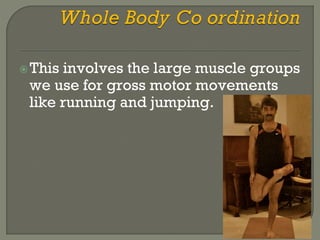
This involves the large muscle groups
we use for gross motor movements
like running and jumping.
This is required for tasks like catching,
throwing or hitting a ball, wielding a
racquet etc.
Requires knowledge of ‘Body
Boundary”.
i.e. a sense of where the body ends and where the
apparatus begins. In order to be able to catch a ball, a
sense of visual and spatial awareness along with a
sense of body boundary needs to be active.
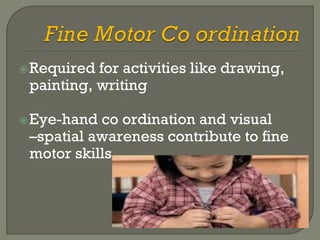
Required for activities like drawing,
painting, writing
Eye-hand co ordination and visual
–spatial awareness contribute to fine
motor skills.
The muscles in the mouth, lips must
work in synchronization to produce
speech.
Another set of muscles help in the
regulation of the tone and pitch of
speech
 A problem in any of these areas
would impede the child’s ability to
articulate speech clearly.
This is the ability to use the right hand
on the left side of the body and vice
versa.
Tying shoelaces, wearing socks,
trousers etc. are some activities that
require crossing the body midline.
Causes problems with two handed
co-ordination like opening a jam
bottle.
It is the study of how children learn to
move effectively & efficiently in
different environments.
Children with dyspraxia frequently
are unable to transfer learning from
one environment to another.
(E.g. a child has to visually understand whether there is enough space for
him to pass between the side table and sofa without bumping into either.
or he learns to swim in the sea, he may not realize that he can now swim
in the pool too).
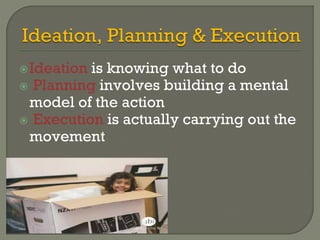
Ideation is knowing what to do
 Planning involves building a mental
model of the action
 Execution is actually carrying out the
movement
“It is widely accepted that the
development of controlled
movement has a part to play in the
intellectual development of
children. Children need to
experience movement in order to
learn about themselves, the
relationship to the environment and
the interaction between the two.”
(French & Lee, 2006)
https://www.youtube.com/watch?v=
9ZjQILd5esk
Many achieve motor skills at
typical times
May not generalize to other
settings
Motor difficulties continue to
be present into adolescence
and adulthood
3/14/2021 DCD/Dr Sen/Birch Hill Hospital
21
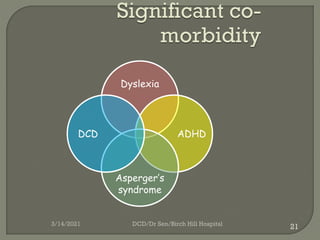
Dyslexia
ADHD
Asperger’s
syndrome
DCD
Can range from mild to severe
Gross and fine motor problems
Learning disabilities
Speech and articulation difficulties
Attention deficit disorders
Low self-esteem
Anxiety and depression
 No specific pathologic process or single
neuroanatomic site has been definitively
associated with DCD.
 DCD is not related to muscle pathology,
peripheral sensory abnormality, or central
nervous system damage that produces
spasticity, athetosis, or ataxia.
 Possible frontal and parietal lobe area
lesions
Associated with prematurity,
low birth weight
Prenatal, perinatal or neonatal
risk factors
 Usually not made until later in school age when
child learns and performs skills that require
adaptation in speed, timing, force or distance of
the movement
 Slowness of movement
 Decreased reaction time and movement time
 Rely on use of vision more heavily
 Decreased strength and power
 Poor hand-eye coordination
Decreased participation in sport and
leisure activities
Decreased opportunities for social
interaction
Decreased physical fitness across the
lifespan
Sedentary lifestyle health risks
 Studies demonstrate children with DCD do
not interpret and utilize sensory feedback
or feedback from task performance in the
same manner as other children
 NO internal representation of the motor
action
 Don’t learn from their mistakes
 Perform like earlier learning stages
 No pre-movement preparation
Freezing or fixing of joints during
task performance
Deliberate stabilization of joints
Movements are stiff, awkward,
clumsy in appearance
Stabilize so another part can be
moved with better control
Controls excess degrees of freedom
Less efficient, causes fatigue
Challenged in timing, duration and
sequencing
Determine what sports/leisure
activities will be successful
• Address specific necessary skills
Prevent long term effects of
inactivity
Address physical impairments
(low tone)
 Children with DCD have difficulty with
activities that require:
• Continuous adaptability
• Eye-hand coordination
• Variable environment
• Constant monitoring of feedback during task
performance
• High level of unpredictability
(e.g: hockey, baseball, basketball, football)
Children with DCD may be successful
with:
• Sequence of movements that are repetitive
• Swimming, skating, skiing, bicycling
• Lifestyle sports
https://www.youtube.com/watch?v=
ncnVYonMA5Y
Without intervention - many
children’s difficulties will persist into
later life- with long-term impact on
social, emotional and educational
well-being
May have learnt to compensate for
their difficulties
Self esteem building must be a key
element in any intervention plan

Children with developmental coordination disorders dcd

  • 1.
    Dr. Maria A.Efstratopoulou Associate Professor Special Education Deparment UAE University, UAE
  • 2.
    Be informed aboutthe different definitions of DCD and Dyspraxia Understand the symptoms and possible causes of the disorder Understand problems associated with DCD in learning , social interaction and everyday life activities for children Explore Intervention programs for children with DCD
  • 3.
    Children also describedas “low tone”, “mild motor” problems Also labeled: • Children with developmental dyspraxia • clumsy child syndrome • physically awkward • perceptual motor dysfunction • sensory integrative dysfunction
  • 4.
     Dyspraxia isa lifelong learning difficultly. It was first defined in the 1980s. Before then, people with this condition were just known as ‘clumsy’  It is often called ’the hidden handicap’, because if you look at a child with dyspraxia you wouldn't know that they have anything wrong with them.  Children with dyspraxia struggle with: gross motor control, fine motor control and sometimes problems with their speech.  Dyspraxia can overlap with other learning difficulties too, such as dyslexia, autism, ADHD, OCD, ASD, Dysgraphia and can lead to Anxiety and depression.
  • 5.
    Dys’ means ‘Faulty’ ‘Praxis’means ‘The ability to use the body as a skilled tool’ Children with dyspraxia find that moving with efficiently flowing movements does not come easily to them. They find this particularly difficult, especially in the face of a new challenge.
  • 6.
    “An impairment orimmaturity in the organization of movement which leads to associated problems with language, perception and thought.” This is the definition as per The Dyslexia Foundation 1997. 6
  • 7.
  • 8.
    “Chronic and usuallypermanent condition characterized by impairment of motor performance that is sufficient to produce functional motor performance deficits that are not explicable by the child's age or intellect, or by other diagnosable neurological or spatial-temporal organizational problems.”
  • 9.
     Specific developmentaldisorders of motor function  A serious impairment of motor co-ordination  Commonly associated with visuo-spatial impairment 3/14/2021 DCD/Dr Sen/Birch Hill Hospital 9
  • 10.
    Co ordination betweendifferent body parts is responsible for different kinds of actions. Depending upon the nature of activity, different kinds of co ordination is required.
  • 11.
    This involves thelarge muscle groups we use for gross motor movements like running and jumping.
  • 12.
    This is requiredfor tasks like catching, throwing or hitting a ball, wielding a racquet etc. Requires knowledge of ‘Body Boundary”. i.e. a sense of where the body ends and where the apparatus begins. In order to be able to catch a ball, a sense of visual and spatial awareness along with a sense of body boundary needs to be active.
  • 13.
    Required for activitieslike drawing, painting, writing Eye-hand co ordination and visual –spatial awareness contribute to fine motor skills.
  • 14.
    The muscles inthe mouth, lips must work in synchronization to produce speech. Another set of muscles help in the regulation of the tone and pitch of speech  A problem in any of these areas would impede the child’s ability to articulate speech clearly.
  • 15.
    This is theability to use the right hand on the left side of the body and vice versa. Tying shoelaces, wearing socks, trousers etc. are some activities that require crossing the body midline. Causes problems with two handed co-ordination like opening a jam bottle.
  • 16.
    It is thestudy of how children learn to move effectively & efficiently in different environments. Children with dyspraxia frequently are unable to transfer learning from one environment to another. (E.g. a child has to visually understand whether there is enough space for him to pass between the side table and sofa without bumping into either. or he learns to swim in the sea, he may not realize that he can now swim in the pool too).
  • 17.
    Ideation is knowingwhat to do  Planning involves building a mental model of the action  Execution is actually carrying out the movement
  • 18.
    “It is widelyaccepted that the development of controlled movement has a part to play in the intellectual development of children. Children need to experience movement in order to learn about themselves, the relationship to the environment and the interaction between the two.” (French & Lee, 2006)
  • 19.
  • 20.
    Many achieve motorskills at typical times May not generalize to other settings Motor difficulties continue to be present into adolescence and adulthood
  • 21.
    3/14/2021 DCD/Dr Sen/BirchHill Hospital 21 Dyslexia ADHD Asperger’s syndrome DCD
  • 22.
    Can range frommild to severe Gross and fine motor problems Learning disabilities Speech and articulation difficulties Attention deficit disorders Low self-esteem Anxiety and depression
  • 23.
     No specificpathologic process or single neuroanatomic site has been definitively associated with DCD.  DCD is not related to muscle pathology, peripheral sensory abnormality, or central nervous system damage that produces spasticity, athetosis, or ataxia.  Possible frontal and parietal lobe area lesions
  • 24.
    Associated with prematurity, lowbirth weight Prenatal, perinatal or neonatal risk factors
  • 25.
     Usually notmade until later in school age when child learns and performs skills that require adaptation in speed, timing, force or distance of the movement  Slowness of movement  Decreased reaction time and movement time  Rely on use of vision more heavily  Decreased strength and power  Poor hand-eye coordination
  • 26.
    Decreased participation insport and leisure activities Decreased opportunities for social interaction Decreased physical fitness across the lifespan Sedentary lifestyle health risks
  • 27.
     Studies demonstratechildren with DCD do not interpret and utilize sensory feedback or feedback from task performance in the same manner as other children  NO internal representation of the motor action  Don’t learn from their mistakes  Perform like earlier learning stages  No pre-movement preparation
  • 28.
    Freezing or fixingof joints during task performance Deliberate stabilization of joints Movements are stiff, awkward, clumsy in appearance
  • 29.
    Stabilize so anotherpart can be moved with better control Controls excess degrees of freedom Less efficient, causes fatigue Challenged in timing, duration and sequencing
  • 30.
    Determine what sports/leisure activitieswill be successful • Address specific necessary skills Prevent long term effects of inactivity Address physical impairments (low tone)
  • 31.
     Children withDCD have difficulty with activities that require: • Continuous adaptability • Eye-hand coordination • Variable environment • Constant monitoring of feedback during task performance • High level of unpredictability (e.g: hockey, baseball, basketball, football)
  • 32.
    Children with DCDmay be successful with: • Sequence of movements that are repetitive • Swimming, skating, skiing, bicycling • Lifestyle sports
  • 33.
  • 35.
    Without intervention -many children’s difficulties will persist into later life- with long-term impact on social, emotional and educational well-being May have learnt to compensate for their difficulties Self esteem building must be a key element in any intervention plan