Child motor development
Motor development can be understood as the way
children learn to use their bodies and their ability to
do the tasks they want to do. Children use their
muscles to do small, precise tasks, such as
cutting, which is a fine motor skill. Muscles are also
used for larger tasks such as running, which is
considered a gross motor task. Developing gross
motor skills and fine motor skills gives your child
the building blocks he needs to skip, play or dance.
Gross Motor Skills


 gross motor skills are the skills your child needs
 to move her body and do activities that use her
 arms and legs. Children develop their large
 motor muscles before their smaller muscles;
 therefore, crawling, walking, running or wiggling
 will progress before skills such as cutting or
 weaving. Simply doing activities that use your
 child's large muscles will help further the
 development of them.
Fine Motor Skills

 Fine motor skills refer to the child's abilities to use
  his hands and feet and his coordination with his
  fingers and toes. Grasping, using scissors, opening
  or closing
  hands, clapping, throwing, catching, folding or
  unfolding are all examples of activities that use the
  small motor skills. Fine motor skills develop well
  after the larger motor skills and giving your child
  tasks that require skills more advanced than his
  developmental range can lead to frustration.
Small Muscle Control
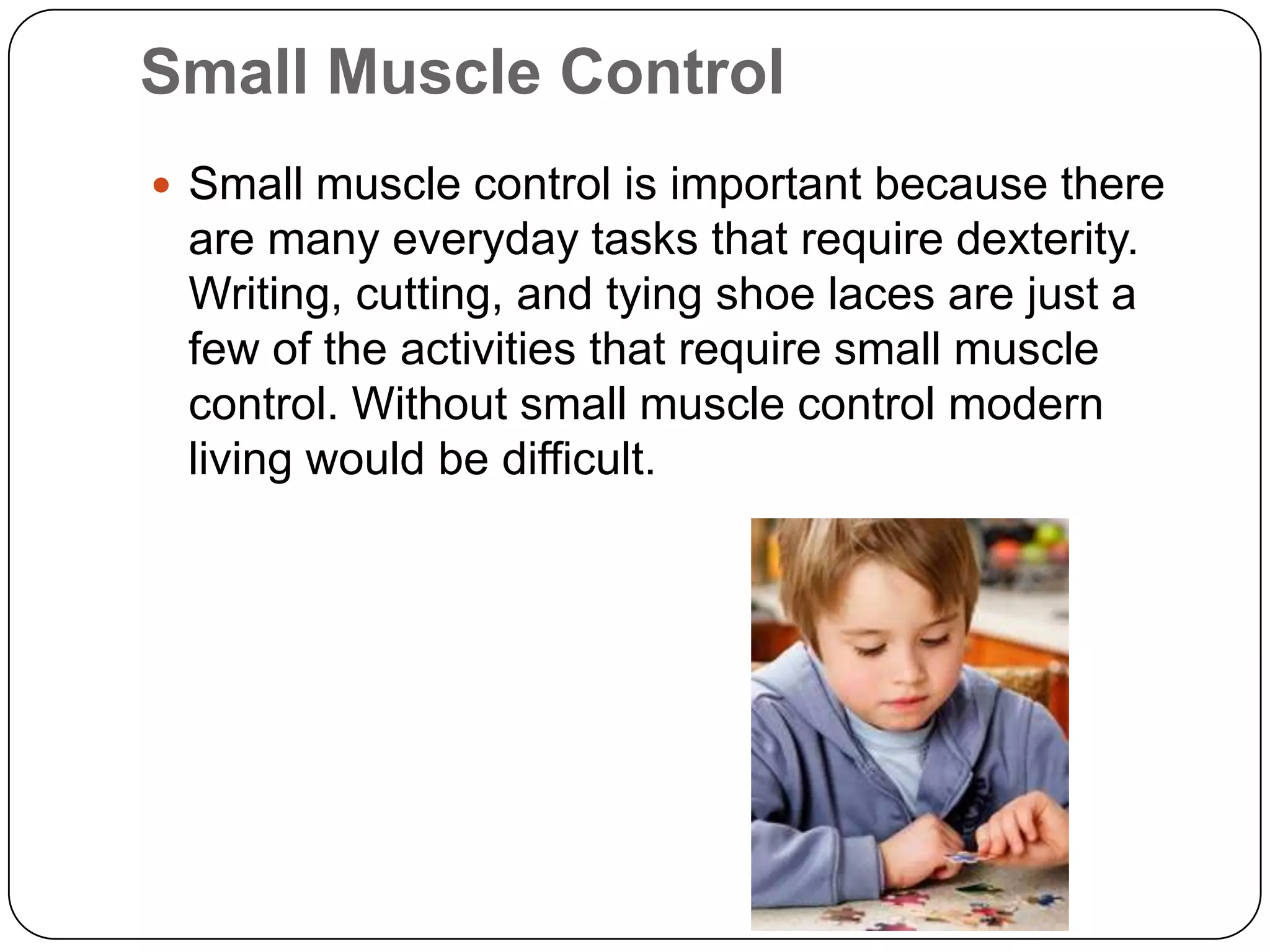
 Small muscle control is important because there
 are many everyday tasks that require dexterity.
 Writing, cutting, and tying shoe laces are just a
 few of the activities that require small muscle
 control. Without small muscle control modern
 living would be difficult.
How Is Small Muscle Control Developed?


 Small muscle control can be developed by
 practice. For example, the more a child writes his
 or her name the more confident (s)he will become
 in forming the letters and writing legible. In the
 same vein, the more a child ties his or her shoe
 laces the more skilled (s)he will become at
 making loops and knots. The same goes for any
 activity that requires small muscle control – the
 more the activity is practiced, the greater small
 muscle control will be.
Fine Motor Play

 Children use a wide variety of objects to develop small
  muscles used for fine motor activities. Building block sets
  such as Lego and Duple build fine motor skills as children
  put them together and pull them apart. Provide old
  newspapers and magazines and let children practice
  tearing off strips of paper and wadding them into balls.
  Sand, rice and water tables offer an endless number of
  play activities for toddlers. A pail and shovel with a pile of
  sand turn children into architects and designers; if you add
  some small cars, they become race car drivers. A rice table
  provides an interesting play surface and a good place to
  hide and find small objects. A water table can be a
  swimming pool for vinyl or plastic dolls, or a lake to float
  boats on. Provide plastic aprons to cover the toddlers
  clothing when they play at the water table. Keep sand and
  water tables on opposite sides of the classroom or open
  only one at a time to avoid having mud tables.
How Is Large Muscle Control Developed?

 Activities to help children develop gross motor skills are
  those that improve coordination in the large muscles and
  that help children with control and coordination of their
  bodies. These skills include head control, rolling and
  walking in very young children, and skills such as running,
  jumping and hopping in older children. There are many
  different kinds of activities that can help children develop
  gross motor skills. The appropriate activities depend upon
  the child's age and the level to which skills have developed
  in the individual.


For example:
  Jump ropes can be incorporated into activities to develop
  gross motor skills with different activities depending upon
  the child's age level.
 Preschool teachers often gather toddlers into a group or
  circle for fun activities that develop gross motor skills.
  Games of Simon Says, Follow the Leader, Duck, Duck,
  Goose, London Bridges and Head and Shoulders, Knees
  and Toes have been used for years and are still popular
  with children today. You can encourage children to engage
  in motor play activities by setting up play areas such as a
  block area where toddlers can build towers, walk under
  them, knock them down and step over them. Lay a sheet
  of bubble wrap on the floor and let children walk and jump
  on it. Provide soft-textured balls, such as inflatable beach
  balls, koosh balls and stress balls, for indoor use. Hang a
  beach ball from the ceiling so toddlers can jump up and hit
  it and leave one down so children can throw and kick it.
  Play a game of hot potato with a ball, tossing it from one
  person to the next. Children also love to dance, so provide
  music to help them get their groove on. Freestyle dance
  works, or you can teach toddlers the bunny hop, chicken
  dance and the hokey pokey.
Developmental Milestones
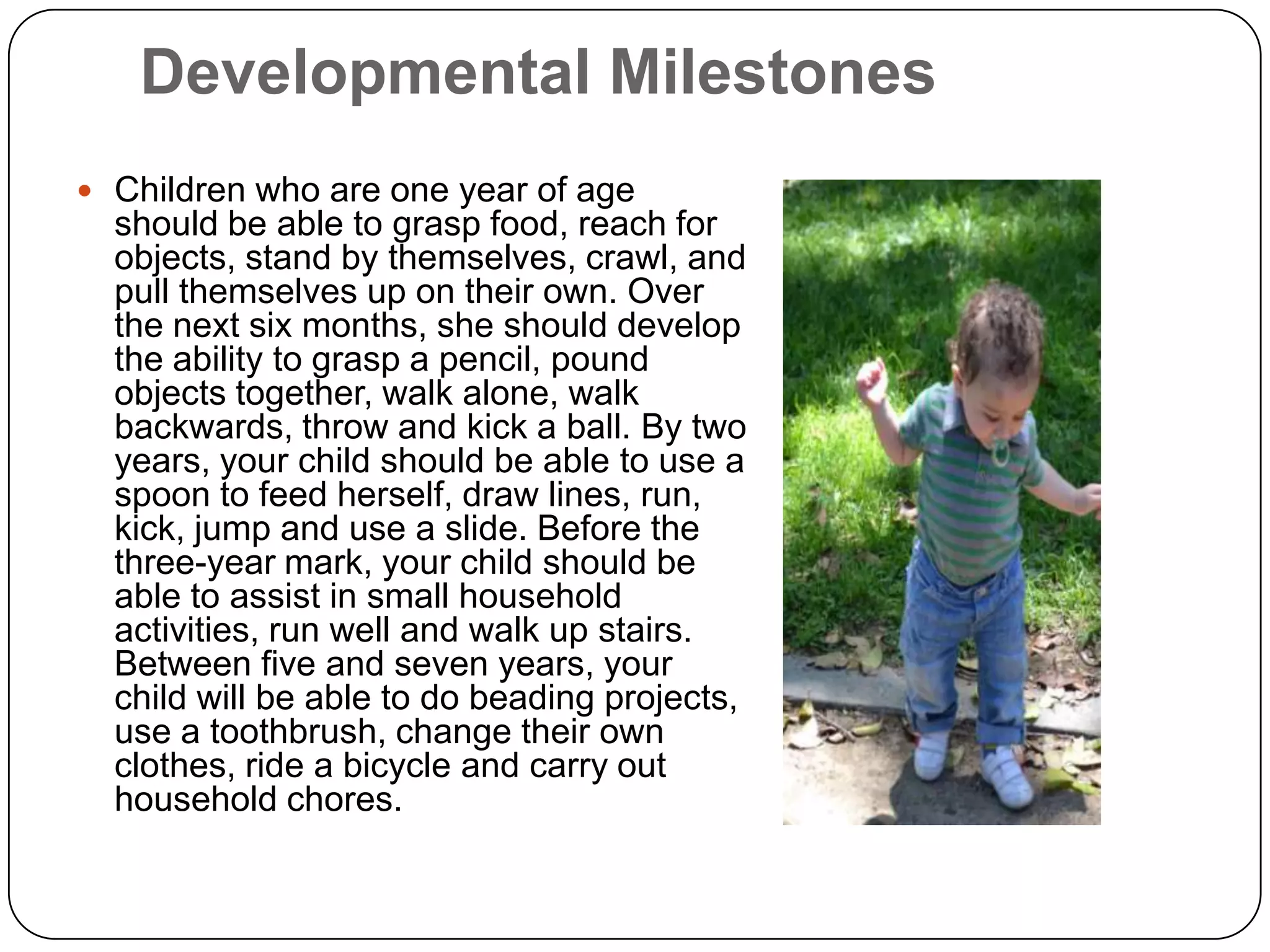
 Children who are one year of age
  should be able to grasp food, reach for
  objects, stand by themselves, crawl, and
  pull themselves up on their own. Over
  the next six months, she should develop
  the ability to grasp a pencil, pound
  objects together, walk alone, walk
  backwards, throw and kick a ball. By two
  years, your child should be able to use a
  spoon to feed herself, draw lines, run,
  kick, jump and use a slide. Before the
  three-year mark, your child should be
  able to assist in small household
  activities, run well and walk up stairs.
  Between five and seven years, your
  child will be able to do beading projects,
  use a toothbrush, change their own
  clothes, ride a bicycle and carry out
  household chores.
Encouraging Motor Development
 During the first year of
  life, make sure your child's
  blankets are loose enough
  that he can use his arms
  and legs to develop his
  muscles. Also, encourage
  him to try activities that are
  just beyond his
  abilities, though not far
  enough advanced that it
  frustrates him and gives him
  a sense of failure. Push him
  to crawl, and as he gets
  older, to
  stand, jump, walk, climb, pla
  y in sand or balance.

Child motor development

  • 1.
  • 2.
    Motor development canbe understood as the way children learn to use their bodies and their ability to do the tasks they want to do. Children use their muscles to do small, precise tasks, such as cutting, which is a fine motor skill. Muscles are also used for larger tasks such as running, which is considered a gross motor task. Developing gross motor skills and fine motor skills gives your child the building blocks he needs to skip, play or dance.
  • 3.
    Gross Motor Skills gross motor skills are the skills your child needs to move her body and do activities that use her arms and legs. Children develop their large motor muscles before their smaller muscles; therefore, crawling, walking, running or wiggling will progress before skills such as cutting or weaving. Simply doing activities that use your child's large muscles will help further the development of them.
  • 4.
    Fine Motor Skills Fine motor skills refer to the child's abilities to use his hands and feet and his coordination with his fingers and toes. Grasping, using scissors, opening or closing hands, clapping, throwing, catching, folding or unfolding are all examples of activities that use the small motor skills. Fine motor skills develop well after the larger motor skills and giving your child tasks that require skills more advanced than his developmental range can lead to frustration.
  • 5.
    Small Muscle Control Small muscle control is important because there are many everyday tasks that require dexterity. Writing, cutting, and tying shoe laces are just a few of the activities that require small muscle control. Without small muscle control modern living would be difficult.
  • 6.
    How Is SmallMuscle Control Developed?  Small muscle control can be developed by practice. For example, the more a child writes his or her name the more confident (s)he will become in forming the letters and writing legible. In the same vein, the more a child ties his or her shoe laces the more skilled (s)he will become at making loops and knots. The same goes for any activity that requires small muscle control – the more the activity is practiced, the greater small muscle control will be.
  • 7.
    Fine Motor Play Children use a wide variety of objects to develop small muscles used for fine motor activities. Building block sets such as Lego and Duple build fine motor skills as children put them together and pull them apart. Provide old newspapers and magazines and let children practice tearing off strips of paper and wadding them into balls. Sand, rice and water tables offer an endless number of play activities for toddlers. A pail and shovel with a pile of sand turn children into architects and designers; if you add some small cars, they become race car drivers. A rice table provides an interesting play surface and a good place to hide and find small objects. A water table can be a swimming pool for vinyl or plastic dolls, or a lake to float boats on. Provide plastic aprons to cover the toddlers clothing when they play at the water table. Keep sand and water tables on opposite sides of the classroom or open only one at a time to avoid having mud tables.
  • 8.
    How Is LargeMuscle Control Developed?  Activities to help children develop gross motor skills are those that improve coordination in the large muscles and that help children with control and coordination of their bodies. These skills include head control, rolling and walking in very young children, and skills such as running, jumping and hopping in older children. There are many different kinds of activities that can help children develop gross motor skills. The appropriate activities depend upon the child's age and the level to which skills have developed in the individual. For example: Jump ropes can be incorporated into activities to develop gross motor skills with different activities depending upon the child's age level.
  • 9.
     Preschool teachersoften gather toddlers into a group or circle for fun activities that develop gross motor skills. Games of Simon Says, Follow the Leader, Duck, Duck, Goose, London Bridges and Head and Shoulders, Knees and Toes have been used for years and are still popular with children today. You can encourage children to engage in motor play activities by setting up play areas such as a block area where toddlers can build towers, walk under them, knock them down and step over them. Lay a sheet of bubble wrap on the floor and let children walk and jump on it. Provide soft-textured balls, such as inflatable beach balls, koosh balls and stress balls, for indoor use. Hang a beach ball from the ceiling so toddlers can jump up and hit it and leave one down so children can throw and kick it. Play a game of hot potato with a ball, tossing it from one person to the next. Children also love to dance, so provide music to help them get their groove on. Freestyle dance works, or you can teach toddlers the bunny hop, chicken dance and the hokey pokey.
  • 10.
    Developmental Milestones  Childrenwho are one year of age should be able to grasp food, reach for objects, stand by themselves, crawl, and pull themselves up on their own. Over the next six months, she should develop the ability to grasp a pencil, pound objects together, walk alone, walk backwards, throw and kick a ball. By two years, your child should be able to use a spoon to feed herself, draw lines, run, kick, jump and use a slide. Before the three-year mark, your child should be able to assist in small household activities, run well and walk up stairs. Between five and seven years, your child will be able to do beading projects, use a toothbrush, change their own clothes, ride a bicycle and carry out household chores.
  • 11.
    Encouraging Motor Development During the first year of life, make sure your child's blankets are loose enough that he can use his arms and legs to develop his muscles. Also, encourage him to try activities that are just beyond his abilities, though not far enough advanced that it frustrates him and gives him a sense of failure. Push him to crawl, and as he gets older, to stand, jump, walk, climb, pla y in sand or balance.