“Sensory Storms”
                                      Causing Challenging Behavior


Adapted from Becky Parker, M. Ed.
Early Childhood/Special Education
Types of Misbehavior

• Attention getting

• Aggressive (redirect with words)

• Non-Compliant (give choices)

• Sensory
Sensory Problems

• A child's learning and behavior
  problems may be the result of
  a neurological disorder (a
  sensory dysfunction) that the
  child cannot control.
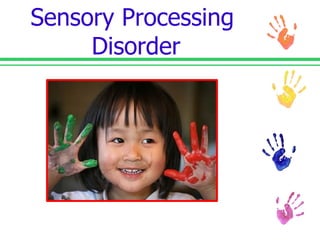
Sensory Processing
     Disorder
Definition

• Children with sensory
  processing disorder have
  difficulty processing
  information from the senses
  (touch, movement, smell,
  taste, vision, and hearing) and
  responding normally to that
  information.
Who Has Sensory
Processing Disorder?
• Children with Autism, Asperger's,
  Cerebral Palsy and other
  developmental disabilities often have
  SID.
• However, it can also be associated
  with premature birth, brain injury,
  learning disorders, and other
  conditions.
What Causes SDI?
• The exact cause is not known.

• Most research suggests it may be due
  to irregular brain function.

• Some children experience small
absence seizures.
Typical Sensory Systems

 • We all have a sensory system,
   specific to OUR body
      ...Discussion...
 • Bare foot vs. shoes
 • Blankets on the bed
 • Temperature
 • Food Textures
Normal Thresholds
  High Arousal – High Sensitivity


  Normal (Optimal) Arousal Level


Low Arousal Level – Low Sensitivity
Sensory Survey - Basics
•   Attention and Regulatory Problems
•   Sensory Defensiveness
•   Activity Levels
•   Behaviors
•   Auditory Processing Problems
Low Sensory (Seekers)
•   Active or fidgety
•   Can't sit still
•   Runs not walks
•   Impulsive
•   Jump, swing, and spin excessively
•   Bumps into people or things
•   Difficulty figuring out how to do new tasks
        – Their little body system is on
            overload
Interventions for Seekers
• Heavy Work – pushing
      – Extra Stimulation - pushing grocery
         cart
      – Push/pull scooters
• Swinging (1, 2, 3)
• Jumping (Toddler Lab – jump-a-roo)
• Hippity Hop Balls (Yoga Balls)
• Climbing
• Sit on ball or disc
High Sensitivity
        (Avoiders)
• Doesn't like crowds or being touched
  by others
• Dislikes getting dirty or working with
  messy supplies (glue, shaving cream,
  finger paint, or soap)
• Oversensitive to odors or lights
• Refuses to eat certain food –
  especially due to texture
High Sensitivity Cont.
• Withdraws when being touched
• Hypersensitive to certain fabrics and
  usually likes clothes that are soft or
  comforting
• Is uncomfortable with some
  movements: swinging, sliding,
  climbing, etc.
• Overly sensitive to sound: Vacuum
  cleaners, lawn mowers, hair dryers,
  etc.
Calming an OVER
         stimulated child
• Deep pressure – hugs, cushions, vest, back
  packs, bean bags, hands on shoulders
• Deep massage
• Joint compression
• Hot baths or warm water in sink
• Heavy work – pushing clothes in baskets,
  crawling, pounding (playdough, drum, etc)
• Low lights, quiet place, wearing a hat or visor
• Calm, reassuring voices
• Running – wears off stress
Tantrums
• Manipulative vs. “Spill-over”
    –   Manipulative tantrums = to get what they want
                     vs.
    –   “Spill-over” or overload tantrums = can't hold it in.
           •     “Cry hard then sleep hard”


• Cannot stop them once they start

• Child is often “sorry” afterwards
What DOESN'T work
• Anger, force or pressure to do
  something
    – This only heightens anxiety
    and fear, they may become
    more stuck, really won't do it,
    or cannot reason and think
    clearly
Last things to Remember
• Realize sometime pressure heightens
  fear
• You cannot reason with the unreasonable
• Consequences are meaningless
• Think “gentle persuasion” more often
  than not
• Use a soft, caring voice
• Sometimes YOU are or will have to be
  their emotional regulator
Use of templates
You are free to use these templates for your personal
and business presentations.

We have put a lot of work into developing all these templates and retain the copyright
in them. They are not Open Source templates. You can use them freely providing
that you do not redistribute or sell them.

Do                                        Don’t
 Use these templates for your           Resell or distribute these templates
  presentations                          Put these templates on a website for
 Display your presentation on a web      download. This includes uploading
  site provided that it is not for the    them onto file sharing networks like
  purpose of downloading the              Slideshare, Myspace, Facebook, bit
  template.                               torrent etc
 If you like these templates, we would  Pass off any of our created content as
  always appreciate a link back to our    your own work
  website. Many thanks.

          You can find many more free templates on the
                Presentation Magazine website
               www.presentationmagazine.com

Sensory Processing Disorder Powerpoint

  • 1.
    “Sensory Storms” Causing Challenging Behavior Adapted from Becky Parker, M. Ed. Early Childhood/Special Education
  • 2.
    Types of Misbehavior •Attention getting • Aggressive (redirect with words) • Non-Compliant (give choices) • Sensory
  • 3.
    Sensory Problems • Achild's learning and behavior problems may be the result of a neurological disorder (a sensory dysfunction) that the child cannot control.
  • 4.
  • 5.
    Definition • Children withsensory processing disorder have difficulty processing information from the senses (touch, movement, smell, taste, vision, and hearing) and responding normally to that information.
  • 6.
    Who Has Sensory ProcessingDisorder? • Children with Autism, Asperger's, Cerebral Palsy and other developmental disabilities often have SID. • However, it can also be associated with premature birth, brain injury, learning disorders, and other conditions.
  • 7.
    What Causes SDI? •The exact cause is not known. • Most research suggests it may be due to irregular brain function. • Some children experience small absence seizures.
  • 8.
    Typical Sensory Systems • We all have a sensory system, specific to OUR body ...Discussion... • Bare foot vs. shoes • Blankets on the bed • Temperature • Food Textures
  • 9.
    Normal Thresholds High Arousal – High Sensitivity Normal (Optimal) Arousal Level Low Arousal Level – Low Sensitivity
  • 10.
    Sensory Survey -Basics • Attention and Regulatory Problems • Sensory Defensiveness • Activity Levels • Behaviors • Auditory Processing Problems
  • 11.
    Low Sensory (Seekers) • Active or fidgety • Can't sit still • Runs not walks • Impulsive • Jump, swing, and spin excessively • Bumps into people or things • Difficulty figuring out how to do new tasks – Their little body system is on overload
  • 12.
    Interventions for Seekers •Heavy Work – pushing – Extra Stimulation - pushing grocery cart – Push/pull scooters • Swinging (1, 2, 3) • Jumping (Toddler Lab – jump-a-roo) • Hippity Hop Balls (Yoga Balls) • Climbing • Sit on ball or disc
  • 13.
    High Sensitivity (Avoiders) • Doesn't like crowds or being touched by others • Dislikes getting dirty or working with messy supplies (glue, shaving cream, finger paint, or soap) • Oversensitive to odors or lights • Refuses to eat certain food – especially due to texture
  • 14.
    High Sensitivity Cont. •Withdraws when being touched • Hypersensitive to certain fabrics and usually likes clothes that are soft or comforting • Is uncomfortable with some movements: swinging, sliding, climbing, etc. • Overly sensitive to sound: Vacuum cleaners, lawn mowers, hair dryers, etc.
  • 15.
    Calming an OVER stimulated child • Deep pressure – hugs, cushions, vest, back packs, bean bags, hands on shoulders • Deep massage • Joint compression • Hot baths or warm water in sink • Heavy work – pushing clothes in baskets, crawling, pounding (playdough, drum, etc) • Low lights, quiet place, wearing a hat or visor • Calm, reassuring voices • Running – wears off stress
  • 16.
    Tantrums • Manipulative vs.“Spill-over” – Manipulative tantrums = to get what they want vs. – “Spill-over” or overload tantrums = can't hold it in. • “Cry hard then sleep hard” • Cannot stop them once they start • Child is often “sorry” afterwards
  • 17.
    What DOESN'T work •Anger, force or pressure to do something – This only heightens anxiety and fear, they may become more stuck, really won't do it, or cannot reason and think clearly
  • 18.
    Last things toRemember • Realize sometime pressure heightens fear • You cannot reason with the unreasonable • Consequences are meaningless • Think “gentle persuasion” more often than not • Use a soft, caring voice • Sometimes YOU are or will have to be their emotional regulator
  • 19.
    Use of templates Youare free to use these templates for your personal and business presentations. We have put a lot of work into developing all these templates and retain the copyright in them. They are not Open Source templates. You can use them freely providing that you do not redistribute or sell them. Do Don’t  Use these templates for your  Resell or distribute these templates presentations  Put these templates on a website for  Display your presentation on a web download. This includes uploading site provided that it is not for the them onto file sharing networks like purpose of downloading the Slideshare, Myspace, Facebook, bit template. torrent etc  If you like these templates, we would  Pass off any of our created content as always appreciate a link back to our your own work website. Many thanks. You can find many more free templates on the Presentation Magazine website www.presentationmagazine.com