Managing Risk & Risk Assessment
“Making the right decisions”
Alan CookAlan CookAlan CookAlan Cook CMIOSH MIIRSM
Head of Safety, Health & Environment
Forterra Building Products Limited
Conference 18th December 2015
• • •
• • •
• • •
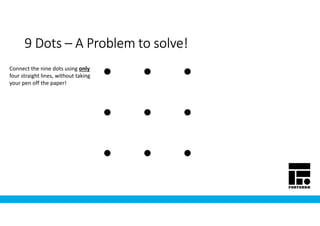
9 Dots9 Dots9 Dots9 Dots –––– A Problem to solve!A Problem to solve!A Problem to solve!A Problem to solve!
Connect the nine dots using only
four straight lines, without taking
your pen off the paper!
• • •
• • •
• • •
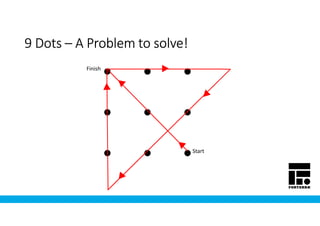
9 Dots9 Dots9 Dots9 Dots –––– A Problem to solve!A Problem to solve!A Problem to solve!A Problem to solve!
Start
Finish
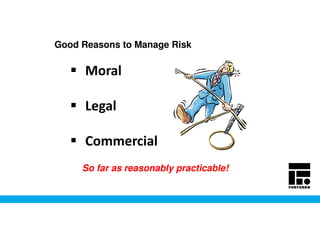
Good Reasons to Manage Risk
Moral
Legal
Commercial
So far as reasonably practicable!
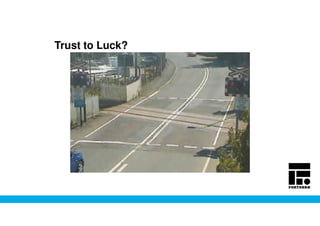
Trust to Luck?
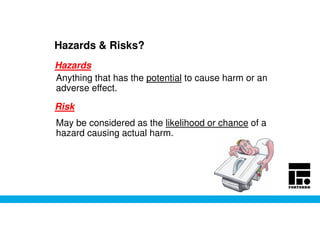
Hazards & Risks?
Hazards
Risk
May be considered as the likelihood or chance of a
hazard causing actual harm.
Anything that has the potential to cause harm or an
adverse effect.
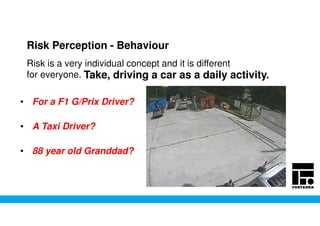
Risk Perception - Behaviour
• For a F1 G/Prix Driver?
• A Taxi Driver?
• 88 year old Granddad?
Risk is a very individual concept and it is different
for everyone. Take, driving a car as a daily activity.
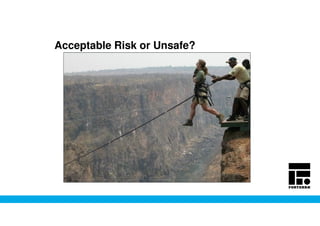
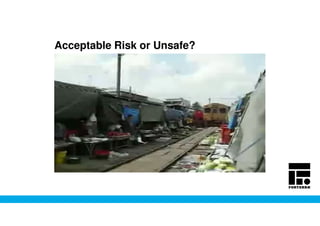
Acceptable Risk or Unsafe?
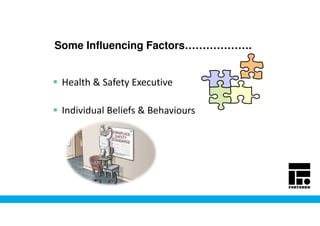
Some Influencing Factors……………….
Health & Safety Executive
Individual Beliefs & Behaviours
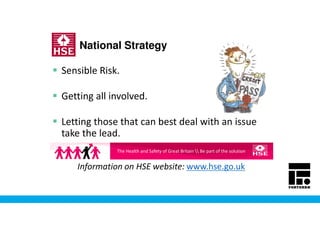
National Strategy
Sensible Risk.
Getting all involved.
Letting those that can best deal with an issue
take the lead.
Information on HSE website: www.hse.go.uk
The Health and Safety of Great Britain  Be part of the solution
Individual BehavioursIndividual BehavioursIndividual BehavioursIndividual Behaviours
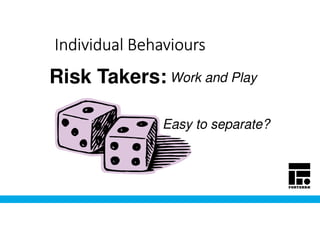
Risk Takers:
Easy to separate?
Work and Play
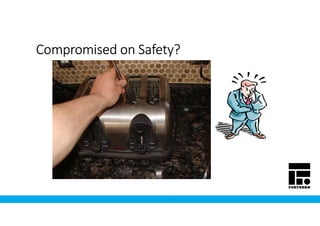
Compromised on Safety?Compromised on Safety?Compromised on Safety?Compromised on Safety?
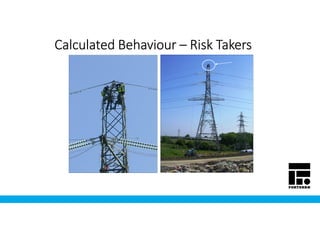
Calculated BehaviourCalculated BehaviourCalculated BehaviourCalculated Behaviour –––– Risk TakersRisk TakersRisk TakersRisk Takers
Impulsive BehaviourImpulsive BehaviourImpulsive BehaviourImpulsive Behaviour –––– Risk TakersRisk TakersRisk TakersRisk Takers
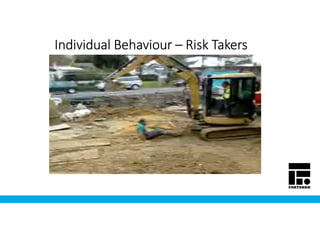
Individual BehaviourIndividual BehaviourIndividual BehaviourIndividual Behaviour –––– Risk TakersRisk TakersRisk TakersRisk Takers
• Risk Takers: Work and Play
• Concentration: May be competent, but can become
complacent. Done it all before……….!
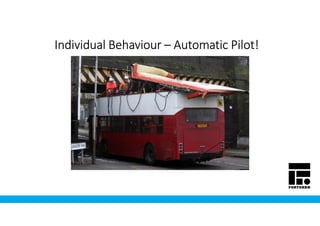
Individual BehaviourIndividual BehaviourIndividual BehaviourIndividual Behaviour –––– Automatic Pilot!Automatic Pilot!Automatic Pilot!Automatic Pilot!
Colour Changing Card Trick!Colour Changing Card Trick!Colour Changing Card Trick!Colour Changing Card Trick!
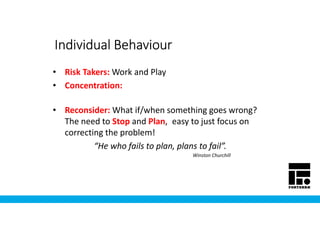
Individual BehaviourIndividual BehaviourIndividual BehaviourIndividual Behaviour
• Risk Takers: Work and Play
• Concentration:
• Reconsider: What if/when something goes wrong?
The need to Stop and Plan,. easy to just focus on
correcting the problem!
“He who fails to plan, plans to fail”.
Winston Churchill
The Experts…….!The Experts…….!The Experts…….!The Experts…….!
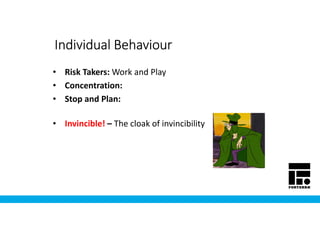
Individual BehaviourIndividual BehaviourIndividual BehaviourIndividual Behaviour
• Risk Takers: Work and Play
• Concentration:
• Stop and Plan:
• Invincible! – The cloak of invincibility
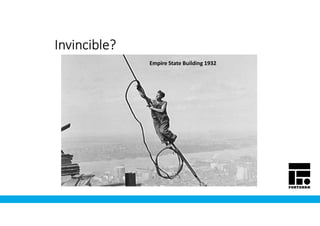
Invincible?Invincible?Invincible?Invincible?
Empire State Building 1932
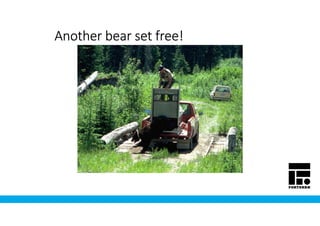
Another bear set free!Another bear set free!Another bear set free!Another bear set free!
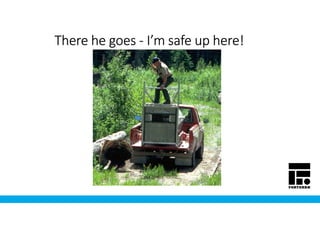
There he goesThere he goesThere he goesThere he goes ---- I’m safe up here!I’m safe up here!I’m safe up here!I’m safe up here!
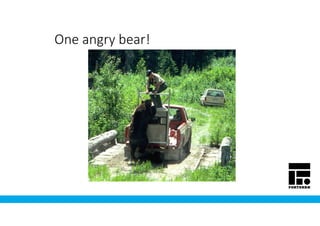
One angry bear!
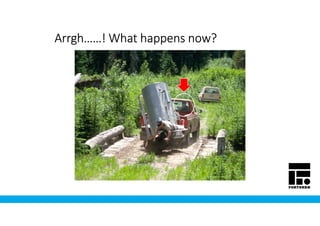
ArrghArrghArrghArrgh……! What happens now?……! What happens now?……! What happens now?……! What happens now?
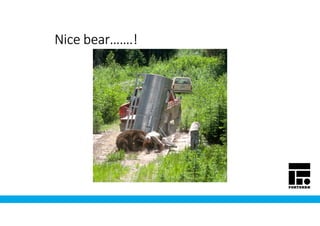
Nice bear…….!Nice bear…….!Nice bear…….!Nice bear…….!
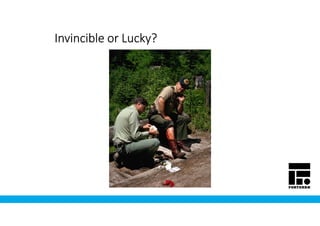
Invincible or Lucky?Invincible or Lucky?Invincible or Lucky?Invincible or Lucky?
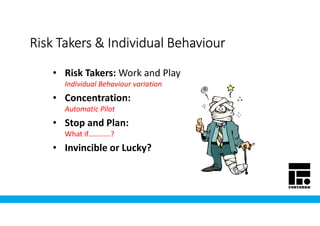
Risk Takers & Individual BehaviourRisk Takers & Individual BehaviourRisk Takers & Individual BehaviourRisk Takers & Individual Behaviour
• Risk Takers: Work and Play
Individual Behaviour variation
• Concentration:
Automatic Pilot
• Stop and Plan:
What if…………?
• Invincible or Lucky?
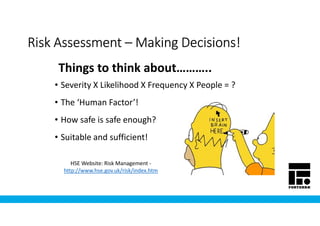
Risk AssessmentRisk AssessmentRisk AssessmentRisk Assessment –––– Making Decisions!Making Decisions!Making Decisions!Making Decisions!
• Severity X Likelihood X Frequency X People = ?
• The ‘Human Factor’!
• How safe is safe enough?
• Suitable and sufficient!
Things to think about………..
HSE Website: Risk Management -
http://www.hse.gov.uk/risk/index.htm
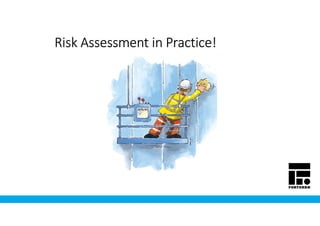
Risk Assessment in Practice!Risk Assessment in Practice!Risk Assessment in Practice!Risk Assessment in Practice!
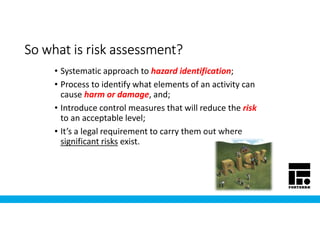
So what is risk assessment?So what is risk assessment?So what is risk assessment?So what is risk assessment?
• Systematic approach to hazard identification;
• Process to identify what elements of an activity can
cause harm or damage, and;
• Introduce control measures that will reduce the risk
to an acceptable level;
• It’s a legal requirement to carry them out where
significant risks exist.
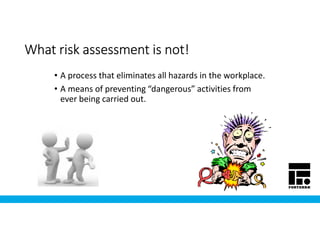
What risk assessment is not!What risk assessment is not!What risk assessment is not!What risk assessment is not!
• A process that eliminates all hazards in the workplace.
• A means of preventing “dangerous” activities from
ever being carried out.
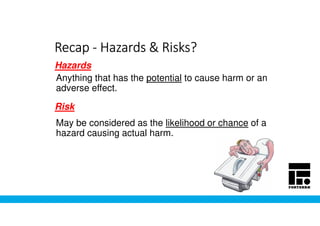
RecapRecapRecapRecap ---- Hazards & Risks?Hazards & Risks?Hazards & Risks?Hazards & Risks?
Hazards
Risk
May be considered as the likelihood or chance of a
hazard causing actual harm.
Anything that has the potential to cause harm or an
adverse effect.
Risk assessmentRisk assessmentRisk assessmentRisk assessment –––– legal requirementlegal requirementlegal requirementlegal requirement
• The Management of Health and Safety at Work
Regulations (overarching regulations).
• “Every employer shall make a suitable and sufficient
assessment of the risk to the health and safety of his
employees to which they are exposed whilst at work”.
• Trivial risks can usually be ignored as can risks arising
from routine activities associated with life in general,
unless work actively compounds those risks.
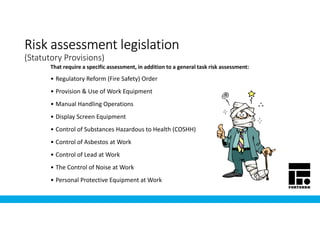
Risk assessment legislationRisk assessment legislationRisk assessment legislationRisk assessment legislation
(Statutory Provisions)
• Regulatory Reform (Fire Safety) Order
• Provision & Use of Work Equipment
• Manual Handling Operations
• Display Screen Equipment
• Control of Substances Hazardous to Health (COSHH)
• Control of Asbestos at Work
• Control of Lead at Work
• The Control of Noise at Work
• Personal Protective Equipment at Work
That require a specific assessment, in addition to a general task risk assessment:
To be “Suitable & Sufficient”To be “Suitable & Sufficient”To be “Suitable & Sufficient”To be “Suitable & Sufficient”
a risk assessment must:
•Identify the significant risks that may arise from the
work or in connection with it;
•Be appropriate to the nature of the work;
•Implementation of suitable controls to reduce risks to
an acceptable level;
•Comply with relevant statutory provision, and;
•Be valid over a reasonable period of time.
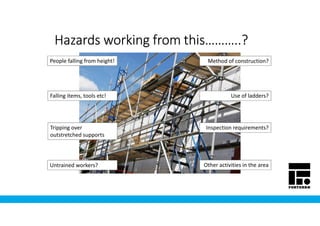
Hazards working from this………..?Hazards working from this………..?Hazards working from this………..?Hazards working from this………..?
Tripping over
outstretched supports
People falling from height!
Falling items, tools etc!
Method of construction?
Use of ladders?
Inspection requirements?
Other activities in the areaUntrained workers?
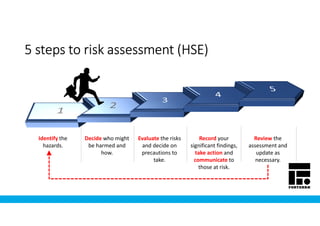
5 steps to risk assessment (HSE)5 steps to risk assessment (HSE)5 steps to risk assessment (HSE)5 steps to risk assessment (HSE)
Identify the
hazards.
Decide who might
be harmed and
how.
Evaluate the risks
and decide on
precautions to
take.
Record your
significant findings,
take action and
communicate to
those at risk.
Review the
assessment and
update as
necessary.
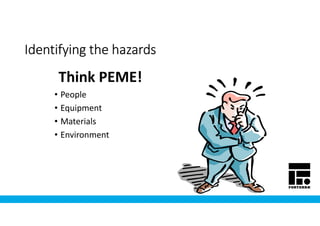
Identifying the hazardsIdentifying the hazardsIdentifying the hazardsIdentifying the hazards
• People
• Equipment
• Materials
• Environment
Think PEME!
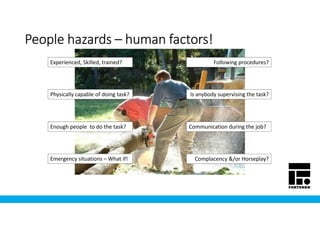
People hazardsPeople hazardsPeople hazardsPeople hazards –––– human factors!human factors!human factors!human factors!
Experienced, Skilled, trained? Following procedures?
Physically capable of doing task? Is anybody supervising the task?
Enough people to do the task? Communication during the job?
Emergency situations – What if! Complacency &/or Horseplay?
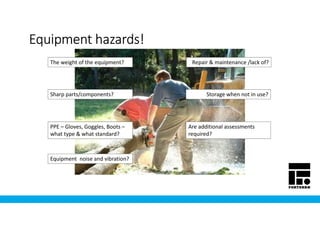
Equipment hazards!Equipment hazards!Equipment hazards!Equipment hazards!
The weight of the equipment? Repair & maintenance /lack of?
Sharp parts/components? Storage when not in use?
PPE – Gloves, Goggles, Boots –
what type & what standard?
Equipment noise and vibration?
Are additional assessments
required?
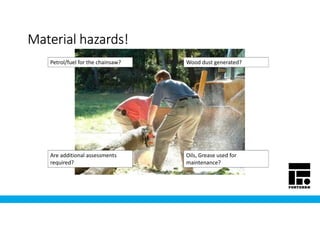
Material hazards!Material hazards!Material hazards!Material hazards!
Petrol/fuel for the chainsaw? Wood dust generated?
Oils, Grease used for
maintenance?
Are additional assessments
required?
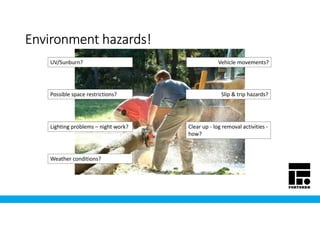
EnvironmentEnvironmentEnvironmentEnvironment hhhhazards!azards!azards!azards!
UV/Sunburn? Vehicle movements?
Possible space restrictions? Slip & trip hazards?
Lighting problems – night work?
Weather conditions?
Clear up - log removal activities -
how?
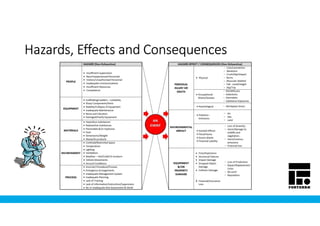
Hazards, Effects and ConsequencesHazards, Effects and ConsequencesHazards, Effects and ConsequencesHazards, Effects and Consequences
Procedures, systems, guides and tools
can be used to complement physical
controls, which specify the safe system
of work to follow to reduce the risks e.g:
• Permit to work
• Checklists
• Toolbox talks
• Job/task safety analysis
• Process maps/deployment flowcharts
• Photographs of sequence of events
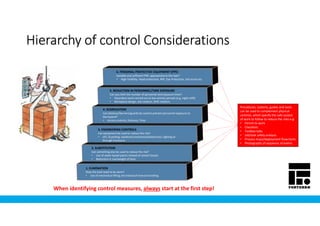
Hierarchy of control ConsiderationsHierarchy of control ConsiderationsHierarchy of control ConsiderationsHierarchy of control Considerations
1. ELIMINATION
Does the task need to be done?
• Use of mechanical lifting aid instead of manual handling.
2. SUBSTITUTION
Can something else be used to reduce the risk?
• Use of water based paints instead of solvent based.
• Reduction in size/weight of item.
3. ENGINEERING CONTROLS
Can equipment be used to reduce the risk?
• LEV, Guarding, Isolations (mechanical/electrical), Lighting or
through Enclosure.
4. SEGREGATION
Can distance/barriers/guards be used to prevent personnel exposure to
the hazard?
• Access controls, Distance, Time.
5. REDUCTION IN PERSONNEL/TIME EXPOSURE
Can you limit the number of personnel and exposure time?
• Hazardous work carried out at low activity periods (e.g. night shift)
• Workplace design, Job rotation, Shift rotation.
6. PERSONAL PROTECTIVE EQUIPMENT (PPE)
Suitable and sufficient PPE, appropriate to the task?
• High Visibility, Head protection, RPE, Eye Protection, Fall arrest etc.
When identifying control measures, always start at the first step!
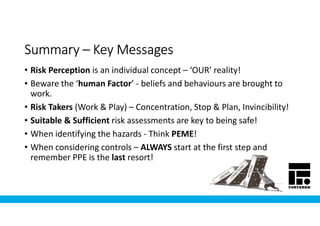
SummarySummarySummarySummary –––– Key MessagesKey MessagesKey MessagesKey Messages
• Risk Perception is an individual concept – ‘OUR’ reality!
• Beware the ‘human Factor’ - beliefs and behaviours are brought to
work.
• Risk Takers (Work & Play) – Concentration, Stop & Plan, Invincibility!
• Suitable & Sufficient risk assessments are key to being safe!
• When identifying the hazards - Think PEME!
• When considering controls – ALWAYS start at the first step and
remember PPE is the last resort!
Any Questions?Any Questions?Any Questions?Any Questions?
Get the basics right first time, every time!Get the basics right first time, every time!Get the basics right first time, every time!Get the basics right first time, every time!

Managing Risk & Risk Assessment - Making the Right Decisions!

  • 1.
    Managing Risk &Risk Assessment “Making the right decisions” Alan CookAlan CookAlan CookAlan Cook CMIOSH MIIRSM Head of Safety, Health & Environment Forterra Building Products Limited Conference 18th December 2015
  • 2.
    • • • •• • • • • 9 Dots9 Dots9 Dots9 Dots –––– A Problem to solve!A Problem to solve!A Problem to solve!A Problem to solve! Connect the nine dots using only four straight lines, without taking your pen off the paper!
  • 3.
    • • • •• • • • • 9 Dots9 Dots9 Dots9 Dots –––– A Problem to solve!A Problem to solve!A Problem to solve!A Problem to solve! Start Finish
  • 4.
    Good Reasons toManage Risk Moral Legal Commercial So far as reasonably practicable!
  • 5.
  • 6.
    Hazards & Risks? Hazards Risk Maybe considered as the likelihood or chance of a hazard causing actual harm. Anything that has the potential to cause harm or an adverse effect.
  • 7.
    Risk Perception -Behaviour • For a F1 G/Prix Driver? • A Taxi Driver? • 88 year old Granddad? Risk is a very individual concept and it is different for everyone. Take, driving a car as a daily activity.
  • 8.
  • 9.
  • 10.
    Some Influencing Factors………………. Health& Safety Executive Individual Beliefs & Behaviours
  • 11.
    National Strategy Sensible Risk. Gettingall involved. Letting those that can best deal with an issue take the lead. Information on HSE website: www.hse.go.uk The Health and Safety of Great Britain Be part of the solution
  • 12.
    Individual BehavioursIndividual BehavioursIndividualBehavioursIndividual Behaviours Risk Takers: Easy to separate? Work and Play
  • 13.
    Compromised on Safety?Compromisedon Safety?Compromised on Safety?Compromised on Safety?
  • 14.
    Calculated BehaviourCalculated BehaviourCalculatedBehaviourCalculated Behaviour –––– Risk TakersRisk TakersRisk TakersRisk Takers
  • 15.
    Impulsive BehaviourImpulsive BehaviourImpulsiveBehaviourImpulsive Behaviour –––– Risk TakersRisk TakersRisk TakersRisk Takers
  • 16.
    Individual BehaviourIndividual BehaviourIndividualBehaviourIndividual Behaviour –––– Risk TakersRisk TakersRisk TakersRisk Takers
  • 17.
    Individual BehaviourIndividual BehaviourIndividualBehaviourIndividual Behaviour –––– Risk TakersRisk TakersRisk TakersRisk Takers • Risk Takers: Work and Play • Concentration: May be competent, but can become complacent. Done it all before……….!
  • 18.
    Individual BehaviourIndividual BehaviourIndividualBehaviourIndividual Behaviour –––– Automatic Pilot!Automatic Pilot!Automatic Pilot!Automatic Pilot!
  • 19.
    Colour Changing CardTrick!Colour Changing Card Trick!Colour Changing Card Trick!Colour Changing Card Trick!
  • 20.
    Individual BehaviourIndividual BehaviourIndividualBehaviourIndividual Behaviour • Risk Takers: Work and Play • Concentration: • Reconsider: What if/when something goes wrong? The need to Stop and Plan,. easy to just focus on correcting the problem! “He who fails to plan, plans to fail”. Winston Churchill
  • 21.
    The Experts…….!The Experts…….!TheExperts…….!The Experts…….!
  • 22.
    Individual BehaviourIndividual BehaviourIndividualBehaviourIndividual Behaviour • Risk Takers: Work and Play • Concentration: • Stop and Plan: • Invincible! – The cloak of invincibility
  • 23.
  • 24.
    Another bear setfree!Another bear set free!Another bear set free!Another bear set free!
  • 25.
    There he goesTherehe goesThere he goesThere he goes ---- I’m safe up here!I’m safe up here!I’m safe up here!I’m safe up here!
  • 26.
  • 27.
    ArrghArrghArrghArrgh……! What happensnow?……! What happens now?……! What happens now?……! What happens now?
  • 28.
    Nice bear…….!Nice bear…….!Nicebear…….!Nice bear…….!
  • 29.
    Invincible or Lucky?Invincibleor Lucky?Invincible or Lucky?Invincible or Lucky?
  • 30.
    Risk Takers &Individual BehaviourRisk Takers & Individual BehaviourRisk Takers & Individual BehaviourRisk Takers & Individual Behaviour • Risk Takers: Work and Play Individual Behaviour variation • Concentration: Automatic Pilot • Stop and Plan: What if…………? • Invincible or Lucky?
  • 31.
    Risk AssessmentRisk AssessmentRiskAssessmentRisk Assessment –––– Making Decisions!Making Decisions!Making Decisions!Making Decisions! • Severity X Likelihood X Frequency X People = ? • The ‘Human Factor’! • How safe is safe enough? • Suitable and sufficient! Things to think about……….. HSE Website: Risk Management - http://www.hse.gov.uk/risk/index.htm
  • 32.
    Risk Assessment inPractice!Risk Assessment in Practice!Risk Assessment in Practice!Risk Assessment in Practice!
  • 33.
    So what isrisk assessment?So what is risk assessment?So what is risk assessment?So what is risk assessment? • Systematic approach to hazard identification; • Process to identify what elements of an activity can cause harm or damage, and; • Introduce control measures that will reduce the risk to an acceptable level; • It’s a legal requirement to carry them out where significant risks exist.
  • 34.
    What risk assessmentis not!What risk assessment is not!What risk assessment is not!What risk assessment is not! • A process that eliminates all hazards in the workplace. • A means of preventing “dangerous” activities from ever being carried out.
  • 35.
    RecapRecapRecapRecap ---- Hazards& Risks?Hazards & Risks?Hazards & Risks?Hazards & Risks? Hazards Risk May be considered as the likelihood or chance of a hazard causing actual harm. Anything that has the potential to cause harm or an adverse effect.
  • 36.
    Risk assessmentRisk assessmentRiskassessmentRisk assessment –––– legal requirementlegal requirementlegal requirementlegal requirement • The Management of Health and Safety at Work Regulations (overarching regulations). • “Every employer shall make a suitable and sufficient assessment of the risk to the health and safety of his employees to which they are exposed whilst at work”. • Trivial risks can usually be ignored as can risks arising from routine activities associated with life in general, unless work actively compounds those risks.
  • 37.
    Risk assessment legislationRiskassessment legislationRisk assessment legislationRisk assessment legislation (Statutory Provisions) • Regulatory Reform (Fire Safety) Order • Provision & Use of Work Equipment • Manual Handling Operations • Display Screen Equipment • Control of Substances Hazardous to Health (COSHH) • Control of Asbestos at Work • Control of Lead at Work • The Control of Noise at Work • Personal Protective Equipment at Work That require a specific assessment, in addition to a general task risk assessment:
  • 38.
    To be “Suitable& Sufficient”To be “Suitable & Sufficient”To be “Suitable & Sufficient”To be “Suitable & Sufficient” a risk assessment must: •Identify the significant risks that may arise from the work or in connection with it; •Be appropriate to the nature of the work; •Implementation of suitable controls to reduce risks to an acceptable level; •Comply with relevant statutory provision, and; •Be valid over a reasonable period of time.
  • 39.
    Hazards working fromthis………..?Hazards working from this………..?Hazards working from this………..?Hazards working from this………..? Tripping over outstretched supports People falling from height! Falling items, tools etc! Method of construction? Use of ladders? Inspection requirements? Other activities in the areaUntrained workers?
  • 40.
    5 steps torisk assessment (HSE)5 steps to risk assessment (HSE)5 steps to risk assessment (HSE)5 steps to risk assessment (HSE) Identify the hazards. Decide who might be harmed and how. Evaluate the risks and decide on precautions to take. Record your significant findings, take action and communicate to those at risk. Review the assessment and update as necessary.
  • 41.
    Identifying the hazardsIdentifyingthe hazardsIdentifying the hazardsIdentifying the hazards • People • Equipment • Materials • Environment Think PEME!
  • 42.
    People hazardsPeople hazardsPeoplehazardsPeople hazards –––– human factors!human factors!human factors!human factors! Experienced, Skilled, trained? Following procedures? Physically capable of doing task? Is anybody supervising the task? Enough people to do the task? Communication during the job? Emergency situations – What if! Complacency &/or Horseplay?
  • 43.
    Equipment hazards!Equipment hazards!Equipmenthazards!Equipment hazards! The weight of the equipment? Repair & maintenance /lack of? Sharp parts/components? Storage when not in use? PPE – Gloves, Goggles, Boots – what type & what standard? Equipment noise and vibration? Are additional assessments required?
  • 44.
    Material hazards!Material hazards!Materialhazards!Material hazards! Petrol/fuel for the chainsaw? Wood dust generated? Oils, Grease used for maintenance? Are additional assessments required?
  • 45.
    EnvironmentEnvironmentEnvironmentEnvironment hhhhazards!azards!azards!azards! UV/Sunburn? Vehiclemovements? Possible space restrictions? Slip & trip hazards? Lighting problems – night work? Weather conditions? Clear up - log removal activities - how?
  • 46.
    Hazards, Effects andConsequencesHazards, Effects and ConsequencesHazards, Effects and ConsequencesHazards, Effects and Consequences
  • 47.
    Procedures, systems, guidesand tools can be used to complement physical controls, which specify the safe system of work to follow to reduce the risks e.g: • Permit to work • Checklists • Toolbox talks • Job/task safety analysis • Process maps/deployment flowcharts • Photographs of sequence of events Hierarchy of control ConsiderationsHierarchy of control ConsiderationsHierarchy of control ConsiderationsHierarchy of control Considerations 1. ELIMINATION Does the task need to be done? • Use of mechanical lifting aid instead of manual handling. 2. SUBSTITUTION Can something else be used to reduce the risk? • Use of water based paints instead of solvent based. • Reduction in size/weight of item. 3. ENGINEERING CONTROLS Can equipment be used to reduce the risk? • LEV, Guarding, Isolations (mechanical/electrical), Lighting or through Enclosure. 4. SEGREGATION Can distance/barriers/guards be used to prevent personnel exposure to the hazard? • Access controls, Distance, Time. 5. REDUCTION IN PERSONNEL/TIME EXPOSURE Can you limit the number of personnel and exposure time? • Hazardous work carried out at low activity periods (e.g. night shift) • Workplace design, Job rotation, Shift rotation. 6. PERSONAL PROTECTIVE EQUIPMENT (PPE) Suitable and sufficient PPE, appropriate to the task? • High Visibility, Head protection, RPE, Eye Protection, Fall arrest etc. When identifying control measures, always start at the first step!
  • 48.
    SummarySummarySummarySummary –––– KeyMessagesKey MessagesKey MessagesKey Messages • Risk Perception is an individual concept – ‘OUR’ reality! • Beware the ‘human Factor’ - beliefs and behaviours are brought to work. • Risk Takers (Work & Play) – Concentration, Stop & Plan, Invincibility! • Suitable & Sufficient risk assessments are key to being safe! • When identifying the hazards - Think PEME! • When considering controls – ALWAYS start at the first step and remember PPE is the last resort!
  • 49.
    Any Questions?Any Questions?AnyQuestions?Any Questions? Get the basics right first time, every time!Get the basics right first time, every time!Get the basics right first time, every time!Get the basics right first time, every time!