GROUND RULES
•EMERGENCIES
•WELFARE
•HOUSEKEEPING
•FINAL ASSESSMENT
2 RISK ASSESSMENT
WHAT WILL BE COVERED?
•Identify all potential hazards associated with the
workplace activities.
•Evaluate the risks
•Develop a plan to Control
•Implement the plan
•Monitor the implementation
3 RISK ASSESSMENT
KEY TERMS
SAFETY
Freedom from unacceptable risk of harm.
RISK
A risk is the likelihood of harm occurring. The degree of risk is based both
on likelihood and severity of outcome.
HAZARD
A hazard is an article, substance or situation that has the potential to
cause harm or damage.
4 RISK ASSESSMENT
RISK ASSESSMENT
A risk assessment is a careful examination
of what, in your work, could cause harm to
people, an evaluation of whether the hazard is
significant and an analysis of whether enough
precaution have been taken to prevent them.
5 RISK ASSESSMENT
DOMINO THEORY
6 RISK ASSESSMENT
WHAT IS RISK ASSESSMENT ?
Risk assessment is a process, used to identify
actual or possible problems that could cause:
• INJURY OR HARM TO PEOPLE
• DAMAGE TO EQUIPMENT AND PREMISES
• DAMAGE TO THE ENVIRONMENT
7 RISK ASSESSMENT
SAFE SYSTEMS OF WORK
One of the main aims of the risk assessment process is to ensure that
a safe system of work exists A safe system of work is a step by step
procedure for carrying out a task safely, taking in to account the risks and
control measures, the equipment needed, the environment, emergencies
and the competence and skills required by workers.
8 RISK ASSESSMENT
RISK USUALLY RESULTS
IN INCIDENTS
NEARMISS ACCIDENTS
9 RISK ASSESSMENT
ACCIDENT
Accidents are undesired and unplanned events which may cause personal
injury, serious injury, death, damage to property or equipment, loss of
output , or a combination of any or all of these potential outcomes.
DANGEROUS OCCURRENCES
Even non injury incidents may have to be reported. There is often a legal
requirement to report those events involving serious potential for injury,
even though no injury in fact resulted, although they frequently involve
some form of loss or damage to equipment.
10 RISK ASSESSMENT
NEAR MISS
Near misses are incidents which do not result in injury or loss. They
may fall in to the categories that must be reported to the authorities as
dangerous occurrences, and it is important not to neglect them when
reviewing safety records, since they may indicate hazards and risks which
are not being adequately protected against. While they do not result in
loss., they had the potential to do so.
11 RISK ASSESSMENT
CATEGORISATION OF ACCIDENTS
• SLIPS /TRIPS/FALLS
• FALL FROM HEIGHT
• FALLING OBJECT
• COLLISION WITH OBJECTS
• TRAPPING/ CRUSHING UNDER OR
BETWEEN OBJECT.
• MANUAL HANDLING
• CONTACT WITH MACHINERY/ HAND
TOOLS
12 RISK ASSESSMENT
CATEGORISATION OF
HEALTH RISKS
CHEMICAL HAZARD
• Liquids
• Dusts
• Fumes
• Mists
• Gases
13 RISK ASSESSMENT
BIOLOGICAL HAZARD
Biological hazard relate mainly
to illness resulting from
exposure to bacteria , viruses
and fungi. People who work in
medical care are at risk from
all types of infection found in
society.
14 RISK ASSESSMENT
PHYSICAL HAZARDS
Physical hazards relate to
harm caused to the body from
mechanical, radiation or
thermal sources or because of
ergonomic conditions.
Mechanical stressors are mainly concerned with
vibrations, which may also create noise, and
with variation of external pressure above and
below normal atmospheric.
15 RISK ASSESSMENT
RADIATION HAZARDS
Hazards from radiation are classified under
two ionizing radiation, which includes alpha,
beta, gamma, and x-ray radiations.
Non ionizing radiation, which
includes lasers, UV, IR, microwave,
and radio frequencies.
Thermal energy problems are related mainly to
the effect of sweating losing large quantities of
body salts.
16 RISK ASSESSMENT
PSYCHOLOGICAL HAZARDS
17 RISK ASSESSMENT
An assessment of risk is nothing more than a careful
examination of what could cause harm to people ,
an evaluation of whether the hazard is significant
and an analysis of whether enough precautions have
been taken to prevent them.
An individual risk assessment exercise may be
carried out in relation to the totality of hazards in a
particular workplace, or may be limited to particular
work activities or specific equipment, depending on
the circumstances. However ,it is still a requirement
that all of the risks in the workplace have been
covered in this way.
18 RISK ASSESSMENT
PERFORMANCE MONITORING
(PROACTIVE)
AUDIT
INSPECTION
SAFETY SURVEY
SAFETY TOUR
HEALTH SURVEILLANCE
BENCH MARKING
SAMPLING
RISK ASSESSMENT
19 RISK ASSESSMENT
LOOK FOR THE HAZARDS
This is the process of identifying all the
hazards that exist in the workplace. You
must be aware of all possible hazards, but it
is the significant one which are important.
All risks in the workplaces should be
assessed in order to identify the most
important ones. We must concentrate
on those and not become distracted in to
devoting too much time to trivial risks.
20 RISK ASSESSMENT
TWO MAIN WAYS
OF IDENTIFYING HAZARDS
BY LOOKING AT INCIDENT DATA:
this is reactive in that we are looking at hazards which have already been
identified by the fact that the risk they present has been realized.
BY LOOKING AT THE WAY WORK IS PERFORMED:
this is active in that we are trying to identify hazards before they are
realized. The main way of examining work are through inspections and by
job/task analysis.
21 RISK ASSESSMENT
SAFETY PROFESSIONALS they
analyze, identify, and measure
workplace hazards or stresses
that can cause sickness, impaired
health, or significant discomfort in
workers through chemical, physical,
ergonomic, or biological exposures.
Two key roles of the safety
professionals are to spot those
conditions and help eliminate or
control them through appropriate
measures.
22 RISK ASSESSMENT
A worksite analysis is an
essential first step that helps
an industrial hygienist or
safety professional determine
what jobs are the sources of
potential problems.
During the worksite analysis,
the industrial hygienist or
safety professional measures
and identifies exposures,
problem tasks, and risks.
23 RISK ASSESSMENT
Inspections relates to the examination of plant and equipment and
the way they are used. It involves physically watching operations and
testing equipment to see if there are any hazards or non compliance with
legislation, rules, or safety procedures.
Inspection are usually carried out on a regular basis, including tests of
plant and equipment, to ensure that everything is working as it should be.
This is likely to be done as a part of routine maintenance. In most cases,
some form of checklist of key points will be used as the basis of a thorough
and methodical approach.
ROLE OF INSPECTION
24 RISK ASSESSMENT
Less common are inspections of the work environment and the way in which
a machinery and equipment is used. It is particularly important to establish
what actually happen in the workplace or during the work activity, especially
where it differs from the approved methods as set out in manuals. Here
inspection is possibly the only way of checking reality, rather than what
workers may want others to believe about the way the work is carried out.
All inspection should be properly documented, noting the hazards identified,
the precautions in place and any action which has been or should be taken.
25 RISK ASSESSMENT
DEVELOPING A SAFE SYSTEM OF WORK
Often referred to as standard operating procedure (SOP) or method
statements, safe system of work are developed by job or task analysis
JOB SAFETY ANALYSIS
Job safety analysis is a work study technique used as a basis for logical
task risk assessment in which a task is carefully observed and every detail
recorded. The method of working is then evaluated to identify hazards,
risks and control measures. It forms the basis for writing safe systems of
work.
26 RISK ASSESSMENT
KEY ELEMENTS OF
SAFE SYSTEM OF WORK
• The system should be planned in advance of the work.
• Systems are required for isolated tasks and non routine tasks, not just the
day to day operations or process.
• The systems should take in to account the disability or experience of
individual workers.
• The employer cannot rely on the fact that his workers are experienced. A
system should be planned taking account of behavior ; and
• The system should be established by instruction, training, in writing or other
method , and enforced.
27 RISK ASSESSMENT
THE PROCESS IS AS FOLLOWS:
• Select the task to be studied.
• Record each stage in the tasks.
• Evaluate the risks by carrying out a risk
assessment on each stage of the tasks.
• Develop a safe system for carrying out the
work implement the safe system monitor
the effectiveness of the system.
28 RISK ASSESSMENT
THE STEPS OF THE PROCESS INVOLVE
SELECT : A new or existing task
is selected. Priorities are often
based on accidents or the
significance of change
RECORD : the task is broken
down in to progressive sub
tasks, from start to completion.
29 RISK ASSESSMENT
EVALUATE : each stage is considered
to determine the detail of the work
methods so that hazards can be
identified at each stage. Depending on
circumstances, the hazards associated
with the task may include:
• MATERIALS , e.g. product / service or materials
• EQUIPMENT, e.g. tools, machinery, sterile packs,
• ENVIRONMENT, e.g. lighting, noise, weather condition
• PEOPLE , e.g. numbers, disability, age, height, competence, skills.
30 RISK ASSESSMENT
Other hazards, e.g. criminal attack , arson, etc. may be involved. A risk
assessment of each stage is then carried out. The risk assessment will
include and evaluation of:
EXISTING PRECAUTIONS
TECHNICAL - i.e. workplace precautions e.g. guarding , lifting,
equipment , PPE’s
PROCEDURAL - e.g. written instructions, training; and
BEHAVIORAL - e.g. following workplace rules such as wearing PPE
Further controls required, including changes to the way the task is carried
out and legal and best practice requirements.
31 RISK ASSESSMENT
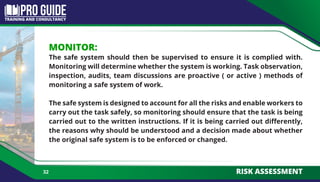
MONITOR:
The safe system should then be supervised to ensure it is complied with.
Monitoring will determine whether the system is working. Task observation,
inspection, audits, team discussions are proactive ( or active ) methods of
monitoring a safe system of work.
The safe system is designed to account for all the risks and enable workers to
carry out the task safely, so monitoring should ensure that the task is being
carried out to the written instructions. If it is being carried out differently,
the reasons why should be understood and a decision made about whether
the original safe system is to be enforced or changed.
32 RISK ASSESSMENT
5 STEPS TO RISK ASSESSMENT
STEP 1		 Look for the hazards
STEP 2		 Decide who might be harmed and how?
STEP 3		 Evaluate the risks arising from the hazard and decide if
						 existing precaustions are adequate or more should be done
STEP 4		 Record your findings
STEP 5		 Review your assessment.
33 RISK ASSESSMENT
IDENTIFYING POPULATION AT RISK
When considering people at risk, it is important to think not only of those
carrying out particular activities, but also of all those who may be affected by
those activities. This may include other workers who may be in the area, both
during working hours as well as those who may be present at other times,
such as cleaners and security guards. In addition, the position of visitors and
other members of the public may be affected must be assessed
34 RISK ASSESSMENT
• Operators
• Maintenance staff
• Cleaners
• Contractors
• Visitors
• Members of the public
• Young people
• Pregnant woman
• Individuals with a disability
35 RISK ASSESSMENT
EVALUATING RISK AND
ADEQUACY OF CONTROL MEASURES
This is where we assess the significance of the risks and suggest what
should be done to protect people.
After we have identified the hazards in the work situation, it is important
to calculate the risk that they represent. And we need some means of
deciding where the priorities lie and what it is practicable to do.
36 RISK ASSESSMENT
QUALITATIVE AND
SEMI-QUANTITATIVE RISK RANKING
• Our matrix shows a general approach to risk ranking, in which we identify
those hazards which represent the greatest risk in terms of likelihood and
outcome. The question is how do we put hazards in to the categories
• We might make subjective judgments by looking at hazards and the
possibility of harm.
• The aim in ranking risk is to have some method which allows meaningful
comparisons to be made between different risks, so that we can make an
objective judgment as to the level of risk which the hazard represents. To do
this, we need some agreed method of quantifying likelihood and outcome.
37 RISK ASSESSMENT
LIKELIHOOD OF RISK
38 RISK ASSESSMENT
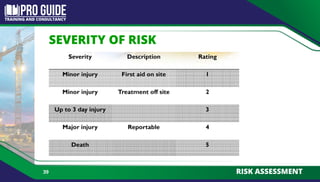
SEVERITY OF RISK
39 RISK ASSESSMENT
LIKELIHOOD * SEVERITY = RISK
40 RISK ASSESSMENT
41 RISK ASSESSMENT
GENERAL CONTROL HIERARCHY
In assessing the practicability of control
measures it is usual to refer to a hierarchy
of control measures.
This is a list of approaches to reducing risk,
starting with the most effective.
42 RISK ASSESSMENT
RISK CONTROL MEASURES
When assessing the control measures there is a hierarchy of options to be
considered. The most effective method is to eliminate the risk altogether.
GENERAL CONTROL HIERARCHY:
1. ELIMINATE
2. REDUCE
3. ISOLATE
4. CONTROL
5. PERSONNEL PROTECTIVE EQUIPMENT
6. DISCIPLINE
43 RISK ASSESSMENT
The most-effective worksite analyses include
all jobs, operations, and work activities. The
safety professional inspects, researches,
or analyzes how the particular chemicals
or physical hazards at that worksite affect
worker health. If a situation hazardous to
health is discovered, the safety professional
recommends the appropriate corrective
actions.
Safety professionals recognize that engineering, work practice, and
administrative controls are the primary means of reducing employee
exposure to occupational hazards.
44 RISK ASSESSMENT
CONTROL MEASURES
Engineering controls minimize employee exposure by
either reducing or removing the hazard at the source or
isolating the worker from the hazard.
Engineering controls include eliminating toxic chemicals
and substituting non-toxic chemicals, enclosing work
processes or confining work operations, and the
installation of general and local ventilation systems.
45 RISK ASSESSMENT
EXAMPLES OF PERSONAL
PROTECTIVE EQUIPMENT
GLOVES
SAFETY GOGGLES
HELMETS
SAFETY SHOES
PROTECTIVE CLOTHING
RESPIRATORS
To be effective, personal protective equipment
must be individually selected; properly fitted and
periodically refitted; conscientiously and properly
worn; regularly maintained; and replaced, as
necessary.
46 RISK ASSESSMENT
PRIORITIZATION BASED ON RISK
Our objective in ranking risks is to determine to what extent protective
measures must be put in place for each hazard.
The process of identifying
where to apply those
resources to the problems
faced is known as
prioritization.
47 RISK ASSESSMENT
ACTION MAY BE REQUIRED
PRIORITY 1 ( IMMEDIATE )
where work should not continue until the risk has been reduced.
PRIORITY 2 ( MEDIUM TERM )
where measures should be taken within the next (14-28 days).
PRIORITY 3 ( LONG TERM )
where non- urgent action is required within the next 12 months.
48 RISK ASSESSMENT
PRIORITIES VS. TIME SCALES
The method of putting solutions in order of their urgency
is known as prioritization.
THE FOLLOWING ARE USEFUL GUIDELINES
HIGH RISK
where it is certain or near- certain that harm will occur.
MEDIUM RISK
where harm will often occur.
LOW RISK
where harm will seldom occur.
49 RISK ASSESSMENT
RECORD SIGNIFICANT FINDINGS
Taken together ,whatever documents are used to record the process, they
must deal with the following issues:
A description of the process /activities assessed and identification of the
significant hazards involved.
Identification of any group of workers at particular risk.
Evaluation of the risks (quantified where possible )
Identification of the adequacy of existing control measures and action plans
for implementing any further precautions necessary.
Date of assessment and date for next review if appropriate, and name of the
competent person carrying out the assessment.
50 RISK ASSESSMENT
REVIEW YOUR ASSESSMENT
• Sooner or later you will bring in new machines, substances and
procedures which could lead to new hazards.
• If there is any significant change, add to the assessment to take account
of the new hazard.
• Don’t amend your assessment for every trivial change, or still more , for
each new job, but if a new job introduces significant new hazards of its
own , you will want to consider them in their own right and do whatever
you need to keep the risks down.
• In any case , it is good practice to review your assessment from time to
time to make sure that the precautions are still working effectively.
51 RISK ASSESSMENT
SUMMARY
YOU NEED TO BE ABLE TO SHOW THAT :
• A proper check was made;
• You asked who might be affected;
• You dealt with all the significant hazards, taking in to account the number
of people who could be involved;
• The precautions are reasonable, and the remaining risk is low and you
involved your staff or their representatives in the process
52 RISK ASSESSMENT
Risk Assessment presentation.pdf

Risk Assessment presentation.pdf

  • 2.
  • 3.
    WHAT WILL BECOVERED? •Identify all potential hazards associated with the workplace activities. •Evaluate the risks •Develop a plan to Control •Implement the plan •Monitor the implementation 3 RISK ASSESSMENT
  • 4.
    KEY TERMS SAFETY Freedom fromunacceptable risk of harm. RISK A risk is the likelihood of harm occurring. The degree of risk is based both on likelihood and severity of outcome. HAZARD A hazard is an article, substance or situation that has the potential to cause harm or damage. 4 RISK ASSESSMENT
  • 5.
    RISK ASSESSMENT A riskassessment is a careful examination of what, in your work, could cause harm to people, an evaluation of whether the hazard is significant and an analysis of whether enough precaution have been taken to prevent them. 5 RISK ASSESSMENT
  • 6.
  • 7.
    WHAT IS RISKASSESSMENT ? Risk assessment is a process, used to identify actual or possible problems that could cause: • INJURY OR HARM TO PEOPLE • DAMAGE TO EQUIPMENT AND PREMISES • DAMAGE TO THE ENVIRONMENT 7 RISK ASSESSMENT
  • 8.
    SAFE SYSTEMS OFWORK One of the main aims of the risk assessment process is to ensure that a safe system of work exists A safe system of work is a step by step procedure for carrying out a task safely, taking in to account the risks and control measures, the equipment needed, the environment, emergencies and the competence and skills required by workers. 8 RISK ASSESSMENT
  • 9.
    RISK USUALLY RESULTS ININCIDENTS NEARMISS ACCIDENTS 9 RISK ASSESSMENT
  • 10.
    ACCIDENT Accidents are undesiredand unplanned events which may cause personal injury, serious injury, death, damage to property or equipment, loss of output , or a combination of any or all of these potential outcomes. DANGEROUS OCCURRENCES Even non injury incidents may have to be reported. There is often a legal requirement to report those events involving serious potential for injury, even though no injury in fact resulted, although they frequently involve some form of loss or damage to equipment. 10 RISK ASSESSMENT
  • 11.
    NEAR MISS Near missesare incidents which do not result in injury or loss. They may fall in to the categories that must be reported to the authorities as dangerous occurrences, and it is important not to neglect them when reviewing safety records, since they may indicate hazards and risks which are not being adequately protected against. While they do not result in loss., they had the potential to do so. 11 RISK ASSESSMENT
  • 12.
    CATEGORISATION OF ACCIDENTS •SLIPS /TRIPS/FALLS • FALL FROM HEIGHT • FALLING OBJECT • COLLISION WITH OBJECTS • TRAPPING/ CRUSHING UNDER OR BETWEEN OBJECT. • MANUAL HANDLING • CONTACT WITH MACHINERY/ HAND TOOLS 12 RISK ASSESSMENT
  • 13.
    CATEGORISATION OF HEALTH RISKS CHEMICALHAZARD • Liquids • Dusts • Fumes • Mists • Gases 13 RISK ASSESSMENT
  • 14.
    BIOLOGICAL HAZARD Biological hazardrelate mainly to illness resulting from exposure to bacteria , viruses and fungi. People who work in medical care are at risk from all types of infection found in society. 14 RISK ASSESSMENT
  • 15.
    PHYSICAL HAZARDS Physical hazardsrelate to harm caused to the body from mechanical, radiation or thermal sources or because of ergonomic conditions. Mechanical stressors are mainly concerned with vibrations, which may also create noise, and with variation of external pressure above and below normal atmospheric. 15 RISK ASSESSMENT
  • 16.
    RADIATION HAZARDS Hazards fromradiation are classified under two ionizing radiation, which includes alpha, beta, gamma, and x-ray radiations. Non ionizing radiation, which includes lasers, UV, IR, microwave, and radio frequencies. Thermal energy problems are related mainly to the effect of sweating losing large quantities of body salts. 16 RISK ASSESSMENT
  • 17.
  • 18.
    An assessment ofrisk is nothing more than a careful examination of what could cause harm to people , an evaluation of whether the hazard is significant and an analysis of whether enough precautions have been taken to prevent them. An individual risk assessment exercise may be carried out in relation to the totality of hazards in a particular workplace, or may be limited to particular work activities or specific equipment, depending on the circumstances. However ,it is still a requirement that all of the risks in the workplace have been covered in this way. 18 RISK ASSESSMENT
  • 19.
    PERFORMANCE MONITORING (PROACTIVE) AUDIT INSPECTION SAFETY SURVEY SAFETYTOUR HEALTH SURVEILLANCE BENCH MARKING SAMPLING RISK ASSESSMENT 19 RISK ASSESSMENT
  • 20.
    LOOK FOR THEHAZARDS This is the process of identifying all the hazards that exist in the workplace. You must be aware of all possible hazards, but it is the significant one which are important. All risks in the workplaces should be assessed in order to identify the most important ones. We must concentrate on those and not become distracted in to devoting too much time to trivial risks. 20 RISK ASSESSMENT
  • 21.
    TWO MAIN WAYS OFIDENTIFYING HAZARDS BY LOOKING AT INCIDENT DATA: this is reactive in that we are looking at hazards which have already been identified by the fact that the risk they present has been realized. BY LOOKING AT THE WAY WORK IS PERFORMED: this is active in that we are trying to identify hazards before they are realized. The main way of examining work are through inspections and by job/task analysis. 21 RISK ASSESSMENT
  • 22.
    SAFETY PROFESSIONALS they analyze,identify, and measure workplace hazards or stresses that can cause sickness, impaired health, or significant discomfort in workers through chemical, physical, ergonomic, or biological exposures. Two key roles of the safety professionals are to spot those conditions and help eliminate or control them through appropriate measures. 22 RISK ASSESSMENT
  • 23.
    A worksite analysisis an essential first step that helps an industrial hygienist or safety professional determine what jobs are the sources of potential problems. During the worksite analysis, the industrial hygienist or safety professional measures and identifies exposures, problem tasks, and risks. 23 RISK ASSESSMENT
  • 24.
    Inspections relates tothe examination of plant and equipment and the way they are used. It involves physically watching operations and testing equipment to see if there are any hazards or non compliance with legislation, rules, or safety procedures. Inspection are usually carried out on a regular basis, including tests of plant and equipment, to ensure that everything is working as it should be. This is likely to be done as a part of routine maintenance. In most cases, some form of checklist of key points will be used as the basis of a thorough and methodical approach. ROLE OF INSPECTION 24 RISK ASSESSMENT
  • 25.
    Less common areinspections of the work environment and the way in which a machinery and equipment is used. It is particularly important to establish what actually happen in the workplace or during the work activity, especially where it differs from the approved methods as set out in manuals. Here inspection is possibly the only way of checking reality, rather than what workers may want others to believe about the way the work is carried out. All inspection should be properly documented, noting the hazards identified, the precautions in place and any action which has been or should be taken. 25 RISK ASSESSMENT
  • 26.
    DEVELOPING A SAFESYSTEM OF WORK Often referred to as standard operating procedure (SOP) or method statements, safe system of work are developed by job or task analysis JOB SAFETY ANALYSIS Job safety analysis is a work study technique used as a basis for logical task risk assessment in which a task is carefully observed and every detail recorded. The method of working is then evaluated to identify hazards, risks and control measures. It forms the basis for writing safe systems of work. 26 RISK ASSESSMENT
  • 27.
    KEY ELEMENTS OF SAFESYSTEM OF WORK • The system should be planned in advance of the work. • Systems are required for isolated tasks and non routine tasks, not just the day to day operations or process. • The systems should take in to account the disability or experience of individual workers. • The employer cannot rely on the fact that his workers are experienced. A system should be planned taking account of behavior ; and • The system should be established by instruction, training, in writing or other method , and enforced. 27 RISK ASSESSMENT
  • 28.
    THE PROCESS ISAS FOLLOWS: • Select the task to be studied. • Record each stage in the tasks. • Evaluate the risks by carrying out a risk assessment on each stage of the tasks. • Develop a safe system for carrying out the work implement the safe system monitor the effectiveness of the system. 28 RISK ASSESSMENT
  • 29.
    THE STEPS OFTHE PROCESS INVOLVE SELECT : A new or existing task is selected. Priorities are often based on accidents or the significance of change RECORD : the task is broken down in to progressive sub tasks, from start to completion. 29 RISK ASSESSMENT
  • 30.
    EVALUATE : eachstage is considered to determine the detail of the work methods so that hazards can be identified at each stage. Depending on circumstances, the hazards associated with the task may include: • MATERIALS , e.g. product / service or materials • EQUIPMENT, e.g. tools, machinery, sterile packs, • ENVIRONMENT, e.g. lighting, noise, weather condition • PEOPLE , e.g. numbers, disability, age, height, competence, skills. 30 RISK ASSESSMENT
  • 31.
    Other hazards, e.g.criminal attack , arson, etc. may be involved. A risk assessment of each stage is then carried out. The risk assessment will include and evaluation of: EXISTING PRECAUTIONS TECHNICAL - i.e. workplace precautions e.g. guarding , lifting, equipment , PPE’s PROCEDURAL - e.g. written instructions, training; and BEHAVIORAL - e.g. following workplace rules such as wearing PPE Further controls required, including changes to the way the task is carried out and legal and best practice requirements. 31 RISK ASSESSMENT
  • 32.
    MONITOR: The safe systemshould then be supervised to ensure it is complied with. Monitoring will determine whether the system is working. Task observation, inspection, audits, team discussions are proactive ( or active ) methods of monitoring a safe system of work. The safe system is designed to account for all the risks and enable workers to carry out the task safely, so monitoring should ensure that the task is being carried out to the written instructions. If it is being carried out differently, the reasons why should be understood and a decision made about whether the original safe system is to be enforced or changed. 32 RISK ASSESSMENT
  • 33.
    5 STEPS TORISK ASSESSMENT STEP 1 Look for the hazards STEP 2 Decide who might be harmed and how? STEP 3 Evaluate the risks arising from the hazard and decide if existing precaustions are adequate or more should be done STEP 4 Record your findings STEP 5 Review your assessment. 33 RISK ASSESSMENT
  • 34.
    IDENTIFYING POPULATION ATRISK When considering people at risk, it is important to think not only of those carrying out particular activities, but also of all those who may be affected by those activities. This may include other workers who may be in the area, both during working hours as well as those who may be present at other times, such as cleaners and security guards. In addition, the position of visitors and other members of the public may be affected must be assessed 34 RISK ASSESSMENT
  • 35.
    • Operators • Maintenancestaff • Cleaners • Contractors • Visitors • Members of the public • Young people • Pregnant woman • Individuals with a disability 35 RISK ASSESSMENT
  • 36.
    EVALUATING RISK AND ADEQUACYOF CONTROL MEASURES This is where we assess the significance of the risks and suggest what should be done to protect people. After we have identified the hazards in the work situation, it is important to calculate the risk that they represent. And we need some means of deciding where the priorities lie and what it is practicable to do. 36 RISK ASSESSMENT
  • 37.
    QUALITATIVE AND SEMI-QUANTITATIVE RISKRANKING • Our matrix shows a general approach to risk ranking, in which we identify those hazards which represent the greatest risk in terms of likelihood and outcome. The question is how do we put hazards in to the categories • We might make subjective judgments by looking at hazards and the possibility of harm. • The aim in ranking risk is to have some method which allows meaningful comparisons to be made between different risks, so that we can make an objective judgment as to the level of risk which the hazard represents. To do this, we need some agreed method of quantifying likelihood and outcome. 37 RISK ASSESSMENT
  • 38.
    LIKELIHOOD OF RISK 38RISK ASSESSMENT
  • 39.
    SEVERITY OF RISK 39RISK ASSESSMENT
  • 40.
    LIKELIHOOD * SEVERITY= RISK 40 RISK ASSESSMENT
  • 41.
  • 42.
    GENERAL CONTROL HIERARCHY Inassessing the practicability of control measures it is usual to refer to a hierarchy of control measures. This is a list of approaches to reducing risk, starting with the most effective. 42 RISK ASSESSMENT
  • 43.
    RISK CONTROL MEASURES Whenassessing the control measures there is a hierarchy of options to be considered. The most effective method is to eliminate the risk altogether. GENERAL CONTROL HIERARCHY: 1. ELIMINATE 2. REDUCE 3. ISOLATE 4. CONTROL 5. PERSONNEL PROTECTIVE EQUIPMENT 6. DISCIPLINE 43 RISK ASSESSMENT
  • 44.
    The most-effective worksiteanalyses include all jobs, operations, and work activities. The safety professional inspects, researches, or analyzes how the particular chemicals or physical hazards at that worksite affect worker health. If a situation hazardous to health is discovered, the safety professional recommends the appropriate corrective actions. Safety professionals recognize that engineering, work practice, and administrative controls are the primary means of reducing employee exposure to occupational hazards. 44 RISK ASSESSMENT
  • 45.
    CONTROL MEASURES Engineering controlsminimize employee exposure by either reducing or removing the hazard at the source or isolating the worker from the hazard. Engineering controls include eliminating toxic chemicals and substituting non-toxic chemicals, enclosing work processes or confining work operations, and the installation of general and local ventilation systems. 45 RISK ASSESSMENT
  • 46.
    EXAMPLES OF PERSONAL PROTECTIVEEQUIPMENT GLOVES SAFETY GOGGLES HELMETS SAFETY SHOES PROTECTIVE CLOTHING RESPIRATORS To be effective, personal protective equipment must be individually selected; properly fitted and periodically refitted; conscientiously and properly worn; regularly maintained; and replaced, as necessary. 46 RISK ASSESSMENT
  • 47.
    PRIORITIZATION BASED ONRISK Our objective in ranking risks is to determine to what extent protective measures must be put in place for each hazard. The process of identifying where to apply those resources to the problems faced is known as prioritization. 47 RISK ASSESSMENT
  • 48.
    ACTION MAY BEREQUIRED PRIORITY 1 ( IMMEDIATE ) where work should not continue until the risk has been reduced. PRIORITY 2 ( MEDIUM TERM ) where measures should be taken within the next (14-28 days). PRIORITY 3 ( LONG TERM ) where non- urgent action is required within the next 12 months. 48 RISK ASSESSMENT
  • 49.
    PRIORITIES VS. TIMESCALES The method of putting solutions in order of their urgency is known as prioritization. THE FOLLOWING ARE USEFUL GUIDELINES HIGH RISK where it is certain or near- certain that harm will occur. MEDIUM RISK where harm will often occur. LOW RISK where harm will seldom occur. 49 RISK ASSESSMENT
  • 50.
    RECORD SIGNIFICANT FINDINGS Takentogether ,whatever documents are used to record the process, they must deal with the following issues: A description of the process /activities assessed and identification of the significant hazards involved. Identification of any group of workers at particular risk. Evaluation of the risks (quantified where possible ) Identification of the adequacy of existing control measures and action plans for implementing any further precautions necessary. Date of assessment and date for next review if appropriate, and name of the competent person carrying out the assessment. 50 RISK ASSESSMENT
  • 51.
    REVIEW YOUR ASSESSMENT •Sooner or later you will bring in new machines, substances and procedures which could lead to new hazards. • If there is any significant change, add to the assessment to take account of the new hazard. • Don’t amend your assessment for every trivial change, or still more , for each new job, but if a new job introduces significant new hazards of its own , you will want to consider them in their own right and do whatever you need to keep the risks down. • In any case , it is good practice to review your assessment from time to time to make sure that the precautions are still working effectively. 51 RISK ASSESSMENT
  • 52.
    SUMMARY YOU NEED TOBE ABLE TO SHOW THAT : • A proper check was made; • You asked who might be affected; • You dealt with all the significant hazards, taking in to account the number of people who could be involved; • The precautions are reasonable, and the remaining risk is low and you involved your staff or their representatives in the process 52 RISK ASSESSMENT