DR FAIZ NAEEM
HOUSE OFFICER
SURGICAL UNIT-II AFH
 Jaundice is a yellow discoloration of skin,sclera and
mucous membrane.
 Jaundice is usually detectable clinically when the
plasma bilirubin exceeds 2.5mg/dl.
1. Pre-Hepatic Jaundice
2. Hepatocellular Jaundice
3. Obstructive Jaundice
INTRAHEPATIC
• Primary Biliary Cholangitis
• Primary Sclerosing Cholangitis
• Alcohol
• Drugs
• Cystic Fibrosis
• Hepatic Infiltrations
• Pregnancy
• Bacterial Infections
• Rotor syndrome
• Dubin johnson syndrome
EXTRAHEPATIC
• Carcinoma
• Choledocholithiasis
• Parasitic Infection
• Traumatic Biliary Strictures
• Chronic Pancreatitis
• Mirizzi’s Syndrome
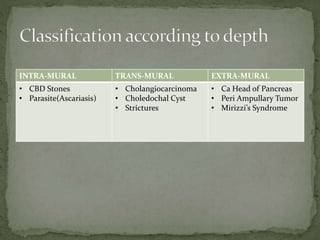
INTRA-MURAL TRANS-MURAL EXTRA-MURAL
• CBD Stones
• Parasite(Ascariasis)
• Cholangiocarcinoma
• Choledochal Cyst
• Strictures
• Ca Head of Pancreas
• Peri Ampullary Tumor
• Mirizzi’s Syndrome
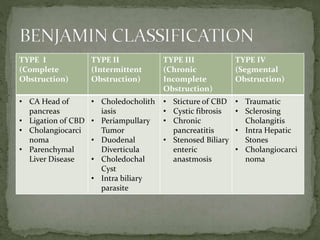
TYPE I
(Complete
Obstruction)
TYPE II
(Intermittent
Obstruction)
TYPE III
(Chronic
Incomplete
Obstruction)
TYPE IV
(Segmental
Obstruction)
• CA Head of
pancreas
• Ligation of CBD
• Cholangiocarci
noma
• Parenchymal
Liver Disease
• Choledocholith
iasis
• Periampullary
Tumor
• Duodenal
Diverticula
• Choledochal
Cyst
• Intra biliary
parasite
• Sticture of CBD
• Cystic fibrosis
• Chronic
pancreatitis
• Stenosed Biliary
enteric
anastmosis
• Traumatic
• Sclerosing
Cholangitis
• Intra Hepatic
Stones
• Cholangiocarci
noma
 Itching
 Abdominal Pain
 Dark urine
 Pale stools
 Weight loss
 Fever
 Dry eyes
 Jaundice
 Fatigue
 Complains of yellow skin , eyes ,pale stools ,dark urine
,jaundice and pruritis
 Patient’s Age
 Presence or Absence of pain
 Location of pain
 Systemic symptoms (fever, anorexia , weight loss)
 History of Anemia
 Previous malignancy
 Known gall stone disease
 Hepatitis
 Previous biliary surgery
 Use of Alcohol , drugs , medications
SITE FINDINGS
FACE Jaundice
xanthelasma
HANDS Clubbing
Leukonychia
CHEST Spider navi
Left supraclavicular lymph nodes
Abdomen inspection Scars
Distension
Caput medusae
Abdomen palpation/percussion Hepatomegaly
Splenomegaly
Ascites
Palpable gallbladder
LEGS Edema
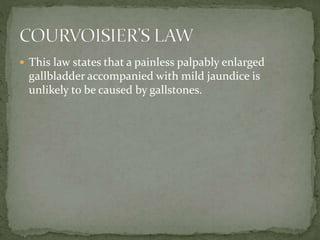
 This law states that a painless palpably enlarged
gallbladder accompanied with mild jaundice is
unlikely to be caused by gallstones.
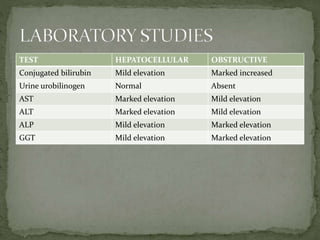
TEST HEPATOCELLULAR OBSTRUCTIVE
Conjugated bilirubin Mild elevation Marked increased
Urine urobilinogen Normal Absent
AST Marked elevation Mild elevation
ALT Marked elevation Mild elevation
ALP Mild elevation Marked elevation
GGT Mild elevation Marked elevation
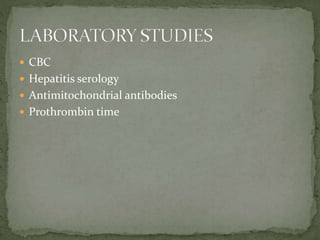
 CBC
 Hepatitis serology
 Antimitochondrial antibodies
 Prothrombin time
 PLAIN ABDOMINAL XRAY
 ABDOMINAL USG
 ENDOSCOPIC USG
 CT SCAN
 MRCP
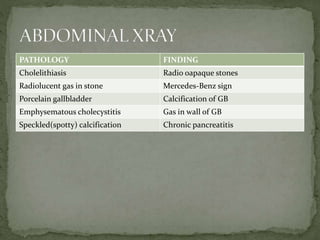
PATHOLOGY FINDING
Cholelithiasis Radio oapaque stones
Radiolucent gas in stone Mercedes-Benz sign
Porcelain gallbladder Calcification of GB
Emphysematous cholecystitis Gas in wall of GB
Speckled(spotty) calcification Chronic pancreatitis
 CHOLELITHIASIS
 STONES IN CBD
 Dilation of CBD at the same level as portal
vein(Dubble-Barrel sign)
 CBD dilation
 Cholangiocarcinoma
 Ca head of pancreas
 EUS usg have 98% acurracy in patients with
obstructive jaundice.
 It allows sampling via eus guided fine needle
aspiration.
 Dilation of CBD
 Cholangiocarcinoma
 Ca head of pancreas
 SPIRAL CT SCAN
 CT cholangiography by helical ct scan
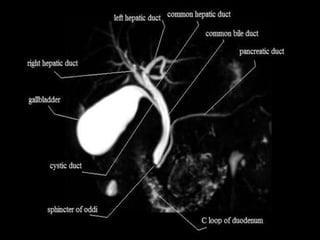
 MRCP is non invasive way to visualize hepatobiliary
tree.
 It can detect biliary and pancreatic duct stone
,strictures , and dilatations in billiary tree.
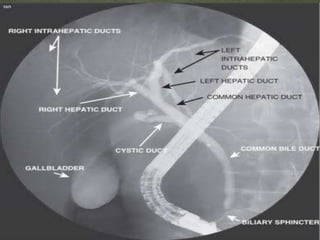
 Endoscopy plus fluoroscopy =ERCP
 It is an invasive procedure
 Has diagnostic and therapeutical potential
 Allows biopsy or brush cytology
 Allows stenting for stricture
 PTC is performed by radiologist using flouroscopic
guidence.
 The liver is punctured to enter the peripheral intra
hepatic bile duct system.
 It can be used to drain biliary obstruction.
 Per –Operative Cholangiography
 Operative biliary endoscopy
 Laproscopic ultrasonography
 Cholangitis
 Septicemia
 Hepato-Renal syndrome
 Coagulopathy
 Pancreatitis
 It is defined as renal failure in patients with advance
cirhosis and ascites.
 DIAGNOSTIC CRITERIA
A. Cirhosis with ascites
B. Creatinine >1.5 mg/dl
C. No shock
D. No nephrotoxic drug use
E. No organic kidney disease
F. No improvement in creatinine after discontinuing
diuretics and volume expansion (1g/kg/d of albumin
for 2 days)
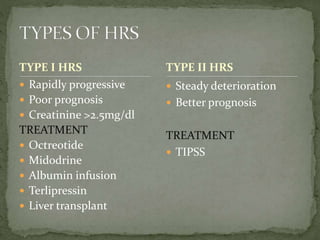
TYPE I HRS
 Rapidly progressive
 Poor prognosis
 Creatinine >2.5mg/dl
TREATMENT
 Octreotide
 Midodrine
 Albumin infusion
 Terlipressin
 Liver transplant
 Steady deterioration
 Better prognosis
TREATMENT
 TIPSS
TYPE II HRS
 Ursodeoxycholic acid (10mg/kg/d)
 Cholestyramine (4g in glass of water three times a day)
 Antihistamine
 Vitamin k
 5 or 10% dextrose water
 Prophylactic antibiotics to prevent cholangitis
 Keep the patient over hydrate
 Broad spectrum antibiotics
 Parentral vitamin k
 Antihistamine
 Nutritional support
 Hydration
 Pre operative biliary drainage
 It can be achieved by internal or external approach.
 Internal biliary drainage is achieved by endoscopic
placement of a biliary stent and endoscopic
sphincterotomy.
 External biliary drainage is performed via flouroscopic
guided percutaneous trans-hepatic approach.
 If the levels of bilirubin is more than 5mg/dl and
duration of jaundice is more than 3 weeks then
drainage improves liver function so that major
operation can be performed without major
complications.
CAUSE TREATMENT
Cholelithiasis • Open cholecystectomy
• Laproscpic
cholecystectomy
CBD stones • Pre operative removal
through ERCP followed
by lap cholecystectomy
• Mechanical lithotripsy
• Shock wave lithotripsy
• Open exploration of CBD
Choledocal cyst • Excision
• Hepaticojejunostomy
Chronic pancreatitis • Endoscopic
sphincterotomy
• Stent placement
• Pancreaticojejunostomy
CAUSE TREATMENT
Biliary stricture • Stent placement
Malignancy • Pre operative drainage
• Resection
• Endoscopic biliary stent
• Whipple resection
• Chemotherapy
• Radiotherapy
ESLD • Liver transplant
 Early cholecystectomy after ERCP within 72 hours has
better outcomes probably due to inflammatory
process.
 The longer the interval between ERCP and LC , the
higher are the chances of complications, the risk to
conversion to open technique and increased hospital
stay.
 Gradual reduction of weight
 High intake of fibre
 Reduce intake of saturated fats
 Reduction in sugar intake
 Regular exercise
 Center SA. Diseases of the gallbladder and biliary tree. Vet Clin North
Am Small Anim Pract. 2009 May. 39(3):543-98. [QxMD MEDLINE
Link].
 Marrelli D, Caruso S, Pedrazzani C, et al. CA19-9 serum levels in
obstructive jaundice: clinical value in benign and malignant
conditions. Am J Surg. 2009 Sep. 198(3):333-9. [QxMD MEDLINE Link].
 Bektas M, Dokmeci A, Cinar K, et al. Endoscopic management of
biliary parasitic diseases. Dig Dis Sci. 2010 May. 55(5):1472-8. [QxMD
MEDLINE Link].
 Zhu AX, Hong TS, Hezel AF, Kooby DA. Current management of
gallbladder carcinoma. Oncologist. 2010. 15(2):168-81. [QxMD
MEDLINE Link]. [Full Text].
 O'Connell W, Shah J, Mitchell J, et al. Obstruction of the biliary and
urinary system. Tech Vasc Interv Radiol. 2017 Dec. 20(4):288-
93. [QxMD MEDLINE Link].
OBSTRUCTIVE JAUNDICE.pptx

OBSTRUCTIVE JAUNDICE.pptx

  • 2.
    DR FAIZ NAEEM HOUSEOFFICER SURGICAL UNIT-II AFH
  • 3.
     Jaundice isa yellow discoloration of skin,sclera and mucous membrane.  Jaundice is usually detectable clinically when the plasma bilirubin exceeds 2.5mg/dl.
  • 5.
    1. Pre-Hepatic Jaundice 2.Hepatocellular Jaundice 3. Obstructive Jaundice
  • 6.
    INTRAHEPATIC • Primary BiliaryCholangitis • Primary Sclerosing Cholangitis • Alcohol • Drugs • Cystic Fibrosis • Hepatic Infiltrations • Pregnancy • Bacterial Infections • Rotor syndrome • Dubin johnson syndrome EXTRAHEPATIC • Carcinoma • Choledocholithiasis • Parasitic Infection • Traumatic Biliary Strictures • Chronic Pancreatitis • Mirizzi’s Syndrome
  • 7.
    INTRA-MURAL TRANS-MURAL EXTRA-MURAL •CBD Stones • Parasite(Ascariasis) • Cholangiocarcinoma • Choledochal Cyst • Strictures • Ca Head of Pancreas • Peri Ampullary Tumor • Mirizzi’s Syndrome
  • 8.
    TYPE I (Complete Obstruction) TYPE II (Intermittent Obstruction) TYPEIII (Chronic Incomplete Obstruction) TYPE IV (Segmental Obstruction) • CA Head of pancreas • Ligation of CBD • Cholangiocarci noma • Parenchymal Liver Disease • Choledocholith iasis • Periampullary Tumor • Duodenal Diverticula • Choledochal Cyst • Intra biliary parasite • Sticture of CBD • Cystic fibrosis • Chronic pancreatitis • Stenosed Biliary enteric anastmosis • Traumatic • Sclerosing Cholangitis • Intra Hepatic Stones • Cholangiocarci noma
  • 9.
     Itching  AbdominalPain  Dark urine  Pale stools  Weight loss  Fever  Dry eyes  Jaundice  Fatigue
  • 10.
     Complains ofyellow skin , eyes ,pale stools ,dark urine ,jaundice and pruritis  Patient’s Age  Presence or Absence of pain  Location of pain  Systemic symptoms (fever, anorexia , weight loss)  History of Anemia  Previous malignancy  Known gall stone disease  Hepatitis  Previous biliary surgery  Use of Alcohol , drugs , medications
  • 12.
    SITE FINDINGS FACE Jaundice xanthelasma HANDSClubbing Leukonychia CHEST Spider navi Left supraclavicular lymph nodes Abdomen inspection Scars Distension Caput medusae Abdomen palpation/percussion Hepatomegaly Splenomegaly Ascites Palpable gallbladder LEGS Edema
  • 13.
     This lawstates that a painless palpably enlarged gallbladder accompanied with mild jaundice is unlikely to be caused by gallstones.
  • 14.
    TEST HEPATOCELLULAR OBSTRUCTIVE Conjugatedbilirubin Mild elevation Marked increased Urine urobilinogen Normal Absent AST Marked elevation Mild elevation ALT Marked elevation Mild elevation ALP Mild elevation Marked elevation GGT Mild elevation Marked elevation
  • 15.
     CBC  Hepatitisserology  Antimitochondrial antibodies  Prothrombin time
  • 16.
     PLAIN ABDOMINALXRAY  ABDOMINAL USG  ENDOSCOPIC USG  CT SCAN  MRCP
  • 17.
    PATHOLOGY FINDING Cholelithiasis Radiooapaque stones Radiolucent gas in stone Mercedes-Benz sign Porcelain gallbladder Calcification of GB Emphysematous cholecystitis Gas in wall of GB Speckled(spotty) calcification Chronic pancreatitis
  • 18.
     CHOLELITHIASIS  STONESIN CBD  Dilation of CBD at the same level as portal vein(Dubble-Barrel sign)  CBD dilation  Cholangiocarcinoma  Ca head of pancreas
  • 19.
     EUS usghave 98% acurracy in patients with obstructive jaundice.  It allows sampling via eus guided fine needle aspiration.  Dilation of CBD  Cholangiocarcinoma  Ca head of pancreas
  • 20.
     SPIRAL CTSCAN  CT cholangiography by helical ct scan  MRCP is non invasive way to visualize hepatobiliary tree.  It can detect biliary and pancreatic duct stone ,strictures , and dilatations in billiary tree.
  • 22.
     Endoscopy plusfluoroscopy =ERCP  It is an invasive procedure  Has diagnostic and therapeutical potential  Allows biopsy or brush cytology  Allows stenting for stricture
  • 24.
     PTC isperformed by radiologist using flouroscopic guidence.  The liver is punctured to enter the peripheral intra hepatic bile duct system.  It can be used to drain biliary obstruction.
  • 26.
     Per –OperativeCholangiography  Operative biliary endoscopy  Laproscopic ultrasonography
  • 27.
     Cholangitis  Septicemia Hepato-Renal syndrome  Coagulopathy  Pancreatitis
  • 28.
     It isdefined as renal failure in patients with advance cirhosis and ascites.  DIAGNOSTIC CRITERIA A. Cirhosis with ascites B. Creatinine >1.5 mg/dl C. No shock D. No nephrotoxic drug use E. No organic kidney disease F. No improvement in creatinine after discontinuing diuretics and volume expansion (1g/kg/d of albumin for 2 days)
  • 30.
    TYPE I HRS Rapidly progressive  Poor prognosis  Creatinine >2.5mg/dl TREATMENT  Octreotide  Midodrine  Albumin infusion  Terlipressin  Liver transplant  Steady deterioration  Better prognosis TREATMENT  TIPSS TYPE II HRS
  • 31.
     Ursodeoxycholic acid(10mg/kg/d)  Cholestyramine (4g in glass of water three times a day)  Antihistamine  Vitamin k  5 or 10% dextrose water  Prophylactic antibiotics to prevent cholangitis  Keep the patient over hydrate
  • 32.
     Broad spectrumantibiotics  Parentral vitamin k  Antihistamine  Nutritional support  Hydration  Pre operative biliary drainage
  • 33.
     It canbe achieved by internal or external approach.  Internal biliary drainage is achieved by endoscopic placement of a biliary stent and endoscopic sphincterotomy.  External biliary drainage is performed via flouroscopic guided percutaneous trans-hepatic approach.  If the levels of bilirubin is more than 5mg/dl and duration of jaundice is more than 3 weeks then drainage improves liver function so that major operation can be performed without major complications.
  • 34.
    CAUSE TREATMENT Cholelithiasis •Open cholecystectomy • Laproscpic cholecystectomy CBD stones • Pre operative removal through ERCP followed by lap cholecystectomy • Mechanical lithotripsy • Shock wave lithotripsy • Open exploration of CBD Choledocal cyst • Excision • Hepaticojejunostomy Chronic pancreatitis • Endoscopic sphincterotomy • Stent placement • Pancreaticojejunostomy
  • 35.
    CAUSE TREATMENT Biliary stricture• Stent placement Malignancy • Pre operative drainage • Resection • Endoscopic biliary stent • Whipple resection • Chemotherapy • Radiotherapy ESLD • Liver transplant
  • 36.
     Early cholecystectomyafter ERCP within 72 hours has better outcomes probably due to inflammatory process.  The longer the interval between ERCP and LC , the higher are the chances of complications, the risk to conversion to open technique and increased hospital stay.
  • 37.
     Gradual reductionof weight  High intake of fibre  Reduce intake of saturated fats  Reduction in sugar intake  Regular exercise
  • 38.
     Center SA.Diseases of the gallbladder and biliary tree. Vet Clin North Am Small Anim Pract. 2009 May. 39(3):543-98. [QxMD MEDLINE Link].  Marrelli D, Caruso S, Pedrazzani C, et al. CA19-9 serum levels in obstructive jaundice: clinical value in benign and malignant conditions. Am J Surg. 2009 Sep. 198(3):333-9. [QxMD MEDLINE Link].  Bektas M, Dokmeci A, Cinar K, et al. Endoscopic management of biliary parasitic diseases. Dig Dis Sci. 2010 May. 55(5):1472-8. [QxMD MEDLINE Link].  Zhu AX, Hong TS, Hezel AF, Kooby DA. Current management of gallbladder carcinoma. Oncologist. 2010. 15(2):168-81. [QxMD MEDLINE Link]. [Full Text].  O'Connell W, Shah J, Mitchell J, et al. Obstruction of the biliary and urinary system. Tech Vasc Interv Radiol. 2017 Dec. 20(4):288- 93. [QxMD MEDLINE Link].