Obesity
Dr Venkatesh Karthikeyan
Department of Community and Family Medicine
AIIMS Patna
www.drvenkateshkarthikeyan.com
t.me/drvkspm
Contents
• What is obesity?
• Pathogenesis
• Burden
• Epidemiology of obesity
• Assessment of obesity
• Consequences of obesity
• Prevention and Control
18-11-2021 Obesity 2
What is obesity?
• Abnormal or excessive fat accumulation in the body that may impair
health.
• A body weight higher than the expected weight for a particular age
and sex is referred to as “obesity” and “overweight”
• It is considered as a disease as well as a risk factor for other diseases
18-11-2021 Obesity 3
Pathogenesis
• Multifactorial
• Most common cause – overnutrition
• Genetic and environmental factors plays a role
• Sedentary habits
• Junk foods
• High fat diet
18-11-2021 Obesity 4
Burden of Obesity – Global Scenario
• In 2016, more than 1.9 billion adults aged 18 years and older were
overweight.
• Of these, over 650 million adults were obese.
• In the same year, 39% of adults aged 18 years and over were
overweight.
• Overall, 13% of the world’s adult population is obese.
• According to WHO, rates of overweight and obesity are increasing in
both developed and developing countries around the world.
18-11-2021 Obesity 5
Burden of Obesity – Indian Scenario
• According to Global Nutritional Report 2017, prevalence of obesity
among
• Under five children is 2%
• Adolescents is 13%
• Adult males – 18% are overweight, 2% are obese
• Adult females – 22% are overweight, 5% are obese
18-11-2021 Obesity 6
Epidemiology of obesity
• Agent factor
• Host factor
• Environment factor
18-11-2021 Obesity 7
Agent factor - Nutrition
• Consuming more quantity of food than required amount leads to
deposition of excess fat in the body.
• QUALITY of food consumed also plays a role.
• Common contributors to obesity
• High sugar foods like ice creams and high fat food
• Protective role
• Salads, whole grains, cereals
18-11-2021 Obesity 8
Host factors
• Age (old people > young)
• Gender (Females > Males)
• Marital status (Married > Single)
• Geographical distribution (People of Europe, US and Australia have greater risk)
• Physical inactivity (Sedentary lifestyle)
• Education (Less educated > well educated)
• Endocrine disorder (Cushing’s, PCOD, Hypothyroidism, diabetes)
• Psychological state (Stress, depression, anxiety)
• Genetics (Prader Willi Syndrome)
• Lifestyle (Binge eating, fast food, sedentary lifestyle)
• Breast feeding (Formula milk)
• Socioeconomic status (higher strata > lower strata)
18-11-2021 Obesity 9
Environmental factors
• Seasonal variation (Winters > Summers)
• Food economics
• Social factors (Urban communities more prone to eating junk food)
• Marketing factors
• Physical environment (lack of parks, lack of walking tracks)
18-11-2021 Obesity 10
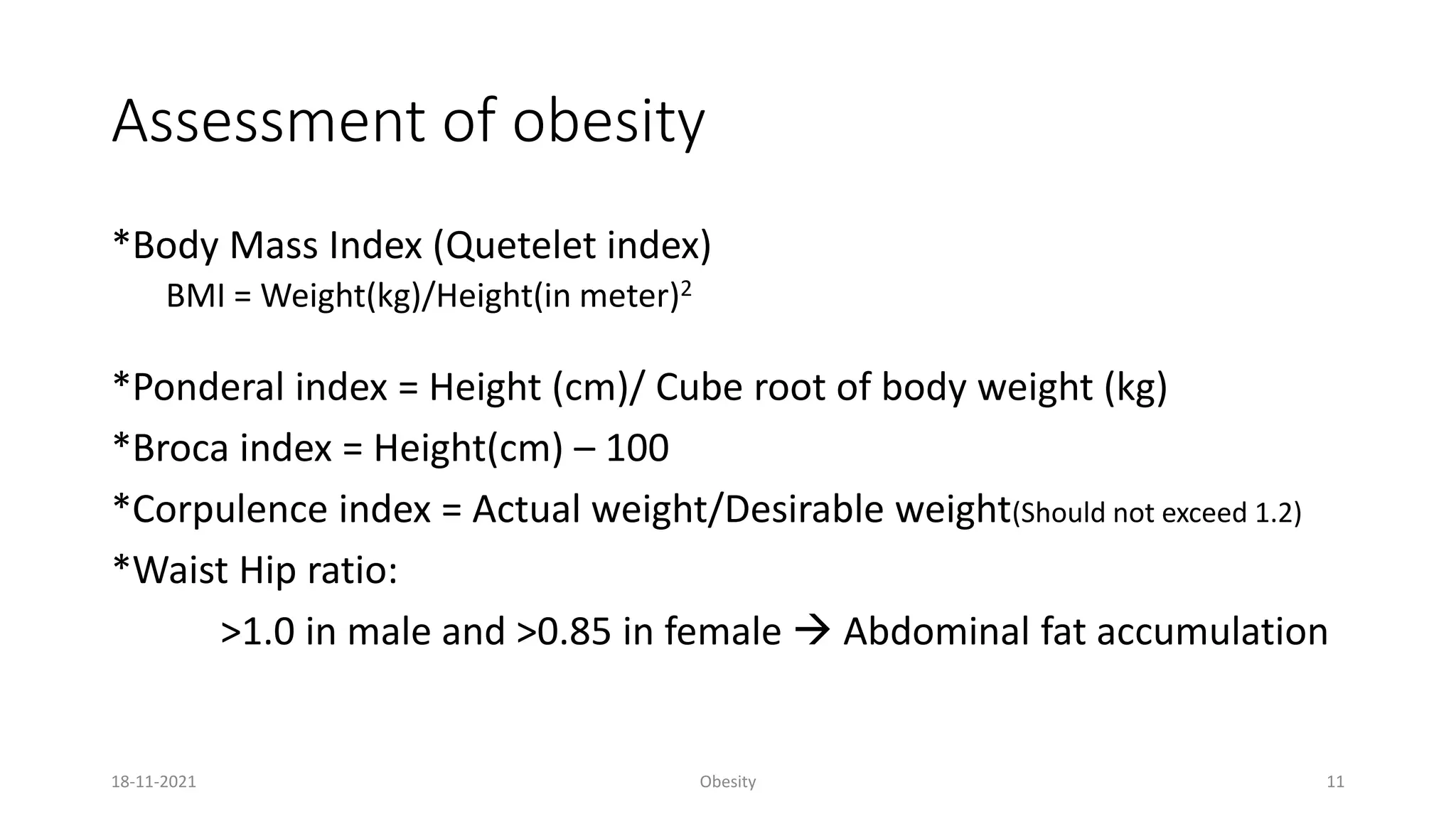
Assessment of obesity
*Body Mass Index (Quetelet index)
BMI = Weight(kg)/Height(in meter)2
*Ponderal index = Height (cm)/ Cube root of body weight (kg)
*Broca index = Height(cm) – 100
*Corpulence index = Actual weight/Desirable weight(Should not exceed 1.2)
*Waist Hip ratio:
>1.0 in male and >0.85 in female  Abdominal fat accumulation
18-11-2021 Obesity 11
Classification of obesity
18-11-2021 Obesity 12
• For children under 5 years of age:
• Overweight : Weight for height greater than 2 SD above WHO Child Growth
Standards median
• Obesity : Weight for height greater than 3 SD above the WHO Child Growth
Standards median
• For children between 5 years and 19 years:
• Overweight : BMI-for-age greater than 1 SD above the WHO Growth Reference
median
• Obesity : BMI-for-age greater than 2 SD above the WHO Growth Reference
Median
18-11-2021 Obesity 13
Consequences of obesity
• Major risk factors for
• NCDS like heart disease and stroke
• Musculoskeletal disorders like osteoarthritis knee
• Cancer of endometrium, ovary, breast, prostate, liver, gall bladder, kidney,
colon.
• Limits the ability for physical activity
• Increased incidence of premature deaths and disabilities in adulthood
• Obese children more prone for breathing difficulties, fractures,
hypertension, insulin resistance and depression.
18-11-2021 Obesity 14
Prevention and Control
• Create enabling and supportive communities
• Choose healthier food choices
• Encourage regular physical activity
• Health education
• Encourage healthy habits
• Discourage unhealthy choices like sweetened beverages, processed
high calorie food
18-11-2021 Obesity 15
Prevention and Control (cont.)
• Policy level decisions like higher taxes on sugar sweetened beverages
and foods
• Policy and guidelines for nutritional content of foods manufactured
• Restriction of marketing for unhealthy food items specifically
targeting children and adolescents.
18-11-2021 Obesity 16
Prevention and Control (cont.)
• Any obesity that may have a medical basis should be referred to an
appropriate physician/specialist.
• Referrals includes suspected Diabetes, Cushing’s, hypothyroidism,
PCOD, etc.
• Suspicion should be more in individuals with typical clinical history or
strong family history of such conditions
18-11-2021 Obesity 17
.
Reference
• IAPSM’s Textbook of Community Medicine
18-11-2021 Obesity 19

Obesity - Community medicine, PSM, SPM

  • 1.
    Obesity Dr Venkatesh Karthikeyan Departmentof Community and Family Medicine AIIMS Patna www.drvenkateshkarthikeyan.com t.me/drvkspm
  • 2.
    Contents • What isobesity? • Pathogenesis • Burden • Epidemiology of obesity • Assessment of obesity • Consequences of obesity • Prevention and Control 18-11-2021 Obesity 2
  • 3.
    What is obesity? •Abnormal or excessive fat accumulation in the body that may impair health. • A body weight higher than the expected weight for a particular age and sex is referred to as “obesity” and “overweight” • It is considered as a disease as well as a risk factor for other diseases 18-11-2021 Obesity 3
  • 4.
    Pathogenesis • Multifactorial • Mostcommon cause – overnutrition • Genetic and environmental factors plays a role • Sedentary habits • Junk foods • High fat diet 18-11-2021 Obesity 4
  • 5.
    Burden of Obesity– Global Scenario • In 2016, more than 1.9 billion adults aged 18 years and older were overweight. • Of these, over 650 million adults were obese. • In the same year, 39% of adults aged 18 years and over were overweight. • Overall, 13% of the world’s adult population is obese. • According to WHO, rates of overweight and obesity are increasing in both developed and developing countries around the world. 18-11-2021 Obesity 5
  • 6.
    Burden of Obesity– Indian Scenario • According to Global Nutritional Report 2017, prevalence of obesity among • Under five children is 2% • Adolescents is 13% • Adult males – 18% are overweight, 2% are obese • Adult females – 22% are overweight, 5% are obese 18-11-2021 Obesity 6
  • 7.
    Epidemiology of obesity •Agent factor • Host factor • Environment factor 18-11-2021 Obesity 7
  • 8.
    Agent factor -Nutrition • Consuming more quantity of food than required amount leads to deposition of excess fat in the body. • QUALITY of food consumed also plays a role. • Common contributors to obesity • High sugar foods like ice creams and high fat food • Protective role • Salads, whole grains, cereals 18-11-2021 Obesity 8
  • 9.
    Host factors • Age(old people > young) • Gender (Females > Males) • Marital status (Married > Single) • Geographical distribution (People of Europe, US and Australia have greater risk) • Physical inactivity (Sedentary lifestyle) • Education (Less educated > well educated) • Endocrine disorder (Cushing’s, PCOD, Hypothyroidism, diabetes) • Psychological state (Stress, depression, anxiety) • Genetics (Prader Willi Syndrome) • Lifestyle (Binge eating, fast food, sedentary lifestyle) • Breast feeding (Formula milk) • Socioeconomic status (higher strata > lower strata) 18-11-2021 Obesity 9
  • 10.
    Environmental factors • Seasonalvariation (Winters > Summers) • Food economics • Social factors (Urban communities more prone to eating junk food) • Marketing factors • Physical environment (lack of parks, lack of walking tracks) 18-11-2021 Obesity 10
  • 11.
    Assessment of obesity *BodyMass Index (Quetelet index) BMI = Weight(kg)/Height(in meter)2 *Ponderal index = Height (cm)/ Cube root of body weight (kg) *Broca index = Height(cm) – 100 *Corpulence index = Actual weight/Desirable weight(Should not exceed 1.2) *Waist Hip ratio: >1.0 in male and >0.85 in female  Abdominal fat accumulation 18-11-2021 Obesity 11
  • 12.
  • 13.
    • For childrenunder 5 years of age: • Overweight : Weight for height greater than 2 SD above WHO Child Growth Standards median • Obesity : Weight for height greater than 3 SD above the WHO Child Growth Standards median • For children between 5 years and 19 years: • Overweight : BMI-for-age greater than 1 SD above the WHO Growth Reference median • Obesity : BMI-for-age greater than 2 SD above the WHO Growth Reference Median 18-11-2021 Obesity 13
  • 14.
    Consequences of obesity •Major risk factors for • NCDS like heart disease and stroke • Musculoskeletal disorders like osteoarthritis knee • Cancer of endometrium, ovary, breast, prostate, liver, gall bladder, kidney, colon. • Limits the ability for physical activity • Increased incidence of premature deaths and disabilities in adulthood • Obese children more prone for breathing difficulties, fractures, hypertension, insulin resistance and depression. 18-11-2021 Obesity 14
  • 15.
    Prevention and Control •Create enabling and supportive communities • Choose healthier food choices • Encourage regular physical activity • Health education • Encourage healthy habits • Discourage unhealthy choices like sweetened beverages, processed high calorie food 18-11-2021 Obesity 15
  • 16.
    Prevention and Control(cont.) • Policy level decisions like higher taxes on sugar sweetened beverages and foods • Policy and guidelines for nutritional content of foods manufactured • Restriction of marketing for unhealthy food items specifically targeting children and adolescents. 18-11-2021 Obesity 16
  • 17.
    Prevention and Control(cont.) • Any obesity that may have a medical basis should be referred to an appropriate physician/specialist. • Referrals includes suspected Diabetes, Cushing’s, hypothyroidism, PCOD, etc. • Suspicion should be more in individuals with typical clinical history or strong family history of such conditions 18-11-2021 Obesity 17
  • 18.
  • 19.
    Reference • IAPSM’s Textbookof Community Medicine 18-11-2021 Obesity 19