

BY: AKANSHA BHATNAGAR
Introduction
Overweight is a state in which weight exceeds a
standard based on height , obesity is a condition
of excess fat accumulation of fat in our body.
The term overweight refers to persons with
body weight 10-20% in excess of ideal body
weight.
Overweight and obesity are therefore relative
terms but not synonymous.
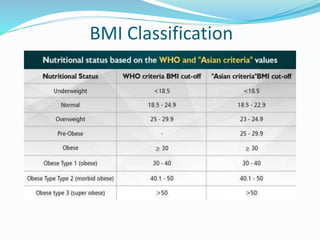
BMI Classification
WHO prevalence of obesity
In 2016 , more than 1.9 billion adults age 18 years and
older were overweight overall about 13% of the world’s
adult population (11% of man and 15% of women ) were
obese in 2016. the world prevalence of obesity nearly
tripled between 1975 and 2016. ( Feb 16, 2018)
IBW ( Ideal body weight) calculation
• Men: 50kg + 2.3 * each inches over height
• Women: 45.5 kg + 2.3*each inches over height
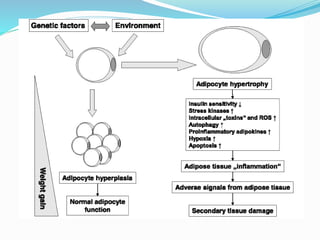
Causes:-
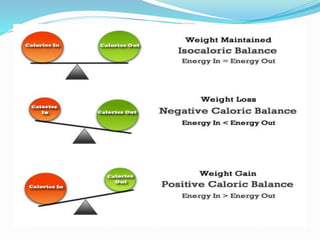
Obesity is due to a positive energy
balance of the body resulting from excessive
energy intakes and low activity levels.
• Genetic factors
• Physiological factors
• Physical Activity
•Psychological factors
•Hormonal imbalance
•Body weight and childhood growth pattern
•Availability
 Genetic Factors:-
•Genetic inheritance influences the person of becoming obese.
•Obesity runs in the families and the chances of obesity increase if both the
parents are obese.
•The specific genes involved in obesity are still unknown.
 Behavioral Factors:-
i. Physical activity:-
Increased mechanization and improved transport and working facilities have
reduced physical activity and promoted sedentary living . This coupled with high
energy intake is a direct cause of increasing incidence of obesity
ii. Eating habits:-
Nibbling in-between meals, eating at night due to insomnia and consumption
of refined ,starchy and fatty foods contributes to high energy intake .
iii. Social aspects:-
Social pressures and needs of often eating out and attending parties is a
common cause of excessive intake of food and energy.
iv. Binge eating.
 Psysiological Factors:-
I. Age and Sex:-
The normal physiology of growth and development during the life
cycle contributes to accumulation of adipose tissue. Critical periods for
development of obesity are early childhood and adulthood when no diet
adjustment is made for decreased activity
women, obesity commonly occurs during pregnancy and after menopause
because of the involvement of certain hormones.
 Endocrinal factors:-
The common occurence of obesity at puberty, pregnancy and menopause is
suggestive that hormonal factors are involved .
Intake of oral contraceptives may lead to obesity as these are hormonal in nature.
Consequences of obesity
 CVD and Stroke
 Type II diabetes mellitus
 Metabolic syndrome
 Gall bladder disease
 Cancer
 Backache, arthritis and gout
 Sleep disorders
 Psychological problems
Management of obesity
 Dietary
 Lifestyle
 Pharmaceutical
 Surgical procedures
 Dietary Management
Objectives:-
• To maintain desirable body weight.
• To correct the nutritional deficiencies if
any.
• To correct faulty food habits.
 Energy:-
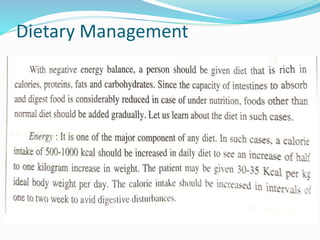
A decrease of 1000 Kcal daily is required to
loose about 1kg a week and reduction of 500 kcal daily
brings about a weight loss of nearly 1/2kg a week.
• Reducing approximately 500kcal per day in the actual
daily intake if the person is over weight .
• Reducing 800- 1000kcal in the actual daily intake if the
person is obese.
• Calculating energy intake is based on the
activity of the individual . This is done according to kcal
prescribed per Kg ideal body weight for an obese.
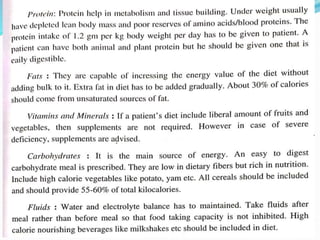
 Protein:- 20-25% of total energy should be provided
from protein. Good quality of protein should be
included in the diet e.g. lean meats, eggs, nuts cereal-
pulse combination, legumes etc.
 Fat:- 20% or less of total energy should be provided
by fat. Fried foods rich in saturated fat, trans fatty acids
and processed foods should be excluded/avoided from
the diet. Rich sources of omega 3 fatty acids such as flax
seeds, nuts, fish should be included.
 Carbohydrates:- 50-55% of total energy should be
come from carbohydrate .
These should be in complex form like starches and
dietary fiber.
Fluids:- Liberal amounts of fluid should be included in the diet
(2.5-3l/day).
 Minerals and vitamins:- Diet should provide
adequate amount of essential nutrients like
minerals and vitamins to maintain good nutritional
Status.( vitamin B, Calcium, Iron, Magnesium). Moderate restriction
in common salt is beneficial especially if the patient is hypertensive.
Consequences of obesity
•Coronary Heart disease
• Diabetes mellitus
• Hypertension
• Cancer
• Gallbladder disease
• Osteoarthritis
• Gout
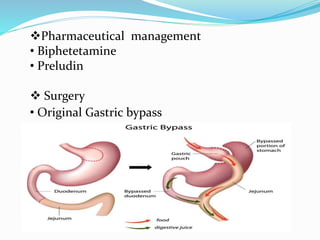
Pharmaceutical management
• Biphetetamine
• Preludin
 Surgery
• Original Gastric bypass
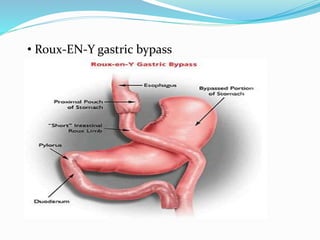
• Roux-EN-Y gastric bypass
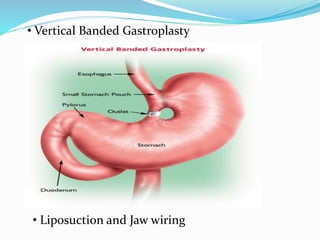
• Vertical Banded Gastroplasty
• Liposuction and Jaw wiring
Underweight
An underweight person is a type of person whose body
weight is considered too low to be healthy .
Underweight people have a body mass index (BMI) of
under 18.5kg/m2.
Dietary Management
EATING DISORDERS
ANOREXIA NERVOSA
 Anorexia is an eating disorder and serious mental
health condition.
 People who have anorexia try to keep their weight as
low as possible by not eating enough food or exercising
too much, or both. This can make them very ill
because they start to starve.
 They often have a distorted image of their bodies,
thinking they are fat even when they are underweight.
 Men and women of any age can get anorexia, but it's
most common in young women and typically starts in
the mid-teens.
Signs and symptoms
 if you're under 18, your weight and height being lower than
expected for your age
 if you're an adult, having an unusually low body mass index
(BMI)
 missing meals, eating very little or avoiding eating any foods
you see as fattening
 believing you are fat when you are a healthy weight or
underweight
 taking medicine to reduce your hunger (appetite
suppressants)
 your periods stopping (in women who have not reached
menopause) or not starting (in younger women and girls)
 physical problems, such as feeling lightheaded or dizzy, hair
loss or dry skin
 Some people with anorexia may also make themselves sick, do
an extreme amount of exercise
Complications
 problems with muscles and bones – including feeling tired
and weak, osteoporosis, and problems with physical
development in children and young adults
 fertility problems
 loss of sex drive
 problems with the heart and blood vessels – including poor
circulation, an irregular heartbeat, low blood pressure,
heart valve disease, heart failure, and swelling in the feet,
hands or face (oedema)
 problems with the brain and nerves – including fits
(seizures), and difficulties with concentration and memory
 kidney or bowel problems
 having a weakened immune system or anaemia
BULIMIA
 Bulimia, is a serious, potentially life-threatening eating
disorder. People with bulimia may secretly binge —
eating large amounts of food with a loss of control over
the eating — and then purge, trying to get rid of the
extra calories in an unhealthy way.
 The exact cause of bulimia is unknown. Many factors
could play a role in the development of eating
disorders, including genetics, biology, emotional
health, societal expectations and other issues.
Symptoms
 Being preoccupied with your body shape and weight
 Living in fear of gaining weight
 Repeated episodes of eating abnormally large amounts of
food in one sitting
 Feeling a loss of control during bingeing — like you can't
stop eating or can't control what you eat
 Forcing yourself to vomit or exercising too much to keep
from gaining weight after bingeing
 Using laxatives, diuretics or enemas after eating when
they're not needed
 Fasting, restricting calories or avoiding certain foods
between binges
 Using dietary supplements or herbal products excessively
for weight loss
BIGOREXIA
 The disorder is formally known as muscle dysmorphia,
an anxiety disorder which causes someone to see
themselves as small, despite actually being big and
muscular.
 It is sometimes described as the opposite of anorexia.
 Signs of bigorexia may include working out
compulsively, often prioritising working out over
family and friends, excessively looking at your body in
the mirror and abusing anabolic steroids, supplements
and protein shakes.
Thank You!

Overweight and Obesity

  • 1.
  • 2.
    Introduction Overweight is astate in which weight exceeds a standard based on height , obesity is a condition of excess fat accumulation of fat in our body. The term overweight refers to persons with body weight 10-20% in excess of ideal body weight. Overweight and obesity are therefore relative terms but not synonymous.
  • 4.
  • 5.
    WHO prevalence ofobesity In 2016 , more than 1.9 billion adults age 18 years and older were overweight overall about 13% of the world’s adult population (11% of man and 15% of women ) were obese in 2016. the world prevalence of obesity nearly tripled between 1975 and 2016. ( Feb 16, 2018)
  • 6.
    IBW ( Idealbody weight) calculation • Men: 50kg + 2.3 * each inches over height • Women: 45.5 kg + 2.3*each inches over height
  • 7.
    Causes:- Obesity is dueto a positive energy balance of the body resulting from excessive energy intakes and low activity levels. • Genetic factors • Physiological factors • Physical Activity •Psychological factors •Hormonal imbalance •Body weight and childhood growth pattern •Availability
  • 9.
     Genetic Factors:- •Geneticinheritance influences the person of becoming obese. •Obesity runs in the families and the chances of obesity increase if both the parents are obese. •The specific genes involved in obesity are still unknown.  Behavioral Factors:- i. Physical activity:- Increased mechanization and improved transport and working facilities have reduced physical activity and promoted sedentary living . This coupled with high energy intake is a direct cause of increasing incidence of obesity ii. Eating habits:- Nibbling in-between meals, eating at night due to insomnia and consumption of refined ,starchy and fatty foods contributes to high energy intake . iii. Social aspects:- Social pressures and needs of often eating out and attending parties is a common cause of excessive intake of food and energy. iv. Binge eating.
  • 10.
     Psysiological Factors:- I.Age and Sex:- The normal physiology of growth and development during the life cycle contributes to accumulation of adipose tissue. Critical periods for development of obesity are early childhood and adulthood when no diet adjustment is made for decreased activity women, obesity commonly occurs during pregnancy and after menopause because of the involvement of certain hormones.  Endocrinal factors:- The common occurence of obesity at puberty, pregnancy and menopause is suggestive that hormonal factors are involved . Intake of oral contraceptives may lead to obesity as these are hormonal in nature.
  • 11.
    Consequences of obesity CVD and Stroke  Type II diabetes mellitus  Metabolic syndrome  Gall bladder disease  Cancer  Backache, arthritis and gout  Sleep disorders  Psychological problems
  • 12.
    Management of obesity Dietary  Lifestyle  Pharmaceutical  Surgical procedures
  • 13.
     Dietary Management Objectives:- •To maintain desirable body weight. • To correct the nutritional deficiencies if any. • To correct faulty food habits.
  • 14.
     Energy:- A decreaseof 1000 Kcal daily is required to loose about 1kg a week and reduction of 500 kcal daily brings about a weight loss of nearly 1/2kg a week. • Reducing approximately 500kcal per day in the actual daily intake if the person is over weight . • Reducing 800- 1000kcal in the actual daily intake if the person is obese. • Calculating energy intake is based on the activity of the individual . This is done according to kcal prescribed per Kg ideal body weight for an obese.
  • 15.
     Protein:- 20-25%of total energy should be provided from protein. Good quality of protein should be included in the diet e.g. lean meats, eggs, nuts cereal- pulse combination, legumes etc.  Fat:- 20% or less of total energy should be provided by fat. Fried foods rich in saturated fat, trans fatty acids and processed foods should be excluded/avoided from the diet. Rich sources of omega 3 fatty acids such as flax seeds, nuts, fish should be included.
  • 16.
     Carbohydrates:- 50-55%of total energy should be come from carbohydrate . These should be in complex form like starches and dietary fiber. Fluids:- Liberal amounts of fluid should be included in the diet (2.5-3l/day).  Minerals and vitamins:- Diet should provide adequate amount of essential nutrients like minerals and vitamins to maintain good nutritional Status.( vitamin B, Calcium, Iron, Magnesium). Moderate restriction in common salt is beneficial especially if the patient is hypertensive.
  • 17.
    Consequences of obesity •CoronaryHeart disease • Diabetes mellitus • Hypertension • Cancer • Gallbladder disease • Osteoarthritis • Gout
  • 18.
    Pharmaceutical management • Biphetetamine •Preludin  Surgery • Original Gastric bypass
  • 19.
  • 20.
    • Vertical BandedGastroplasty • Liposuction and Jaw wiring
  • 21.
    Underweight An underweight personis a type of person whose body weight is considered too low to be healthy . Underweight people have a body mass index (BMI) of under 18.5kg/m2.
  • 22.
  • 24.
  • 25.
    ANOREXIA NERVOSA  Anorexiais an eating disorder and serious mental health condition.  People who have anorexia try to keep their weight as low as possible by not eating enough food or exercising too much, or both. This can make them very ill because they start to starve.  They often have a distorted image of their bodies, thinking they are fat even when they are underweight.  Men and women of any age can get anorexia, but it's most common in young women and typically starts in the mid-teens.
  • 26.
    Signs and symptoms if you're under 18, your weight and height being lower than expected for your age  if you're an adult, having an unusually low body mass index (BMI)  missing meals, eating very little or avoiding eating any foods you see as fattening  believing you are fat when you are a healthy weight or underweight  taking medicine to reduce your hunger (appetite suppressants)  your periods stopping (in women who have not reached menopause) or not starting (in younger women and girls)  physical problems, such as feeling lightheaded or dizzy, hair loss or dry skin  Some people with anorexia may also make themselves sick, do an extreme amount of exercise
  • 27.
    Complications  problems withmuscles and bones – including feeling tired and weak, osteoporosis, and problems with physical development in children and young adults  fertility problems  loss of sex drive  problems with the heart and blood vessels – including poor circulation, an irregular heartbeat, low blood pressure, heart valve disease, heart failure, and swelling in the feet, hands or face (oedema)  problems with the brain and nerves – including fits (seizures), and difficulties with concentration and memory  kidney or bowel problems  having a weakened immune system or anaemia
  • 28.
    BULIMIA  Bulimia, isa serious, potentially life-threatening eating disorder. People with bulimia may secretly binge — eating large amounts of food with a loss of control over the eating — and then purge, trying to get rid of the extra calories in an unhealthy way.  The exact cause of bulimia is unknown. Many factors could play a role in the development of eating disorders, including genetics, biology, emotional health, societal expectations and other issues.
  • 29.
    Symptoms  Being preoccupiedwith your body shape and weight  Living in fear of gaining weight  Repeated episodes of eating abnormally large amounts of food in one sitting  Feeling a loss of control during bingeing — like you can't stop eating or can't control what you eat  Forcing yourself to vomit or exercising too much to keep from gaining weight after bingeing  Using laxatives, diuretics or enemas after eating when they're not needed  Fasting, restricting calories or avoiding certain foods between binges  Using dietary supplements or herbal products excessively for weight loss
  • 30.
    BIGOREXIA  The disorderis formally known as muscle dysmorphia, an anxiety disorder which causes someone to see themselves as small, despite actually being big and muscular.  It is sometimes described as the opposite of anorexia.  Signs of bigorexia may include working out compulsively, often prioritising working out over family and friends, excessively looking at your body in the mirror and abusing anabolic steroids, supplements and protein shakes.
  • 31.