UNIT ONE
Organizational Behavior 8 hours
Concept of OB; Contributing disciplines to OB; Challenges and opportunities in the
field: Emerging trends in OB (improving quality and productivity, improving people's
skills, managing workforce diversity)
Managers make decisions, allocate resources, and direct the activities of others to attain goals
within organizations. An organization is a consciously coordinated social unit, composed of
two or more people, that functions on a relatively continuous basis to achieve a common goal
or set of goals.
Based on the work of French industrialist Henri Fayol, managers can be said to perform
four functions: planning, organizing, leading, and controlling. Henry Mintzberg studied
management roles, which he grouped under the headings of interpersonal roles, informational
roles, and decisional roles. Interpersonal roles included symbolic, figurehead, and leadership
roles; informational roles included disseminator, monitor, and spokesperson roles; and
decisional roles were comprised of entrepreneur, disturbance handler, resource allocator, and
negotiator roles. Robert Katz identified the three essential management skills as technical,
human, and conceptual. Lastly, Fred Luthans and his colleagues found that managers engaged
in four major activities. First, managers participated in traditional management activities such
as decision making, planning, and controlling. Managers were also engaged in communication
activities such as exchanging routine information and processing paperwork. Luthans found
that managers also performed human resource management functions such as motivating,
disciplining, managing conflict, staffing, and training. Finally, managers engaged in
networking activities, through socializing, politicking, and interacting with outsiders.
Organizational behaviour is the field of study that investigates the impact that individuals,
groups, and structure have on behaviour within organizations for the purpose of applying such
knowledge toward improving an organization's effectiveness. It is a study of individuals,
groups and structure in a systematic way to make organizations work more effectively. Core
topics include motivation, leader behaviour, power, interpersonal communication, group
structure and processes, learning, attitude development, perception, change processes, conflict,
work design, and work stress.
The text will use systematic study in an attempt to explain and predict behaviour in
organizations. Systematic study attempts to attribute cause and effects, basing conclusions on
scientific evidence by gathering data under controlled conditions and measuring and
interpreting it in a rigorous manner. The systematic study of organizational behaviour concepts
replaces popularly held, but erroneous preconceived notions with data based on science-based
study. The field of organizational behaviour is an integration of psychology, sociology,
anthropology, and social psychology
There are many challenges and opportunities that create a significant demand for
understanding organizational behaviour. Organizations are no longer constrained by national
borders and managers find themselves having to travel to different countries, work with people
from different cultures, and cope with anti-capitalism backlash. An area of growing importance
is the movement of jobs to countries with low-cost labour. Organizations also contend with
within country diversity caused by shifting demographics and immigration. In addition to
country diversity, diversity also includes race, gender, sexual orientation, ethnicity, religion,
cultural values, lifestyle preferences, and virtually any dimension on which employees differ.
When diversity is not managed properly, there is a potential for higher turnover,
misunderstandings, and interpersonal conflicts. Perhaps the most significant change in the
European labour force in the last 50 years has been the sharp increase in the number of female
workers. In addition, the first half of the twentieth century will be notable for changes in the
racial and ethnic composition of the workforce as well as an aging generation of Baby Boomers.
Other trends include an increased emphasis on quality management or the attainment of
customer satisfaction through the continuous improvement of all organizational processes. A
customer responsive culture can be created through helping employees to improve their people
skills. It is also essential to help employees to quickly respond to organizational change.
Today's managers and employees must learn to cope with "temporariness" and manage the
stresses inherent to working in networked organizations. Flexibility must also be shown to
employees, who can better do their jobs if their work and family responsibilities are balanced.
A growth area in OB research has been positive organizational scholarship, which concerns
how organizations develop human strengths, foster vitality and resilience, and unlock potential.
Finally, managers must create an ethically healthy environment for his or her employees.
A model is an abstraction of reality, a simplified representation of some real world
phenomenon. The model of organizational behaviour includes both dependent and independent
variables. A dependent variable is the key factor that is explained or predicted by some other
(independent) factor. The key dependent variables in the model of organizational behaviour
are productivity, absenteeism, turnover, deviant workplace behaviour, organizational
citizenship behaviour, and job satisfaction. These dependent variables can be explained by
the independent variables. Independent variables occur at the level of the individual, group,
and organization. Finally, there are a number of contingency variables that affect the model.
A number of conclusions emerge from this analysis. Organizational behaviour uses systematic
study to improve predictions about the behaviour of individuals and groups within the
workplace. The study of organizational behaviour can improve productivity; reduce
absenteeism, turnover, and deviant workplace behaviour; and increase organizational
citizenship behaviour and job satisfaction.
What is Organizational Behavior?
Organizational behavior is the area of study that investigates the impact that individuals, groups
and structure have on behavior within organization for the purpose of applying such knowledge
toward improving an organization’s effectiveness.
An organization is a collection of people who work together to achieve a wide variety of goals,
both goals of the organization and goals of the various individuals in the organization.
Organizations exist to provide services and goods that people want. These goods and services
are the products of the behaviors of workers. Organizational behavior usually known as ‘OB’
is the study of the many factors that have an impact on how individuals and groups respond to
and act in organizations and how organizations manage their environments.
Organizational behavior is a field of study, that statement means that it is a distinct area of
expertise with a common body of knowledge. What does it study? It studies three determinants
of behavior in organizations: individuals, structure and groups. In addition, OB applies the
knowledge gained about individuals, groups and the effect of structure on behavior in order to
make organizations work more effectively.
To sum up our definition, OB is concerned with the study or what people do in an organization
and how that behavior affects the performance of the organization. And because the OB is
specifically concerned with employment related situations, you should not be surprised to find
that is emphasizes behavior as related to jobs, work, absenteeism, employment turnover,
productivity, human performance and management.
Although many people assume that understanding human behavior in organizations is intuitive,
many commonly held beliefs about behavior in organizations, such as the idea that a “happy
worker is a productive worker”, are either entirely false or true only in specific situations. The
study of organizational behavior provides a set of tools, concepts and theories that help people
understand, analyze and describe what goes on in organizations and why. How do the
characteristics of individuals, groups, work situations, and the organization itself affect how
members feel about their organization?
The ability to use the tools of organizational behavior to understand behavior in organizations
is one reason for studying this subject. A second reason is to learn how to apply these concepts,
theories, and techniques to improve behavior in organizations so that individuals, groups and
organizations can achieve their goals. Managers are challenged to find new ways to motivate
and coordinate employees to ensure that their goals are aligned with organizational goals.
Five Contributing Disciplines to the Organizational Behaviour
OB is a behavioural science that is built upon contributions from a number of behavioural
disciplines. The dominant areas are psychology, sociology, social psychology, anthropology,
and political science. As we shall learn, psychology’s contributions have been mainly at the
micro level of analysis; the other four disciplines have contributed to our understanding of
macro concepts such as organization and group process.
1. Psychology
Psychology is the science that seeks to measure, explain, and sometimes change the behavior
of humans and other animals. Psychologists involve themselves with studying and attempting
to understand individual behavior. Those who have contributed and continue to add to the
knowledge of organizational behavior are learning theorists, personality theorists, counselling
psychologists, and, most important industrial and organizational psychologist. Early industrial
and organizational psychologists concerned themselves with problems of fatigue, boredom,
and other factors relevant to working conditions that could impede efficient work performance.
More recently, their contributions have been expanded to include learning, perception,
personality, training, leadership effectiveness, needs and motivational forces, job satisfaction,
decision making processes, performance appraisals, attitude measurement, employee selection
techniques, work design and job stress.
2. Sociology
Where psychologists focus on the individual, sociologists study the social system in which
individual fills their role; that is, sociology studies people in relation to their fellow human
beings. Specifically, sociologists have made their greatest contribution to organizational
behavior through their study of group behavior in organizations, particularly in formal and
complex organizations. Some of the areas within organizational behavior that have received
valuable input from sociologist are group dynamics, design of work teams, organizational
culture, formal organization theory and structure, organizational technology, communications,
power conflict, and inter group behavior.
3. Social Psychology
Social psychology is an area within psychology, but it blends concepts from psychology and
sociology. It concentrates on the influence of people on one another. One of the major areas
receiving considerable investigation from social psychologist have been change, how to
implement it and how to reduce barriers to its acceptance. In addition, social psychologists are
making significant contributions in the areas of measuring, understanding, and changing
attitudes; communication patterns; the ways in which group activities can satisfy individual
needs; and group decision making processes.
4. Anthropology
Anthropology is the study or societies to learn about human beings and their activities.
Anthropologists’ work on cultures and environments, for instance, has helped us understand
differences in fundamental values, attitudes, and behavior between people in different countries
and within different organizations. Much of our current understanding of organizational
culture, organizational environments, and differences between national cultures is the result of
the work of anthropologist or researchers using their methodologies.
5. Political Science
Although frequently overlooked, the contributions of political scientists are significant to the
understanding of behavior in organizations. Political science studies the behavior of individuals
and groups within a political environment. Specific topics of concern include structuring of
conflict, allocation of power and how people manipulate power for individual self-interest.
Contributing disciplines to the Organisational Behaviour field
Organizational behaviour is an applied behavioural science that is built upon contributions
from a number of behavioural disciplines. The predominant areas are psychology, sociology,
social psychology, anthropology, and political science
Psychology
 Psychology is the science that seeks to measure, explain, and sometimes change the
behaviour of humans and other animals.
 To use psychological and organizational theory and research to improve organizational
effectiveness and the work life of all individuals.
 Psychologists concern themselves with studying and attempting to understand
individual behaviour
 learning, perception, personality, emotions, training, leadership effectiveness, needs
and motivational forces, job satisfaction, decision-making process, performance
appraisals, attitude measurement, employee selection techniques, work design and job
stress
Sociology
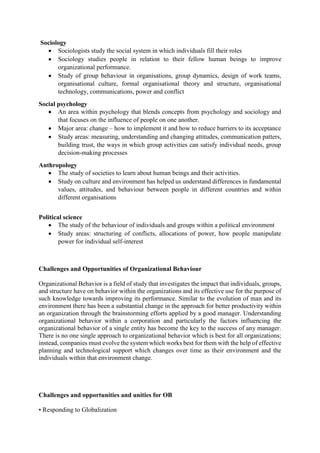
 Sociologists study the social system in which individuals fill their roles
 Sociology studies people in relation to their fellow human beings to improve
organizational performance.
 Study of group behaviour in organisations, group dynamics, design of work teams,
organisational culture, formal organisational theory and structure, organisational
technology, communications, power and conflict
Social psychology
 An area within psychology that blends concepts from psychology and sociology and
that focuses on the influence of people on one another.
 Major area: change – how to implement it and how to reduce barriers to its acceptance
 Study areas: measuring, understanding and changing attitudes, communication patters,
building trust, the ways in which group activities can satisfy individual needs, group
decision-making processes
Anthropology
 The study of societies to learn about human beings and their activities.
 Study on culture and environment has helped us understand differences in fundamental
values, attitudes, and behaviour between people in different countries and within
different organisations
Political science
 The study of the behaviour of individuals and groups within a political environment
 Study areas: structuring of conflicts, allocations of power, how people manipulate
power for individual self-interest
Challenges and Opportunities of Organizational Behaviour
Organizational Behavior is a field of study that investigates the impact that individuals, groups,
and structure have on behavior within the organizations and its effective use for the purpose of
such knowledge towards improving its performance. Similar to the evolution of man and its
environment there has been a substantial change in the approach for better productivity within
an organization through the brainstorming efforts applied by a good manager. Understanding
organizational behavior within a corporation and particularly the factors influencing the
organizational behavior of a single entity has become the key to the success of any manager.
There is no one single approach to organizational behavior which is best for all organizations;
instead, companies must evolve the system which works best for them with the help of effective
planning and technological support which changes over time as their environment and the
individuals within that environment change.
Challenges and opportunities and unities for OB
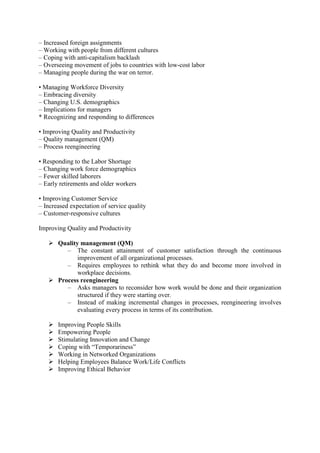
• Responding to Globalization
– Increased foreign assignments
– Working with people from different cultures
– Coping with anti-capitalism backlash
– Overseeing movement of jobs to countries with low-cost labor
– Managing people during the war on terror.
• Managing Workforce Diversity
– Embracing diversity
– Changing U.S. demographics
– Implications for managers
* Recognizing and responding to differences
• Improving Quality and Productivity
– Quality management (QM)
– Process reengineering
• Responding to the Labor Shortage
– Changing work force demographics
– Fewer skilled laborers
– Early retirements and older workers
• Improving Customer Service
– Increased expectation of service quality
– Customer-responsive cultures
Improving Quality and Productivity
 Quality management (QM)
– The constant attainment of customer satisfaction through the continuous
improvement of all organizational processes.
– Requires employees to rethink what they do and become more involved in
workplace decisions.
 Process reengineering
– Asks managers to reconsider how work would be done and their organization
structured if they were starting over.
– Instead of making incremental changes in processes, reengineering involves
evaluating every process in terms of its contribution.
 Improving People Skills
 Empowering People
 Stimulating Innovation and Change
 Coping with “Temporariness”
 Working in Networked Organizations
 Helping Employees Balance Work/Life Conflicts
 Improving Ethical Behavior

Organisational Behaviour BBA 5th SEm

  • 1.
    UNIT ONE Organizational Behavior8 hours Concept of OB; Contributing disciplines to OB; Challenges and opportunities in the field: Emerging trends in OB (improving quality and productivity, improving people's skills, managing workforce diversity) Managers make decisions, allocate resources, and direct the activities of others to attain goals within organizations. An organization is a consciously coordinated social unit, composed of two or more people, that functions on a relatively continuous basis to achieve a common goal or set of goals. Based on the work of French industrialist Henri Fayol, managers can be said to perform four functions: planning, organizing, leading, and controlling. Henry Mintzberg studied management roles, which he grouped under the headings of interpersonal roles, informational roles, and decisional roles. Interpersonal roles included symbolic, figurehead, and leadership roles; informational roles included disseminator, monitor, and spokesperson roles; and decisional roles were comprised of entrepreneur, disturbance handler, resource allocator, and negotiator roles. Robert Katz identified the three essential management skills as technical, human, and conceptual. Lastly, Fred Luthans and his colleagues found that managers engaged in four major activities. First, managers participated in traditional management activities such as decision making, planning, and controlling. Managers were also engaged in communication activities such as exchanging routine information and processing paperwork. Luthans found that managers also performed human resource management functions such as motivating, disciplining, managing conflict, staffing, and training. Finally, managers engaged in networking activities, through socializing, politicking, and interacting with outsiders. Organizational behaviour is the field of study that investigates the impact that individuals, groups, and structure have on behaviour within organizations for the purpose of applying such knowledge toward improving an organization's effectiveness. It is a study of individuals, groups and structure in a systematic way to make organizations work more effectively. Core topics include motivation, leader behaviour, power, interpersonal communication, group structure and processes, learning, attitude development, perception, change processes, conflict, work design, and work stress. The text will use systematic study in an attempt to explain and predict behaviour in organizations. Systematic study attempts to attribute cause and effects, basing conclusions on scientific evidence by gathering data under controlled conditions and measuring and interpreting it in a rigorous manner. The systematic study of organizational behaviour concepts replaces popularly held, but erroneous preconceived notions with data based on science-based study. The field of organizational behaviour is an integration of psychology, sociology, anthropology, and social psychology There are many challenges and opportunities that create a significant demand for understanding organizational behaviour. Organizations are no longer constrained by national borders and managers find themselves having to travel to different countries, work with people from different cultures, and cope with anti-capitalism backlash. An area of growing importance is the movement of jobs to countries with low-cost labour. Organizations also contend with within country diversity caused by shifting demographics and immigration. In addition to
  • 2.
    country diversity, diversityalso includes race, gender, sexual orientation, ethnicity, religion, cultural values, lifestyle preferences, and virtually any dimension on which employees differ. When diversity is not managed properly, there is a potential for higher turnover, misunderstandings, and interpersonal conflicts. Perhaps the most significant change in the European labour force in the last 50 years has been the sharp increase in the number of female workers. In addition, the first half of the twentieth century will be notable for changes in the racial and ethnic composition of the workforce as well as an aging generation of Baby Boomers. Other trends include an increased emphasis on quality management or the attainment of customer satisfaction through the continuous improvement of all organizational processes. A customer responsive culture can be created through helping employees to improve their people skills. It is also essential to help employees to quickly respond to organizational change. Today's managers and employees must learn to cope with "temporariness" and manage the stresses inherent to working in networked organizations. Flexibility must also be shown to employees, who can better do their jobs if their work and family responsibilities are balanced. A growth area in OB research has been positive organizational scholarship, which concerns how organizations develop human strengths, foster vitality and resilience, and unlock potential. Finally, managers must create an ethically healthy environment for his or her employees. A model is an abstraction of reality, a simplified representation of some real world phenomenon. The model of organizational behaviour includes both dependent and independent variables. A dependent variable is the key factor that is explained or predicted by some other (independent) factor. The key dependent variables in the model of organizational behaviour are productivity, absenteeism, turnover, deviant workplace behaviour, organizational citizenship behaviour, and job satisfaction. These dependent variables can be explained by the independent variables. Independent variables occur at the level of the individual, group, and organization. Finally, there are a number of contingency variables that affect the model. A number of conclusions emerge from this analysis. Organizational behaviour uses systematic study to improve predictions about the behaviour of individuals and groups within the workplace. The study of organizational behaviour can improve productivity; reduce absenteeism, turnover, and deviant workplace behaviour; and increase organizational citizenship behaviour and job satisfaction. What is Organizational Behavior? Organizational behavior is the area of study that investigates the impact that individuals, groups and structure have on behavior within organization for the purpose of applying such knowledge toward improving an organization’s effectiveness. An organization is a collection of people who work together to achieve a wide variety of goals, both goals of the organization and goals of the various individuals in the organization. Organizations exist to provide services and goods that people want. These goods and services are the products of the behaviors of workers. Organizational behavior usually known as ‘OB’ is the study of the many factors that have an impact on how individuals and groups respond to and act in organizations and how organizations manage their environments. Organizational behavior is a field of study, that statement means that it is a distinct area of expertise with a common body of knowledge. What does it study? It studies three determinants of behavior in organizations: individuals, structure and groups. In addition, OB applies the
  • 3.
    knowledge gained aboutindividuals, groups and the effect of structure on behavior in order to make organizations work more effectively. To sum up our definition, OB is concerned with the study or what people do in an organization and how that behavior affects the performance of the organization. And because the OB is specifically concerned with employment related situations, you should not be surprised to find that is emphasizes behavior as related to jobs, work, absenteeism, employment turnover, productivity, human performance and management. Although many people assume that understanding human behavior in organizations is intuitive, many commonly held beliefs about behavior in organizations, such as the idea that a “happy worker is a productive worker”, are either entirely false or true only in specific situations. The study of organizational behavior provides a set of tools, concepts and theories that help people understand, analyze and describe what goes on in organizations and why. How do the characteristics of individuals, groups, work situations, and the organization itself affect how members feel about their organization? The ability to use the tools of organizational behavior to understand behavior in organizations is one reason for studying this subject. A second reason is to learn how to apply these concepts, theories, and techniques to improve behavior in organizations so that individuals, groups and organizations can achieve their goals. Managers are challenged to find new ways to motivate and coordinate employees to ensure that their goals are aligned with organizational goals. Five Contributing Disciplines to the Organizational Behaviour OB is a behavioural science that is built upon contributions from a number of behavioural disciplines. The dominant areas are psychology, sociology, social psychology, anthropology, and political science. As we shall learn, psychology’s contributions have been mainly at the micro level of analysis; the other four disciplines have contributed to our understanding of macro concepts such as organization and group process. 1. Psychology Psychology is the science that seeks to measure, explain, and sometimes change the behavior of humans and other animals. Psychologists involve themselves with studying and attempting to understand individual behavior. Those who have contributed and continue to add to the knowledge of organizational behavior are learning theorists, personality theorists, counselling psychologists, and, most important industrial and organizational psychologist. Early industrial and organizational psychologists concerned themselves with problems of fatigue, boredom, and other factors relevant to working conditions that could impede efficient work performance. More recently, their contributions have been expanded to include learning, perception, personality, training, leadership effectiveness, needs and motivational forces, job satisfaction, decision making processes, performance appraisals, attitude measurement, employee selection techniques, work design and job stress. 2. Sociology Where psychologists focus on the individual, sociologists study the social system in which individual fills their role; that is, sociology studies people in relation to their fellow human beings. Specifically, sociologists have made their greatest contribution to organizational
  • 4.
    behavior through theirstudy of group behavior in organizations, particularly in formal and complex organizations. Some of the areas within organizational behavior that have received valuable input from sociologist are group dynamics, design of work teams, organizational culture, formal organization theory and structure, organizational technology, communications, power conflict, and inter group behavior. 3. Social Psychology Social psychology is an area within psychology, but it blends concepts from psychology and sociology. It concentrates on the influence of people on one another. One of the major areas receiving considerable investigation from social psychologist have been change, how to implement it and how to reduce barriers to its acceptance. In addition, social psychologists are making significant contributions in the areas of measuring, understanding, and changing attitudes; communication patterns; the ways in which group activities can satisfy individual needs; and group decision making processes. 4. Anthropology Anthropology is the study or societies to learn about human beings and their activities. Anthropologists’ work on cultures and environments, for instance, has helped us understand differences in fundamental values, attitudes, and behavior between people in different countries and within different organizations. Much of our current understanding of organizational culture, organizational environments, and differences between national cultures is the result of the work of anthropologist or researchers using their methodologies. 5. Political Science Although frequently overlooked, the contributions of political scientists are significant to the understanding of behavior in organizations. Political science studies the behavior of individuals and groups within a political environment. Specific topics of concern include structuring of conflict, allocation of power and how people manipulate power for individual self-interest. Contributing disciplines to the Organisational Behaviour field Organizational behaviour is an applied behavioural science that is built upon contributions from a number of behavioural disciplines. The predominant areas are psychology, sociology, social psychology, anthropology, and political science Psychology  Psychology is the science that seeks to measure, explain, and sometimes change the behaviour of humans and other animals.  To use psychological and organizational theory and research to improve organizational effectiveness and the work life of all individuals.  Psychologists concern themselves with studying and attempting to understand individual behaviour  learning, perception, personality, emotions, training, leadership effectiveness, needs and motivational forces, job satisfaction, decision-making process, performance appraisals, attitude measurement, employee selection techniques, work design and job stress
  • 5.
    Sociology  Sociologists studythe social system in which individuals fill their roles  Sociology studies people in relation to their fellow human beings to improve organizational performance.  Study of group behaviour in organisations, group dynamics, design of work teams, organisational culture, formal organisational theory and structure, organisational technology, communications, power and conflict Social psychology  An area within psychology that blends concepts from psychology and sociology and that focuses on the influence of people on one another.  Major area: change – how to implement it and how to reduce barriers to its acceptance  Study areas: measuring, understanding and changing attitudes, communication patters, building trust, the ways in which group activities can satisfy individual needs, group decision-making processes Anthropology  The study of societies to learn about human beings and their activities.  Study on culture and environment has helped us understand differences in fundamental values, attitudes, and behaviour between people in different countries and within different organisations Political science  The study of the behaviour of individuals and groups within a political environment  Study areas: structuring of conflicts, allocations of power, how people manipulate power for individual self-interest Challenges and Opportunities of Organizational Behaviour Organizational Behavior is a field of study that investigates the impact that individuals, groups, and structure have on behavior within the organizations and its effective use for the purpose of such knowledge towards improving its performance. Similar to the evolution of man and its environment there has been a substantial change in the approach for better productivity within an organization through the brainstorming efforts applied by a good manager. Understanding organizational behavior within a corporation and particularly the factors influencing the organizational behavior of a single entity has become the key to the success of any manager. There is no one single approach to organizational behavior which is best for all organizations; instead, companies must evolve the system which works best for them with the help of effective planning and technological support which changes over time as their environment and the individuals within that environment change. Challenges and opportunities and unities for OB • Responding to Globalization
  • 6.
    – Increased foreignassignments – Working with people from different cultures – Coping with anti-capitalism backlash – Overseeing movement of jobs to countries with low-cost labor – Managing people during the war on terror. • Managing Workforce Diversity – Embracing diversity – Changing U.S. demographics – Implications for managers * Recognizing and responding to differences • Improving Quality and Productivity – Quality management (QM) – Process reengineering • Responding to the Labor Shortage – Changing work force demographics – Fewer skilled laborers – Early retirements and older workers • Improving Customer Service – Increased expectation of service quality – Customer-responsive cultures Improving Quality and Productivity  Quality management (QM) – The constant attainment of customer satisfaction through the continuous improvement of all organizational processes. – Requires employees to rethink what they do and become more involved in workplace decisions.  Process reengineering – Asks managers to reconsider how work would be done and their organization structured if they were starting over. – Instead of making incremental changes in processes, reengineering involves evaluating every process in terms of its contribution.  Improving People Skills  Empowering People  Stimulating Innovation and Change  Coping with “Temporariness”  Working in Networked Organizations  Helping Employees Balance Work/Life Conflicts  Improving Ethical Behavior