Organizational BehaviourUnit 1Development of Organizational Behaviour
Toward a definition of OBThe concept of organizational behaviour is somewhat misleading because OB refers to the behaviour of people in an organization.An organization is a system of two or more people, engaged in cooperative action trying to reach a purpose(Kilduff and Doughberrysired in Champoux, 2006 p6).Hellriegel, slocum and Woodman (1995 p4) define organizational behaviour as a study of human behaviour, attitudes and performance in an organization.
Toward a definition of OBIt is interdisciplinary, drawing from concepts from social and clinical psychology, sociology, cultural anthropology, industrial engineering, and organizational psychology.
Historical foundations of OBScientific Management Frederick W. Taylor (1911)The four principles of Taylor’s scientific management:Carefully study the jobs to develop standard work practices. Standardize the tools used by workers.Select each worker scientifically.Management and workers cooperate to ensure that work is done according to standard procedures.Management plans and makes task assignments; workers carry out assigned task.
Historical foundations of OBTheory of AdministrationHenri Fayol (1919)Fayol’s theory described the major management functions and several principles that act as a administrative guide.Five functions of management:PlanningOrganizingCommandingCoordinatingcontrolling
Historical foundations of OBFayol (con’t)“all must observe the same general principles”. The principle of administration were central to his theory of administration. They are set tools a manager needs to perform the function of management. Division of labourAuthority and responsibilityCentralizationDelegation of authorityUnity of commandUnity of direction
Historical foundations of OBBureaucracy (Max Weber, 1922)An administrative structure with well defined offices and functions and hierarchical relationships among the functions. The bureaucracy defines the authority when it develops its division of labour. The person who takes authority assumes the authority of that position.
Historical foundations of OBBureaucracy (con’t)Features:Clearly defined and specialized functionsUse of legal authorityHierarchical formWritten rulesTechnical trained bureaucratsAppointment based on technical competenceClearly defined career pathFixed formal relationships among clearly defined hierarchically organized functions.
Historical foundations of OBMary Parker Follet’s (1925) and Chester Bernard (1938) – humanistic perspective on management that emphasized:Importance of understanding human behavioursNeeds and attitudes in the work placeSocial interaction and group processes
Historical foundations of OBHuman Relations MovementThe human relations school considers that effective control comes from within the individual rather than from strict, authoritarian control.The relations movement emphasized satisfaction of employee’s basic needs as key to increased productivity.The Hawthorne Studies (1939) is a significant qualifying perspective as it emphasized the extent to which social pressures affect employees in the work place and how the relationship between managers and operatives influence the level of productivity in the work environment.Maslow and McGregor (1960) – motivation of the individual
Historical foundations of OBPeter Drucker (1995)Proposed the philosophy of management by objectives (MBO) and self-control.Managers and employees define goals for every department, project, and person and use them to monitor subsequence performance.
Why study OB?To attain the competencies needed to be an effective employee, team leader, and/or manager.Knowledge and skills gained should help to diagnose, understand, and explain what is happening around to an employee in his or her job.
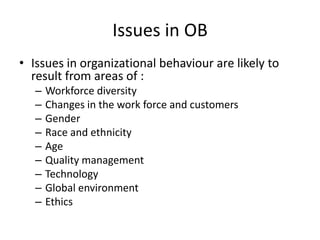
Issues in OBIssues in organizational behaviour are likely to result from areas of :Workforce diversityChanges in the work force and customersGenderRace and ethnicityAgeQuality managementTechnologyGlobal environmentEthics
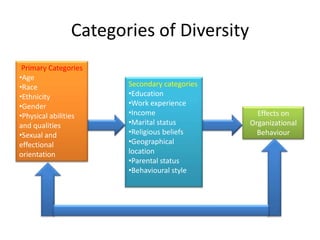
Categories of DiversityPrimary CategoriesAge
Race

Development of Organizational Behaviour

  • 1.
  • 2.
    Toward a definitionof OBThe concept of organizational behaviour is somewhat misleading because OB refers to the behaviour of people in an organization.An organization is a system of two or more people, engaged in cooperative action trying to reach a purpose(Kilduff and Doughberrysired in Champoux, 2006 p6).Hellriegel, slocum and Woodman (1995 p4) define organizational behaviour as a study of human behaviour, attitudes and performance in an organization.
  • 3.
    Toward a definitionof OBIt is interdisciplinary, drawing from concepts from social and clinical psychology, sociology, cultural anthropology, industrial engineering, and organizational psychology.
  • 4.
    Historical foundations ofOBScientific Management Frederick W. Taylor (1911)The four principles of Taylor’s scientific management:Carefully study the jobs to develop standard work practices. Standardize the tools used by workers.Select each worker scientifically.Management and workers cooperate to ensure that work is done according to standard procedures.Management plans and makes task assignments; workers carry out assigned task.
  • 5.
    Historical foundations ofOBTheory of AdministrationHenri Fayol (1919)Fayol’s theory described the major management functions and several principles that act as a administrative guide.Five functions of management:PlanningOrganizingCommandingCoordinatingcontrolling
  • 6.
    Historical foundations ofOBFayol (con’t)“all must observe the same general principles”. The principle of administration were central to his theory of administration. They are set tools a manager needs to perform the function of management. Division of labourAuthority and responsibilityCentralizationDelegation of authorityUnity of commandUnity of direction
  • 7.
    Historical foundations ofOBBureaucracy (Max Weber, 1922)An administrative structure with well defined offices and functions and hierarchical relationships among the functions. The bureaucracy defines the authority when it develops its division of labour. The person who takes authority assumes the authority of that position.
  • 8.
    Historical foundations ofOBBureaucracy (con’t)Features:Clearly defined and specialized functionsUse of legal authorityHierarchical formWritten rulesTechnical trained bureaucratsAppointment based on technical competenceClearly defined career pathFixed formal relationships among clearly defined hierarchically organized functions.
  • 9.
    Historical foundations ofOBMary Parker Follet’s (1925) and Chester Bernard (1938) – humanistic perspective on management that emphasized:Importance of understanding human behavioursNeeds and attitudes in the work placeSocial interaction and group processes
  • 10.
    Historical foundations ofOBHuman Relations MovementThe human relations school considers that effective control comes from within the individual rather than from strict, authoritarian control.The relations movement emphasized satisfaction of employee’s basic needs as key to increased productivity.The Hawthorne Studies (1939) is a significant qualifying perspective as it emphasized the extent to which social pressures affect employees in the work place and how the relationship between managers and operatives influence the level of productivity in the work environment.Maslow and McGregor (1960) – motivation of the individual
  • 11.
    Historical foundations ofOBPeter Drucker (1995)Proposed the philosophy of management by objectives (MBO) and self-control.Managers and employees define goals for every department, project, and person and use them to monitor subsequence performance.
  • 12.
    Why study OB?Toattain the competencies needed to be an effective employee, team leader, and/or manager.Knowledge and skills gained should help to diagnose, understand, and explain what is happening around to an employee in his or her job.
  • 13.
    Issues in OBIssuesin organizational behaviour are likely to result from areas of :Workforce diversityChanges in the work force and customersGenderRace and ethnicityAgeQuality managementTechnologyGlobal environmentEthics
  • 14.
  • 15.
  • 16.
  • 17.
  • 18.
  • 19.
    Sexual and effectionalorientationSecondary categoriesEducation
  • 20.
  • 21.
  • 22.
  • 23.
  • 24.
  • 25.
  • 26.
    Behavioural styleEffects onOrganizational Behaviour
  • 27.