Kelley’s theory of
attribution
1
Presented By,
Sam Mathew
samcmathew@yahoo.com
Introduction
• Attribution is the process through which we seek to identify the
cause of others behavior & also gain knowledge of their stable
traits & disposition.
• Cause of a behavior can be assigned to internal or external
factors.
2
Kelley’s theory of causal attribution.
• Proposed by Horald Kelly in 1967.
• The theory says that people assign the cause of behavior to
the factors that covaries most closely with the behavior.
• According to theory, behavior can be attributed to
dispositional (internal) or Situational (external) factors.
3
3 major dimensions
• Consensus: It is the extent to which others react to same stimuli or
event in the same manner as the person.
• Consistency: It is the extent to which the person react to the stimuli or
event in the same way on similiar occasions across time. Extend to
which a behavior Y always co-occurs with a stimulus X
• Distinctiveness: It is the extend to which the person react in the same
manner to other different stimuli or event. i.e. whether the person
reacts same only with one stimuli, or is common to many stimuli.
4
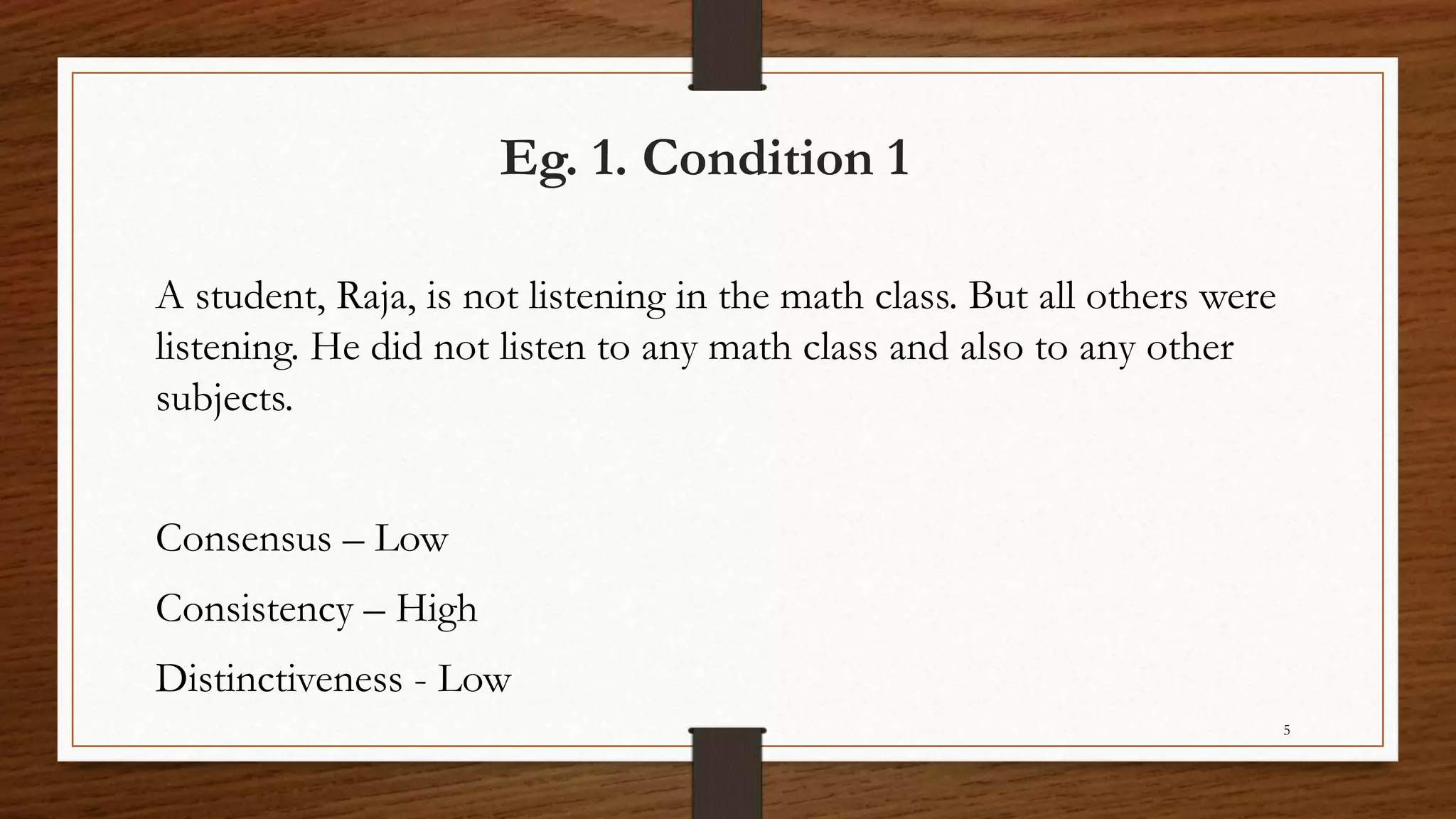
Eg. 1. Condition 1
A student, Raja, is not listening in the math class. But all others were
listening. He did not listen to any math class and also to any other
subjects.
Consensus – Low
Consistency – High
Distinctiveness - Low
5
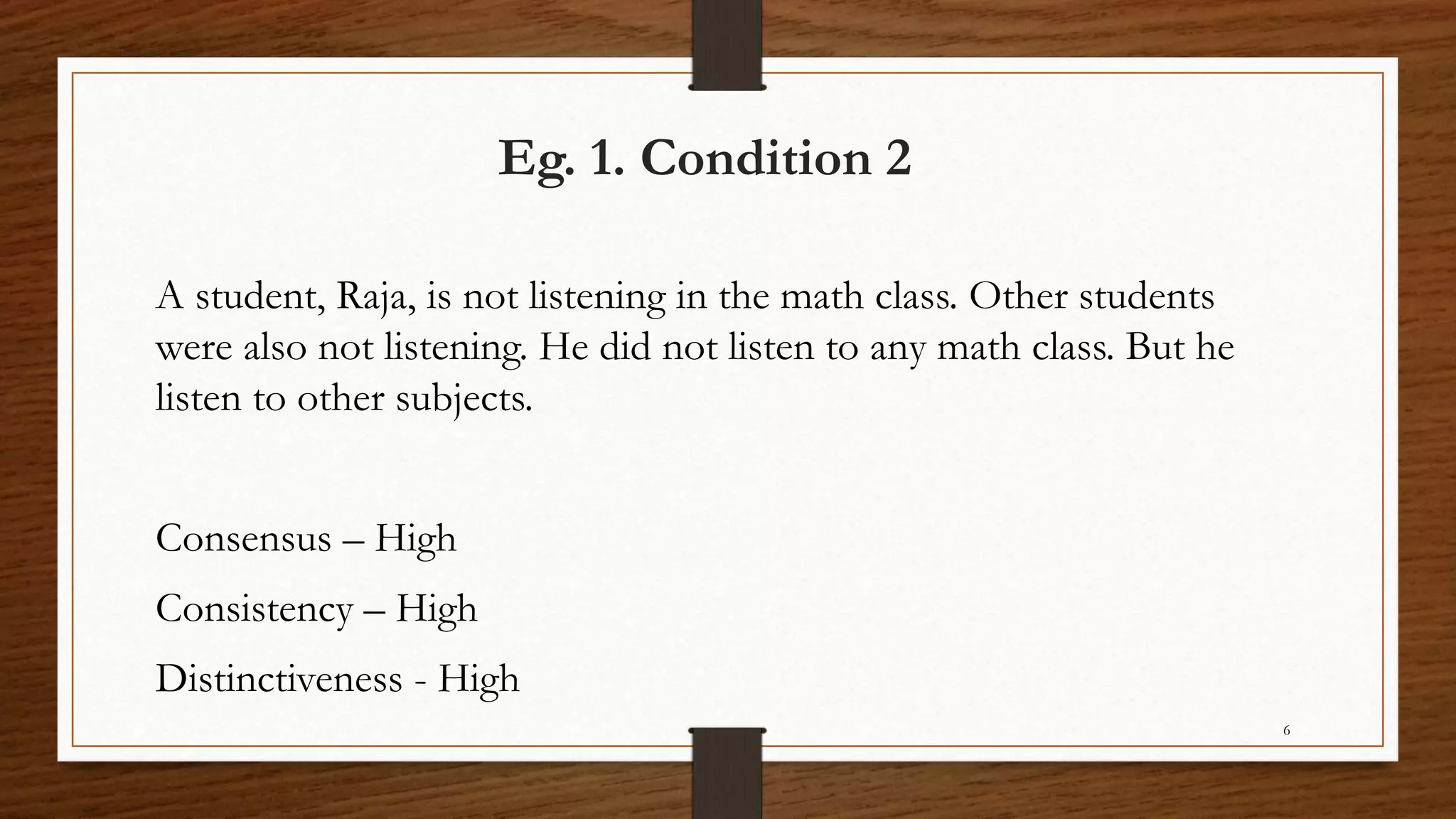
Eg. 1. Condition 2
A student, Raja, is not listening in the math class. Other students
were also not listening. He did not listen to any math class. But he
listen to other subjects.
Consensus – High
Consistency – High
Distinctiveness - High
6
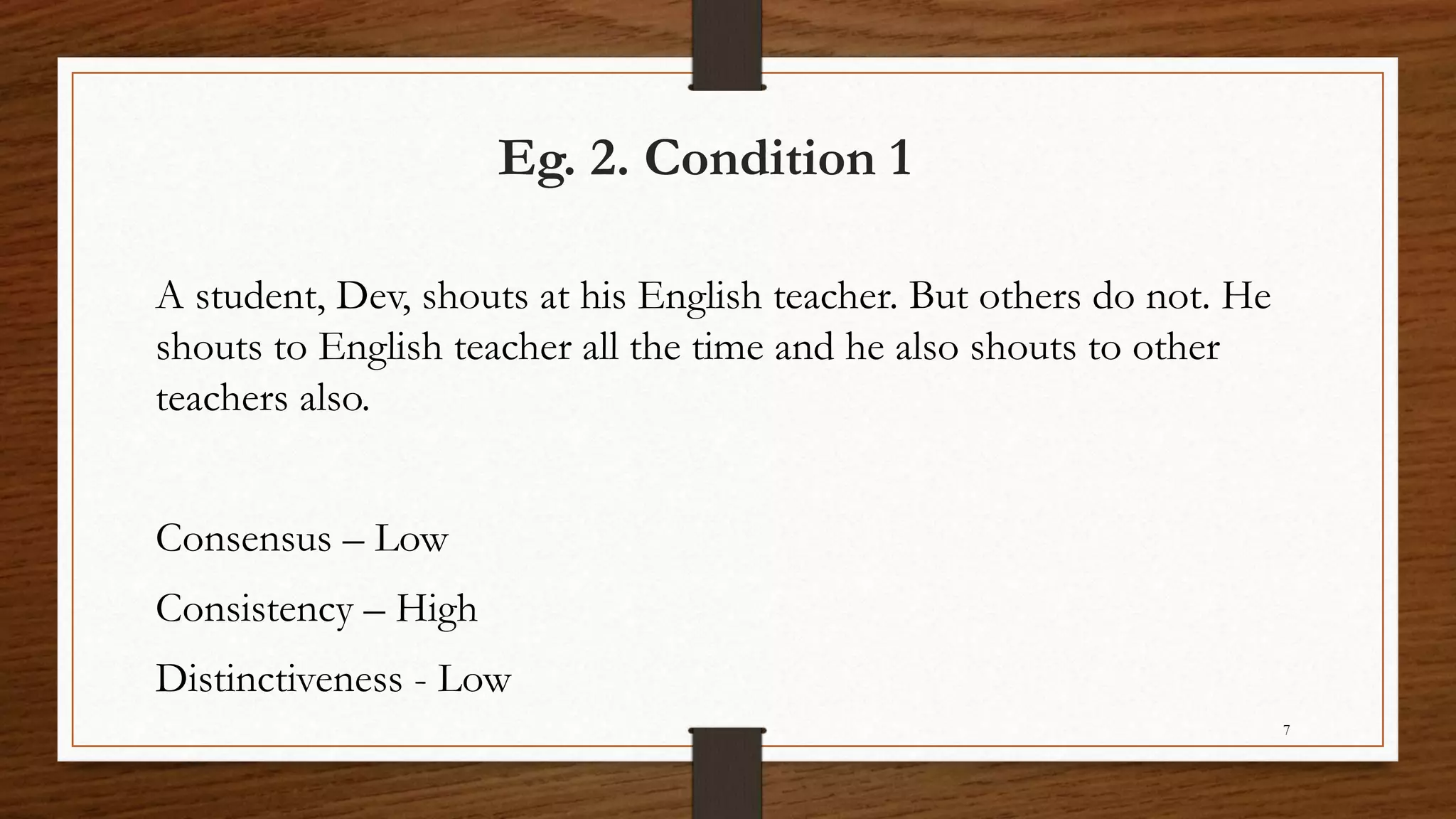
Eg. 2. Condition 1
A student, Dev, shouts at his English teacher. But others do not. He
shouts to English teacher all the time and he also shouts to other
teachers also.
Consensus – Low
Consistency – High
Distinctiveness - Low
7
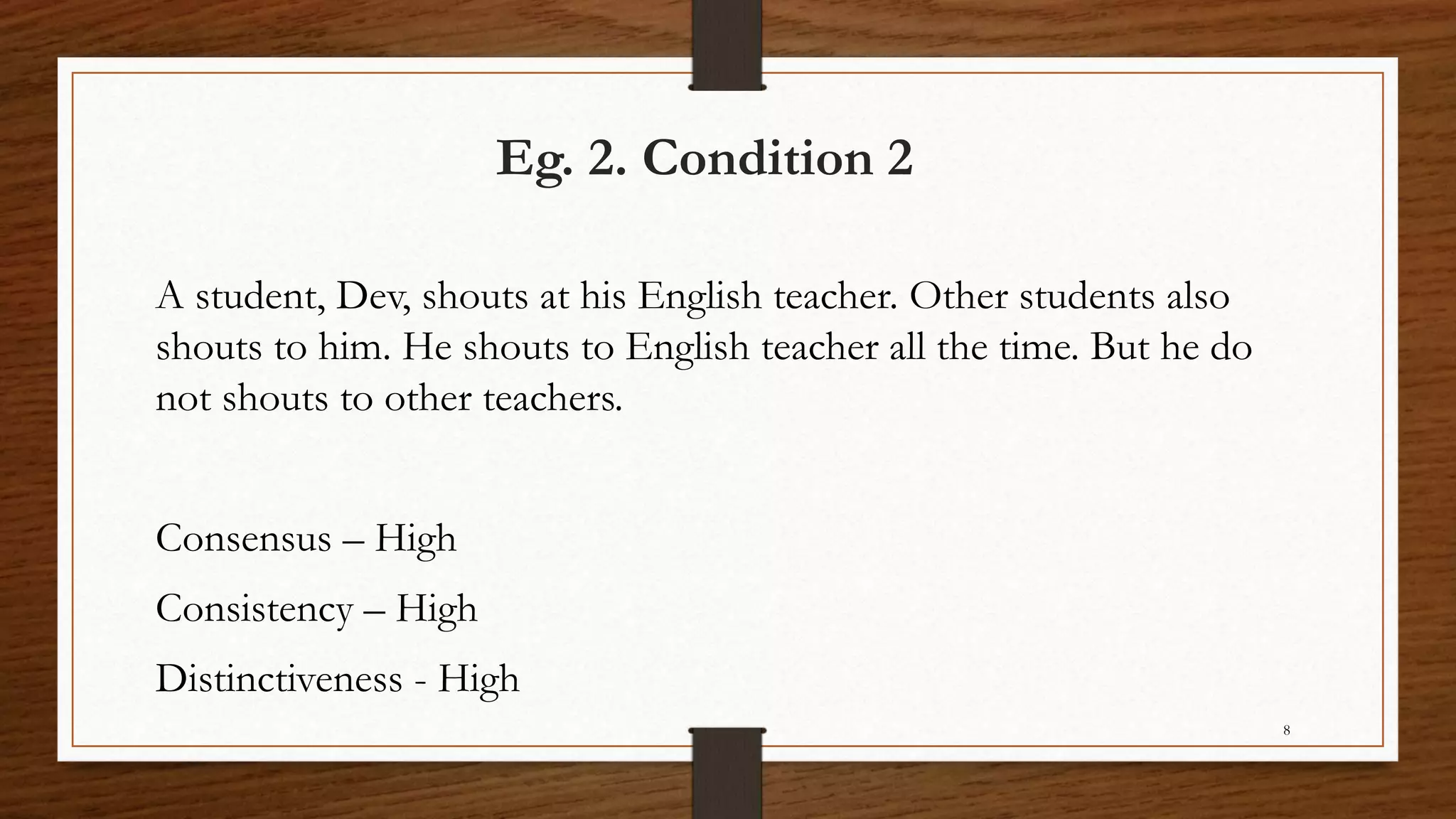
Eg. 2. Condition 2
A student, Dev, shouts at his English teacher. Other students also
shouts to him. He shouts to English teacher all the time. But he do
not shouts to other teachers.
Consensus – High
Consistency – High
Distinctiveness - High
8
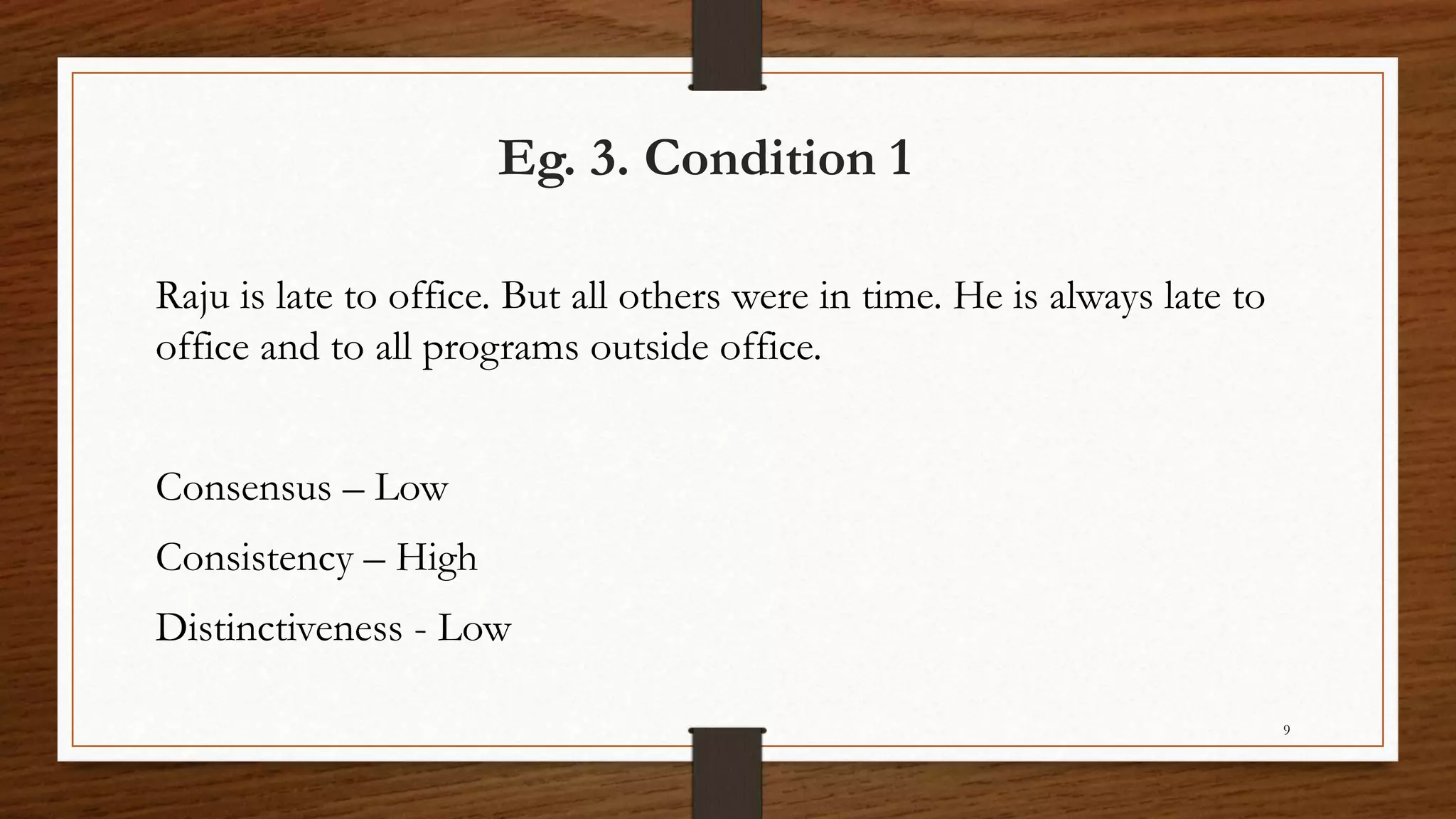
Eg. 3. Condition 1
Raju is late to office. But all others were in time. He is always late to
office and to all programs outside office.
Consensus – Low
Consistency – High
Distinctiveness - Low
9
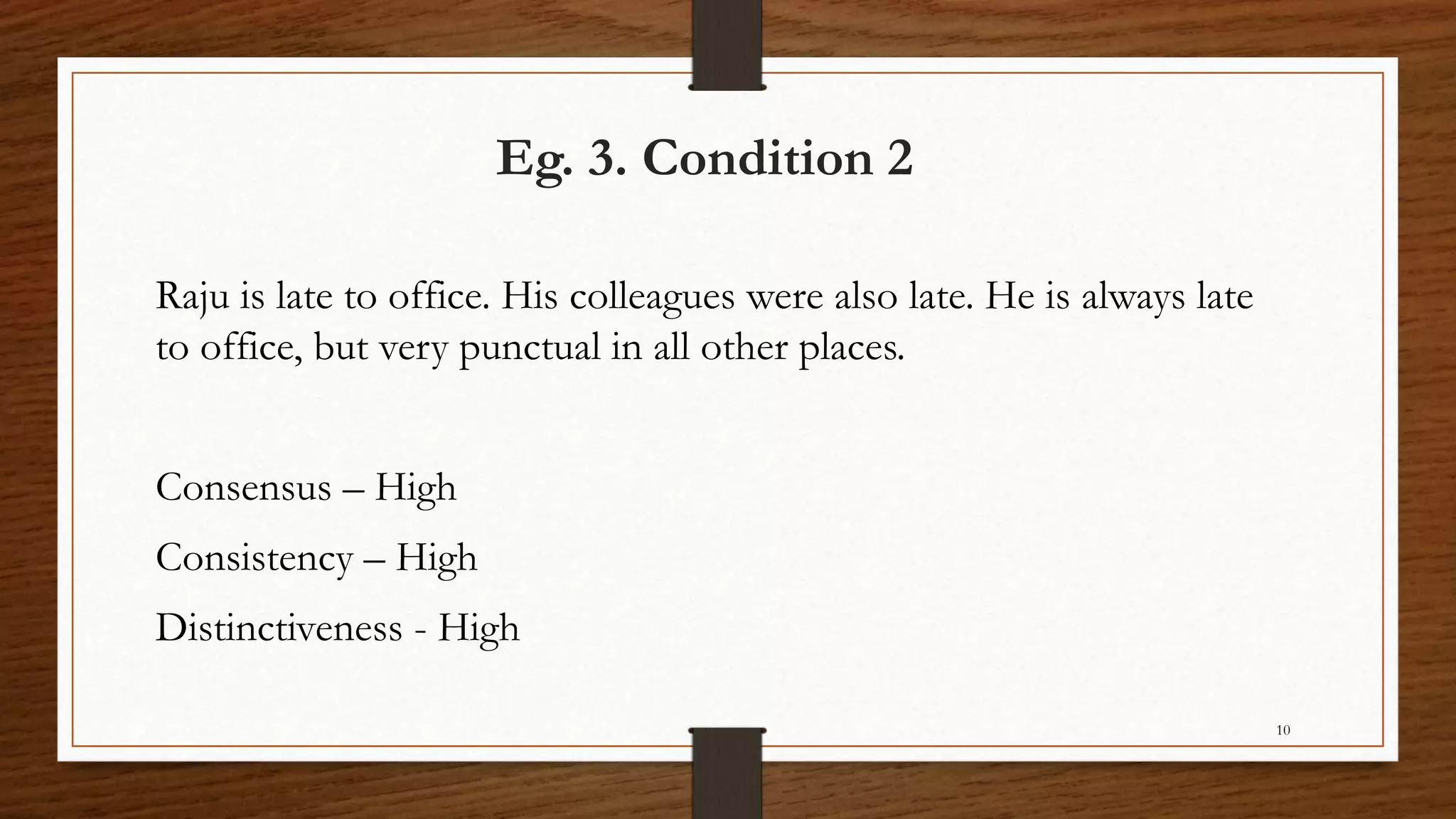
Eg. 3. Condition 2
Raju is late to office. His colleagues were also late. He is always late
to office, but very punctual in all other places.
Consensus – High
Consistency – High
Distinctiveness - High
10
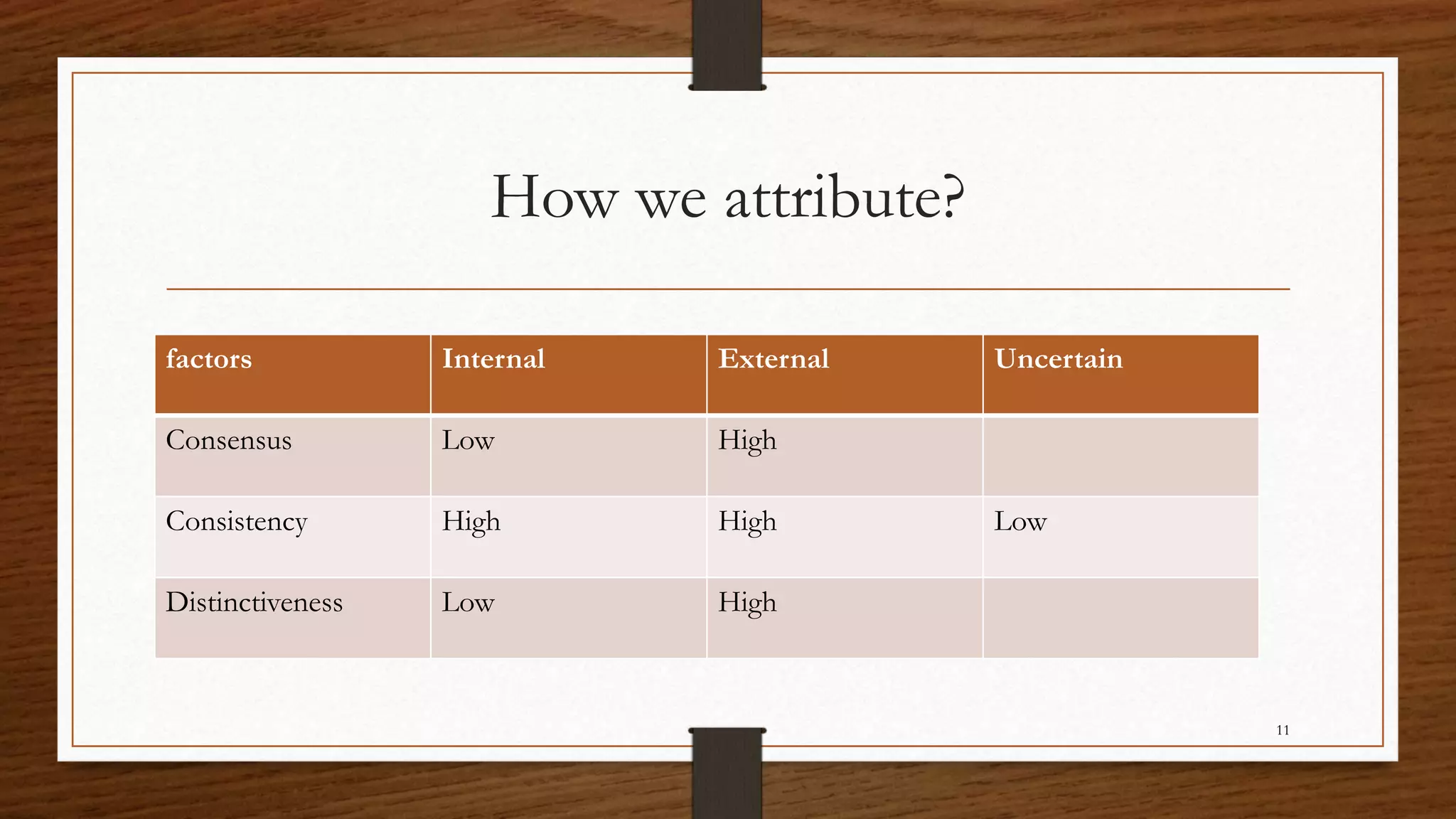
How we attribute?
factors Internal External Uncertain
Consensus Low High
Consistency High High Low
Distinctiveness Low High
11
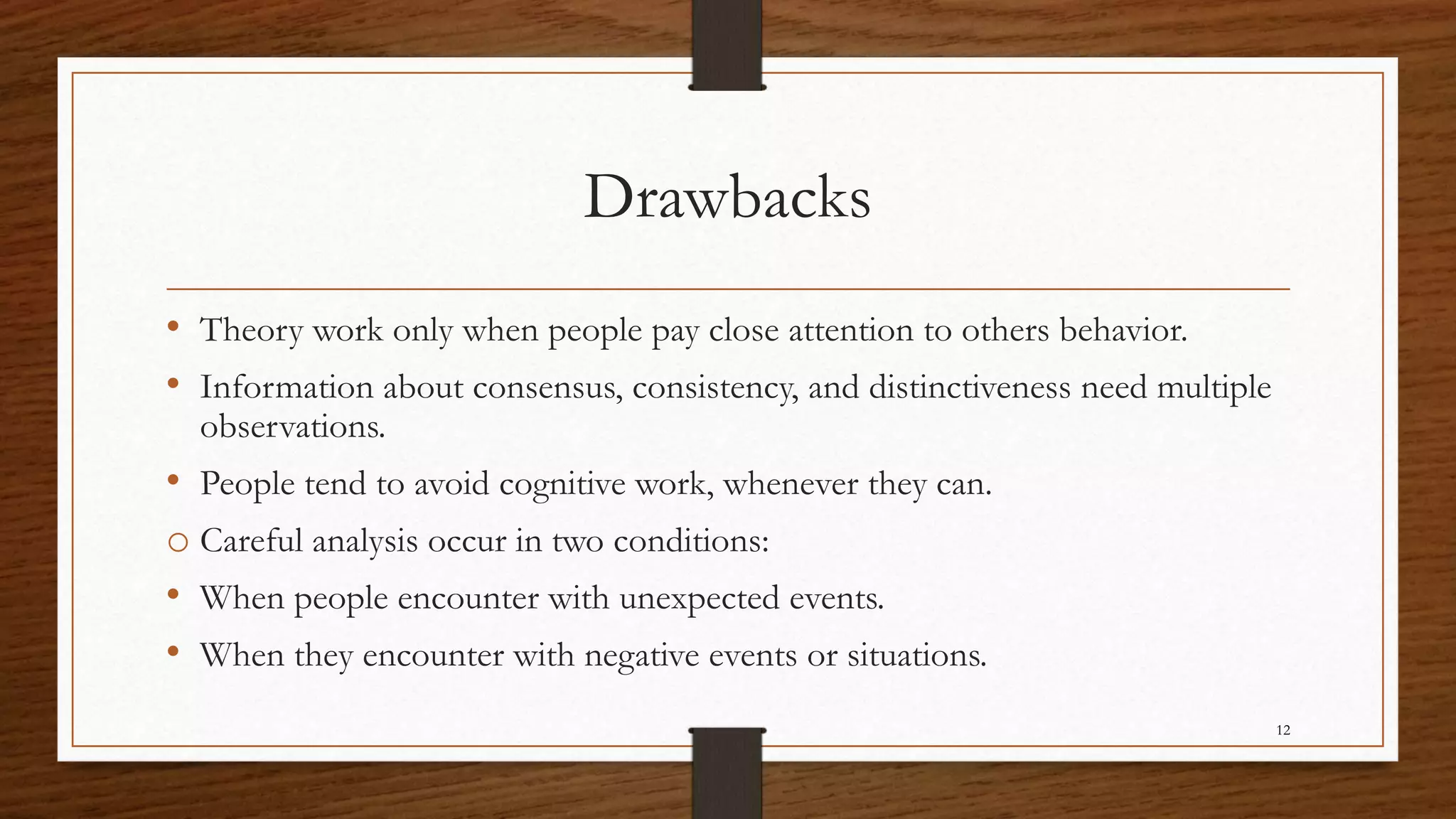
Drawbacks
• Theory work only when people pay close attention to others behavior.
• Information about consensus, consistency, and distinctiveness need multiple
observations.
• People tend to avoid cognitive work, whenever they can.
o Careful analysis occur in two conditions:
• When people encounter with unexpected events.
• When they encounter with negative events or situations.
12
Reference
• Baron, R A; Branscombe, N L. (2012). Social Psychology. New Delhi: Pearson
Publishers.
• Hogg, M A; Vaughan, G M. (2011). Social Psychology. Harlow: Pearson
Publishers.
• Sanderson, C A. (2011). Social Psychology. New Delhi: Wiley India Publishers.
13
14

Kelley’s theory of attribution

  • 1.
    Kelley’s theory of attribution 1 PresentedBy, Sam Mathew samcmathew@yahoo.com
  • 2.
    Introduction • Attribution isthe process through which we seek to identify the cause of others behavior & also gain knowledge of their stable traits & disposition. • Cause of a behavior can be assigned to internal or external factors. 2
  • 3.
    Kelley’s theory ofcausal attribution. • Proposed by Horald Kelly in 1967. • The theory says that people assign the cause of behavior to the factors that covaries most closely with the behavior. • According to theory, behavior can be attributed to dispositional (internal) or Situational (external) factors. 3
  • 4.
    3 major dimensions •Consensus: It is the extent to which others react to same stimuli or event in the same manner as the person. • Consistency: It is the extent to which the person react to the stimuli or event in the same way on similiar occasions across time. Extend to which a behavior Y always co-occurs with a stimulus X • Distinctiveness: It is the extend to which the person react in the same manner to other different stimuli or event. i.e. whether the person reacts same only with one stimuli, or is common to many stimuli. 4
  • 5.
    Eg. 1. Condition1 A student, Raja, is not listening in the math class. But all others were listening. He did not listen to any math class and also to any other subjects. Consensus – Low Consistency – High Distinctiveness - Low 5
  • 6.
    Eg. 1. Condition2 A student, Raja, is not listening in the math class. Other students were also not listening. He did not listen to any math class. But he listen to other subjects. Consensus – High Consistency – High Distinctiveness - High 6
  • 7.
    Eg. 2. Condition1 A student, Dev, shouts at his English teacher. But others do not. He shouts to English teacher all the time and he also shouts to other teachers also. Consensus – Low Consistency – High Distinctiveness - Low 7
  • 8.
    Eg. 2. Condition2 A student, Dev, shouts at his English teacher. Other students also shouts to him. He shouts to English teacher all the time. But he do not shouts to other teachers. Consensus – High Consistency – High Distinctiveness - High 8
  • 9.
    Eg. 3. Condition1 Raju is late to office. But all others were in time. He is always late to office and to all programs outside office. Consensus – Low Consistency – High Distinctiveness - Low 9
  • 10.
    Eg. 3. Condition2 Raju is late to office. His colleagues were also late. He is always late to office, but very punctual in all other places. Consensus – High Consistency – High Distinctiveness - High 10
  • 11.
    How we attribute? factorsInternal External Uncertain Consensus Low High Consistency High High Low Distinctiveness Low High 11
  • 12.
    Drawbacks • Theory workonly when people pay close attention to others behavior. • Information about consensus, consistency, and distinctiveness need multiple observations. • People tend to avoid cognitive work, whenever they can. o Careful analysis occur in two conditions: • When people encounter with unexpected events. • When they encounter with negative events or situations. 12
  • 13.
    Reference • Baron, RA; Branscombe, N L. (2012). Social Psychology. New Delhi: Pearson Publishers. • Hogg, M A; Vaughan, G M. (2011). Social Psychology. Harlow: Pearson Publishers. • Sanderson, C A. (2011). Social Psychology. New Delhi: Wiley India Publishers. 13
  • 14.

Editor's Notes

  • #3 It is a process of assigning a cause to particular behavior.
  • #5 Consensus: If others also do same, High If others do not do same, Low Consistency: If person act same to same stimuli over time – High If person act differently to same stimuli - Low Distinctiveness: info. If person behave same only to particular events – High If person behave same to different events - Low
  • #12 Where the locus is?
  • #13 Cognitive misers. – just jump to conclusions With past experiences they attribute internal or external factors. Success – efforts and ability(internal) Laughing & being amused - Exposure to some fun (external)