CRITICAL THINKING
SONIA NOOR
BSN(Gen.)
Objectives
■ Relate the importance of critical thinking in nursing.
■ Discuss definitions of, characteristics of, and skills used in critical thinking.
■ Classify the three major factors that affect thinking.
■ Assess ways to develop critical thinking skills especially as applied to nursing .
■ Plan personal goals for developing critical thinking skills
Critical Thinking
■ Critical Thinking: Careful and goal-directed thinking that is used to assess more
complicated situations, identify actual and potential problems, and make decisions
about an action plan.
■ Critical thinking is the ability to think clearly and rationally about what to do or what
to believe.
■ It includes the ability to engage in reflective and independent thinking.
Critical thinking and clinical Reasoning
■ The practice of nursing requires critical thinking and clinical reasoning.
■ Critical thinking
■ Is the process of intentional higher level thinking of defining a clients’ problem,
examining, the evidence –based practice in caring for the client, and make choices
in the delivery of care.
Critical thinking and clinical Reasoning
■ Clinical reasoning:
■ Is the cognitive process that uses thinking strategies to gather and analyze clients
information ,evaluate the relevance of the information , and decide on possible
nursing to improve the clients physiological and psychosocial outcomes clinical
reasoning requires the integration of critical thinking in the identification of the most
appropriate interventions that will improve the clients condition.
Components of critical thinking
■ A person will do the following :
■ Ask questions to determine the reason why certain developments have occurred
and to see whether more information is needed to understand the situation
accurately.
■ Gather as much relevant information as possible to consider as many factors as
possible
■ Validate the information presented to make sure that it is accurate (not just
supposition or opinion), that it makes sense, and that it is based on fact and
evidence
Continue.…
■ Analyze the information to determine what it means and to see whether it forms
clusters or patterns that point to certain conclusions.
■ Draw on past clinical experience and knowledge to explain what is happening and to
anticipate what might hap next, acknowledging personal bias and cultural
influences.
■ Maintain a flexible attitude that allows the facts to guide thinking and takes into
account all possibilities.
■ Consider available options and examine each in terms of its advantages and
disadvantages.
■ Formulate decisions that reflect creativity and independent decision making.
Critical thinking in Nursing practice
■ Nurses must use critical thinking skills in all practice settings—acute care,
ambulatory care, extended care, and in the home and community.
■ Regardless of the setting, each patient situation is viewed as unique and dynamic.
■ The unique factors that the patient and nurse bring to the health care situation are
considered, studied, analyzed, and interpreted.
■ Interpretation of the information presented then allows the nurse to focus on those
factors that are most relevant and most significant to the clinical situation.
■ Decisions about what to do and how to do it are then developed into a plan of
action.
Applying critical thinking to nursing practice
■ Implementation of the nursing process provides nurses with a creative approach to
thinking and doing to obtain, categorize, and analyze client data and plan actions
that will meet the client’s needs.
■ Nursing process: is a systematic, rational method of planning
■ And providing individualized nursing care.
■ The phases of the nursing process are assessing, diagnosing, planning,
■ Implementing, and evaluating
Applying critical thinking to nursing practice
Problem Solving
■ Problem solving: Process used when a gap is perceived between an existing state
(what is occurring)& a desired state of what should be occurring.
■ Throughout the problem-solving process the implementation of critical thought may
or may not be required in working toward a solution (Wilkinson, 2012). The nurse
carefully evaluates the possible solutions and chooses the best one to implement.
■ Commonly used approaches to problem solving include trial and error, intuition, and
the research process
Continue…
Trial And Error:
■ In trial and error, a number of approaches are tried until a solution is found.
■ The use of trial- and-error methods in nursing care can be dangerous because the
client might suffer harm if an approach is inappropriate.
■ However, nurses often use trial and error in the home setting due to logistics,
equipment, and client lifestyle .
Continue…
Intuition:
■ Is a problem-solving approach that relies on a nurse’s inner sense. It is a legitimate
aspect of a nursing judgment in the implementation of care.
■ Intuition is the understanding or learning of things without the conscious use of the
reasoning. It I also known as sixth sense, feeling, or suspicion.
Continue…
Clinical judgment:
■ In nursing is a decision-making process to ascertain the right nursing action to be
implemented at the appropriate time in the client’s care.
■ The nurse must first have the knowledge base necessary to practice in the clinical
area and then use that knowledge in clinical practice.
■ Clinical experience allows the nurse to recognize cues and patterns and begin to
reach correct conclusions.
Continue…
Research Process:
■ Is a formalized, logical, systematic approach to problem solving. The classic
quantitative
■ Research process is most useful when the researcher is working in a controlled
situation. Health professionals, often working with people.
■ For example, unlike many experiments with animals in which the environment can
be strictly regulated, the effects of diet on health in humans are complicated by a
person’s genetic variations, lifestyle, and personal preferences. However, it is
becoming increasingly important for nurses to identify evidence that supports
effective nursing care. One critical source of this evidence is research.
Ways to Enhance Critical Thinking In Nursing
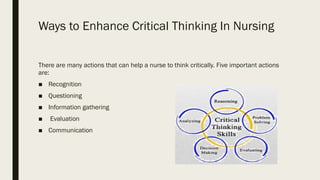
There are many actions that can help a nurse to think critically. Five important actions
are:
■ Recognition
■ Questioning
■ Information gathering
■ Evaluation
■ Communication
Characteristics of Critical Thinkers
■ Strive for understanding
■ Are honest with themselves
■ Base judgment on evidence
■ Are interested in other people’s ideas
■ Control their feeling/emotions
■ Keep an open mind
■ They are very observant
■ Identify key issues and raise questions
■ Obtain relevant facts
■ Evaluate the findings from judgments
Skills used in critical thinking
■ Analytical skills
■ Communication
■ Creativity
■ Open Minded
■ Problem solving
■ 6.Identifying Biases
1:Analytical skills
■ People with analytical skills can examine information, and then understand what it
means, and what it represents.
■ Asking thoughtful questions
■ Data analysis
■ Information seeking
■ Interpretation
■ Judgment
■ Questioning evidence
■ Recognizing differences and similarities
2.Communication
■ Often, you will need to share your conclusions with your employers or with a group of
colleagues. You need to be able to communicate with others to share your ideas effectively.
■ Assessment
■ Collaboration
■ Explanation
■ Expressing opinions and ideas
■ Presentation
■ Teamwork
■ Verbal communication
■ Written communication
3.Creativity
■ Critical thinking often involves some level of creativity. You might need to spot patterns in the information
you are looking at or come up with a solution that no one else has thought of before. All of this involves a
creative eye.
■ Cognitive flexibility
■ Conceptualization
■ Curiosity (interest)
■ Imagination
■ Making abstract connections
■ Predicting
■ Synthesizing (produce)
■ Visionary (idealistic)
4.Open Minded
■ To think critically, you need to be able to put aside any assumptions or judgments
and merely(simply) analyze the information you receive. You need to be objective,
evaluating ideas without bias.
■ Embracing different cultural perspectives
■ Fair
■ Humble
■ Inclusive (wide range)
■ Objective (neutral)
■ Observation
5. Problem Solving
■ Problem solving is another important critical thinking skill that involves analyzing a problem,
generating and implementing a solution, and assessing the success of the plan.
■ Applying standards
■ Attention to detail
■ Clarification
■ Collaboration (team work)
■ Decision making
■ Evaluation
■ Innovative (advanced )
■ Logical reasoning
6.Identifying Biases
■ This skill can be exceedingly difficult, as even the smartest among us can fail to
recognize biases.
■ Strong critical thinkers do their best to evaluate information objectively.
■ Think of yourself as a judge in that you want to evaluate the claims of both sides of
an argument, but you’ll also need to keep in mind the biases each side may
possess.
Factors That Affect Thinking
■ Attitude
■ Common Sense
■ Nature
■ Intelligence
■ Mindset
■ Wisdom
■ Environment
■ Stage of health
■ Companions
■ Lack of knowledge
■ Lack of skills
■ Lack of awareness
■ Lack of confidence
■ Dependency thinking
■ Cognitive style
References
■ Kozier & Erb’s Fundamental of Nursing Book, 8th
edition.
■ Michael A Bettman FACRS “Self Esteem article” 1960.
■ Thomas Fuller Ph.D/MCPR “Teaching and Learning” 1955.
■ John Jackson M.D “of nursing research 6th
edition. Manual

critical thinking presentation in nursing

  • 1.
  • 2.
    Objectives ■ Relate theimportance of critical thinking in nursing. ■ Discuss definitions of, characteristics of, and skills used in critical thinking. ■ Classify the three major factors that affect thinking. ■ Assess ways to develop critical thinking skills especially as applied to nursing . ■ Plan personal goals for developing critical thinking skills
  • 3.
    Critical Thinking ■ CriticalThinking: Careful and goal-directed thinking that is used to assess more complicated situations, identify actual and potential problems, and make decisions about an action plan. ■ Critical thinking is the ability to think clearly and rationally about what to do or what to believe. ■ It includes the ability to engage in reflective and independent thinking.
  • 4.
    Critical thinking andclinical Reasoning ■ The practice of nursing requires critical thinking and clinical reasoning. ■ Critical thinking ■ Is the process of intentional higher level thinking of defining a clients’ problem, examining, the evidence –based practice in caring for the client, and make choices in the delivery of care.
  • 5.
    Critical thinking andclinical Reasoning ■ Clinical reasoning: ■ Is the cognitive process that uses thinking strategies to gather and analyze clients information ,evaluate the relevance of the information , and decide on possible nursing to improve the clients physiological and psychosocial outcomes clinical reasoning requires the integration of critical thinking in the identification of the most appropriate interventions that will improve the clients condition.
  • 6.
    Components of criticalthinking ■ A person will do the following : ■ Ask questions to determine the reason why certain developments have occurred and to see whether more information is needed to understand the situation accurately. ■ Gather as much relevant information as possible to consider as many factors as possible ■ Validate the information presented to make sure that it is accurate (not just supposition or opinion), that it makes sense, and that it is based on fact and evidence
  • 7.
    Continue.… ■ Analyze theinformation to determine what it means and to see whether it forms clusters or patterns that point to certain conclusions. ■ Draw on past clinical experience and knowledge to explain what is happening and to anticipate what might hap next, acknowledging personal bias and cultural influences. ■ Maintain a flexible attitude that allows the facts to guide thinking and takes into account all possibilities. ■ Consider available options and examine each in terms of its advantages and disadvantages. ■ Formulate decisions that reflect creativity and independent decision making.
  • 8.
    Critical thinking inNursing practice ■ Nurses must use critical thinking skills in all practice settings—acute care, ambulatory care, extended care, and in the home and community. ■ Regardless of the setting, each patient situation is viewed as unique and dynamic. ■ The unique factors that the patient and nurse bring to the health care situation are considered, studied, analyzed, and interpreted. ■ Interpretation of the information presented then allows the nurse to focus on those factors that are most relevant and most significant to the clinical situation. ■ Decisions about what to do and how to do it are then developed into a plan of action.
  • 9.
    Applying critical thinkingto nursing practice ■ Implementation of the nursing process provides nurses with a creative approach to thinking and doing to obtain, categorize, and analyze client data and plan actions that will meet the client’s needs. ■ Nursing process: is a systematic, rational method of planning ■ And providing individualized nursing care. ■ The phases of the nursing process are assessing, diagnosing, planning, ■ Implementing, and evaluating
  • 10.
    Applying critical thinkingto nursing practice Problem Solving ■ Problem solving: Process used when a gap is perceived between an existing state (what is occurring)& a desired state of what should be occurring. ■ Throughout the problem-solving process the implementation of critical thought may or may not be required in working toward a solution (Wilkinson, 2012). The nurse carefully evaluates the possible solutions and chooses the best one to implement. ■ Commonly used approaches to problem solving include trial and error, intuition, and the research process
  • 11.
    Continue… Trial And Error: ■In trial and error, a number of approaches are tried until a solution is found. ■ The use of trial- and-error methods in nursing care can be dangerous because the client might suffer harm if an approach is inappropriate. ■ However, nurses often use trial and error in the home setting due to logistics, equipment, and client lifestyle .
  • 12.
    Continue… Intuition: ■ Is aproblem-solving approach that relies on a nurse’s inner sense. It is a legitimate aspect of a nursing judgment in the implementation of care. ■ Intuition is the understanding or learning of things without the conscious use of the reasoning. It I also known as sixth sense, feeling, or suspicion.
  • 13.
    Continue… Clinical judgment: ■ Innursing is a decision-making process to ascertain the right nursing action to be implemented at the appropriate time in the client’s care. ■ The nurse must first have the knowledge base necessary to practice in the clinical area and then use that knowledge in clinical practice. ■ Clinical experience allows the nurse to recognize cues and patterns and begin to reach correct conclusions.
  • 14.
    Continue… Research Process: ■ Isa formalized, logical, systematic approach to problem solving. The classic quantitative ■ Research process is most useful when the researcher is working in a controlled situation. Health professionals, often working with people. ■ For example, unlike many experiments with animals in which the environment can be strictly regulated, the effects of diet on health in humans are complicated by a person’s genetic variations, lifestyle, and personal preferences. However, it is becoming increasingly important for nurses to identify evidence that supports effective nursing care. One critical source of this evidence is research.
  • 15.
    Ways to EnhanceCritical Thinking In Nursing There are many actions that can help a nurse to think critically. Five important actions are: ■ Recognition ■ Questioning ■ Information gathering ■ Evaluation ■ Communication
  • 16.
    Characteristics of CriticalThinkers ■ Strive for understanding ■ Are honest with themselves ■ Base judgment on evidence ■ Are interested in other people’s ideas ■ Control their feeling/emotions ■ Keep an open mind ■ They are very observant ■ Identify key issues and raise questions ■ Obtain relevant facts ■ Evaluate the findings from judgments
  • 17.
    Skills used incritical thinking ■ Analytical skills ■ Communication ■ Creativity ■ Open Minded ■ Problem solving ■ 6.Identifying Biases
  • 18.
    1:Analytical skills ■ Peoplewith analytical skills can examine information, and then understand what it means, and what it represents. ■ Asking thoughtful questions ■ Data analysis ■ Information seeking ■ Interpretation ■ Judgment ■ Questioning evidence ■ Recognizing differences and similarities
  • 19.
    2.Communication ■ Often, youwill need to share your conclusions with your employers or with a group of colleagues. You need to be able to communicate with others to share your ideas effectively. ■ Assessment ■ Collaboration ■ Explanation ■ Expressing opinions and ideas ■ Presentation ■ Teamwork ■ Verbal communication ■ Written communication
  • 20.
    3.Creativity ■ Critical thinkingoften involves some level of creativity. You might need to spot patterns in the information you are looking at or come up with a solution that no one else has thought of before. All of this involves a creative eye. ■ Cognitive flexibility ■ Conceptualization ■ Curiosity (interest) ■ Imagination ■ Making abstract connections ■ Predicting ■ Synthesizing (produce) ■ Visionary (idealistic)
  • 21.
    4.Open Minded ■ Tothink critically, you need to be able to put aside any assumptions or judgments and merely(simply) analyze the information you receive. You need to be objective, evaluating ideas without bias. ■ Embracing different cultural perspectives ■ Fair ■ Humble ■ Inclusive (wide range) ■ Objective (neutral) ■ Observation
  • 22.
    5. Problem Solving ■Problem solving is another important critical thinking skill that involves analyzing a problem, generating and implementing a solution, and assessing the success of the plan. ■ Applying standards ■ Attention to detail ■ Clarification ■ Collaboration (team work) ■ Decision making ■ Evaluation ■ Innovative (advanced ) ■ Logical reasoning
  • 23.
    6.Identifying Biases ■ Thisskill can be exceedingly difficult, as even the smartest among us can fail to recognize biases. ■ Strong critical thinkers do their best to evaluate information objectively. ■ Think of yourself as a judge in that you want to evaluate the claims of both sides of an argument, but you’ll also need to keep in mind the biases each side may possess.
  • 24.
    Factors That AffectThinking ■ Attitude ■ Common Sense ■ Nature ■ Intelligence ■ Mindset ■ Wisdom ■ Environment ■ Stage of health ■ Companions ■ Lack of knowledge ■ Lack of skills ■ Lack of awareness ■ Lack of confidence ■ Dependency thinking ■ Cognitive style
  • 25.
    References ■ Kozier &Erb’s Fundamental of Nursing Book, 8th edition. ■ Michael A Bettman FACRS “Self Esteem article” 1960. ■ Thomas Fuller Ph.D/MCPR “Teaching and Learning” 1955. ■ John Jackson M.D “of nursing research 6th edition. Manual