
NURSING
AS A
PROFESSION
Part - I
BY:
Mrs. Babitha K Devu
Assistant Professor
SMVDCoN
Introduction
• Nursing has been called the oldest of the arts
and the youngest of the professions. The
term ‘Nurse’ evolve from the Latin word
nutrix, which means to nourish or to cherish.
• Today nursing emerged as a learned
profession, that is both a science and an art.
• It is a body of knowledge. Knowledge is an
awareness or perception of reality, which is
acquired through learning or investigation.
• Science is defined as both a unified body of
knowledge concerned with specific subject
matter, the skills and methodology necessary
to provide such knowledge.
Introduction
• Nursing as an art is the application of
knowledge and skill to bring about
desired results. It is an individual action.
Nursing art is carried out by the nurse in
an one-to-one relationship with the patient
and constitutes the nurse’s conscious
responses to a specific and patient’s
immediate situation.
Definitions
• Profession: a type of occupation that
meets certain criteria that raise it to a level
above that of an occupation.
• Profession: is a calling that requires
special knowledge, skill and preparation.
• An occupation that requires advanced
knowledge and skills and that it grows out
of society’s needs for special services.
Definitions
• Professional: a person who belongs to and
practices a profession
• Professionalism: demonstration of high
level of personal, ethical and high level of
skill characteristics for a member of a
profession.
Definitions
• Difference between Occupation &
Profession.
According to Webster:
– Occupation: is defined as what occupies or
engages, one’s time, business and
employment.
– Profession: is defined as a vocation requiring
advanced training and usually involving
mental rather than manual work, as teaching,
engineering, especially medicine, law etc.
CRITERIA OF PROFESSION
High Intellectual Level Of Functioning:
Modern nurses use assessment skill and
knowledge, have the ability to reason and
make routine judgment depending on
patient’s condition. Professional nurses
functions at a high intellectual level.
Florence nightingale raised the bar for
education and graduates of her school
were considered to be highly educated.
CRITERIA OF PROFESSION
High Level Of Individual Responsibility
And Accountability:
Nurses must be accountable and demonstrate a
high level of individual responsibility for the
care and services they provide. The concept
of accountability has legal, ethical and
professional implications that include
accepting responsibility for action taken to
provide client care as well as accepting
responsibility for the consequences of action
that are not performed.
CRITERIA OF PROFESSION
Specialized Body Of Knowledge:
Nursing has developed into an identifiable
separate discipline, a specialized body of
knowledge called as nursing science. It was
compiled through the research effort of nurses
with advanced educational degrees.
Although this body of specialized knowledge is
relatively small, it forms a theoretical basis for
the practice of nursing today. As more nurses
obtain advanced degrees, conduct research
and develop philosophies, and theories about
nursing, this body of knowledge will increase
in scope.
CRITERIA OF PROFESSION
Evidence Based Practice:
Almost all the currently used nursing theories
address this issue in some way. Evidenced
based practice is the practice of nursing in
which interventions are based on data
obtained from research that demonstrate
that, the findings are appropriate and
successful. It involves a systematic process of
uncovering, evaluating and using
information from research as the basis for
making decisions about providing client care.
CRITERIA OF PROFESSION
Public Service And Altruistic Activities:
Individual is the focal point of all nursing
models and nursing practice. Nursing has
been viewed universally as being an
altruistic profession composed of selfless
individuals who place the lives and well
being of their clients above their personal
safety. Dedicated nurses provide care for
victims of deadly diseases with little
regard for their own welfare.
CRITERIA OF PROFESSION
Well Organised And Strong
Representation:
Professional organizations represent the
members of the profession and control the
quality of professional practice. In India
TNAI & SNA are the two organizations
that represent nursing in today’s health
care system. Many do belong to specialty
organizations that represent a specific area
of practice.
CRITERIA OF PROFESSION
Code Of Ethics:
A code of ethics document may outline the
mission and values of the business or
organization, how professionals are
supposed to approach problems,
the ethical principles based on the
organization's core values and the
standards to which the professional is
held. Some of the ethical principles are
autonomy, justice, non-maleficence ...
CRITERIA OF PROFESSION
Competencies And Professional License:
Nurses must pass a national licensure
examination to demonstrate that they are
qualified to practice nursing. Only after
passing the examination the nurses are
allowed to practice. The granting of a
nursing license is a legal activity
conducted by the individual state under
the regulations contained in the state’s
nursing practice act.
CRITERIA OF PROFESSION
Autonomy And Independence Of Practice:
In reality nursing is both an independent and
interdependent discipline. Nurses in all health
care setting must work with physicians, hospital
administrators, pharmacists and other groups in
the provision of care. In some cases nurses in
advanced practice role eg. Nurse practitioners can
do establish their independent practices. To be
considered a true profession, nursing will need to
be recognised by other disciplines as having
practitioners who practice nursing independently.
CRITERIA OF PROFESSION
Professional Identity And Development:
Until nurses are fully committed to the
profession of nursing, identify with it as a
profession and are dedicated to its future
development, nursing will probably not
achieve professional status.
CHARACTERISTICS OF A
PROFESSION
A basic profession requires an extended
education of its members, as well as a basic
liberal foundation.
A profession has a theoretical body of
knowledge leading to defined skills, abilities
and norms.
A profession provides a specific service.
Members of a profession have autonomy in
decision-making and practice.
The profession has a code of ethics for
practice.
Definitions of Nursing
The unique function of nurses in caring for
individuals, sick or well, is to assess their
responses to their health status and to assist
them in the performance of those activities
contributing to health or recovery or to
dignified death that they would perform
unaided if they had the necessary strength,
will, or knowledge and to do this in such a
way as to help them gain full or partial
independence as rapidly as possible
(Virginia Henderson, 1977)
Definitions of Nursing
Nursing encompasses autonomous and
collaborative care of individuals of all
ages, families, groups and communities,
sick or well and in all settings. Nursing
includes the promotion of health,
prevention of illness, and the care of ill,
disabled and dying people.
(Short Version definition by ICN)
Definitions of Nursing
Nightingale defined nursing over 100
years ago as “the act of utilizing the
environment of the patient to assist him in
his recovery”.
(Florence Nightingale, 1860)
Definitions of Nursing
“Nursing is the protection, promotion,
and optimization of health and abilities,
prevention of illness and injury,
alleviation of suffering through the
diagnosis and treatment of human
response, and advocacy in the care of
individuals, families, communities and
populations.”
(American Nurses Association)
Concepts of Nursing
• The art and science of modern nursing
encompasses fundamental nursing concepts
that include health, illness, stress and health
promotion. Nurses work with physicians and
other medical staff in a wide variety of
medical and community settings.
• They provide preventive, primary, acute and
chronic care for sick and injured patients
with health information, restorative care,
medication administration and emergency
care. Nursing care focuses on protecting and
promoting physical and mental health for
patients and for the community.
Concepts of Nursing
Health:
Health is the absence of illness, injury and
disease. Health as a fundamental nursing
concept involves both mental and
physiological well being, and it changes over
a patient's lifetime. Nurses work in health
care to promote and protect health by
instructing patients about self-care, and
about how lifestyle and behavior affects their
health. They help people to recover from
physical and mental illness, and they tend to
sick and injured patients to restore health.
Concepts of Nursing
Illness:
Illness is a fundamental nursing concept that
defines a deviation from health with three
stages: the onset of illness, the acceptance of
the state of illness and the convalescence or
recovery stage. A nurse’s role in illness
includes monitoring and interpreting
symptoms, administering medication and
self-care information, and caring for patients
who are incapacitated by illness, such as
administering intravenous fluids to a patient
dehydrated from fever and vomiting.
Concepts of Nursing
Stress:
Nurses work to make patients more
comfortable, and a big part of nursing care
includes reducing patient stress. Nurses care
for patients who experience stress from being
weakened due to illness or injury, being
removed from a familiar environment etc.
Nurses explain procedures to patients, listen
to patient concerns and answer questions,
protect patients' privacy and ask how
patients are feeling. The goal is to calm them
and make them feel more physically and
emotionally comfortable.
Concepts of Nursing
Health Promotion:
It’s the responsibility of every nurse to
promote better health by informing
patients of things such as illness
prevention methods, safe health practices
and healthy lifestyle choices. Nurses
promote health by discussing weight and
exercise issues, nutrition, the risks of
drinking, smoking and drug use, and
other self-care that increases their quality
and length of life.
Philosophy of Nursing
A philosophy of nursing is a statement,
sometimes written, that declares a nurse’s
beliefs, values, and ethics regarding their
care and treatment of patients while they are
in the nursing profession. Although the
philosophy may seem solely academic and
too cerebral to be of any use, it is vital to
approaching your profession in an
appropriate manner. When you develop a
personal philosophy of nursing, it benefits
your career and the lives of the people you
provide care to and their families.
Philosophy of Nursing
Nursing is a profession that can make a
significant impact in the lives of many. Being
so, there are certain qualities that I feel are
necessary to be an amazing nurse:
compassion, honesty, and respect. During
these present times, it is so easy to be task-
oriented and constantly on the go. As nurses,
we will have multiple patients at a time, so
there is potential to treat the diagnosis and
not the individual. I truly feel that these three
qualities ensure that nurses will provide
patients with best care possible.
Philosophy of Nursing
Compassion:
Compassion, in my opinion, is a must-have
quality when it comes to nursing. A nurse
without compassion treats only the
diagnosis, and a person’s health is made up
of more than one component: physical, social
and mental wellbeing (Centers for Disease
Control And Prevention, 2014). Being able to
empathize with patients, builds rapport, and
creates an environment that is inclusive of
the physical, social, and mental aspects of
health.
Philosophy of Nursing
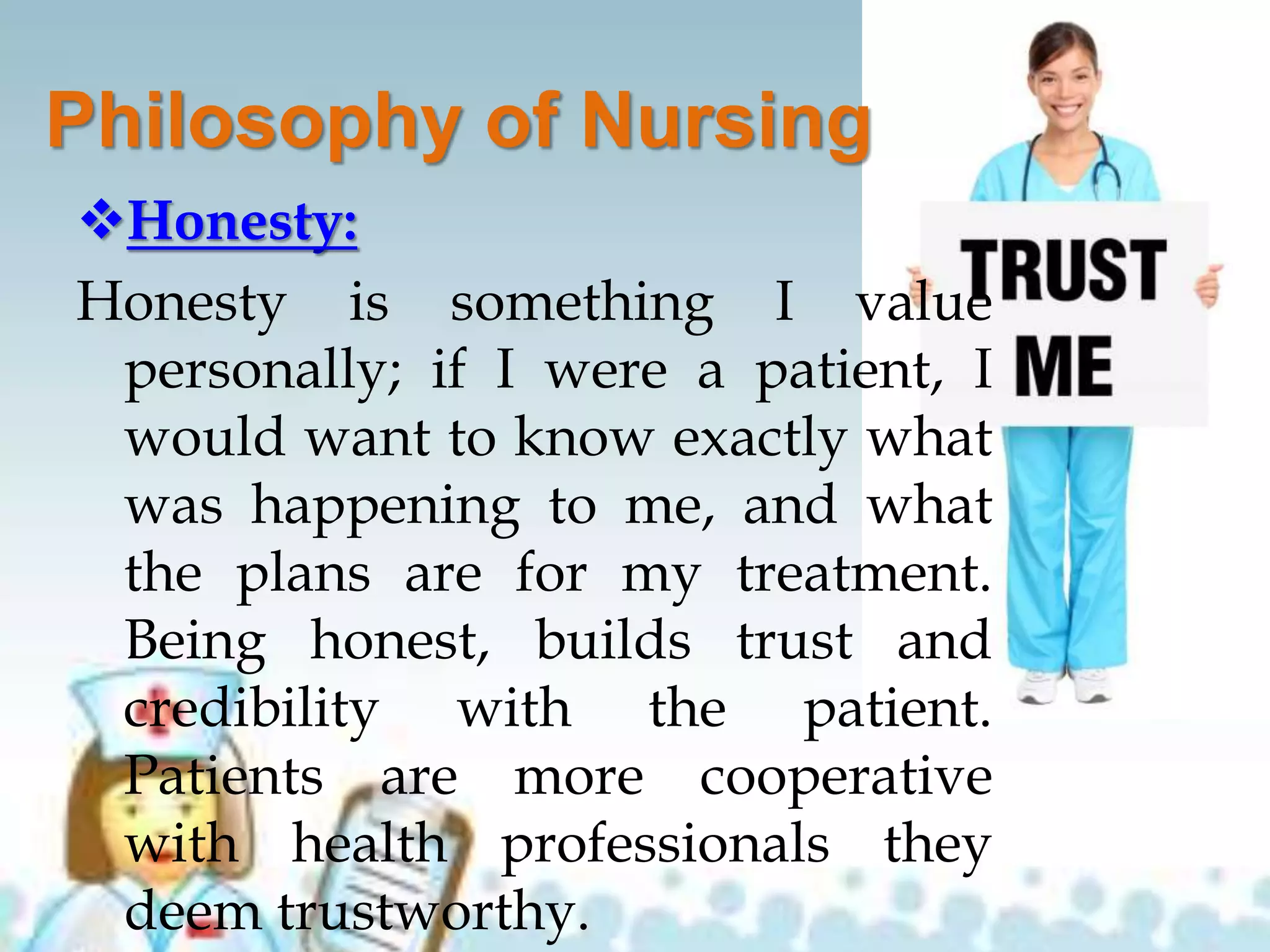
Honesty:
Honesty is something I value
personally; if I were a patient, I
would want to know exactly what
was happening to me, and what
the plans are for my treatment.
Being honest, builds trust and
credibility with the patient.
Patients are more cooperative
with health professionals they
deem trustworthy.
Philosophy of
Nursing Respect:
Respect is another quality that builds rapport with the
patient. Patients want to be treated with dignity and
involved with their treatment. Being respectful to
patients encompasses getting to know them, their
culture, and beliefs; it helps to distinguish a treatment
plan that the patient will be cooperative with.
These qualities are crucial in nursing because each person
should be treated as an individual and not a diagnosis.
Health includes a person’s social and mental wellbeing
as well as their physical wellbeing, so developing
relationships with patients is critical in delivering the
best quality of care. With compassion, honesty, and
respect, nurses will be able to create an environment
that optimizes the health of their patients.
Objectives of Nursing
Maintain and promote wellness, prevent illness,
care for and rehabilitate the sick of disabled
through the human science of nursing.
Reduce stress.
Provide comfort to the client during diseases
process.
Provide service to individual families and
societies.
Work independently with other health workers
assisting the client to gain independence as
quickly as possible.
Develop interaction between nurse and client.
Focus on a man a living unity and man’s
qualitative participation with experience.
Characteristics of Nursing
Nursing is caring.
Nursing involves close personal contact with the
recipient of care.
Nursing is concerned with services that take humans
into account as physiological, psychological, and
sociological organisms.
Nursing is committed to promoting individual, family,
community, and national health goals in its best
manner possible.
Nursing is committed to personalized services for all
persons without regard to color, creed, social or
economic status.
Nursing is committed to involvement in ethical, legal,
and political issues in the delivery of health care.
Nature And Scope Of Nursing Practice
Nurses contribute to health care within a
multidisciplinary team. They are individually
accountable for their actions and practise
within a statutory regulatory framework
established to protect the public and assure
the quality of nursing services.
The role of the nurse is constantly changing
and developing. This means that nurses may
add new functions to their work. When
deciding to do so, nurses must be sure that
patients will benefit and that they are
competent for the new role.
Nature And Scope Of Nursing Practice
Nursing is a service which:
• Helps individuals, families and communities
to achieve and maintain good health
• Supports, assists and cares for people during
illness or when their health is threatened
• Enhances people's ability to cope with the
effects of illness and disability
• Ensures, as far as possible, that death is
dignified and free from pain.
Nature And Scope Of Nursing Practice
Nursing achieves these goals by applying
knowledge and skills gained through education
and training, updated and tested by research. It is
the combination of professional knowledge and
skills, with the desire to care for others, which
provides the base of nursing.
Nursing practice includes:
• Assessing people's health, their health problems
and the resources they have to cope with them;
deciding what nursing help is needed and
referring them to other sources of expertise when
necessary
• Planning, giving and evaluating programmes of
skilled nursing care.
Nature And Scope Of Nursing Practice
A professional nursing organization has a
responsibility to its members and to the
public it serves to develop the scope and
standards of its profession’s practice. As
the professional organization for all
registered nurses, has assumed the
responsibility for developing the scope
and standards that apply to the practice of
all professional nurses and serve as a
template for nursing specialty practice.
Nature And Scope Of Nursing Practice
The scope of nursing practice is defined as
the range of roles, functions, responsibilities,
and activities which registered nurses are
educated and authorized to perform.
The Scope of Nursing Practice describes the
“who,” “what,” “where,” “when,” “why,”
and “how” of nursing practice.
The broad scope of nursing practice reflects
all of the roles and activities undertaken by
registered nurses to address the full range of
human experiences and responses to health
and illness. This includes: health promotion,
health protection, health maintenance, health
restoration, rehabilitation, and palliation.
Nature And Scope Of Nursing Practice
The actual scope of practice of individual
nurses is always narrower than that of the
scope of the nursing profession as a
whole. The scope of practice of the
individual nurse is influenced by the
nurses’ knowledge, practice setting,
employer requirements, and client needs
(CNA, 2002c). It is often described in job
descriptions and/or illustrated in practice
settings as competencies.
Nature And Scope Of Nursing Practice
They can work in settings like :
• Hospital
• Nursing homes.
• Clinics and Heath Department
• Orphanages and old age homes
• Military (Army, Navy, Air Force and
Marines)
• Community settings i.e. school nurse, health
visitor.
• Industrial houses and factories
• Railways and public sector medical
departments
Nature And Scope Of Nursing Practice
They can work in settings like :
• Training Institutes as educators
• Home care , Palliative care, hospice
• Public health agencies
• Ambulatory care centres ,extended care centers
• 0ffices ,corporations ,health-related industries ,
occupational settings
• Mental health services
• Private health care providers e.g. Practitioners •
Prison nurse/ Correctional , de- addiction.
• Researcher – promoting advances in health care
and health promotion practice
Nature And Scope Of Nursing Practice
They can diversify into different areas of
nursing practice:
–operating room, critical care and
emergency departments, women's
health and mental health.
–And there are many sub-specialty areas
such as sports injury nursing, cancer
nursing, cardiac care, newborn intensive
care.
Nature And Scope Of Nursing Practice
Nurses may choose to work in one
permanent setting, or may take short-term
assignments as a travel nurse to fulfill
temporary projects for nursing staff
internationally. They can even serve in
key government and elected positions
become a nurse practitioner, clinical nurse
specialist, nurse educator, researcher, or a
nurse manager.
DEFINITION OF NURSE
NURSE – originated from a Latin word
NUTRIX, means to nourish.
Dictionary definition says that A person
trained, licensed, or skilled in nursing is
called nurse.
Florence Nightingale in her Notes on Nursing
described the Nurse’s role as “one that
would put the patient in the best condition
for nature to act upon him. “
A professional nurse is a person who has
completed a basic nursing education
program and is licensed in his country to
practice professional nursing.
QUALITIES OF NURSE
1.Communication Skills:
Solid communication skills are a basic foundation
for any career. But for nurses, it’s one of the
most important aspects of the job. A great nurse
has excellent communication skills, especially
when it comes to speaking and listening. Based
on team and patient feedback, they are able to
problem-solve and effectively communicate
with patients and families.
Nurses always need to be on top of their game and
make sure that their patients are clearly
understood by everyone else. A truly stellar
nurse is able to advocate for her patients and
anticipate their needs.
QUALITIES OF NURSE
Emotional Stability:
Nursing is a stressful job where traumatic situations
are common. The ability to accept suffering and
death without letting it get personal is crucial.
Some days can seem like non-stop gloom and
doom.
That’s not to say that there aren’t heart-warming
moments in nursing. Helping a patient recover,
reuniting families, or bonding with fellow nurses
are special benefits of the job. A great nurse is able
to manage the stress of sad situations, but also
draws strength from the wonderful outcomes that
can and do happen.
QUALITIES OF NURSE
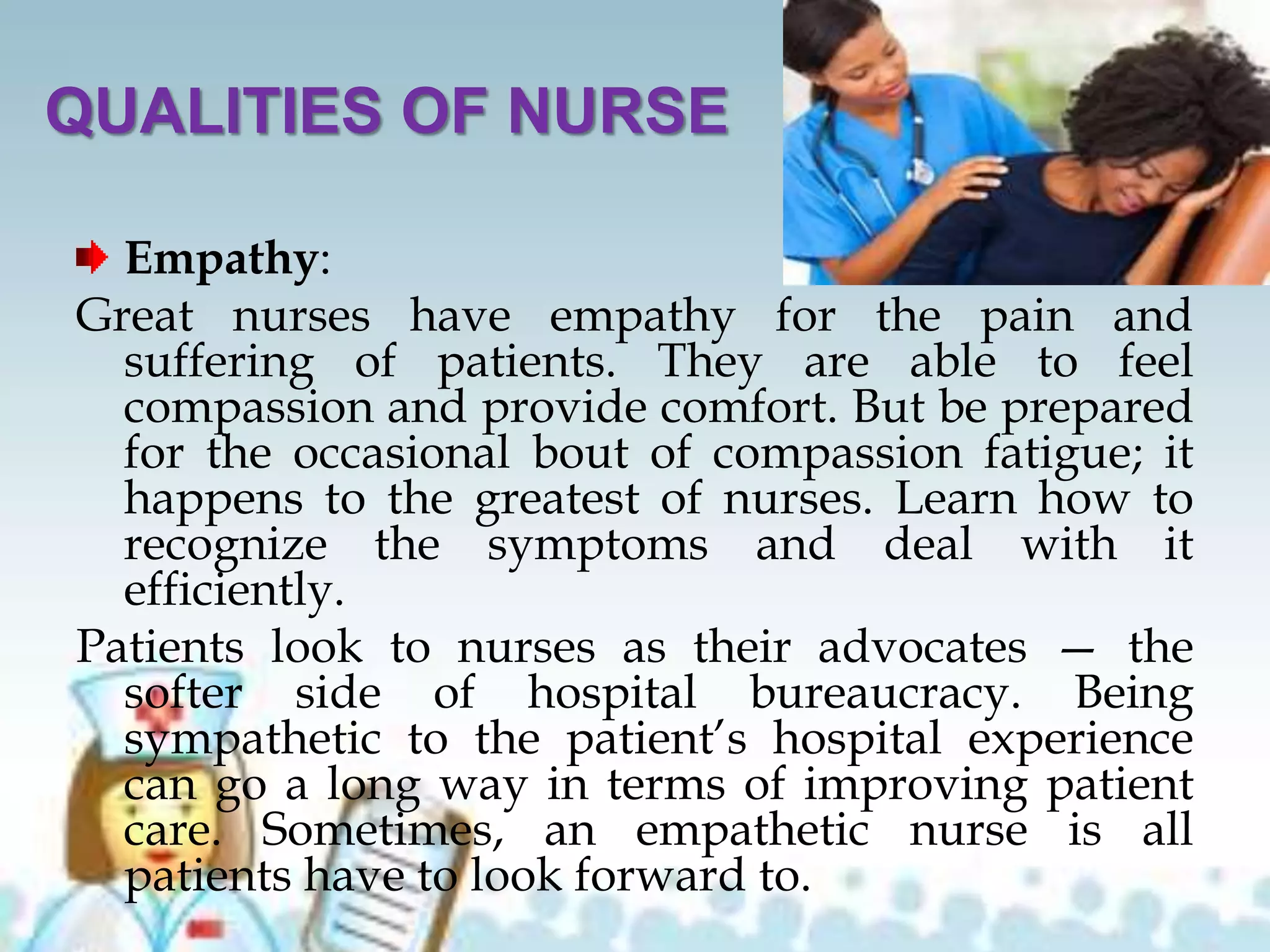
Empathy:
Great nurses have empathy for the pain and
suffering of patients. They are able to feel
compassion and provide comfort. But be prepared
for the occasional bout of compassion fatigue; it
happens to the greatest of nurses. Learn how to
recognize the symptoms and deal with it
efficiently.
Patients look to nurses as their advocates — the
softer side of hospital bureaucracy. Being
sympathetic to the patient’s hospital experience
can go a long way in terms of improving patient
care. Sometimes, an empathetic nurse is all
patients have to look forward to.
QUALITIES OF NURSE
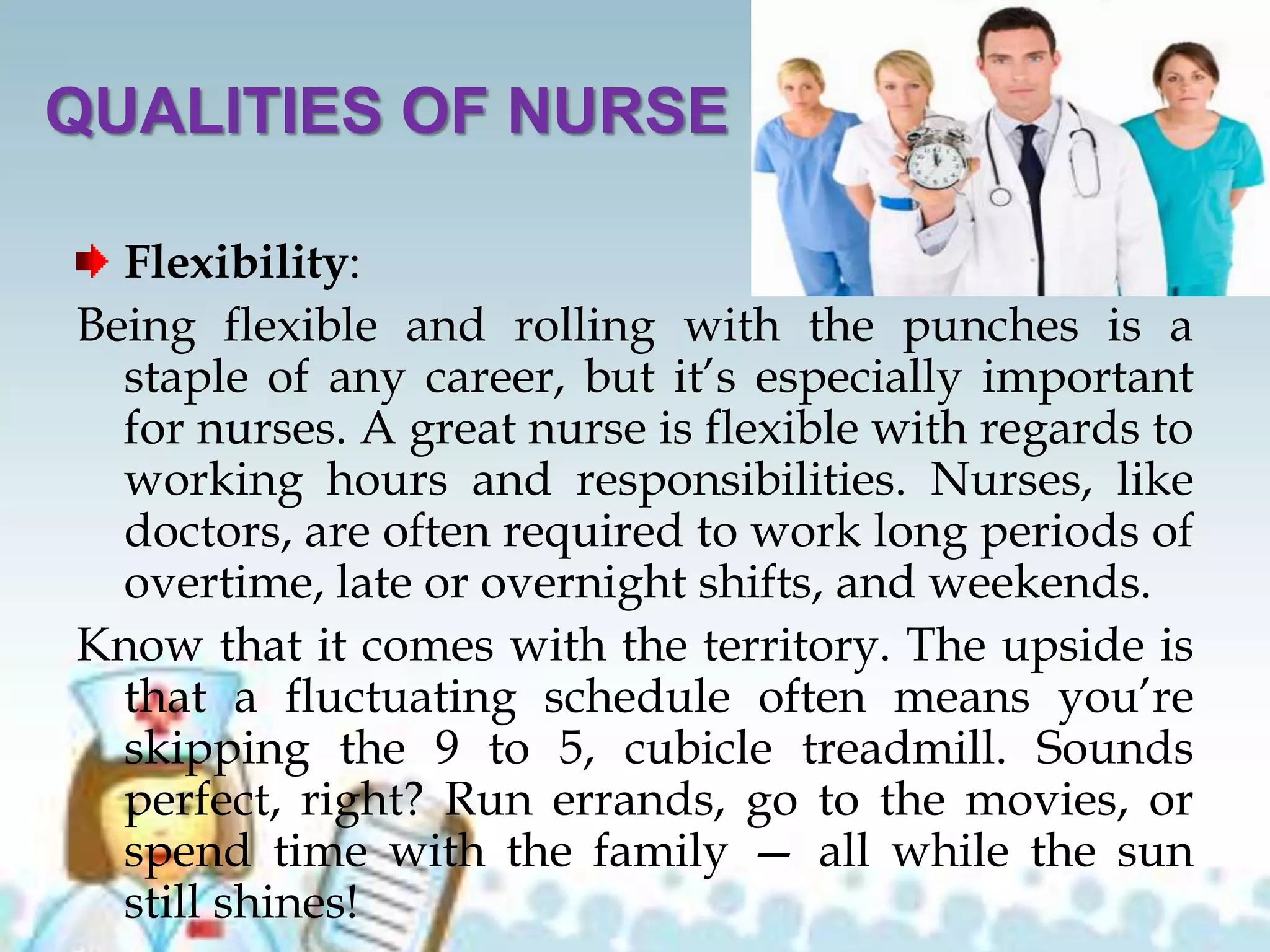
Flexibility:
Being flexible and rolling with the punches is a
staple of any career, but it’s especially important
for nurses. A great nurse is flexible with regards to
working hours and responsibilities. Nurses, like
doctors, are often required to work long periods of
overtime, late or overnight shifts, and weekends.
Know that it comes with the territory. The upside is
that a fluctuating schedule often means you’re
skipping the 9 to 5, cubicle treadmill. Sounds
perfect, right? Run errands, go to the movies, or
spend time with the family — all while the sun
still shines!
QUALITIES OF NURSE
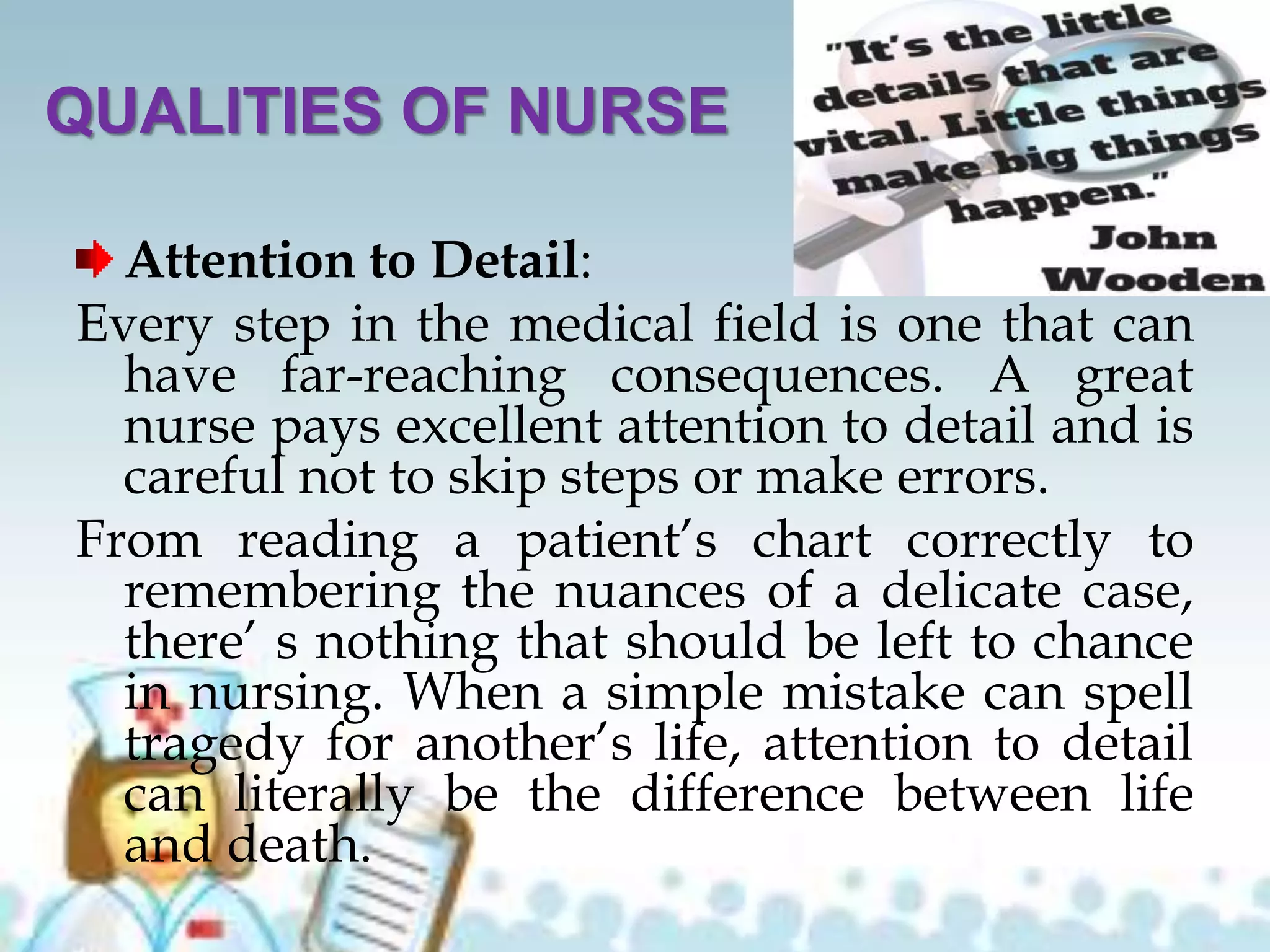
Attention to Detail:
Every step in the medical field is one that can
have far-reaching consequences. A great
nurse pays excellent attention to detail and is
careful not to skip steps or make errors.
From reading a patient’s chart correctly to
remembering the nuances of a delicate case,
there’ s nothing that should be left to chance
in nursing. When a simple mistake can spell
tragedy for another’s life, attention to detail
can literally be the difference between life
and death.
QUALITIES OF NURSE
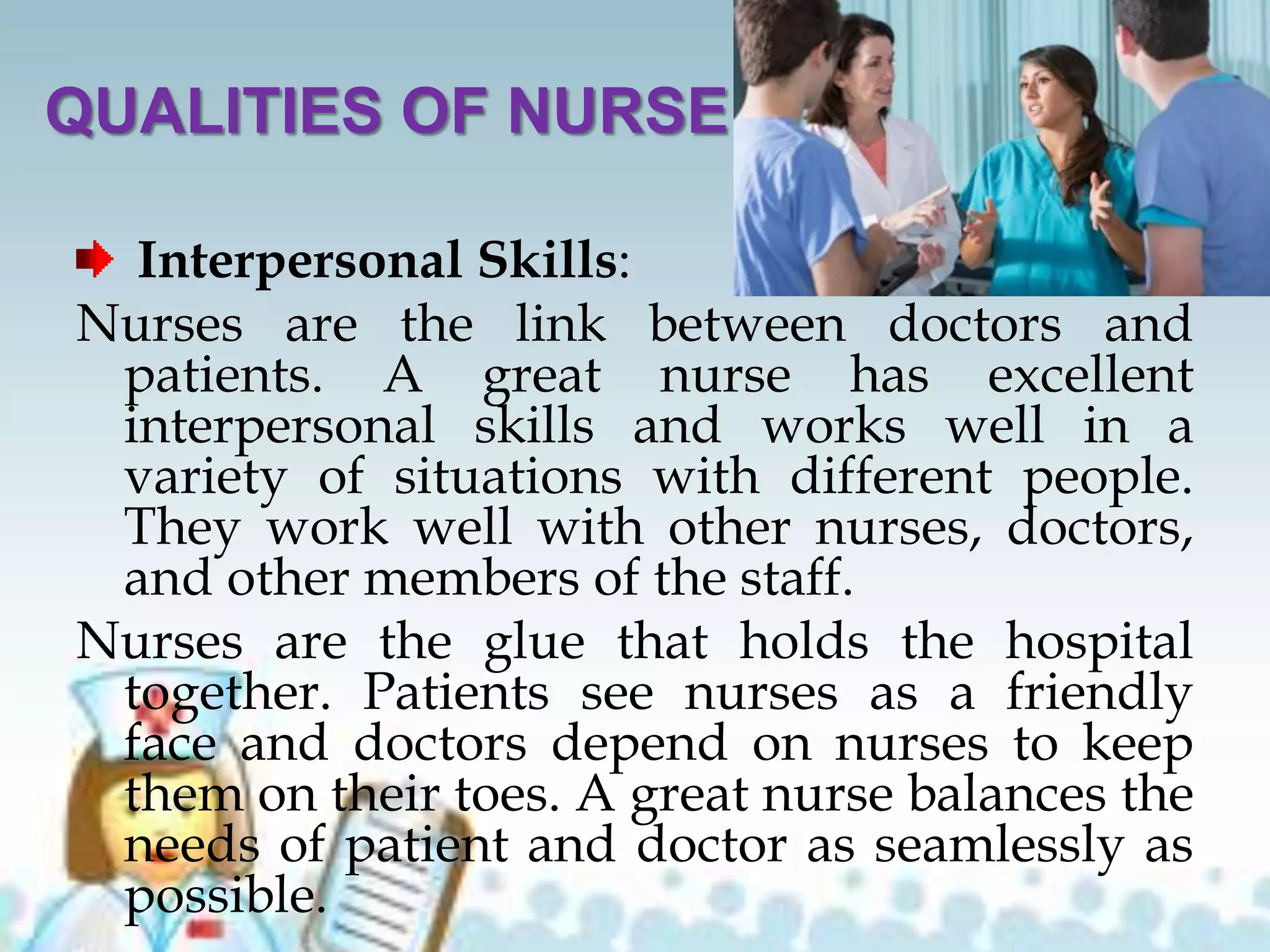
Interpersonal Skills:
Nurses are the link between doctors and
patients. A great nurse has excellent
interpersonal skills and works well in a
variety of situations with different people.
They work well with other nurses, doctors,
and other members of the staff.
Nurses are the glue that holds the hospital
together. Patients see nurses as a friendly
face and doctors depend on nurses to keep
them on their toes. A great nurse balances the
needs of patient and doctor as seamlessly as
possible.
QUALITIES OF NURSE
Physical Endurance:
Frequent physical tasks, standing for long
periods of time, lifting heavy objects (or
people), and performing a number of taxing
maneuvers on a daily basis are staples of
nursing life. It’s definitely not a desk job.
Always on the go, a great nurse maintains her
energy throughout her shift, whether she’s in
a surgery or checking in on a patient. Staying
strong, eating right, and having a healthy
lifestyle outside of nursing is important too!
QUALITIES OF NURSE
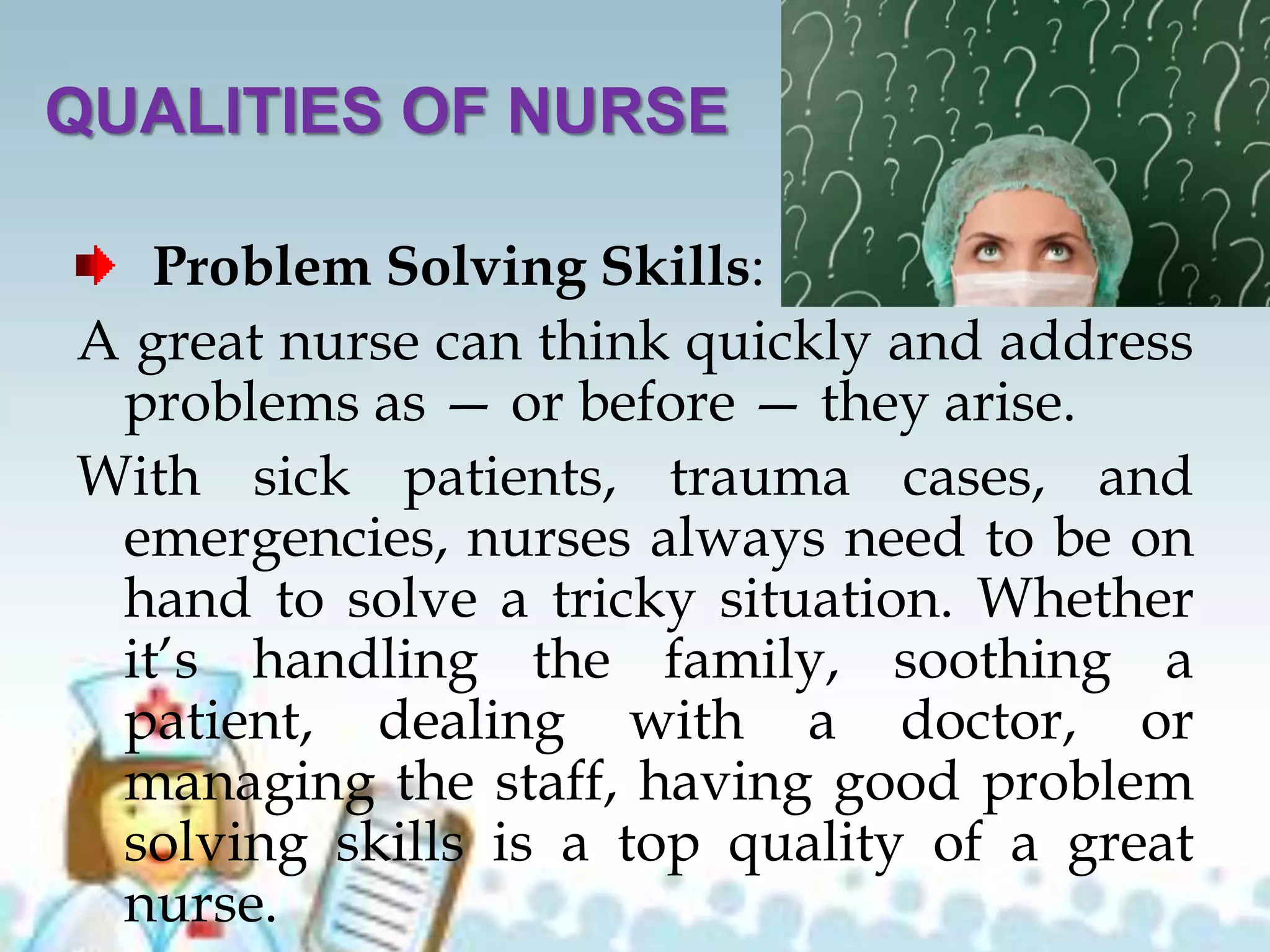
Problem Solving Skills:
A great nurse can think quickly and address
problems as — or before — they arise.
With sick patients, trauma cases, and
emergencies, nurses always need to be on
hand to solve a tricky situation. Whether
it’s handling the family, soothing a
patient, dealing with a doctor, or
managing the staff, having good problem
solving skills is a top quality of a great
nurse.
QUALITIES OF NURSE
Quick Response:
Nurses need to be ready to respond quickly
to emergencies and other situations that
arise. Quite often, health care work is
simply the response to sudden incidences,
and nurses must always be prepared for
the unexpected.
Staying on their feet, keeping their head cool
in a crisis, and a calm attitude are great
qualities in a nurse.
QUALITIES OF NURSE
Respect:
Respect goes a long way. Great nurses respect
people and rules. They remain impartial at
all times and are mindful of confidentiality
requirements and different cultures and
traditions. Above all, they respect the wishes
of the patient him- or herself.
Great nurses respect the hospital staff and each
other, understanding that the patient comes
first. And nurses who respect others are
highly respected in return.
QUALITIES OF NURSE
QUALITIES OF NURSE
• Must have a Bachelor of Science degree in
nursing.
• Must be physically and mentally fit.
• Must have a license to practice nursing in
the country.
QUALITIES OF NURSE
Mnemonics of NURSE
N – Noble/ Nurturing
U – Understanding/Usefulness
R – Reliable/Respectfulness
S – Selfless/Smart
E – Empathy/Efficiency
ROLE & FUNCTIONS OF NURSE
Caregiver
The caregiver role has traditionally
included those activities that assist
the client physically and
psychologically while preserving the
client’s dignity. Care giving
encompasses the physical,
psychosocial, developmental, cultural
and spiritual levels.
ROLE & FUNCTIONS OF NURSE
Communicator
Communication is an integral to all
nursing roles. Nurses communicate with
the client, support persons, other health
professionals, and people in the
community. In the role of communicator,
nurses identify client problems and then
communicate these verbally or in writing
to other members of the health team. The
quality of a nurse’s communication is an
important factor in nursing care.
ROLE & FUNCTIONS OF NURSE
Teacher
As a teacher, the nurse helps clients learn
about their health and the health care
procedures they need to perform to
restore or maintain their health. The
nurse assesses the client’s learning needs
and readiness to learn, sets specific
learning goals in conjunction with the
client, enacts teaching strategies and
measures learning.
ROLE & FUNCTIONS OF NURSE
Client advocate
Client advocate acts to protect the
client. In this role the nurse may
represent the client’s needs and
wishes to other health professionals,
such as relaying the client’s wishes
for information to the physician. They
also assist clients in exercising their
rights and help them speak up for
themselves.
ROLE & FUNCTIONS OF NURSE
Clinical & Ethical Decision Maker
Here the nurse uses the critical thinking
skills throughout the nursing process
and makes decisions in collaboration
with client and family members.
As a decision maker she collaborate and
consult with other health care team
members.
ROLE & FUNCTIONS OF NURSE
Counsellor
Counseling is a process of helping a
client to recognize and cope with
stressful psychological or social
problems, to developed improved
interpersonal relationships, and to
promote personal growth. It involves
providing emotional, intellectual, and
psychological support.
ROLE & FUNCTIONS OF NURSE
Change agent
The nurse acts as a change agent when
assisting others, that is, clients, to
make modifications in their own
behaviour. Nurses also often act to
make changes in a system such as
clinical care, if it is not helping a
client return to health.
ROLE & FUNCTIONS OF NURSE
Leader
A leader influences others to work together
to accomplish a specific goal. The leader
role can be employed at different levels;
individual client, family, groups of
clients, colleagues, or the community.
Effective leadership is a learned process
requiring an understanding of the needs
and goals that motivate people, the
knowledge to apply the leadership skills,
and the interpersonal skills to influence
others.
ROLE & FUNCTIONS OF NURSE
Manager
The nurse manages the nursing care of
individuals, families, and communities. The
nurse-manager also delegates nursing
activities to ancillary workers and other
nurses, and supervises and evaluates their
performance.
Case Manager
Nurse case managers work with the
multidisciplinary health care team to
measure the effectiveness of the case
management plan and to monitor outcomes.
ROLE & FUNCTIONS OF NURSE
Research consumer
Nurses often use research to improve client
care. In a clinical area nurses need to:
– Have some awareness of the process and
language of research
– Be sensitive to issues related to protecting the
rights of human subjects
– Participate in identification of significant
researchable problems
– Be a discriminating consumer of research
findings
ROLE & FUNCTIONS OF NURSE
Expanded role of the nurse
Clinical Specialists
Is a nurse who has completed a master’s
degree in specialty and has considerable
clinical expertise in that specialty. She
provides expert care to individuals,
participates in educating health care
professionals and ancillary, acts as a
clinical consultant and participates in
research.
ROLE & FUNCTIONS OF NURSE
Expanded role of the nurse
Nurse Practitioner
Is a nurse who has completed either as
certificate program or a master’s degree in
a specialty and is also certified by the
appropriate specialty organization. She is
skilled at making nursing assessments,
performing P. E., counseling, teaching and
treating minor and self- limiting illness.
ROLE & FUNCTIONS OF NURSE
Expanded role of the nurse
Nurse – Midwife
A nurse who has completed a program in
midwifery; provides prenatal and
postnatal care and delivers babies to
woman with uncomplicated pregnancies.
Nurse Anaesthetist
A nurse who completed the course of study
in an anaesthesia school and carries out
pre-operative status of clients.
ROLE & FUNCTIONS OF NURSE
Expanded role of the nurse
Nurse Educator
A nurse usually with advanced degree, who beaches
in clinical or educational settings, teaches
theoretical knowledge, clinical skills and conduct
research
Nurse Entrepreneur
A nurse who has an advanced degree, and manages
health-related business.
Nurse administrator
A nurse who functions at various levels of
management in health settings; responsible for the
management and administration of resources and
personnel involved in giving patient care.
ROLE & FUNCTIONS OF NURSE
Expanded role of the nurse
Nurse Researcher
Nurse researchers are scientists who study various
aspects of health, illness and health care.
Nurse researchers identify research question, design
and conduct scientific studies, collect and analyze
data and report their findings. This is a highly
specific category of nursing with various
additional training in research methodology and
tools used to perform research. The data collected
can be used to save the lives of patients and make
medical professionals’ lives easier on the job.
Nursing service is the part of the total health
organization which aims at satisfying the nursing
needs of the patients/community. In nursing
services, the nurse works with the members of
allied disciples such as dietetics, medical social
service, pharmacy etc. in supplying a
comprehensive program of patient care in the
hospital.
Definition of Nursing Services:-
WHO expert committee on nursing defines the
nursing services as the part of the total health
organization which aims to satisfy major objective
of the nursing services is to provide prevention of
disease and promotion of health.
ORGANISATION OF NURSING SERVICES IN
HOSPITALS:-
• CHIEF NURSING OFFICER
|
• NURSING SUPDT
|
• DY. NURSING SUPDT.
|
• ASSTT. NURSING SUPDT.
|
• WARD SISTER-CLINICAL SUPERVISOR (GRADE I)
|
• STAFF NUIRSE (Grade II)
|
• STUDENT NURSE
CNO (CHIEF NURSING OFFICER)
1. She/he will be responsible for efficient running of
Nursing Services at hospitals.
2. She will assist the Director in formulating broad
policies concerning Nursing Services and inform the
happening concerning the hospital.
3. She will disseminate the AIM, objectives and
policies regarding patient care to all cadres of
nursing services & will implement policies and
procedures of Institute regarding nursing services.
4.She/he will plan future requirements of nurses and
carry out recruitment of nurses from time to time.
CNO (CHIEF NURSING OFFICER)
5. She/he will plan and disseminate programmes for
continuing education re-orientation programmes
for nurses.
6. She/he will encourage research by nurses in their
work areas.
7. She will strive to implement standard nursing
practices and maintain highest quality of care.
8. She will critically analyse the budgets for nursing
services.
9. Evaluate confidential reports of higher level
nursing officers and recommend for promotion.
Nursing Superintendent is responsible to the
C.N.O. for planning organisation and
development of nursing services in the hospital in
consultation with Medical Supdt./Chief of
centres.
1. She will be responsible for implementing
hospital policies amongst various nursing units.
2. She will recommend personnel and material
requirement for nursing various nursing service
departments of the hospital.
3. She will ensure safe and efficient care rendered to
patients in various wards etc.
4. She will prepare budgets for nursing services.
5. She will be responsible for counseling and
guidance of sub-ordinate staff.
6. Making duty roaster of nursing personnel.
DEPUTY NURSING SUPERINTENDENT
• Deputy Nursing Superintendent is responsible to the
Nursing Supdt. and assist her in the administration
of nursing services in the hospital.
1. Supervise the nursing care given to the patients in
various departments by taking regular round of her
area.
2. Act as a liasion officer between Nursing Supdt. and
the nursing staff of the hospital.
3. Interpret the policies and procedures of the Nursing
service department to sub-oradinate staff and others.
4. Maintain the records of attendance of nursing staff
and leave of any kind.
5. Conduct regular physical verification of hospital
stocks, i.e. drugs, equipments etc.
6. Initiate procedure for condemnation and
procurement of hospital equipment/linen etc.
7. Maintain the confidential report and records of
nursing personnel.
8. Assist the nursing supdt. in making master duty
roster of nursing personnel.
9. Arrange orientation programmes for new nursing
staff.
10. Maintain discipline among nursing personnel.
11. Ensure clinical experience facilities for student
nurses in various clinical areas of the hospital.
ASSISTANT NURSING SUPERINTENDENT
• Asstt. Nursing Supdt, is responsible to Deputy Nursing
Supdt. for the total nursing care of patients, management
and development of the unit assigned to her
1. Plan and arrange duty for nursing personnel posted under
her.
2. To ensure availability of adequate nursing staff in all
shifts.
3. Maintain cleanliness of unit its annexes and environment.
4. Interact with the engineering service department for
proper up keep of the unit.
5. Guide the Sister Grade-I to ensure supplies and
equipments of different stores, and re-checking their use
and care.
6. Maintain good public relation with patients relatives and
the public, and project positive image of the hospital.
7. Maintain disciple of nursing and domestic staff.
NURSING SISTER GRADE-I
• The Nursing Sister Grade-I is responsible to
the Assistant Nursing Superintendent or the
total care of patients in the wards and
supervision of the Nursing Sister Grade-II,
student nurses and Domestic staff. She
would also be assisted by Nursing Sister
Grade-II, Clinical and Domestic staff. The
main aim of the sister Grade-I should be to
foster team spirit in her area of works as a
team leader.
NURSING SISTER GRADE-II
Nursing sister grade-II is directly
responsible to Nursing Sister Grade-I
(Ward In-Charge) for total nursing care of
the patient assigned to him/her.
ORGANISATION OF NURSING PERSONNEL IN
EDUCATIONAL INSTITUTES:-
• PRINCIPAL
|
• VICE PRINCIPAL
|
• PROFESSORS
|
• ASSOCIATE PROFESSORS
|
• ASSISTANT PROFESSOR
|
• CLINICAL INSTRUCTORS/NURSING TUTOR
ORGANISATION OF NURSING
PERSONNEL IN COMMUNITY
SETTING:-
• The nurses working in the community level
are also a large part of the health care
delivery system.
• They work at various levels and provide care
to various levels.
• They can be broadly classified as
– Female health worker
– Community health nurse
ORGANISATION OF NURSING
PERSONNEL IN COMMUNITY
SETTING:-
• The nurses working in the community level
are also a large part of the health care
delivery system.
• They work at various levels and provide care
to various levels.
• They can be broadly classified as
– Female health worker
– Community health nurse
ORGANISATION OF NURSING
PERSONNEL IN COMMUNITY
SETTING:-
There are various community health nurse
levels in various states of India. Generally
they can be classified as :
• DPHNO : District public health nursing
Officer
• BPHN: Block Public health Nurse
• PHN : Public health nurse/ Lady Health
Visitor
• ANM: Axillary Nurse midwife / Female
Health Workers
ORGANISATION OF NURSING PERSONNEL IN
COMMUNITY SETTING:-
• Female Health Workers
• Registers and cares for the pre-natal and post natal mothers
at home.
• Registers and follows up all the eligible couples.
• Provides nutritional advice and immunization to mother
and children.
• Carries out family planning services and including the
distribution of the contraceptives.
• Provides treatment to minor ailments.
• Notifies communicable diseases
• Maintains the records and registers all the services
provided and vital events like birth and death.
• Participates in the various disease control programmes.
• Conducts surveys of all sub-center areas and maintains
records about every family.
ORGANISATION OF NURSING
PERSONNEL IN COMMUNITY
SETTING:-
• Community health nurse
• Qualified community health nurse is one who has
undergone general training , and basic education in the
community health nursing. She must have a B.Sc.
Nursing with a registration to work as a community
health nurse
• Roles of community health nurse is Health education,
Individual practitioner, Decision maker, Programme
director, Planner, Researcher, Supervisor, Evaluator,
Advocate, and Direct care provider
Note nursing as a profession   1

Note nursing as a profession 1

  • 1.
    NURSING AS A PROFESSION Part -I BY: Mrs. Babitha K Devu Assistant Professor SMVDCoN
  • 2.
    Introduction • Nursing hasbeen called the oldest of the arts and the youngest of the professions. The term ‘Nurse’ evolve from the Latin word nutrix, which means to nourish or to cherish. • Today nursing emerged as a learned profession, that is both a science and an art. • It is a body of knowledge. Knowledge is an awareness or perception of reality, which is acquired through learning or investigation. • Science is defined as both a unified body of knowledge concerned with specific subject matter, the skills and methodology necessary to provide such knowledge.
  • 3.
    Introduction • Nursing asan art is the application of knowledge and skill to bring about desired results. It is an individual action. Nursing art is carried out by the nurse in an one-to-one relationship with the patient and constitutes the nurse’s conscious responses to a specific and patient’s immediate situation.
  • 5.
    Definitions • Profession: atype of occupation that meets certain criteria that raise it to a level above that of an occupation. • Profession: is a calling that requires special knowledge, skill and preparation. • An occupation that requires advanced knowledge and skills and that it grows out of society’s needs for special services.
  • 6.
    Definitions • Professional: aperson who belongs to and practices a profession • Professionalism: demonstration of high level of personal, ethical and high level of skill characteristics for a member of a profession.
  • 7.
    Definitions • Difference betweenOccupation & Profession. According to Webster: – Occupation: is defined as what occupies or engages, one’s time, business and employment. – Profession: is defined as a vocation requiring advanced training and usually involving mental rather than manual work, as teaching, engineering, especially medicine, law etc.
  • 8.
    CRITERIA OF PROFESSION HighIntellectual Level Of Functioning: Modern nurses use assessment skill and knowledge, have the ability to reason and make routine judgment depending on patient’s condition. Professional nurses functions at a high intellectual level. Florence nightingale raised the bar for education and graduates of her school were considered to be highly educated.
  • 9.
    CRITERIA OF PROFESSION HighLevel Of Individual Responsibility And Accountability: Nurses must be accountable and demonstrate a high level of individual responsibility for the care and services they provide. The concept of accountability has legal, ethical and professional implications that include accepting responsibility for action taken to provide client care as well as accepting responsibility for the consequences of action that are not performed.
  • 10.
    CRITERIA OF PROFESSION SpecializedBody Of Knowledge: Nursing has developed into an identifiable separate discipline, a specialized body of knowledge called as nursing science. It was compiled through the research effort of nurses with advanced educational degrees. Although this body of specialized knowledge is relatively small, it forms a theoretical basis for the practice of nursing today. As more nurses obtain advanced degrees, conduct research and develop philosophies, and theories about nursing, this body of knowledge will increase in scope.
  • 11.
    CRITERIA OF PROFESSION EvidenceBased Practice: Almost all the currently used nursing theories address this issue in some way. Evidenced based practice is the practice of nursing in which interventions are based on data obtained from research that demonstrate that, the findings are appropriate and successful. It involves a systematic process of uncovering, evaluating and using information from research as the basis for making decisions about providing client care.
  • 12.
    CRITERIA OF PROFESSION PublicService And Altruistic Activities: Individual is the focal point of all nursing models and nursing practice. Nursing has been viewed universally as being an altruistic profession composed of selfless individuals who place the lives and well being of their clients above their personal safety. Dedicated nurses provide care for victims of deadly diseases with little regard for their own welfare.
  • 13.
    CRITERIA OF PROFESSION WellOrganised And Strong Representation: Professional organizations represent the members of the profession and control the quality of professional practice. In India TNAI & SNA are the two organizations that represent nursing in today’s health care system. Many do belong to specialty organizations that represent a specific area of practice.
  • 14.
    CRITERIA OF PROFESSION CodeOf Ethics: A code of ethics document may outline the mission and values of the business or organization, how professionals are supposed to approach problems, the ethical principles based on the organization's core values and the standards to which the professional is held. Some of the ethical principles are autonomy, justice, non-maleficence ...
  • 15.
    CRITERIA OF PROFESSION CompetenciesAnd Professional License: Nurses must pass a national licensure examination to demonstrate that they are qualified to practice nursing. Only after passing the examination the nurses are allowed to practice. The granting of a nursing license is a legal activity conducted by the individual state under the regulations contained in the state’s nursing practice act.
  • 16.
    CRITERIA OF PROFESSION AutonomyAnd Independence Of Practice: In reality nursing is both an independent and interdependent discipline. Nurses in all health care setting must work with physicians, hospital administrators, pharmacists and other groups in the provision of care. In some cases nurses in advanced practice role eg. Nurse practitioners can do establish their independent practices. To be considered a true profession, nursing will need to be recognised by other disciplines as having practitioners who practice nursing independently.
  • 17.
    CRITERIA OF PROFESSION ProfessionalIdentity And Development: Until nurses are fully committed to the profession of nursing, identify with it as a profession and are dedicated to its future development, nursing will probably not achieve professional status.
  • 18.
    CHARACTERISTICS OF A PROFESSION Abasic profession requires an extended education of its members, as well as a basic liberal foundation. A profession has a theoretical body of knowledge leading to defined skills, abilities and norms. A profession provides a specific service. Members of a profession have autonomy in decision-making and practice. The profession has a code of ethics for practice.
  • 20.
    Definitions of Nursing Theunique function of nurses in caring for individuals, sick or well, is to assess their responses to their health status and to assist them in the performance of those activities contributing to health or recovery or to dignified death that they would perform unaided if they had the necessary strength, will, or knowledge and to do this in such a way as to help them gain full or partial independence as rapidly as possible (Virginia Henderson, 1977)
  • 21.
    Definitions of Nursing Nursingencompasses autonomous and collaborative care of individuals of all ages, families, groups and communities, sick or well and in all settings. Nursing includes the promotion of health, prevention of illness, and the care of ill, disabled and dying people. (Short Version definition by ICN)
  • 22.
    Definitions of Nursing Nightingaledefined nursing over 100 years ago as “the act of utilizing the environment of the patient to assist him in his recovery”. (Florence Nightingale, 1860)
  • 23.
    Definitions of Nursing “Nursingis the protection, promotion, and optimization of health and abilities, prevention of illness and injury, alleviation of suffering through the diagnosis and treatment of human response, and advocacy in the care of individuals, families, communities and populations.” (American Nurses Association)
  • 24.
    Concepts of Nursing •The art and science of modern nursing encompasses fundamental nursing concepts that include health, illness, stress and health promotion. Nurses work with physicians and other medical staff in a wide variety of medical and community settings. • They provide preventive, primary, acute and chronic care for sick and injured patients with health information, restorative care, medication administration and emergency care. Nursing care focuses on protecting and promoting physical and mental health for patients and for the community.
  • 25.
    Concepts of Nursing Health: Healthis the absence of illness, injury and disease. Health as a fundamental nursing concept involves both mental and physiological well being, and it changes over a patient's lifetime. Nurses work in health care to promote and protect health by instructing patients about self-care, and about how lifestyle and behavior affects their health. They help people to recover from physical and mental illness, and they tend to sick and injured patients to restore health.
  • 26.
    Concepts of Nursing Illness: Illnessis a fundamental nursing concept that defines a deviation from health with three stages: the onset of illness, the acceptance of the state of illness and the convalescence or recovery stage. A nurse’s role in illness includes monitoring and interpreting symptoms, administering medication and self-care information, and caring for patients who are incapacitated by illness, such as administering intravenous fluids to a patient dehydrated from fever and vomiting.
  • 27.
    Concepts of Nursing Stress: Nurseswork to make patients more comfortable, and a big part of nursing care includes reducing patient stress. Nurses care for patients who experience stress from being weakened due to illness or injury, being removed from a familiar environment etc. Nurses explain procedures to patients, listen to patient concerns and answer questions, protect patients' privacy and ask how patients are feeling. The goal is to calm them and make them feel more physically and emotionally comfortable.
  • 28.
    Concepts of Nursing HealthPromotion: It’s the responsibility of every nurse to promote better health by informing patients of things such as illness prevention methods, safe health practices and healthy lifestyle choices. Nurses promote health by discussing weight and exercise issues, nutrition, the risks of drinking, smoking and drug use, and other self-care that increases their quality and length of life.
  • 29.
    Philosophy of Nursing Aphilosophy of nursing is a statement, sometimes written, that declares a nurse’s beliefs, values, and ethics regarding their care and treatment of patients while they are in the nursing profession. Although the philosophy may seem solely academic and too cerebral to be of any use, it is vital to approaching your profession in an appropriate manner. When you develop a personal philosophy of nursing, it benefits your career and the lives of the people you provide care to and their families.
  • 30.
    Philosophy of Nursing Nursingis a profession that can make a significant impact in the lives of many. Being so, there are certain qualities that I feel are necessary to be an amazing nurse: compassion, honesty, and respect. During these present times, it is so easy to be task- oriented and constantly on the go. As nurses, we will have multiple patients at a time, so there is potential to treat the diagnosis and not the individual. I truly feel that these three qualities ensure that nurses will provide patients with best care possible.
  • 31.
    Philosophy of Nursing Compassion: Compassion,in my opinion, is a must-have quality when it comes to nursing. A nurse without compassion treats only the diagnosis, and a person’s health is made up of more than one component: physical, social and mental wellbeing (Centers for Disease Control And Prevention, 2014). Being able to empathize with patients, builds rapport, and creates an environment that is inclusive of the physical, social, and mental aspects of health.
  • 32.
    Philosophy of Nursing Honesty: Honestyis something I value personally; if I were a patient, I would want to know exactly what was happening to me, and what the plans are for my treatment. Being honest, builds trust and credibility with the patient. Patients are more cooperative with health professionals they deem trustworthy.
  • 33.
    Philosophy of Nursing Respect: Respectis another quality that builds rapport with the patient. Patients want to be treated with dignity and involved with their treatment. Being respectful to patients encompasses getting to know them, their culture, and beliefs; it helps to distinguish a treatment plan that the patient will be cooperative with. These qualities are crucial in nursing because each person should be treated as an individual and not a diagnosis. Health includes a person’s social and mental wellbeing as well as their physical wellbeing, so developing relationships with patients is critical in delivering the best quality of care. With compassion, honesty, and respect, nurses will be able to create an environment that optimizes the health of their patients.
  • 34.
    Objectives of Nursing Maintainand promote wellness, prevent illness, care for and rehabilitate the sick of disabled through the human science of nursing. Reduce stress. Provide comfort to the client during diseases process. Provide service to individual families and societies. Work independently with other health workers assisting the client to gain independence as quickly as possible. Develop interaction between nurse and client. Focus on a man a living unity and man’s qualitative participation with experience.
  • 35.
    Characteristics of Nursing Nursingis caring. Nursing involves close personal contact with the recipient of care. Nursing is concerned with services that take humans into account as physiological, psychological, and sociological organisms. Nursing is committed to promoting individual, family, community, and national health goals in its best manner possible. Nursing is committed to personalized services for all persons without regard to color, creed, social or economic status. Nursing is committed to involvement in ethical, legal, and political issues in the delivery of health care.
  • 36.
    Nature And ScopeOf Nursing Practice Nurses contribute to health care within a multidisciplinary team. They are individually accountable for their actions and practise within a statutory regulatory framework established to protect the public and assure the quality of nursing services. The role of the nurse is constantly changing and developing. This means that nurses may add new functions to their work. When deciding to do so, nurses must be sure that patients will benefit and that they are competent for the new role.
  • 37.
    Nature And ScopeOf Nursing Practice Nursing is a service which: • Helps individuals, families and communities to achieve and maintain good health • Supports, assists and cares for people during illness or when their health is threatened • Enhances people's ability to cope with the effects of illness and disability • Ensures, as far as possible, that death is dignified and free from pain.
  • 38.
    Nature And ScopeOf Nursing Practice Nursing achieves these goals by applying knowledge and skills gained through education and training, updated and tested by research. It is the combination of professional knowledge and skills, with the desire to care for others, which provides the base of nursing. Nursing practice includes: • Assessing people's health, their health problems and the resources they have to cope with them; deciding what nursing help is needed and referring them to other sources of expertise when necessary • Planning, giving and evaluating programmes of skilled nursing care.
  • 39.
    Nature And ScopeOf Nursing Practice A professional nursing organization has a responsibility to its members and to the public it serves to develop the scope and standards of its profession’s practice. As the professional organization for all registered nurses, has assumed the responsibility for developing the scope and standards that apply to the practice of all professional nurses and serve as a template for nursing specialty practice.
  • 40.
    Nature And ScopeOf Nursing Practice The scope of nursing practice is defined as the range of roles, functions, responsibilities, and activities which registered nurses are educated and authorized to perform. The Scope of Nursing Practice describes the “who,” “what,” “where,” “when,” “why,” and “how” of nursing practice. The broad scope of nursing practice reflects all of the roles and activities undertaken by registered nurses to address the full range of human experiences and responses to health and illness. This includes: health promotion, health protection, health maintenance, health restoration, rehabilitation, and palliation.
  • 41.
    Nature And ScopeOf Nursing Practice The actual scope of practice of individual nurses is always narrower than that of the scope of the nursing profession as a whole. The scope of practice of the individual nurse is influenced by the nurses’ knowledge, practice setting, employer requirements, and client needs (CNA, 2002c). It is often described in job descriptions and/or illustrated in practice settings as competencies.
  • 42.
    Nature And ScopeOf Nursing Practice They can work in settings like : • Hospital • Nursing homes. • Clinics and Heath Department • Orphanages and old age homes • Military (Army, Navy, Air Force and Marines) • Community settings i.e. school nurse, health visitor. • Industrial houses and factories • Railways and public sector medical departments
  • 43.
    Nature And ScopeOf Nursing Practice They can work in settings like : • Training Institutes as educators • Home care , Palliative care, hospice • Public health agencies • Ambulatory care centres ,extended care centers • 0ffices ,corporations ,health-related industries , occupational settings • Mental health services • Private health care providers e.g. Practitioners • Prison nurse/ Correctional , de- addiction. • Researcher – promoting advances in health care and health promotion practice
  • 44.
    Nature And ScopeOf Nursing Practice They can diversify into different areas of nursing practice: –operating room, critical care and emergency departments, women's health and mental health. –And there are many sub-specialty areas such as sports injury nursing, cancer nursing, cardiac care, newborn intensive care.
  • 45.
    Nature And ScopeOf Nursing Practice Nurses may choose to work in one permanent setting, or may take short-term assignments as a travel nurse to fulfill temporary projects for nursing staff internationally. They can even serve in key government and elected positions become a nurse practitioner, clinical nurse specialist, nurse educator, researcher, or a nurse manager.
  • 46.
    DEFINITION OF NURSE NURSE– originated from a Latin word NUTRIX, means to nourish. Dictionary definition says that A person trained, licensed, or skilled in nursing is called nurse. Florence Nightingale in her Notes on Nursing described the Nurse’s role as “one that would put the patient in the best condition for nature to act upon him. “ A professional nurse is a person who has completed a basic nursing education program and is licensed in his country to practice professional nursing.
  • 47.
    QUALITIES OF NURSE 1.CommunicationSkills: Solid communication skills are a basic foundation for any career. But for nurses, it’s one of the most important aspects of the job. A great nurse has excellent communication skills, especially when it comes to speaking and listening. Based on team and patient feedback, they are able to problem-solve and effectively communicate with patients and families. Nurses always need to be on top of their game and make sure that their patients are clearly understood by everyone else. A truly stellar nurse is able to advocate for her patients and anticipate their needs.
  • 48.
    QUALITIES OF NURSE EmotionalStability: Nursing is a stressful job where traumatic situations are common. The ability to accept suffering and death without letting it get personal is crucial. Some days can seem like non-stop gloom and doom. That’s not to say that there aren’t heart-warming moments in nursing. Helping a patient recover, reuniting families, or bonding with fellow nurses are special benefits of the job. A great nurse is able to manage the stress of sad situations, but also draws strength from the wonderful outcomes that can and do happen.
  • 49.
    QUALITIES OF NURSE Empathy: Greatnurses have empathy for the pain and suffering of patients. They are able to feel compassion and provide comfort. But be prepared for the occasional bout of compassion fatigue; it happens to the greatest of nurses. Learn how to recognize the symptoms and deal with it efficiently. Patients look to nurses as their advocates — the softer side of hospital bureaucracy. Being sympathetic to the patient’s hospital experience can go a long way in terms of improving patient care. Sometimes, an empathetic nurse is all patients have to look forward to.
  • 50.
    QUALITIES OF NURSE Flexibility: Beingflexible and rolling with the punches is a staple of any career, but it’s especially important for nurses. A great nurse is flexible with regards to working hours and responsibilities. Nurses, like doctors, are often required to work long periods of overtime, late or overnight shifts, and weekends. Know that it comes with the territory. The upside is that a fluctuating schedule often means you’re skipping the 9 to 5, cubicle treadmill. Sounds perfect, right? Run errands, go to the movies, or spend time with the family — all while the sun still shines!
  • 51.
    QUALITIES OF NURSE Attentionto Detail: Every step in the medical field is one that can have far-reaching consequences. A great nurse pays excellent attention to detail and is careful not to skip steps or make errors. From reading a patient’s chart correctly to remembering the nuances of a delicate case, there’ s nothing that should be left to chance in nursing. When a simple mistake can spell tragedy for another’s life, attention to detail can literally be the difference between life and death.
  • 52.
    QUALITIES OF NURSE InterpersonalSkills: Nurses are the link between doctors and patients. A great nurse has excellent interpersonal skills and works well in a variety of situations with different people. They work well with other nurses, doctors, and other members of the staff. Nurses are the glue that holds the hospital together. Patients see nurses as a friendly face and doctors depend on nurses to keep them on their toes. A great nurse balances the needs of patient and doctor as seamlessly as possible.
  • 53.
    QUALITIES OF NURSE PhysicalEndurance: Frequent physical tasks, standing for long periods of time, lifting heavy objects (or people), and performing a number of taxing maneuvers on a daily basis are staples of nursing life. It’s definitely not a desk job. Always on the go, a great nurse maintains her energy throughout her shift, whether she’s in a surgery or checking in on a patient. Staying strong, eating right, and having a healthy lifestyle outside of nursing is important too!
  • 54.
    QUALITIES OF NURSE ProblemSolving Skills: A great nurse can think quickly and address problems as — or before — they arise. With sick patients, trauma cases, and emergencies, nurses always need to be on hand to solve a tricky situation. Whether it’s handling the family, soothing a patient, dealing with a doctor, or managing the staff, having good problem solving skills is a top quality of a great nurse.
  • 55.
    QUALITIES OF NURSE QuickResponse: Nurses need to be ready to respond quickly to emergencies and other situations that arise. Quite often, health care work is simply the response to sudden incidences, and nurses must always be prepared for the unexpected. Staying on their feet, keeping their head cool in a crisis, and a calm attitude are great qualities in a nurse.
  • 56.
    QUALITIES OF NURSE Respect: Respectgoes a long way. Great nurses respect people and rules. They remain impartial at all times and are mindful of confidentiality requirements and different cultures and traditions. Above all, they respect the wishes of the patient him- or herself. Great nurses respect the hospital staff and each other, understanding that the patient comes first. And nurses who respect others are highly respected in return.
  • 57.
  • 58.
    QUALITIES OF NURSE •Must have a Bachelor of Science degree in nursing. • Must be physically and mentally fit. • Must have a license to practice nursing in the country.
  • 59.
    QUALITIES OF NURSE Mnemonicsof NURSE N – Noble/ Nurturing U – Understanding/Usefulness R – Reliable/Respectfulness S – Selfless/Smart E – Empathy/Efficiency
  • 60.
    ROLE & FUNCTIONSOF NURSE Caregiver The caregiver role has traditionally included those activities that assist the client physically and psychologically while preserving the client’s dignity. Care giving encompasses the physical, psychosocial, developmental, cultural and spiritual levels.
  • 61.
    ROLE & FUNCTIONSOF NURSE Communicator Communication is an integral to all nursing roles. Nurses communicate with the client, support persons, other health professionals, and people in the community. In the role of communicator, nurses identify client problems and then communicate these verbally or in writing to other members of the health team. The quality of a nurse’s communication is an important factor in nursing care.
  • 62.
    ROLE & FUNCTIONSOF NURSE Teacher As a teacher, the nurse helps clients learn about their health and the health care procedures they need to perform to restore or maintain their health. The nurse assesses the client’s learning needs and readiness to learn, sets specific learning goals in conjunction with the client, enacts teaching strategies and measures learning.
  • 63.
    ROLE & FUNCTIONSOF NURSE Client advocate Client advocate acts to protect the client. In this role the nurse may represent the client’s needs and wishes to other health professionals, such as relaying the client’s wishes for information to the physician. They also assist clients in exercising their rights and help them speak up for themselves.
  • 64.
    ROLE & FUNCTIONSOF NURSE Clinical & Ethical Decision Maker Here the nurse uses the critical thinking skills throughout the nursing process and makes decisions in collaboration with client and family members. As a decision maker she collaborate and consult with other health care team members.
  • 65.
    ROLE & FUNCTIONSOF NURSE Counsellor Counseling is a process of helping a client to recognize and cope with stressful psychological or social problems, to developed improved interpersonal relationships, and to promote personal growth. It involves providing emotional, intellectual, and psychological support.
  • 66.
    ROLE & FUNCTIONSOF NURSE Change agent The nurse acts as a change agent when assisting others, that is, clients, to make modifications in their own behaviour. Nurses also often act to make changes in a system such as clinical care, if it is not helping a client return to health.
  • 67.
    ROLE & FUNCTIONSOF NURSE Leader A leader influences others to work together to accomplish a specific goal. The leader role can be employed at different levels; individual client, family, groups of clients, colleagues, or the community. Effective leadership is a learned process requiring an understanding of the needs and goals that motivate people, the knowledge to apply the leadership skills, and the interpersonal skills to influence others.
  • 68.
    ROLE & FUNCTIONSOF NURSE Manager The nurse manages the nursing care of individuals, families, and communities. The nurse-manager also delegates nursing activities to ancillary workers and other nurses, and supervises and evaluates their performance. Case Manager Nurse case managers work with the multidisciplinary health care team to measure the effectiveness of the case management plan and to monitor outcomes.
  • 69.
    ROLE & FUNCTIONSOF NURSE Research consumer Nurses often use research to improve client care. In a clinical area nurses need to: – Have some awareness of the process and language of research – Be sensitive to issues related to protecting the rights of human subjects – Participate in identification of significant researchable problems – Be a discriminating consumer of research findings
  • 70.
    ROLE & FUNCTIONSOF NURSE Expanded role of the nurse Clinical Specialists Is a nurse who has completed a master’s degree in specialty and has considerable clinical expertise in that specialty. She provides expert care to individuals, participates in educating health care professionals and ancillary, acts as a clinical consultant and participates in research.
  • 71.
    ROLE & FUNCTIONSOF NURSE Expanded role of the nurse Nurse Practitioner Is a nurse who has completed either as certificate program or a master’s degree in a specialty and is also certified by the appropriate specialty organization. She is skilled at making nursing assessments, performing P. E., counseling, teaching and treating minor and self- limiting illness.
  • 72.
    ROLE & FUNCTIONSOF NURSE Expanded role of the nurse Nurse – Midwife A nurse who has completed a program in midwifery; provides prenatal and postnatal care and delivers babies to woman with uncomplicated pregnancies. Nurse Anaesthetist A nurse who completed the course of study in an anaesthesia school and carries out pre-operative status of clients.
  • 73.
    ROLE & FUNCTIONSOF NURSE Expanded role of the nurse Nurse Educator A nurse usually with advanced degree, who beaches in clinical or educational settings, teaches theoretical knowledge, clinical skills and conduct research Nurse Entrepreneur A nurse who has an advanced degree, and manages health-related business. Nurse administrator A nurse who functions at various levels of management in health settings; responsible for the management and administration of resources and personnel involved in giving patient care.
  • 74.
    ROLE & FUNCTIONSOF NURSE Expanded role of the nurse Nurse Researcher Nurse researchers are scientists who study various aspects of health, illness and health care. Nurse researchers identify research question, design and conduct scientific studies, collect and analyze data and report their findings. This is a highly specific category of nursing with various additional training in research methodology and tools used to perform research. The data collected can be used to save the lives of patients and make medical professionals’ lives easier on the job.
  • 75.
    Nursing service isthe part of the total health organization which aims at satisfying the nursing needs of the patients/community. In nursing services, the nurse works with the members of allied disciples such as dietetics, medical social service, pharmacy etc. in supplying a comprehensive program of patient care in the hospital. Definition of Nursing Services:- WHO expert committee on nursing defines the nursing services as the part of the total health organization which aims to satisfy major objective of the nursing services is to provide prevention of disease and promotion of health.
  • 76.
    ORGANISATION OF NURSINGSERVICES IN HOSPITALS:- • CHIEF NURSING OFFICER | • NURSING SUPDT | • DY. NURSING SUPDT. | • ASSTT. NURSING SUPDT. | • WARD SISTER-CLINICAL SUPERVISOR (GRADE I) | • STAFF NUIRSE (Grade II) | • STUDENT NURSE
  • 77.
    CNO (CHIEF NURSINGOFFICER) 1. She/he will be responsible for efficient running of Nursing Services at hospitals. 2. She will assist the Director in formulating broad policies concerning Nursing Services and inform the happening concerning the hospital. 3. She will disseminate the AIM, objectives and policies regarding patient care to all cadres of nursing services & will implement policies and procedures of Institute regarding nursing services. 4.She/he will plan future requirements of nurses and carry out recruitment of nurses from time to time.
  • 78.
    CNO (CHIEF NURSINGOFFICER) 5. She/he will plan and disseminate programmes for continuing education re-orientation programmes for nurses. 6. She/he will encourage research by nurses in their work areas. 7. She will strive to implement standard nursing practices and maintain highest quality of care. 8. She will critically analyse the budgets for nursing services. 9. Evaluate confidential reports of higher level nursing officers and recommend for promotion.
  • 79.
    Nursing Superintendent isresponsible to the C.N.O. for planning organisation and development of nursing services in the hospital in consultation with Medical Supdt./Chief of centres. 1. She will be responsible for implementing hospital policies amongst various nursing units. 2. She will recommend personnel and material requirement for nursing various nursing service departments of the hospital. 3. She will ensure safe and efficient care rendered to patients in various wards etc. 4. She will prepare budgets for nursing services. 5. She will be responsible for counseling and guidance of sub-ordinate staff. 6. Making duty roaster of nursing personnel.
  • 80.
    DEPUTY NURSING SUPERINTENDENT •Deputy Nursing Superintendent is responsible to the Nursing Supdt. and assist her in the administration of nursing services in the hospital. 1. Supervise the nursing care given to the patients in various departments by taking regular round of her area. 2. Act as a liasion officer between Nursing Supdt. and the nursing staff of the hospital. 3. Interpret the policies and procedures of the Nursing service department to sub-oradinate staff and others. 4. Maintain the records of attendance of nursing staff and leave of any kind.
  • 81.
    5. Conduct regularphysical verification of hospital stocks, i.e. drugs, equipments etc. 6. Initiate procedure for condemnation and procurement of hospital equipment/linen etc. 7. Maintain the confidential report and records of nursing personnel. 8. Assist the nursing supdt. in making master duty roster of nursing personnel. 9. Arrange orientation programmes for new nursing staff. 10. Maintain discipline among nursing personnel. 11. Ensure clinical experience facilities for student nurses in various clinical areas of the hospital.
  • 82.
    ASSISTANT NURSING SUPERINTENDENT •Asstt. Nursing Supdt, is responsible to Deputy Nursing Supdt. for the total nursing care of patients, management and development of the unit assigned to her 1. Plan and arrange duty for nursing personnel posted under her. 2. To ensure availability of adequate nursing staff in all shifts. 3. Maintain cleanliness of unit its annexes and environment. 4. Interact with the engineering service department for proper up keep of the unit. 5. Guide the Sister Grade-I to ensure supplies and equipments of different stores, and re-checking their use and care. 6. Maintain good public relation with patients relatives and the public, and project positive image of the hospital. 7. Maintain disciple of nursing and domestic staff.
  • 83.
    NURSING SISTER GRADE-I •The Nursing Sister Grade-I is responsible to the Assistant Nursing Superintendent or the total care of patients in the wards and supervision of the Nursing Sister Grade-II, student nurses and Domestic staff. She would also be assisted by Nursing Sister Grade-II, Clinical and Domestic staff. The main aim of the sister Grade-I should be to foster team spirit in her area of works as a team leader.
  • 84.
    NURSING SISTER GRADE-II Nursingsister grade-II is directly responsible to Nursing Sister Grade-I (Ward In-Charge) for total nursing care of the patient assigned to him/her.
  • 85.
    ORGANISATION OF NURSINGPERSONNEL IN EDUCATIONAL INSTITUTES:- • PRINCIPAL | • VICE PRINCIPAL | • PROFESSORS | • ASSOCIATE PROFESSORS | • ASSISTANT PROFESSOR | • CLINICAL INSTRUCTORS/NURSING TUTOR
  • 86.
    ORGANISATION OF NURSING PERSONNELIN COMMUNITY SETTING:- • The nurses working in the community level are also a large part of the health care delivery system. • They work at various levels and provide care to various levels. • They can be broadly classified as – Female health worker – Community health nurse
  • 87.
    ORGANISATION OF NURSING PERSONNELIN COMMUNITY SETTING:- • The nurses working in the community level are also a large part of the health care delivery system. • They work at various levels and provide care to various levels. • They can be broadly classified as – Female health worker – Community health nurse
  • 88.
    ORGANISATION OF NURSING PERSONNELIN COMMUNITY SETTING:- There are various community health nurse levels in various states of India. Generally they can be classified as : • DPHNO : District public health nursing Officer • BPHN: Block Public health Nurse • PHN : Public health nurse/ Lady Health Visitor • ANM: Axillary Nurse midwife / Female Health Workers
  • 89.
    ORGANISATION OF NURSINGPERSONNEL IN COMMUNITY SETTING:- • Female Health Workers • Registers and cares for the pre-natal and post natal mothers at home. • Registers and follows up all the eligible couples. • Provides nutritional advice and immunization to mother and children. • Carries out family planning services and including the distribution of the contraceptives. • Provides treatment to minor ailments. • Notifies communicable diseases • Maintains the records and registers all the services provided and vital events like birth and death. • Participates in the various disease control programmes. • Conducts surveys of all sub-center areas and maintains records about every family.
  • 90.
    ORGANISATION OF NURSING PERSONNELIN COMMUNITY SETTING:- • Community health nurse • Qualified community health nurse is one who has undergone general training , and basic education in the community health nursing. She must have a B.Sc. Nursing with a registration to work as a community health nurse • Roles of community health nurse is Health education, Individual practitioner, Decision maker, Programme director, Planner, Researcher, Supervisor, Evaluator, Advocate, and Direct care provider