Critical Thinking and Nursing Judgment
 How do we make decisions?
 How do nurses make decisions about patient care?
 What do we rely on to help us in decision making?
 Not a linear step by step process
 Process acquired through hard work, commitment, and an active curiosity
toward learning
 Decision making is the skill that separates the professional nurse from
technical or ancillary staff
 Good problem solving skills
 Not always a clear textbook answer
 Nurse must learn to question, look at alternatives
How do nurse's accomplish this?
 Learns to be flexible in clinical decision making
 Reflect on past experiences and previous knowledge
 Listen to others point of view
 Identify the nature of the problem
 Select the best solution for improving client’s health
Definition of Critical Thinking
Cognitive process during which an individual reviews data and considers
potential explanations and outcomes before forming an opinion or making a
decision
“Critical thinking in nursing practice is a discipline specific, reflective reasoning
process that guides the nurse in generating, implementing, and evaluating
approaches for dealing with client care and professional concerns.” NLN 2000
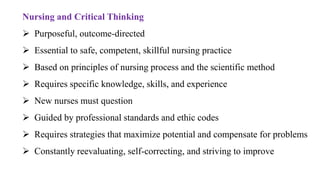
Nursing and Critical Thinking
 Purposeful, outcome-directed
 Essential to safe, competent, skillful nursing practice
 Based on principles of nursing process and the scientific method
 Requires specific knowledge, skills, and experience
 New nurses must question
 Guided by professional standards and ethic codes
 Requires strategies that maximize potential and compensate for problems
 Constantly reevaluating, self-correcting, and striving to improve
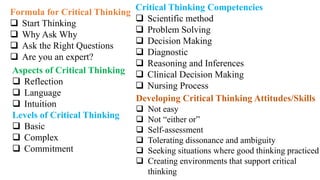
Formula for Critical Thinking
 Start Thinking
 Why Ask Why
 Ask the Right Questions
 Are you an expert?
Aspects of Critical Thinking
 Reflection
 Language
 Intuition
Levels of Critical Thinking
 Basic
 Complex
 Commitment
Critical Thinking Competencies
 Scientific method
 Problem Solving
 Decision Making
 Diagnostic
 Reasoning and Inferences
 Clinical Decision Making
 Nursing Process
Developing Critical Thinking Attitudes/Skills
 Not easy
 Not “either or”
 Self-assessment
 Tolerating dissonance and ambiguity
 Seeking situations where good thinking practiced
 Creating environments that support critical
thinking
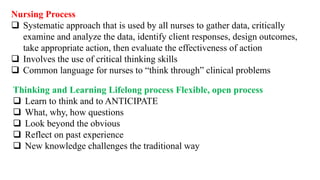
Nursing Process
 Systematic approach that is used by all nurses to gather data, critically
examine and analyze the data, identify client responses, design outcomes,
take appropriate action, then evaluate the effectiveness of action
 Involves the use of critical thinking skills
 Common language for nurses to “think through” clinical problems
Thinking and Learning Lifelong process Flexible, open process
 Learn to think and to ANTICIPATE
 What, why, how questions
 Look beyond the obvious
 Reflect on past experience
 New knowledge challenges the traditional way
Attitudes That Foster Critical Thinking
 Independence
 Fair-mindedness
 Insight into ethnocentricity
 Intellectual humility
 Intellectual courage to challenge status quo
 Integrity
 Perseverance
 Confidence
 Curiosity
Components Of Critical Thinking
 Scientific Knowledge Base
 Experience
 Competencies
 Attitudes
 Standards
When using the Nursing Process
 Identify health care needs
 Determine Priorities
 Establish goals & expected
outcomes
 Provide appropriate interventions
 Evaluate effectiveness
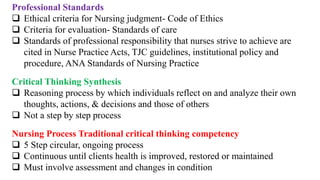
Professional Standards
 Ethical criteria for Nursing judgment- Code of Ethics
 Criteria for evaluation- Standards of care
 Standards of professional responsibility that nurses strive to achieve are
cited in Nurse Practice Acts, TJC guidelines, institutional policy and
procedure, ANA Standards of Nursing Practice
Critical Thinking Synthesis
 Reasoning process by which individuals reflect on and analyze their own
thoughts, actions, & decisions and those of others
 Not a step by step process
Nursing Process Traditional critical thinking competency
 5 Step circular, ongoing process
 Continuous until clients health is improved, restored or maintained
 Must involve assessment and changes in condition
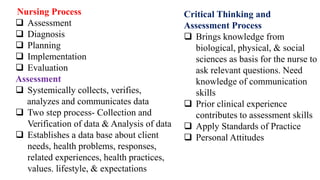
Nursing Process
 Assessment
 Diagnosis
 Planning
 Implementation
 Evaluation
Assessment
 Systemically collects, verifies,
analyzes and communicates data
 Two step process- Collection and
Verification of data & Analysis of data
 Establishes a data base about client
needs, health problems, responses,
related experiences, health practices,
values. lifestyle, & expectations
Critical Thinking and
Assessment Process
 Brings knowledge from
biological, physical, & social
sciences as basis for the nurse to
ask relevant questions. Need
knowledge of communication
skills
 Prior clinical experience
contributes to assessment skills
 Apply Standards of Practice
 Personal Attitudes
Nursing Diagnosis Process Relationship between the diagnostic statement
Assessment Data Subjective Data Objective Data Sources of Data
 Methods of Data Collection-Interview
 Interview initiates nurse-client relationship
 Use open-ended questions
 Nursing health history
Nursing Diagnosis
 Statement that describes the client’s actual or potential response to a
health problem
 Focuses on client-centered problems
 First introduced in the 1950’s
 NANDA established in 1982
 Step of the nursing process that allows nurse to individualize care
Planning for Nursing Care
 Client-centered goals and expected outcomes are established
 Priorities are set relating to unmet needs
 Maslow’s Hierarchy of Needs is a useful method for setting priorities
 Priorities are classifies as high, intermediate, or low
Purpose of Goals and Outcomes
 Provides direction for individualized nursing interventions
 Sets standards of determining the effectiveness of interventions
 Indicates anticipated client behavior or response to nursing care
 End point of nursing care
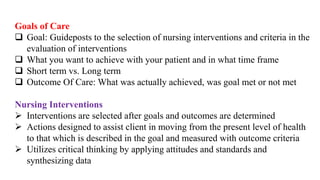
Goals of Care
 Goal: Guideposts to the selection of nursing interventions and criteria in the
evaluation of interventions
 What you want to achieve with your patient and in what time frame
 Short term vs. Long term
 Outcome Of Care: What was actually achieved, was goal met or not met
Nursing Interventions
 Interventions are selected after goals and outcomes are determined
 Actions designed to assist client in moving from the present level of health
to that which is described in the goal and measured with outcome criteria
 Utilizes critical thinking by applying attitudes and standards and
synthesizing data
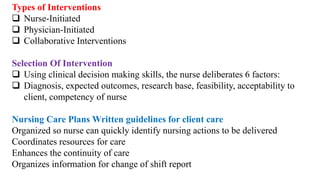
Types of Interventions
 Nurse-Initiated
 Physician-Initiated
 Collaborative Interventions
Selection Of Intervention
 Using clinical decision making skills, the nurse deliberates 6 factors:
 Diagnosis, expected outcomes, research base, feasibility, acceptability to
client, competency of nurse
Nursing Care Plans Written guidelines for client care
Organized so nurse can quickly identify nursing actions to be delivered
Coordinates resources for care
Enhances the continuity of care
Organizes information for change of shift report
Nursing Care Plans vs Concept Maps
Implementation of Nursing Interventions
Describes a category of nursing behaviors in which the actions necessary for
achieving the goals and outcomes are initiated and completed
Action taken by nurse
Types of Nursing Interventions
Standing Orders: Document containing orders for the use of routine therapies,
monitoring guidelines, and/or diagnostic procedure for specific condition
Protocols: Written plan specifying the procedures to be followed during care of
a client with a select clinical condition or situation (Pneumonia, MI, CVA)
Implementation Process involves:
Reassessing the client
Reviewing and revising the existing care plan
Organizing resources and care delivery (equipment, personnel, environment)
Evaluation
 Step of the nursing process that measures the client’s response to nursing
actions and the client’s progress toward achieving goals
 Data collected on an on-going basis
 Supports the basis of the usefulness and effectiveness of nursing practice
 Involves measurement of Quality of Care
Evaluation of Goal Achievement
 Measures and Sources: Assessment skills and techniques
 As goals are evaluated, adjustments of the care plan are made
 If the goal was met, that part of the care plan is discontinued
 Redefines priorities
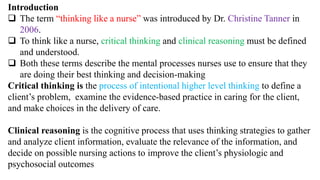
Introduction
 The term “thinking like a nurse” was introduced by Dr. Christine Tanner in
2006.
 To think like a nurse, critical thinking and clinical reasoning must be defined
and understood.
 Both these terms describe the mental processes nurses use to ensure that they
are doing their best thinking and decision-making
Critical thinking is the process of intentional higher level thinking to define a
client’s problem, examine the evidence-based practice in caring for the client,
and make choices in the delivery of care.
Clinical reasoning is the cognitive process that uses thinking strategies to gather
and analyze client information, evaluate the relevance of the information, and
decide on possible nursing actions to improve the client’s physiologic and
psychosocial outcomes
“Clinical reasoning comprises the set of reasoning strategies that permit us to
combine and synthesize diverse data into one or more diagnostic hypotheses,
make the complex trade-offs between the benefits and risks of tests and
treatments, and formulate plans for patient management” (Cooper & Frain,
2017, p. 1).
Alfaro-Le Fevre’s 4-Circle Critical
Thinking Model provides a visual
representation of critical thinking
abilities and promotes making
meaningful connections between nursing
research and critical thinking and
practice
critical thinking presentation in nursing

critical thinking presentation in nursing

  • 1.
    Critical Thinking andNursing Judgment  How do we make decisions?  How do nurses make decisions about patient care?  What do we rely on to help us in decision making?  Not a linear step by step process  Process acquired through hard work, commitment, and an active curiosity toward learning  Decision making is the skill that separates the professional nurse from technical or ancillary staff
  • 2.
     Good problemsolving skills  Not always a clear textbook answer  Nurse must learn to question, look at alternatives How do nurse's accomplish this?  Learns to be flexible in clinical decision making  Reflect on past experiences and previous knowledge  Listen to others point of view  Identify the nature of the problem  Select the best solution for improving client’s health
  • 3.
    Definition of CriticalThinking Cognitive process during which an individual reviews data and considers potential explanations and outcomes before forming an opinion or making a decision “Critical thinking in nursing practice is a discipline specific, reflective reasoning process that guides the nurse in generating, implementing, and evaluating approaches for dealing with client care and professional concerns.” NLN 2000
  • 4.
    Nursing and CriticalThinking  Purposeful, outcome-directed  Essential to safe, competent, skillful nursing practice  Based on principles of nursing process and the scientific method  Requires specific knowledge, skills, and experience  New nurses must question  Guided by professional standards and ethic codes  Requires strategies that maximize potential and compensate for problems  Constantly reevaluating, self-correcting, and striving to improve
  • 5.
    Formula for CriticalThinking  Start Thinking  Why Ask Why  Ask the Right Questions  Are you an expert? Aspects of Critical Thinking  Reflection  Language  Intuition Levels of Critical Thinking  Basic  Complex  Commitment Critical Thinking Competencies  Scientific method  Problem Solving  Decision Making  Diagnostic  Reasoning and Inferences  Clinical Decision Making  Nursing Process Developing Critical Thinking Attitudes/Skills  Not easy  Not “either or”  Self-assessment  Tolerating dissonance and ambiguity  Seeking situations where good thinking practiced  Creating environments that support critical thinking
  • 6.
    Nursing Process  Systematicapproach that is used by all nurses to gather data, critically examine and analyze the data, identify client responses, design outcomes, take appropriate action, then evaluate the effectiveness of action  Involves the use of critical thinking skills  Common language for nurses to “think through” clinical problems Thinking and Learning Lifelong process Flexible, open process  Learn to think and to ANTICIPATE  What, why, how questions  Look beyond the obvious  Reflect on past experience  New knowledge challenges the traditional way
  • 7.
    Attitudes That FosterCritical Thinking  Independence  Fair-mindedness  Insight into ethnocentricity  Intellectual humility  Intellectual courage to challenge status quo  Integrity  Perseverance  Confidence  Curiosity Components Of Critical Thinking  Scientific Knowledge Base  Experience  Competencies  Attitudes  Standards When using the Nursing Process  Identify health care needs  Determine Priorities  Establish goals & expected outcomes  Provide appropriate interventions  Evaluate effectiveness
  • 8.
    Professional Standards  Ethicalcriteria for Nursing judgment- Code of Ethics  Criteria for evaluation- Standards of care  Standards of professional responsibility that nurses strive to achieve are cited in Nurse Practice Acts, TJC guidelines, institutional policy and procedure, ANA Standards of Nursing Practice Critical Thinking Synthesis  Reasoning process by which individuals reflect on and analyze their own thoughts, actions, & decisions and those of others  Not a step by step process Nursing Process Traditional critical thinking competency  5 Step circular, ongoing process  Continuous until clients health is improved, restored or maintained  Must involve assessment and changes in condition
  • 9.
    Nursing Process  Assessment Diagnosis  Planning  Implementation  Evaluation Assessment  Systemically collects, verifies, analyzes and communicates data  Two step process- Collection and Verification of data & Analysis of data  Establishes a data base about client needs, health problems, responses, related experiences, health practices, values. lifestyle, & expectations Critical Thinking and Assessment Process  Brings knowledge from biological, physical, & social sciences as basis for the nurse to ask relevant questions. Need knowledge of communication skills  Prior clinical experience contributes to assessment skills  Apply Standards of Practice  Personal Attitudes
  • 11.
    Nursing Diagnosis ProcessRelationship between the diagnostic statement
  • 13.
    Assessment Data SubjectiveData Objective Data Sources of Data  Methods of Data Collection-Interview  Interview initiates nurse-client relationship  Use open-ended questions  Nursing health history Nursing Diagnosis  Statement that describes the client’s actual or potential response to a health problem  Focuses on client-centered problems  First introduced in the 1950’s  NANDA established in 1982  Step of the nursing process that allows nurse to individualize care
  • 14.
    Planning for NursingCare  Client-centered goals and expected outcomes are established  Priorities are set relating to unmet needs  Maslow’s Hierarchy of Needs is a useful method for setting priorities  Priorities are classifies as high, intermediate, or low Purpose of Goals and Outcomes  Provides direction for individualized nursing interventions  Sets standards of determining the effectiveness of interventions  Indicates anticipated client behavior or response to nursing care  End point of nursing care
  • 15.
    Goals of Care Goal: Guideposts to the selection of nursing interventions and criteria in the evaluation of interventions  What you want to achieve with your patient and in what time frame  Short term vs. Long term  Outcome Of Care: What was actually achieved, was goal met or not met Nursing Interventions  Interventions are selected after goals and outcomes are determined  Actions designed to assist client in moving from the present level of health to that which is described in the goal and measured with outcome criteria  Utilizes critical thinking by applying attitudes and standards and synthesizing data
  • 16.
    Types of Interventions Nurse-Initiated  Physician-Initiated  Collaborative Interventions Selection Of Intervention  Using clinical decision making skills, the nurse deliberates 6 factors:  Diagnosis, expected outcomes, research base, feasibility, acceptability to client, competency of nurse Nursing Care Plans Written guidelines for client care Organized so nurse can quickly identify nursing actions to be delivered Coordinates resources for care Enhances the continuity of care Organizes information for change of shift report
  • 17.
    Nursing Care Plansvs Concept Maps
  • 19.
    Implementation of NursingInterventions Describes a category of nursing behaviors in which the actions necessary for achieving the goals and outcomes are initiated and completed Action taken by nurse Types of Nursing Interventions Standing Orders: Document containing orders for the use of routine therapies, monitoring guidelines, and/or diagnostic procedure for specific condition Protocols: Written plan specifying the procedures to be followed during care of a client with a select clinical condition or situation (Pneumonia, MI, CVA) Implementation Process involves: Reassessing the client Reviewing and revising the existing care plan Organizing resources and care delivery (equipment, personnel, environment)
  • 20.
    Evaluation  Step ofthe nursing process that measures the client’s response to nursing actions and the client’s progress toward achieving goals  Data collected on an on-going basis  Supports the basis of the usefulness and effectiveness of nursing practice  Involves measurement of Quality of Care Evaluation of Goal Achievement  Measures and Sources: Assessment skills and techniques  As goals are evaluated, adjustments of the care plan are made  If the goal was met, that part of the care plan is discontinued  Redefines priorities
  • 21.
    Introduction  The term“thinking like a nurse” was introduced by Dr. Christine Tanner in 2006.  To think like a nurse, critical thinking and clinical reasoning must be defined and understood.  Both these terms describe the mental processes nurses use to ensure that they are doing their best thinking and decision-making Critical thinking is the process of intentional higher level thinking to define a client’s problem, examine the evidence-based practice in caring for the client, and make choices in the delivery of care. Clinical reasoning is the cognitive process that uses thinking strategies to gather and analyze client information, evaluate the relevance of the information, and decide on possible nursing actions to improve the client’s physiologic and psychosocial outcomes
  • 22.
    “Clinical reasoning comprisesthe set of reasoning strategies that permit us to combine and synthesize diverse data into one or more diagnostic hypotheses, make the complex trade-offs between the benefits and risks of tests and treatments, and formulate plans for patient management” (Cooper & Frain, 2017, p. 1). Alfaro-Le Fevre’s 4-Circle Critical Thinking Model provides a visual representation of critical thinking abilities and promotes making meaningful connections between nursing research and critical thinking and practice