PROFESSIONAL
NURSING CONCEPTS
AND PRACTICES
-JOMILY JOYSON
LECTURER-OBSTETRICS AND GYNECOLOGY
INTRODUCTION
• Nursing is a intensive course and designed to introduce care concept
related to Nursing.
• Professional nursing concept is a philosophy and conceptual framework of
the nursing. In making decisions about their individual scope of practice;
nurses should keep to the fore the rights, needs and overall benefit to the
patient and the importance of promoting and maintaining the highest
standards of quality in the health services.
NURSING:A PROFESSION
• Nursing is a profession within the health care sector focused on the care of
individuals, families, and communities so they may attain, maintain, or
recover optimal health and quality of life.
• The course of this course is to introduce student to critically think about
nursing profession historical and theoretical framework moral and legal
issues and standard of nursing practice.
DEFINE : PROFESSIONAL NURSING CONCEPT
• According to Parul Dutta : “Professional Nursing concept is a Nursing
encompasses autonomous and collaborative care of individuals of all ages,
families, groups and communities, sick or well and in all settings. Nursing
includes the promotion of health, prevention of illness, and the care of ill,
disabled and dying people. Advocacy, promotion of a safe environment,
research, participation in shaping health policy and in patient and health
systems management, and education are also key nursing roles.”
DEFINE : PROFESSIONAL NURSING PRACTICE
• According to K.P. Neerja: The professional nursing practice is a Nursing,
as an integral part of the health care system, encompasses the promotion of
health, prevention of illness, and care of physically ill, mentally ill, and
disabled people of all ages, in all health care and other community settings.
NURSING CONCEPT
• “Health” as a fundamental nursing concept involves both mental and
physiological well being, and it changes over a patient's lifetime.
• Nurses work in health care to promote and protect health by instructing
patients about self-care, and about how lifestyle and behavior affects their
health.
NURSING PRACTICE
The American Nurses Association (ANA) provides leadership in determining the goals,
objectives, and professional practice of nursing. ANA defines nursing as " … a caring-
based practice in which processes of diagnosis and treatment are applied to human
experiences of health and illness" (ANA, 1994).
ANA describes three basic nursing activities that explicitly include issues related to the
environment and health, a preventive approach to health, and concern for populations
as well as individuals:
1.Restorative practices modify the impact of illness and disease.
2.Supportive practices are oriented toward modification of relationships or the
environment to support health.
3.Promotive practices mobilize healthy patterns of living, foster personal and familial
development, and support self-defined goals of individuals, families, and communities.
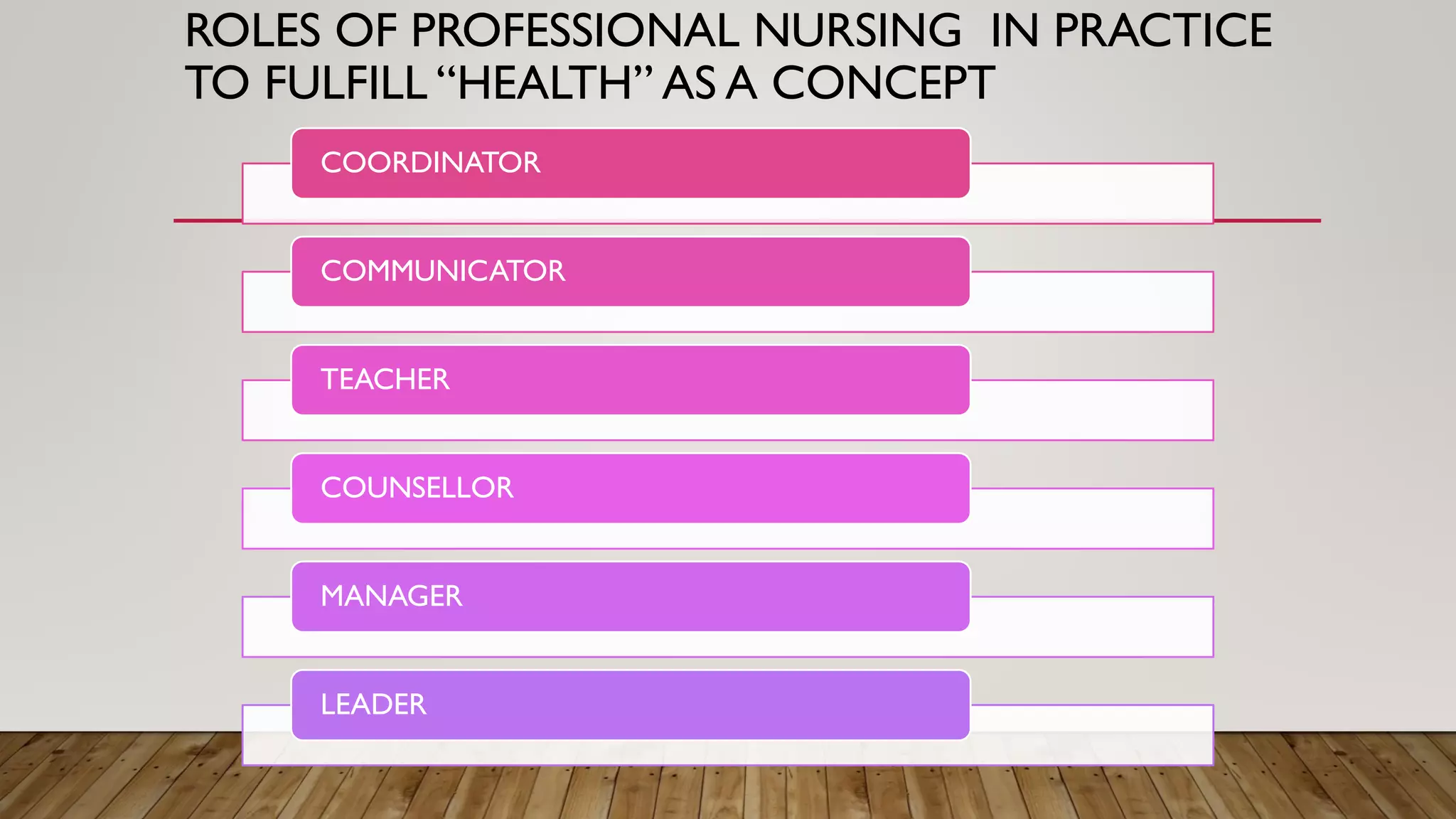
ROLES OF PROFESSIONAL NURSING IN PRACTICE
TO FULFILL “HEALTH” AS A CONCEPT
COORDINATOR
COMMUNICATOR
TEACHER
COUNSELLOR
MANAGER
LEADER
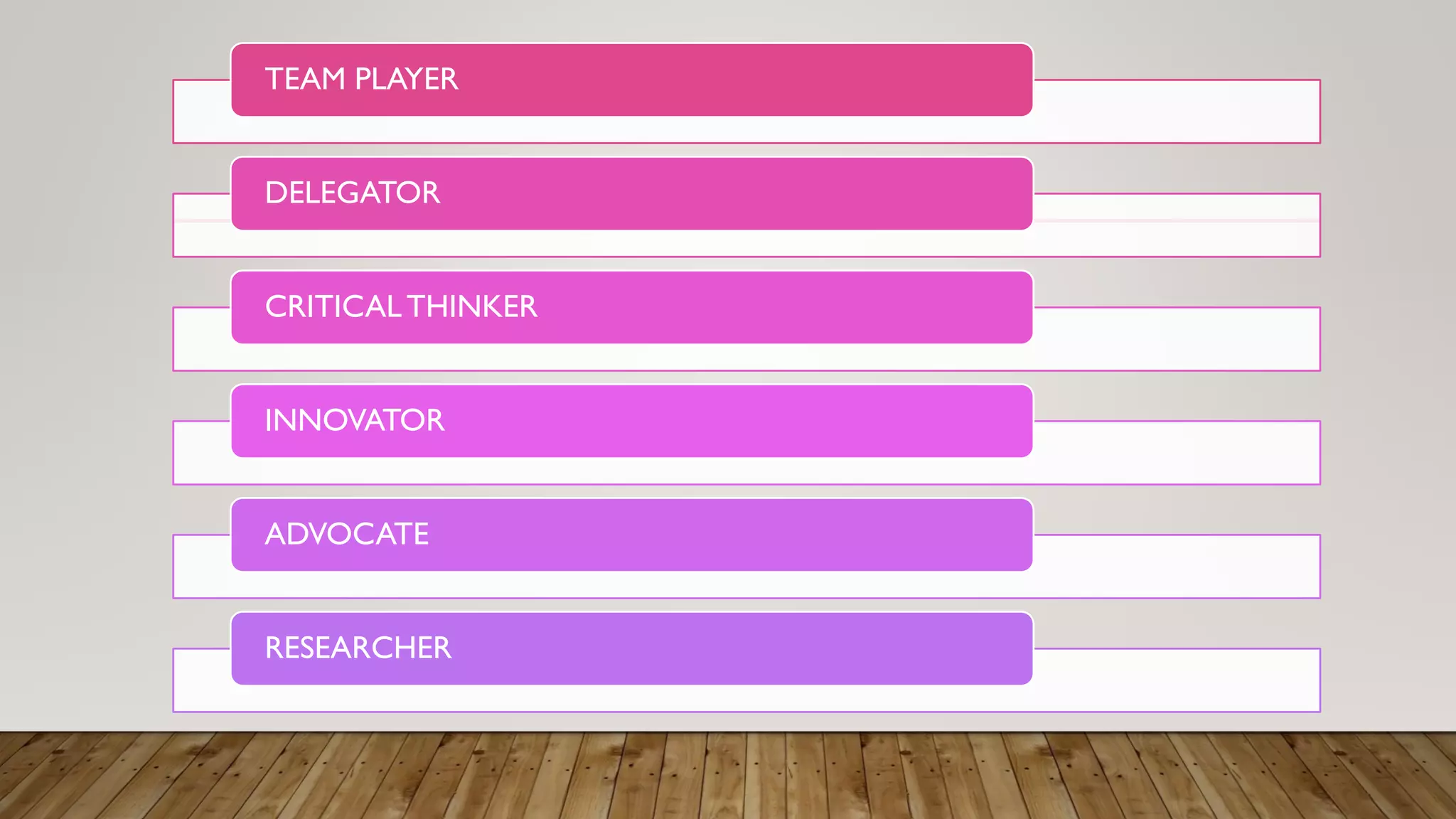
TEAM PLAYER
DELEGATOR
CRITICALTHINKER
INNOVATOR
ADVOCATE
RESEARCHER
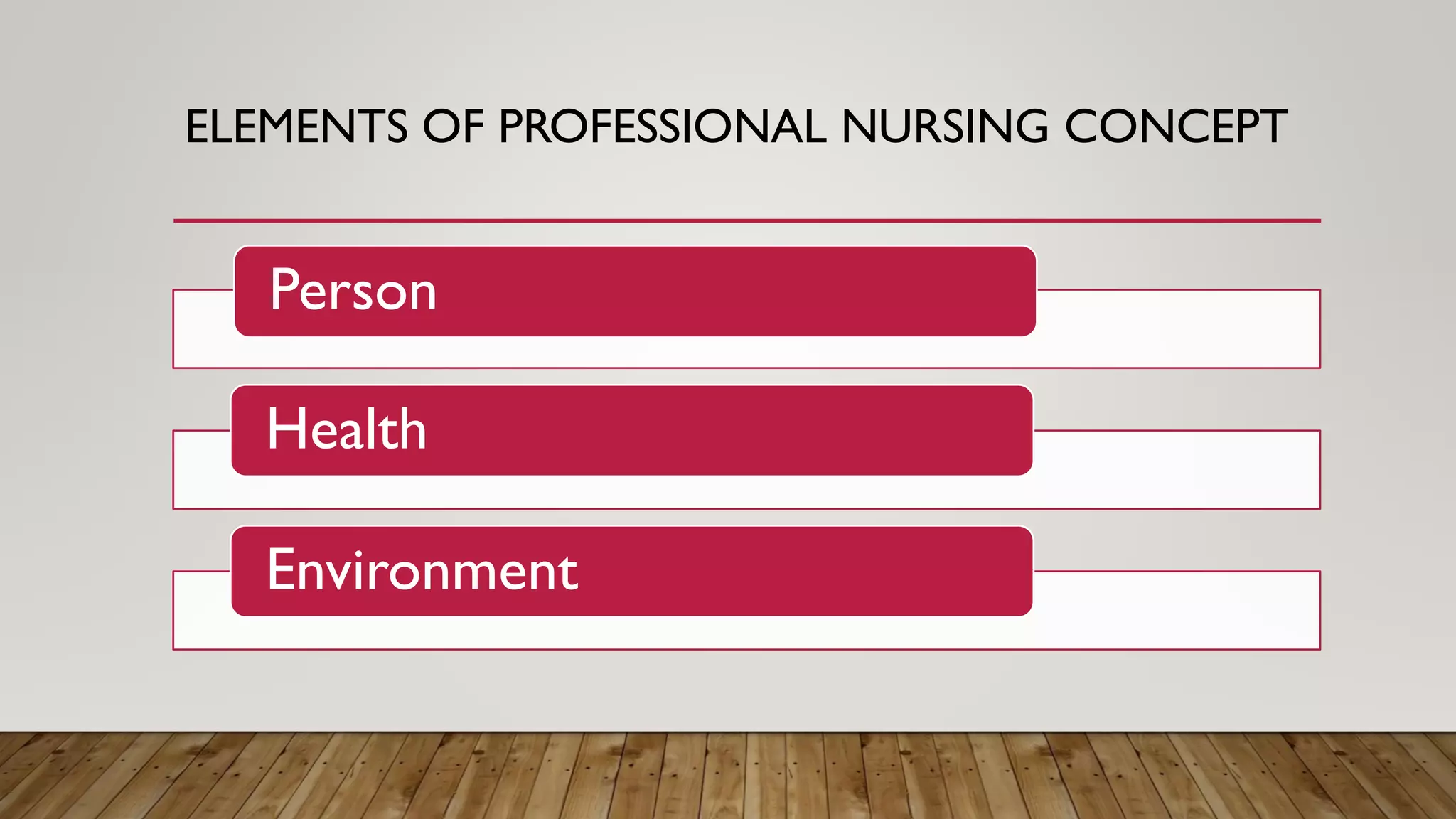
ELEMENTS OF PROFESSIONAL NURSING CONCEPT
Person
Health
Environment
PERSON:
The first basic concept is that of the human being, or that each person
comprises several different aspects to create a whole. This includes
psychological, social, physical and spiritual areas of a person's life. It also
includes cultural aspects that might be important to the patient.
Understanding how a patient is more than just the medical condition that
brought him into the hospital is essential to his care.
HEALTH
• The second concept is health. Nurses need to be continuously aware of the health
of their patients. Nurses usually focus first on the patient's main health complaint,
but they also must pay attention to any other possible symptoms, and the overall
wellness of the patient. For example, an older woman who is seeking treatment
for a heart condition might also be having problems with medication side effects.
She might also be worried about her health in general, and need reassurance. A
nurse would make note of the secondary health concerns, and try to reassure the
patient, as well as letting the doctor know of the patient's concerns.
ENVIRONMENT
• A patient's environment, which includes where they spend their time and their socio-
economic status, as well as the people within their environment.
• One of the most influential aspects of environment is the health care a person has access
to. For example, the health of someone who has had regular access to quality health care
has a better chance of catching serious conditions, such as cancer, in the very early stages,
giving them a better chance of recovery.An individual who does not have this access to
health care might have the same problems, but might not catch it as early, resulting in a
less optimistic prognosis.
• Environment also includes the social support a patient receives and the environment of
the hospital, which is partially controlled by nurses.A comfortable environment and
proper care can influence the speed of a patient's recovery.
MODELS OF PROFESSIONAL NURSING CONCEPT
AND PRACTICE
• What is a Model: It is theoretical way of understanding a concept or
idea.
• Model represents different way of approaching complex issues
• Nurses developed various health models to provide effective health
care
• Nursing models allows the nurses to understand and predict patient
behavior
DIFFERENT MODELS
Health Illness continuum model
Health Belief Model
Health promotion model
Maslow hierarchy of needs
Holistic health model
HEALTH ILLNESS CONTINUUM MODEL
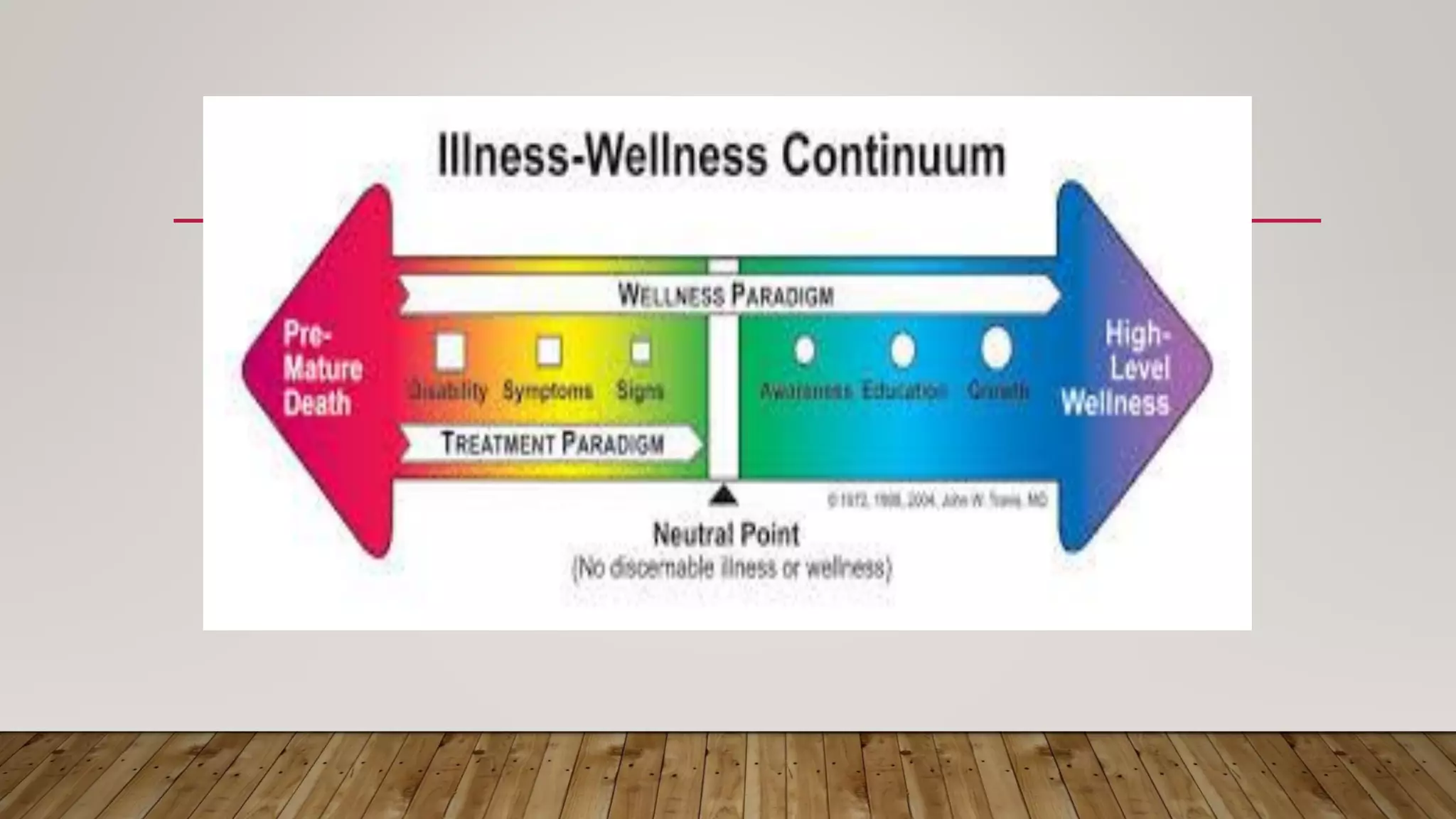
• The Illness-Wellness Continuum is a graphical illustration of a wellbeing concept first
proposed by Dr.Travis in 1972.It proposes that wellbeing includes mental and emotional
health, as well as the presence or absence of illness.
• Travis believed that the standard approach to medicines , which assumes a person is well
when there are no signs or symptoms of disease ,was insufficient.
• Composed of two arrows pointing in opposite direction and joined at a neutral point.
• Movement to the right to the arrows (toward the high level of wellness) equals an
increase in level of health and wellbeing Achieved in three steps :
1. Awareness
2. Education
3. Growth
• Movement to the left to the arrows (towards premature death) equates a progressively
decreasing state of health.Achieved in three steps:
1.Signs
2. Symptoms
3. Disability
HEALTH BELIEF MODEL
• The health belief model (HBM) is a social psychological health behavior
change model developed to explain and predict health-related behaviors,
particularly in regard to the uptake of health services.
• The HBM was developed in the 1950s by social psychologists at U.S public
health sector and remains one of the best known and most widely used theories in
health behavior research.
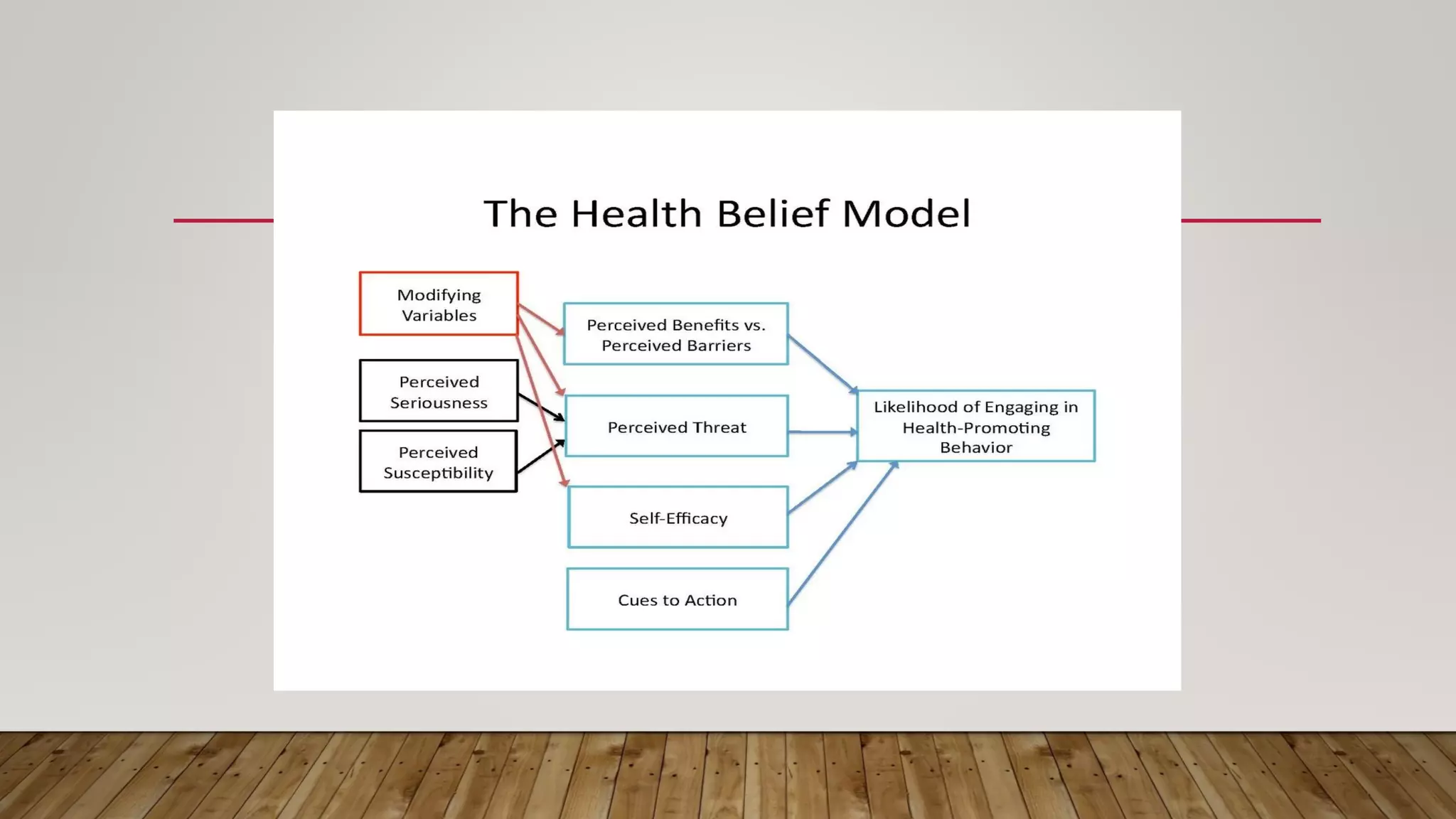
• The HBM suggests that people's beliefs about health problems, perceived benefits
of action and barriers to action, and self-efficacy explain engagement (or lack of
engagement) in health-promoting behavior.A stimulus or cue to action, must also
be present in order to trigger the health-promoting behavior.
HEALTH PROMOTION MODEL
• The health promotion model (HPM) proposed by Nola J Pender (1982; revised, 1996)
was designed to be a “complementary counterpart to models of health protection.”
• It defines health as a positive dynamic state not merely the absence of disease. Health
promotion is directed at increasing a client’s level of well being.
• The health promotion model describes the multi dimensional nature of persons as they
interact within their environment to pursue health.
• The model focuses on following three areas:
1. Individual characteristics and experiences
2. Behavior-specific cognitions and affect
3. Behavioral outcomes
• The health promotion model notes that each person has unique personal characteristics
and experiences that affect subsequent actions. The set of variables for behavioral specific
knowledge and affect have important motivational significance. These variables can be
modified through nursing actions. Health promoting behavior is the desired behavioral
outcome and is the end point in the HPM. Health promoting behaviors should result in
improved health, enhanced functional ability and better quality of life at all stages of
development. The final behavioral demand is also influenced by the immediate competing
demand and preferences, which can derail an intended health promoting actions.
MASLOW HIERARCHY OF NEEDS
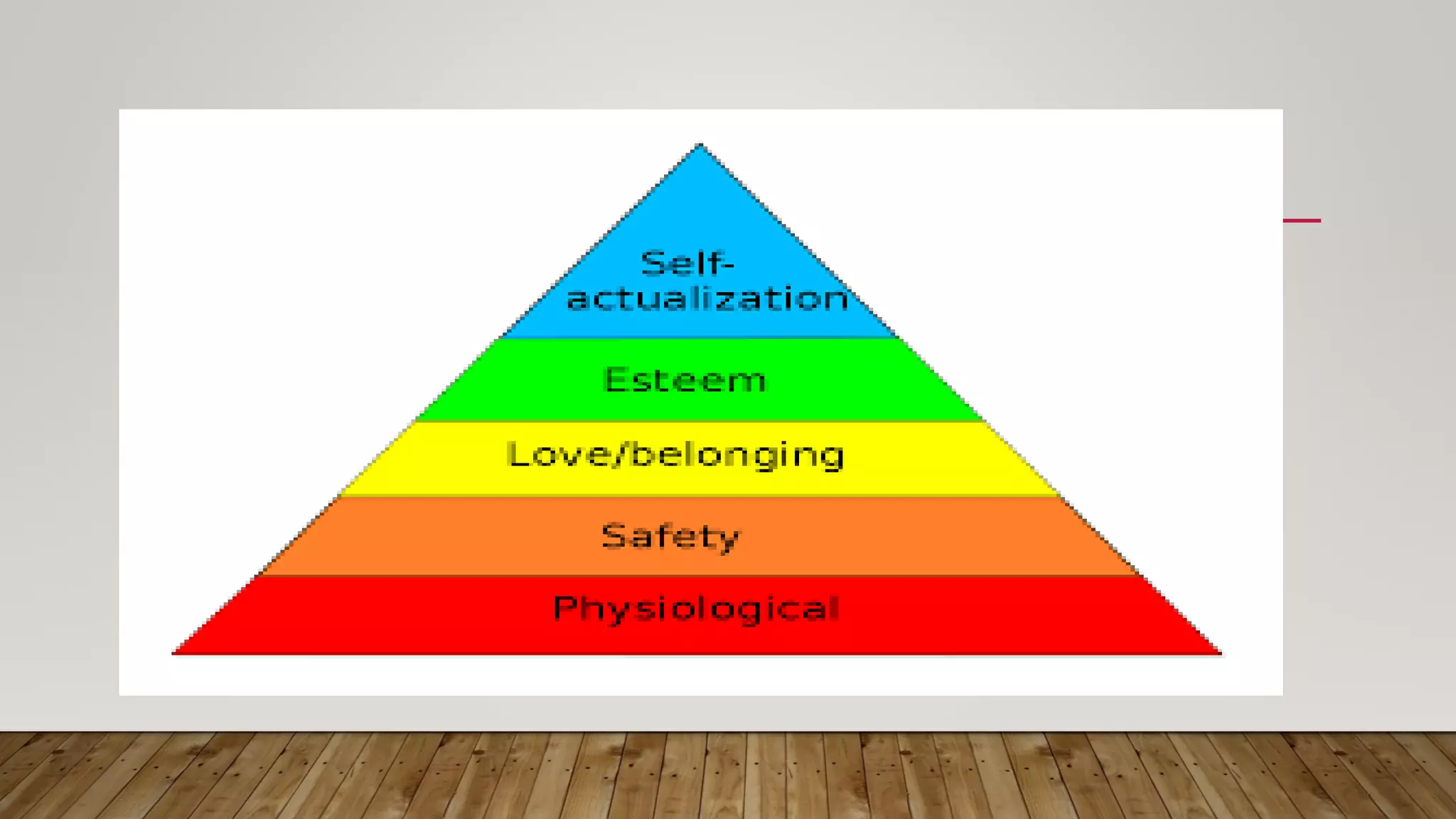
• Maslow's hierarchy of needs is a theory by Abraham Maslow which puts forward
that people are motivated by five basic categories of needs:
• 1. physiological
• 2. safety,
• 3. love
• 4. esteem
• 5. self-actualization.
HOLISTIC HEALTH MODEL
• The American Holistic Health Association (AHHA) describes it this way: "Rather than
focusing on illness or specific parts of the body, this ancient approach
to health considers the whole person and how he or she interacts with his or her
environment.
• It emphasizes the connection of mind, body, and spirit.
• The 5 Aspects Of Holistic Health: physical, emotional, social, spiritual, and Mental.
When it comes to holistic health we are looking beyond the physical body and are
addressing physical, emotional, social, spiritual, and intellectual health.
THEORIES OF PROFESSIONAL NURSING CONCEPT
AND PRACTICE

Professional nursing concepts and practice fon

  • 1.
    PROFESSIONAL NURSING CONCEPTS AND PRACTICES -JOMILYJOYSON LECTURER-OBSTETRICS AND GYNECOLOGY
  • 2.
    INTRODUCTION • Nursing isa intensive course and designed to introduce care concept related to Nursing. • Professional nursing concept is a philosophy and conceptual framework of the nursing. In making decisions about their individual scope of practice; nurses should keep to the fore the rights, needs and overall benefit to the patient and the importance of promoting and maintaining the highest standards of quality in the health services.
  • 3.
    NURSING:A PROFESSION • Nursingis a profession within the health care sector focused on the care of individuals, families, and communities so they may attain, maintain, or recover optimal health and quality of life. • The course of this course is to introduce student to critically think about nursing profession historical and theoretical framework moral and legal issues and standard of nursing practice.
  • 4.
    DEFINE : PROFESSIONALNURSING CONCEPT • According to Parul Dutta : “Professional Nursing concept is a Nursing encompasses autonomous and collaborative care of individuals of all ages, families, groups and communities, sick or well and in all settings. Nursing includes the promotion of health, prevention of illness, and the care of ill, disabled and dying people. Advocacy, promotion of a safe environment, research, participation in shaping health policy and in patient and health systems management, and education are also key nursing roles.”
  • 5.
    DEFINE : PROFESSIONALNURSING PRACTICE • According to K.P. Neerja: The professional nursing practice is a Nursing, as an integral part of the health care system, encompasses the promotion of health, prevention of illness, and care of physically ill, mentally ill, and disabled people of all ages, in all health care and other community settings.
  • 6.
    NURSING CONCEPT • “Health”as a fundamental nursing concept involves both mental and physiological well being, and it changes over a patient's lifetime. • Nurses work in health care to promote and protect health by instructing patients about self-care, and about how lifestyle and behavior affects their health.
  • 7.
    NURSING PRACTICE The AmericanNurses Association (ANA) provides leadership in determining the goals, objectives, and professional practice of nursing. ANA defines nursing as " … a caring- based practice in which processes of diagnosis and treatment are applied to human experiences of health and illness" (ANA, 1994). ANA describes three basic nursing activities that explicitly include issues related to the environment and health, a preventive approach to health, and concern for populations as well as individuals: 1.Restorative practices modify the impact of illness and disease. 2.Supportive practices are oriented toward modification of relationships or the environment to support health. 3.Promotive practices mobilize healthy patterns of living, foster personal and familial development, and support self-defined goals of individuals, families, and communities.
  • 8.
    ROLES OF PROFESSIONALNURSING IN PRACTICE TO FULFILL “HEALTH” AS A CONCEPT COORDINATOR COMMUNICATOR TEACHER COUNSELLOR MANAGER LEADER
  • 9.
  • 10.
    ELEMENTS OF PROFESSIONALNURSING CONCEPT Person Health Environment
  • 11.
    PERSON: The first basicconcept is that of the human being, or that each person comprises several different aspects to create a whole. This includes psychological, social, physical and spiritual areas of a person's life. It also includes cultural aspects that might be important to the patient. Understanding how a patient is more than just the medical condition that brought him into the hospital is essential to his care.
  • 12.
    HEALTH • The secondconcept is health. Nurses need to be continuously aware of the health of their patients. Nurses usually focus first on the patient's main health complaint, but they also must pay attention to any other possible symptoms, and the overall wellness of the patient. For example, an older woman who is seeking treatment for a heart condition might also be having problems with medication side effects. She might also be worried about her health in general, and need reassurance. A nurse would make note of the secondary health concerns, and try to reassure the patient, as well as letting the doctor know of the patient's concerns.
  • 13.
    ENVIRONMENT • A patient'senvironment, which includes where they spend their time and their socio- economic status, as well as the people within their environment. • One of the most influential aspects of environment is the health care a person has access to. For example, the health of someone who has had regular access to quality health care has a better chance of catching serious conditions, such as cancer, in the very early stages, giving them a better chance of recovery.An individual who does not have this access to health care might have the same problems, but might not catch it as early, resulting in a less optimistic prognosis. • Environment also includes the social support a patient receives and the environment of the hospital, which is partially controlled by nurses.A comfortable environment and proper care can influence the speed of a patient's recovery.
  • 14.
    MODELS OF PROFESSIONALNURSING CONCEPT AND PRACTICE • What is a Model: It is theoretical way of understanding a concept or idea. • Model represents different way of approaching complex issues • Nurses developed various health models to provide effective health care • Nursing models allows the nurses to understand and predict patient behavior
  • 15.
    DIFFERENT MODELS Health Illnesscontinuum model Health Belief Model Health promotion model Maslow hierarchy of needs Holistic health model
  • 16.
    HEALTH ILLNESS CONTINUUMMODEL • The Illness-Wellness Continuum is a graphical illustration of a wellbeing concept first proposed by Dr.Travis in 1972.It proposes that wellbeing includes mental and emotional health, as well as the presence or absence of illness. • Travis believed that the standard approach to medicines , which assumes a person is well when there are no signs or symptoms of disease ,was insufficient.
  • 18.
    • Composed oftwo arrows pointing in opposite direction and joined at a neutral point. • Movement to the right to the arrows (toward the high level of wellness) equals an increase in level of health and wellbeing Achieved in three steps : 1. Awareness 2. Education 3. Growth • Movement to the left to the arrows (towards premature death) equates a progressively decreasing state of health.Achieved in three steps: 1.Signs 2. Symptoms 3. Disability
  • 19.
    HEALTH BELIEF MODEL •The health belief model (HBM) is a social psychological health behavior change model developed to explain and predict health-related behaviors, particularly in regard to the uptake of health services. • The HBM was developed in the 1950s by social psychologists at U.S public health sector and remains one of the best known and most widely used theories in health behavior research. • The HBM suggests that people's beliefs about health problems, perceived benefits of action and barriers to action, and self-efficacy explain engagement (or lack of engagement) in health-promoting behavior.A stimulus or cue to action, must also be present in order to trigger the health-promoting behavior.
  • 21.
    HEALTH PROMOTION MODEL •The health promotion model (HPM) proposed by Nola J Pender (1982; revised, 1996) was designed to be a “complementary counterpart to models of health protection.” • It defines health as a positive dynamic state not merely the absence of disease. Health promotion is directed at increasing a client’s level of well being. • The health promotion model describes the multi dimensional nature of persons as they interact within their environment to pursue health.
  • 22.
    • The modelfocuses on following three areas: 1. Individual characteristics and experiences 2. Behavior-specific cognitions and affect 3. Behavioral outcomes • The health promotion model notes that each person has unique personal characteristics and experiences that affect subsequent actions. The set of variables for behavioral specific knowledge and affect have important motivational significance. These variables can be modified through nursing actions. Health promoting behavior is the desired behavioral outcome and is the end point in the HPM. Health promoting behaviors should result in improved health, enhanced functional ability and better quality of life at all stages of development. The final behavioral demand is also influenced by the immediate competing demand and preferences, which can derail an intended health promoting actions.
  • 23.
    MASLOW HIERARCHY OFNEEDS • Maslow's hierarchy of needs is a theory by Abraham Maslow which puts forward that people are motivated by five basic categories of needs: • 1. physiological • 2. safety, • 3. love • 4. esteem • 5. self-actualization.
  • 25.
    HOLISTIC HEALTH MODEL •The American Holistic Health Association (AHHA) describes it this way: "Rather than focusing on illness or specific parts of the body, this ancient approach to health considers the whole person and how he or she interacts with his or her environment. • It emphasizes the connection of mind, body, and spirit. • The 5 Aspects Of Holistic Health: physical, emotional, social, spiritual, and Mental. When it comes to holistic health we are looking beyond the physical body and are addressing physical, emotional, social, spiritual, and intellectual health.
  • 27.
    THEORIES OF PROFESSIONALNURSING CONCEPT AND PRACTICE