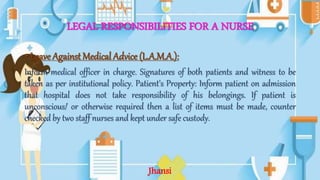
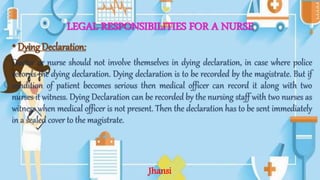
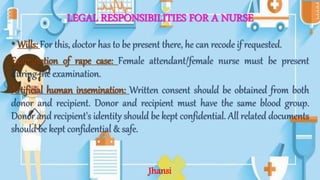
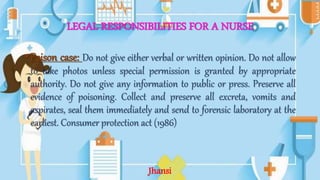
Jhansi
Jhansi
NURSING AS A
PROFESSION
BY JHANSI
Jhansi
INTRODUCTION
• Nursing has been called the oldest of the arts and the youngest of the professions. The
term ‘Nurse’ evolve from the Latin word nutrix, which means to nourish or to cherish.
• Today nursing emerged as a learned profession, that is both a science and an art.
• It is a body of knowledge. Knowledge is an awareness or perception of reality, which is
acquired through learning or investigation.
• Science is defined as both a unified body of knowledge concerned with specific subject
matter, the skills and methodology necessary to provide such knowledge.
Jhansi
•Nursing as an art is the application of knowledge and skill to
bring about desired results. It is an individual action. Nursing
art is carried out by the nurse in an one-to-one relationship with
the patient and constitutes the nurse’s conscious responses to a
specific and patient’s immediate situation.
Jhansi
INTRODUCTION
DEFINITIONS
Profession: A type of occupation that meets certain criteria that raise
it to a level above that of an occupation.
Profession: is a calling that requires special knowledge, skill and
preparation.
•An occupation that requires advanced knowledge and skills and that it
grows out of society’s needs for special services.
Jhansi
Professional: A person who belongs to and practices a profession
Professionlism: Demonstration of high level of personal, ethical
and high level of skill characteristics for a member of a profession.
Jhansi
DIFFERENCE BETWEEN OCCUPATION
& PROFESSION
– According to Webster…..
Occupation: is defined as what occupies or engages, one’s time,
business and employment.
Profession: is defined as a vocation requiring advanced training and
usually involving mental rather than manual work, as teaching,
engineering, especially medicine, law etc.
Jhansi
Jhansi
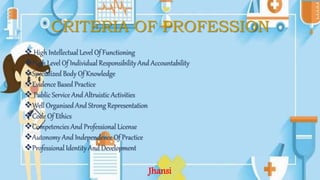
CRITERIA OF PROFESSION
 High Intellectual Level Of Functioning
High Level Of Individual Responsibility And Accountability
Specialized Body Of Knowledge
Evidence Based Practice
 Public Service And Altruistic Activities
Well Organised And Strong Representation
Code Of Ethics
Competencies And Professional License
Autonomy And Independence Of Practice
Professional Identity And Development
Jhansi
o High Intellectual Level Of Functioning:
Modern nurses use assessment skill and knowledge, have the ability to
reason and make routine judgment depending on patient’s condition.
Professional nurses functions at a high intellectual level. Florence
nightingale raised the bar for education and graduates of her school were
considered to be highly educated.
Jhansi
o High Level Of Individual Responsibility And Accountability
Nurses must be accountable and demonstrate a high level of individual
responsibility for the care and services they provide. The concept of
accountability has legal, ethical and professional implications that
include accepting responsibility for action taken to provide client care as
well as accepting responsibility for the consequences of action that are not
performed.
Jhansi
o Specialized Body Of Knowledge
Nursing has developed into an identifiable separate discipline, a specialized body
of knowledge called as nursing science. It was compiled through the research effort
of nurses with advanced educational degrees. Although this body of specialized
knowledge is relatively small, it forms a theoretical basis for the practice of nursing
today. As more nurses obtain advanced degrees, conduct research and develop
philosophies, and theories about nursing, this body of knowledge will increase in
scope.
Jhansi
o Evidence Based Practice:
• Almost all the currently used nursing theories address this issue in some way.
Evidenced based practice is the practice of nursing in which interventions are
based on data obtained from research that demonstrate that, the findings are
appropriate and successful. It involves a systematic process of uncovering,
evaluating and using information from research as the basis for making
decisions about providing client care.
Jhansi
o Public Service And Altruistic Activities
Individual is the focal point of all nursing models and nursing practice.
Nursing has been viewed universally as being an altruistic profession
composed of selfless individuals who place the lives and well being of their
clients above their personal safety. Dedicated nurses provide care for
victims of deadly diseases with little regard for their own welfare.
Jhansi
o Well Organised And Strong Representation
:Professional organizations represent the members of the profession and
control the quality of professional practice. In India TNAI & SNA are the
two organizations that represent nursing in today’s health care system.
Many do belong to specialty organizations that represent a specific area of
practice.
Jhansi
o Code Of Ethics
A code of ethics document may outline the mission and values of the
business or organization, how professionals are supposed to approach
problems, the ethical principles based on the organization's core values
and the standards to which the professional is held. Some of the ethical
principles are autonomy, justice, non-maleficence
Jhansi
o Competencies And Professional License
Nurses must pass a national licensure examination to demonstrate that
they are qualified to practice nursing. Only after passing the examination
the nurses are allowed to practice. The granting of a nursing license is a
legal activity conducted by the individual state under the regulations
contained in the state’s nursing practice act.
Jhansi
o Autonomy And Independence Of Practice
• : In reality nursing is both an independent and interdependent discipline.
Nurses in all health care setting must work with physicians, hospital
administrators, pharmacists and other groups in the provision of care. In some
cases nurses in advanced practice role eg. Nurse practitioners can do establish
their independent practices. To be considered a true profession, nursing will
need to be recognised by other disciplines as having practitioners who practice
nursing independently.
Jhansi
o Professional Identity And Development
Until nurses are fully committed to the profession of nursing,
identify with it as a profession and are dedicated to its future
development, nursing will probably not achieve professional
status.
Jhansi
Jhansi
CHARACTERISTICS OF A PROFESSION
A basic profession requires an extended education of its members, as
well as a basic liberal foundation.
 A profession has a theoretical body of knowledge leading to defined
skills, abilities and norms.
A profession provides a specific service.
Members of a profession have autonomy in decision-making and
practice.
The profession has a code of ethics for practice.
Jhansi
Jhansi
Definitions of Nursing
The unique function of nurses in caring for individuals, sick or well, is to assess
their responses to their health status and to assist them in the performance of
those activities contributing to health or recovery or to dignified death that they
would perform unaided if they had the necessary strength, will, or knowledge and
to do this in such a way as to help them gain full or partial independence as
rapidly as possible
(Virginia Henderson, 1977)
Jhansi
Definitions of Nursing
Nursing encompasses autonomous and collaborative care of individuals
of all ages, families, groups and communities, sick or well and in all
settings. Nursing includes the promotion of health, prevention of illness,
and the care of ill, disabled and dying people.
(Short Version definition by ICN)
Jhansi
Definitions of Nursing
Nightingale defined nursing over 100 years ago as “the act of
utilizing the environment of the patient to assist him in his
recovery”.
(Florence Nightingale, 1860)
Jhansi
Definitions of Nursing
“Nursing is the protection, promotion, and optimization of health and
abilities, prevention of illness and injury, alleviation of suffering through
the diagnosis and treatment of human response, and advocacy in the care
of individuals, families, communities and populations.”
(American Nurses Association)
Jhansi
Jhansi
Concepts of Nursing
• The art and science of modern nursing encompasses fundamental nursing concepts
that include health, illness, stress and health promotion. Nurses work with physicians
and other medical staff in a wide variety of medical and community settings.
• They provide preventive, primary, acute and chronic care for sick and injured patients
with health information, restorative care, medication administration and emergency
care. Nursing care focuses on protecting and promoting physical and mental health for
patients and for the community.
Jhansi
Concepts of Nursing
Health:
Health is the absence of illness, injury and disease. Health as a fundamental
nursing concept involves both mental and physiological well being, and it changes
over a patient's lifetime. Nurses work in health care to promote and protect health
by instructing patients about self-care, and about how lifestyle and behavior affects
their health. They help people to recover from physical and mental illness, and they
tend to sick and injured patients to restore health.
Jhansi
Concepts of Nursing
Illness:
Illness is a fundamental nursing concept that defines a deviation from health with
three stages: the onset of illness, the acceptance of the state of illness and the
convalescence or recovery stage. A nurse’s role in illness includes monitoring and
interpreting symptoms, administering medication and self-care information, and
caring for patients who are incapacitated by illness, such as administering
intravenous fluids to a patient dehydrated from fever and vomiting.
Jhansi
Concepts of Nursing
Stress:
Nurses work to make patients more comfortable, and a big part of nursing care
includes reducing patient stress. Nurses care for patients who experience stress
from being weakened due to illness or injury, being removed from a familiar
environment etc. Nurses explain procedures to patients, listen to patient concerns
and answer questions, protect patients' privacy and ask how patients are feeling.
The goal is to calm them and make them feel more physically and emotionally
comfortable.
Jhansi
Concepts of Nursing
Health Promotion:
It’s the responsibility of every nurse to promote better health by informing patients
of things such as illness prevention methods, safe health practices and healthy
lifestyle choices. Nurses promote health by discussing weight and exercise issues,
nutrition, the risks of drinking, smoking and drug use, and other self-care that
increases their quality and length of life.
Jhansi
Jhansi
Philosophy of Nursing
A philosophy of nursing is a statement, sometimes written, that declares a nurse’s
beliefs, values, and ethics regarding their care and treatment of patients while they
are in the nursing profession.
Although the philosophy may seem solely academic and too cerebral to be of any
use, it is vital to approaching your profession in an appropriate manner. When you
develop a personal philosophy of nursing, it benefits your career and the lives of
the people you provide care to and their families.
Jhansi
Philosophy of Nursing
Nursing is a profession that can make a significant impact in the lives of many.
Being so, there are certain qualities that I feel are necessary to be an amazing
nurse: compassion, honesty, and respect.
During these present times, it is so easy to be task- oriented and constantly on the
go. As nurses, we will have multiple patients at a time, so there is potential to treat
the diagnosis and not the individual. I truly feel that these three qualities ensure
that nurses will provide patients with best care possible.
Jhansi
Philosophy of Nursing
 Compassion:
Compassion, in my opinion, is a must-have quality when it comes to nursing. A
nurse without compassion treats only the diagnosis, and a person’s health is made
up of more than one component: physical, social and mental wellbeing (Centers for
Disease Control And Prevention, 2014). Being able to empathize with patients,
builds rapport, and creates an environment that is inclusive of the physical, social,
and mental aspects of health.
Jhansi
Philosophy of Nursing
Honesty:
Honesty is something I value personally; if I were a patient, I would want to know
exactly what was happening to me, and what the plans are for my treatment. Being
honest, builds trust and credibility with the patient. Patients are more cooperative
with health professionals they deem trustworthy.
Jhansi
Philosophy of Nursing
 Respect:
• Respect is another quality that builds rapport with the patient. Patients want to be treated with
dignity and involved with their treatment. Being respectful to patients encompasses getting to
know them, their culture, and beliefs; it helps to distinguish a treatment plan that the patient
will be cooperative with.
• These qualities are crucial in nursing because each person should be treated as an individual
and not a diagnosis. Health includes a person’s social and mental wellbeing as well as their
physical wellbeing, so developing relationships with patients is critical in delivering the best
quality of care. With compassion, honesty, and respect, nurses will be able to create an
environment that optimizes the health of their patients.
Jhansi
Jhansi
OBJECTIVES OF NURSING
Maintain and promote wellness, prevent illness, care for and rehabilitate the sick of disabled
through the human science of nursing.
Reduce stress.
Provide comfort to the client during diseases process.
Provide service to individual families and societies.
Work independently with other health workers assisting the client to gain independence as
quickly as possible.
Develop interaction between nurse and client.
Focus on a man a living unity and man’s qualitative participation with experience.
Jhansi
Jhansi
CHARACTERISTICS OF NURSING
Nursing is caring.
Nursing involves close personal contact with the recipient of care.
Nursing is concerned with services that take humans into account as physiological,
psychological, and sociological organisms.
Nursing is committed to promoting individual, family, community, and national health goals
in its best manner possible.
Nursing is committed to personalized services for all persons without regard to color, creed,
social or economic status.
Nursing is committed to involvement in ethical, legal, and political issues in the delivery of
health care.
Jhansi
Jhansi
NatureAndScopeOfNursingPractice
∆Nurses contribute to health care within a multidisciplinary team.
∆They are individually accountable for their actions and practise within a statutory
regulatory framework established to protect the public and assure the quality of
nursing services.
∆The role of the nurse is constantly changing and developing.
∆This means that nurses may add new functions to their work. When deciding to do
so, nurses must be sure that patients will benefit and that they are competent for the
new role.
Jhansi
NatureAndScopeOfNursingPractice
• Nursing is a service which:
• • Helps individuals, families and communities to achieve and maintain good
health
• • Supports, assists and cares for people during illness or when their health is
threatened
• • Enhances people's ability to cope with the effects of illness and disability
• • Ensures, as far as possible, that death is dignified and free from pain.
Jhansi
NatureAndScopeOfNursingPractice
• Nursing achieves these goals by applying knowledge and skills gained through education
and training, updated and tested by research.
• It is the combination of professional knowledge and skills, with the desire to care for others,
which provides the base of nursing.
•Nursing practice includes:
• Assessing people's health, their health problems and the resources they have to cope with
them; deciding what nursing help is needed and referring them to other sources of expertise
when necessary
• Planning, giving and evaluating programmes of skilled nursing care.
Jhansi
NatureAndScopeOfNursingPractice
A professional nursing organization has a responsibility to its members
and to the public it serves to develop the scope and standards of its
profession’s practice.
As the professional organization for all registered nurses, has assumed
the responsibility for developing the scope and standards that apply to
the practice of all professional nurses and serve as a template for nursing
specialty practice.
Jhansi
NatureAndScopeOfNursingPractice
• The scope of nursing practice is defined as the range of roles, functions, responsibilities,
and activities which registered nurses are educated and authorized to perform.
• The Scope of Nursing Practice describes the “who,” “what,” “where,” “when,” “why,” and
“how” of nursing practice.
• The broad scope of nursing practice reflects all of the roles and activities undertaken by
registered nurses to address the full range of human experiences and responses to health
and illness. This includes: health promotion, health protection, health maintenance,
health restoration, rehabilitation, and palliation.
Jhansi
NatureAndScopeOfNursingPractice
The actual scope of practice of individual nurses is always narrower than
that of the scope of the nursing profession as a whole.
The scope of practice of the individual nurse is influenced by the nurses’
knowledge, practice setting, employer requirements, and client needs
(CNA, 2002c).
It is often described in job descriptions and/or illustrated in practice
settings as competencies.
Jhansi
NatureAndScopeOfNursingPractice
• They can work in settings like :
• Hospital
• Nursing homes.
• Clinics and Heath Department
• Orphanages and old age homes
• Military (Army, Navy, Air Force and Marines)
• Community settings i.e. school nurse, health visitor.
• Industrial houses and factories
• Railways and public sector medical departments
Jhansi
NatureAndScopeOfNursingPractice
• They can work in settings like :
• Training Institutes as educators
• Home care , Palliative care, hospice
• Public health agencies
• Ambulatory care centres ,extended care centers
• 0ffices ,corporations ,health-related industries , occupational settings
• Mental health services
• Private health care providers e.g. Practitioners
• Prison nurse/ Correctional , de- addiction.
• Researcher – promoting advances in health care and health promotion practice
Jhansi
NatureAndScopeOfNursingPractice
• They can diversify into different areas of nursing practice:
• –operating room, critical care and emergency departments, women's
health and mental health.
• –And there are many sub-specialty areas such as sports injury nursing,
cancer nursing, cardiac care, newborn intensive care.
Jhansi
NatureAndScopeOfNursingPractice
• Nurses may choose to work in one permanent setting, or may take
short-term assignments as a travel nurse to fulfill temporary projects for
nursing staff internationally.
• They can even serve in key government and elected positions become a
nurse practitioner, clinical nurse specialist, nurse educator, researcher,
or a nurse manager.
Jhansi
DEFINITION OF NURSE
NURSE – originated from a Latin word NUTRIX, means to nourish. Dictionary
definition says that A person trained, licensed, or skilled in nursing is called nurse.
Florence Nightingale in her Notes on Nursing described the Nurse’s role as “one
that would put the patient in the best condition for nature to act upon him.
“ A professional nurse is a person who has completed a basic nursing education
program and is licensed in his country to practice professional nursing.
Jhansi
Jhansi
QUALITIES OF
NURSE
1.Communication Skills:
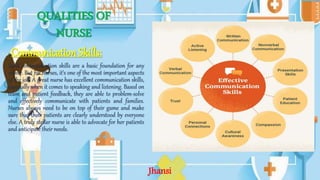
Solid communication skills are a basic foundation for any
career. But for nurses, it’s one of the most important aspects
of the job. A great nurse has excellent communication skills,
especially when it comes to speaking and listening. Based on
team and patient feedback, they are able to problem-solve
and effectively communicate with patients and families.
Nurses always need to be on top of their game and make
sure that their patients are clearly understood by everyone
else. A truly stellar nurse is able to advocate for her patients
and anticipate their needs.
Jhansi
QUALITIES OF
NURSE
2.Emotional Stability:
Nursing is a stressful job where traumatic situations are
common. The ability to accept suffering and death
without letting it get personal is crucial. Some days can
seem like non-stop gloom and doom. That’s not to say
that there aren’t heart-warming moments in nursing.
Helping a patient recover, reuniting families, or bonding
with fellow nurses are special benefits of the job. A great
nurse is able to manage the stress of sad situations, but
also draws strength from the wonderful outcomes that
can and do happen.
Jhansi
QUALITIES OF
NURSE
3.Empathy:
Great nurses have empathy for the pain and suffering of patients.
They are able to feel compassion and provide comfort. But be
prepared for the occasional bout of compassion fatigue; it
happens to the greatest of nurses. Learn how to recognize the
symptoms and deal with it efficiently. Patients look to nurses as
their advocates — the softer side of hospital bureaucracy. Being
sympathetic to the patient’s hospital experience can go a long way
in terms of improving patient care. Sometimes, an empathetic
nurse is all patients have to look forward to.
Jhansi
QUALITIES OF
NURSE
4.Flexibility:
Being flexible and rolling with the punches is a staple of
any career, but it’s especially important for nurses. A great
nurse is flexible with regards to working hours and
responsibilities. Nurses, like doctors, are often required to
work long periods of overtime, late or overnight shifts, and
weekends. Know that it comes with the territory. The upside
is that a fluctuating schedule often means you’re skipping
the 9 to 5, cubicle treadmill. Sounds perfect, right? Run
errands, go to the movies, or spend time with the family —
all while the sun still shines!
Jhansi
QUALITIES OF
NURSE
5.Attention to Detail:
Every step in the medical field is one that can have
far-reaching consequences. A great nurse pays
excellent attention to detail and is careful not to skip
steps or make errors. From reading a patient’s chart
correctly to remembering the nuances of a delicate
case, there’ s nothing that should be left to chance in
nursing. When a simple mistake can spell tragedy
for another’s life, attention to detail can literally be
the difference between life and death.
Jhansi
QUALITIES OF
NURSE
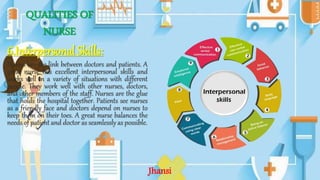
6.Interpersonal Skills:
Nurses are the link between doctors and patients. A
great nurse has excellent interpersonal skills and
works well in a variety of situations with different
people. They work well with other nurses, doctors,
and other members of the staff. Nurses are the glue
that holds the hospital together. Patients see nurses
as a friendly face and doctors depend on nurses to
keep them on their toes. A great nurse balances the
needs of patient and doctor as seamlessly as possible.
Jhansi
QUALITIES OF
NURSE
7.Physical Endurance:
Frequent physical tasks, standing for long periods of
time, lifting heavy objects (or people), and performing
a number of taxing maneuvers on a daily basis are
staples of nursing life. It’s definitely not a desk job.
Always on the go, a great nurse maintains her energy
throughout her shift, whether she’s in a surgery or
checking in on a patient. Staying strong, eating right,
and having a healthy lifestyle outside of nursing is
important too!
Jhansi
QUALITIES OF
NURSE
8.Problem Solving Skills:
A great nurse can think quickly and address
problems as — or before — they arise. With
sick patients, trauma cases, and emergencies,
nurses always need to be on hand to solve a
tricky situation. Whether it’s handling the
family, soothing a patient, dealing with a doctor,
or managing the staff, having good problem
solving skills is a top quality of a great nurse.
Jhansi
QUALITIES OF
NURSE
9.Quick Response:
Nurses need to be ready to respond quickly to
emergencies and other situations that arise.
Quite often, health care work is simply the
response to sudden incidences, and nurses must
always be prepared for the unexpected. Staying
on their feet, keeping their head cool in a crisis,
and a calm attitude are great qualities in a nurse.
Jhansi
QUALITIES OF
NURSE
10.Respect:
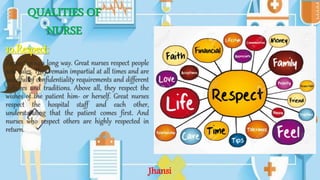
Respect goes a long way. Great nurses respect people
and rules. They remain impartial at all times and are
mindful of confidentiality requirements and different
cultures and traditions. Above all, they respect the
wishes of the patient him- or herself. Great nurses
respect the hospital staff and each other,
understanding that the patient comes first. And
nurses who respect others are highly respected in
return.
Jhansi
Jhansi
QUALITIES OF NURSE
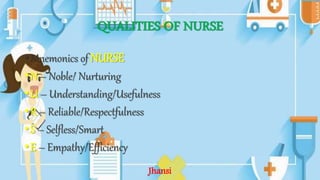
•Mnemonics of NURSE
•N – Noble/ Nurturing
•U – Understanding/Usefulness
•R – Reliable/Respectfulness
•S – Selfless/Smart
•E – Empathy/Efficiency
Jhansi
Jhansi
Jhansi
ROLES&FUNCTIONSOFNURSE
Care giver
Communicator
Client advocate
Teacher
Clinical and ethical decision making
Leader
Change agent
Counsellor
Manager
Researcher
Jhansi
Jhansi
1.Caregiver:
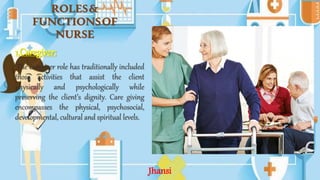
The caregiver role has traditionally included
those activities that assist the client
physically and psychologically while
preserving the client’s dignity. Care giving
encompasses the physical, psychosocial,
developmental, cultural and spiritual levels.
ROLES&
FUNCTIONSOF
NURSE
ROLES&
FUNCTIONSOF
NURSE
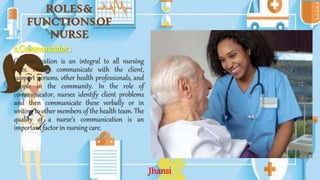
2.Communicator :
Communication is an integral to all nursing
roles. Nurses communicate with the client,
support persons, other health professionals, and
people in the community. In the role of
communicator, nurses identify client problems
and then communicate these verbally or in
writing to other members of the health team. The
quality of a nurse’s communication is an
important factor in nursing care.
Jhansi
ROLES&
FUNCTIONSOF
NURSE
3.Teacher:
As a teacher, the nurse helps clients learn
about their health and the health care
procedures they need to perform to restore or
maintain their health. The nurse assesses the
client’s learning needs and readiness to learn,
sets specific learning goals in conjunction
with the client, enacts teaching strategies and
measures learning.
Jhansi
ROLES&
FUNCTIONSOF
NURSE
4.Client advocate :
Client advocate acts to protect the client.
In this role the nurse may represent the
client’s needs and wishes to other health
professionals, such as relaying the client’s
wishes for information to the physician.
They also assist clients in exercising their
rights and help them speak up for
themselves.
Jhansi
ROLES&
FUNCTIONSOF
NURSE
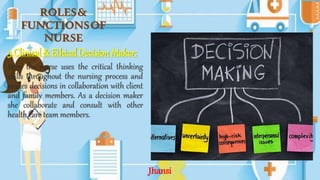
5.Clinical & Ethical Decision Maker:
Here the nurse uses the critical thinking
skills throughout the nursing process and
makes decisions in collaboration with client
and family members. As a decision maker
she collaborate and consult with other
health care team members.
Jhansi
ROLES&
FUNCTIONSOF
NURSE
6.Counsellor:
Counseling is a process of helping a client to
recognize and cope with stressful
psychological or social problems, to
developed improved interpersonal
relationships, and to promote personal
growth. It involves providing emotional,
intellectual, and psychological support.
Jhansi
ROLES&
FUNCTIONSOF
NURSE
7.Change agent:
The nurse acts as a change agent when
assisting others, that is, clients, to make
modifications in their own behaviour.
Nurses also often act to make changes in a
system such as clinical care, if it is not
helping a client return to health.
Jhansi
ROLES&
FUNCTIONSOF
NURSE
8.Leader :
A leader influences others to work together to
accomplish a specific goal. The leader role can be
employed at different levels; individual client, family,
groups of clients, colleagues, or the community.
Effective leadership is a learned process requiring an
understanding of the needs and goals that motivate
people, the knowledge to apply the leadership skills,
and the interpersonal skills to influence others.
Jhansi
ROLES&
FUNCTIONSOF
NURSE
9.Manager :
The nurse manages the nursing care of individuals,
families, and communities. The nurse-manager
also delegates nursing activities to ancillary
workers and other nurses, and supervises and
evaluates their performance.
Case Manager: Nurse case managers work with
the multidisciplinary health care team to measure
the effectiveness of the case management plan and
to monitor outcomes.
Jhansi
ROLES&
FUNCTIONSOF
NURSE
10. Research :
consumer Nurses often use research to
improve client care. In a clinical area nurses
need to: – Have some awareness of the
process and language of research – Be
sensitive to issues related to protecting the
rights of human subjects – Participate in
identification of significant researchable
problems – Be a discriminating consumer of
research findings
Jhansi
Expanded role of the nurse
•Clinical Specialists Is a nurse who has completed a master’s degree in
specialty and has considerable clinical expertise in that specialty.
She provides expert care to individuals, participates in educating health
care professionals and ancillary, acts as a clinical consultant and
participates in research.
Jhansi
Expanded role of the nurse
•Nurse Practitioner Is a nurse who has completed either as
certificate program or a master’s degree in a specialty and is also
certified by the appropriate specialty organization. She is skilled
at making nursing assessments, performing P. E., counseling,
teaching and treating minor and self- limiting illness.
Jhansi
Expanded role of the nurse
•Nurse – Midwife A nurse who has completed a program in
midwifery; provides prenatal and postnatal care and delivers
babies to woman with uncomplicated pregnancies.
•Nurse Anaesthetist A nurse who completed the course of study
in an anaesthesia school and carries out pre-operative status of
clients.
Jhansi
Expanded role of the nurse
Nurse Educator
A nurse usually with advanced degree, who beaches in clinical or educational settings, teaches theoretical
knowledge, clinical skills and conduct research
Nurse Entrepreneur
A nurse who has an advanced degree, and manages health-related business.
Nurse administrator A nurse who functions at various levels of management in health settings;
responsible for the management and administration of resources and personnel involved in giving patient
care.
Jhansi
Expanded role of the nurse
• Nurse Researcher Nurse researchers are scientists who study various aspects of
health, illness and health care. Nurse researchers identify research question,
design and conduct scientific studies, collect and analyze data and report their
findings. This is a highly specific category of nursing with various additional
training in research methodology and tools used to perform research. The data
collected can be used to save the lives of patients and make medical professionals’
lives easier on the job.
Jhansi
Jhansi
CATEGORIES OF NURSING PERSONNEL
• Nursing service is the part of the total health organization which aims at satisfying the
nursing needs of the patients/community. In nursing services, the nurse works with the
members of allied disciples such as dietetics, medical social service, pharmacy etc. in
supplying a comprehensive program of patient care in the hospital.
Definition of NursingServices:-
• WHO expert committee on nursing defines the nursing services as the part of the total
health organization which aims to satisfy major objective of the nursing services is to
provide prevention of disease and promotion of health.
Jhansi
CATEGORIES OF NURSING PERSONNEL
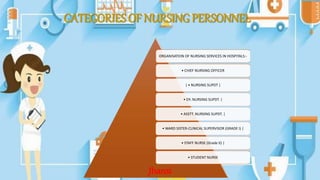
ORGANISATION OF NURSING SERVICES IN HOSPITALS:-
• CHIEF NURSING OFFICER
| • NURSING SUPDT |
• DY. NURSING SUPDT. |
• ASSTT. NURSING SUPDT. |
• WARD SISTER-CLINICAL SUPERVISOR (GRADE I) |
• STAFF NURSE (Grade II) |
• STUDENT NURSE
Jhansi
CNO (CHIEF NURSING OFFICER):
1. She/he will be responsible for efficient running of Nursing Services at hospitals.
2. She will assist the Director in formulating broad policies concerning Nursing Services
and inform the happening concerning the hospital.
3. She will disseminate the AIM, objectives and policies regarding patient care to all
cadres of nursing services & will implement policies and procedures of Institute
regarding nursing services. 4.She/he will plan future requirements of nurses and carry
out recruitment of nurses from time to time.
Jhansi
Contd….
5. She/he will plan and disseminate programmes for continuing education re-
orientation programmes for nurses.
6. She/he will encourage research by nurses in their work areas.
7. She will strive to implement standard nursing practices and maintain highest
quality of care. 8. She will critically analyse the budgets for nursing services. 9.
Evaluate confidential reports of higher level nursing officers and recommend for
promotion.
Jhansi
Nursing Superintendent:
• is responsible to the C.N.O. for planning organisation and development of nursing services in
the hospital in consultation with Medical Supdt./Chief of centres.
• 1. She will be responsible for implementing hospital policies amongst various nursing units.
• 2. She will recommend personnel and material requirement for nursing various nursing service
departments of the hospital.
• 3. She will ensure safe and efficient care rendered to patients in various wards etc.
• 4. She will prepare budgets for nursing services.
• 5. She will be responsible for counseling and guidance of sub-ordinate staff. 6. Making duty
roaster of nursing personnel.
Jhansi
DEPUTY NURSING SUPERINTENDENT:
• • Deputy Nursing Superintendent is responsible to the Nursing Supdt. and assist
her in the administration of nursing services in the hospital.
1. Supervise the nursing care given to the patients in various departments by
taking regular round of her area.
2. Act as a liasion officer between Nursing Supdt. and the nursing staff of the
hospital.
3. Interpret the policies and procedures of the Nursing service department to sub-
oradinate staff and others.
4. Maintain the records of attendance of nursing staff and leave of any kind.
Jhansi
Contd….
• 5. Conduct regular physical verification of hospital stocks, i.e. drugs, equipments etc.
• 6. Initiate procedure for condemnation and procurement of hospital equipment/linen etc.
• 7. Maintain the confidential report and records of nursing personnel.
• 8. Assist the nursing supdt. in making master duty roster of nursing personnel.
• 9. Arrange orientation programmes for new nursing staff.
• 10. Maintain discipline among nursing personnel.
• 11. Ensure clinical experience facilities for student nurses in various clinical areas of the
hospital.
Jhansi
ASSISTANT NURSING SUPERINTENDENT:
• • Asstt. Nursing Supdt, is responsible to Deputy Nursing Supdt. for the total nursing care of patients,
management and development of the unit assigned to her
1. Plan and arrange duty for nursing personnel posted under her.
2. To ensure availability of adequate nursing staff in all shifts.
3. Maintain cleanliness of unit its annexes and environment.
4. Interact with the engineering service department for proper up keep of the unit.
5. Guide the Sister Grade-I to ensure supplies and equipments of different stores, and re-checking their
use and care.
6. Maintain good public relation with patients relatives and the public, and project positive image of the
hospital.
7. Maintain disciple of nursing and domestic staff.
Jhansi
NURSING SISTER GRADE-I:
• • The Nursing Sister Grade-I is responsible to the Assistant Nursing
Superintendent or the total care of patients in the wards and
supervision of the Nursing Sister Grade-II, student nurses and Domestic
staff.
• She would also be assisted by Nursing Sister Grade-II, Clinical and
Domestic staff. The main aim of the sister Grade-I should be to foster
team spirit in her area of works as a team leader.
Jhansi
NURSING SISTER GRADE-II:
1.Nursing sister grade-II is directly responsible to Nursing Sister
Grade-I (Ward In-Charge) for total nursing care of the patient
assigned to him/her.
Jhansi
IN EDUCATIONAL…
ORGANISATION OF NURSING PERSONNEL IN EDUCATIONAL INSTITUTES:-
PRINCIPAL
VICE PRINCIPAL
• PROFESSORS
• ASSOCIATE PROFESSORS
• ASSISTANT PROFESSOR
• CLINICAL INSTRUCTORS/NURSING TUTOR
Jhansi
ORGANISATION OF NURSING PERSONNEL
IN COMMUNITY SETTING
• The nurses working in the community level are also a large part of the
health care delivery system.
• They work at various levels and provide care to various levels.
• They can be broadly classified as
– Female health worker
– Community health nurse
Jhansi
ORGANISATION OF NURSING PERSONNEL
IN COMMUNITY SETTING
• There are various community health nurse levels in various states of
India.
Generally they can be classified as :
• DPHNO : District public health nursing Officer
• BPHN: Block Public health Nurse
• PHN : Public health nurse/ Lady Health Visitor
• ANM: Axillary Nurse midwife / Female Health Workers
Jhansi
ORGANISATION OF NURSING PERSONNEL
IN COMMUNITY SETTING
•Female Health Workers
• Registers and cares for the pre-natal and post natal mothers at home.
• Registers and follows up all the eligible couples.
• Provides nutritional advice and immunization to mother and children.
• Carries out family planning services and including the distribution of the contraceptives.
• Provides treatment to minor ailments.
• Notifies communicable diseases
• Maintains the records and registers all the services provided and vital events like birth and death.
• Participates in the various disease control programmes.
• Conducts surveys of all sub-center areas and maintains records about every family.
Jhansi
ORGANISATION OF NURSING PERSONNEL
IN COMMUNITY SETTING
•Community health nurse
• Qualified community health nurse is one who has undergone general training ,
and basic education in the community health nursing. She must have a B.Sc.
Nursing with a registration to work as a community health nurse
• Roles of community health nurse is Health education, Individual practitioner,
Decision maker, Programme director, Planner, Researcher, Supervisor, Evaluator,
Advocate, and Direct care provider
Jhansi
Jhansi
HISTORY OF NURSING
• Illness earlier was seen as “magic”, “sin” or “punishment”. During 700-600 B.C -
Sushruta Samhita was written by the great surgeon Sushruta, who said "the
physician, the patient, the drugs and the nurse are four feet of `Padas' of the
medicine, upon which the cure depends". The first nursing school started in India
in 250 B.C. during Charaka's time and only men were considered pure enough to
be nurses. Other civilisations as Egyptians, Babylonians, Hebrews, Greeks and
Romans also shows evidences of nursing care.
Jhansi
HISTORY OF NURSING
• The early history of nurses suffers from a lack of source material, but nursing in general
has long been an extension of the wet-nurse function of women.
• 300 AD - Entry of women into nursing. Women began nursing as an expression of
Christianity (acts of mercy). Women were recognized as important members of
community.
• 1633 - Sisters of Charity founded by Louise de Marillac - established the first educational
program to be affiliated with a religious nursing order
• 1809 - Mother Elizabeth Seton introduced the Sisters of Charity into America, later
known as the Daughters of Charity.
Jhansi
HISTORY OF NURSING
•Modern nursing began in the 19th century in Germany and Britain, and
spread worldwide by 1900.
•1836 - Deaconess Institute of Kaiserwerth, Germany, founded. This was the
institute where Florence Nightingale received her initial education in
nursing.
•1860 - establishment of the Nightingale Training School for Nurses at St.
Thomas Hospital in London, England. The first organized program for
training nurses
Jhansi
HISTORY OF NURSING
• DARK PERIOD OF NURSING - From 17th century – 19th century. Also called the Period of
Reformation until the American Civil War.
• Hospitals were closed.
• Nursing were the works of the least desirable people (criminals, prostitutes, drunkards,
slaves, and opportunists). Nurses were uneducated, filthy, harsh, ill-fed, overworked.
• 1854 - 1856 (CRIMEAN WAR)- On Oct. 21, 1854, Nightingale left with 38women for the
Crimean War—British casualties were high; within 6 months, death rate cut in half. Made
rounds at night with a lamp “Lady of the Lamp”. Compiled the “Notes on Nursing: What it
is and What is not” and became the first nurse theorist.
Jhansi
HISTORY OF NURSING
• 1884 - Mary Snively assumed directorship of Toronto General Hospital
and began to form the Canadian National Association of Trained
Nurses. Later became the Canadian Nurses Association. 1890 -
establishment of the Nurses Associated Alumni of the United States and
Canada & this later became the American Nurses Association.
Jhansi
HISTORY OF NURSING
• 1901 - first university affiliated nursing program, Army Nurse Corps
established.
• 1901 - New Zealand was the first country to regulate nurses nationally,
with adoption of the Nurses Registration Act on the 12 September 1901. It
was here in New Zealand that Ellen Dougherty became the first
registered nurse.
• 1911 - formed American Nurses Association.
Jhansi
HISTORY OF NURSING
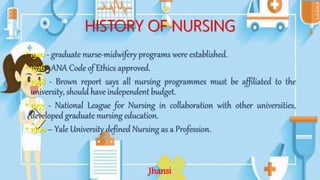
• 1920 - graduate nurse-midwifery programs were established.
• 1926 - ANA Code of Ethics approved.
• 1948 - Brown report says all nursing programmes must be affiliated to the
university, should have independent budget.
• 1953 - National League for Nursing in collaboration with other universities,
developed graduate nursing education.
• 1960 – Yale University defined Nursing as a Profession.
Jhansi
HISTORY OF NURSING
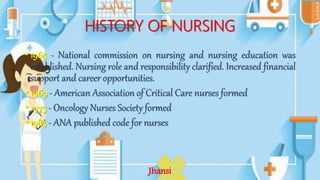
• 1965 - National commission on nursing and nursing education was
established. Nursing role and responsibility clarified. Increased financial
support and career opportunities.
• 1969 - American Association of Critical Care nurses formed
• 1975 - Oncology Nurses Society formed
• 1985 - ANA published code for nurses
Jhansi
HISTORY OF NURSING
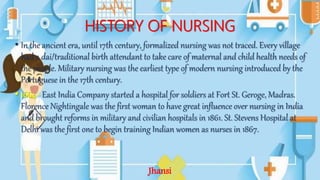
• In the ancient era, until 17th century, formalized nursing was not traced. Every village
had a dai/traditional birth attendant to take care of maternal and child health needs of
the people. Military nursing was the earliest type of modern nursing introduced by the
Portuguese in the 17th century.
• 1664 - East India Company started a hospital for soldiers at Fort St. Geroge, Madras.
Florence Nightingale was the first woman to have great influence over nursing in India
and brought reforms in military and civilian hospitals in 1861. St. Stevens Hospital at
Delhi was the first one to begin training Indian women as nurses in 1867.
Jhansi
HISTORY OF NURSING
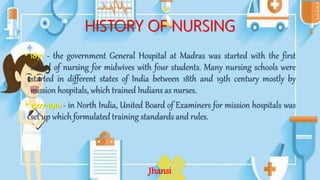
• 1871 - the government General Hospital at Madras was started with the first
school of nursing for midwives with four students. Many nursing schools were
started in different states of India between 18th and 19th century mostly by
mission hospitals, which trained Indians as nurses.
• 1907-1910 - in North India, United Board of Examiners for mission hospitals was
set up which formulated training standards and rules.
Jhansi
HISTORY OF NURSING
• Later Mid India (1926) and South India (1913) boards (boards of CMAI) were set up which
conducted examination and gave diplomas. The first school of Health visitors was started
in 1918 by Lady Reading Health School, Delhi.
• 1946 - The first four-year Basic B.Sc. program was established at RAK College of Nursing
in Delhi and CMC College of Nursing in Vellore.
• 1951 - a two-year ANM course was established in St. Mary’s Hospital at Punjab.
• 1960 - M.Sc. was established in RAK College of Nursing, Delhi.
Jhansi
HISTORY OF NURSING
• 1963 - the School of Nursing in Trivandrum, instituted the first two-year post
certificate bachelor's degree programme.
• 1980 - RAK college of nursing started an MPhil programme as a regular and part
time course. Doctorate Of Philosophy In Nursing (PhD in Nursing. Earlier Indian
nurses were sent abroad for Ph. D programme. PhD programmes in nursing was
first started in India in 1992 under Department of Nursing, University of Delhi
through RAK.
Jhansi
HISTORY OF NURSING
• 1992 - Post Basic BSc Nursing programme was launched by IGNOU, which is three years duration course
is recognized by INC. Post-Basic/Post Certificate Short-Term Courses And Diploma Programmes:
• During 1948-50 four nurses were sent to the U.K.by Govt. of India for mental health nursing diploma.
• During 1954 Manzil Medical Health centre, Lucknow gave psychiatric nursing orientation course of 4 –
6weeks duration.
• In 1951 a one year course in public health was started at college of nursing Delhi. Govt. of India felt
urgent need for psychiatric nurses during 1953-54,this resulted in first organized course at All India
Institute of Mental Health.
• In 1962 diploma in peadatric nursing was established at J.J. Group of Hospitals, Bombay. At present
there are many other courses of three months duration which are monitored and recognized by INC.
Jhansi
HISTORY OF NURSING
• NURSING COUNCILS –
• 1890 - Bombay Presidency Nursing Association was the first state nursing association.
• 1908 - the Trained Nurses Association was formed to uphold the dignity and honor of nursing
profession. The first state registration council at Madras Nursing Council was constituted in 1926
and Bombay Nursing Council was constituted in 1935.
• In 1949, Indian Nursing Council (INC) was established to maintain a uniform standard of training
for nurses, midwives and health visitors and regulate the standards of nursing in India.
• INC act was passed in 1947 that was amended in 1950 and 1957.
Jhansi
HISTORY OF NURSING
• By 2000, nursing advisor post was instituted at the national level; three nursing
posts were increased to five with the introduction of Asst. Director General
Nursing and Dy. Asst. Director General.
• 2003 - The College of Nursing PGI, Chandigarh and College of Nursing, CMC
Vellore were designated as WHO collaborating centers for nursing and
midwifery development.
Jhansi
HISTORY OF NURSING
• Nursing education have expanded considerably post independence.
• University education in nursing brought about changes in nursing education. The
type of nurses required today is an “all round personality”.
• Education brings changes in behaviour of the individual in a desirable manner. It
aims at all round development of an individual to become mature, self - sufficient,
intellectually, culturally refined socially efficient and spiritually advanced.
Jhansi
Jhansi
VALUES
• Values have major influence on a person's behavior and attitude and serve as
broad guidelines in all situations.
• Dictionary Definitions:
• • The moral principles and beliefs or accepted standards of a person or social
group.
• • The principles that help you to decide what is right and wrong, and how to
act in various situations
Jhansi
VALUES
•Definitions:
Values are enduring beliefs or attitudes about the worth of a
person, object, idea, or action. Values are important because they
influence decisions and actions, including nurses’ ethical decision
making.
Jhansi
Definition Of Values:
• A Values are principles that allow us to guide our behavior to fulfill ourselves as
individuals.
• They are fundamental beliefs that help us prefer, accept and choose one thing over
another or a behavior over another. They are also a source of satisfaction and
fulfillment. They provide a guideline to formulate goals and objectives, whether
personal or collective.
They reflect our keenest interests, feelings and convictions. Values refer to human needs
and represent ideals, dreams and aspirations. Their importance is independent of the
circumstances. For example, even though we may be unfair, fairness still has a value. The
same happens with wellbeing or happiness.
Jhansi
Types Of Values
• We can speak of universal values, because ever since human beings have lived in
community, they have had to establish principles to guide their behavior towards others.
• In this sense, honesty, responsibility, truth, solidarity, cooperation, tolerance, respect and
peace, among others, are considered universal values.
• However, in order to understand them better, it is useful to classify values according to
the following criteria:
Personal values: These are considered essential principles on which we build our life and
guide us to relate with other people. They are usually a blend of family values and social-
cultural values, together with our own individual ones, according to our experiences.
Jhansi
Types Of Values
•Family values: These are valued in a family and are considered either
good or bad. These derive from the fundamental beliefs of the parents,
who use them to educate their children. They are the basic principles
and guidelines of our initial behavior in society, and are conveyed
through our behaviors in the family, from the simplest to the most
complex.
Jhansi
Types Of Values
•Social-cultural values: These are the prevailing values of our society,
which change with time, and either coincide or not with our family or
personal values. They constitute a complex mix of different values, and
at times they contradict one another, or pose a dilemma. For example, if
work is not valued socially as a means of personal fulfillment, then the
society is indirectly fostering “anti-values” like dishonesty,
irresponsibility, or crime.
Jhansi
Types Of Values
•Material values: These values allow us to survive, and are related to our
basic needs as human beings, such as food and clothing and protection
from the environment. They are fundamental needs, part of the
complex web that is created between personal, family and social-
cultural values.
Jhansi
Types Of Values
•Spiritual values: They refer to the importance we give to non- material
aspects in our lives. They are part of our human needs and allow us to
feel fulfilled. They add meaning and foundation to our life, as do
religious beliefs. Moral values: The attitudes and behaviors that a society
considers essential for coexistence, order, and general well.
Jhansi
VALUES
• Values In Professional Nursing : Professional values are the guiding beliefs
and principles that influence your work behaviour.
• Your professional values are usually an extension of your personal values such
as honesty, generosity and helpfulness. These values may change over time and
around different life events, your core beliefs should stay the same.
• Nurses professional values are acquired during socialization into nursing from
codes of ethics, nursing experiences, teachers and peers.
Jhansi
VALUES
• Values In Professional Nursing : Professional nursing values were defined as
important professional nursing principles of human dignity, integrity, altruism,
and justice that serve as a framework for standards, professional practice, and
evaluation. Schank and Weis stated that these are “standards for action that are
accepted by the practitioner and/or professional group and provide a framework
for evaluating beliefs and attitudes that influence behavior”.
Jhansi
VALUES
• Values In Professional Nursing :
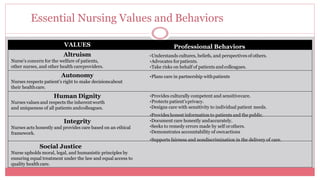
• The American Association of Colleges of Nursing (AACN, 1998) identified five
values essential for the professional nurse: Altruism, Autonomy, Human dignity,
Integrity, Social justice.
Jhansi
Essential Nursing Values and Behaviors
VALUES
Altruism
Nurse’s concern for the welfare of patients,
other nurses, and other health careproviders.
Autonomy
Nurses respects patient’s right to make decisionsabout
their healthcare.
Human Dignity
Nurses values and respects the inherentworth
and uniqueness of all patients andcolleagues.
Integrity
Nurses acts honestly and provides care based on an ethical
framework.
Social Justice
Nurse upholds moral, legal, and humanistic principles by
ensuring equal treatment under the law and equal access to
quality health care.
Professional Behaviors
•Understands cultures, beliefs, and perspectives of others.
•Advocates forpatients.
•Take risks on behalf of patients andcolleagues.
•Plans care in partnership withpatients
•Provides culturally competent and sensitivecare.
•Protects patient’sprivacy.
•Designs care with sensitivity to individual patient needs.
•Provides honest information to patients and the public.
•Document care honestly andaccurately.
•Seeks to remedy errors made by self orothers.
•Demonstrates accountability of ownactions
•Supports fairness and nondiscrimination in the delivery of care.
VALUES
• Other Values In Professional Nursing : The values every nurse or midwife
should work to, known as the 'six Cs’.
• The six Cs - care, compassion, competence, communication, courage and
commitment - are the other core nursing values.
Core Values of Nurse Advocacy
Three core values help form the basis of nursing advocacy: preserving human
dignity; patient equality; and freedom from suffering.
Jhansi
Development of values/ value transmission
•
• •An individual is not born with values, rather values are formed during
a lifetime from information gathered from the envt, family & culture.
• •As children observe the actions of others, they quickly learn what has
high & low value for them.
Jhansi
Common modes of value transmission:
• Modelling
• Moralizing
• Laissez- faire
• Rewarding & punishing
• Responsible choice
Jhansi
Modelling:
•Through modelling, children learn what is of high or low value
by observing parents, peers & significant others. Thus it leads to
socially acceptable or unacceptable behaviour.
Jhansi
Moralizing:
•In this mode of value transmission, children are taught a
complete value system by parents or an institution that allows
little opportunity for them to weigh different values.
Jhansi
Laissez-faire
•In this approach, children are left to explore values on their own
& to develop a personal value system. In this no one set of values
is presented as best for all. This approach often involves little or
no guidance & can lead to confusion & conflict.
Jhansi
Rewarding & punishing
•Children are rewarded for demonstrating values held by
parents & punished for demonstrating unacceptable
values.
Jhansi
Responsible choice
•In this mode, the caregivers encourage children to explore
competing values and to weigh their consequences. Support &
guidance are offered as children develop a personal value system.
Jhansi
Values Clarification:
• It is a process by which people identify, examine and develop
their own individual values.
• A method whereby a person can discover his or her own values
by assessing, exploring, and determining what those personal
values are and how they affect personal decision making.
Jhansi
Values Clarification:
• Goal: The goal of "values clarification" is for you to become fully
conscious of their influence, and to explore and honestly acknowledge
what you truly value at this time in your life. This promotes personal
growth by fostering awareness, empathy and insight.
• Principles: No one set of values is right for everyone.
Jhansi
Values Clarification:
• Steps/Theory of Value Clarification:
One widely used theory was developed by Raths, Harmin and Simon
(1978). They described a valuing process of thinking, feeling and
behaviour that they termed ‘choosing’, ‘prizing’ and ‘acting’.
Jhansi
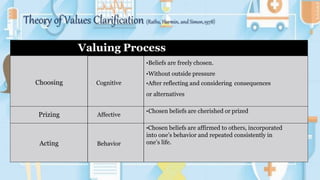
Theory of Values Clarification (Raths, Harmin, and Simon,1978)
Valuing Process
Choosing Cognitive
•Beliefs are freely chosen.
•Without outside pressure
•After reflecting and considering consequences
or alternatives
Prizing Affective
•Chosen beliefs are cherished or prized
Acting Behavior
•Chosen beliefs are affirmed to others, incorporated
into one’s behavior and repeated consistently in
one’s life.
Values Clarification:
•Clarifying the Nurse’s Values
Nurses and nursing students need to examine the values they
hold about life, death, health and illness. One strategy for gaining
awareness of personal values is to consider one’s attitudes about
specific issues such as abortion or euthanasia, asking: “Can I
accept this, or live with this?” “Why does this bother me?”….
Jhansi
Values Clarification:
• Clarifyingthe Client Values
To plan effective care, nurses need to identify client’s values as they
influence and relate to a particular health problem. For Eg:- A client with
lose of eye sight will place high value on the ability to see. When clients
hold unclear or conflicting values that are detrimental to their health, the
nurse should use values clarification as an intervention.
Jhansi
Values Clarification
• Clarifying the Client Values
Examples are:-
1. List alternatives: make sure that the client is aware all the alternative actions.
2. Examine possible consequences of choice: make sure the client has thought about
the possible results of each action.
3. Choose freely: to determine whether the client chose freely.
4. Feel good about the choice: to determine how the client feels.
Jhansi
Values Clarification
5. Affirmthe choice: ask “What will you say to others about this?”
6. Act on the choice: to determine whether the client is prepared to act on
the decisions made.
7. Act with a pattern: to determine whether the client consistently behaves
in a certain way. When implementing these seven steps to clarify values,
the nurse assists the client to think each question through, but does not
impose personal values.
Jhansi
Clarifying the Client Values
Process How?
List Alternatives Ask: “Are you considering other alternative courses of actions?”
“Tell me aboutthem”
Examine possible
consequences of choices
Ask: “What do you think you will gain from doingthat?”
Choose freely Ask: “Did you have any say in thatdecision?”
Feel good about the choice Ask: “How do you feel about that decision?” “Some people feel
good after a decision is made; others feel bad. How do youfeel?”
Affirm the choice Ask: “What will you say to family or friendsaboutthis?”
Act on the choice Ask: “Will it be difficult to tell your wife about this?” (it
determines the client’s preparedness to act in hisdecision)
Act with a pattern Ask: “How many times have you done that before?” or“Would
you act that wayagain?”
Values Clarification:
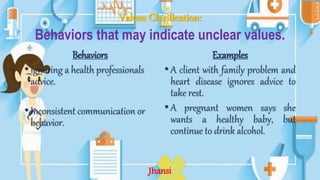
Behaviors that may indicate unclear values.
Behaviors
• Ignoring a health professionals
advice.
• Inconsistent communication or
behavior.
Examples
•A client with family problem and
heart disease ignores advice to
take rest.
•A pregnant women says she
wants a healthy baby, but
continue to drink alcohol.
Jhansi
Clarifying the Client Values
Is an intervention used by the nurse s when clients experiences
unclear values that are harmful to their health.
Behavior Example
Ignoring a health professional’s
advice
A child client’s parent who valuesthe
Inconsistent communication behavior A n elderly who says she don’t want anymore to use cane when walking, but
won’t cooperate during hertherapy.
Numerous admissions to a health
agency for the same problem
A hypertensive client repeatedly seeks help for headache but does not take
the prescribed maintenancemedicine.
Confusion about which course
of action to take
A pregnant woman who values her job to meet financial obligations, but also
needs to have complete bed rest for a safe labor anddelivery.
Jhansi
ETHICS
DEFINITIONS:
The word ethics is derived from the Greek word “ethos”, which means
custom or guiding beliefs. Ethics is defined as a set of rules or principles
that govern right conduct and is designed to protect the rights of a
human being. Ethics is a branch of philosophy; it is moral philosophy or
philosophical thinking about morality, moral problems, and moral
judgements.
Jhansi
ETHICS
DEFINITIONS:
Nursing ethics is the values and ethical principles governing nursing
practice, conduct, and relationships.
Nursing Ethics refers to the moral code of nursing & is based on
obligation to service & respect for human life.
Jhansi
ETHICS
• ETHICAL PRINCIPLE:
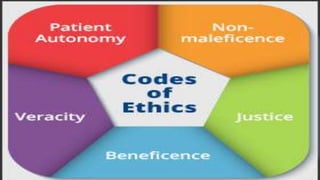
The ethical principles that nurses must adhere to are:- The principles of
justice, Beneficence ,Non – maleficence, Accountability ,Fidelity, Autonomy,
Veracity.
Jhansi
ETHICAL PRINCIPLE:
• The principles of justice: Justice is fairness. Nurses must be fair when
they distribute care. Care must be fairly, justly, and equitably
distributed among a group of patients.
• Beneficence: Beneficence is doing good and the right thing for the
patient.
• Non – maleficence: Nonmaleficence is doing no harm, as stated in the
historical Hippocratic Oath. Harm can be intentional or unintentional.
Jhansi
ETHICAL PRINCIPLE:
•Accountability: Accountability is accepting responsibility for one's own
actions. Nurses are accountable for their nursing care and other actions.
They must accept all of the professional and personal consequences that can
occur as the result of their actions.
•Fidelity: Fidelity is keeping one's promises. The nurse must be faithful and
true to their professional promises and responsibilities by providing high
quality, safe care in a competent manner.
Jhansi
ETHICAL PRINCIPLE:
• Autonomy: Autonomy and patient self- determination are upheld when the nurse
accepts the client as a unique person who has the innate right to have their own
opinions, perspectives, values and beliefs. Nurses encourage patients to make their
own decision without any judgments or coercion from the nurse. The patient has the
right to reject or accept all treatments.
• Veracity: Veracity is being completely truthful with patients; nurses must not
withhold the whole truth from clients even when it may lead to patient distress.
Jhansi
Jhansi
CODE OF ETHICS
• Code :
Systematic collection of statutes, body of laws so arranged as to avoid
inconsistency and overlapping ; set of rules on any subject.
• A code of ethics is a set of ethical principles that are accepted by all members
of a profession.
Potter & Perry
• Code of ethics is a guideline for performance & standards & personal
responsibilities.
Jhansi
CODE OF ETHICS
•PURPOSES :
•Set standards for the behaviours of nurse & provide general
guidelines for nursing action Helps to distinguish between right
& wrong Enables a correct decision Protect the rights of
individual
Jhansi
CODE OF ETHICS
• An international code of ethics for nurses was first adopted by the
International Council of Nurses (ICN) in 1953.
• It has been revised and reaffirmed at various times since, most recently
with this review and revision completed in 2012.
Jhansi
Jhansi
CODE OF ETHICS
• The ICN Code of Ethics for Nurses has four principal elements that
outline the standards of ethical conduct.
• ELEMENTS OF THE CODE:
1. Nurses and people
2. Nurses and practice
3. Nurses and the profession
4. Nurses and co-workers
Jhansi
CODE OF ETHICS
ELEMENTS OF THE CODE:
1. Nurses and people:
The nurse’s primary professional responsibility is to people requiring nursing
care.In providing care, the nurse promotes an environment in which the human
rights, values, customs and spiritual beliefs of the individual, family and
community are respected. The nurse ensures that the individual receives accurate,
sufficient and timely information in a culturally appropriate manner on which to
base consent for care and related treatment.
Jhansi
CODE OF ETHICS
•ELEMENTS OF THE CODE:
•1. Nurses and people
•The nurse holds in confidence personal information and uses
judgement in sharing this information. The nurse shares with society
the responsibility for initiating and supporting action to meet the
health and social needs of the public, in particular those of vulnerable
populations.
Jhansi
CODE OF ETHICS
•ELEMENTS OF THE CODE:
•1. Nurses and people
The nurse advocates for equity and social justice in resource allocation,
access to health care and other social and economic services. The nurse
demonstrates professional values such as respectfulness,
responsiveness, compassion, trustworthiness and integrity
Jhansi
CODE OF ETHICS
•ELEMENTS OF THE CODE:
2. Nurses and Practice:
The nurse carries personal responsibility and accountability for
nursing practice, and for maintaining competence by continual
learning. The nurse maintains a standard of personal health such
that the ability to provide care is not compromised.
Jhansi
CODE OF ETHICS
•ELEMENTS OF THE CODE:
2. Nurses and Practice:
•The nurse uses judgement regarding individual competence
when accepting and delegating responsibility. The nurse at all
times maintains standards of personal conduct which reflect well
on the profession and enhance its image and public confidence.
Jhansi
CODE OF ETHICS
•ELEMENTS OF THE CODE:
2. Nurses and Practice:
•The nurse, in providing care, ensures that use of technology and
scientific advances are compatible with the safety, dignity and
rights of people. The nurse strives to foster and maintain a
practice culture promoting ethical behaviour and open dialogue.
Jhansi
CODE OF ETHICS
•ELEMENTS OF THE CODE:
3. Nurses and Profession:
•The nurse assumes the major role in determining and implementing acceptable
standards of clinical nursing practice, management, research and education.
The nurse is active in developing a core of research-based professional
knowledge that supports evidence-based practice. The nurse is active in
developing and sustaining a core of professional values.
Jhansi
CODE OF ETHICS
•ELEMENTS OF THE CODE:
3. Nurses and Profession:
•The nurse, acting through the professional organisation, participates in
creating a positive practice environment and maintaining safe, equitable
social and economic working conditions in nursing. The nurse practices to
sustain and protect the natural environment and is aware of its consequences
on health. The nurse contributes to an ethical organisational environment
and challenges unethical practices and settings.
Jhansi
CODE OF ETHICS
• ELEMENTS OF THE CODE:
4. Nurses and co-workers:
• The nurse sustains a collaborative and respectful relationship with co-workers in
nursing and other fields. The nurse takes appropriate action to safeguard
individuals, families and communities when their health is endangered by a co-
worker or any other person. The nurse takes appropriate action to support and
guide co-workers to advance ethical conduct.
Jhansi
CODE OF ETHICS BY INC
• 1.The nurse respects the uniqueness of individual in provision of care -
Nurse
1.1 Provides care of individuals without consideration of caste, creed,
religion, culture, ethnicity, gender, socio-economic and political status,
personal attributes, or any other grounds
1.2 Individualizes the care considering the beliefs, values and cultural
sensitivities
Jhansi
CODE OF ETHICS BY INC
1.The nurse respects the uniqueness of individual in provision of care - Nurse
1.3 Appreciates the place of individual in the family and community and
facilitates participation of significant others in the care.
1.4 Develops and promotes trustful relationship with individual(s)
1.5 Recognizes uniqueness of response of individuals to interventions and
adapts accordingly
Jhansi
CODE OF ETHICS BY INC
• 2. The nurse respects the rights of individuals as partner in care and help in
making informed choices - Nurse
2.1 Appreciates individual’s right to make decisions about their care and therefore
gives adequate and accurate information for enabling them to make informed
choices
2.2 Respects the decisions made by individual(s) regarding their care
Jhansi
CODE OF ETHICS BY INC
• 2. The nurse respects the rights of individuals as partner in care and help
in making informed choices - Nurse
2.3 Protects public from misinformation and misinterpretations
2.4 Advocates special provision to protect vulnerable individuals/groups.
Jhansi
CODE OF ETHICS BY INC
• 3. The nurse respects individual’s right to privacy, maintains
confidentiality, and shares information judiciously- Nurse
3.1 Respects the individual’s right to privacy of their personal information
3.2 Maintains confidentiality of privileged information except in life
threatening situations and uses discretion in sharing information.
Jhansi
CODE OF ETHICS BY INC
3. The nurse respects individual’s right to privacy, maintains confidentiality,
and shares information judiciously- Nurse
3.3 Takes informed consent and maintains anonymity when information is
required for quality assurance/ academic/legal reasons
3.4 Limits the access to all personal records written and computerized to
authorized persons only.
Jhansi
CODE OF ETHICS BY INC
• 4. Nurse maintains competence in order to render Quality NursingCare
4.1 Nursing care must be provided only by registered nurse 4.2 Nurse strives to maintain
quality nursing care and upholds the standards of care
4.3 Nurse values continuing education, initiates and utilizes all opportunities for self
development.
4.4 Nurses values research as a means of development of nursing profession and
participates in nursing research adhering to ethical principles.
Jhansi
CODE OF ETHICS BY INC
• 5. The nurse if obliged to practice within the framework of ethical,
professional and legal boundaries - Nurse
5.1 Adheres to code of ethics and code of professional conduct for nurses
in India developed by Indian Nursing Council
5.2 Familiarizes with relevant laws and practices in accordance with the
law of the state
Jhansi
CODE OF ETHICS BY INC
• 6. Nurse is obliged to work harmoniously with members of the health
team- Nurse
6.1 Appreciates the team efforts in rendering care
6.2 Cooperates, coordinates and collaborates with members of the health
team to meet the needs of people
Jhansi
CODE OF ETHICS BY INC
•7. Nurse commits to reciprocate the trust invested in nursing
profession by society __Nurse
7.1 Demonstrates personal etiquettes in all dealings
7.2Demonstrates professional attributes in all dealings
Jhansi
PROFESSIONAL CONDUCT FOR NURSES:
• Professional conduct refers to the manner in which nurses and
midwives behave while acting in a professional capacity.
• This code is not intended to give detailed professional advice on any
specific issues and / or any specific areas of practice, rather it identifies
the minimum requirements for conduct in the profession.
Jhansi
PROFESSIONAL CONDUCT FOR NURSES:
•A breach of the Code of Professional Conduct may represent professional
misconduct or unprofessional conduct.
•The profession expects that all levels of nurses and midwives will conduct
themselves personally and professionally in a way that will maintain strong
public confidence and care excellence in the profession.
•Nurses and midwives have a responsibility to provide safe and competent care
which is responsive to the individual, family, community needs and the
profession.
Jhansi
PROFESSIONAL CONDUCT FOR NURSES:
•1. Professional Responsibility and accountability - Nurse
1.1 Appreciates sense of self-worth and nurtures it
1.2 Maintains standards of personal conduct reflecting credit upon the profession
1.3 Carries out responsibilities within the framework of the professional
boundaries
1.4 Is accountable for maintaining practice standards set by Indian Nursing
Council
Jhansi
PROFESSIONAL CONDUCT FOR NURSES:
•1. Professional Responsibility and accountability - Nurse
1.5 Is accountable for own decisions and actions
1.6 Is compassionate
1.7 Is responsible for continuous improvement of current practices
1.8 Provides adequate information to individuals that allows them informed
choices
1.9 Practices healthful behaviour
Jhansi
PROFESSIONAL CONDUCT FOR NURSES:
•2. Nursing Practice - Nurse
2.1 Provides care in accordance with set standards of practice
2.2 Treats all individuals and families with human dignity in providing physical,
psychological, emotional, social and spiritual aspects of care
2.3 Respects individuals and families in the context of traditional and cultural
practices, promoting healthy practices and discouraging harmful practices
Jhansi
PROFESSIONAL CONDUCT FOR NURSES:
•2. Nursing Practice - Nurse
2.4 Presents realistic picture truthfully in all situations for facilitating autonomous
decision- making by individuals and families
2.5 Promotes participation of individuals and significant others in the care
2.6 Ensures safe practice
2.7 Consults, coordinates, collaborates and follows up appropriately when
individuals’ care needs exceed the nurse’s competence
Jhansi
PROFESSIONAL CONDUCT FOR NURSES:
• 3. Communication and Interpersonal Relationships - Nurse
3.1 Establishes and maintains effective interpersonal relationships with individuals,
families and communities
3.2 Upholds the dignity of team members and maintains effective interpersonal
relationship with them
3.3 Appreciates and nurtures professional role of team members
3.4 Cooperates with other health professional to meet the needs of the individuals,
families and communities
Jhansi
PROFESSIONAL CONDUCT FOR NURSES:
•4. Valuing Human Being - Nurse
4.1 Takes appropriate action to protect individuals from harmful unethical
practice
4.2 Considers relevant facts while taking conscience decisions in the best interest
of individuals
4.3 Encourages and supports individuals in their right to speak for themselves
on issues affecting their health and welfare
4.4 Respects and supports choices made by individuals
Jhansi
PROFESSIONAL CONDUCT FOR NURSES:
5. Management - Nurse
5.1 Ensures appropriate allocation and utilization of available resources
5.2 Participates in supervision and education of students and other formal care
providers
5.3 Uses judgment in relation to individual competence while accepting and
delegating responsibility 5.4 Facilitates conductive work culture in order to achieve
institutional objectives
Jhansi
PROFESSIONAL CONDUCT FOR NURSES:
•5. Management - Nurse
5.5 Communicates effectively following appropriate channels of communication
5.6 Participates in performance appraisal
5.7 Participates in evaluation of nursing services
5.8 Participates in policy decisions, following the principle of equity and accessibility of
services
5.9 Works with individuals to identify their needs and sensitizes policy makers and
funding agencies for resource allocation
Jhansi
PROFESSIONAL CONDUCT FOR NURSES:
• 6. Professional Advancement -Nurse
6.1Ensures the protection of the human rights while pursuing the advancement of
knowledge
6.2 Contributes to the development of nursing practice
6.3 Participates in determining and implementing quality care
6.4 Takes responsibility for updating own knowledge and competencies
6.5 Contributes to core of professional knowledge by conducting and participating in
research
Jhansi
Jhansi
LEGAL ISSUES IN NURSING
• As a nurse, it has become an important necessity to be aware of the legal aspects
associated with caring and helping people in the healthcare industry today.
• The first nursing law created was that of nursing registration in 1903.
• Liability: As an educated professional, nurses are always legally responsible or liable for
their action. Although each person is legally responsible for his or her own actions, there
are also situations in which a person or organization may be held liable for actions taken
by others. Some of the liabilities are personal, employers, supervisors etc.
Jhansi
LEGAL ISSUES IN NURSING
•Informedconsent:
Every person has the right to either consent to or refuse medical treatment. The law
requires that a person give voluntary and informed consent to treatment. This consent may
be either verbal or written. Written consent usually is preferred in health care to ensure
that a record of consent exists. The patients also have the right to withdraw the consent
which in the case may notify the concerned authority. The consent of minor is usually given
by a parent or legal guardian. If a true emergency exists, consent for care is considered to
be implied. The law holds that if a reasonable person were aware that the situation was life-
threatening, he or she would give consent for care.
Jhansi
LEGAL ISSUES IN NURSING
•Fraud:
Fraud is a deliberate deception for the purpose of personal gain and is usually
prosecuted as crime situations but fraud in nursing care are not common. One
example would be trying to obtain a better position by giving incorrect information to a
prospective employer.
Medication errors: Some errors result from drugs with similar names, lookalike
medication containers, poor systems for communication in which handwriting
problems may contribute to lack of clarity. It may be charged and may contribute to the
awarding of punitive damages as well as ordinary damages.
Jhansi
LEGAL ISSUES IN NURSING
• Torts:
Torts are civil wrongs committed by one person against another. The wrong may be physical harm,
psychological harm or harm to reputation, livelihood or some other less tangible value.
Assault: Assault is an intentional threat to bring about harmful or offensive contact. No actual contact is
necessary. It is an assault for a nurse to threaten to give a client for an X-ray procedure when the client
has refused consent.
Battery: Battery is a un-consented or unlawful touching of a person. For battery to occur, the touching
must occur without consent.
False imprisonment: The tort of false imprisonment occurs with unjustified restraining of a person
without a legal warrant. For example, this occurs when nurses restrain a client in a bounded area to keep
the person away from freedom.
Jhansi
LEGAL ISSUES IN NURSING
• Invasion of privacy:
It is the intrusion into the personal life of another, without just cause, which can give the
person whose privacy has been invaded a right to bring a lawsuit for damages against the
person or entity that intruded.
Negligence: It refers to the act of doing something or refraining from doing something
that any other reasonable medical professional would do or refrain from doing in a
similar situation. Eg. Breach of duty, Injury, Performance failures, etc,
Jhansi
LEGAL ISSUES IN NURSING
•Malpractice: It is defined as improper or negligent practice by a lawyer, physician, or
another professional who injures a client or patient. Medical malpractice is defined as a
wrongful act by a physician, nurse, or another medical professional in the
administration of treatment or at times, the omission of medical treatment, to a patient
under his or her care. Nursing malpractice takes many forms, including medication
errors, failure to follow physician’s order, delaying patient care etc.
Jhansi
Jhansi
LEGAL RESPONSIBILITIES FOR A NURSE
• Registration: Licensing is a mandatory procedure for practice of
nursing. Registration aims at protecting patients by providing qualified
nurses. The nurse is responsible to obtain registration in the respective
State Nursing Registration Council. Legal Liability/Act Of Negligence:
License of a nurse can be suspended or cancelled for any act of
negligence or mal practice, following a specified procedure.
Jhansi
LEGAL RESPONSIBILITIES FOR A NURSE
•Medico — Legal case (M.L.C.): A medico legal case is a patient who is
admitted to the hospital with some unnatural pathology and has to be taken
care of in concurrence with the police and/or court.
•Correct identity: A nurse/midwife is responsible to make sure that all the
patients especially the newborns are to be correctly identified and labelled. A
nurse who is working with various instruments/swabs at OT have to check
before closure it is returned.
Jhansi
LEGAL RESPONSIBILITIES FOR A NURSE
• Leave Against Medical Advice (L.A.M.A.):
Inform medical officer in charge. Signatures of both patients and witness to be
taken as per institutional policy. Patient's Property: Inform patient on admission
that hospital does not take responsibility of his belongings. If patient is
unconscious/ or otherwise required then a list of items must be made, counter
checked by two staff nurses and kept under safe custody.
Jhansi
LEGAL RESPONSIBILITIES FOR A NURSE
•Dying Declaration:
Doctor or nurse should not involve themselves in dying declaration, in case where police
records the dying declaration. Dying declaration is to be recorded by the magistrate. But if
condition of patient becomes serious then medical officer can record it along with two
nurses it witness. Dying Declaration can be recorded by the nursing staff with two nurses as
witness when medical officer is not present. Then the declaration has to be sent immediately
in a sealed cover to the magistrate.
Jhansi
LEGAL RESPONSIBILITIES FOR A NURSE
•Wills: For this, doctor has to be present there, he can recode if requested.
Examination of rape case: Female attendant/female nurse must be present
during the examination.
Artificial human insemination: Written consent should be obtained from both
donor and recipient. Donor and recipient must have the same blood group.
Donor and recipient's identity should be kept confidential. All related documents
should be kept confidential & safe.
Jhansi
LEGAL RESPONSIBILITIES FOR A NURSE
•Poison case: Do not give either verbal or written opinion. Do not allow
to take photos unless special permission is granted by appropriate
authority. Do not give any information to public or press. Preserve all
evidence of poisoning. Collect and preserve all excreta, vomits and
aspirates, seal them immediately and send to forensic laboratory at the
earliest. Consumer protection act (1986)
Jhansi
Jhansi
CONSUMER PROTECTION ACT
• “An Act to provide for better protection of the interests of consumers and for that
purpose to make provision for the establishment of consumer councils and other
authorities for the settlement of consumers' disputes and for matters connected
therewith.”(According to Consumer Protection Act, 1986). Consumer Protection Act,
1986 seeks to promote and protect the interest of consumers against deficiencies and
defects in goods or services. It also seeks to secure the rights of a consumer against
unfair or restrictive trade practices.
Jhansi
CONSUMER PROTECTION ACT
• Objectives of CPA
• To prevent the marketing of goods and services which are hazardous to life and property.
• To protect the consumer on their right to be informed about the quality, quantity, potency,
purity, standard and price of goods and services.
• The right to access to a variety of goods and services at competitive prices as per the availability.
• The right to use grievance redressal management system against unfair trade/service practices.
The consumer is assured that their voice is heard.
Jhansi
CONSUMER PROTECTION ACT
• Consumer Rights Vs Responsibilities SI. No Rights
Responsibilities 1. Right to be heard 1. Ensure that the
company has provided you the contact details of the consumer
grievance handling system and are easily accessible. 2. Avoid
purchase of products/services from a company which do not
provide details of the consumer grievance officers to handle
consumer grievances.
Jhansi
Jhansi
Jhansi
Jhansi
Jhansi
Jhansi
PATIENTS BILL OF RIGHTS
• The Patient's Bill of Rights was first adopted by the American Hospital
Association in 1973 and revised in October, 1992. Patient rights were developed
with the expectation that hospitals and health care institutions would support
these rights in the interest of delivering effective patient care. The American
Hospital Association encourages institutions to translate and/or simplify the bill
of rights to meet the needs of their specific patient populations and to make
patient rights and responsibilities understandable to patients and their families.
Jhansi
PATIENTS BILL OF RIGHTS
• DEFINITIONOF PATIENT’S BILLOF RIGHTS:
Patient rights encompass legal and ethical issues in the provider- patient
relationship, including a person’s right to privacy, the right to quality
medical care without prejudicies, the right to make informed decisions
about care and treatment options, and to right to refuse treatment.
- US ADVISORY COMMISSION (1998)
Jhansi
PATIENTS BILL OF RIGHTS
• GOALS OF PATIENT’S BILL OF RIGHTS: To help patients feel more
confident in the health care system.
To stress the importance of a strong relationship between patients and
their health care providers.
To stress the key role of patients play in staying healthy by laying out
rights and responsibilities for all patients and health care providers.
Jhansi
PATIENTS BILL OF RIGHTS
• WHAT ARE PATIENTS RIGHTS?
Patients rights emanate from human rights, constitutional rights, civil rights, consumer rights, codes of
ethics of medical and nursing profession. The Indian Constitution bestows certain rights on the citizens.
One of them is Right to life. Right to a healthy life is an integral part of the Right to life. Basic optimal
health care is the right of every Indian citizen and it is the responsibility of the state to provide it. The
Government in the country has legislated certain laws to protect the citizens. Some of these are, The Drugs
and Cosmetics Act, The Medical Council Act and The Consumer Protection Act. The codes of ethics of
medical and nursing councils define the duties of the doctors and nurses towards the patients. Thus these
duties form the basis of patient’s rights.
Jhansi
Jhansi
RIGHTS OF PATIENT
• Right to considerate and respectful care.
• Right to information on diagnosis, treatment and medicines. Right to obtain all the
relevant information about the professionals involved in the patient care.
• Right to expect that all the communications and records pertaining to his/her case be
treated as confidential.
• Right to every consideration of his/her privacy concerning his/her medical care
programme.
• Right to get quality health care without discrimination because of race, creed, gender,
religion or source of payment.
Jhansi
RIGHTS OF PATIENT
• Right to expect prompt treatment in an emergency.
• Right to refuse to participate in human experimentation, research, project affecting his/her
care or treatment.
• Right to get copies of medical records.
• Right to know what hospital rules and regulations apply to him/her as a patient and the
facilities obtainable to the patient.
• Right to get details of the bill.
• Right to seek second opinion about his/her disease, treatment, etc. Complain or compliment
without the fear of retaliation or compromise of access or quality of care.
Jhansi
Jhansi
CONCLUSION
• • Nursing is one of the most exciting and in- demand jobs today. Nurses work to
promote health, prevent disease and help patients cope with illness.
• They are advocates and health educators for patients, families and communities.
When providing direct patient care, they observe, assess and record patient
symptoms, reactions and progress.
• Nurses collaborate with physicians in the performance of treatments and
examinations, the administration of medications and the provision of direct
patient care in convalescence and rehabilitation.
Jhansi
CONCLUSION
• • Nurses work in an environment that is constantly changing to provide the best
possible care for patients.
• • They are continuously learning about the latest technology and medication as
well as considering the evidence that their nursing practice is based upon.
Because they will actually spend more face- to-face time with a patient than
doctors, nurses must be particularly skilled at interacting with patients, putting
them at ease, and assisting them in their recovery. It is often said that physicians
cure, and nurses care.
Jhansi
Jhansi
Jhansi
Jhansi
Jhansi
Jhansi

Nursing as a profession detailed

  • 1.
  • 2.
  • 3.
  • 4.
  • 5.
    INTRODUCTION • Nursing hasbeen called the oldest of the arts and the youngest of the professions. The term ‘Nurse’ evolve from the Latin word nutrix, which means to nourish or to cherish. • Today nursing emerged as a learned profession, that is both a science and an art. • It is a body of knowledge. Knowledge is an awareness or perception of reality, which is acquired through learning or investigation. • Science is defined as both a unified body of knowledge concerned with specific subject matter, the skills and methodology necessary to provide such knowledge. Jhansi
  • 6.
    •Nursing as anart is the application of knowledge and skill to bring about desired results. It is an individual action. Nursing art is carried out by the nurse in an one-to-one relationship with the patient and constitutes the nurse’s conscious responses to a specific and patient’s immediate situation. Jhansi INTRODUCTION
  • 7.
    DEFINITIONS Profession: A typeof occupation that meets certain criteria that raise it to a level above that of an occupation. Profession: is a calling that requires special knowledge, skill and preparation. •An occupation that requires advanced knowledge and skills and that it grows out of society’s needs for special services. Jhansi
  • 8.
    Professional: A personwho belongs to and practices a profession Professionlism: Demonstration of high level of personal, ethical and high level of skill characteristics for a member of a profession. Jhansi
  • 9.
    DIFFERENCE BETWEEN OCCUPATION &PROFESSION – According to Webster….. Occupation: is defined as what occupies or engages, one’s time, business and employment. Profession: is defined as a vocation requiring advanced training and usually involving mental rather than manual work, as teaching, engineering, especially medicine, law etc. Jhansi
  • 10.
  • 11.
    CRITERIA OF PROFESSION High Intellectual Level Of Functioning High Level Of Individual Responsibility And Accountability Specialized Body Of Knowledge Evidence Based Practice  Public Service And Altruistic Activities Well Organised And Strong Representation Code Of Ethics Competencies And Professional License Autonomy And Independence Of Practice Professional Identity And Development Jhansi
  • 12.
    o High IntellectualLevel Of Functioning: Modern nurses use assessment skill and knowledge, have the ability to reason and make routine judgment depending on patient’s condition. Professional nurses functions at a high intellectual level. Florence nightingale raised the bar for education and graduates of her school were considered to be highly educated. Jhansi
  • 13.
    o High LevelOf Individual Responsibility And Accountability Nurses must be accountable and demonstrate a high level of individual responsibility for the care and services they provide. The concept of accountability has legal, ethical and professional implications that include accepting responsibility for action taken to provide client care as well as accepting responsibility for the consequences of action that are not performed. Jhansi
  • 14.
    o Specialized BodyOf Knowledge Nursing has developed into an identifiable separate discipline, a specialized body of knowledge called as nursing science. It was compiled through the research effort of nurses with advanced educational degrees. Although this body of specialized knowledge is relatively small, it forms a theoretical basis for the practice of nursing today. As more nurses obtain advanced degrees, conduct research and develop philosophies, and theories about nursing, this body of knowledge will increase in scope. Jhansi
  • 15.
    o Evidence BasedPractice: • Almost all the currently used nursing theories address this issue in some way. Evidenced based practice is the practice of nursing in which interventions are based on data obtained from research that demonstrate that, the findings are appropriate and successful. It involves a systematic process of uncovering, evaluating and using information from research as the basis for making decisions about providing client care. Jhansi
  • 16.
    o Public ServiceAnd Altruistic Activities Individual is the focal point of all nursing models and nursing practice. Nursing has been viewed universally as being an altruistic profession composed of selfless individuals who place the lives and well being of their clients above their personal safety. Dedicated nurses provide care for victims of deadly diseases with little regard for their own welfare. Jhansi
  • 17.
    o Well OrganisedAnd Strong Representation :Professional organizations represent the members of the profession and control the quality of professional practice. In India TNAI & SNA are the two organizations that represent nursing in today’s health care system. Many do belong to specialty organizations that represent a specific area of practice. Jhansi
  • 18.
    o Code OfEthics A code of ethics document may outline the mission and values of the business or organization, how professionals are supposed to approach problems, the ethical principles based on the organization's core values and the standards to which the professional is held. Some of the ethical principles are autonomy, justice, non-maleficence Jhansi
  • 19.
    o Competencies AndProfessional License Nurses must pass a national licensure examination to demonstrate that they are qualified to practice nursing. Only after passing the examination the nurses are allowed to practice. The granting of a nursing license is a legal activity conducted by the individual state under the regulations contained in the state’s nursing practice act. Jhansi
  • 20.
    o Autonomy AndIndependence Of Practice • : In reality nursing is both an independent and interdependent discipline. Nurses in all health care setting must work with physicians, hospital administrators, pharmacists and other groups in the provision of care. In some cases nurses in advanced practice role eg. Nurse practitioners can do establish their independent practices. To be considered a true profession, nursing will need to be recognised by other disciplines as having practitioners who practice nursing independently. Jhansi
  • 21.
    o Professional IdentityAnd Development Until nurses are fully committed to the profession of nursing, identify with it as a profession and are dedicated to its future development, nursing will probably not achieve professional status. Jhansi
  • 22.
  • 23.
    CHARACTERISTICS OF APROFESSION A basic profession requires an extended education of its members, as well as a basic liberal foundation.  A profession has a theoretical body of knowledge leading to defined skills, abilities and norms. A profession provides a specific service. Members of a profession have autonomy in decision-making and practice. The profession has a code of ethics for practice. Jhansi
  • 24.
  • 25.
    Definitions of Nursing Theunique function of nurses in caring for individuals, sick or well, is to assess their responses to their health status and to assist them in the performance of those activities contributing to health or recovery or to dignified death that they would perform unaided if they had the necessary strength, will, or knowledge and to do this in such a way as to help them gain full or partial independence as rapidly as possible (Virginia Henderson, 1977) Jhansi
  • 26.
    Definitions of Nursing Nursingencompasses autonomous and collaborative care of individuals of all ages, families, groups and communities, sick or well and in all settings. Nursing includes the promotion of health, prevention of illness, and the care of ill, disabled and dying people. (Short Version definition by ICN) Jhansi
  • 27.
    Definitions of Nursing Nightingaledefined nursing over 100 years ago as “the act of utilizing the environment of the patient to assist him in his recovery”. (Florence Nightingale, 1860) Jhansi
  • 28.
    Definitions of Nursing “Nursingis the protection, promotion, and optimization of health and abilities, prevention of illness and injury, alleviation of suffering through the diagnosis and treatment of human response, and advocacy in the care of individuals, families, communities and populations.” (American Nurses Association) Jhansi
  • 29.
  • 30.
    Concepts of Nursing •The art and science of modern nursing encompasses fundamental nursing concepts that include health, illness, stress and health promotion. Nurses work with physicians and other medical staff in a wide variety of medical and community settings. • They provide preventive, primary, acute and chronic care for sick and injured patients with health information, restorative care, medication administration and emergency care. Nursing care focuses on protecting and promoting physical and mental health for patients and for the community. Jhansi
  • 31.
    Concepts of Nursing Health: Healthis the absence of illness, injury and disease. Health as a fundamental nursing concept involves both mental and physiological well being, and it changes over a patient's lifetime. Nurses work in health care to promote and protect health by instructing patients about self-care, and about how lifestyle and behavior affects their health. They help people to recover from physical and mental illness, and they tend to sick and injured patients to restore health. Jhansi
  • 32.
    Concepts of Nursing Illness: Illnessis a fundamental nursing concept that defines a deviation from health with three stages: the onset of illness, the acceptance of the state of illness and the convalescence or recovery stage. A nurse’s role in illness includes monitoring and interpreting symptoms, administering medication and self-care information, and caring for patients who are incapacitated by illness, such as administering intravenous fluids to a patient dehydrated from fever and vomiting. Jhansi
  • 33.
    Concepts of Nursing Stress: Nurseswork to make patients more comfortable, and a big part of nursing care includes reducing patient stress. Nurses care for patients who experience stress from being weakened due to illness or injury, being removed from a familiar environment etc. Nurses explain procedures to patients, listen to patient concerns and answer questions, protect patients' privacy and ask how patients are feeling. The goal is to calm them and make them feel more physically and emotionally comfortable. Jhansi
  • 34.
    Concepts of Nursing HealthPromotion: It’s the responsibility of every nurse to promote better health by informing patients of things such as illness prevention methods, safe health practices and healthy lifestyle choices. Nurses promote health by discussing weight and exercise issues, nutrition, the risks of drinking, smoking and drug use, and other self-care that increases their quality and length of life. Jhansi
  • 35.
  • 36.
    Philosophy of Nursing Aphilosophy of nursing is a statement, sometimes written, that declares a nurse’s beliefs, values, and ethics regarding their care and treatment of patients while they are in the nursing profession. Although the philosophy may seem solely academic and too cerebral to be of any use, it is vital to approaching your profession in an appropriate manner. When you develop a personal philosophy of nursing, it benefits your career and the lives of the people you provide care to and their families. Jhansi
  • 37.
    Philosophy of Nursing Nursingis a profession that can make a significant impact in the lives of many. Being so, there are certain qualities that I feel are necessary to be an amazing nurse: compassion, honesty, and respect. During these present times, it is so easy to be task- oriented and constantly on the go. As nurses, we will have multiple patients at a time, so there is potential to treat the diagnosis and not the individual. I truly feel that these three qualities ensure that nurses will provide patients with best care possible. Jhansi
  • 38.
    Philosophy of Nursing Compassion: Compassion, in my opinion, is a must-have quality when it comes to nursing. A nurse without compassion treats only the diagnosis, and a person’s health is made up of more than one component: physical, social and mental wellbeing (Centers for Disease Control And Prevention, 2014). Being able to empathize with patients, builds rapport, and creates an environment that is inclusive of the physical, social, and mental aspects of health. Jhansi
  • 39.
    Philosophy of Nursing Honesty: Honestyis something I value personally; if I were a patient, I would want to know exactly what was happening to me, and what the plans are for my treatment. Being honest, builds trust and credibility with the patient. Patients are more cooperative with health professionals they deem trustworthy. Jhansi
  • 40.
    Philosophy of Nursing Respect: • Respect is another quality that builds rapport with the patient. Patients want to be treated with dignity and involved with their treatment. Being respectful to patients encompasses getting to know them, their culture, and beliefs; it helps to distinguish a treatment plan that the patient will be cooperative with. • These qualities are crucial in nursing because each person should be treated as an individual and not a diagnosis. Health includes a person’s social and mental wellbeing as well as their physical wellbeing, so developing relationships with patients is critical in delivering the best quality of care. With compassion, honesty, and respect, nurses will be able to create an environment that optimizes the health of their patients. Jhansi
  • 41.
  • 42.
    OBJECTIVES OF NURSING Maintainand promote wellness, prevent illness, care for and rehabilitate the sick of disabled through the human science of nursing. Reduce stress. Provide comfort to the client during diseases process. Provide service to individual families and societies. Work independently with other health workers assisting the client to gain independence as quickly as possible. Develop interaction between nurse and client. Focus on a man a living unity and man’s qualitative participation with experience. Jhansi
  • 43.
  • 44.
    CHARACTERISTICS OF NURSING Nursingis caring. Nursing involves close personal contact with the recipient of care. Nursing is concerned with services that take humans into account as physiological, psychological, and sociological organisms. Nursing is committed to promoting individual, family, community, and national health goals in its best manner possible. Nursing is committed to personalized services for all persons without regard to color, creed, social or economic status. Nursing is committed to involvement in ethical, legal, and political issues in the delivery of health care. Jhansi
  • 45.
  • 46.
    NatureAndScopeOfNursingPractice ∆Nurses contribute tohealth care within a multidisciplinary team. ∆They are individually accountable for their actions and practise within a statutory regulatory framework established to protect the public and assure the quality of nursing services. ∆The role of the nurse is constantly changing and developing. ∆This means that nurses may add new functions to their work. When deciding to do so, nurses must be sure that patients will benefit and that they are competent for the new role. Jhansi
  • 47.
    NatureAndScopeOfNursingPractice • Nursing isa service which: • • Helps individuals, families and communities to achieve and maintain good health • • Supports, assists and cares for people during illness or when their health is threatened • • Enhances people's ability to cope with the effects of illness and disability • • Ensures, as far as possible, that death is dignified and free from pain. Jhansi
  • 48.
    NatureAndScopeOfNursingPractice • Nursing achievesthese goals by applying knowledge and skills gained through education and training, updated and tested by research. • It is the combination of professional knowledge and skills, with the desire to care for others, which provides the base of nursing. •Nursing practice includes: • Assessing people's health, their health problems and the resources they have to cope with them; deciding what nursing help is needed and referring them to other sources of expertise when necessary • Planning, giving and evaluating programmes of skilled nursing care. Jhansi
  • 49.
    NatureAndScopeOfNursingPractice A professional nursingorganization has a responsibility to its members and to the public it serves to develop the scope and standards of its profession’s practice. As the professional organization for all registered nurses, has assumed the responsibility for developing the scope and standards that apply to the practice of all professional nurses and serve as a template for nursing specialty practice. Jhansi
  • 50.
    NatureAndScopeOfNursingPractice • The scopeof nursing practice is defined as the range of roles, functions, responsibilities, and activities which registered nurses are educated and authorized to perform. • The Scope of Nursing Practice describes the “who,” “what,” “where,” “when,” “why,” and “how” of nursing practice. • The broad scope of nursing practice reflects all of the roles and activities undertaken by registered nurses to address the full range of human experiences and responses to health and illness. This includes: health promotion, health protection, health maintenance, health restoration, rehabilitation, and palliation. Jhansi
  • 51.
    NatureAndScopeOfNursingPractice The actual scopeof practice of individual nurses is always narrower than that of the scope of the nursing profession as a whole. The scope of practice of the individual nurse is influenced by the nurses’ knowledge, practice setting, employer requirements, and client needs (CNA, 2002c). It is often described in job descriptions and/or illustrated in practice settings as competencies. Jhansi
  • 52.
    NatureAndScopeOfNursingPractice • They canwork in settings like : • Hospital • Nursing homes. • Clinics and Heath Department • Orphanages and old age homes • Military (Army, Navy, Air Force and Marines) • Community settings i.e. school nurse, health visitor. • Industrial houses and factories • Railways and public sector medical departments Jhansi
  • 53.
    NatureAndScopeOfNursingPractice • They canwork in settings like : • Training Institutes as educators • Home care , Palliative care, hospice • Public health agencies • Ambulatory care centres ,extended care centers • 0ffices ,corporations ,health-related industries , occupational settings • Mental health services • Private health care providers e.g. Practitioners • Prison nurse/ Correctional , de- addiction. • Researcher – promoting advances in health care and health promotion practice Jhansi
  • 54.
    NatureAndScopeOfNursingPractice • They candiversify into different areas of nursing practice: • –operating room, critical care and emergency departments, women's health and mental health. • –And there are many sub-specialty areas such as sports injury nursing, cancer nursing, cardiac care, newborn intensive care. Jhansi

  • 55.
    NatureAndScopeOfNursingPractice • Nurses maychoose to work in one permanent setting, or may take short-term assignments as a travel nurse to fulfill temporary projects for nursing staff internationally. • They can even serve in key government and elected positions become a nurse practitioner, clinical nurse specialist, nurse educator, researcher, or a nurse manager. Jhansi
  • 56.
    DEFINITION OF NURSE NURSE– originated from a Latin word NUTRIX, means to nourish. Dictionary definition says that A person trained, licensed, or skilled in nursing is called nurse. Florence Nightingale in her Notes on Nursing described the Nurse’s role as “one that would put the patient in the best condition for nature to act upon him. “ A professional nurse is a person who has completed a basic nursing education program and is licensed in his country to practice professional nursing. Jhansi
  • 57.
  • 58.
    QUALITIES OF NURSE 1.Communication Skills: Solidcommunication skills are a basic foundation for any career. But for nurses, it’s one of the most important aspects of the job. A great nurse has excellent communication skills, especially when it comes to speaking and listening. Based on team and patient feedback, they are able to problem-solve and effectively communicate with patients and families. Nurses always need to be on top of their game and make sure that their patients are clearly understood by everyone else. A truly stellar nurse is able to advocate for her patients and anticipate their needs. Jhansi
  • 59.
    QUALITIES OF NURSE 2.Emotional Stability: Nursingis a stressful job where traumatic situations are common. The ability to accept suffering and death without letting it get personal is crucial. Some days can seem like non-stop gloom and doom. That’s not to say that there aren’t heart-warming moments in nursing. Helping a patient recover, reuniting families, or bonding with fellow nurses are special benefits of the job. A great nurse is able to manage the stress of sad situations, but also draws strength from the wonderful outcomes that can and do happen. Jhansi
  • 60.
    QUALITIES OF NURSE 3.Empathy: Great nurseshave empathy for the pain and suffering of patients. They are able to feel compassion and provide comfort. But be prepared for the occasional bout of compassion fatigue; it happens to the greatest of nurses. Learn how to recognize the symptoms and deal with it efficiently. Patients look to nurses as their advocates — the softer side of hospital bureaucracy. Being sympathetic to the patient’s hospital experience can go a long way in terms of improving patient care. Sometimes, an empathetic nurse is all patients have to look forward to. Jhansi
  • 61.
    QUALITIES OF NURSE 4.Flexibility: Being flexibleand rolling with the punches is a staple of any career, but it’s especially important for nurses. A great nurse is flexible with regards to working hours and responsibilities. Nurses, like doctors, are often required to work long periods of overtime, late or overnight shifts, and weekends. Know that it comes with the territory. The upside is that a fluctuating schedule often means you’re skipping the 9 to 5, cubicle treadmill. Sounds perfect, right? Run errands, go to the movies, or spend time with the family — all while the sun still shines! Jhansi
  • 62.
    QUALITIES OF NURSE 5.Attention toDetail: Every step in the medical field is one that can have far-reaching consequences. A great nurse pays excellent attention to detail and is careful not to skip steps or make errors. From reading a patient’s chart correctly to remembering the nuances of a delicate case, there’ s nothing that should be left to chance in nursing. When a simple mistake can spell tragedy for another’s life, attention to detail can literally be the difference between life and death. Jhansi
  • 63.
    QUALITIES OF NURSE 6.Interpersonal Skills: Nursesare the link between doctors and patients. A great nurse has excellent interpersonal skills and works well in a variety of situations with different people. They work well with other nurses, doctors, and other members of the staff. Nurses are the glue that holds the hospital together. Patients see nurses as a friendly face and doctors depend on nurses to keep them on their toes. A great nurse balances the needs of patient and doctor as seamlessly as possible. Jhansi
  • 64.
    QUALITIES OF NURSE 7.Physical Endurance: Frequentphysical tasks, standing for long periods of time, lifting heavy objects (or people), and performing a number of taxing maneuvers on a daily basis are staples of nursing life. It’s definitely not a desk job. Always on the go, a great nurse maintains her energy throughout her shift, whether she’s in a surgery or checking in on a patient. Staying strong, eating right, and having a healthy lifestyle outside of nursing is important too! Jhansi
  • 65.
    QUALITIES OF NURSE 8.Problem SolvingSkills: A great nurse can think quickly and address problems as — or before — they arise. With sick patients, trauma cases, and emergencies, nurses always need to be on hand to solve a tricky situation. Whether it’s handling the family, soothing a patient, dealing with a doctor, or managing the staff, having good problem solving skills is a top quality of a great nurse. Jhansi
  • 66.
    QUALITIES OF NURSE 9.Quick Response: Nursesneed to be ready to respond quickly to emergencies and other situations that arise. Quite often, health care work is simply the response to sudden incidences, and nurses must always be prepared for the unexpected. Staying on their feet, keeping their head cool in a crisis, and a calm attitude are great qualities in a nurse. Jhansi
  • 67.
    QUALITIES OF NURSE 10.Respect: Respect goesa long way. Great nurses respect people and rules. They remain impartial at all times and are mindful of confidentiality requirements and different cultures and traditions. Above all, they respect the wishes of the patient him- or herself. Great nurses respect the hospital staff and each other, understanding that the patient comes first. And nurses who respect others are highly respected in return. Jhansi
  • 68.
  • 69.
    QUALITIES OF NURSE •Mnemonicsof NURSE •N – Noble/ Nurturing •U – Understanding/Usefulness •R – Reliable/Respectfulness •S – Selfless/Smart •E – Empathy/Efficiency Jhansi
  • 70.
  • 71.
  • 72.
    ROLES&FUNCTIONSOFNURSE Care giver Communicator Client advocate Teacher Clinicaland ethical decision making Leader Change agent Counsellor Manager Researcher Jhansi
  • 73.
    Jhansi 1.Caregiver: The caregiver rolehas traditionally included those activities that assist the client physically and psychologically while preserving the client’s dignity. Care giving encompasses the physical, psychosocial, developmental, cultural and spiritual levels. ROLES& FUNCTIONSOF NURSE
  • 74.
    ROLES& FUNCTIONSOF NURSE 2.Communicator : Communication isan integral to all nursing roles. Nurses communicate with the client, support persons, other health professionals, and people in the community. In the role of communicator, nurses identify client problems and then communicate these verbally or in writing to other members of the health team. The quality of a nurse’s communication is an important factor in nursing care. Jhansi
  • 75.
    ROLES& FUNCTIONSOF NURSE 3.Teacher: As a teacher,the nurse helps clients learn about their health and the health care procedures they need to perform to restore or maintain their health. The nurse assesses the client’s learning needs and readiness to learn, sets specific learning goals in conjunction with the client, enacts teaching strategies and measures learning. Jhansi
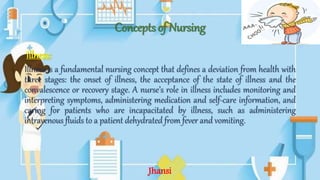
  • 76.
    ROLES& FUNCTIONSOF NURSE 4.Client advocate : Clientadvocate acts to protect the client. In this role the nurse may represent the client’s needs and wishes to other health professionals, such as relaying the client’s wishes for information to the physician. They also assist clients in exercising their rights and help them speak up for themselves. Jhansi
  • 77.
    ROLES& FUNCTIONSOF NURSE 5.Clinical & EthicalDecision Maker: Here the nurse uses the critical thinking skills throughout the nursing process and makes decisions in collaboration with client and family members. As a decision maker she collaborate and consult with other health care team members. Jhansi
  • 78.
    ROLES& FUNCTIONSOF NURSE 6.Counsellor: Counseling is aprocess of helping a client to recognize and cope with stressful psychological or social problems, to developed improved interpersonal relationships, and to promote personal growth. It involves providing emotional, intellectual, and psychological support. Jhansi
  • 79.
    ROLES& FUNCTIONSOF NURSE 7.Change agent: The nurseacts as a change agent when assisting others, that is, clients, to make modifications in their own behaviour. Nurses also often act to make changes in a system such as clinical care, if it is not helping a client return to health. Jhansi
  • 80.
    ROLES& FUNCTIONSOF NURSE 8.Leader : A leaderinfluences others to work together to accomplish a specific goal. The leader role can be employed at different levels; individual client, family, groups of clients, colleagues, or the community. Effective leadership is a learned process requiring an understanding of the needs and goals that motivate people, the knowledge to apply the leadership skills, and the interpersonal skills to influence others. Jhansi
  • 81.
    ROLES& FUNCTIONSOF NURSE 9.Manager : The nursemanages the nursing care of individuals, families, and communities. The nurse-manager also delegates nursing activities to ancillary workers and other nurses, and supervises and evaluates their performance. Case Manager: Nurse case managers work with the multidisciplinary health care team to measure the effectiveness of the case management plan and to monitor outcomes. Jhansi
  • 82.
    ROLES& FUNCTIONSOF NURSE 10. Research : consumerNurses often use research to improve client care. In a clinical area nurses need to: – Have some awareness of the process and language of research – Be sensitive to issues related to protecting the rights of human subjects – Participate in identification of significant researchable problems – Be a discriminating consumer of research findings Jhansi
  • 83.
    Expanded role ofthe nurse •Clinical Specialists Is a nurse who has completed a master’s degree in specialty and has considerable clinical expertise in that specialty. She provides expert care to individuals, participates in educating health care professionals and ancillary, acts as a clinical consultant and participates in research. Jhansi
  • 84.
    Expanded role ofthe nurse •Nurse Practitioner Is a nurse who has completed either as certificate program or a master’s degree in a specialty and is also certified by the appropriate specialty organization. She is skilled at making nursing assessments, performing P. E., counseling, teaching and treating minor and self- limiting illness. Jhansi
  • 85.
    Expanded role ofthe nurse •Nurse – Midwife A nurse who has completed a program in midwifery; provides prenatal and postnatal care and delivers babies to woman with uncomplicated pregnancies. •Nurse Anaesthetist A nurse who completed the course of study in an anaesthesia school and carries out pre-operative status of clients. Jhansi
  • 86.
    Expanded role ofthe nurse Nurse Educator A nurse usually with advanced degree, who beaches in clinical or educational settings, teaches theoretical knowledge, clinical skills and conduct research Nurse Entrepreneur A nurse who has an advanced degree, and manages health-related business. Nurse administrator A nurse who functions at various levels of management in health settings; responsible for the management and administration of resources and personnel involved in giving patient care. Jhansi
  • 87.
    Expanded role ofthe nurse • Nurse Researcher Nurse researchers are scientists who study various aspects of health, illness and health care. Nurse researchers identify research question, design and conduct scientific studies, collect and analyze data and report their findings. This is a highly specific category of nursing with various additional training in research methodology and tools used to perform research. The data collected can be used to save the lives of patients and make medical professionals’ lives easier on the job. Jhansi
  • 88.
  • 89.
    CATEGORIES OF NURSINGPERSONNEL • Nursing service is the part of the total health organization which aims at satisfying the nursing needs of the patients/community. In nursing services, the nurse works with the members of allied disciples such as dietetics, medical social service, pharmacy etc. in supplying a comprehensive program of patient care in the hospital. Definition of NursingServices:- • WHO expert committee on nursing defines the nursing services as the part of the total health organization which aims to satisfy major objective of the nursing services is to provide prevention of disease and promotion of health. Jhansi
  • 90.
    CATEGORIES OF NURSINGPERSONNEL ORGANISATION OF NURSING SERVICES IN HOSPITALS:- • CHIEF NURSING OFFICER | • NURSING SUPDT | • DY. NURSING SUPDT. | • ASSTT. NURSING SUPDT. | • WARD SISTER-CLINICAL SUPERVISOR (GRADE I) | • STAFF NURSE (Grade II) | • STUDENT NURSE Jhansi
  • 91.
    CNO (CHIEF NURSINGOFFICER): 1. She/he will be responsible for efficient running of Nursing Services at hospitals. 2. She will assist the Director in formulating broad policies concerning Nursing Services and inform the happening concerning the hospital. 3. She will disseminate the AIM, objectives and policies regarding patient care to all cadres of nursing services & will implement policies and procedures of Institute regarding nursing services. 4.She/he will plan future requirements of nurses and carry out recruitment of nurses from time to time. Jhansi
  • 92.
    Contd…. 5. She/he willplan and disseminate programmes for continuing education re- orientation programmes for nurses. 6. She/he will encourage research by nurses in their work areas. 7. She will strive to implement standard nursing practices and maintain highest quality of care. 8. She will critically analyse the budgets for nursing services. 9. Evaluate confidential reports of higher level nursing officers and recommend for promotion. Jhansi
  • 93.
    Nursing Superintendent: • isresponsible to the C.N.O. for planning organisation and development of nursing services in the hospital in consultation with Medical Supdt./Chief of centres. • 1. She will be responsible for implementing hospital policies amongst various nursing units. • 2. She will recommend personnel and material requirement for nursing various nursing service departments of the hospital. • 3. She will ensure safe and efficient care rendered to patients in various wards etc. • 4. She will prepare budgets for nursing services. • 5. She will be responsible for counseling and guidance of sub-ordinate staff. 6. Making duty roaster of nursing personnel. Jhansi
  • 94.
    DEPUTY NURSING SUPERINTENDENT: •• Deputy Nursing Superintendent is responsible to the Nursing Supdt. and assist her in the administration of nursing services in the hospital. 1. Supervise the nursing care given to the patients in various departments by taking regular round of her area. 2. Act as a liasion officer between Nursing Supdt. and the nursing staff of the hospital. 3. Interpret the policies and procedures of the Nursing service department to sub- oradinate staff and others. 4. Maintain the records of attendance of nursing staff and leave of any kind. Jhansi
  • 95.
    Contd…. • 5. Conductregular physical verification of hospital stocks, i.e. drugs, equipments etc. • 6. Initiate procedure for condemnation and procurement of hospital equipment/linen etc. • 7. Maintain the confidential report and records of nursing personnel. • 8. Assist the nursing supdt. in making master duty roster of nursing personnel. • 9. Arrange orientation programmes for new nursing staff. • 10. Maintain discipline among nursing personnel. • 11. Ensure clinical experience facilities for student nurses in various clinical areas of the hospital. Jhansi
  • 96.
    ASSISTANT NURSING SUPERINTENDENT: •• Asstt. Nursing Supdt, is responsible to Deputy Nursing Supdt. for the total nursing care of patients, management and development of the unit assigned to her 1. Plan and arrange duty for nursing personnel posted under her. 2. To ensure availability of adequate nursing staff in all shifts. 3. Maintain cleanliness of unit its annexes and environment. 4. Interact with the engineering service department for proper up keep of the unit. 5. Guide the Sister Grade-I to ensure supplies and equipments of different stores, and re-checking their use and care. 6. Maintain good public relation with patients relatives and the public, and project positive image of the hospital. 7. Maintain disciple of nursing and domestic staff. Jhansi
  • 97.
    NURSING SISTER GRADE-I: •• The Nursing Sister Grade-I is responsible to the Assistant Nursing Superintendent or the total care of patients in the wards and supervision of the Nursing Sister Grade-II, student nurses and Domestic staff. • She would also be assisted by Nursing Sister Grade-II, Clinical and Domestic staff. The main aim of the sister Grade-I should be to foster team spirit in her area of works as a team leader. Jhansi
  • 98.
    NURSING SISTER GRADE-II: 1.Nursingsister grade-II is directly responsible to Nursing Sister Grade-I (Ward In-Charge) for total nursing care of the patient assigned to him/her. Jhansi
  • 99.
    IN EDUCATIONAL… ORGANISATION OFNURSING PERSONNEL IN EDUCATIONAL INSTITUTES:- PRINCIPAL VICE PRINCIPAL • PROFESSORS • ASSOCIATE PROFESSORS • ASSISTANT PROFESSOR • CLINICAL INSTRUCTORS/NURSING TUTOR Jhansi
  • 100.
    ORGANISATION OF NURSINGPERSONNEL IN COMMUNITY SETTING • The nurses working in the community level are also a large part of the health care delivery system. • They work at various levels and provide care to various levels. • They can be broadly classified as – Female health worker – Community health nurse Jhansi
  • 101.
    ORGANISATION OF NURSINGPERSONNEL IN COMMUNITY SETTING • There are various community health nurse levels in various states of India. Generally they can be classified as : • DPHNO : District public health nursing Officer • BPHN: Block Public health Nurse • PHN : Public health nurse/ Lady Health Visitor • ANM: Axillary Nurse midwife / Female Health Workers Jhansi
  • 102.
    ORGANISATION OF NURSINGPERSONNEL IN COMMUNITY SETTING •Female Health Workers • Registers and cares for the pre-natal and post natal mothers at home. • Registers and follows up all the eligible couples. • Provides nutritional advice and immunization to mother and children. • Carries out family planning services and including the distribution of the contraceptives. • Provides treatment to minor ailments. • Notifies communicable diseases • Maintains the records and registers all the services provided and vital events like birth and death. • Participates in the various disease control programmes. • Conducts surveys of all sub-center areas and maintains records about every family. Jhansi
  • 103.
    ORGANISATION OF NURSINGPERSONNEL IN COMMUNITY SETTING •Community health nurse • Qualified community health nurse is one who has undergone general training , and basic education in the community health nursing. She must have a B.Sc. Nursing with a registration to work as a community health nurse • Roles of community health nurse is Health education, Individual practitioner, Decision maker, Programme director, Planner, Researcher, Supervisor, Evaluator, Advocate, and Direct care provider Jhansi
  • 104.
  • 105.
    HISTORY OF NURSING •Illness earlier was seen as “magic”, “sin” or “punishment”. During 700-600 B.C - Sushruta Samhita was written by the great surgeon Sushruta, who said "the physician, the patient, the drugs and the nurse are four feet of `Padas' of the medicine, upon which the cure depends". The first nursing school started in India in 250 B.C. during Charaka's time and only men were considered pure enough to be nurses. Other civilisations as Egyptians, Babylonians, Hebrews, Greeks and Romans also shows evidences of nursing care. Jhansi
  • 106.
    HISTORY OF NURSING •The early history of nurses suffers from a lack of source material, but nursing in general has long been an extension of the wet-nurse function of women. • 300 AD - Entry of women into nursing. Women began nursing as an expression of Christianity (acts of mercy). Women were recognized as important members of community. • 1633 - Sisters of Charity founded by Louise de Marillac - established the first educational program to be affiliated with a religious nursing order • 1809 - Mother Elizabeth Seton introduced the Sisters of Charity into America, later known as the Daughters of Charity. Jhansi
  • 107.
    HISTORY OF NURSING •Modernnursing began in the 19th century in Germany and Britain, and spread worldwide by 1900. •1836 - Deaconess Institute of Kaiserwerth, Germany, founded. This was the institute where Florence Nightingale received her initial education in nursing. •1860 - establishment of the Nightingale Training School for Nurses at St. Thomas Hospital in London, England. The first organized program for training nurses Jhansi
  • 108.
    HISTORY OF NURSING •DARK PERIOD OF NURSING - From 17th century – 19th century. Also called the Period of Reformation until the American Civil War. • Hospitals were closed. • Nursing were the works of the least desirable people (criminals, prostitutes, drunkards, slaves, and opportunists). Nurses were uneducated, filthy, harsh, ill-fed, overworked. • 1854 - 1856 (CRIMEAN WAR)- On Oct. 21, 1854, Nightingale left with 38women for the Crimean War—British casualties were high; within 6 months, death rate cut in half. Made rounds at night with a lamp “Lady of the Lamp”. Compiled the “Notes on Nursing: What it is and What is not” and became the first nurse theorist. Jhansi
  • 109.
    HISTORY OF NURSING •1884 - Mary Snively assumed directorship of Toronto General Hospital and began to form the Canadian National Association of Trained Nurses. Later became the Canadian Nurses Association. 1890 - establishment of the Nurses Associated Alumni of the United States and Canada & this later became the American Nurses Association. Jhansi
  • 110.
    HISTORY OF NURSING •1901 - first university affiliated nursing program, Army Nurse Corps established. • 1901 - New Zealand was the first country to regulate nurses nationally, with adoption of the Nurses Registration Act on the 12 September 1901. It was here in New Zealand that Ellen Dougherty became the first registered nurse. • 1911 - formed American Nurses Association. Jhansi
  • 111.
    HISTORY OF NURSING •1920 - graduate nurse-midwifery programs were established. • 1926 - ANA Code of Ethics approved. • 1948 - Brown report says all nursing programmes must be affiliated to the university, should have independent budget. • 1953 - National League for Nursing in collaboration with other universities, developed graduate nursing education. • 1960 – Yale University defined Nursing as a Profession. Jhansi
  • 112.
    HISTORY OF NURSING •1965 - National commission on nursing and nursing education was established. Nursing role and responsibility clarified. Increased financial support and career opportunities. • 1969 - American Association of Critical Care nurses formed • 1975 - Oncology Nurses Society formed • 1985 - ANA published code for nurses Jhansi
  • 113.
    HISTORY OF NURSING •In the ancient era, until 17th century, formalized nursing was not traced. Every village had a dai/traditional birth attendant to take care of maternal and child health needs of the people. Military nursing was the earliest type of modern nursing introduced by the Portuguese in the 17th century. • 1664 - East India Company started a hospital for soldiers at Fort St. Geroge, Madras. Florence Nightingale was the first woman to have great influence over nursing in India and brought reforms in military and civilian hospitals in 1861. St. Stevens Hospital at Delhi was the first one to begin training Indian women as nurses in 1867. Jhansi
  • 114.
    HISTORY OF NURSING •1871 - the government General Hospital at Madras was started with the first school of nursing for midwives with four students. Many nursing schools were started in different states of India between 18th and 19th century mostly by mission hospitals, which trained Indians as nurses. • 1907-1910 - in North India, United Board of Examiners for mission hospitals was set up which formulated training standards and rules. Jhansi
  • 115.
    HISTORY OF NURSING •Later Mid India (1926) and South India (1913) boards (boards of CMAI) were set up which conducted examination and gave diplomas. The first school of Health visitors was started in 1918 by Lady Reading Health School, Delhi. • 1946 - The first four-year Basic B.Sc. program was established at RAK College of Nursing in Delhi and CMC College of Nursing in Vellore. • 1951 - a two-year ANM course was established in St. Mary’s Hospital at Punjab. • 1960 - M.Sc. was established in RAK College of Nursing, Delhi. Jhansi
  • 116.
    HISTORY OF NURSING •1963 - the School of Nursing in Trivandrum, instituted the first two-year post certificate bachelor's degree programme. • 1980 - RAK college of nursing started an MPhil programme as a regular and part time course. Doctorate Of Philosophy In Nursing (PhD in Nursing. Earlier Indian nurses were sent abroad for Ph. D programme. PhD programmes in nursing was first started in India in 1992 under Department of Nursing, University of Delhi through RAK. Jhansi
  • 117.
    HISTORY OF NURSING •1992 - Post Basic BSc Nursing programme was launched by IGNOU, which is three years duration course is recognized by INC. Post-Basic/Post Certificate Short-Term Courses And Diploma Programmes: • During 1948-50 four nurses were sent to the U.K.by Govt. of India for mental health nursing diploma. • During 1954 Manzil Medical Health centre, Lucknow gave psychiatric nursing orientation course of 4 – 6weeks duration. • In 1951 a one year course in public health was started at college of nursing Delhi. Govt. of India felt urgent need for psychiatric nurses during 1953-54,this resulted in first organized course at All India Institute of Mental Health. • In 1962 diploma in peadatric nursing was established at J.J. Group of Hospitals, Bombay. At present there are many other courses of three months duration which are monitored and recognized by INC. Jhansi

  • 118.
    HISTORY OF NURSING •NURSING COUNCILS – • 1890 - Bombay Presidency Nursing Association was the first state nursing association. • 1908 - the Trained Nurses Association was formed to uphold the dignity and honor of nursing profession. The first state registration council at Madras Nursing Council was constituted in 1926 and Bombay Nursing Council was constituted in 1935. • In 1949, Indian Nursing Council (INC) was established to maintain a uniform standard of training for nurses, midwives and health visitors and regulate the standards of nursing in India. • INC act was passed in 1947 that was amended in 1950 and 1957. Jhansi
  • 119.
    HISTORY OF NURSING •By 2000, nursing advisor post was instituted at the national level; three nursing posts were increased to five with the introduction of Asst. Director General Nursing and Dy. Asst. Director General. • 2003 - The College of Nursing PGI, Chandigarh and College of Nursing, CMC Vellore were designated as WHO collaborating centers for nursing and midwifery development. Jhansi
  • 120.
    HISTORY OF NURSING •Nursing education have expanded considerably post independence. • University education in nursing brought about changes in nursing education. The type of nurses required today is an “all round personality”. • Education brings changes in behaviour of the individual in a desirable manner. It aims at all round development of an individual to become mature, self - sufficient, intellectually, culturally refined socially efficient and spiritually advanced. Jhansi
  • 121.
  • 122.
    VALUES • Values havemajor influence on a person's behavior and attitude and serve as broad guidelines in all situations. • Dictionary Definitions: • • The moral principles and beliefs or accepted standards of a person or social group. • • The principles that help you to decide what is right and wrong, and how to act in various situations Jhansi
  • 123.
    VALUES •Definitions: Values are enduringbeliefs or attitudes about the worth of a person, object, idea, or action. Values are important because they influence decisions and actions, including nurses’ ethical decision making. Jhansi
  • 124.
    Definition Of Values: •A Values are principles that allow us to guide our behavior to fulfill ourselves as individuals. • They are fundamental beliefs that help us prefer, accept and choose one thing over another or a behavior over another. They are also a source of satisfaction and fulfillment. They provide a guideline to formulate goals and objectives, whether personal or collective. They reflect our keenest interests, feelings and convictions. Values refer to human needs and represent ideals, dreams and aspirations. Their importance is independent of the circumstances. For example, even though we may be unfair, fairness still has a value. The same happens with wellbeing or happiness. Jhansi
  • 125.
    Types Of Values •We can speak of universal values, because ever since human beings have lived in community, they have had to establish principles to guide their behavior towards others. • In this sense, honesty, responsibility, truth, solidarity, cooperation, tolerance, respect and peace, among others, are considered universal values. • However, in order to understand them better, it is useful to classify values according to the following criteria: Personal values: These are considered essential principles on which we build our life and guide us to relate with other people. They are usually a blend of family values and social- cultural values, together with our own individual ones, according to our experiences. Jhansi
  • 126.
    Types Of Values •Familyvalues: These are valued in a family and are considered either good or bad. These derive from the fundamental beliefs of the parents, who use them to educate their children. They are the basic principles and guidelines of our initial behavior in society, and are conveyed through our behaviors in the family, from the simplest to the most complex. Jhansi
  • 127.
    Types Of Values •Social-culturalvalues: These are the prevailing values of our society, which change with time, and either coincide or not with our family or personal values. They constitute a complex mix of different values, and at times they contradict one another, or pose a dilemma. For example, if work is not valued socially as a means of personal fulfillment, then the society is indirectly fostering “anti-values” like dishonesty, irresponsibility, or crime. Jhansi
  • 128.
    Types Of Values •Materialvalues: These values allow us to survive, and are related to our basic needs as human beings, such as food and clothing and protection from the environment. They are fundamental needs, part of the complex web that is created between personal, family and social- cultural values. Jhansi
  • 129.
    Types Of Values •Spiritualvalues: They refer to the importance we give to non- material aspects in our lives. They are part of our human needs and allow us to feel fulfilled. They add meaning and foundation to our life, as do religious beliefs. Moral values: The attitudes and behaviors that a society considers essential for coexistence, order, and general well. Jhansi
  • 130.
    VALUES • Values InProfessional Nursing : Professional values are the guiding beliefs and principles that influence your work behaviour. • Your professional values are usually an extension of your personal values such as honesty, generosity and helpfulness. These values may change over time and around different life events, your core beliefs should stay the same. • Nurses professional values are acquired during socialization into nursing from codes of ethics, nursing experiences, teachers and peers. Jhansi
  • 131.
    VALUES • Values InProfessional Nursing : Professional nursing values were defined as important professional nursing principles of human dignity, integrity, altruism, and justice that serve as a framework for standards, professional practice, and evaluation. Schank and Weis stated that these are “standards for action that are accepted by the practitioner and/or professional group and provide a framework for evaluating beliefs and attitudes that influence behavior”. Jhansi
  • 132.
    VALUES • Values InProfessional Nursing : • The American Association of Colleges of Nursing (AACN, 1998) identified five values essential for the professional nurse: Altruism, Autonomy, Human dignity, Integrity, Social justice. Jhansi
  • 133.
    Essential Nursing Valuesand Behaviors VALUES Altruism Nurse’s concern for the welfare of patients, other nurses, and other health careproviders. Autonomy Nurses respects patient’s right to make decisionsabout their healthcare. Human Dignity Nurses values and respects the inherentworth and uniqueness of all patients andcolleagues. Integrity Nurses acts honestly and provides care based on an ethical framework. Social Justice Nurse upholds moral, legal, and humanistic principles by ensuring equal treatment under the law and equal access to quality health care. Professional Behaviors •Understands cultures, beliefs, and perspectives of others. •Advocates forpatients. •Take risks on behalf of patients andcolleagues. •Plans care in partnership withpatients •Provides culturally competent and sensitivecare. •Protects patient’sprivacy. •Designs care with sensitivity to individual patient needs. •Provides honest information to patients and the public. •Document care honestly andaccurately. •Seeks to remedy errors made by self orothers. •Demonstrates accountability of ownactions •Supports fairness and nondiscrimination in the delivery of care.
  • 134.
    VALUES • Other ValuesIn Professional Nursing : The values every nurse or midwife should work to, known as the 'six Cs’. • The six Cs - care, compassion, competence, communication, courage and commitment - are the other core nursing values. Core Values of Nurse Advocacy Three core values help form the basis of nursing advocacy: preserving human dignity; patient equality; and freedom from suffering. Jhansi
  • 135.
    Development of values/value transmission • • •An individual is not born with values, rather values are formed during a lifetime from information gathered from the envt, family & culture. • •As children observe the actions of others, they quickly learn what has high & low value for them. Jhansi
  • 136.
    Common modes ofvalue transmission: • Modelling • Moralizing • Laissez- faire • Rewarding & punishing • Responsible choice Jhansi
  • 137.
    Modelling: •Through modelling, childrenlearn what is of high or low value by observing parents, peers & significant others. Thus it leads to socially acceptable or unacceptable behaviour. Jhansi
  • 138.
    Moralizing: •In this modeof value transmission, children are taught a complete value system by parents or an institution that allows little opportunity for them to weigh different values. Jhansi
  • 139.
    Laissez-faire •In this approach,children are left to explore values on their own & to develop a personal value system. In this no one set of values is presented as best for all. This approach often involves little or no guidance & can lead to confusion & conflict. Jhansi
  • 140.
    Rewarding & punishing •Childrenare rewarded for demonstrating values held by parents & punished for demonstrating unacceptable values. Jhansi
  • 141.
    Responsible choice •In thismode, the caregivers encourage children to explore competing values and to weigh their consequences. Support & guidance are offered as children develop a personal value system. Jhansi
  • 142.
    Values Clarification: • Itis a process by which people identify, examine and develop their own individual values. • A method whereby a person can discover his or her own values by assessing, exploring, and determining what those personal values are and how they affect personal decision making. Jhansi
  • 143.
    Values Clarification: • Goal:The goal of "values clarification" is for you to become fully conscious of their influence, and to explore and honestly acknowledge what you truly value at this time in your life. This promotes personal growth by fostering awareness, empathy and insight. • Principles: No one set of values is right for everyone. Jhansi
  • 144.
    Values Clarification: • Steps/Theoryof Value Clarification: One widely used theory was developed by Raths, Harmin and Simon (1978). They described a valuing process of thinking, feeling and behaviour that they termed ‘choosing’, ‘prizing’ and ‘acting’. Jhansi
  • 145.
    Theory of ValuesClarification (Raths, Harmin, and Simon,1978) Valuing Process Choosing Cognitive •Beliefs are freely chosen. •Without outside pressure •After reflecting and considering consequences or alternatives Prizing Affective •Chosen beliefs are cherished or prized Acting Behavior •Chosen beliefs are affirmed to others, incorporated into one’s behavior and repeated consistently in one’s life.
  • 146.
    Values Clarification: •Clarifying theNurse’s Values Nurses and nursing students need to examine the values they hold about life, death, health and illness. One strategy for gaining awareness of personal values is to consider one’s attitudes about specific issues such as abortion or euthanasia, asking: “Can I accept this, or live with this?” “Why does this bother me?”…. Jhansi
  • 147.
    Values Clarification: • ClarifyingtheClient Values To plan effective care, nurses need to identify client’s values as they influence and relate to a particular health problem. For Eg:- A client with lose of eye sight will place high value on the ability to see. When clients hold unclear or conflicting values that are detrimental to their health, the nurse should use values clarification as an intervention. Jhansi
  • 148.
    Values Clarification • Clarifyingthe Client Values Examples are:- 1. List alternatives: make sure that the client is aware all the alternative actions. 2. Examine possible consequences of choice: make sure the client has thought about the possible results of each action. 3. Choose freely: to determine whether the client chose freely. 4. Feel good about the choice: to determine how the client feels. Jhansi
  • 149.
    Values Clarification 5. Affirmthechoice: ask “What will you say to others about this?” 6. Act on the choice: to determine whether the client is prepared to act on the decisions made. 7. Act with a pattern: to determine whether the client consistently behaves in a certain way. When implementing these seven steps to clarify values, the nurse assists the client to think each question through, but does not impose personal values. Jhansi
  • 150.
    Clarifying the ClientValues Process How? List Alternatives Ask: “Are you considering other alternative courses of actions?” “Tell me aboutthem” Examine possible consequences of choices Ask: “What do you think you will gain from doingthat?” Choose freely Ask: “Did you have any say in thatdecision?” Feel good about the choice Ask: “How do you feel about that decision?” “Some people feel good after a decision is made; others feel bad. How do youfeel?” Affirm the choice Ask: “What will you say to family or friendsaboutthis?” Act on the choice Ask: “Will it be difficult to tell your wife about this?” (it determines the client’s preparedness to act in hisdecision) Act with a pattern Ask: “How many times have you done that before?” or“Would you act that wayagain?”
  • 151.
    Values Clarification: Behaviors thatmay indicate unclear values. Behaviors • Ignoring a health professionals advice. • Inconsistent communication or behavior. Examples •A client with family problem and heart disease ignores advice to take rest. •A pregnant women says she wants a healthy baby, but continue to drink alcohol. Jhansi
  • 152.
    Clarifying the ClientValues Is an intervention used by the nurse s when clients experiences unclear values that are harmful to their health. Behavior Example Ignoring a health professional’s advice A child client’s parent who valuesthe Inconsistent communication behavior A n elderly who says she don’t want anymore to use cane when walking, but won’t cooperate during hertherapy. Numerous admissions to a health agency for the same problem A hypertensive client repeatedly seeks help for headache but does not take the prescribed maintenancemedicine. Confusion about which course of action to take A pregnant woman who values her job to meet financial obligations, but also needs to have complete bed rest for a safe labor anddelivery.
  • 153.
  • 154.
    ETHICS DEFINITIONS: The word ethicsis derived from the Greek word “ethos”, which means custom or guiding beliefs. Ethics is defined as a set of rules or principles that govern right conduct and is designed to protect the rights of a human being. Ethics is a branch of philosophy; it is moral philosophy or philosophical thinking about morality, moral problems, and moral judgements. Jhansi
  • 155.
    ETHICS DEFINITIONS: Nursing ethics isthe values and ethical principles governing nursing practice, conduct, and relationships. Nursing Ethics refers to the moral code of nursing & is based on obligation to service & respect for human life. Jhansi
  • 156.
    ETHICS • ETHICAL PRINCIPLE: Theethical principles that nurses must adhere to are:- The principles of justice, Beneficence ,Non – maleficence, Accountability ,Fidelity, Autonomy, Veracity. Jhansi
  • 157.
    ETHICAL PRINCIPLE: • Theprinciples of justice: Justice is fairness. Nurses must be fair when they distribute care. Care must be fairly, justly, and equitably distributed among a group of patients. • Beneficence: Beneficence is doing good and the right thing for the patient. • Non – maleficence: Nonmaleficence is doing no harm, as stated in the historical Hippocratic Oath. Harm can be intentional or unintentional. Jhansi
  • 158.
    ETHICAL PRINCIPLE: •Accountability: Accountabilityis accepting responsibility for one's own actions. Nurses are accountable for their nursing care and other actions. They must accept all of the professional and personal consequences that can occur as the result of their actions. •Fidelity: Fidelity is keeping one's promises. The nurse must be faithful and true to their professional promises and responsibilities by providing high quality, safe care in a competent manner. Jhansi
  • 159.
    ETHICAL PRINCIPLE: • Autonomy:Autonomy and patient self- determination are upheld when the nurse accepts the client as a unique person who has the innate right to have their own opinions, perspectives, values and beliefs. Nurses encourage patients to make their own decision without any judgments or coercion from the nurse. The patient has the right to reject or accept all treatments. • Veracity: Veracity is being completely truthful with patients; nurses must not withhold the whole truth from clients even when it may lead to patient distress. Jhansi
  • 160.
  • 161.
    CODE OF ETHICS •Code : Systematic collection of statutes, body of laws so arranged as to avoid inconsistency and overlapping ; set of rules on any subject. • A code of ethics is a set of ethical principles that are accepted by all members of a profession. Potter & Perry • Code of ethics is a guideline for performance & standards & personal responsibilities. Jhansi
  • 162.
    CODE OF ETHICS •PURPOSES: •Set standards for the behaviours of nurse & provide general guidelines for nursing action Helps to distinguish between right & wrong Enables a correct decision Protect the rights of individual Jhansi
  • 163.
    CODE OF ETHICS •An international code of ethics for nurses was first adopted by the International Council of Nurses (ICN) in 1953. • It has been revised and reaffirmed at various times since, most recently with this review and revision completed in 2012. Jhansi
  • 164.
  • 165.
    CODE OF ETHICS •The ICN Code of Ethics for Nurses has four principal elements that outline the standards of ethical conduct. • ELEMENTS OF THE CODE: 1. Nurses and people 2. Nurses and practice 3. Nurses and the profession 4. Nurses and co-workers Jhansi
  • 166.
    CODE OF ETHICS ELEMENTSOF THE CODE: 1. Nurses and people: The nurse’s primary professional responsibility is to people requiring nursing care.In providing care, the nurse promotes an environment in which the human rights, values, customs and spiritual beliefs of the individual, family and community are respected. The nurse ensures that the individual receives accurate, sufficient and timely information in a culturally appropriate manner on which to base consent for care and related treatment. Jhansi
  • 167.
    CODE OF ETHICS •ELEMENTSOF THE CODE: •1. Nurses and people •The nurse holds in confidence personal information and uses judgement in sharing this information. The nurse shares with society the responsibility for initiating and supporting action to meet the health and social needs of the public, in particular those of vulnerable populations. Jhansi
  • 168.
    CODE OF ETHICS •ELEMENTSOF THE CODE: •1. Nurses and people The nurse advocates for equity and social justice in resource allocation, access to health care and other social and economic services. The nurse demonstrates professional values such as respectfulness, responsiveness, compassion, trustworthiness and integrity Jhansi
  • 169.
    CODE OF ETHICS •ELEMENTSOF THE CODE: 2. Nurses and Practice: The nurse carries personal responsibility and accountability for nursing practice, and for maintaining competence by continual learning. The nurse maintains a standard of personal health such that the ability to provide care is not compromised. Jhansi
  • 170.
    CODE OF ETHICS •ELEMENTSOF THE CODE: 2. Nurses and Practice: •The nurse uses judgement regarding individual competence when accepting and delegating responsibility. The nurse at all times maintains standards of personal conduct which reflect well on the profession and enhance its image and public confidence. Jhansi
  • 171.
    CODE OF ETHICS •ELEMENTSOF THE CODE: 2. Nurses and Practice: •The nurse, in providing care, ensures that use of technology and scientific advances are compatible with the safety, dignity and rights of people. The nurse strives to foster and maintain a practice culture promoting ethical behaviour and open dialogue. Jhansi
  • 172.
    CODE OF ETHICS •ELEMENTSOF THE CODE: 3. Nurses and Profession: •The nurse assumes the major role in determining and implementing acceptable standards of clinical nursing practice, management, research and education. The nurse is active in developing a core of research-based professional knowledge that supports evidence-based practice. The nurse is active in developing and sustaining a core of professional values. Jhansi
  • 173.
    CODE OF ETHICS •ELEMENTSOF THE CODE: 3. Nurses and Profession: •The nurse, acting through the professional organisation, participates in creating a positive practice environment and maintaining safe, equitable social and economic working conditions in nursing. The nurse practices to sustain and protect the natural environment and is aware of its consequences on health. The nurse contributes to an ethical organisational environment and challenges unethical practices and settings. Jhansi

  • 174.
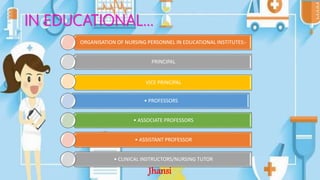
    CODE OF ETHICS •ELEMENTS OF THE CODE: 4. Nurses and co-workers: • The nurse sustains a collaborative and respectful relationship with co-workers in nursing and other fields. The nurse takes appropriate action to safeguard individuals, families and communities when their health is endangered by a co- worker or any other person. The nurse takes appropriate action to support and guide co-workers to advance ethical conduct. Jhansi
  • 175.
    CODE OF ETHICSBY INC • 1.The nurse respects the uniqueness of individual in provision of care - Nurse 1.1 Provides care of individuals without consideration of caste, creed, religion, culture, ethnicity, gender, socio-economic and political status, personal attributes, or any other grounds 1.2 Individualizes the care considering the beliefs, values and cultural sensitivities Jhansi
  • 176.
    CODE OF ETHICSBY INC 1.The nurse respects the uniqueness of individual in provision of care - Nurse 1.3 Appreciates the place of individual in the family and community and facilitates participation of significant others in the care. 1.4 Develops and promotes trustful relationship with individual(s) 1.5 Recognizes uniqueness of response of individuals to interventions and adapts accordingly Jhansi
  • 177.
    CODE OF ETHICSBY INC • 2. The nurse respects the rights of individuals as partner in care and help in making informed choices - Nurse 2.1 Appreciates individual’s right to make decisions about their care and therefore gives adequate and accurate information for enabling them to make informed choices 2.2 Respects the decisions made by individual(s) regarding their care Jhansi
  • 178.
    CODE OF ETHICSBY INC • 2. The nurse respects the rights of individuals as partner in care and help in making informed choices - Nurse 2.3 Protects public from misinformation and misinterpretations 2.4 Advocates special provision to protect vulnerable individuals/groups. Jhansi
  • 179.
    CODE OF ETHICSBY INC • 3. The nurse respects individual’s right to privacy, maintains confidentiality, and shares information judiciously- Nurse 3.1 Respects the individual’s right to privacy of their personal information 3.2 Maintains confidentiality of privileged information except in life threatening situations and uses discretion in sharing information. Jhansi
  • 180.
    CODE OF ETHICSBY INC 3. The nurse respects individual’s right to privacy, maintains confidentiality, and shares information judiciously- Nurse 3.3 Takes informed consent and maintains anonymity when information is required for quality assurance/ academic/legal reasons 3.4 Limits the access to all personal records written and computerized to authorized persons only. Jhansi
  • 181.
    CODE OF ETHICSBY INC • 4. Nurse maintains competence in order to render Quality NursingCare 4.1 Nursing care must be provided only by registered nurse 4.2 Nurse strives to maintain quality nursing care and upholds the standards of care 4.3 Nurse values continuing education, initiates and utilizes all opportunities for self development. 4.4 Nurses values research as a means of development of nursing profession and participates in nursing research adhering to ethical principles. Jhansi
  • 182.
    CODE OF ETHICSBY INC • 5. The nurse if obliged to practice within the framework of ethical, professional and legal boundaries - Nurse 5.1 Adheres to code of ethics and code of professional conduct for nurses in India developed by Indian Nursing Council 5.2 Familiarizes with relevant laws and practices in accordance with the law of the state Jhansi
  • 183.
    CODE OF ETHICSBY INC • 6. Nurse is obliged to work harmoniously with members of the health team- Nurse 6.1 Appreciates the team efforts in rendering care 6.2 Cooperates, coordinates and collaborates with members of the health team to meet the needs of people Jhansi
  • 184.
    CODE OF ETHICSBY INC •7. Nurse commits to reciprocate the trust invested in nursing profession by society __Nurse 7.1 Demonstrates personal etiquettes in all dealings 7.2Demonstrates professional attributes in all dealings Jhansi
  • 185.
    PROFESSIONAL CONDUCT FORNURSES: • Professional conduct refers to the manner in which nurses and midwives behave while acting in a professional capacity. • This code is not intended to give detailed professional advice on any specific issues and / or any specific areas of practice, rather it identifies the minimum requirements for conduct in the profession. Jhansi
  • 186.
    PROFESSIONAL CONDUCT FORNURSES: •A breach of the Code of Professional Conduct may represent professional misconduct or unprofessional conduct. •The profession expects that all levels of nurses and midwives will conduct themselves personally and professionally in a way that will maintain strong public confidence and care excellence in the profession. •Nurses and midwives have a responsibility to provide safe and competent care which is responsive to the individual, family, community needs and the profession. Jhansi
  • 187.
    PROFESSIONAL CONDUCT FORNURSES: •1. Professional Responsibility and accountability - Nurse 1.1 Appreciates sense of self-worth and nurtures it 1.2 Maintains standards of personal conduct reflecting credit upon the profession 1.3 Carries out responsibilities within the framework of the professional boundaries 1.4 Is accountable for maintaining practice standards set by Indian Nursing Council Jhansi
  • 188.
    PROFESSIONAL CONDUCT FORNURSES: •1. Professional Responsibility and accountability - Nurse 1.5 Is accountable for own decisions and actions 1.6 Is compassionate 1.7 Is responsible for continuous improvement of current practices 1.8 Provides adequate information to individuals that allows them informed choices 1.9 Practices healthful behaviour Jhansi
  • 189.
    PROFESSIONAL CONDUCT FORNURSES: •2. Nursing Practice - Nurse 2.1 Provides care in accordance with set standards of practice 2.2 Treats all individuals and families with human dignity in providing physical, psychological, emotional, social and spiritual aspects of care 2.3 Respects individuals and families in the context of traditional and cultural practices, promoting healthy practices and discouraging harmful practices Jhansi
  • 190.
    PROFESSIONAL CONDUCT FORNURSES: •2. Nursing Practice - Nurse 2.4 Presents realistic picture truthfully in all situations for facilitating autonomous decision- making by individuals and families 2.5 Promotes participation of individuals and significant others in the care 2.6 Ensures safe practice 2.7 Consults, coordinates, collaborates and follows up appropriately when individuals’ care needs exceed the nurse’s competence Jhansi
  • 191.
    PROFESSIONAL CONDUCT FORNURSES: • 3. Communication and Interpersonal Relationships - Nurse 3.1 Establishes and maintains effective interpersonal relationships with individuals, families and communities 3.2 Upholds the dignity of team members and maintains effective interpersonal relationship with them 3.3 Appreciates and nurtures professional role of team members 3.4 Cooperates with other health professional to meet the needs of the individuals, families and communities Jhansi
  • 192.
    PROFESSIONAL CONDUCT FORNURSES: •4. Valuing Human Being - Nurse 4.1 Takes appropriate action to protect individuals from harmful unethical practice 4.2 Considers relevant facts while taking conscience decisions in the best interest of individuals 4.3 Encourages and supports individuals in their right to speak for themselves on issues affecting their health and welfare 4.4 Respects and supports choices made by individuals Jhansi
  • 193.
    PROFESSIONAL CONDUCT FORNURSES: 5. Management - Nurse 5.1 Ensures appropriate allocation and utilization of available resources 5.2 Participates in supervision and education of students and other formal care providers 5.3 Uses judgment in relation to individual competence while accepting and delegating responsibility 5.4 Facilitates conductive work culture in order to achieve institutional objectives Jhansi
  • 194.
    PROFESSIONAL CONDUCT FORNURSES: •5. Management - Nurse 5.5 Communicates effectively following appropriate channels of communication 5.6 Participates in performance appraisal 5.7 Participates in evaluation of nursing services 5.8 Participates in policy decisions, following the principle of equity and accessibility of services 5.9 Works with individuals to identify their needs and sensitizes policy makers and funding agencies for resource allocation Jhansi
  • 195.
    PROFESSIONAL CONDUCT FORNURSES: • 6. Professional Advancement -Nurse 6.1Ensures the protection of the human rights while pursuing the advancement of knowledge 6.2 Contributes to the development of nursing practice 6.3 Participates in determining and implementing quality care 6.4 Takes responsibility for updating own knowledge and competencies 6.5 Contributes to core of professional knowledge by conducting and participating in research Jhansi
  • 196.
  • 197.
    LEGAL ISSUES INNURSING • As a nurse, it has become an important necessity to be aware of the legal aspects associated with caring and helping people in the healthcare industry today. • The first nursing law created was that of nursing registration in 1903. • Liability: As an educated professional, nurses are always legally responsible or liable for their action. Although each person is legally responsible for his or her own actions, there are also situations in which a person or organization may be held liable for actions taken by others. Some of the liabilities are personal, employers, supervisors etc. Jhansi
  • 198.
    LEGAL ISSUES INNURSING •Informedconsent: Every person has the right to either consent to or refuse medical treatment. The law requires that a person give voluntary and informed consent to treatment. This consent may be either verbal or written. Written consent usually is preferred in health care to ensure that a record of consent exists. The patients also have the right to withdraw the consent which in the case may notify the concerned authority. The consent of minor is usually given by a parent or legal guardian. If a true emergency exists, consent for care is considered to be implied. The law holds that if a reasonable person were aware that the situation was life- threatening, he or she would give consent for care. Jhansi
  • 199.
    LEGAL ISSUES INNURSING •Fraud: Fraud is a deliberate deception for the purpose of personal gain and is usually prosecuted as crime situations but fraud in nursing care are not common. One example would be trying to obtain a better position by giving incorrect information to a prospective employer. Medication errors: Some errors result from drugs with similar names, lookalike medication containers, poor systems for communication in which handwriting problems may contribute to lack of clarity. It may be charged and may contribute to the awarding of punitive damages as well as ordinary damages. Jhansi
  • 200.
    LEGAL ISSUES INNURSING • Torts: Torts are civil wrongs committed by one person against another. The wrong may be physical harm, psychological harm or harm to reputation, livelihood or some other less tangible value. Assault: Assault is an intentional threat to bring about harmful or offensive contact. No actual contact is necessary. It is an assault for a nurse to threaten to give a client for an X-ray procedure when the client has refused consent. Battery: Battery is a un-consented or unlawful touching of a person. For battery to occur, the touching must occur without consent. False imprisonment: The tort of false imprisonment occurs with unjustified restraining of a person without a legal warrant. For example, this occurs when nurses restrain a client in a bounded area to keep the person away from freedom. Jhansi
  • 201.
    LEGAL ISSUES INNURSING • Invasion of privacy: It is the intrusion into the personal life of another, without just cause, which can give the person whose privacy has been invaded a right to bring a lawsuit for damages against the person or entity that intruded. Negligence: It refers to the act of doing something or refraining from doing something that any other reasonable medical professional would do or refrain from doing in a similar situation. Eg. Breach of duty, Injury, Performance failures, etc, Jhansi
  • 202.
    LEGAL ISSUES INNURSING •Malpractice: It is defined as improper or negligent practice by a lawyer, physician, or another professional who injures a client or patient. Medical malpractice is defined as a wrongful act by a physician, nurse, or another medical professional in the administration of treatment or at times, the omission of medical treatment, to a patient under his or her care. Nursing malpractice takes many forms, including medication errors, failure to follow physician’s order, delaying patient care etc. Jhansi
  • 203.
  • 204.
    LEGAL RESPONSIBILITIES FORA NURSE • Registration: Licensing is a mandatory procedure for practice of nursing. Registration aims at protecting patients by providing qualified nurses. The nurse is responsible to obtain registration in the respective State Nursing Registration Council. Legal Liability/Act Of Negligence: License of a nurse can be suspended or cancelled for any act of negligence or mal practice, following a specified procedure. Jhansi
  • 205.
    LEGAL RESPONSIBILITIES FORA NURSE •Medico — Legal case (M.L.C.): A medico legal case is a patient who is admitted to the hospital with some unnatural pathology and has to be taken care of in concurrence with the police and/or court. •Correct identity: A nurse/midwife is responsible to make sure that all the patients especially the newborns are to be correctly identified and labelled. A nurse who is working with various instruments/swabs at OT have to check before closure it is returned. Jhansi
  • 206.
    LEGAL RESPONSIBILITIES FORA NURSE • Leave Against Medical Advice (L.A.M.A.): Inform medical officer in charge. Signatures of both patients and witness to be taken as per institutional policy. Patient's Property: Inform patient on admission that hospital does not take responsibility of his belongings. If patient is unconscious/ or otherwise required then a list of items must be made, counter checked by two staff nurses and kept under safe custody. Jhansi
  • 207.
    LEGAL RESPONSIBILITIES FORA NURSE •Dying Declaration: Doctor or nurse should not involve themselves in dying declaration, in case where police records the dying declaration. Dying declaration is to be recorded by the magistrate. But if condition of patient becomes serious then medical officer can record it along with two nurses it witness. Dying Declaration can be recorded by the nursing staff with two nurses as witness when medical officer is not present. Then the declaration has to be sent immediately in a sealed cover to the magistrate. Jhansi
  • 208.
    LEGAL RESPONSIBILITIES FORA NURSE •Wills: For this, doctor has to be present there, he can recode if requested. Examination of rape case: Female attendant/female nurse must be present during the examination. Artificial human insemination: Written consent should be obtained from both donor and recipient. Donor and recipient must have the same blood group. Donor and recipient's identity should be kept confidential. All related documents should be kept confidential & safe. Jhansi
  • 209.
    LEGAL RESPONSIBILITIES FORA NURSE •Poison case: Do not give either verbal or written opinion. Do not allow to take photos unless special permission is granted by appropriate authority. Do not give any information to public or press. Preserve all evidence of poisoning. Collect and preserve all excreta, vomits and aspirates, seal them immediately and send to forensic laboratory at the earliest. Consumer protection act (1986) Jhansi
  • 210.
  • 211.
    CONSUMER PROTECTION ACT •“An Act to provide for better protection of the interests of consumers and for that purpose to make provision for the establishment of consumer councils and other authorities for the settlement of consumers' disputes and for matters connected therewith.”(According to Consumer Protection Act, 1986). Consumer Protection Act, 1986 seeks to promote and protect the interest of consumers against deficiencies and defects in goods or services. It also seeks to secure the rights of a consumer against unfair or restrictive trade practices. Jhansi
  • 212.
    CONSUMER PROTECTION ACT •Objectives of CPA • To prevent the marketing of goods and services which are hazardous to life and property. • To protect the consumer on their right to be informed about the quality, quantity, potency, purity, standard and price of goods and services. • The right to access to a variety of goods and services at competitive prices as per the availability. • The right to use grievance redressal management system against unfair trade/service practices. The consumer is assured that their voice is heard. Jhansi
  • 213.
    CONSUMER PROTECTION ACT •Consumer Rights Vs Responsibilities SI. No Rights Responsibilities 1. Right to be heard 1. Ensure that the company has provided you the contact details of the consumer grievance handling system and are easily accessible. 2. Avoid purchase of products/services from a company which do not provide details of the consumer grievance officers to handle consumer grievances. Jhansi
  • 214.
  • 215.
  • 216.
  • 217.
  • 218.
  • 219.
    PATIENTS BILL OFRIGHTS • The Patient's Bill of Rights was first adopted by the American Hospital Association in 1973 and revised in October, 1992. Patient rights were developed with the expectation that hospitals and health care institutions would support these rights in the interest of delivering effective patient care. The American Hospital Association encourages institutions to translate and/or simplify the bill of rights to meet the needs of their specific patient populations and to make patient rights and responsibilities understandable to patients and their families. Jhansi
  • 220.
    PATIENTS BILL OFRIGHTS • DEFINITIONOF PATIENT’S BILLOF RIGHTS: Patient rights encompass legal and ethical issues in the provider- patient relationship, including a person’s right to privacy, the right to quality medical care without prejudicies, the right to make informed decisions about care and treatment options, and to right to refuse treatment. - US ADVISORY COMMISSION (1998) Jhansi
  • 221.
    PATIENTS BILL OFRIGHTS • GOALS OF PATIENT’S BILL OF RIGHTS: To help patients feel more confident in the health care system. To stress the importance of a strong relationship between patients and their health care providers. To stress the key role of patients play in staying healthy by laying out rights and responsibilities for all patients and health care providers. Jhansi
  • 222.
    PATIENTS BILL OFRIGHTS • WHAT ARE PATIENTS RIGHTS? Patients rights emanate from human rights, constitutional rights, civil rights, consumer rights, codes of ethics of medical and nursing profession. The Indian Constitution bestows certain rights on the citizens. One of them is Right to life. Right to a healthy life is an integral part of the Right to life. Basic optimal health care is the right of every Indian citizen and it is the responsibility of the state to provide it. The Government in the country has legislated certain laws to protect the citizens. Some of these are, The Drugs and Cosmetics Act, The Medical Council Act and The Consumer Protection Act. The codes of ethics of medical and nursing councils define the duties of the doctors and nurses towards the patients. Thus these duties form the basis of patient’s rights. Jhansi
  • 223.
  • 224.
    RIGHTS OF PATIENT •Right to considerate and respectful care. • Right to information on diagnosis, treatment and medicines. Right to obtain all the relevant information about the professionals involved in the patient care. • Right to expect that all the communications and records pertaining to his/her case be treated as confidential. • Right to every consideration of his/her privacy concerning his/her medical care programme. • Right to get quality health care without discrimination because of race, creed, gender, religion or source of payment. Jhansi
  • 225.
    RIGHTS OF PATIENT •Right to expect prompt treatment in an emergency. • Right to refuse to participate in human experimentation, research, project affecting his/her care or treatment. • Right to get copies of medical records. • Right to know what hospital rules and regulations apply to him/her as a patient and the facilities obtainable to the patient. • Right to get details of the bill. • Right to seek second opinion about his/her disease, treatment, etc. Complain or compliment without the fear of retaliation or compromise of access or quality of care. Jhansi
  • 226.
  • 227.
    CONCLUSION • • Nursingis one of the most exciting and in- demand jobs today. Nurses work to promote health, prevent disease and help patients cope with illness. • They are advocates and health educators for patients, families and communities. When providing direct patient care, they observe, assess and record patient symptoms, reactions and progress. • Nurses collaborate with physicians in the performance of treatments and examinations, the administration of medications and the provision of direct patient care in convalescence and rehabilitation. Jhansi
  • 228.
    CONCLUSION • • Nurseswork in an environment that is constantly changing to provide the best possible care for patients. • • They are continuously learning about the latest technology and medication as well as considering the evidence that their nursing practice is based upon. Because they will actually spend more face- to-face time with a patient than doctors, nurses must be particularly skilled at interacting with patients, putting them at ease, and assisting them in their recovery. It is often said that physicians cure, and nurses care. Jhansi
  • 229.
  • 230.
  • 231.
  • 232.
  • 233.