NURSING AS A
PROFESSION
NinaAnne Bernadette P
Paracad, MSN
Nurse Instructor
Medical Colleges of
Northern Philippines
2.
PROFESSION
It is anorganization of an occupational group based on
the application of special knowledge
which establishes its own rules and standards for
the protection of the public and the professionals.
Altruism- a core value of the profession that means selfless
service (concern in the well-being of others).
3.
PRIMARY CHARACTERISTICS/CRITERIA OFA PROFESSION
Education- Extended
education of its
members as well as
basic liberal foundation
Theory- a profession
must have a theoretical
body of knowledge
leading to defined
skills, abilities, and
norms
Service- must be able
to provide basic
services
Autonomy- members of
the profession have
autonomy in decision-
making and in practice
Code of ethics- a
profession has sufficient
self-impelling power to
retain its members
throughout life.
Caring- The most
unique characteristics
of nursing as a
profession
4.
NURSING
It is acaring profession. It is practiced
with an earnest concern for the art of care
and the science of health. The profession
involves a humanistic blend of scientific
knowledge and holistic nursing practice.
(science+health+caring=nursing)
CONCEPT OF NURSINGAND CARING
• An act utilizing the environment of the patient to assist him in
his recovery (Nightingale)
• Unique function of the nurse is to assist the individual sick or
well in the performance of those activities contributing to the
health or its recovery or to peaceful death….. or to help him
gain independence (Henderson)
• Nursing is a humanistic Science dedicated to compassionate
concern with maintaining and promoting health and
preventing illness and caring for and rehabilitating the sick
and disabled (Rogers)
7.
• A theoreticalsystem of knowledge
that prescribes a process of
analysis and action related to the
care of the ill person (Roy).
• An act of helping or assisting
(Orem).
• Assist individuals and society to
attain and maintain, and restore
the health, and dignity of the client
until death (King).
8.
• Unique professionthat is concerned with all the factors affecting
an individual’s response to stressors, the intra-, inter-, and extra-
personal in nature. (Neuman)
• A practice of caring that enables nurses to help the client to
recover in the face of illness. (Benner)
• Transpersonal caring expands the limits of openness and allows
access to the higher human spirit, thus expanding human
consciousness. (Watson)
• Integration of clients’ behavior at an optimal level under some
conditions. (Johnson)
9.
Caring is theessence and central unifying and dominant
domain that distinguishes nursing from the other health
disciplines. It refers to the direct and indirect nurturant and skillful
activities, processes, and decisions that assist people in many
ways that are emphatic, compassionate, and supportive.
(Leininger)
FIVE PROCESS
OF CARING
(SWANSON)
Knowing-striving to understand an event
as it has meaning in the life of the other
Being with- being emotionally present to
the other
Doing for- doing for the other as he/she
would do for the self if it were at all possible
Enabling- facilitating the other’s passage
through life transitions and unfamiliar events
Maintaining beliefs- sustaining faith in the
other’s capacity to get through an event or
transition and face a future with meaning
12.
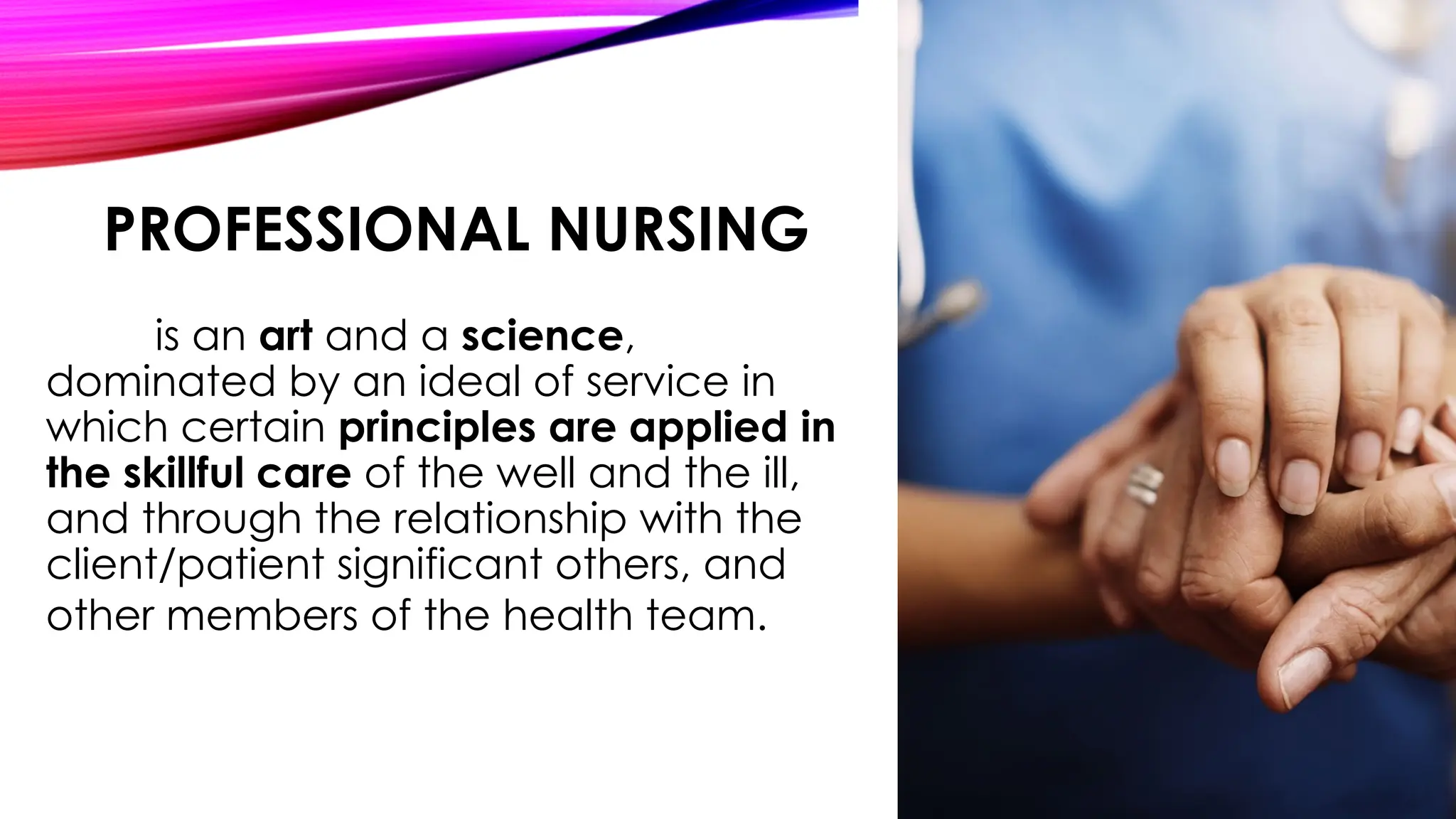
PROFESSIONAL NURSING
is anart and a science,
dominated by an ideal of service in
which certain principles are applied in
the skillful care of the well and the ill,
and through the relationship with the
client/patient significant others, and
other members of the health team.
13.
PROFESSIONAL NURSE
is onewho acquired the art
and science of nursing through
his/her education, and who
interprets his/her role in nursing.
14.
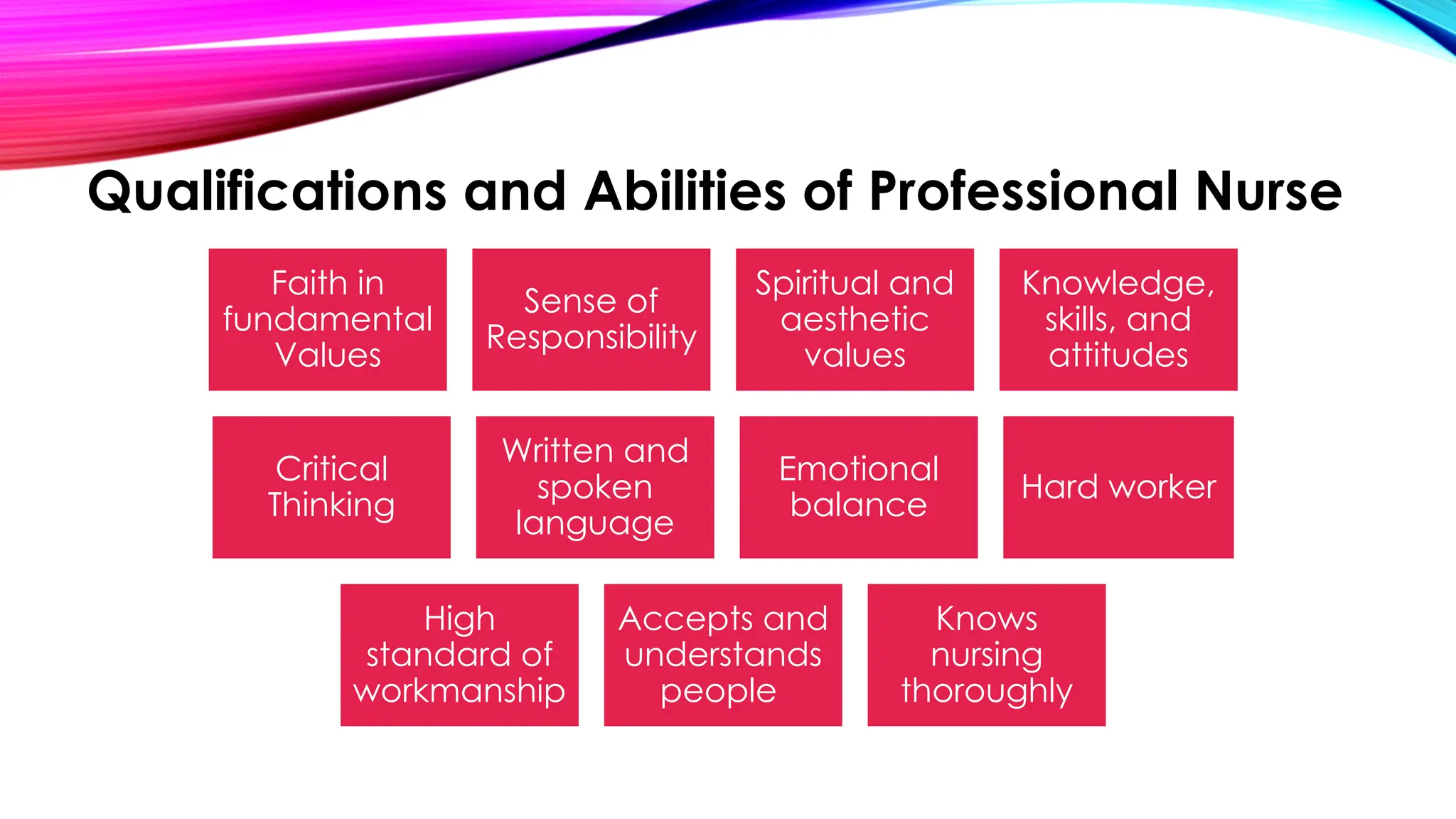
Qualifications and Abilitiesof Professional Nurse
Faith in
fundamental
Values
Sense of
Responsibility
Spiritual and
aesthetic
values
Knowledge,
skills, and
attitudes
Critical
Thinking
Written and
spoken
language
Emotional
balance
Hard worker
High
standard of
workmanship
Accepts and
understands
people
Knows
nursing
thoroughly
PHILOSOPHY OF LIFE
Itis concerned with the basic truths
that contribute to personal growth in a
systematic fashion and with those
principles that relate to the moral values
that shape the facets of the character.
17.
GOOD PERSONALITY
• Consistsof the distinctive
individual qualities that
differentiate one person from the
other
• It is a result of integrating one’s
abilities, desires impulses, habits,
and physical character into a
harmonious whole.
CHARACTER
Refers to themoral
values and beliefs that
are used as guides to
personal behavior and
actions.
Charity- the greatest
virtue and serves as the
foundation for a sense
of values and the
development of human
character.
20.
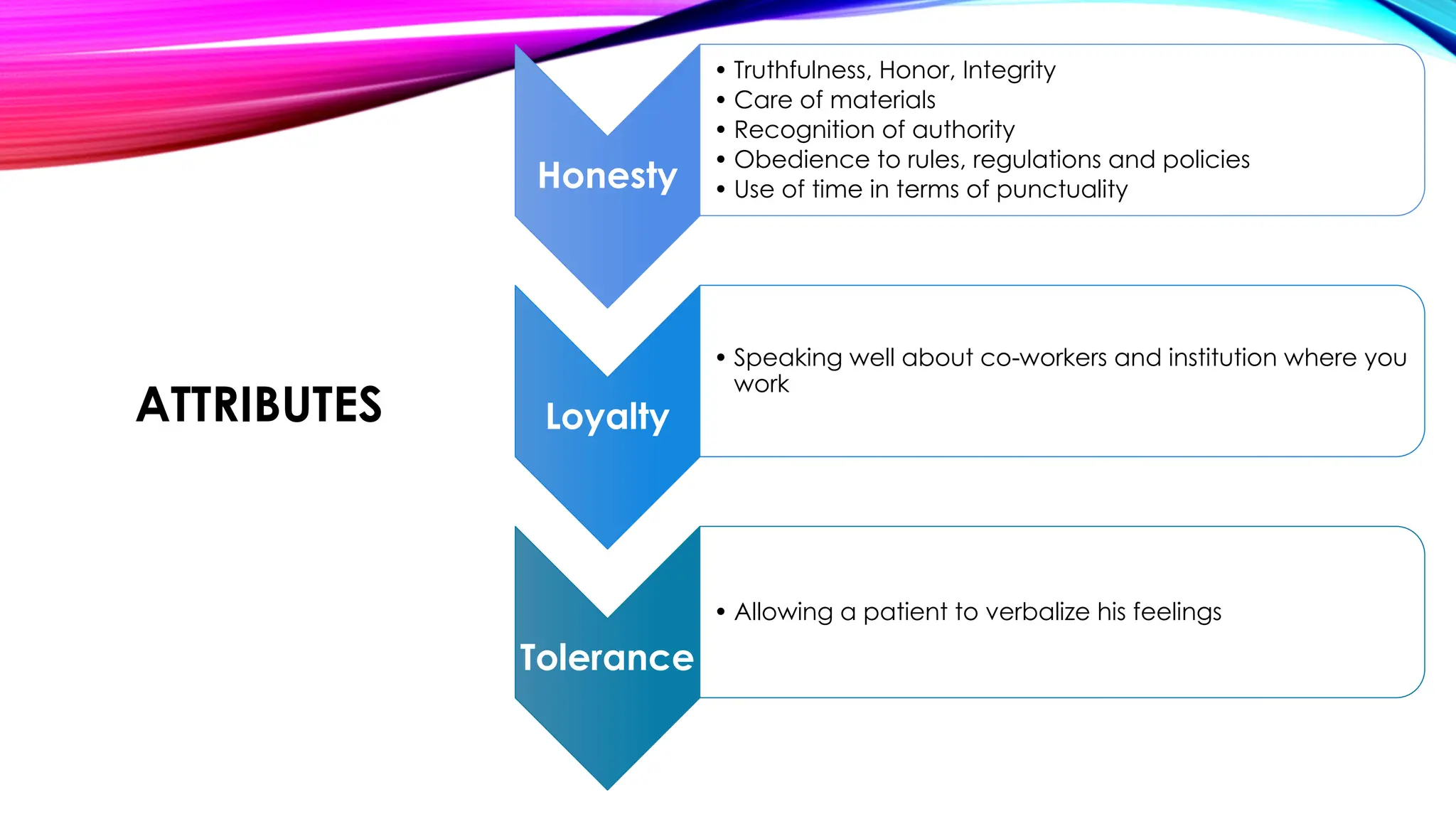
ATTRIBUTES
Honesty
• Truthfulness, Honor,Integrity
• Care of materials
• Recognition of authority
• Obedience to rules, regulations and policies
• Use of time in terms of punctuality
Loyalty
• Speaking well about co-workers and institution where you
work
Tolerance
• Allowing a patient to verbalize his feelings
CARPER’S PATTERN OFKNOWING
Empiric Knowing- Based on the
assumption that what is known is
accessible through physical senses
(seeing, hearing, touching), It is
expressed in practice as scientific
competence
Ethical Knowing- involves making
moment-moment judgments about
what is ought to be done, what is
good, what is right, and what is
responsible.
Personal knowing- concerns with inner
experience of becoming a holistic,
authentic self capable of unifying the
plural dimension in which that self lives
in an honest and open manner.
Aesthetic (esthetic) knowing- involves
deep appreciation of the meaning of
a situation and calls forth, inner
creativity that transforms experience
into what is not real, bringing reality
something that would not otherwise
be possible.
25.
LEVEL OF PROFICIENCYACCORDING TO PATRICIA
BENNER
Novice- beginning nursing student
or any nurse entering a situation in
which he or she has had no
previous experience.
Advance Beginner- Demonstrates
marginally acceptable
performance. He or she had
enough experience in actual
situations to identify meaningful
aspects or global characteristics
that can be identified only through
prior experience.
Competent- reflected by the nurse
who has been on the same job for
2-3 years and consciously and
deliberately plans care in terms of
long-term goals
Proficient- nurse perceives
situations as a whole rather than in
term of aspects and manages
nursing care rather than
performing tasks
Expert- nurse no longer relies on
rules or guidelines to connect an
understanding of a situation to
appropriate action. Has intuitive
grasp of the situation.
DIFFERENT FIELDS OFNURSING
Institutional Nursing
(Hospital Staff Nursing)
Community Health Nursing/
Public Health Nursing
Nurse Practitioner
Has advance education
( Bachelor Degree Holder, with
Master degree)
Clinical Nurse Specialist
Have advance specialty in areas
of practice ( gerontology,
oncology, pediatrics,
endocrinology)
28.
• Nurse Midwife
•Educated in nursing and midwifery and is licensed to provide
independent care for men during normal pregnancy, labor
and delivery.
• Nurse anesthetist
• RNs with advance education in anesthesiology
• Nurse researcher
• Nurse Administrators
• Nurse educator- must have at least Masters Degree
when teaching in the undergraduate, and Doctorate
Degree when teaching in the Post-graduate
29.
•RA 9173- PhilippineNursing Act of 2002
• Scope of nursing practice in the
Philippines.
30.
NURSING ETHICS
• Camefrom Greek word “ethos” which means moral
duty
• Standard to examine and understand moral life. It is
a study of how people make judgement in regards
to right or wrong.
31.
UNIVERSAL PRINCIPLES OFBIOMEDICAL ETHICS
• Autonomy- It involves self-determination and freedom to choose
and implement one’s decision, free from deceit, duress, constraint,
or coercion.
• Informed Consent
• Veracity- To maximize the efficiency of health care, the patient
and the healthcare providers are bound to tell the truth.
• Beneficence- Act of kindness and mercy that directly benefits the
patient (“to be good”)
• Nonmaleficence- “to do no harm”
• Justice- Right to demand to be treated justly, fairly and equally













![Reading Techniques [Autosaved].pptxReading Techniques [Autosaved].pptx](https://cdn.slidesharecdn.com/ss_thumbnails/readingtechniquesautosaved-251211193055-b8821f9d-thumbnail.jpg?width=640&height=640&fit=bounds)


