SEMINAR ON
INDEPENDENT
PRACTICE ISSUES
Presented by :-
Siyona Sanjay Bansode
F.Y. MSc. Nursing (Sem I)
General Objectives :
 At the end of the seminar the group
will be able to perceive in depth the
knowledge regarding independent
practice issues and will be able to
apply this knowledge in future nursing
practices.
Specific Objectives :
At the end of the class students will be
able to :
 Define Independent Nurse Practioner.
 Enlist the courses available for
Independent Nurse Practioner.
 Analyze the issues faced by the
nurses during independent practices .
Outline :
 Introduction
 Definition
 Philosophy Of INP
 Historical Development Of INP
 Key Practices
 Key Issues To Consider Professional Issues
 The Process Of Independent Nurse Practioner
 Independent Courses For Nurse Practioner
 Educational requirements for INP
 Responsiblities of INP
 Courses available for INP
 Issues of INP
 Summmary
 Conclusion
 Bibliography
INTRODUCTION :
Changes in health care and nursing
profession have provided nurses with
more opportunities to apply expertise
independently.
The government recognizes significant
expansion in tertiary care services both in
public and private health sectors. In
building their capacity, it is highly
significant that the health care
professionals require advanced
educational preparation in specialty and
super-speciality services. To support
specialized and super-specialized
 Nurse practitioners (NPs) will be able
to meet this demand provided they are
well trained and legally empowered to
practice. With establishment of new
cadres and legal empowerment,
master level prepared NPs will be able
to provide cost effective, competent,
safe and quality driven specialized
nursing care to patients in a variety of
settings in tertiary care centres.
DEFINITION
DEFINITION:
 According to American Academy of
Nurse Practioners :
“An Independent Nurse Practioner
is reffered as advanced practice nurse
has a master’s degree in nursing in the
specialized area of his/her interest and
licensed to practice in his/her state.”
 According to The International Council
Of Nurses :
An Independent Nurse Practioner
is a registered nurse who has acquired
the expert knowledge base, complex
decision making skills and clinical
competencies for expanded practice.
PHILOSOPHY OF INP
PHILOSOPHY OF INP :
 The core philosophy of INP is to
provide individuals care to patients of
all ages. It’s care focuses on patient’s
conditions as well as the effects of
illness on the lives of the patients and
their families.
 INP’s make prevention, wellness and
patient education priorities. This
means fewer prescriptions and less
expensive treatment.
 Informing patients of their healthcare
and encouraging them to participate in
decisions central to the care.
 In addition to care, INP’s conduct
research and are often active in
patient advocacy activities.
HISTORICAL DEVELOPMENT OF
INP
HISTORICAL DEVELOPMENT
OF INP :
 1965 :
Dr. Loretta Ford and Dr. Henry Silver
develop the first nurse practioner (NP)
program at the University Of Colorado.
 1967 :
Boston College initiates one of the earliest
master’s program of NP.
 1968 :
Directed by a nurse and physician team,
the Boston based Bunker Hill/
Massachuttess General Nurse Practioner
Program begins.
 1973 :
More than 65 NP programs exisit in the
U.S.
National Association of Peadiatric
Practitioners (NAPNAP) was
established.
 1978 :
The Association Of Faculties And
Paediatric Nurse Practioners (AFPNP)
was established and begins developing
PNP curriculum.
 1985 :
The American Academy of Nurse
Practioners (AANP) is established.
 1987 :
AANP conducts a member survey
regarding NP professional malpractice
liability insuarance coverage, assisting
NPs in re-establishing affordable
malpractice insurance.
 1989 :
Publication of the Journal of the
American Association Of Nurse
Practioners (JAANP) began.
 2019 :
AANP builds and moves into its first
fully owned corporate headquartes in
Austin, Texas. AANP surpasses
100,000 members.
KEY ISSUES
TO
CONSIDER
PROFESSIO
NAL
ISSUES
KEY ISSUES TO CONSIDER
PROFESSIONAL ISSUES:
Conflict Of Interest :
• Primary obligation is providing
professional care to his/her clients.
• In a position of trust and cannot use
their position to influence their clients
for financial gain of non financial
benefit.
• Avoid selling products or services to
clients they are treating.
• Avoid conflict of interest situations in
their practice, particularly when it
comes to the endorsement and
advertising of products
Endorsement :
• Endorsing or promoting a product or
services is closely linked to conflict of
interest.
• Endorsement occurs when a nurse uses
her credentials to lend to a commercial
product line or service.
• The endorsement of a product or service
without providing information about other
options could mislead the public and
compromise trust.
• For example, a nurse in independent
practice who provides foot care services
should not sell any foot care products for
her clients.
Advertising :
• Advertising may take various forms,
such as business cards listing in
telephone directories, announcements
in newspapers and periodicals and
promotional materials.
• It can include information such as a
description of services and nursing
credentials, practice experience, fees,
address and phone number.
Fees :
 According to Nursing Act 1991
 Submitting an account or change for
services that the member know false or
misleading.
 Failing to fulfill the terms of an
agreement for professional services.
 Changing a fee that is excessive in
relation to the service for which is
charged.
 Offering or giving a reduction for prompt
payment of an account.
 Before setting fees, a nurse should
research the fees of other nurses who
have similar qualification and experience
and who provide comparable services.
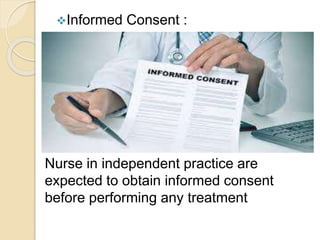
Informed Consent :
Nurse in independent practice are
expected to obtain informed consent
before performing any treatment
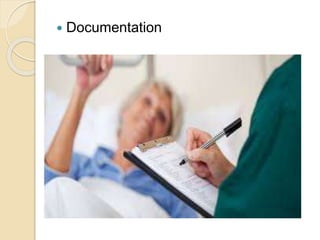
 Documentation
 Health records are the means by
which information about the client is
communicated the health care team
and how continuity of care is
maintained.
 They also demonstrate the nurses
accountability and answer questions
about the type of care provided.
Confidentiality System :
 Nurse in independent practice
requires to maintain the confidentiality
of the client information and cannot
communicate the information to
another person unless the client or
client’s representative gives consent
or it is required by law.
Other Issues:
 Bussiness or legal Council:
Nurses may want to seek legal advise
before starting and independent nursing
practice.
 Liability of Protection :
The college recommends that nurses in
independent practice purchase liability
protection to enable public redress if
any problems occurs.
 Networking:
Entrepreneurial support groups for self
employed nurses offer assistance with
peer feedback, idea and issue sharing,
planning for vacation and sickness etc.
THE PROCESS
OF
INDEPENDENT
NURSE
PRACTIONER
 Novice :
In the beginning a nursing student, or
any nurse entering a situation in which
there is no previous level of experience,
for example, an experienced operating
room nurse chooses to practice in home
health. The learner learns via specific
set of rules or procedures, which are
usually linear.
 Advanced Beginner :
A nurse who had some level of
experience with the situation is termed
as an advanced beginner. This
experience may only be observational
in nature, but the nurse is liable to
identify meaningful aspects of or
principles of nursing care.
 Competent :
A nurse who has been in same clinical
position for 2-3 years. This nurse
understands the organization and
specific care required by the type of
clients. E.g. Surgical, oncology or
orthopaedic clients. This nurse is a
competent practioner who is able to
anticipate nursing care and establish
long range goals. In this phase, the
nurse has usually had experience with
all types of psychomotor skills required
by this specific group of clients.
 Proficient :
A nurse with greater than 2-3 years of
experience in the same clinical position
will be proficient in that setting. This
nurse perceives a client’s clinical
situation, and can transfer knowledge
gained from multiple previous
experiences to a situation. This nurse
focuses on managing care opposed to
managing and performing skills.
 Expert :
A nurse with diverse experience who
has an imitative grasp of existing or
potential clinical problem is termed as
an expert. The nurse is skilled at
identifying client centered problems, as
well as problems related to healthcare
sytems or perhaps the needs of the
invoice nurse.
EDUCATIONAL
REQUIREMENTS FOR NURSE
PRACTIONERS
 Pursue a bachelor of science in
nursing ( BSN/ B.Sc. Nursing ) from
an accredited program ( 4 years).
 Become a registered nurse (RN) and
get experience in a concerned
speciality (1-2 years).
 Get proper regional licensure and
speciality certification.
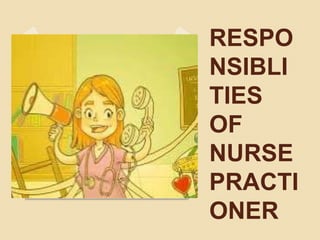
RESPO
NSIBLI
TIES
OF
NURSE
PRACTI
ONER
 Taking verbal patient histories
 Ordering and interpreting diagnostic
tests, including labs and imaging
 Prescribing medication
 Administering immunizations
 Developing and managing treatment
plans
 Performing in-office procedures
 Treating minor injuries
 Diagnosing acute and chronic
illnesses
 Developing policies
 Educating and counselling patients
INDEPENDEN
T COURSES
FOR NURSES
INDEPENDENT COURSES FOR
NURSES
 Adult Nurse Practioner
 Family Nurse Practioner
 Pediatric Nurse Practioner
 Acute Care Nurse Practioner
 Geriatric Care Nurse Practioner
 Psychiatric And Mental Health Nurse
Practioner
 School Health Nurse Practioner
 Family Nurse Practioner
 Midwifery Or Women’s Health Practioner
 Nurse Practioner In Critical Care
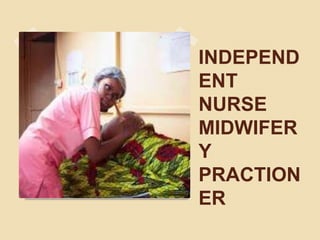
INDEPEND
ENT
NURSE
MIDWIFER
Y
PRACTION
ER
Introduction
Midwifery term is used to describe the
activities of health care providers who
are experts in the women health care
including prenatal care to expectant
mothers, attending at birth and
providing post-partum care to mother
and her infant. Practitioners of
midwifery are known as midwives.
Definition
Independent midwifery practice enables
registered nurse midwives to utilize their
knowledge skills, judgement and authority
in the provision of midwifery practice
package and primary women's health
services while maintaining accountability
for the management of patient care in
accordance with midwifery standards laid
down by the midwifery or nursing council
of their country. Independent should not
interpreted to mean alone, as there are
clinical situations when any prudent
practitioner would seek the assistance of
another qualified.
Midwifery Practice Package
For Independent Practice:
 Access to a midwife 24 hours a day, 7
days a week.
 Two midwives available alternatively and
provide women centered antenatal,
intrapartum and post-natal midwifery
care.
 Antenatal care in privacy.
 Continuity of care throughout labour.
 Post-natal care up to 6 weeks.
 Knowledgeable breast-feeding support.
Standard required for the
practice of Midwifery
Standard - I
 Midwifery care is provided by qualified
practitioners Midwifery should be
registered.
 Shows evidence of continuing
competency as required by
certification agency or council.
 It is in compliance with the legal
requirements of the jurisdiction where
the midwifery practice occurs.
Standard - II
 Midwifery care occurs in a safe environment
within the context of the family, community
and a system of health care.
 Demonstrates a safe mechanism for
obtaining medical consultation, collaboration
and referral.
 Uses community services as needed.
 Demonstrates knowledge of the medical,
psychological, economical, cultural and family
factors that affect care.
 Demonstrates appropriate techniques for
emergency management including
arrangements for emergency transportation.
 Promotes involvement of support persons in
the practice settings
Standard - III
 The midwives practices in accordance
with the philosophy and the code of
ethics of the professional body
provides clients with a description of
the scope of midwifery services and
information regarding the client's
rights and responsibilities.
Standard – IV
 Midwifery care is comprised of
knowledge, skills and judgement that
foster the delivery of safe satisfying and
culturally competent care.
 The midwife collects and assesses client
care data, develops and implement
individualized plan of management and
evaluates outcome of care.
 Demonstrates the clinical skills and
judgements described in the basic
midwifery practice.
 Practices in accordance with standards.
Standard – V
 Midwifery care is based upon
knowledge, skills, and judgment which
are reflected in written practice
guidelines.
 Midwife describes the parameters of
services for independent and
collaborative midwifery management
and transfer of care when needed.
 Establish practice guidelines for each
specialty area which may include, but
is not care of the child bearing family
and new born care.
 Includes the following information in
each specialty area
a) Client selection criteria
b) Parameters and methods for
assessing health status.
c) Parameters for risk assessment
d) Parameters for consultation,
collaboration and referral.
e) Appropriate interventions including
treatment, medications and or devices.
Standard – VI
 Midwifery care is documented in a
format that is accessible and
competent.
 The midwife uses records that
facilitate communications and
institutions.
 Provides prompt and complete
documentation of evaluation, course
of management and outcome of care.
Standard – VII
 Midwifery care is evaluated according
to an established programme for
quality management that includes a
plan to identify and resolve problems.
 The midwife participates in
programme of quality management for
the evaluation of practice within the
setting in which it occurs.
 Provides for a systemic collection of
practice data as a part of a
programme of quality, management.
Standard – VIII
 Midwifery practice may be extended
beyond the set competencies to
incorporate new procedure that
improve care for women and their
fames.
 The midwife identifies the need for
new procedure taking into
consideration consumer demand,
standards for safe practice and
availability of other
qualified personnel.
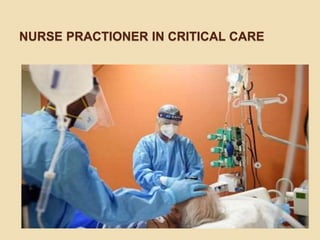
NURSE PRACTIONER IN CRITICAL CARE
Indtroduction
Critical Care Nurse Practitioner Program is
intended to prepare registered BSc Nurses
to provide advanced nursing care to adults
who are critically ill. The nursing care is
focused on stabilizing patients’ condition,
minimizing acute complications and
maximizing restoration of health. These
NPs are required to practice in tertiary
care centers. The program consists of
various courses of study that are based on
strong scientific foundations including
evidenced based practice and the
management of complex health systems.
The NPs in CC when exercising prescriptive
authority or drug administration as per
institutional protocols, they are accountable for
the competency in
 a) Patient selection/admission into ICU and
discharge
 b) Problem identification through appropriate
assessment
 c) Selection/administration of medication or
devices or therapies
 d) Patients’ education for use of therapeutics
 e) Knowledge of interactions of therapeutics,
if any
 f) Evaluation of outcomes and
 g) Recognition and management of
complications and untoward reactions.
Philosophy
 Indian Nursing Council believes that
there is a great need to establish a
postgraduate program titled Nurse
Practitioner in Critical Care to meet
the challenges and demands of
tertiary health care services in India
which is reflected in the National
Health Policy (NHP draft document
2015) in order to provide quality care
to critically ill patients and families.
 INC also believes that a variety of
educational strategies can be used in
the clinical settings to address the
deficit of qualified critical care nursing
faculty. It is hoped to facilitate
developing policies towards licensure
and create cadre positions for
appropriate placement of these
postgraduate critical care NPs in
tertiary care centers.
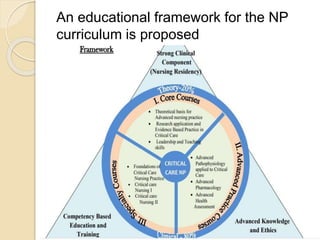
 An educational framework for the NP
curriculum is proposed
An educational framework for the NP
curriculum is proposed
Objectives
 1. Assume responsibility and accountability to
provide competent care to critically ill patients
and appropriate family care in tertiary care
centres.
 2. Demonstrate clinical competence /
expertise in providing critical care which
includes diagnostic reasoning, complex
monitoring and therapies
 3. Apply theoretical, patho-physiological and
pharmacological principles and evidence
base in implementing therapies /
interventions in critical care.
 4. Identify the critical conditions and carry
out interventions to stabilize and restore
patient’s health and minimize or manage
complications
 5. Collaborate with other health care
Standards/Requirements to start
the NP program :
The teaching institution must accept
the accountability for the NP program
and its students and offer the program
congruent with the INC standards. The
hospital should be a parent tertiary care
centre with a minimum of 500 beds and
above having Medical ICU, Surgical
ICU, Cardio/thoracic ICU and
Emergency care unit with a minimum of
10 beds and above in each ICU, to a
total of 40-50 ICU beds in the hospital.
ISSUES OF
INDEPENDENT
NURSE PRACTIONER
 An inadequate national nursing midwifery
education plan and development.
 Shortage of qualified nurse educators.
 Limited role and authority of INC in nursing
development.
 Lack of positions at State and National levels.
 Limited active involvement of professional
organization.
 Inadequate motivation to provide effective
care.
 Non-creation of posts for clinical nurse
specialist
 Insufficient nurse specialist and nurse
practioner.
 Inadequate standards and guidelines for
nurse practioners.
There are many legal issues confronting
practicing nursing today but nurses should
view the law, not with apprehension, but as a
helpful partner inn defining nursing practice.
Nurses who are aware of legal rights and
obligations are better prepared to take good
care of patients. Nurses are responsible for
knowing the laws that apply to their areas of
nursing practice.
Bibliography
 Jones L. In-patient nurse practioners. 1985. 48-
92
 Hooker,R,Cypher D, Sekscenski E. Patient
satisfaction with physician assistant, nurse
practioner and physician care, A method survey
of Medicare beneficiaries. J Clin Outcomes
Manage. 2005; 12 (2) : 88-92
 http://nurse-practioners-and-
physicianassistants.advancedweb.com/features/
articles/establishing-an-independent-nurse-
practioner-practice.aspx
 Advanced Nursing Practice By Shebeer P.
Basheer & S. Yaseen Khan publication of
EMMESS p.694 – 699
 Textbook of Advanced Nursing Practice By
Navdeep Kaur Brar & Rawat p. 975 – 983
 Advanced Nursing Practice By Neelam Kumari
HAVE A GOOD DAY AHEAD !!!

SEMINAR ON INDEPENDENT PRACTICE ISSUES.pptx

  • 1.
    SEMINAR ON INDEPENDENT PRACTICE ISSUES Presentedby :- Siyona Sanjay Bansode F.Y. MSc. Nursing (Sem I)
  • 2.
    General Objectives : At the end of the seminar the group will be able to perceive in depth the knowledge regarding independent practice issues and will be able to apply this knowledge in future nursing practices.
  • 3.
    Specific Objectives : Atthe end of the class students will be able to :  Define Independent Nurse Practioner.  Enlist the courses available for Independent Nurse Practioner.  Analyze the issues faced by the nurses during independent practices .
  • 4.
    Outline :  Introduction Definition  Philosophy Of INP  Historical Development Of INP  Key Practices  Key Issues To Consider Professional Issues  The Process Of Independent Nurse Practioner  Independent Courses For Nurse Practioner  Educational requirements for INP  Responsiblities of INP  Courses available for INP  Issues of INP  Summmary  Conclusion  Bibliography
  • 6.
    INTRODUCTION : Changes inhealth care and nursing profession have provided nurses with more opportunities to apply expertise independently. The government recognizes significant expansion in tertiary care services both in public and private health sectors. In building their capacity, it is highly significant that the health care professionals require advanced educational preparation in specialty and super-speciality services. To support specialized and super-specialized
  • 7.
     Nurse practitioners(NPs) will be able to meet this demand provided they are well trained and legally empowered to practice. With establishment of new cadres and legal empowerment, master level prepared NPs will be able to provide cost effective, competent, safe and quality driven specialized nursing care to patients in a variety of settings in tertiary care centres.
  • 8.
  • 9.
    DEFINITION:  According toAmerican Academy of Nurse Practioners : “An Independent Nurse Practioner is reffered as advanced practice nurse has a master’s degree in nursing in the specialized area of his/her interest and licensed to practice in his/her state.”
  • 10.
     According toThe International Council Of Nurses : An Independent Nurse Practioner is a registered nurse who has acquired the expert knowledge base, complex decision making skills and clinical competencies for expanded practice.
  • 11.
  • 12.
    PHILOSOPHY OF INP:  The core philosophy of INP is to provide individuals care to patients of all ages. It’s care focuses on patient’s conditions as well as the effects of illness on the lives of the patients and their families.  INP’s make prevention, wellness and patient education priorities. This means fewer prescriptions and less expensive treatment.
  • 13.
     Informing patientsof their healthcare and encouraging them to participate in decisions central to the care.  In addition to care, INP’s conduct research and are often active in patient advocacy activities.
  • 14.
  • 15.
    HISTORICAL DEVELOPMENT OF INP:  1965 : Dr. Loretta Ford and Dr. Henry Silver develop the first nurse practioner (NP) program at the University Of Colorado.  1967 : Boston College initiates one of the earliest master’s program of NP.  1968 : Directed by a nurse and physician team, the Boston based Bunker Hill/ Massachuttess General Nurse Practioner Program begins.
  • 16.
     1973 : Morethan 65 NP programs exisit in the U.S. National Association of Peadiatric Practitioners (NAPNAP) was established.  1978 : The Association Of Faculties And Paediatric Nurse Practioners (AFPNP) was established and begins developing PNP curriculum.
  • 17.
     1985 : TheAmerican Academy of Nurse Practioners (AANP) is established.  1987 : AANP conducts a member survey regarding NP professional malpractice liability insuarance coverage, assisting NPs in re-establishing affordable malpractice insurance.
  • 18.
     1989 : Publicationof the Journal of the American Association Of Nurse Practioners (JAANP) began.  2019 : AANP builds and moves into its first fully owned corporate headquartes in Austin, Texas. AANP surpasses 100,000 members.
  • 19.
  • 20.
    KEY ISSUES TOCONSIDER PROFESSIONAL ISSUES: Conflict Of Interest :
  • 21.
    • Primary obligationis providing professional care to his/her clients. • In a position of trust and cannot use their position to influence their clients for financial gain of non financial benefit. • Avoid selling products or services to clients they are treating. • Avoid conflict of interest situations in their practice, particularly when it comes to the endorsement and advertising of products
  • 22.
  • 23.
    • Endorsing orpromoting a product or services is closely linked to conflict of interest. • Endorsement occurs when a nurse uses her credentials to lend to a commercial product line or service. • The endorsement of a product or service without providing information about other options could mislead the public and compromise trust. • For example, a nurse in independent practice who provides foot care services should not sell any foot care products for her clients.
  • 24.
  • 25.
    • Advertising maytake various forms, such as business cards listing in telephone directories, announcements in newspapers and periodicals and promotional materials. • It can include information such as a description of services and nursing credentials, practice experience, fees, address and phone number.
  • 26.
  • 27.
     According toNursing Act 1991  Submitting an account or change for services that the member know false or misleading.  Failing to fulfill the terms of an agreement for professional services.  Changing a fee that is excessive in relation to the service for which is charged.  Offering or giving a reduction for prompt payment of an account.  Before setting fees, a nurse should research the fees of other nurses who have similar qualification and experience and who provide comparable services.
  • 28.
    Informed Consent : Nursein independent practice are expected to obtain informed consent before performing any treatment
  • 29.
  • 30.
     Health recordsare the means by which information about the client is communicated the health care team and how continuity of care is maintained.  They also demonstrate the nurses accountability and answer questions about the type of care provided.
  • 31.
  • 32.
     Nurse inindependent practice requires to maintain the confidentiality of the client information and cannot communicate the information to another person unless the client or client’s representative gives consent or it is required by law.
  • 33.
    Other Issues:  Bussinessor legal Council: Nurses may want to seek legal advise before starting and independent nursing practice.  Liability of Protection : The college recommends that nurses in independent practice purchase liability protection to enable public redress if any problems occurs.
  • 34.
     Networking: Entrepreneurial supportgroups for self employed nurses offer assistance with peer feedback, idea and issue sharing, planning for vacation and sickness etc.
  • 35.
  • 36.
     Novice : Inthe beginning a nursing student, or any nurse entering a situation in which there is no previous level of experience, for example, an experienced operating room nurse chooses to practice in home health. The learner learns via specific set of rules or procedures, which are usually linear.
  • 37.
     Advanced Beginner: A nurse who had some level of experience with the situation is termed as an advanced beginner. This experience may only be observational in nature, but the nurse is liable to identify meaningful aspects of or principles of nursing care.
  • 38.
     Competent : Anurse who has been in same clinical position for 2-3 years. This nurse understands the organization and specific care required by the type of clients. E.g. Surgical, oncology or orthopaedic clients. This nurse is a competent practioner who is able to anticipate nursing care and establish long range goals. In this phase, the nurse has usually had experience with all types of psychomotor skills required by this specific group of clients.
  • 39.
     Proficient : Anurse with greater than 2-3 years of experience in the same clinical position will be proficient in that setting. This nurse perceives a client’s clinical situation, and can transfer knowledge gained from multiple previous experiences to a situation. This nurse focuses on managing care opposed to managing and performing skills.
  • 40.
     Expert : Anurse with diverse experience who has an imitative grasp of existing or potential clinical problem is termed as an expert. The nurse is skilled at identifying client centered problems, as well as problems related to healthcare sytems or perhaps the needs of the invoice nurse.
  • 41.
    EDUCATIONAL REQUIREMENTS FOR NURSE PRACTIONERS Pursue a bachelor of science in nursing ( BSN/ B.Sc. Nursing ) from an accredited program ( 4 years).  Become a registered nurse (RN) and get experience in a concerned speciality (1-2 years).  Get proper regional licensure and speciality certification.
  • 42.
  • 43.
     Taking verbalpatient histories  Ordering and interpreting diagnostic tests, including labs and imaging  Prescribing medication  Administering immunizations  Developing and managing treatment plans  Performing in-office procedures  Treating minor injuries  Diagnosing acute and chronic illnesses  Developing policies  Educating and counselling patients
  • 44.
  • 45.
    INDEPENDENT COURSES FOR NURSES Adult Nurse Practioner  Family Nurse Practioner  Pediatric Nurse Practioner  Acute Care Nurse Practioner  Geriatric Care Nurse Practioner  Psychiatric And Mental Health Nurse Practioner  School Health Nurse Practioner  Family Nurse Practioner  Midwifery Or Women’s Health Practioner  Nurse Practioner In Critical Care
  • 46.
  • 47.
    Introduction Midwifery term isused to describe the activities of health care providers who are experts in the women health care including prenatal care to expectant mothers, attending at birth and providing post-partum care to mother and her infant. Practitioners of midwifery are known as midwives.
  • 48.
    Definition Independent midwifery practiceenables registered nurse midwives to utilize their knowledge skills, judgement and authority in the provision of midwifery practice package and primary women's health services while maintaining accountability for the management of patient care in accordance with midwifery standards laid down by the midwifery or nursing council of their country. Independent should not interpreted to mean alone, as there are clinical situations when any prudent practitioner would seek the assistance of another qualified.
  • 49.
    Midwifery Practice Package ForIndependent Practice:  Access to a midwife 24 hours a day, 7 days a week.  Two midwives available alternatively and provide women centered antenatal, intrapartum and post-natal midwifery care.  Antenatal care in privacy.  Continuity of care throughout labour.  Post-natal care up to 6 weeks.  Knowledgeable breast-feeding support.
  • 50.
    Standard required forthe practice of Midwifery Standard - I  Midwifery care is provided by qualified practitioners Midwifery should be registered.  Shows evidence of continuing competency as required by certification agency or council.  It is in compliance with the legal requirements of the jurisdiction where the midwifery practice occurs.
  • 51.
    Standard - II Midwifery care occurs in a safe environment within the context of the family, community and a system of health care.  Demonstrates a safe mechanism for obtaining medical consultation, collaboration and referral.  Uses community services as needed.  Demonstrates knowledge of the medical, psychological, economical, cultural and family factors that affect care.  Demonstrates appropriate techniques for emergency management including arrangements for emergency transportation.  Promotes involvement of support persons in the practice settings
  • 52.
    Standard - III The midwives practices in accordance with the philosophy and the code of ethics of the professional body provides clients with a description of the scope of midwifery services and information regarding the client's rights and responsibilities.
  • 53.
    Standard – IV Midwifery care is comprised of knowledge, skills and judgement that foster the delivery of safe satisfying and culturally competent care.  The midwife collects and assesses client care data, develops and implement individualized plan of management and evaluates outcome of care.  Demonstrates the clinical skills and judgements described in the basic midwifery practice.  Practices in accordance with standards.
  • 54.
    Standard – V Midwifery care is based upon knowledge, skills, and judgment which are reflected in written practice guidelines.  Midwife describes the parameters of services for independent and collaborative midwifery management and transfer of care when needed.  Establish practice guidelines for each specialty area which may include, but is not care of the child bearing family and new born care.
  • 55.
     Includes thefollowing information in each specialty area a) Client selection criteria b) Parameters and methods for assessing health status. c) Parameters for risk assessment d) Parameters for consultation, collaboration and referral. e) Appropriate interventions including treatment, medications and or devices.
  • 56.
    Standard – VI Midwifery care is documented in a format that is accessible and competent.  The midwife uses records that facilitate communications and institutions.  Provides prompt and complete documentation of evaluation, course of management and outcome of care.
  • 57.
    Standard – VII Midwifery care is evaluated according to an established programme for quality management that includes a plan to identify and resolve problems.  The midwife participates in programme of quality management for the evaluation of practice within the setting in which it occurs.  Provides for a systemic collection of practice data as a part of a programme of quality, management.
  • 58.
    Standard – VIII Midwifery practice may be extended beyond the set competencies to incorporate new procedure that improve care for women and their fames.  The midwife identifies the need for new procedure taking into consideration consumer demand, standards for safe practice and availability of other qualified personnel.
  • 59.
    NURSE PRACTIONER INCRITICAL CARE
  • 60.
    Indtroduction Critical Care NursePractitioner Program is intended to prepare registered BSc Nurses to provide advanced nursing care to adults who are critically ill. The nursing care is focused on stabilizing patients’ condition, minimizing acute complications and maximizing restoration of health. These NPs are required to practice in tertiary care centers. The program consists of various courses of study that are based on strong scientific foundations including evidenced based practice and the management of complex health systems.
  • 61.
    The NPs inCC when exercising prescriptive authority or drug administration as per institutional protocols, they are accountable for the competency in  a) Patient selection/admission into ICU and discharge  b) Problem identification through appropriate assessment  c) Selection/administration of medication or devices or therapies  d) Patients’ education for use of therapeutics  e) Knowledge of interactions of therapeutics, if any  f) Evaluation of outcomes and  g) Recognition and management of complications and untoward reactions.
  • 62.
    Philosophy  Indian NursingCouncil believes that there is a great need to establish a postgraduate program titled Nurse Practitioner in Critical Care to meet the challenges and demands of tertiary health care services in India which is reflected in the National Health Policy (NHP draft document 2015) in order to provide quality care to critically ill patients and families.
  • 63.
     INC alsobelieves that a variety of educational strategies can be used in the clinical settings to address the deficit of qualified critical care nursing faculty. It is hoped to facilitate developing policies towards licensure and create cadre positions for appropriate placement of these postgraduate critical care NPs in tertiary care centers.  An educational framework for the NP curriculum is proposed
  • 64.
    An educational frameworkfor the NP curriculum is proposed
  • 65.
    Objectives  1. Assumeresponsibility and accountability to provide competent care to critically ill patients and appropriate family care in tertiary care centres.  2. Demonstrate clinical competence / expertise in providing critical care which includes diagnostic reasoning, complex monitoring and therapies  3. Apply theoretical, patho-physiological and pharmacological principles and evidence base in implementing therapies / interventions in critical care.  4. Identify the critical conditions and carry out interventions to stabilize and restore patient’s health and minimize or manage complications  5. Collaborate with other health care
  • 66.
    Standards/Requirements to start theNP program : The teaching institution must accept the accountability for the NP program and its students and offer the program congruent with the INC standards. The hospital should be a parent tertiary care centre with a minimum of 500 beds and above having Medical ICU, Surgical ICU, Cardio/thoracic ICU and Emergency care unit with a minimum of 10 beds and above in each ICU, to a total of 40-50 ICU beds in the hospital.
  • 67.
  • 68.
     An inadequatenational nursing midwifery education plan and development.  Shortage of qualified nurse educators.  Limited role and authority of INC in nursing development.  Lack of positions at State and National levels.  Limited active involvement of professional organization.  Inadequate motivation to provide effective care.  Non-creation of posts for clinical nurse specialist  Insufficient nurse specialist and nurse practioner.  Inadequate standards and guidelines for nurse practioners.
  • 69.
    There are manylegal issues confronting practicing nursing today but nurses should view the law, not with apprehension, but as a helpful partner inn defining nursing practice. Nurses who are aware of legal rights and obligations are better prepared to take good care of patients. Nurses are responsible for knowing the laws that apply to their areas of nursing practice.
  • 71.
    Bibliography  Jones L.In-patient nurse practioners. 1985. 48- 92  Hooker,R,Cypher D, Sekscenski E. Patient satisfaction with physician assistant, nurse practioner and physician care, A method survey of Medicare beneficiaries. J Clin Outcomes Manage. 2005; 12 (2) : 88-92  http://nurse-practioners-and- physicianassistants.advancedweb.com/features/ articles/establishing-an-independent-nurse- practioner-practice.aspx  Advanced Nursing Practice By Shebeer P. Basheer & S. Yaseen Khan publication of EMMESS p.694 – 699  Textbook of Advanced Nursing Practice By Navdeep Kaur Brar & Rawat p. 975 – 983  Advanced Nursing Practice By Neelam Kumari
  • 72.
    HAVE A GOODDAY AHEAD !!!