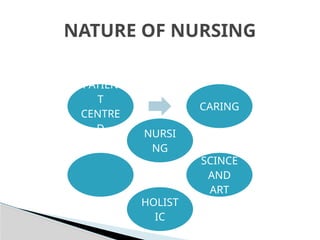
Nursing is anart and a science. As a
professional nurse you will learn to
deliver care artfully with compassion,
caring and respect of each patient’s
dignity and personhood. As a science,
nursing practice is based on a body of
knowledge that is continually changing
with new discoveries and innovations ,
INTRODUCTION OF NURSING
4.
The word nurseoriginated from the
Latin word NUTTIX ,which means “to
nourish". The nurse is defined as
person who nourishes ,fosters. Protects
and who is prepared to take care of
sock ,injured and aged people with the
expanding role and functions of the
nurse .in today’s society ,however ,any
one definition is too limited to define
nursing
CONCEPTS OF NURSING
5.
Nursing is anart and science .it
may be defined as service to the
individual which helps him/her to
obtain or maintain a helathy state of
mind or body and the relief of pain and
discomfort .
-Hemmer and Henderson
DEFINITION OF NURSING
6.
Nursing is aunique function of the
nurse, to assist individual , sick or well in
the performance of those activities
contributing to health or recovery or to a
peaceful death that he/ she had the
necessary strength, will or knowledge,
and to do so in such in such a way as to
help him/her to gain independence as
rapidly a possible.
-Virginia Henderson
DEFINITION OF NURSING
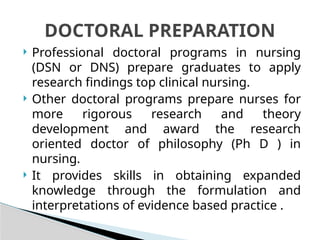
7.
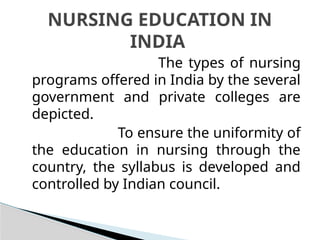
Philosophy of nursingstates that our
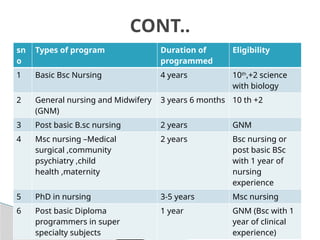
thoughts on what we believe to be true about
the nature of the profession of nursing and
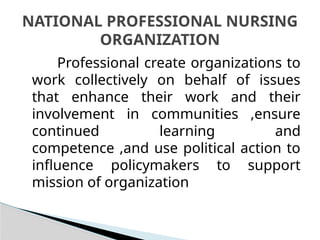
provide a basis for nursing activities .
The international council of nurses states
the philosophy of nursing as following
We work as a collaborative team to
continuously improve the health and well
beings of ourselves and the community
PHILOSOPHY OF NURSING
8.
We accept andrespect our patient’s unique
view of self and their world.
We believe in the involvement of the
professional nurse in share governance and we
incorporate research and evidence based
practice in the development of standards of
care.
Nurses are responsible for lifelong learning,
accountability for their practice and
participation in interdisciplinary activity.
PHILOSOPHY OF NURSING
9.
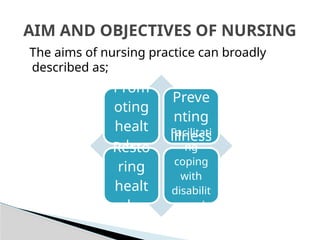
The aims ofnursing practice can broadly
described as;
AIM AND OBJECTIVES OF NURSING
Prom
oting
healt
h
Preve
nting
illness
Resto
ring
healt
h
Facilitati
ng
coping
with
disabilit
y and
death
10.
PROMOTING HEALTH
Health promotion is a framework for
nursing activities.
Increasing health awareness by teaching
certain behaviors and factors that can prevent
deterioration in health.
Encouraging health promotion by providing
information and referrals.
Teaching self care activity to maximize
achievement of goal.
AIM AND OBJECTIVES OF NURSING
11.
PREVENTING ILLNESS
Nurseprevent illness primarily by
teaching which includes educational
programmes and community
programmes for promoting health
habits.
Education through literatures, television
,radio and internet.
AIM AND OBJECTIVES OF NURSING
12.
RESTORING HEALTH
Focusing on early detection of disease for
rehabilitation and teaching during recovery.
Promoting diagnostic measurement for
early detection of disease.
Providing direct care to person who is ill.
Collaborating with other health care
provider.
AIM AND OBJECTIVES OF NURSING
13.
FACILITATING COPINGWITH DISABILITY AND
DEATH
Altered function decrease an individuals
ability to carry out activities of daily living and
the expected role.
Nurse can facilitate an optimum level of
function by maximizing the patients strength
and potentials through teaching and referring
both the patient and family to community
resources during the last phase of life.
AIM AND OBJECTIVES OF NURSING
14.
The characteristics ofnursing are;
Nursing is a care
Nursing involves close personal contact with
the recipient of care.
Nursing is concerned with services that take
humans into account as physiological
psychological and sociological organisms.
Nursing is committed to promoting individual,
families, communities and national health goal
in its best manner possible.
CHARACTERISTICS OF NURSING
15.
Nursing is committedto personalized
services for all persons with out regard
to color and social or economic status.
Nursing is committed to involvement in
ethical , legal ,and political issues in the
delivery of health care.
CONTINUE
FUNCTION OF NURSING
Caregiver
Counselor
Clinical and ethical decision maker
Protector and clinical advocate
Change agent
Case manager
Rehalibilitator
Comforter
Communicator
Teacher
Leader
Researcher
18.
To become agood nurse
Self confident
Humble and honest
Loyal
Co operative
Good listener
Keen observer
Good administrator
QUALITY OF NURSE
19.
Good supervisor
Impartial
Capable
Good workman
Responsible
Accountable
Competent
Goodly judgmental
Advocate
QUALITY OF NURSE
20.
Specialized education
Specializededucation is an
important aspect of professional
status .there are five means of entry
into registered nursing, hospital
master’s degree ,baccabureate degree,
master’s degree and doctoral degree
BASIC CHARACTERISTICS OF A PROFESSION
21.
Body ofknowledge
As a profession , nursing is establishing
a well defined body of knowledge and
expertise
Service Orientation:
A service orientation differentiates
nursing from an occupation pursued
primarily for profit
BASIC CHARACTERISTICS OF A PROFESSION
22.
Ongoing Research
increasingresearch in nursing is
contributing to nursing practice .Most early
research was directed to the study of nursing
education.
Code of ethics:
the nursing profession requires
integrity of its members i.e. a member is
expected to what is right regardless of the
personal cost
BASIC CHARACTERISTICS OF A PROFESSION
23.
When givingcare ,it is essential
to provide a specified service according
to the standards of practice and to
follow the code of ethics
Professional practice includes
knowledge from social and behavioral
sciences ,biological and physiological
sciences and nursing theories
SCOPE AND STANDARDS PRACTICE
24.
The standardsof practice describe a
competent level of nursing care . The
level of care are demonstrated by a
critical thinking model known as
nursing process .
Assessment , diagnosis, outcomes,
identification and planning,
implementation and evaluation
STANDARD PRACTICE
25.
The ANA standardsof professional performance
Ethics
Education
Evidenced based practice and research
Quality of practice
Communication
Leadership
Collaboration
Professional practice evaluation
Resources
Environmental health
STANDARDS OF PROFESSIONAL
PERFORMANCE
26.
• You areresponsible for obtaining
and maintaining specific knowledge and skills
for a variety of professional role and
responsibilities
Autonomy and Accountability:
Autonomy is essential element of
professional nursing that involves the
initiation of independent nursing
interventions without medical order
PROFESSIONAL
RESPONSIBILITIES AND ROLES
27.
Caregiver
As acaregiver you help patients maintain and
regain health ,manage disease and symptoms
and attain a maximal level of function and
independence through the healing process.
Advocate:
As a patient advocate you product your
patient’s human and legal rights and provides
assistance in asserting these rights if need
arises.
PROFESSIONAL RESPONSIBILITIES
AND ROLES
28.
Educator
As aeducator you explain
concepts and facts about health,
describe the reason for routine care
activities ,reinforce learning or
patient behavior and evaluate the
patient’s progress in learning
PROFESSIONAL RESPONSIBILITIES
AND ROLES
29.
Communicator
Your effectivenessas a communicator is
central to the nurse –patient relationship. It
allows you to know your patients, including
their strengths, weaknesses and needs.
Manager
Today’s healthcare environment is last
paced and complex nurse managers need to
establish an environment for collaborative
patient centered care to provide safe quality
case with positive patient outcomes.
PROFESSIONAL RESPONSIBILITIES AND ROLES
30.
Nursing providesan opportunity for you to commit
to lifelong learning and career development because
of increasing educational opportunities for nurses
the growth of nursing as a profession offers different
career opportunities
Care provider :
Most nurses provide direct patient care in
an acute care setting. However as changes in health
care services and reimbursement continue. there will
be an increase in the direct care setting and an
increased need for community based health
promotion activities
CAREER DEVELOPMENT
31.
ADVANCED PRACTICERIGISTER NURSE
The advanced practice registered nurse (APRN) is
the most independently functioning nurse .An
APRN has advanced education in path
physiology and physical assessment and
certification and expertise in a specialized area
of practice.
Clinical nurse specialist
A clinical nurse specialist (CNS)
is an APRN who is an expert clinician in a
specialized area of practice.
32.
Nurse Practitioner
Anurse practitioner (NP)is an APRN who
provides health care to group of patients
usually is an out patient ambulatory care or
community based setting.
Certified Nurse midwife:
A certified nurse midwife
(CNW) is an APRN who is also educated in
midwifery and is certified by the American
college of nurse midwives .
33.
Certified registerednurse anesthetist
A Certified registered nurse
anesthetist (CRNA) is an APRN with
advanced education from a nurse
accredited program.
Nurse Educator :
A nurse educator works primarily in
schools of nursing ,staff development
departments of health care agencies
and patients education department
34.
Nurse administrator:
A Nurse administrator manages patient
care and the delivery of specific nursing
services with in a health care agency. Nursing
services with in a health care agency. Nursing
administration being with positions such as
clinical care co coordinators
Nurse researcher
The nurse researcher conducts
evidence based practice and research to
improve scope of nursing practice
35.
Nursing is adynamic profession
that grows and evolves as society and
lifestyles change as health care
priorities and technologies change and
a nurses themselves change which
addresses the needs of the whole
person in all dimension in health and
illness and in interaction with the
family and community.
TRENDS IN NURSING
36.
Today thegeneral public is more informed
about their health care needs the cost of health
care and the incidence of medical errors with in
health care institutions.
Your practice needs to be based on current
evidence ,not just according to your education
and experiences and the policies nit just
according to your education and experiences
and the policies and procedures of health care
facilities.
EVIDENCE BASED PRACTICE
37.
To reducehealth care errors and improve
patient safety by implementing evidence based
practices.
In addition , many hospitals are achieving
magnet recognition which recognizes
excellences in nursing practice.
A Component of excellence in practice is quality
of care which is achieved by implementing
evidence based practice.
CONT..
38.
The RWSFsponsored the (Quality and safety
education for nurse (QSEN) imitative to
respond to reports about safety and quality
patient care by the ION .
To prepare nurses with the competencies
needed to continuously improve the quality of
care in their work environment .
The competencies of patient centered care,
teamwork and collaboration evidence based
practice, quality improvement, safety and
informatics.
QUALITY AND SAFETY EDUCATION
FOR NURSES
39.
Nursing requiresa significant amount of formal
education
Most nurse agree that nursing education is
important to practice and tat education needs to
respond to changes in health care created by
scientific and technological advances
Various education preparations are available for
an individual intending to be an RN. In
addition ,graduate nurse education and
continuing and in service education are available
for practicing nurses
PROFESSIONAL REGISTERED NURSE
EDUCATION
40.
Degree programusually includes 4 years of
study in a college or university .It focus on the
basic sciences this the critical and clinical
courses and course in the social sciences arts
and humanities to support nursing theory .
Graduate Education:
After obtaining a baccalaurean degree in
nursing you can pursue graduate education
leading to a master’s or doctoral degree in
any number of graduate fields, including
nursing .
CONT..
41.
A nurse completinga
graduate program can receive a
master’s degree in nursing. A graduate
degree provides the advanced clinician
with string skills in nursing science and
theory. A master’s degree in nursing is
important for the roles of nurse
educator and nurse administrator.
CONT..
42.
Professional doctoralprograms in nursing
(DSN or DNS) prepare graduates to apply
research findings top clinical nursing.
Other doctoral programs prepare nurses for
more rigorous research and theory
development and award the research
oriented doctor of philosophy (Ph D ) in
nursing.
It provides skills in obtaining expanded
knowledge through the formulation and
interpretations of evidence based practice .
DOCTORAL PREPARATION
43.
The types ofnursing
programs offered in India by the several
government and private colleges are
depicted.
To ensure the uniformity of
the education in nursing through the
country, the syllabus is developed and
controlled by Indian council.
NURSING EDUCATION IN
INDIA
44.
sn
o
Types of programDuration of
programmed
Eligibility
1 Basic Bsc Nursing 4 years 10th
,+2 science
with biology
2 General nursing and Midwifery
(GNM)
3 years 6 months 10 th +2
3 Post basic B.sc nursing 2 years GNM
4 Msc nursing –Medical
surgical ,community
psychiatry ,child
health ,maternity
2 years Bsc nursing or
post basic BSc
with 1 year of
nursing
experience
5 PhD in nursing 3-5 years Msc nursing
6 Post basic Diploma
programmers in super
specialty subjects
1 year GNM (Bsc with 1
year of clinical
experience)
CONT..
45.
Continuing Education
Continuingeducation programs help nurses
maintain current nursing skills ,gain new knowledge
and theory and obtain new skills reflecting the
changes in the health care delivery system.
In service education
In service education programs are
instruction or training provided by a health care
agency or an institution. An in-service program is
held in an institution and it is designed to increase
the knowledge ,skills and competencies of nurses
and other healthcare professionals employed by the
institution.
46.
Professional create organizationsto
work collectively on behalf of issues
that enhance their work and their
involvement in communities ,ensure
continued learning and
competence ,and use political action to
influence policymakers to support
mission of organization
NATIONAL PROFESSIONAL NURSING
ORGANIZATION
47.
To understandthe role of professional
organizations in empowering nursing in their
merging professionalism
To discuss the functions of each professional
organization
To discuss importance of self assertiveness in
safeguarding nursing profession
To study the vast scope of collective
bargaining in nursing profession
OBJECTIVES
48.
The trainednurses association of India
(TNAI) is a national organization of
nurse professional at different level.
It was established in 1908 and was
initially known as association of nursing
superintendent.
The Government of India has
recognized TNAI as a service
organization in 1950.
TRAINED NURSES ASSOCIATION OF
INDIA
49.
The birthof NRSI in the year of 1987 has been
A very significant land mark in the history of
nursing profession in India . In general and
nursing research in particular.
NRSI is dedicated to create a community of
nurses interested in promoting and
supporting nursing research, providing a
platform for nurses scientists to interact on
issues related to nursing.
NURSING RESEARCH SOCIETY OF
INDIA (NRSI)
50.
SOCHNI wasstarted with a call to serve its,
To product the professional interests of
community health nurses.
The vision of the founder members for the
association is collaboration for empowerment
of community health nurses , continued
education and professional development of
community health nurses.
To expand the scope of community health
nursing practice in India (SOCHNI 2016).
SOCIETY OF COMMUNITY HEALTH
NURSES IF INDIA (SOCHNI)
51.
Society ofmidwives India is registered
as a society at Hyderabad, Andhra
Pradesh on the date of November
22/2000 .
Society of midwives India NGO charity is
working on key issues of children,
health and family welfare , women's
development and empowerment.
SOCIETY OF MIDWIVES OF INDIA
52.
To developand delivering the tools and
connections you need to do advance your career
and evolve the profession.
Today more than ever before, high risk neonates
have a better chance of thriving because of the
advances in medicine and the dedicated care
they receive.
The national association of neonatal
nurses(NANN) stands behind these nurses ,
supporting and tending to their educational and
professionals needs.
INDIAN ASSOCIATION OF NEONATAL
NURSES (IANN)
53.
ISPN startedin the year of 1991 with a
motive of Advanced knowledge and skill
in field of mental health nursing.
This society is mean for the professional
scientific development in the field of
mental health nursing .
ISPN organized conferences every year
from 2002 till date.
INDIAN SOCIETY OF PSYCHIATRIC
NURSES
54.
The oncologynursing society(ONAI) is a
professional association of more than 39,000
members committed.
To promoting excellence in oncology nursing and
the transformation of cancer care.
Since 1975 ,ONS has provided a professional
community for oncology nurses ,developed
evidence based education programs and
treatment information and advocate for patient
care, all Indian effort to improve quality of life
and outcomes for patient with cancer and their
families.
ONCOLOGY NURSES ASSOCIATION
OF INDIA (ONSI)
55.
Indian societyof medical surgical
nurses (ISMSN) was brought in
existence in the year 2013 for
empowering the medical surgical
nurses in India with evidence based
practice.
INDIAN SOCIETY OF MEDICAL
SURGICAL NURSES (ISMSN)
56.
Nursing definitionreflect changes in the
practice of nursing and help bring
about changes by identifying the
domains of nursing practice and
guiding research practice and
education. Nurses are become more
politically and results are able to
increase the influence of nursing on
health care policy and practice.
CONCLUSION
57.
Celestina franciskritika misra fundamentals of
Nursing 2nd
edition Lotus publishers 2019
Page no :26-40
Kozier & Erb’s fundamentals of nursing 11 th edition
pearson publications 2022
Page no :43-46
Mary sulakshini immanuel nursing foundation
universities press publications -2014
Page no :25-42
Potter & perry ‘s fundamentals of nursing 2 nd edition
South Asia edition elserier publications Page no :41-57
Bibliography :