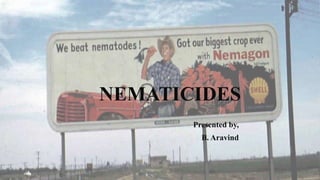
NEMATICIDES
Presented by,
B. Aravind
What is a nematicide?
 A nematicide is a type
of chemical pesticide used to kill
plant-parasitic nematodes.
 Nematicides have tended to be broad-
spectrum toxicants possessing high
volatility or other properties
promoting migration through the soil.
NEED FOR NEMATICIDE:
NEMATODE becoming a major
pest in agriculture.
Losses due to nematode attack are
crossing billion year by year.
Nematode cuticle is permeable to a
wide range of organic compounds.
NEMATICIDAL PROPERTIES:
water solubility
vapour pressure, volatility, fumigant
action
Henry's constant (kH) - affinity for
water
method of incorporation or
movement in soil
TYPES OF NEMATICIDES:
Natural nematicides
Artificial nematicides
• Fumigants
• Carbamates
• Organophosphates
NATURAL NEMATICIDES:
Garlic developed polysulfide product
Neem cakes
Root exudates of MARIGOLD
(Tagetes)
Nematophagous fungi - Paecilomyces
Neem cake
Paecilomyces
ARTIFICIAL NEMATICIDES:
These are artificially synthesised
chemical compounds that are highly
toxic and in some extinct even
carcinogenic used for nematode control
in a field.
They might be fumigants, carbamates or
organophosphates.
FUMIGANTS:
1,3-Dichloropropene:
• Substitute to 1,2dichloropropene.
• Eliminates ground water contamination.
• Combine activity over nematodes
insects and fungi.
• INACTIVE over Globodera
rostochiensis.
Ethylene Dibromide:
• Abundantly used, but prohibited in USA in
1983 because of ground water
contamination.
• Also it is a carcinogen.
1,2 – dibromo – chloropropane:
• Once popular for specific nematode activity.
• Banned in 1977 in US because 1/3rd of male
workers at DBCP manufacturing plant
became sterile.
CARBAMATES
Aldoxycarb:
Aldicarb oxidised to aldicarb sulfone
the insecticide/ nematicide aldoxycarb
Carbofuran:
A systemic insecticidal/nematicidal carbamate in
granular and liquid formulations.
Probihibited because of bird kill.
Oxamyl
• A systemic insecticidal/nematicidal
carbamate in granular and liquid
formulations.
• Granular formation prohibited.
• Liquid formation is still used as foliar
sprays.
• Said to control Pratylenchus penetrans on
lily.
Organophosphates:
Ethoprop – incecticide/nematicide(non
carcinogenic)
Fenamiphos – only nematicide(non
carcinogenic)
Cadusafos:
• excellent control of the burrowing
nematode, Radopholus similis.
• possesses reduced risk for contaminating
groundwater
• Good control of the citrus
nematode, Tylenchulus semipenetrans.
New emerged nematicides
NIMITZ™ Nematicide Approved by EPA
MCW-2, a new nematicide of the fluoroalkenyl
group, against the root-knot nematode
Meloidogyne javanica.
NIMITZ™
ADAMA USA.(Agricultural Solutions Ltd,.)
Revolutionizing global nematode control.
The nematicide approved by EPA.
“In contrast to fumigant nematicides, NIMITZ
simplifies nematode management by lessening
complex handling practices and application
restrictions” .
“NIMITZ provides a non-restricted use
pesticide alternative that is effective, easy to
apply, and with lower environmental impact.”
Within one hour of contact, nematodes cease
feeding and quickly become paralyzed. Within
24 to 48 hours, pest mortality occurs rather than
temporary nematostatic (immobilizing) activity,
as seen with organophosphate and carbamate
nematicides.
MCW-2
MCW-2, a new nematicide of the fluoroalkenyl
group, against the root-knot nematode
Meloidogyne javanica.
MCW-2 showed irreversible nematicidal
activity against second-stage juveniles of M.
javanica in vitro, following exposure for 48 h at
concentrations as low as 0.5 mg L-1 .
MCW-2 at 8 mg L(-1) inhibited nematode
hatching, which, however, recovered after
rinsing in water. In pot and plot experiments,
0.5 mg MCW-2 L(-1) soil and 2 kg MCW-2
ha(-1), respectively, controlled M. javanica
similarly to or better than fenamiphos or
cadusafos at the same concentrations.
It has a novel mode of action.
APPLICATION METHODS:
Fumigation
Irrigation
Granules and broadcast sprays
Seed dressing
Bare root dip.
Fumigation
Prior preparation like tillage activites carried
out.
chisel or shank injection
Upper 15 – 40 cm of soil
Fumigant loss
Plastic(tarpaulin) covering of soil
Buffer application in borders of fields.
Fumigation
Fumigation
Fumigation
Fumigant
Fumigant
Fumigation
Irrigation
Liquid and emulsifiable formulations of
nematicides
surface or drip irrigation systems
Drip irrigation also is useful for post plant
applications, and it avoids the use of granular
materials that may pose risks to birds.
Fields are not irrigated for 2 weeks following
application for maximum efficiency.
Successful control of P. penetrans on lilies -
drip-irrigated ethoprop, fenamiphos.
Drip-irrigated emulsifiable 1,3-D provided
control of the citrus
nematode, Tylenchulus semipenetrans
Overhead spray irrigation can also effectively
convey nematicides.
Flood irrigation
Furrow irrigation
Drip irrigation
Drip irrigation
Granules and Broadcast Sprays:
widely practiced method of applying non
fumigant nematicides is with granular
formulations.
Band application, furrow application, side dress
applications and broadcast application.
Incorporation of nematicides.
Broadcasting
Nematicide(granules)
Seed Dressing and Bare Root Dip
Seed coated with nematicides in case of direct
sowing.
control of P. penetrans on corn by seed
treatment with oxamyl.
Dipping roots in nematicides (aqueous) in case
of transplanted seedlings.
Root dips .have provided nematode control in
several situations
Bare root dip:
NEMATICIDE ECOLOGY
Effects of Temperature on Activity
Effects of Soil Structure on Activity
Degradation of Nematicides
Effects on Non target Organisms
Environmental Contamination
Reference
Plant Nematology: 2nd Edition edited by
Roland N Perry, Maurice Moens
TNAU Agritech portal {crop protection}
Adama USA.com
NCBI(National Center For Biotechnology
International).com
NEMATODE DEAD !

Nematicides

  • 1.
  • 2.
    What is anematicide?  A nematicide is a type of chemical pesticide used to kill plant-parasitic nematodes.  Nematicides have tended to be broad- spectrum toxicants possessing high volatility or other properties promoting migration through the soil.
  • 3.
    NEED FOR NEMATICIDE: NEMATODEbecoming a major pest in agriculture. Losses due to nematode attack are crossing billion year by year. Nematode cuticle is permeable to a wide range of organic compounds.
  • 4.
    NEMATICIDAL PROPERTIES: water solubility vapourpressure, volatility, fumigant action Henry's constant (kH) - affinity for water method of incorporation or movement in soil
  • 5.
    TYPES OF NEMATICIDES: Naturalnematicides Artificial nematicides • Fumigants • Carbamates • Organophosphates
  • 6.
    NATURAL NEMATICIDES: Garlic developedpolysulfide product Neem cakes Root exudates of MARIGOLD (Tagetes) Nematophagous fungi - Paecilomyces
  • 7.
  • 8.
  • 9.
    ARTIFICIAL NEMATICIDES: These areartificially synthesised chemical compounds that are highly toxic and in some extinct even carcinogenic used for nematode control in a field. They might be fumigants, carbamates or organophosphates.
  • 10.
    FUMIGANTS: 1,3-Dichloropropene: • Substitute to1,2dichloropropene. • Eliminates ground water contamination. • Combine activity over nematodes insects and fungi. • INACTIVE over Globodera rostochiensis.
  • 11.
    Ethylene Dibromide: • Abundantlyused, but prohibited in USA in 1983 because of ground water contamination. • Also it is a carcinogen. 1,2 – dibromo – chloropropane: • Once popular for specific nematode activity. • Banned in 1977 in US because 1/3rd of male workers at DBCP manufacturing plant became sterile.
  • 12.
    CARBAMATES Aldoxycarb: Aldicarb oxidised toaldicarb sulfone the insecticide/ nematicide aldoxycarb Carbofuran: A systemic insecticidal/nematicidal carbamate in granular and liquid formulations. Probihibited because of bird kill.
  • 13.
    Oxamyl • A systemicinsecticidal/nematicidal carbamate in granular and liquid formulations. • Granular formation prohibited. • Liquid formation is still used as foliar sprays. • Said to control Pratylenchus penetrans on lily.
  • 14.
  • 15.
    Cadusafos: • excellent controlof the burrowing nematode, Radopholus similis. • possesses reduced risk for contaminating groundwater • Good control of the citrus nematode, Tylenchulus semipenetrans.
  • 16.
    New emerged nematicides NIMITZ™Nematicide Approved by EPA MCW-2, a new nematicide of the fluoroalkenyl group, against the root-knot nematode Meloidogyne javanica.
  • 17.
    NIMITZ™ ADAMA USA.(Agricultural SolutionsLtd,.) Revolutionizing global nematode control. The nematicide approved by EPA. “In contrast to fumigant nematicides, NIMITZ simplifies nematode management by lessening complex handling practices and application restrictions” .
  • 18.
    “NIMITZ provides anon-restricted use pesticide alternative that is effective, easy to apply, and with lower environmental impact.” Within one hour of contact, nematodes cease feeding and quickly become paralyzed. Within 24 to 48 hours, pest mortality occurs rather than temporary nematostatic (immobilizing) activity, as seen with organophosphate and carbamate nematicides.
  • 19.
    MCW-2 MCW-2, a newnematicide of the fluoroalkenyl group, against the root-knot nematode Meloidogyne javanica. MCW-2 showed irreversible nematicidal activity against second-stage juveniles of M. javanica in vitro, following exposure for 48 h at concentrations as low as 0.5 mg L-1 .
  • 20.
    MCW-2 at 8mg L(-1) inhibited nematode hatching, which, however, recovered after rinsing in water. In pot and plot experiments, 0.5 mg MCW-2 L(-1) soil and 2 kg MCW-2 ha(-1), respectively, controlled M. javanica similarly to or better than fenamiphos or cadusafos at the same concentrations. It has a novel mode of action.
  • 21.
    APPLICATION METHODS: Fumigation Irrigation Granules andbroadcast sprays Seed dressing Bare root dip.
  • 22.
    Fumigation Prior preparation liketillage activites carried out. chisel or shank injection Upper 15 – 40 cm of soil Fumigant loss Plastic(tarpaulin) covering of soil Buffer application in borders of fields.
  • 23.
  • 24.
  • 25.
  • 26.
  • 27.
  • 28.
  • 29.
    Irrigation Liquid and emulsifiableformulations of nematicides surface or drip irrigation systems Drip irrigation also is useful for post plant applications, and it avoids the use of granular materials that may pose risks to birds.
  • 30.
    Fields are notirrigated for 2 weeks following application for maximum efficiency. Successful control of P. penetrans on lilies - drip-irrigated ethoprop, fenamiphos. Drip-irrigated emulsifiable 1,3-D provided control of the citrus nematode, Tylenchulus semipenetrans Overhead spray irrigation can also effectively convey nematicides.
  • 31.
  • 32.
  • 33.
  • 34.
  • 35.
    Granules and BroadcastSprays: widely practiced method of applying non fumigant nematicides is with granular formulations. Band application, furrow application, side dress applications and broadcast application. Incorporation of nematicides.
  • 36.
  • 37.
  • 38.
    Seed Dressing andBare Root Dip Seed coated with nematicides in case of direct sowing. control of P. penetrans on corn by seed treatment with oxamyl. Dipping roots in nematicides (aqueous) in case of transplanted seedlings. Root dips .have provided nematode control in several situations
  • 39.
  • 40.
    NEMATICIDE ECOLOGY Effects ofTemperature on Activity Effects of Soil Structure on Activity Degradation of Nematicides Effects on Non target Organisms Environmental Contamination
  • 41.
    Reference Plant Nematology: 2ndEdition edited by Roland N Perry, Maurice Moens TNAU Agritech portal {crop protection} Adama USA.com NCBI(National Center For Biotechnology International).com
  • 42.