Cultural Strategies for Nematode Management
Nematode Management With Plants
- No plants – fallow
- Nonhosts – crop rotation
- Green manure cover crops
- Antagonistic plants
- Trap crops
- Resistant cultivars
- Timing of planting and harvest to avoid damage
= “escaping in time”
ANTAGONISTIC PLANTS
A number of plants are antagonistic to nematodes.
Mechanism of “antagonism” is not always clear.
Need more study as potential sources of suppression.
Used as a rotation crop, cover crop, or an intercrop.
Some are simply “nonhosts” due to some
biochemical or physical incompatibility between the
nematode and the plant.
ANTAGONISTIC PLANTS
However, others appear to produce some kind of
chemical exudate that acts nematicidal.
In other cases, the growing plant is not particularly
nematicidal, but the decomposing plant, when
incorporated as a green manure, displays nematicidal
properties.
Rapeseed is a host for Pratylenchus penetrans but a
green manure amendment of rapeseed tops can reduce
P. penetrans populations.

It may also be possible that the growing or
decomposing plant encourages microbial antagonists.
ANTAGONISTIC PLANTS
“Antagonistic plants” have not been studied
extensively in developed countries but are commonly
studied in developing countries.
Interest has increased as nematicides are lost.
Information often comes from anecdotal observations.

Literature often hard to retrieve since most research is
done and published in undeveloped countries.
Will go through the more prominent examples.
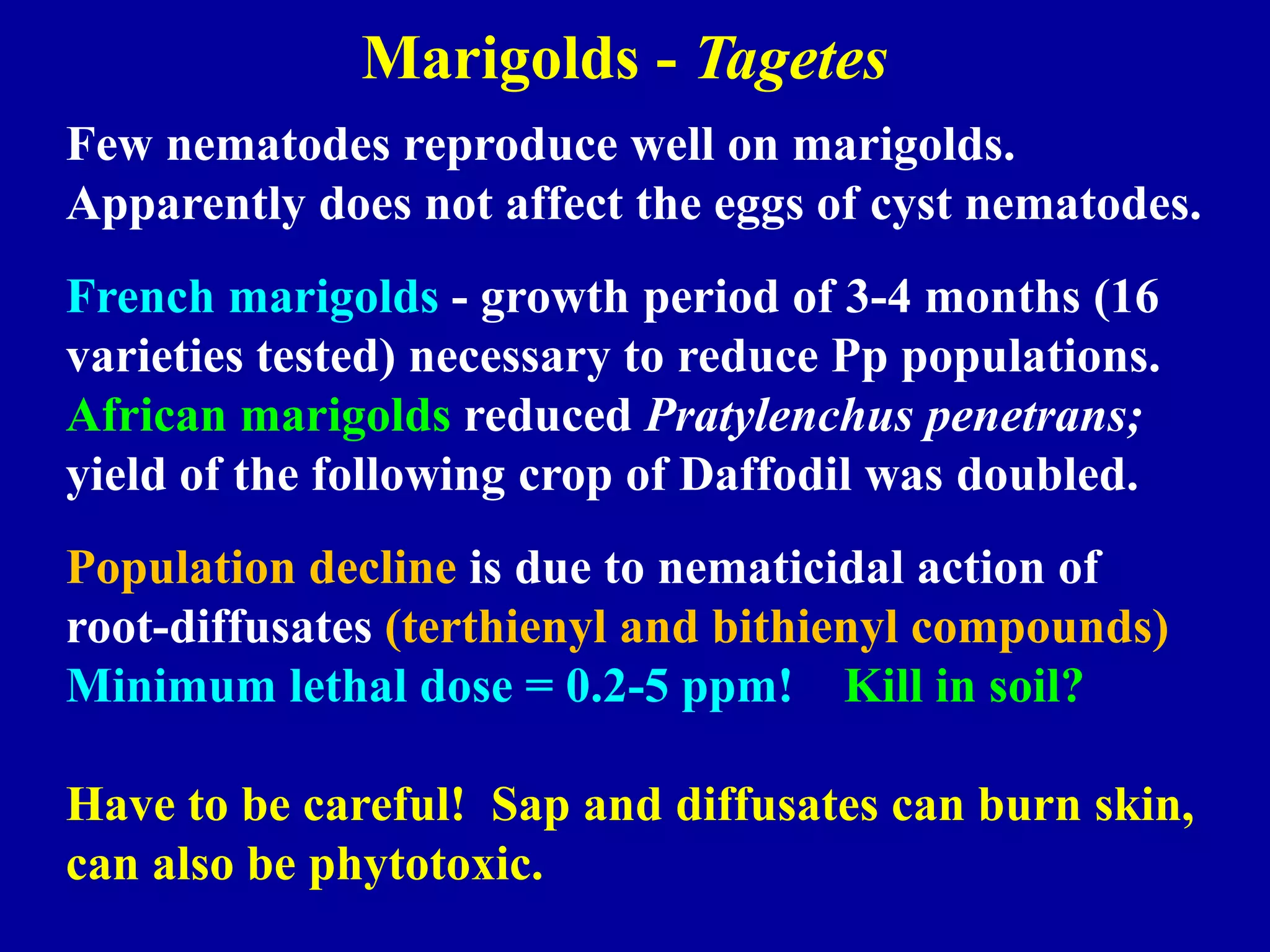
Marigolds - Tagetes
Few nematodes reproduce well on marigolds.
Apparently does not affect the eggs of cyst nematodes.
French marigolds - growth period of 3-4 months (16
varieties tested) necessary to reduce Pp populations.
African marigolds reduced Pratylenchus penetrans;
yield of the following crop of Daffodil was doubled.
Population decline is due to nematicidal action of
root-diffusates (terthienyl and bithienyl compounds)
Minimum lethal dose = 0.2-5 ppm! Kill in soil?
Have to be careful! Sap and diffusates can burn skin,
can also be phytotoxic.
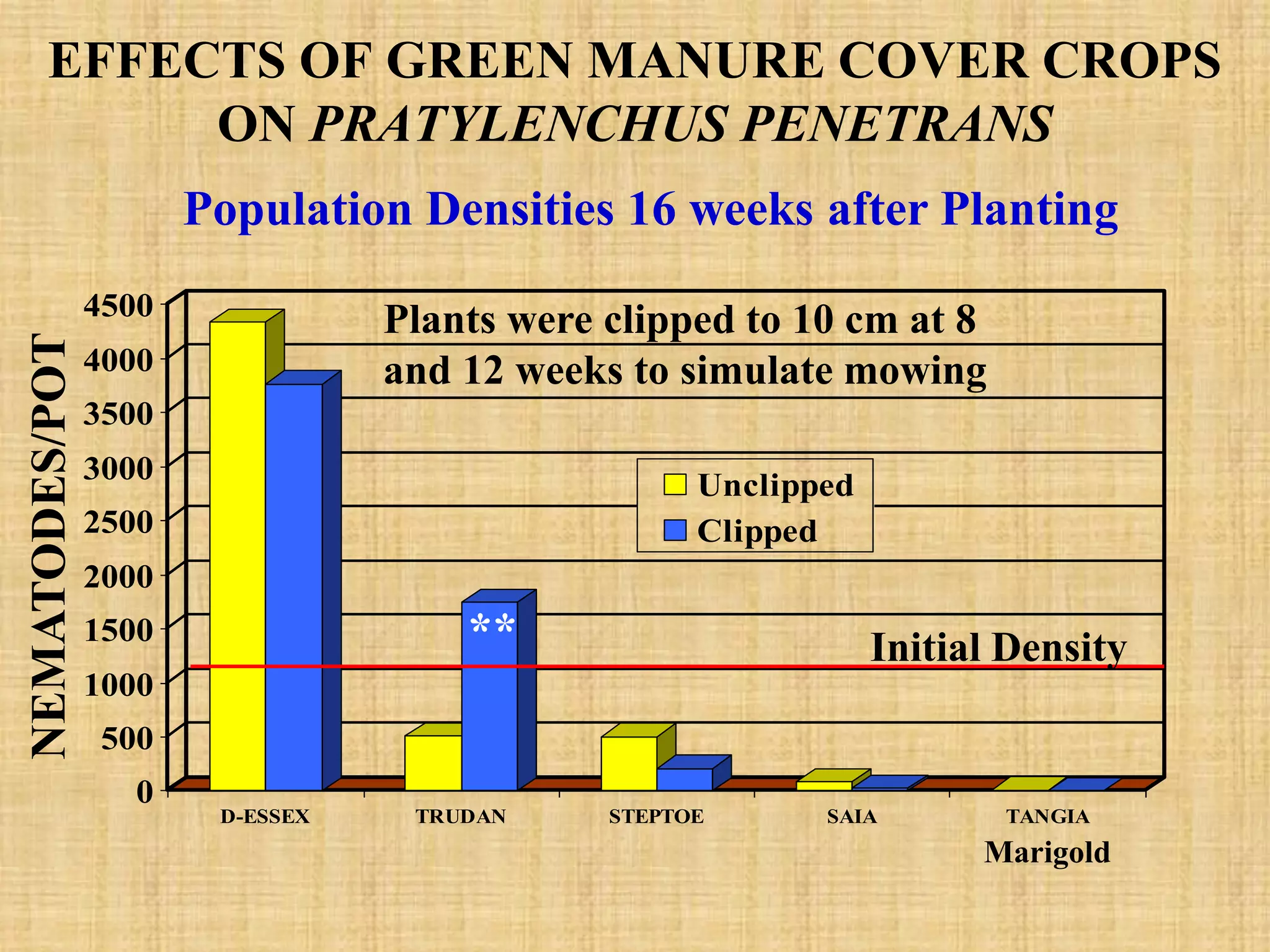
EFFECTS OF GREEN MANURE COVER CROPS
ON PRATYLENCHUS PENETRANS
Population Densities 16 weeks after Planting
NEMATODES/POT

4500

Plants were clipped to 10 cm at 8
and 12 weeks to simulate mowing

4000
3500
3000

Unclipped
Clipped

2500
2000

**

1500

Initial Density

1000
500
0

D-ESSEX

TRUDAN

STEPTOE

SAIA

TANGIA

Marigold
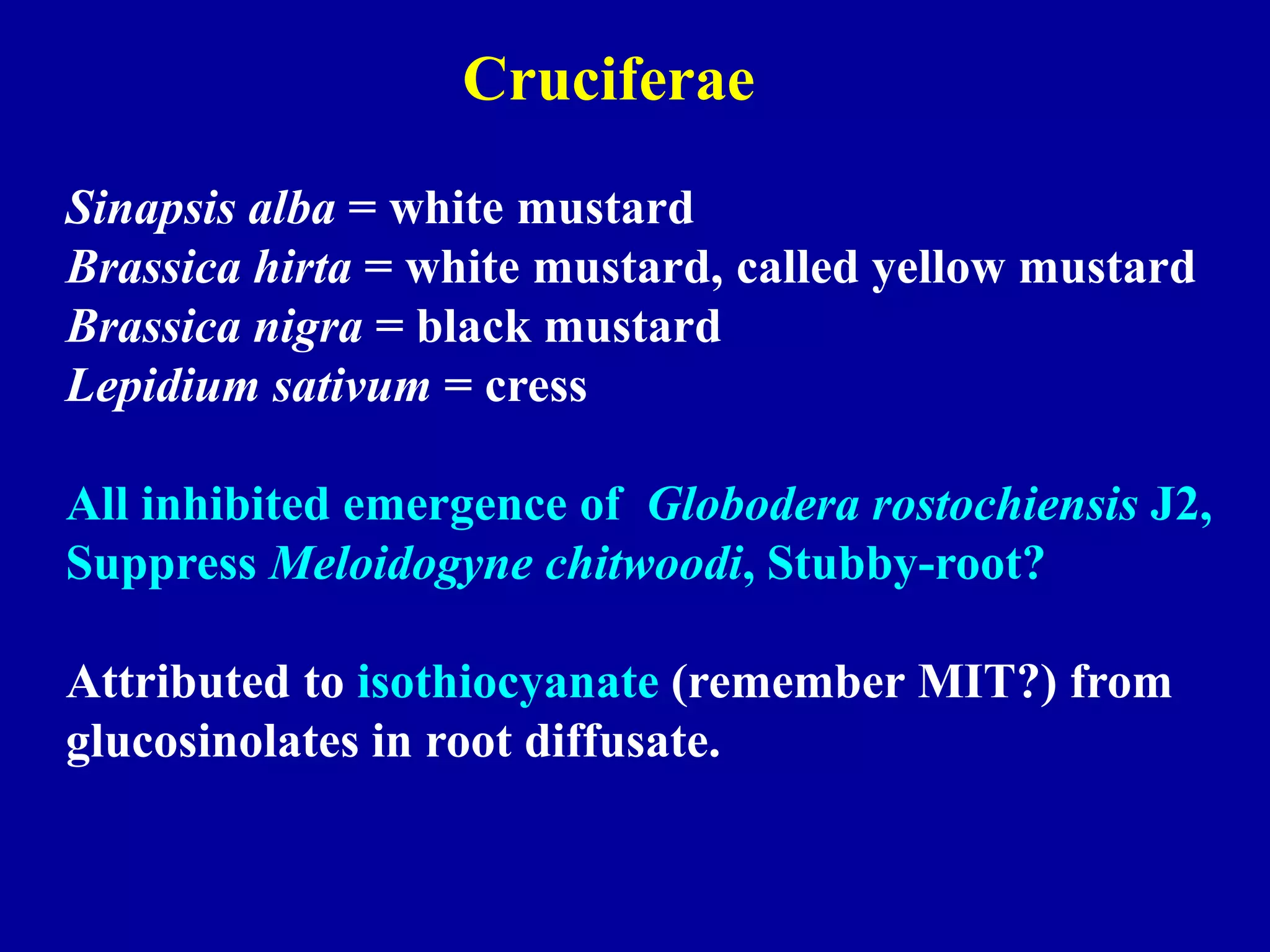
Cruciferae
Sinapsis alba = white mustard
Brassica hirta = white mustard, called yellow mustard
Brassica nigra = black mustard
Lepidium sativum = cress
All inhibited emergence of Globodera rostochiensis J2,
Suppress Meloidogyne chitwoodi, Stubby-root?
Attributed to isothiocyanate (remember MIT?) from
glucosinolates in root diffusate.
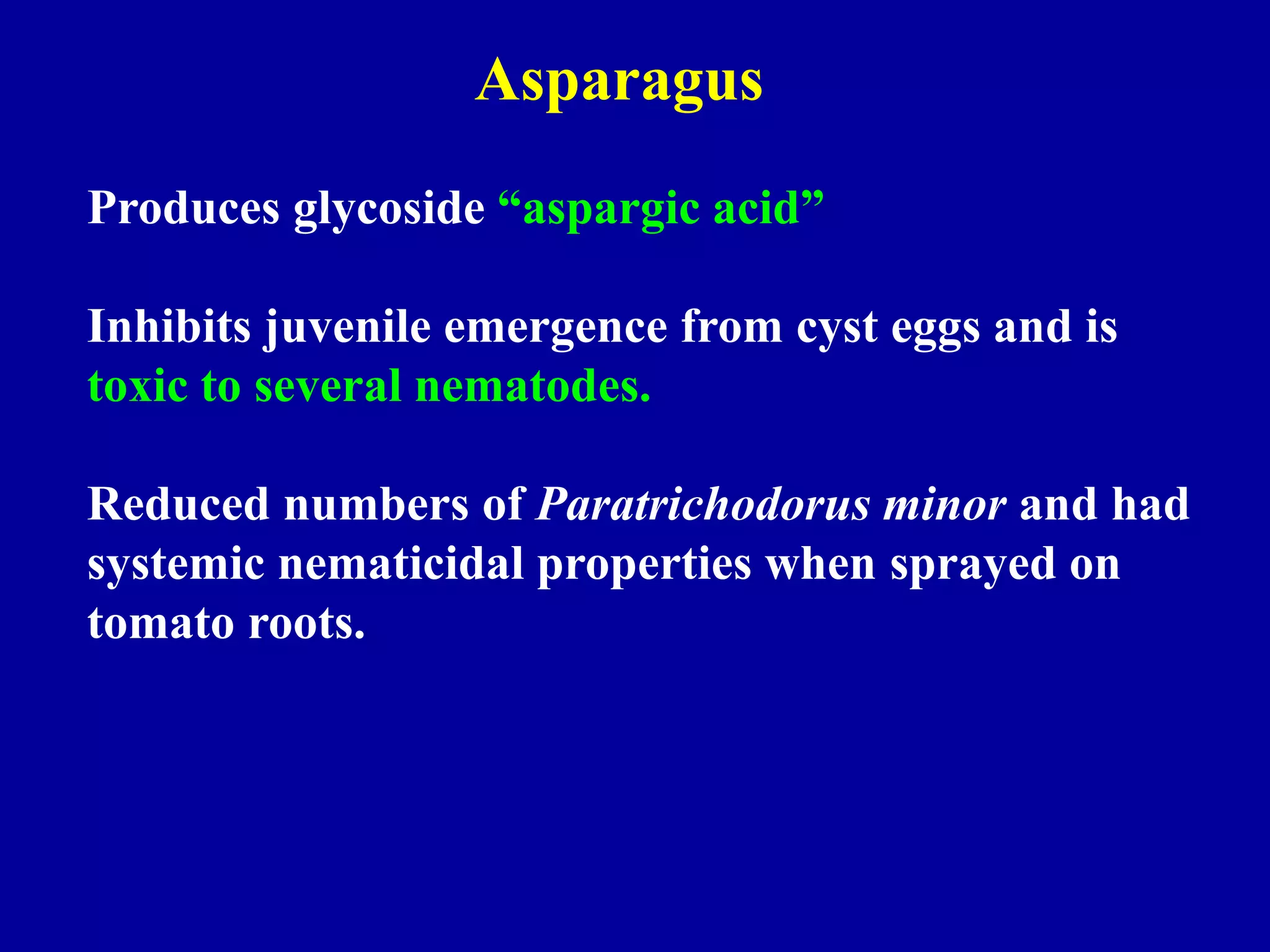
Asparagus
Produces glycoside “aspargic acid”
Inhibits juvenile emergence from cyst eggs and is
toxic to several nematodes.
Reduced numbers of Paratrichodorus minor and had
systemic nematicidal properties when sprayed on
tomato roots.
Crotalaria
Crotalaria juncea – Sunn Hemp
Being used as a cover crop in tropical and subtropics
Crotalaria spectabilis (Rattlebox) = suppress nematodes
when used in various cropping sequences.
May be due to the alkaloid monocrotaline =
pyrrolizidine ester
- Inhibited mobility of Meloidogyne incognita.

However, other plants with this compound are
susceptible.
Neem
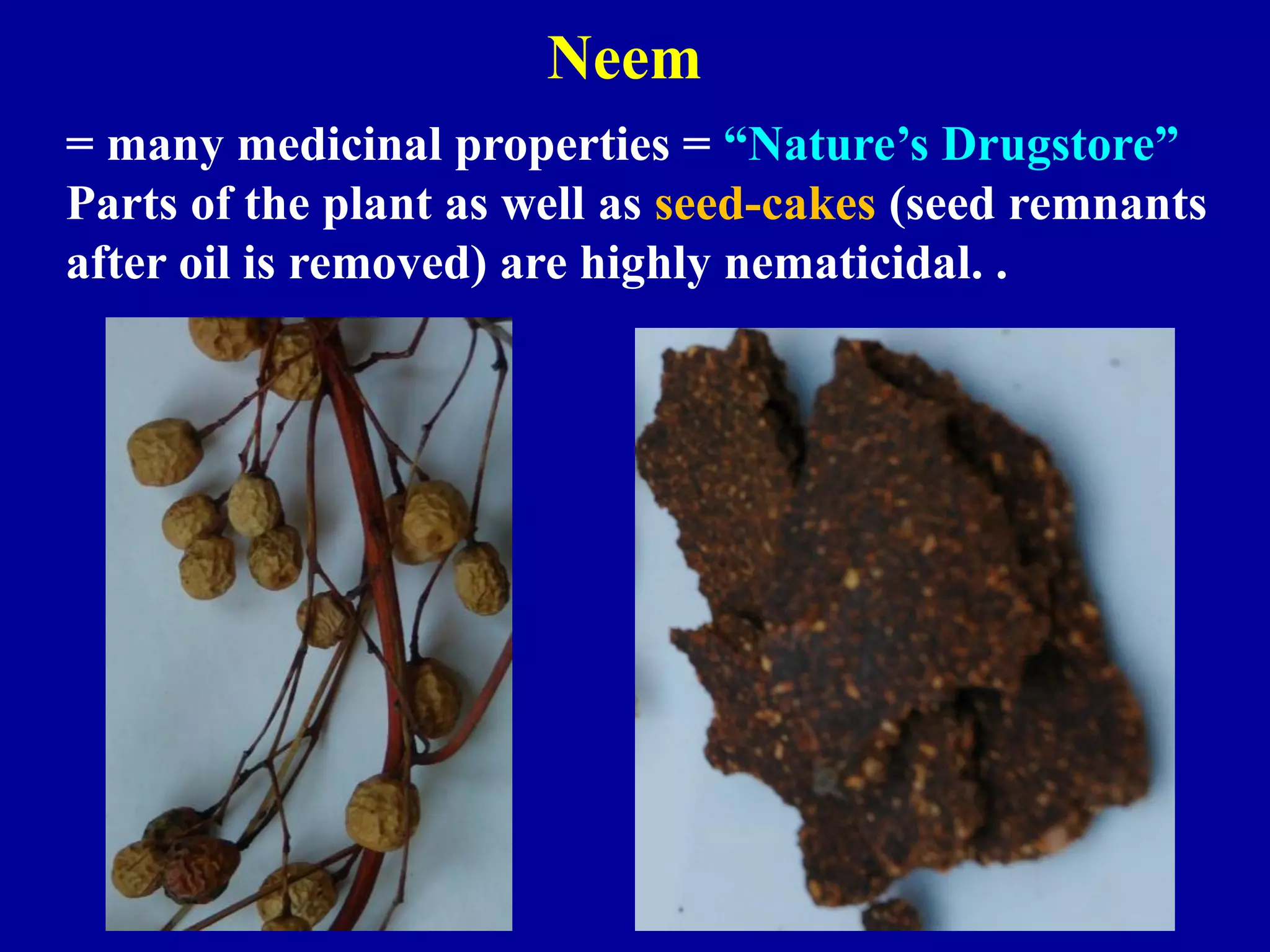
= many medicinal properties = “Nature’s Drugstore”
Parts of the plant as well as seed-cakes (seed remnants
after oil is removed) are highly nematicidal. .
Neem
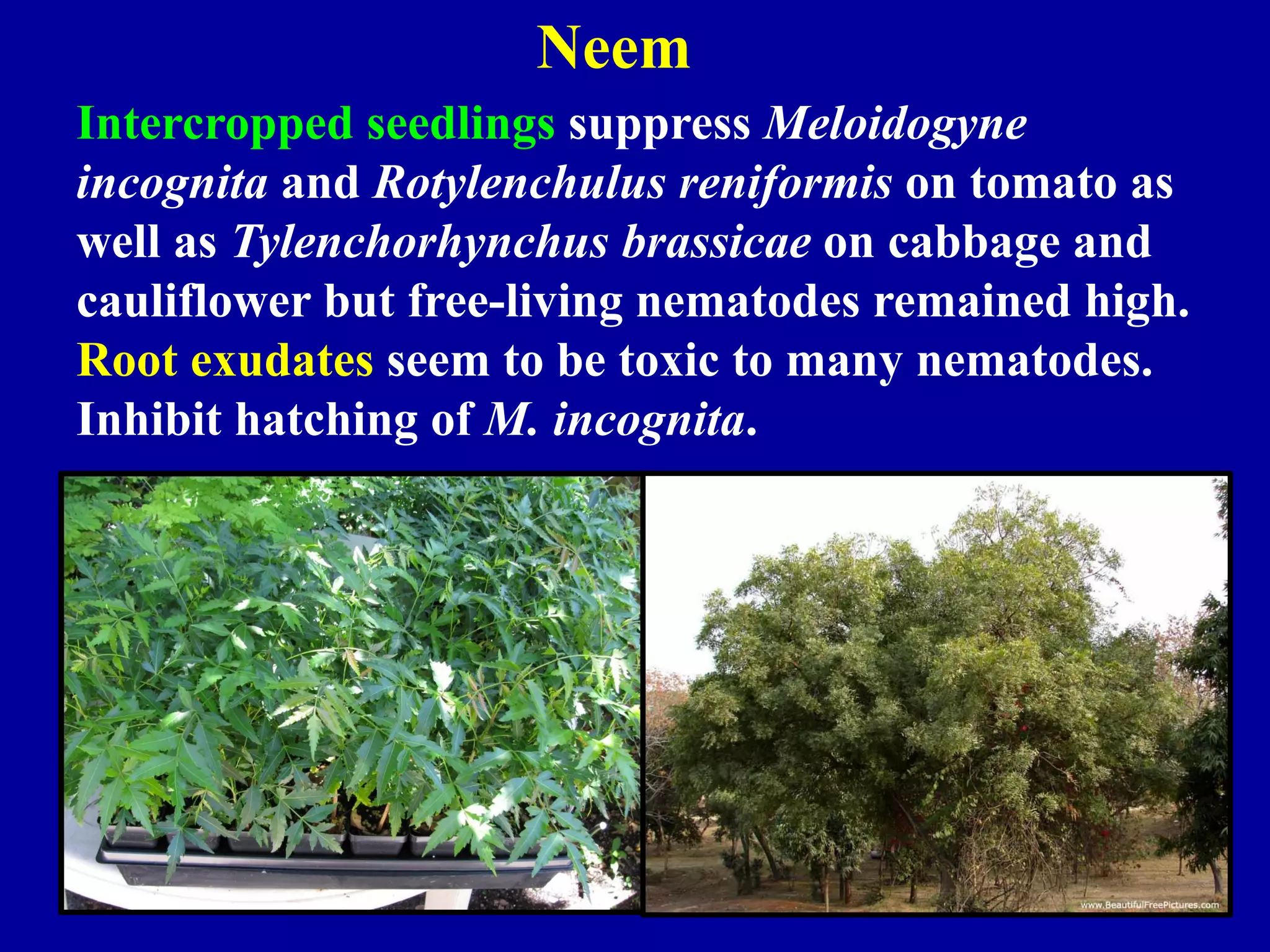
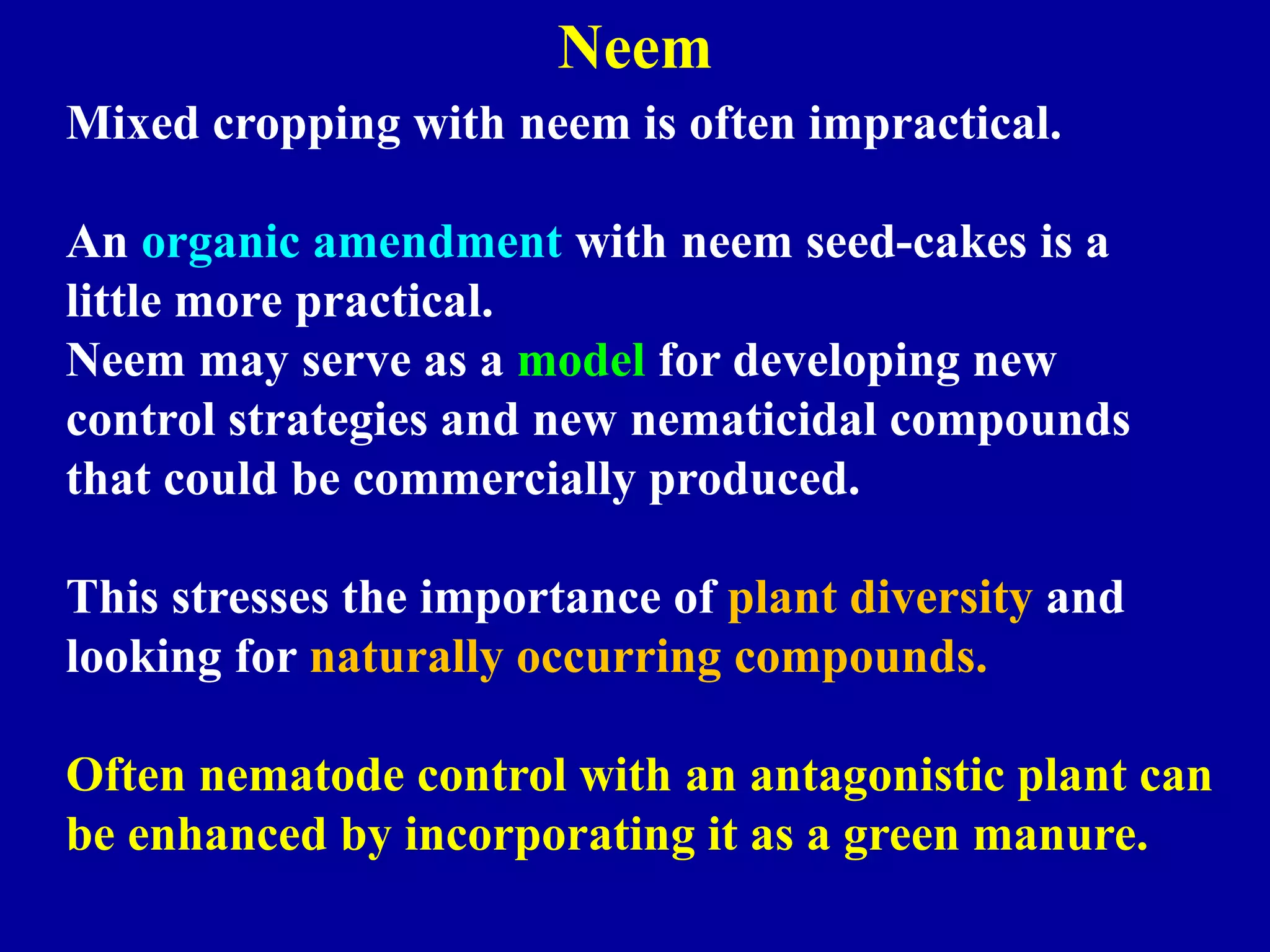
Intercropped seedlings suppress Meloidogyne
incognita and Rotylenchulus reniformis on tomato as
well as Tylenchorhynchus brassicae on cabbage and
cauliflower but free-living nematodes remained high.
Root exudates seem to be toxic to many nematodes.
Inhibit hatching of M. incognita.
Neem
Mixed cropping with neem is often impractical.
An organic amendment with neem seed-cakes is a
little more practical.
Neem may serve as a model for developing new
control strategies and new nematicidal compounds
that could be commercially produced.

This stresses the importance of plant diversity and
looking for naturally occurring compounds.
Often nematode control with an antagonistic plant can
be enhanced by incorporating it as a green manure.
Cultural Strategies for Nematode Management
Nematode Management With Plants
- No plants – fallow
- Nonhosts – crop rotation
- Green manure cover crops
- Antagonistic plants
- Trap crops
- Resistant cultivars
- Timing of planting and harvest to avoid damage
= “escaping in time”
Trap Crops
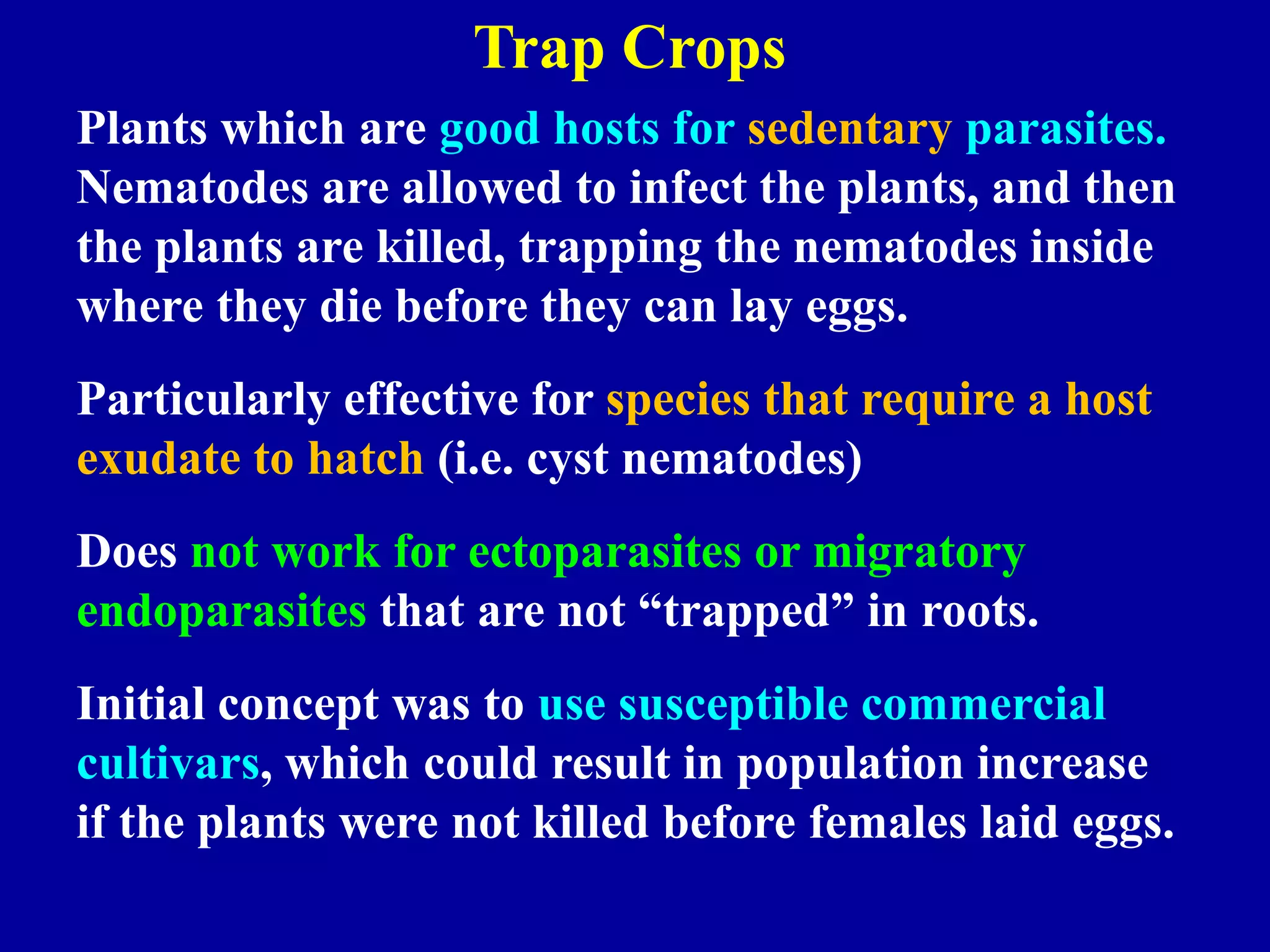
Plants which are good hosts for sedentary parasites.
Nematodes are allowed to infect the plants, and then
the plants are killed, trapping the nematodes inside
where they die before they can lay eggs.
Particularly effective for species that require a host
exudate to hatch (i.e. cyst nematodes)

Does not work for ectoparasites or migratory
endoparasites that are not “trapped” in roots.
Initial concept was to use susceptible commercial
cultivars, which could result in population increase
if the plants were not killed before females laid eggs.
Trap Crops
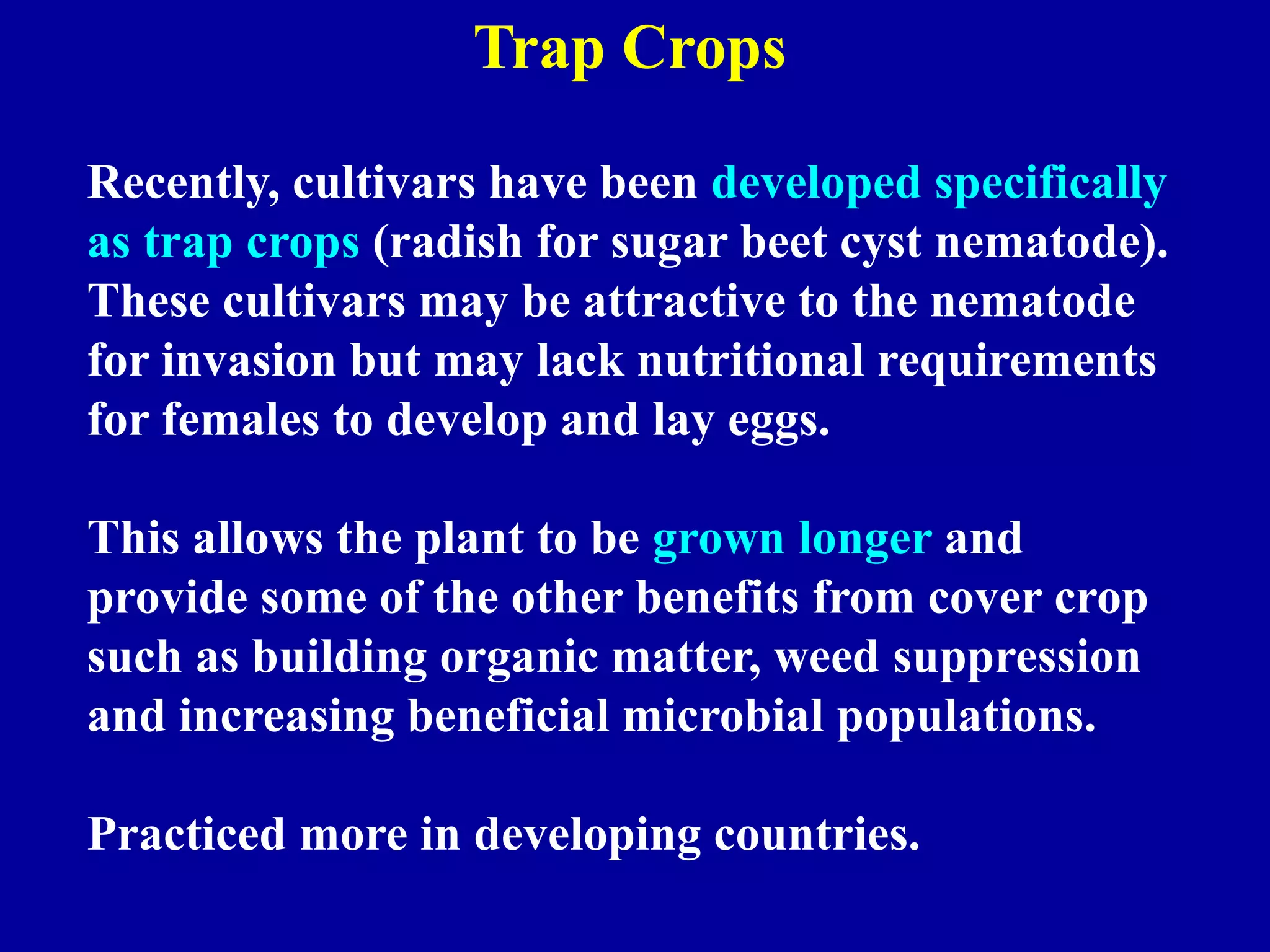
Recently, cultivars have been developed specifically
as trap crops (radish for sugar beet cyst nematode).
These cultivars may be attractive to the nematode
for invasion but may lack nutritional requirements
for females to develop and lay eggs.
This allows the plant to be grown longer and
provide some of the other benefits from cover crop
such as building organic matter, weed suppression
and increasing beneficial microbial populations.
Practiced more in developing countries.
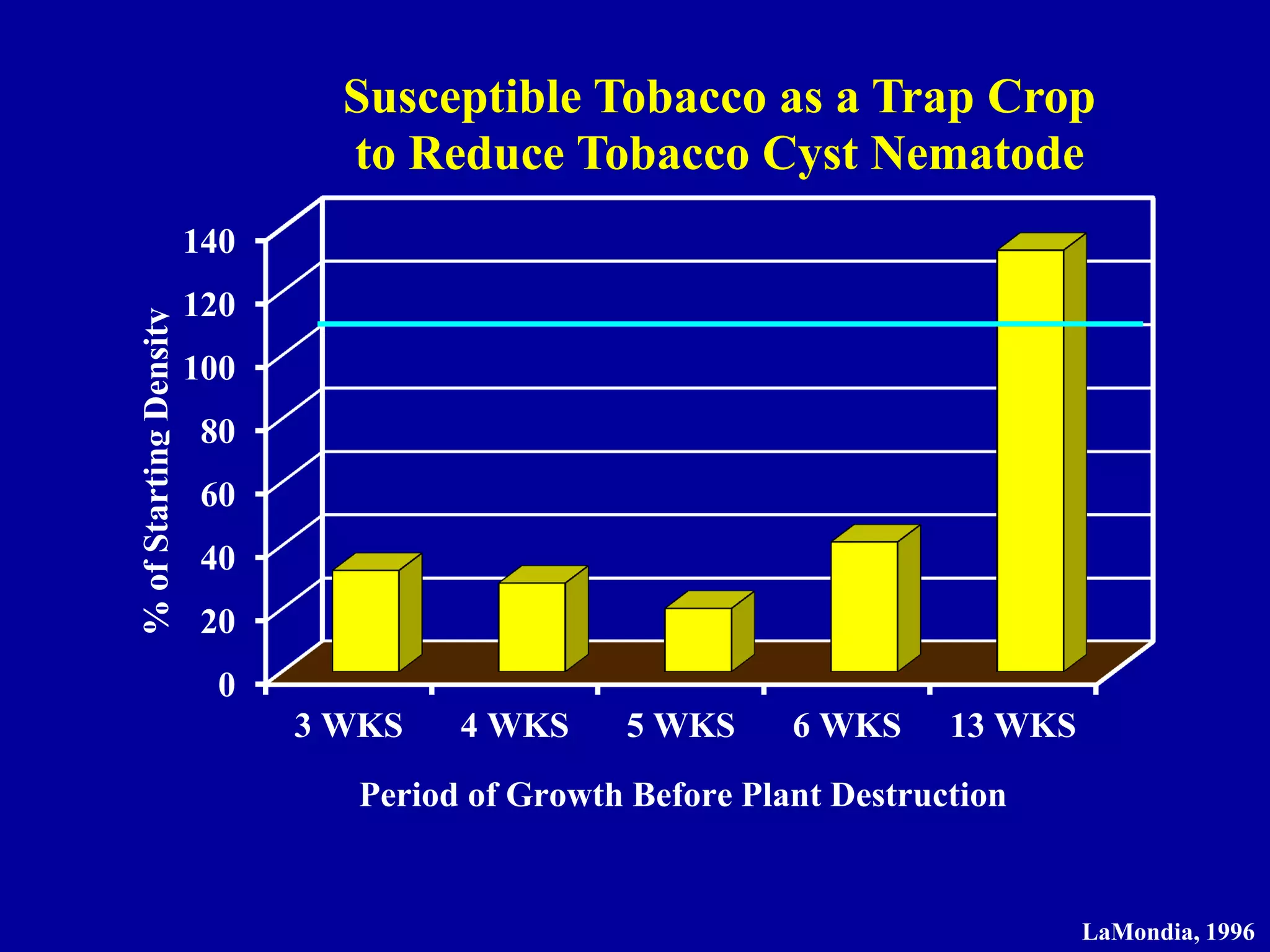
Susceptible Tobacco as a Trap Crop
to Reduce Tobacco Cyst Nematode

% of Starting Density

140
120

100
80

60
40

20
0
3 WKS

4 WKS

5 WKS

6 WKS

13 WKS

Period of Growth Before Plant Destruction
P

LaMondia, 1996
Tobacco as a Trap Crop
to Reduce Tobacco Cyst Nematode

% of Starting Density

140

Susceptible
Resistant

120
100
80
60
40

20
0
3 WKS

4 WKS

5 WKS

6 WKS

13 WKS

Period of Growth Before Plant Destruction
P

LaMondia, 1996
Cultural Strategies for Nematode Management
Nematode Management With Plants
- No plants – fallow
- Nonhosts – crop rotation
- Green manure cover crops
- Antagonistic plants
- Trap crops
- Resistant cultivars
- Timing of planting and harvest to avoid damage
= “escaping in time”
Nematode Management by
Early Planting and Harvest
Nematodes are limited by cool soil temperatures.
For crops that tolerate cool temperatures
planting early can give the crop a “head start” before
temperatures allow nematode activity to cause
substantial damage.
Once the crop develops a sufficient root system it can
tolerate a moderate density of nematodes when they
do become active.

Earlier planting can also result in an earlier harvest
and crops can be removed before damage can occur.
Examples
Sugarbeet seed germinates at cool spring
temperatures before sugar beet cyst nematode
(Heterodera schachtii) becomes active.
Planting early when it is cool allows the plant to
develop a robust root system that can tolerate a larger
nematode population when soils warm later.
Examples
Cereal cyst nematode (Heterodera avenae) hatch and
infect roots in the spring.
Fall-planted cereals are larger than spring-planted
cereals when nematodes begin infecting roots so
plants tolerate nematodes better, are not as stressed,
and yield reduction is less.
Examples
The first generation J2 of Northern root-knot
nematode (Meloidogyne hapla) infect roots of potato
when soil temperature is warm enough.
Second and later generations infect tubers as well as
roots. If potato is planted and harvested early, you
can avoid most or all nematode infection of tubers.
Any nematodes in tubers will not develop in storage
because temperatures are too cool, symptoms will not
be expressed.
Examples
This will not work for Columbia root-knot nematode
which becomes active at cooler temperatures and
infects potato roots much earlier.
Therefore, second generation J2 emerge earlier and
infect tubers before they are large enough to harvest.
Columbia root-knot nematode also can continue to
develop under some storage temperatures so
symptoms can be expressed in storage.

Antagonistic Plants for Nematode Management

  • 1.
    Cultural Strategies forNematode Management Nematode Management With Plants - No plants – fallow - Nonhosts – crop rotation - Green manure cover crops - Antagonistic plants - Trap crops - Resistant cultivars - Timing of planting and harvest to avoid damage = “escaping in time”
  • 2.
    ANTAGONISTIC PLANTS A numberof plants are antagonistic to nematodes. Mechanism of “antagonism” is not always clear. Need more study as potential sources of suppression. Used as a rotation crop, cover crop, or an intercrop. Some are simply “nonhosts” due to some biochemical or physical incompatibility between the nematode and the plant.
  • 3.
    ANTAGONISTIC PLANTS However, othersappear to produce some kind of chemical exudate that acts nematicidal. In other cases, the growing plant is not particularly nematicidal, but the decomposing plant, when incorporated as a green manure, displays nematicidal properties. Rapeseed is a host for Pratylenchus penetrans but a green manure amendment of rapeseed tops can reduce P. penetrans populations. It may also be possible that the growing or decomposing plant encourages microbial antagonists.
  • 4.
    ANTAGONISTIC PLANTS “Antagonistic plants”have not been studied extensively in developed countries but are commonly studied in developing countries. Interest has increased as nematicides are lost. Information often comes from anecdotal observations. Literature often hard to retrieve since most research is done and published in undeveloped countries. Will go through the more prominent examples.
  • 5.
    Marigolds - Tagetes Fewnematodes reproduce well on marigolds. Apparently does not affect the eggs of cyst nematodes. French marigolds - growth period of 3-4 months (16 varieties tested) necessary to reduce Pp populations. African marigolds reduced Pratylenchus penetrans; yield of the following crop of Daffodil was doubled. Population decline is due to nematicidal action of root-diffusates (terthienyl and bithienyl compounds) Minimum lethal dose = 0.2-5 ppm! Kill in soil? Have to be careful! Sap and diffusates can burn skin, can also be phytotoxic.
  • 6.
    EFFECTS OF GREENMANURE COVER CROPS ON PRATYLENCHUS PENETRANS Population Densities 16 weeks after Planting NEMATODES/POT 4500 Plants were clipped to 10 cm at 8 and 12 weeks to simulate mowing 4000 3500 3000 Unclipped Clipped 2500 2000 ** 1500 Initial Density 1000 500 0 D-ESSEX TRUDAN STEPTOE SAIA TANGIA Marigold
  • 7.
    Cruciferae Sinapsis alba =white mustard Brassica hirta = white mustard, called yellow mustard Brassica nigra = black mustard Lepidium sativum = cress All inhibited emergence of Globodera rostochiensis J2, Suppress Meloidogyne chitwoodi, Stubby-root? Attributed to isothiocyanate (remember MIT?) from glucosinolates in root diffusate.
  • 8.
    Asparagus Produces glycoside “aspargicacid” Inhibits juvenile emergence from cyst eggs and is toxic to several nematodes. Reduced numbers of Paratrichodorus minor and had systemic nematicidal properties when sprayed on tomato roots.
  • 9.
    Crotalaria Crotalaria juncea –Sunn Hemp Being used as a cover crop in tropical and subtropics Crotalaria spectabilis (Rattlebox) = suppress nematodes when used in various cropping sequences. May be due to the alkaloid monocrotaline = pyrrolizidine ester - Inhibited mobility of Meloidogyne incognita. However, other plants with this compound are susceptible.
  • 10.
    Neem = many medicinalproperties = “Nature’s Drugstore” Parts of the plant as well as seed-cakes (seed remnants after oil is removed) are highly nematicidal. .
  • 11.
    Neem Intercropped seedlings suppressMeloidogyne incognita and Rotylenchulus reniformis on tomato as well as Tylenchorhynchus brassicae on cabbage and cauliflower but free-living nematodes remained high. Root exudates seem to be toxic to many nematodes. Inhibit hatching of M. incognita.
  • 12.
    Neem Mixed cropping withneem is often impractical. An organic amendment with neem seed-cakes is a little more practical. Neem may serve as a model for developing new control strategies and new nematicidal compounds that could be commercially produced. This stresses the importance of plant diversity and looking for naturally occurring compounds. Often nematode control with an antagonistic plant can be enhanced by incorporating it as a green manure.
  • 13.
    Cultural Strategies forNematode Management Nematode Management With Plants - No plants – fallow - Nonhosts – crop rotation - Green manure cover crops - Antagonistic plants - Trap crops - Resistant cultivars - Timing of planting and harvest to avoid damage = “escaping in time”
  • 14.
    Trap Crops Plants whichare good hosts for sedentary parasites. Nematodes are allowed to infect the plants, and then the plants are killed, trapping the nematodes inside where they die before they can lay eggs. Particularly effective for species that require a host exudate to hatch (i.e. cyst nematodes) Does not work for ectoparasites or migratory endoparasites that are not “trapped” in roots. Initial concept was to use susceptible commercial cultivars, which could result in population increase if the plants were not killed before females laid eggs.
  • 15.
    Trap Crops Recently, cultivarshave been developed specifically as trap crops (radish for sugar beet cyst nematode). These cultivars may be attractive to the nematode for invasion but may lack nutritional requirements for females to develop and lay eggs. This allows the plant to be grown longer and provide some of the other benefits from cover crop such as building organic matter, weed suppression and increasing beneficial microbial populations. Practiced more in developing countries.
  • 16.
    Susceptible Tobacco asa Trap Crop to Reduce Tobacco Cyst Nematode % of Starting Density 140 120 100 80 60 40 20 0 3 WKS 4 WKS 5 WKS 6 WKS 13 WKS Period of Growth Before Plant Destruction P LaMondia, 1996
  • 17.
    Tobacco as aTrap Crop to Reduce Tobacco Cyst Nematode % of Starting Density 140 Susceptible Resistant 120 100 80 60 40 20 0 3 WKS 4 WKS 5 WKS 6 WKS 13 WKS Period of Growth Before Plant Destruction P LaMondia, 1996
  • 18.
    Cultural Strategies forNematode Management Nematode Management With Plants - No plants – fallow - Nonhosts – crop rotation - Green manure cover crops - Antagonistic plants - Trap crops - Resistant cultivars - Timing of planting and harvest to avoid damage = “escaping in time”
  • 19.
    Nematode Management by EarlyPlanting and Harvest Nematodes are limited by cool soil temperatures. For crops that tolerate cool temperatures planting early can give the crop a “head start” before temperatures allow nematode activity to cause substantial damage. Once the crop develops a sufficient root system it can tolerate a moderate density of nematodes when they do become active. Earlier planting can also result in an earlier harvest and crops can be removed before damage can occur.
  • 20.
    Examples Sugarbeet seed germinatesat cool spring temperatures before sugar beet cyst nematode (Heterodera schachtii) becomes active. Planting early when it is cool allows the plant to develop a robust root system that can tolerate a larger nematode population when soils warm later.
  • 21.
    Examples Cereal cyst nematode(Heterodera avenae) hatch and infect roots in the spring. Fall-planted cereals are larger than spring-planted cereals when nematodes begin infecting roots so plants tolerate nematodes better, are not as stressed, and yield reduction is less.
  • 22.
    Examples The first generationJ2 of Northern root-knot nematode (Meloidogyne hapla) infect roots of potato when soil temperature is warm enough. Second and later generations infect tubers as well as roots. If potato is planted and harvested early, you can avoid most or all nematode infection of tubers. Any nematodes in tubers will not develop in storage because temperatures are too cool, symptoms will not be expressed.
  • 23.
    Examples This will notwork for Columbia root-knot nematode which becomes active at cooler temperatures and infects potato roots much earlier. Therefore, second generation J2 emerge earlier and infect tubers before they are large enough to harvest. Columbia root-knot nematode also can continue to develop under some storage temperatures so symptoms can be expressed in storage.