CULTURAL METHOD IN
NEMATODE CONTROL
BY
HARINI P
2021018041
INTRODUCTION
 Plant parasitic nematodes can be controlled by several
methods.
 The nematode control aims to improve growth, quality and
yield by keeping the nematode population below the
economical threshold level.
 The control measures to be adopted should be profitable and
cost effective.
 It is essential to calculate the cost benefit ratio before
adopting control measures.
NEMATODE CONTROL METHODS
 Regulatory (legal) method
 Cultural control
 Physical control
 Biological control
 Chemical control
CULTURAL CONTROL METHODS
 Selection of healthy seed material.
 Adjusting the time of planting.
 Fallowing
 Deep summer ploughing.
 Manuring.
 Flooding.
 Trap cropping.
 Antagonistic crop
 Removal and destruction of infected plants.
 Use of resistant varieties.
SELECTION OF HEALTHY SEED MATERIAL
 In the plants which are vegetatively propagated we can select the
vegetative part from healthy plants and thus eliminate the
nematodes.
 Golden nematode of potato, burrowing, spiral and lesion
nematodes of banana – nematodes eliminated by selecting
nematode free plant material.
 The wheat seed gall nematode and rice white tip nematode –
controlled by using nematode free seeds.
ADJUSTING THE TIME OF PLANTING
 Nematode life cycle depends on the climatic factors.
 Adjusting the time of planting helps to avoid nematode damage.
 Early potatoes and sugar beets are grown in cold season – to avoid
cyst nematodes – because they are inactive at low temperature.
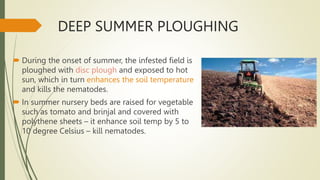
DEEP SUMMER PLOUGHING
 During the onset of summer, the infested field is
ploughed with disc plough and exposed to hot
sun, which in turn enhances the soil temperature
and kills the nematodes.
 In summer nursery beds are raised for vegetable
such as tomato and brinjal and covered with
polythene sheets – it enhance soil temp by 5 to
10 degree Celsius – kill nematodes.
FALLOWING
 Leaving field without cultivation preferably after ploughing –
expose nematodes to sunlight and they die due to starvation
without host plant.
 This method is not economical.
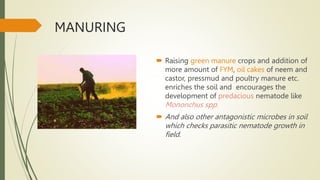
MANURING
 Raising green manure crops and addition of
more amount of FYM, oil cakes of neem and
castor, pressmud and poultry manure etc.
enriches the soil and encourages the
development of predacious nematode like
Mononchus spp.
 And also other antagonistic microbes in soil
which checks parasitic nematode growth in
field.
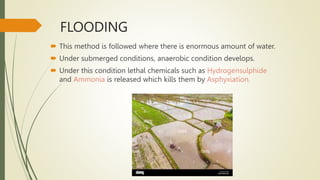
FLOODING
 This method is followed where there is enormous amount of water.
 Under submerged conditions, anaerobic condition develops.
 Under this condition lethal chemicals such as Hydrogensulphide
and Ammonia is released which kills them by Asphyxiation.
TRAP CROPPING
 Two crops are grown in field, where one crop is highly susceptible
to the nematode.
 By careful planning we can grow the highly susceptible crop first
and then remove it and burn it before the nematode matures.
 Thus the main crop which is grown next will be prevented from the
damage.
 Cowpea is a highly susceptible crop to Root-knot nematode.
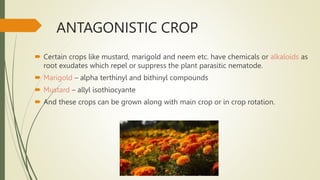
ANTAGONISTIC CROP
 Certain crops like mustard, marigold and neem etc. have chemicals or alkaloids as
root exudates which repel or suppress the plant parasitic nematode.
 Marigold – alpha terthinyl and bithinyl compounds
 Mustard – allyl isothiocyante
 And these crops can be grown along with main crop or in crop rotation.
REMOVAL AND DESTRUCTION OF
INFECTED PLANTS
 Early detection of infected plants and removal helps to reduce the
nematode spread.
 In Tobacco, the root system is left in the field after harvest. This will
serve as an inoculum for next season crops.
 After the harvest the stubbles of infested plants are to be removed.
USE OF RESISTANT VARIETIES
 It is a very effective method to avoid nematode damage.
 Nemared , Hisar Lalit , Atkinson – Tomato varieties – resistant to
Meloidogyne incognitia
 Kurfi Swarna – Potato variety – Globodera spp.
CULTURAL METHOD IN NEMATODE CONTROL HariniP.pptx

CULTURAL METHOD IN NEMATODE CONTROL HariniP.pptx

  • 1.
    CULTURAL METHOD IN NEMATODECONTROL BY HARINI P 2021018041
  • 2.
    INTRODUCTION  Plant parasiticnematodes can be controlled by several methods.  The nematode control aims to improve growth, quality and yield by keeping the nematode population below the economical threshold level.  The control measures to be adopted should be profitable and cost effective.  It is essential to calculate the cost benefit ratio before adopting control measures.
  • 3.
    NEMATODE CONTROL METHODS Regulatory (legal) method  Cultural control  Physical control  Biological control  Chemical control
  • 4.
    CULTURAL CONTROL METHODS Selection of healthy seed material.  Adjusting the time of planting.  Fallowing  Deep summer ploughing.  Manuring.  Flooding.  Trap cropping.  Antagonistic crop  Removal and destruction of infected plants.  Use of resistant varieties.
  • 5.
    SELECTION OF HEALTHYSEED MATERIAL  In the plants which are vegetatively propagated we can select the vegetative part from healthy plants and thus eliminate the nematodes.  Golden nematode of potato, burrowing, spiral and lesion nematodes of banana – nematodes eliminated by selecting nematode free plant material.  The wheat seed gall nematode and rice white tip nematode – controlled by using nematode free seeds.
  • 6.
    ADJUSTING THE TIMEOF PLANTING  Nematode life cycle depends on the climatic factors.  Adjusting the time of planting helps to avoid nematode damage.  Early potatoes and sugar beets are grown in cold season – to avoid cyst nematodes – because they are inactive at low temperature.
  • 7.
    DEEP SUMMER PLOUGHING During the onset of summer, the infested field is ploughed with disc plough and exposed to hot sun, which in turn enhances the soil temperature and kills the nematodes.  In summer nursery beds are raised for vegetable such as tomato and brinjal and covered with polythene sheets – it enhance soil temp by 5 to 10 degree Celsius – kill nematodes.
  • 8.
    FALLOWING  Leaving fieldwithout cultivation preferably after ploughing – expose nematodes to sunlight and they die due to starvation without host plant.  This method is not economical.
  • 9.
    MANURING  Raising greenmanure crops and addition of more amount of FYM, oil cakes of neem and castor, pressmud and poultry manure etc. enriches the soil and encourages the development of predacious nematode like Mononchus spp.  And also other antagonistic microbes in soil which checks parasitic nematode growth in field.
  • 10.
    FLOODING  This methodis followed where there is enormous amount of water.  Under submerged conditions, anaerobic condition develops.  Under this condition lethal chemicals such as Hydrogensulphide and Ammonia is released which kills them by Asphyxiation.
  • 11.
    TRAP CROPPING  Twocrops are grown in field, where one crop is highly susceptible to the nematode.  By careful planning we can grow the highly susceptible crop first and then remove it and burn it before the nematode matures.  Thus the main crop which is grown next will be prevented from the damage.  Cowpea is a highly susceptible crop to Root-knot nematode.
  • 12.
    ANTAGONISTIC CROP  Certaincrops like mustard, marigold and neem etc. have chemicals or alkaloids as root exudates which repel or suppress the plant parasitic nematode.  Marigold – alpha terthinyl and bithinyl compounds  Mustard – allyl isothiocyante  And these crops can be grown along with main crop or in crop rotation.
  • 13.
    REMOVAL AND DESTRUCTIONOF INFECTED PLANTS  Early detection of infected plants and removal helps to reduce the nematode spread.  In Tobacco, the root system is left in the field after harvest. This will serve as an inoculum for next season crops.  After the harvest the stubbles of infested plants are to be removed.
  • 14.
    USE OF RESISTANTVARIETIES  It is a very effective method to avoid nematode damage.  Nemared , Hisar Lalit , Atkinson – Tomato varieties – resistant to Meloidogyne incognitia  Kurfi Swarna – Potato variety – Globodera spp.