Department of Mechanical Engineering
JSS Academy of Technical Education, Bangalore-560060
Kinematics of Machines
(Course Code:18ME44)
Kinematics of Machines
Module 5: Numerical problems on spur gears
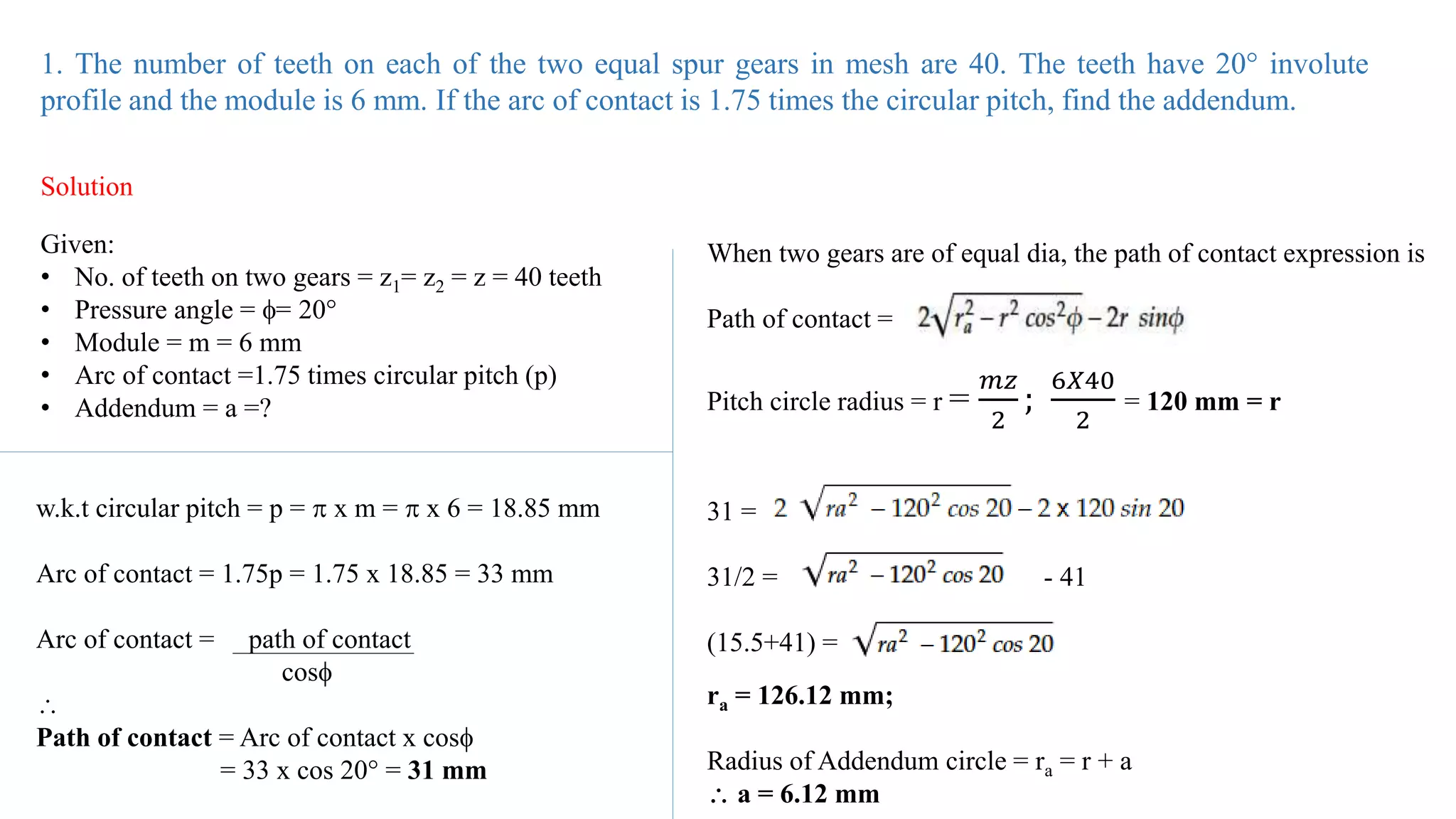
1. The number of teeth on each of the two equal spur gears in mesh are 40. The teeth have 20° involute
profile and the module is 6 mm. If the arc of contact is 1.75 times the circular pitch, find the addendum.
Solution
Given:
• No. of teeth on two gears = z1= z2 = z = 40 teeth
• Pressure angle = = 20°
• Module = m = 6 mm
• Arc of contact =1.75 times circular pitch (p)
• Addendum = a =?
w.k.t circular pitch = p =  x m =  x 6 = 18.85 mm
Arc of contact = 1.75p = 1.75 x 18.85 = 33 mm
Arc of contact = path of contact
cos

Path of contact = Arc of contact x cos
= 33 x cos 20 = 31 mm
When two gears are of equal dia, the path of contact expression is
Path of contact =
Pitch circle radius = r =
𝑚𝑧
2
;
6𝑋40
2
= 120 mm = r
31 =
31/2 = - 41
(15.5+41) =
ra = 126.12 mm;
Radius of Addendum circle = ra = r + a
 a = 6.12 mm
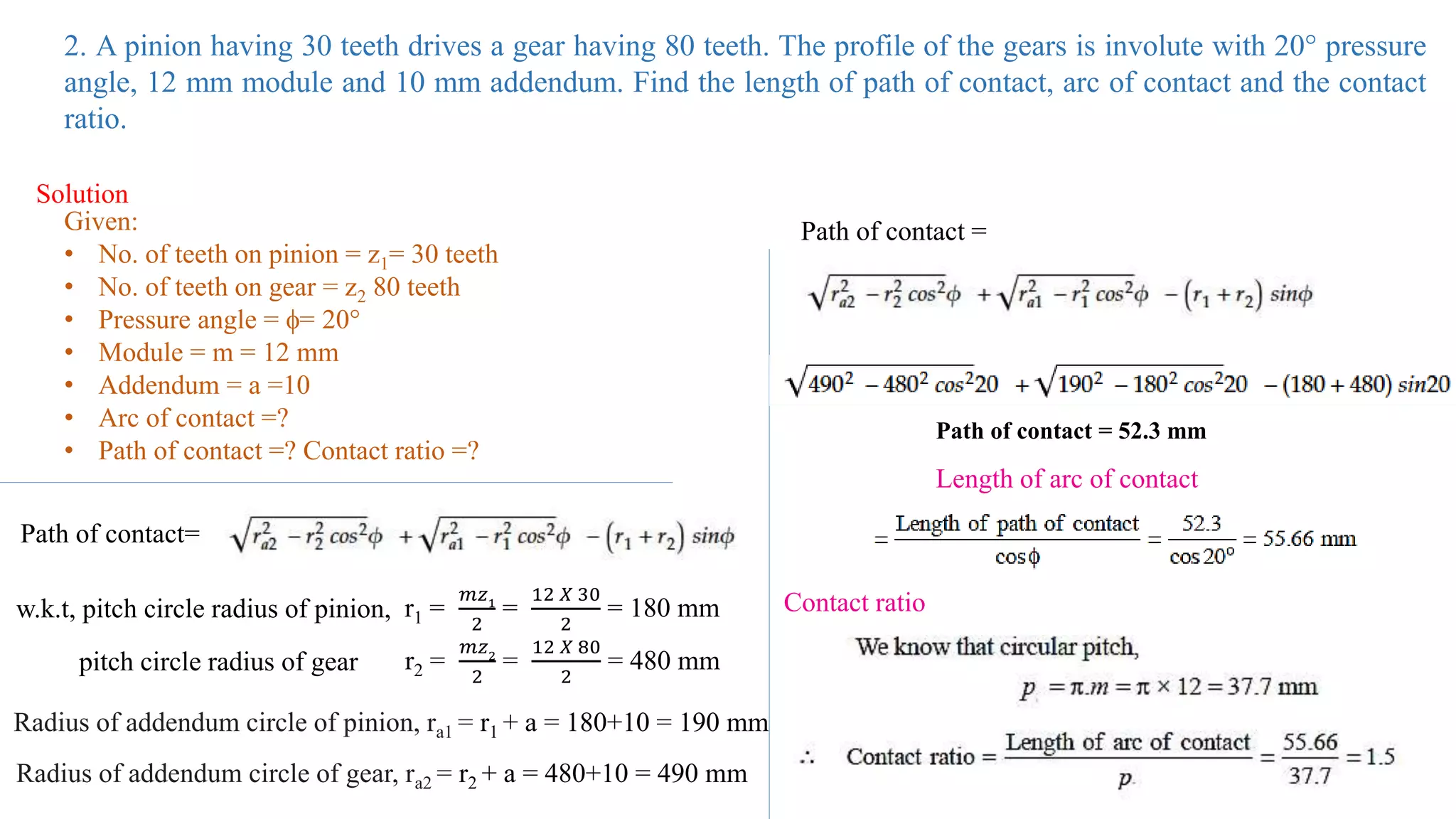
2. A pinion having 30 teeth drives a gear having 80 teeth. The profile of the gears is involute with 20° pressure
angle, 12 mm module and 10 mm addendum. Find the length of path of contact, arc of contact and the contact
ratio.
Solution
Given:
• No. of teeth on pinion = z1= 30 teeth
• No. of teeth on gear = z2 80 teeth
• Pressure angle = = 20°
• Module = m = 12 mm
• Addendum = a =10
• Arc of contact =?
• Path of contact =? Contact ratio =?
Path of contact=
w.k.t, pitch circle radius of pinion, r1 =
𝑚𝑧1
2
=
12 𝑋 30
2
= 180 mm
pitch circle radius of gear r2 =
𝑚𝑧2
2
=
12 𝑋 80
2
= 480 mm
Radius of addendum circle of pinion, ra1 = r1 + a = 180+10 = 190 mm
Radius of addendum circle of gear, ra2 = r2 + a = 480+10 = 490 mm
Path of contact =
Path of contact = 52.3 mm
Length of arc of contact
Contact ratio
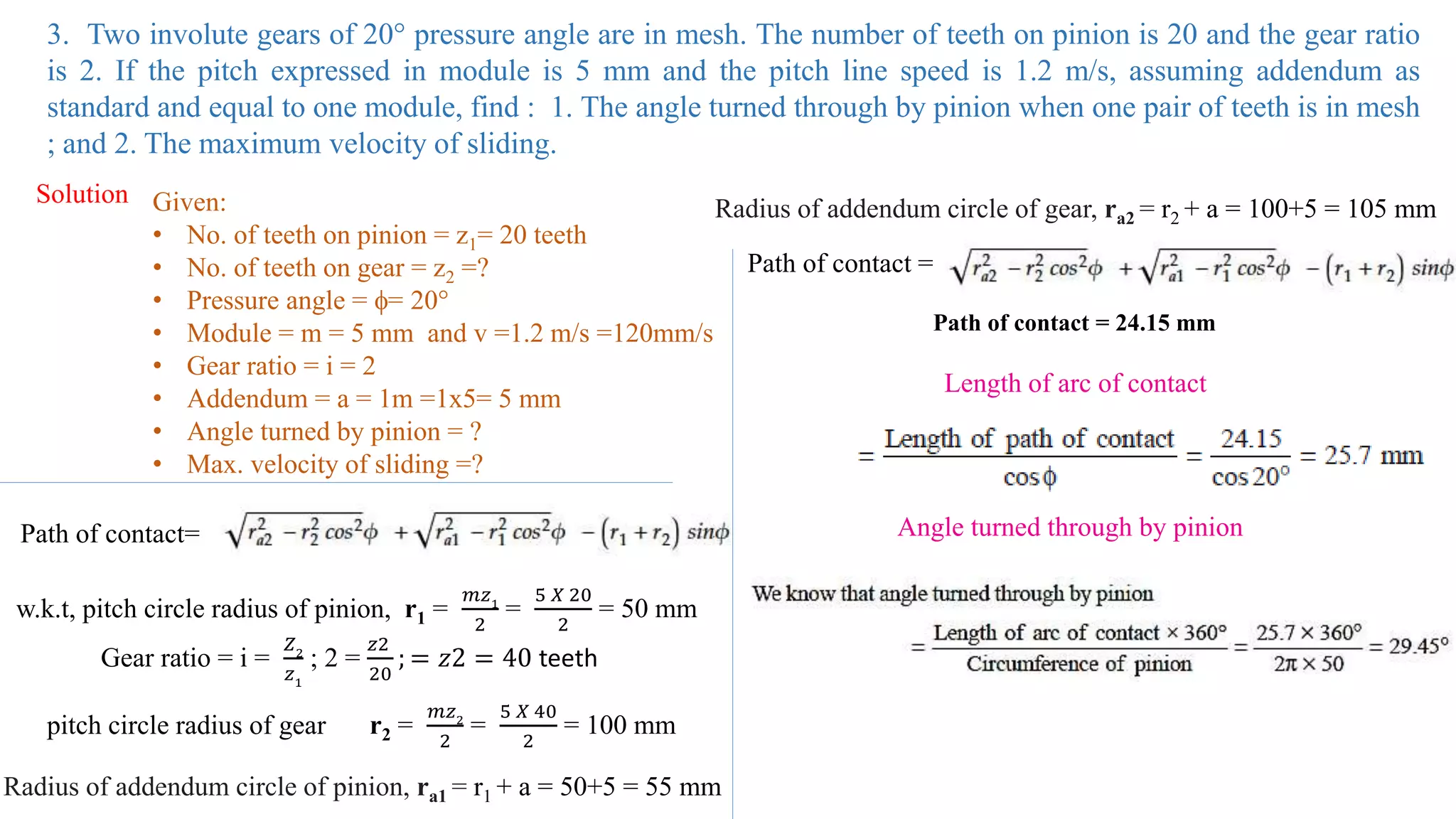
3. Two involute gears of 20° pressure angle are in mesh. The number of teeth on pinion is 20 and the gear ratio
is 2. If the pitch expressed in module is 5 mm and the pitch line speed is 1.2 m/s, assuming addendum as
standard and equal to one module, find : 1. The angle turned through by pinion when one pair of teeth is in mesh
; and 2. The maximum velocity of sliding.
Solution Given:
• No. of teeth on pinion = z1= 20 teeth
• No. of teeth on gear = z2 =?
• Pressure angle = = 20°
• Module = m = 5 mm and v =1.2 m/s =120mm/s
• Gear ratio = i = 2
• Addendum = a = 1m =1x5= 5 mm
• Angle turned by pinion = ?
• Max. velocity of sliding =?
Path of contact=
w.k.t, pitch circle radius of pinion, r1 =
𝑚𝑧1
2
=
5 𝑋 20
2
= 50 mm
pitch circle radius of gear r2 =
𝑚𝑧2
2
=
5 𝑋 40
2
= 100 mm
Radius of addendum circle of pinion, ra1 = r1 + a = 50+5 = 55 mm
Radius of addendum circle of gear, ra2 = r2 + a = 100+5 = 105 mm
Path of contact =
Path of contact = 24.15 mm
Length of arc of contact
Gear ratio = i =
𝑍2
𝑧1
; 2 =
𝑧2
20
; = 𝑧2 = 40 teeth
Angle turned through by pinion
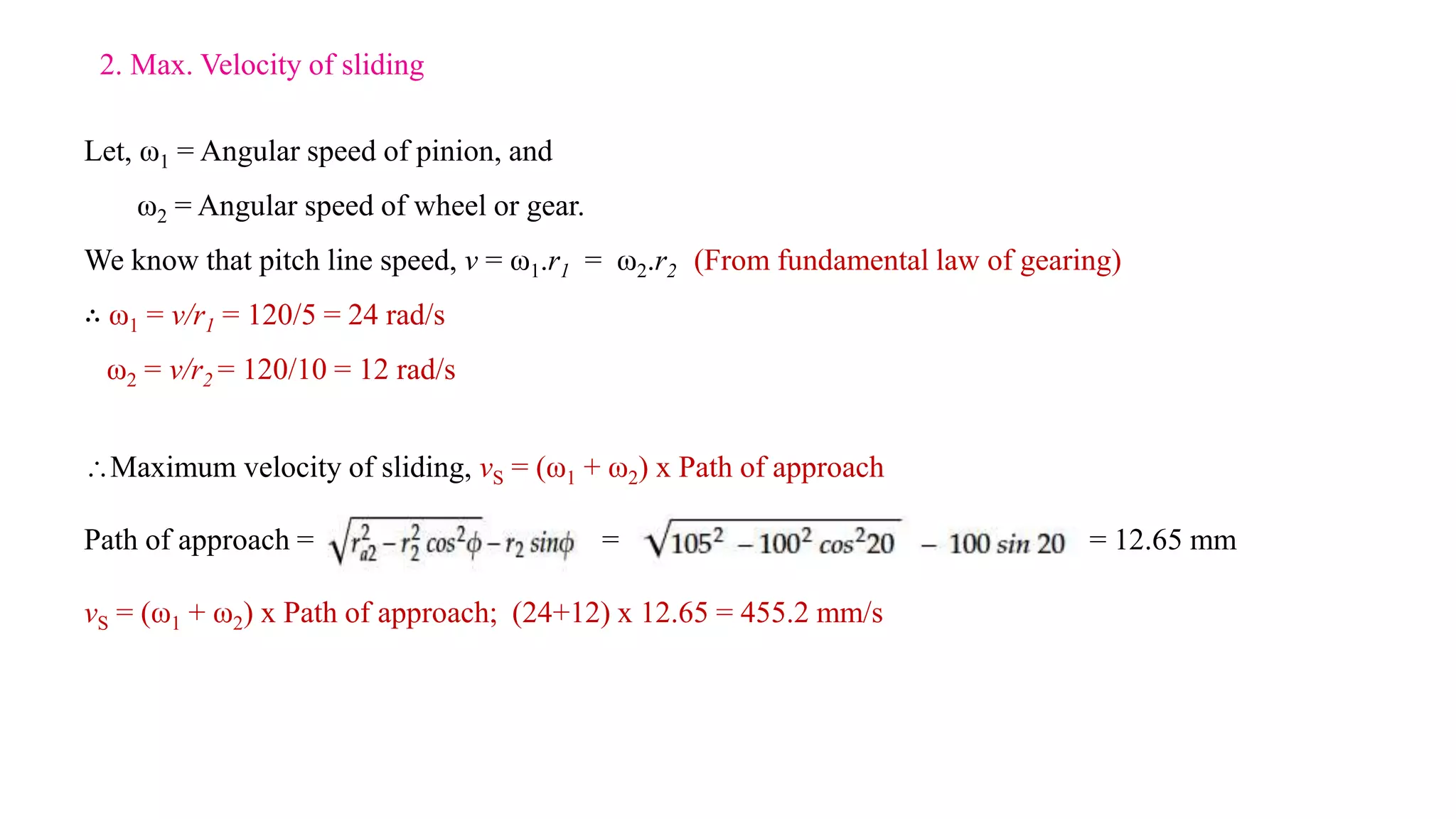
Let, ω1 = Angular speed of pinion, and
ω2 = Angular speed of wheel or gear.
We know that pitch line speed, v = ω1.r1 = ω2.r2 (From fundamental law of gearing)
∴ ω1 = v/r1 = 120/5 = 24 rad/s
ω2 = v/r2 = 120/10 = 12 rad/s
Maximum velocity of sliding, vS = (ω1 + ω2) x Path of approach
Path of approach = = = 12.65 mm
vS = (ω1 + ω2) x Path of approach; (24+12) x 12.65 = 455.2 mm/s
2. Max. Velocity of sliding
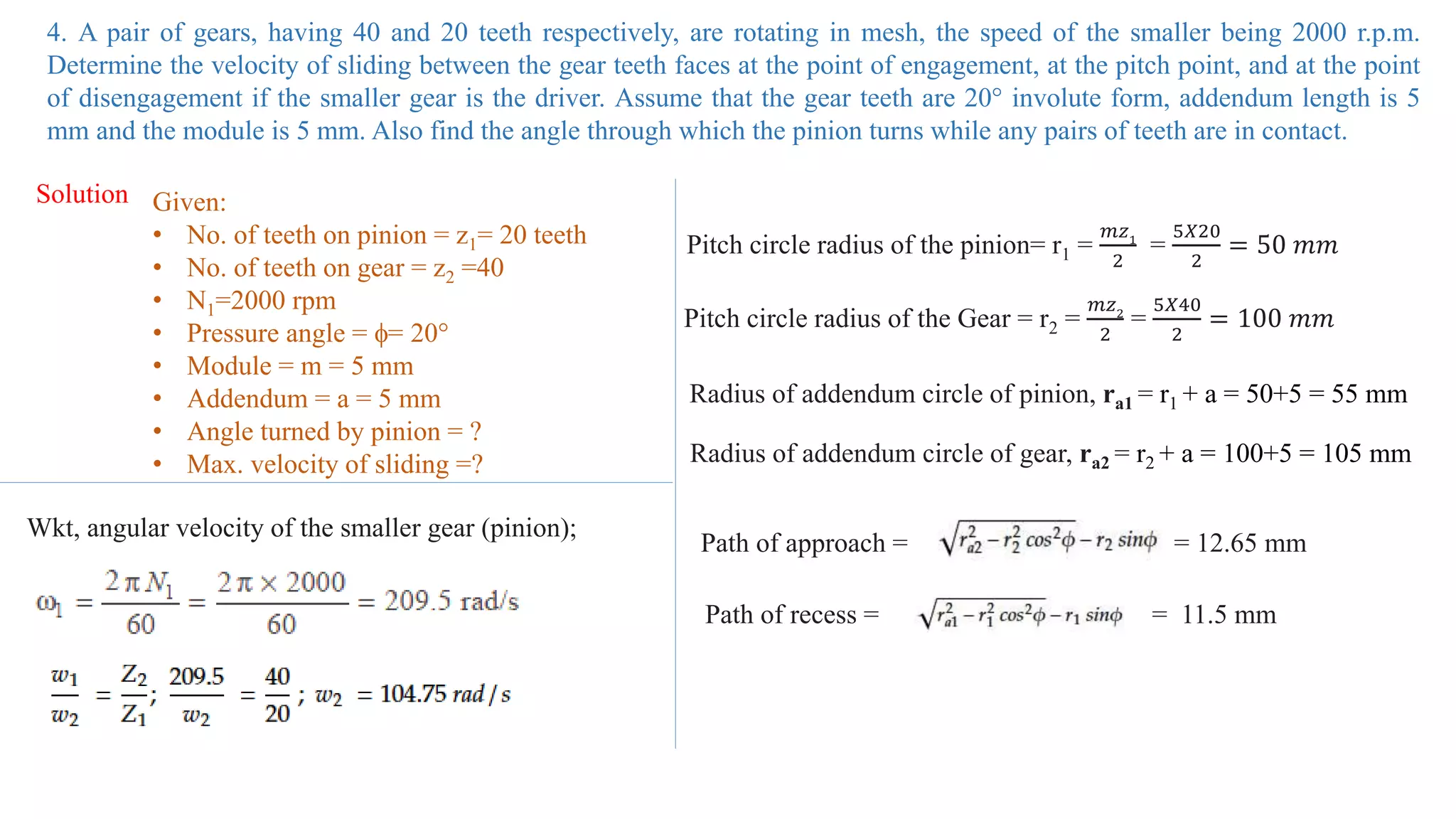
4. A pair of gears, having 40 and 20 teeth respectively, are rotating in mesh, the speed of the smaller being 2000 r.p.m.
Determine the velocity of sliding between the gear teeth faces at the point of engagement, at the pitch point, and at the point
of disengagement if the smaller gear is the driver. Assume that the gear teeth are 20° involute form, addendum length is 5
mm and the module is 5 mm. Also find the angle through which the pinion turns while any pairs of teeth are in contact.
Solution Given:
• No. of teeth on pinion = z1= 20 teeth
• No. of teeth on gear = z2 =40
• N1=2000 rpm
• Pressure angle = = 20°
• Module = m = 5 mm
• Addendum = a = 5 mm
• Angle turned by pinion = ?
• Max. velocity of sliding =?
Wkt, angular velocity of the smaller gear (pinion);
Pitch circle radius of the pinion= r1 =
𝑚𝑧1
2
=
5𝑋20
2
= 50 𝑚𝑚
Pitch circle radius of the Gear = r2 =
𝑚𝑧2
2
=
5𝑋40
2
= 100 𝑚𝑚
Radius of addendum circle of pinion, ra1 = r1 + a = 50+5 = 55 mm
Radius of addendum circle of gear, ra2 = r2 + a = 100+5 = 105 mm
Path of approach = = 12.65 mm
Path of recess = = 11.5 mm
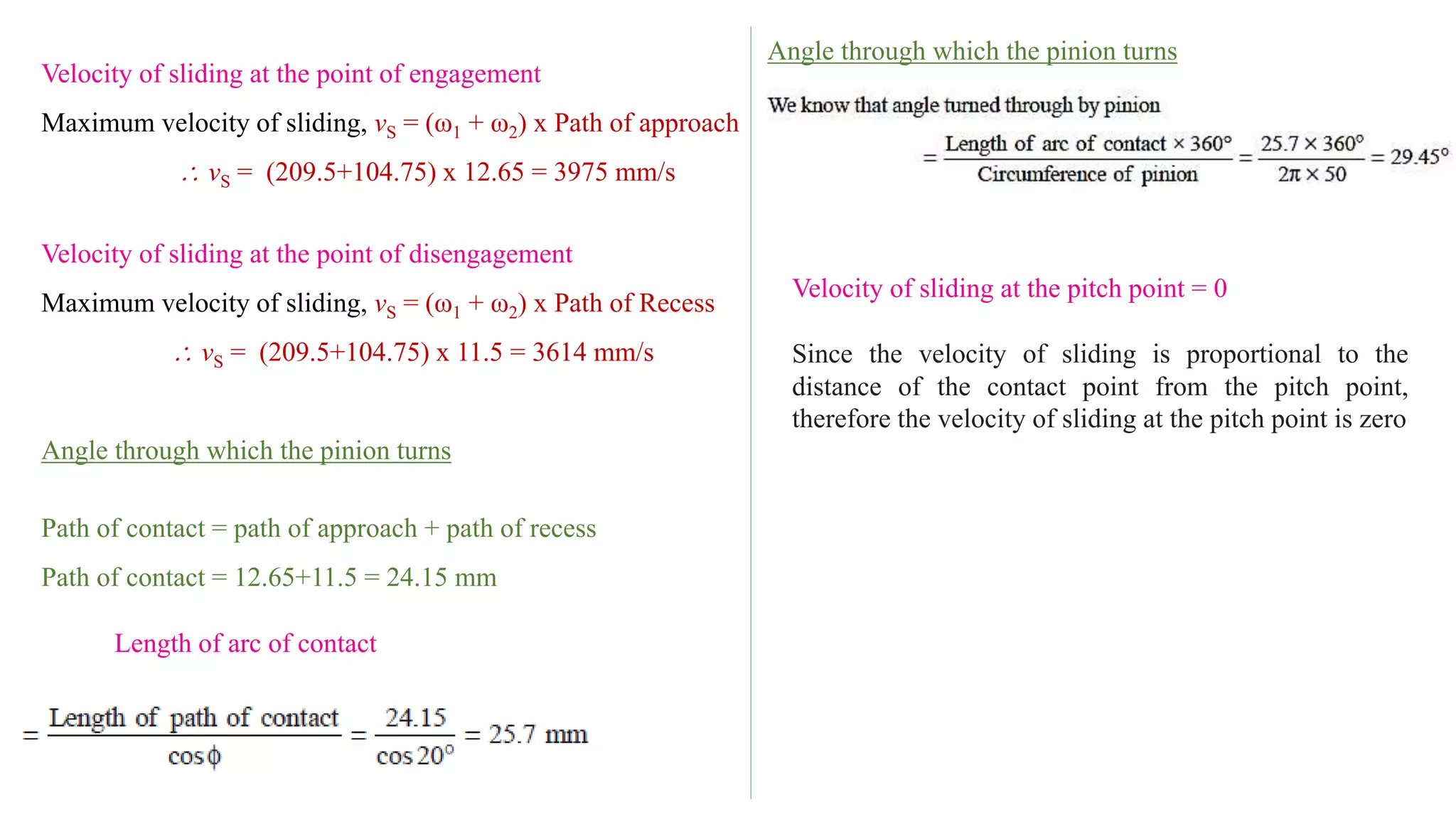
Velocity of sliding at the point of engagement
Maximum velocity of sliding, vS = (ω1 + ω2) x Path of approach
 vS = (209.5+104.75) x 12.65 = 3975 mm/s
Velocity of sliding at the point of disengagement
Maximum velocity of sliding, vS = (ω1 + ω2) x Path of Recess
 vS = (209.5+104.75) x 11.5 = 3614 mm/s
Angle through which the pinion turns
Path of contact = path of approach + path of recess
Path of contact = 12.65+11.5 = 24.15 mm
Length of arc of contact
Angle through which the pinion turns
Velocity of sliding at the pitch point = 0
Since the velocity of sliding is proportional to the
distance of the contact point from the pitch point,
therefore the velocity of sliding at the pitch point is zero
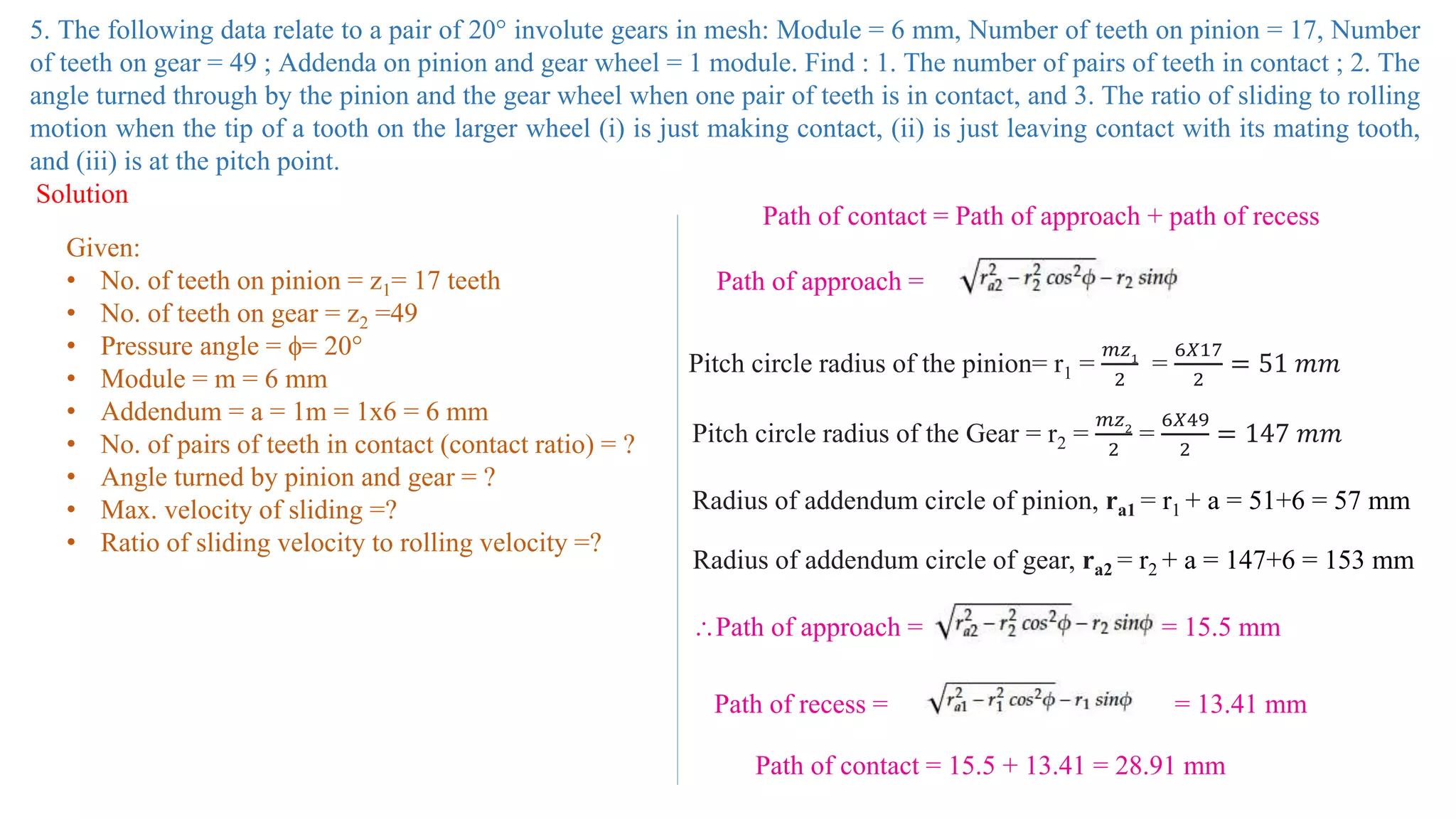
5. The following data relate to a pair of 20° involute gears in mesh: Module = 6 mm, Number of teeth on pinion = 17, Number
of teeth on gear = 49 ; Addenda on pinion and gear wheel = 1 module. Find : 1. The number of pairs of teeth in contact ; 2. The
angle turned through by the pinion and the gear wheel when one pair of teeth is in contact, and 3. The ratio of sliding to rolling
motion when the tip of a tooth on the larger wheel (i) is just making contact, (ii) is just leaving contact with its mating tooth,
and (iii) is at the pitch point.
Solution
Given:
• No. of teeth on pinion = z1= 17 teeth
• No. of teeth on gear = z2 =49
• Pressure angle = = 20°
• Module = m = 6 mm
• Addendum = a = 1m = 1x6 = 6 mm
• No. of pairs of teeth in contact (contact ratio) = ?
• Angle turned by pinion and gear = ?
• Max. velocity of sliding =?
• Ratio of sliding velocity to rolling velocity =?
Path of contact = Path of approach + path of recess
Path of approach =
Pitch circle radius of the pinion= r1 =
𝑚𝑧1
2
=
6𝑋17
2
= 51 𝑚𝑚
Pitch circle radius of the Gear = r2 =
𝑚𝑧2
2
=
6𝑋49
2
= 147 𝑚𝑚
Radius of addendum circle of pinion, ra1 = r1 + a = 51+6 = 57 mm
Radius of addendum circle of gear, ra2 = r2 + a = 147+6 = 153 mm
Path of approach = = 15.5 mm
Path of recess = = 13.41 mm
Path of contact = 15.5 + 13.41 = 28.91 mm
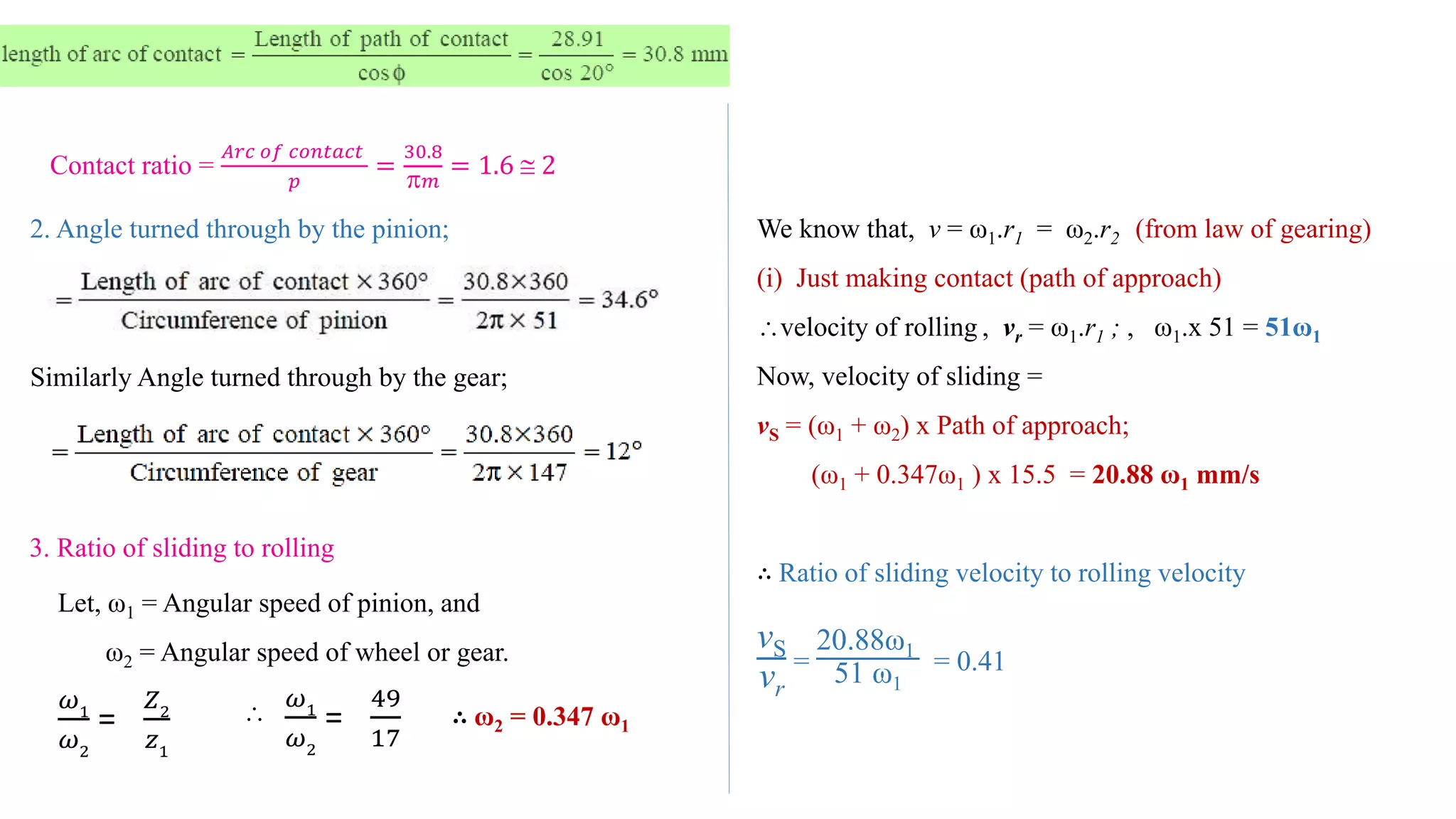
Contact ratio =
𝐴𝑟𝑐 𝑜𝑓 𝑐𝑜𝑛𝑡𝑎𝑐𝑡
𝑝
=
30.8
 𝑚
= 1.6  2
2. Angle turned through by the pinion;
Similarly Angle turned through by the gear;
3. Ratio of sliding to rolling
Let, ω1 = Angular speed of pinion, and
ω2 = Angular speed of wheel or gear.
𝜔1
𝜔2
=
𝑍2
𝑧1

𝜔1
𝜔2
=
49
17
∴ ω2 = 0.347 ω1
We know that, v = ω1.r1 = ω2.r2 (from law of gearing)
(i) Just making contact (path of approach)
velocity of rolling , vr = ω1.r1 ; , ω1.x 51 = 51ω1
Now, velocity of sliding =
vS = (ω1 + ω2) x Path of approach;
(ω1 + 0.347ω1 ) x 15.5 = 20.88 ω1 mm/s
∴ Ratio of sliding velocity to rolling velocity
vS
vr
=
20.88ω1
51 ω1
= 0.41
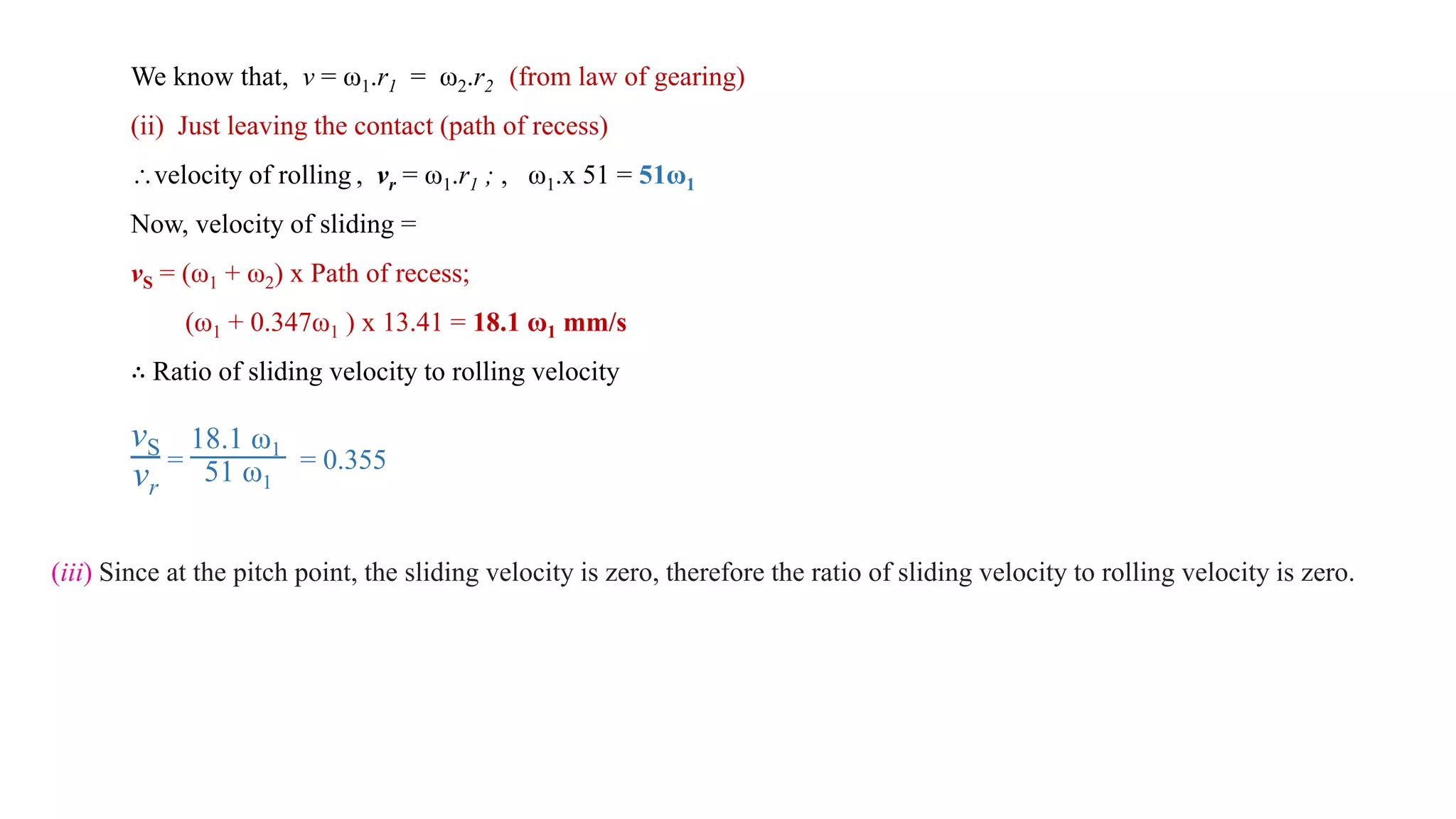
We know that, v = ω1.r1 = ω2.r2 (from law of gearing)
(ii) Just leaving the contact (path of recess)
velocity of rolling , vr = ω1.r1 ; , ω1.x 51 = 51ω1
Now, velocity of sliding =
vS = (ω1 + ω2) x Path of recess;
(ω1 + 0.347ω1 ) x 13.41 = 18.1 ω1 mm/s
∴ Ratio of sliding velocity to rolling velocity
vS
vr
=
18.1 ω1
51 ω1
= 0.355
(iii) Since at the pitch point, the sliding velocity is zero, therefore the ratio of sliding velocity to rolling velocity is zero.
End of Module

Numerical problems on spur gear (type i)

  • 1.
    Department of MechanicalEngineering JSS Academy of Technical Education, Bangalore-560060 Kinematics of Machines (Course Code:18ME44)
  • 2.
    Kinematics of Machines Module5: Numerical problems on spur gears
  • 3.
    1. The numberof teeth on each of the two equal spur gears in mesh are 40. The teeth have 20° involute profile and the module is 6 mm. If the arc of contact is 1.75 times the circular pitch, find the addendum. Solution Given: • No. of teeth on two gears = z1= z2 = z = 40 teeth • Pressure angle = = 20° • Module = m = 6 mm • Arc of contact =1.75 times circular pitch (p) • Addendum = a =? w.k.t circular pitch = p =  x m =  x 6 = 18.85 mm Arc of contact = 1.75p = 1.75 x 18.85 = 33 mm Arc of contact = path of contact cos  Path of contact = Arc of contact x cos = 33 x cos 20 = 31 mm When two gears are of equal dia, the path of contact expression is Path of contact = Pitch circle radius = r = 𝑚𝑧 2 ; 6𝑋40 2 = 120 mm = r 31 = 31/2 = - 41 (15.5+41) = ra = 126.12 mm; Radius of Addendum circle = ra = r + a  a = 6.12 mm
  • 4.
    2. A pinionhaving 30 teeth drives a gear having 80 teeth. The profile of the gears is involute with 20° pressure angle, 12 mm module and 10 mm addendum. Find the length of path of contact, arc of contact and the contact ratio. Solution Given: • No. of teeth on pinion = z1= 30 teeth • No. of teeth on gear = z2 80 teeth • Pressure angle = = 20° • Module = m = 12 mm • Addendum = a =10 • Arc of contact =? • Path of contact =? Contact ratio =? Path of contact= w.k.t, pitch circle radius of pinion, r1 = 𝑚𝑧1 2 = 12 𝑋 30 2 = 180 mm pitch circle radius of gear r2 = 𝑚𝑧2 2 = 12 𝑋 80 2 = 480 mm Radius of addendum circle of pinion, ra1 = r1 + a = 180+10 = 190 mm Radius of addendum circle of gear, ra2 = r2 + a = 480+10 = 490 mm Path of contact = Path of contact = 52.3 mm Length of arc of contact Contact ratio
  • 5.
    3. Two involutegears of 20° pressure angle are in mesh. The number of teeth on pinion is 20 and the gear ratio is 2. If the pitch expressed in module is 5 mm and the pitch line speed is 1.2 m/s, assuming addendum as standard and equal to one module, find : 1. The angle turned through by pinion when one pair of teeth is in mesh ; and 2. The maximum velocity of sliding. Solution Given: • No. of teeth on pinion = z1= 20 teeth • No. of teeth on gear = z2 =? • Pressure angle = = 20° • Module = m = 5 mm and v =1.2 m/s =120mm/s • Gear ratio = i = 2 • Addendum = a = 1m =1x5= 5 mm • Angle turned by pinion = ? • Max. velocity of sliding =? Path of contact= w.k.t, pitch circle radius of pinion, r1 = 𝑚𝑧1 2 = 5 𝑋 20 2 = 50 mm pitch circle radius of gear r2 = 𝑚𝑧2 2 = 5 𝑋 40 2 = 100 mm Radius of addendum circle of pinion, ra1 = r1 + a = 50+5 = 55 mm Radius of addendum circle of gear, ra2 = r2 + a = 100+5 = 105 mm Path of contact = Path of contact = 24.15 mm Length of arc of contact Gear ratio = i = 𝑍2 𝑧1 ; 2 = 𝑧2 20 ; = 𝑧2 = 40 teeth Angle turned through by pinion
  • 6.
    Let, ω1 =Angular speed of pinion, and ω2 = Angular speed of wheel or gear. We know that pitch line speed, v = ω1.r1 = ω2.r2 (From fundamental law of gearing) ∴ ω1 = v/r1 = 120/5 = 24 rad/s ω2 = v/r2 = 120/10 = 12 rad/s Maximum velocity of sliding, vS = (ω1 + ω2) x Path of approach Path of approach = = = 12.65 mm vS = (ω1 + ω2) x Path of approach; (24+12) x 12.65 = 455.2 mm/s 2. Max. Velocity of sliding
  • 7.
    4. A pairof gears, having 40 and 20 teeth respectively, are rotating in mesh, the speed of the smaller being 2000 r.p.m. Determine the velocity of sliding between the gear teeth faces at the point of engagement, at the pitch point, and at the point of disengagement if the smaller gear is the driver. Assume that the gear teeth are 20° involute form, addendum length is 5 mm and the module is 5 mm. Also find the angle through which the pinion turns while any pairs of teeth are in contact. Solution Given: • No. of teeth on pinion = z1= 20 teeth • No. of teeth on gear = z2 =40 • N1=2000 rpm • Pressure angle = = 20° • Module = m = 5 mm • Addendum = a = 5 mm • Angle turned by pinion = ? • Max. velocity of sliding =? Wkt, angular velocity of the smaller gear (pinion); Pitch circle radius of the pinion= r1 = 𝑚𝑧1 2 = 5𝑋20 2 = 50 𝑚𝑚 Pitch circle radius of the Gear = r2 = 𝑚𝑧2 2 = 5𝑋40 2 = 100 𝑚𝑚 Radius of addendum circle of pinion, ra1 = r1 + a = 50+5 = 55 mm Radius of addendum circle of gear, ra2 = r2 + a = 100+5 = 105 mm Path of approach = = 12.65 mm Path of recess = = 11.5 mm
  • 8.
    Velocity of slidingat the point of engagement Maximum velocity of sliding, vS = (ω1 + ω2) x Path of approach  vS = (209.5+104.75) x 12.65 = 3975 mm/s Velocity of sliding at the point of disengagement Maximum velocity of sliding, vS = (ω1 + ω2) x Path of Recess  vS = (209.5+104.75) x 11.5 = 3614 mm/s Angle through which the pinion turns Path of contact = path of approach + path of recess Path of contact = 12.65+11.5 = 24.15 mm Length of arc of contact Angle through which the pinion turns Velocity of sliding at the pitch point = 0 Since the velocity of sliding is proportional to the distance of the contact point from the pitch point, therefore the velocity of sliding at the pitch point is zero
  • 9.
    5. The followingdata relate to a pair of 20° involute gears in mesh: Module = 6 mm, Number of teeth on pinion = 17, Number of teeth on gear = 49 ; Addenda on pinion and gear wheel = 1 module. Find : 1. The number of pairs of teeth in contact ; 2. The angle turned through by the pinion and the gear wheel when one pair of teeth is in contact, and 3. The ratio of sliding to rolling motion when the tip of a tooth on the larger wheel (i) is just making contact, (ii) is just leaving contact with its mating tooth, and (iii) is at the pitch point. Solution Given: • No. of teeth on pinion = z1= 17 teeth • No. of teeth on gear = z2 =49 • Pressure angle = = 20° • Module = m = 6 mm • Addendum = a = 1m = 1x6 = 6 mm • No. of pairs of teeth in contact (contact ratio) = ? • Angle turned by pinion and gear = ? • Max. velocity of sliding =? • Ratio of sliding velocity to rolling velocity =? Path of contact = Path of approach + path of recess Path of approach = Pitch circle radius of the pinion= r1 = 𝑚𝑧1 2 = 6𝑋17 2 = 51 𝑚𝑚 Pitch circle radius of the Gear = r2 = 𝑚𝑧2 2 = 6𝑋49 2 = 147 𝑚𝑚 Radius of addendum circle of pinion, ra1 = r1 + a = 51+6 = 57 mm Radius of addendum circle of gear, ra2 = r2 + a = 147+6 = 153 mm Path of approach = = 15.5 mm Path of recess = = 13.41 mm Path of contact = 15.5 + 13.41 = 28.91 mm
  • 10.
    Contact ratio = 𝐴𝑟𝑐𝑜𝑓 𝑐𝑜𝑛𝑡𝑎𝑐𝑡 𝑝 = 30.8  𝑚 = 1.6  2 2. Angle turned through by the pinion; Similarly Angle turned through by the gear; 3. Ratio of sliding to rolling Let, ω1 = Angular speed of pinion, and ω2 = Angular speed of wheel or gear. 𝜔1 𝜔2 = 𝑍2 𝑧1  𝜔1 𝜔2 = 49 17 ∴ ω2 = 0.347 ω1 We know that, v = ω1.r1 = ω2.r2 (from law of gearing) (i) Just making contact (path of approach) velocity of rolling , vr = ω1.r1 ; , ω1.x 51 = 51ω1 Now, velocity of sliding = vS = (ω1 + ω2) x Path of approach; (ω1 + 0.347ω1 ) x 15.5 = 20.88 ω1 mm/s ∴ Ratio of sliding velocity to rolling velocity vS vr = 20.88ω1 51 ω1 = 0.41
  • 11.
    We know that,v = ω1.r1 = ω2.r2 (from law of gearing) (ii) Just leaving the contact (path of recess) velocity of rolling , vr = ω1.r1 ; , ω1.x 51 = 51ω1 Now, velocity of sliding = vS = (ω1 + ω2) x Path of recess; (ω1 + 0.347ω1 ) x 13.41 = 18.1 ω1 mm/s ∴ Ratio of sliding velocity to rolling velocity vS vr = 18.1 ω1 51 ω1 = 0.355 (iii) Since at the pitch point, the sliding velocity is zero, therefore the ratio of sliding velocity to rolling velocity is zero.
  • 12.