SETS
Submitted to
Md. Auhidur Rahman
Lecturer
Institute of Information & Technology
Presented by
Nadim Bhuiyan(ASH1825034M)
Saifur Rahman(ASH1825031M)
Fazle Rabbi(ASH1825004M)
Mahabub (ASH1825003M)
Contents
 Definition of Sets
 Kinds of sets
 Venn Diagrams
 Operation on sets
 Laws of sets
Definition of sets:
 A set is a simply well defined list or collection distinct objects.The objects in a set is called
element or member of the set.
 A set is an abstract data type that can store certain values,without any particular order,
and no repeated values,
 A set is a group or collection of objects or number considered as an entity unto itself.
 For Example:
• a set of chairs,
• the set of nobel laureates in the worlds,
• the set of integers,
• the set of natural numbers less than 10,
• the set of books in the table.
Kinds of sets
Empty Set
Finite Set
Infinite Set
Sub Set
Disjoint Set
Equality Set
Union Set
Intersection Set
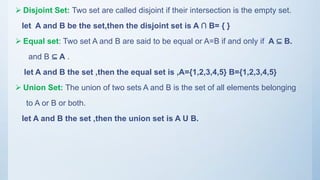
 Disjoint Set: Two set are called disjoint if their intersection is the empty set.
let A and B be the set,then the disjoint set is A ∩ B= { }
 Equal set: Two set A and B are said to be equal or A=B if and only if A ⊆ B.
and B ⊆ A .
let A and B the set ,then the equal set is ,A={1,2,3,4,5} B={1,2,3,4,5}
 Union Set: The union of two sets A and B is the set of all elements belonging
to A or B or both.
let A and B the set ,then the union set is A U B.
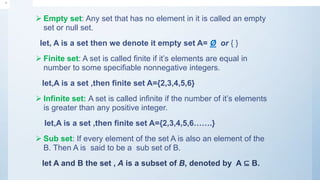
 Empty set: Any set that has no element in it is called an empty
set or null set.
let, A is a set then we denote it empty set A= Ø or { }
 Finite set: A set is called finite if it’s elements are equal in
number to some specifiable nonnegative integers.
let,A is a set ,then finite set A={2,3,4,5,6}
 Infinite set: A set is called infinite if the number of it’s elements
is greater than any positive integer.
let,A is a set ,then finite set A={2,3,4,5,6…….}
 Sub set: If every element of the set A is also an element of the
B. Then A is said to be a sub set of B.
let A and B the set , A is a subset of B, denoted by A ⊆ B.
•
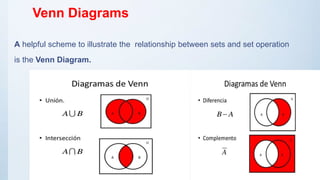
Venn Diagrams
A helpful scheme to illustrate the relationship between sets and set operation
is the Venn Diagram.
Operation on Sets
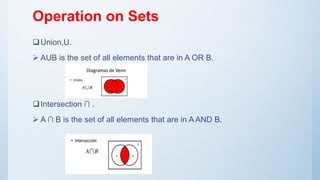
Union,U.
 AUB is the set of all elements that are in A OR B.
Intersection ∩ .
 A ∩ B is the set of all elements that are in A AND B.
Operation of sets
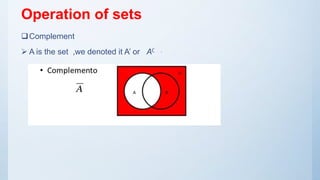
Complement
 A is the set ,we denoted it A’ or A∁ .
Laws of sets
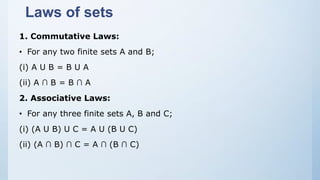
1. Commutative Laws:
• For any two finite sets A and B;
(i) A U B = B U A
(ii) A ∩ B = B ∩ A
2. Associative Laws:
• For any three finite sets A, B and C;
(i) (A U B) U C = A U (B U C)
(ii) (A ∩ B) ∩ C = A ∩ (B ∩ C)
Laws of sets
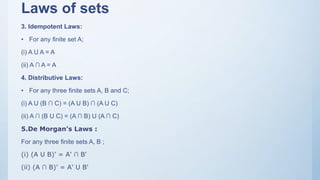
3. Idempotent Laws:
• For any finite set A;
(i) A U A = A
(ii) A ∩ A = A
4. Distributive Laws:
• For any three finite sets A, B and C;
(i) A U (B ∩ C) = (A U B) ∩ (A U C)
(ii) A ∩ (B U C) = (A ∩ B) U (A ∩ C)
5.De Morgan’s Laws :
For any three finite sets A, B ;
(i) (A U B)’ = A' ∩ B'
(ii) (A ∩ B)’ = A' U B'
Discrete math (sets)

Discrete math (sets)

  • 1.
    SETS Submitted to Md. AuhidurRahman Lecturer Institute of Information & Technology Presented by Nadim Bhuiyan(ASH1825034M) Saifur Rahman(ASH1825031M) Fazle Rabbi(ASH1825004M) Mahabub (ASH1825003M)
  • 2.
    Contents  Definition ofSets  Kinds of sets  Venn Diagrams  Operation on sets  Laws of sets
  • 3.
    Definition of sets: A set is a simply well defined list or collection distinct objects.The objects in a set is called element or member of the set.  A set is an abstract data type that can store certain values,without any particular order, and no repeated values,  A set is a group or collection of objects or number considered as an entity unto itself.  For Example: • a set of chairs, • the set of nobel laureates in the worlds, • the set of integers, • the set of natural numbers less than 10, • the set of books in the table.
  • 4.
    Kinds of sets EmptySet Finite Set Infinite Set Sub Set Disjoint Set Equality Set Union Set Intersection Set
  • 5.
     Disjoint Set:Two set are called disjoint if their intersection is the empty set. let A and B be the set,then the disjoint set is A ∩ B= { }  Equal set: Two set A and B are said to be equal or A=B if and only if A ⊆ B. and B ⊆ A . let A and B the set ,then the equal set is ,A={1,2,3,4,5} B={1,2,3,4,5}  Union Set: The union of two sets A and B is the set of all elements belonging to A or B or both. let A and B the set ,then the union set is A U B.
  • 6.
     Empty set:Any set that has no element in it is called an empty set or null set. let, A is a set then we denote it empty set A= Ø or { }  Finite set: A set is called finite if it’s elements are equal in number to some specifiable nonnegative integers. let,A is a set ,then finite set A={2,3,4,5,6}  Infinite set: A set is called infinite if the number of it’s elements is greater than any positive integer. let,A is a set ,then finite set A={2,3,4,5,6…….}  Sub set: If every element of the set A is also an element of the B. Then A is said to be a sub set of B. let A and B the set , A is a subset of B, denoted by A ⊆ B. •
  • 7.
    Venn Diagrams A helpfulscheme to illustrate the relationship between sets and set operation is the Venn Diagram.
  • 8.
    Operation on Sets Union,U. AUB is the set of all elements that are in A OR B. Intersection ∩ .  A ∩ B is the set of all elements that are in A AND B.
  • 9.
    Operation of sets Complement A is the set ,we denoted it A’ or A∁ .
  • 10.
    Laws of sets 1.Commutative Laws: • For any two finite sets A and B; (i) A U B = B U A (ii) A ∩ B = B ∩ A 2. Associative Laws: • For any three finite sets A, B and C; (i) (A U B) U C = A U (B U C) (ii) (A ∩ B) ∩ C = A ∩ (B ∩ C)
  • 11.
    Laws of sets 3.Idempotent Laws: • For any finite set A; (i) A U A = A (ii) A ∩ A = A 4. Distributive Laws: • For any three finite sets A, B and C; (i) A U (B ∩ C) = (A U B) ∩ (A U C) (ii) A ∩ (B U C) = (A ∩ B) U (A ∩ C) 5.De Morgan’s Laws : For any three finite sets A, B ; (i) (A U B)’ = A' ∩ B' (ii) (A ∩ B)’ = A' U B'