This document contains 25 multiple choice questions about identifying relations and functions based on graphs, tables, and ordered pairs. Key concepts covered include:
- The vertical line test to determine if a graph represents a function
- A function mapping each domain element to only one range element
- A relation allowing multiple mappings between domain and range elements
The questions require applying these concepts to determine if a given representation is a relation only, function only, both a relation and function, or neither.
RELATIONS & FUNCTIONSWorksheet
1.
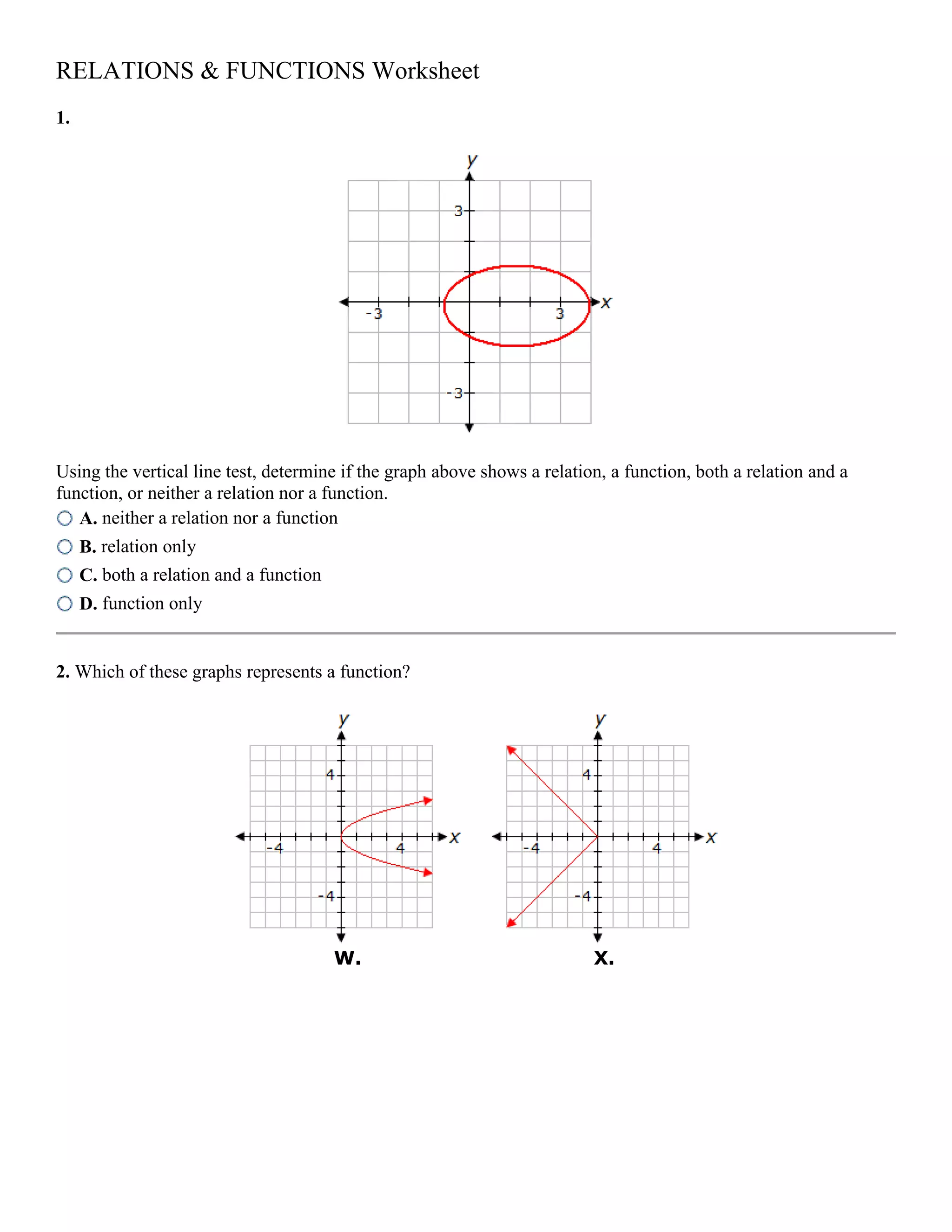
Using the vertical line test, determine if the graph above shows a relation, a function, both a relation and a
function, or neither a relation nor a function.
A. neither a relation nor a function
B. relation only
C. both a relation and a function
D. function only
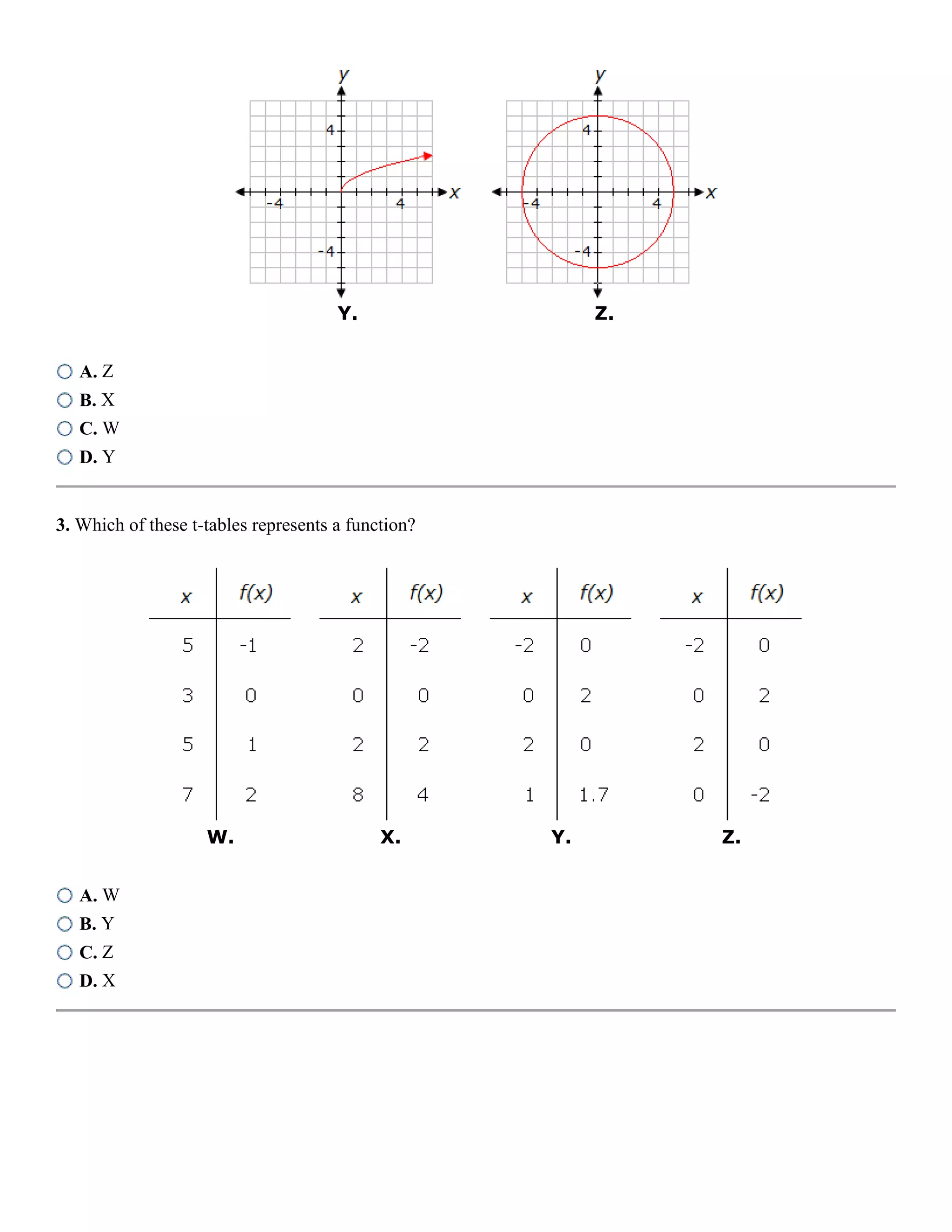
2. Which of these graphs represents a function?
W. X.
2.
Y. Z.
A. Z
B.X
C. W
D. Y
3. Which of these t-tables represents a function?
W. X. Y. Z.
A. W
B. Y
C. Z
D. X
3.
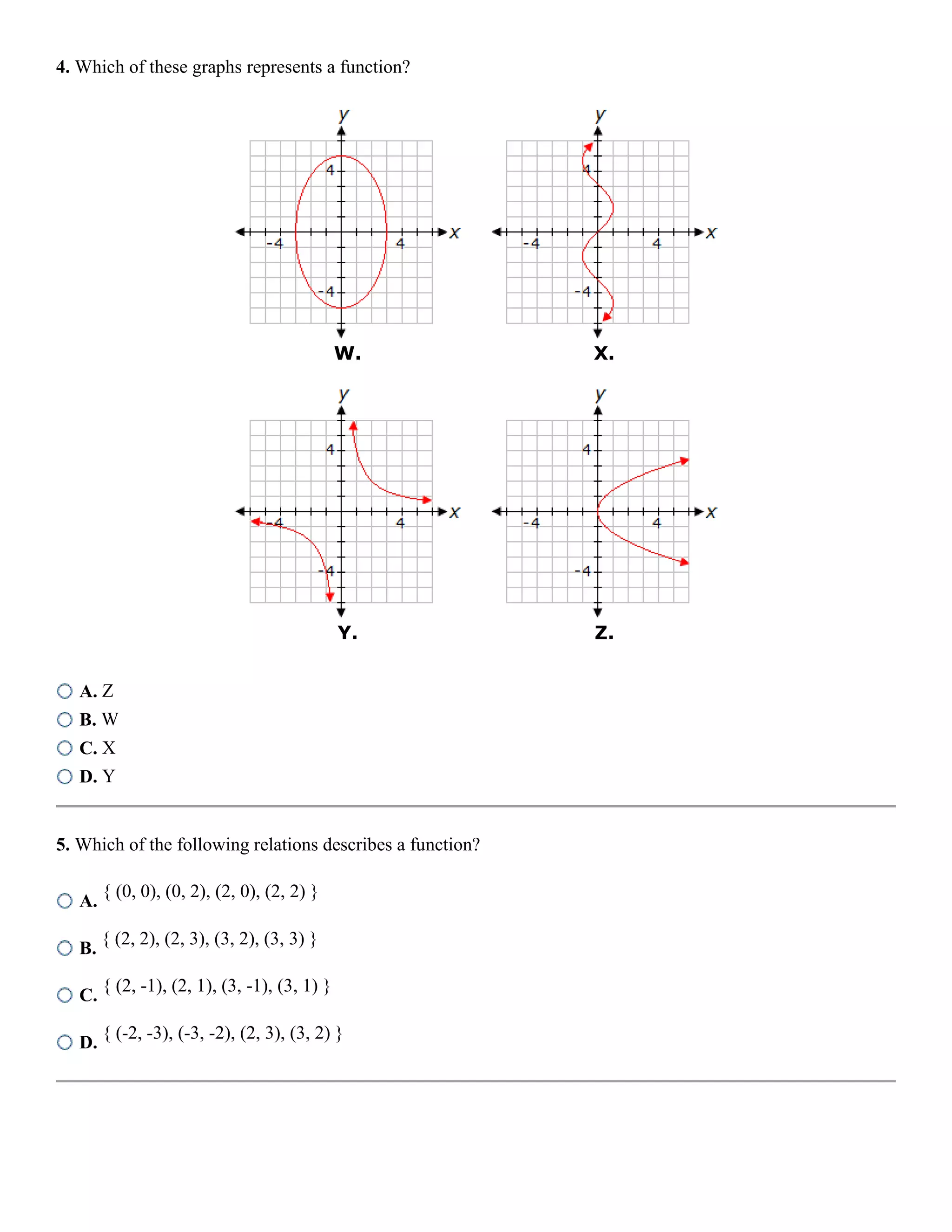
4. Which ofthese graphs represents a function?
W. X.
Y. Z.
A. Z
B. W
C. X
D. Y
5. Which of the following relations describes a function?
A.
{ (0, 0), (0, 2), (2, 0), (2, 2) }
B.
{ (2, 2), (2, 3), (3, 2), (3, 3) }
C.
{ (2, -1), (2, 1), (3, -1), (3, 1) }
D.
{ (-2, -3), (-3, -2), (2, 3), (3, 2) }
4.
6. Do theordered pairs below represent a relation, a function, both a relation and a function, or neither a relation
nor a function?
(-2,-1) , (1,-4) , (7,-10) , (8,-11)
A. neither a relation nor a function
B. both a relation and a function
C. relation only
D. function only
7.
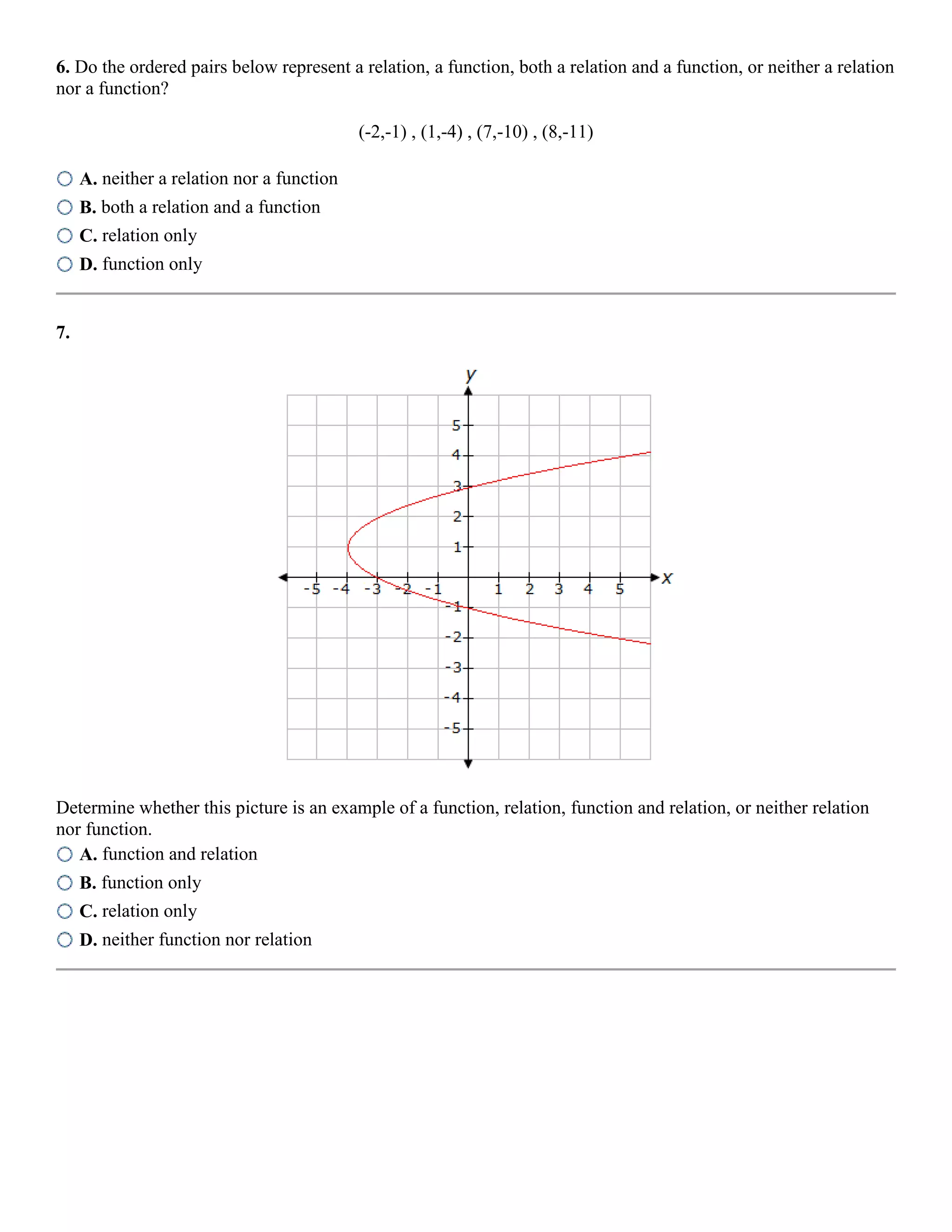
Determine whether this picture is an example of a function, relation, function and relation, or neither relation
nor function.
A. function and relation
B. function only
C. relation only
D. neither function nor relation
5.
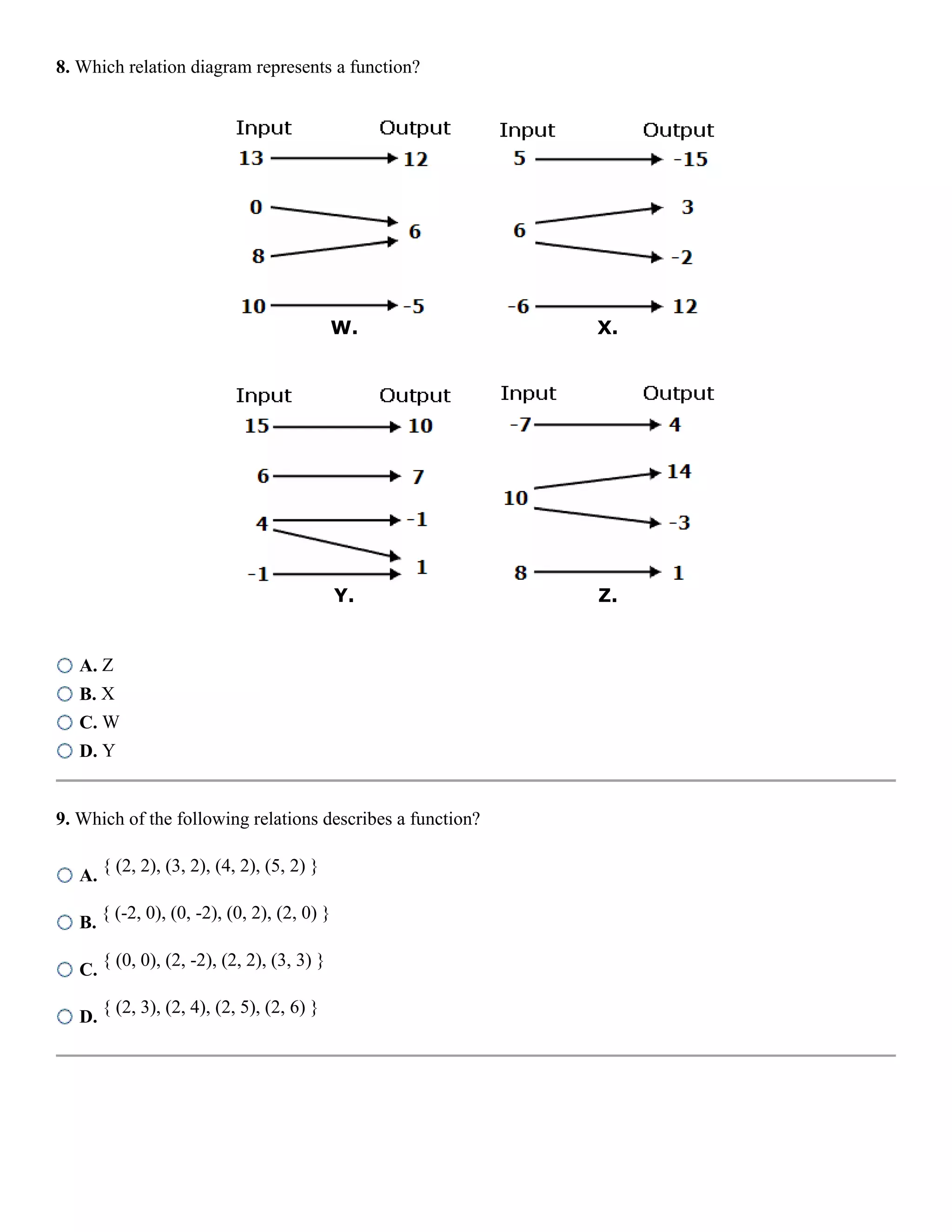
8. Which relationdiagram represents a function?
W. X.
Y. Z.
A. Z
B. X
C. W
D. Y
9. Which of the following relations describes a function?
A.
{ (2, 2), (3, 2), (4, 2), (5, 2) }
B.
{ (-2, 0), (0, -2), (0, 2), (2, 0) }
C.
{ (0, 0), (2, -2), (2, 2), (3, 3) }
D.
{ (2, 3), (2, 4), (2, 5), (2, 6) }
6.
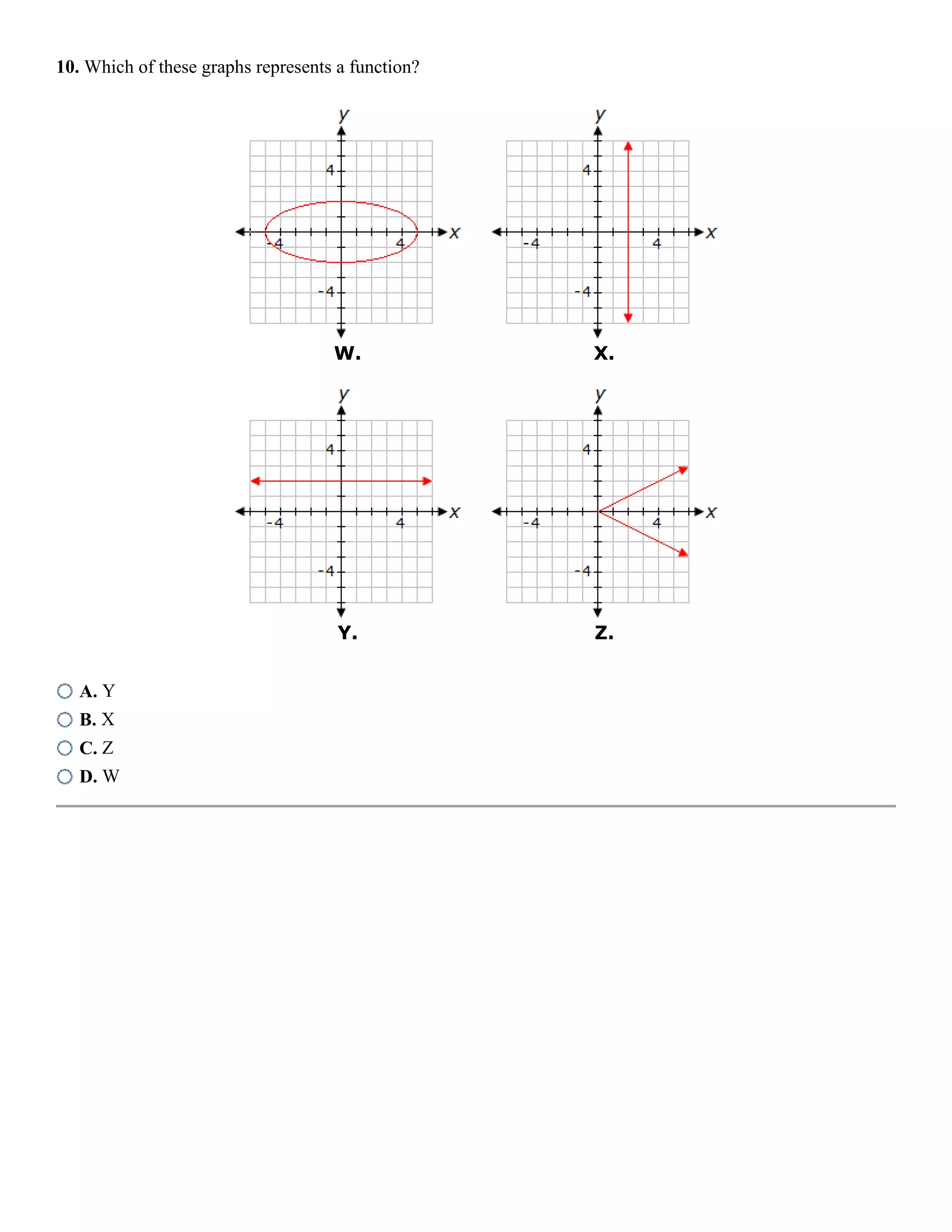
10. Which ofthese graphs represents a function?
W. X.
Y. Z.
A. Y
B. X
C. Z
D. W
7.
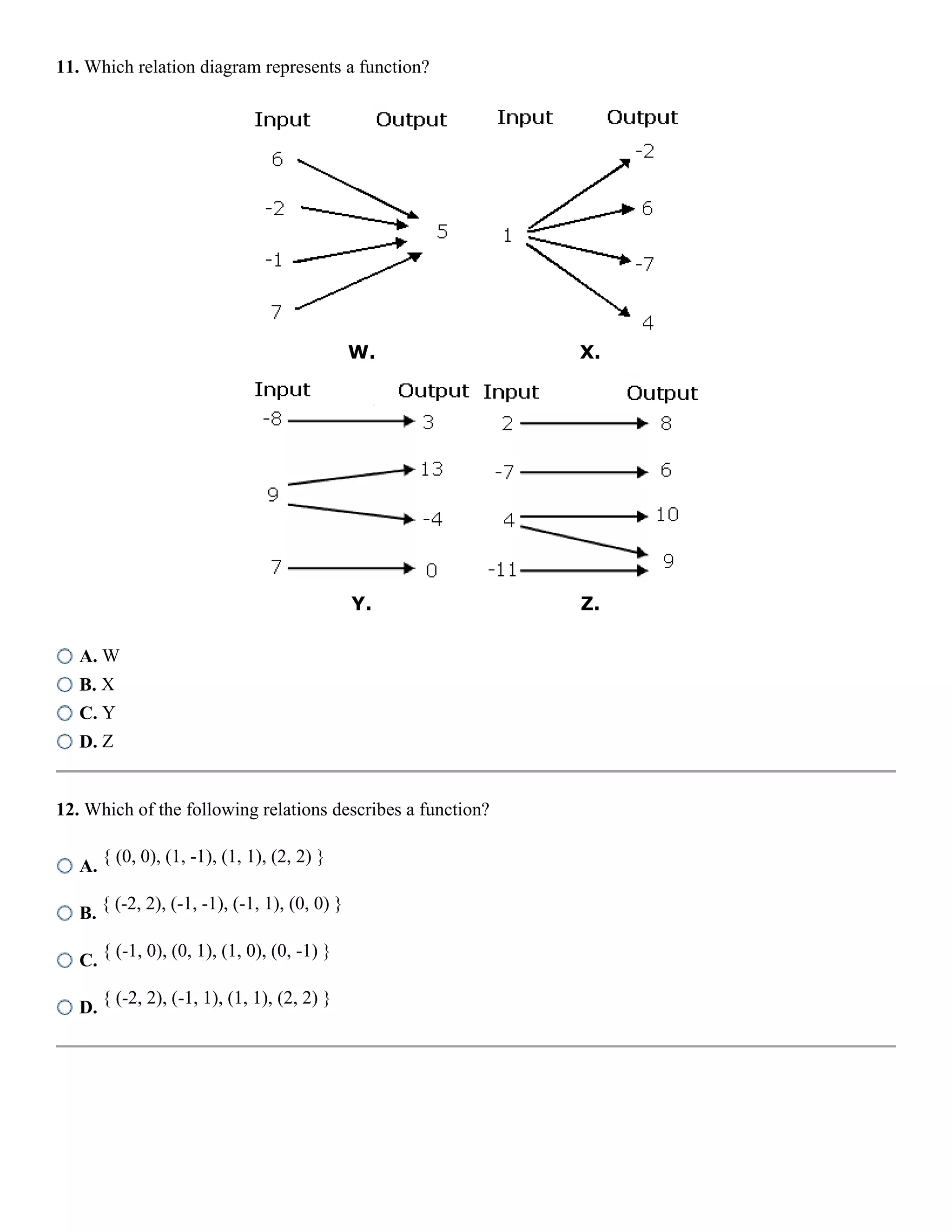
11. Which relationdiagram represents a function?
W. X.
Y. Z.
A. W
B. X
C. Y
D. Z
12. Which of the following relations describes a function?
A.
{ (0, 0), (1, -1), (1, 1), (2, 2) }
B.
{ (-2, 2), (-1, -1), (-1, 1), (0, 0) }
C.
{ (-1, 0), (0, 1), (1, 0), (0, -1) }
D.
{ (-2, 2), (-1, 1), (1, 1), (2, 2) }
8.
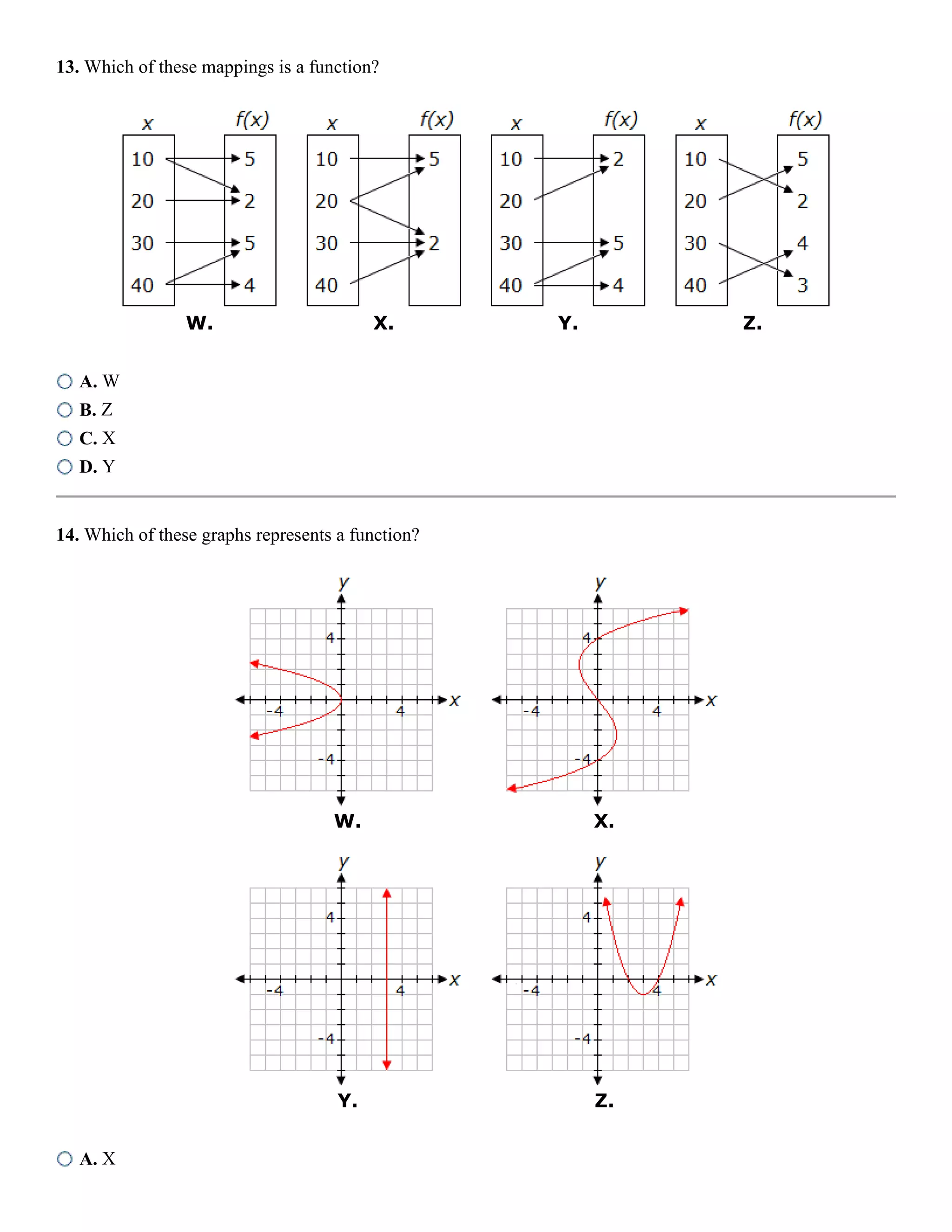
13. Which ofthese mappings is a function?
W. X. Y. Z.
A. W
B. Z
C. X
D. Y
14. Which of these graphs represents a function?
W. X.
Y. Z.
A. X
9.
B. W
C. Y
D.Z
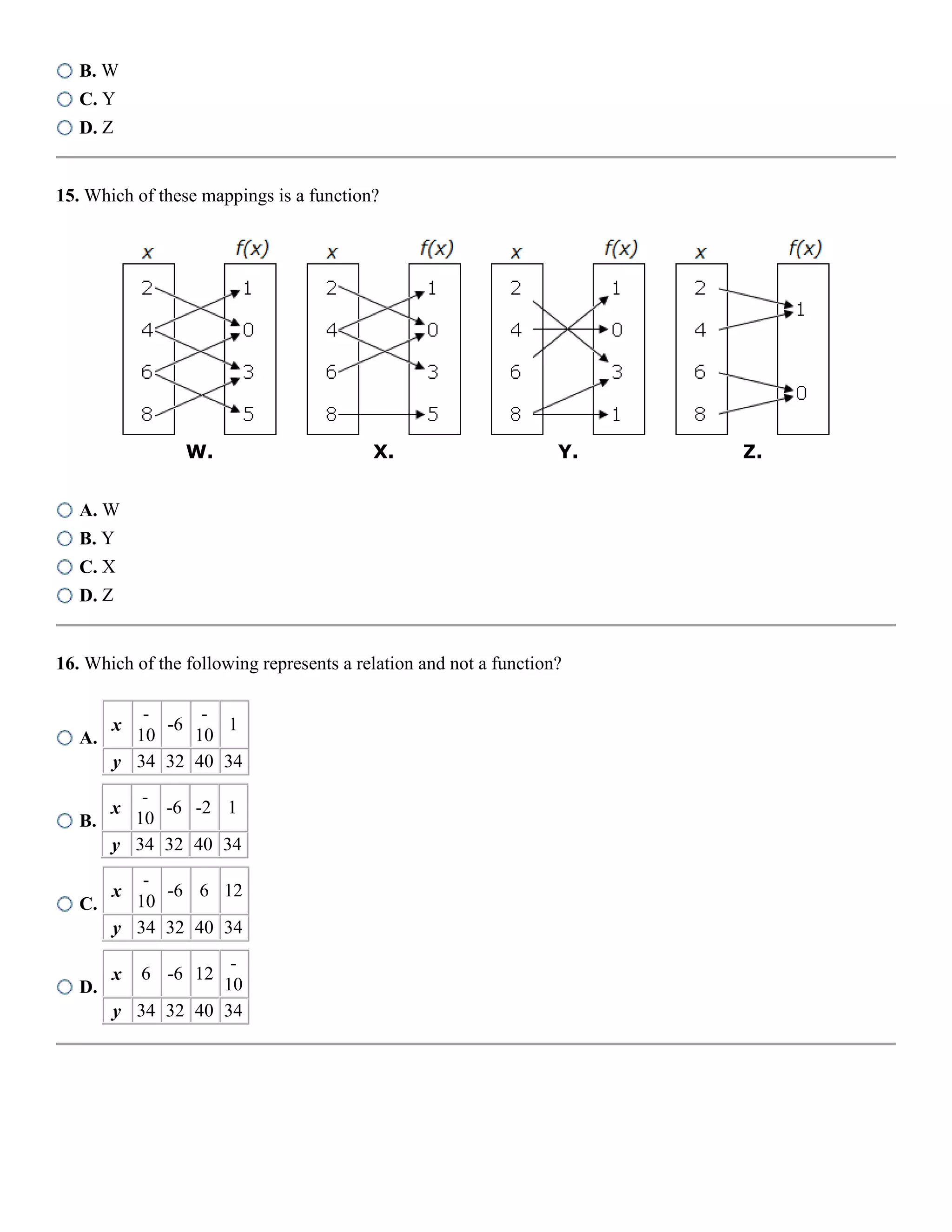
15. Which of these mappings is a function?
W. X. Y. Z.
A. W
B. Y
C. X
D. Z
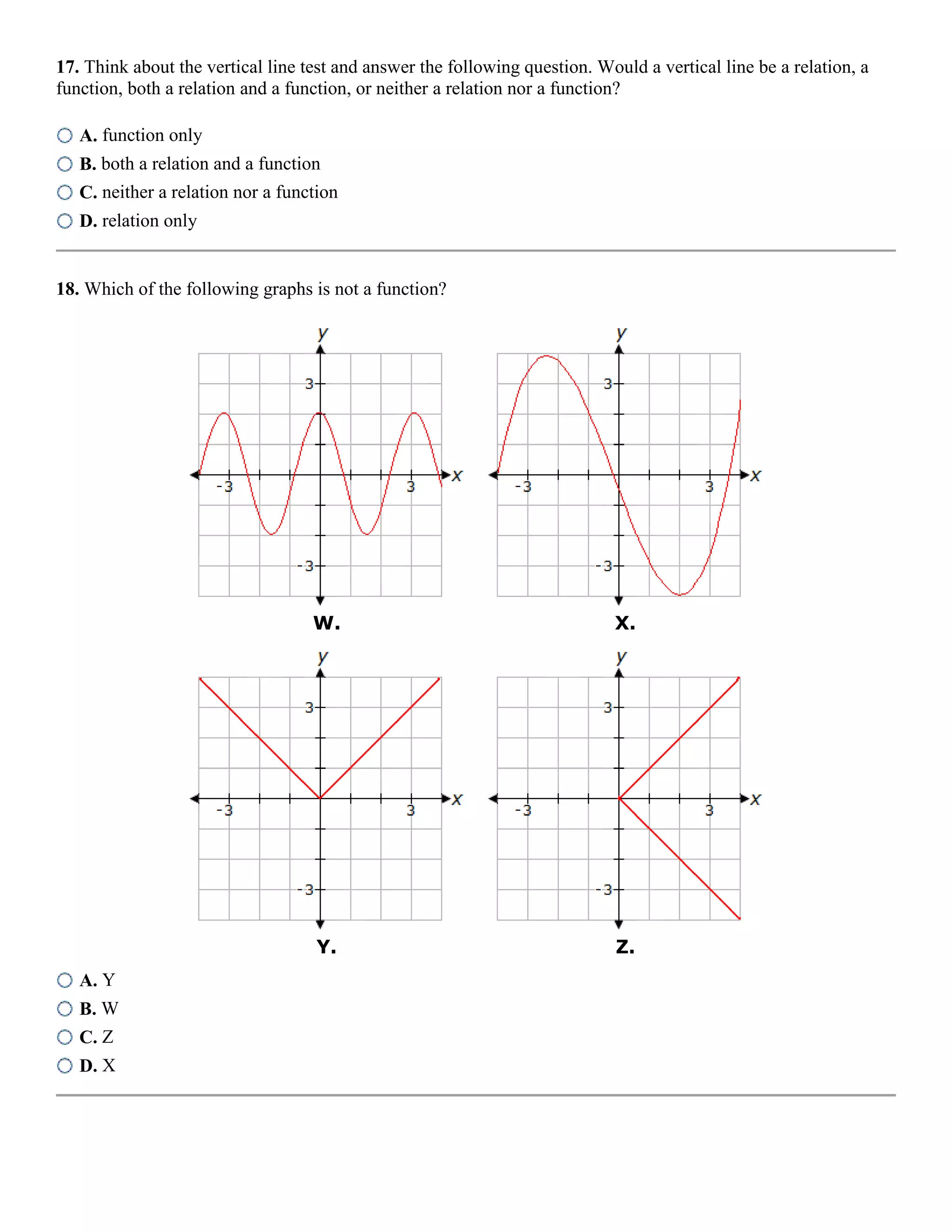
16. Which of the following represents a relation and not a function?
A.
x
-
10
-6
-
10
1
y 34 32 40 34
B.
x
-
10
-6 -2 1
y 34 32 40 34
C.
x
-
10
-6 6 12
y 34 32 40 34
D.
x 6 -6 12
-
10
y 34 32 40 34
10.
17. Think aboutthe vertical line test and answer the following question. Would a vertical line be a relation, a
function, both a relation and a function, or neither a relation nor a function?
A. function only
B. both a relation and a function
C. neither a relation nor a function
D. relation only
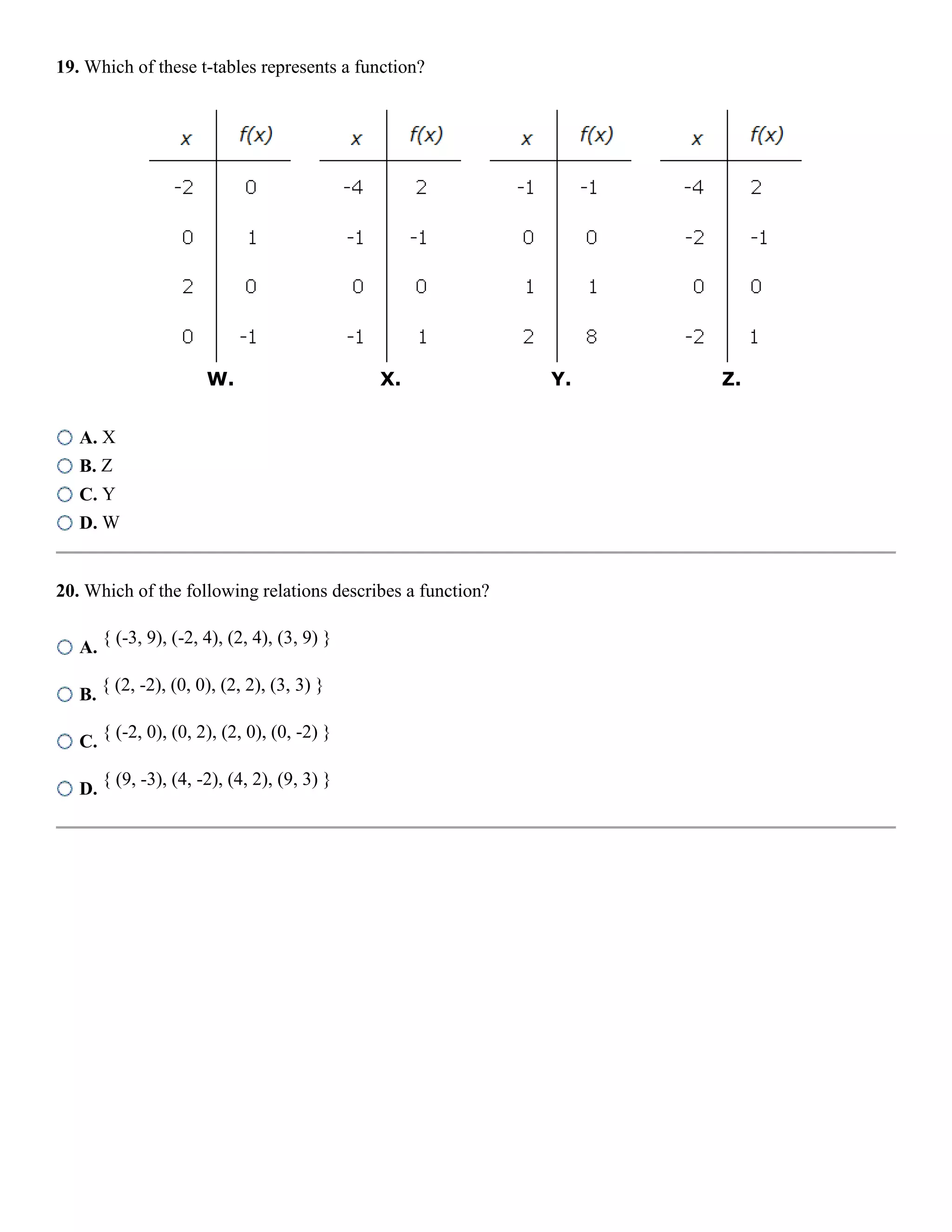
18. Which of the following graphs is not a function?
W. X.
Y. Z.
A. Y
B. W
C. Z
D. X
11.
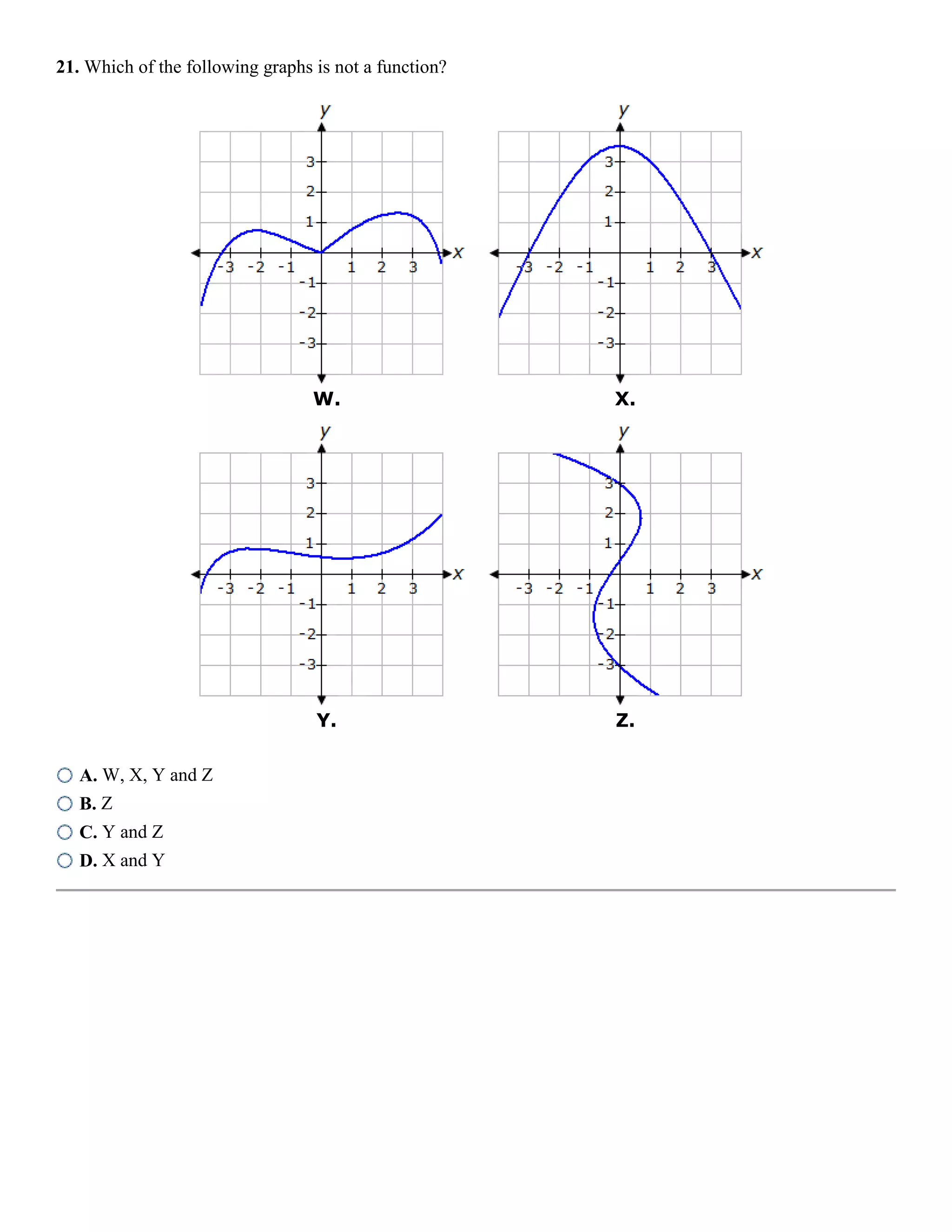
19. Which ofthese t-tables represents a function?
W. X. Y. Z.
A. X
B. Z
C. Y
D. W
20. Which of the following relations describes a function?
A.
{ (-3, 9), (-2, 4), (2, 4), (3, 9) }
B.
{ (2, -2), (0, 0), (2, 2), (3, 3) }
C.
{ (-2, 0), (0, 2), (2, 0), (0, -2) }
D.
{ (9, -3), (4, -2), (4, 2), (9, 3) }
12.
21. Which ofthe following graphs is not a function?
W. X.
Y. Z.
A. W, X, Y and Z
B. Z
C. Y and Z
D. X and Y
13.
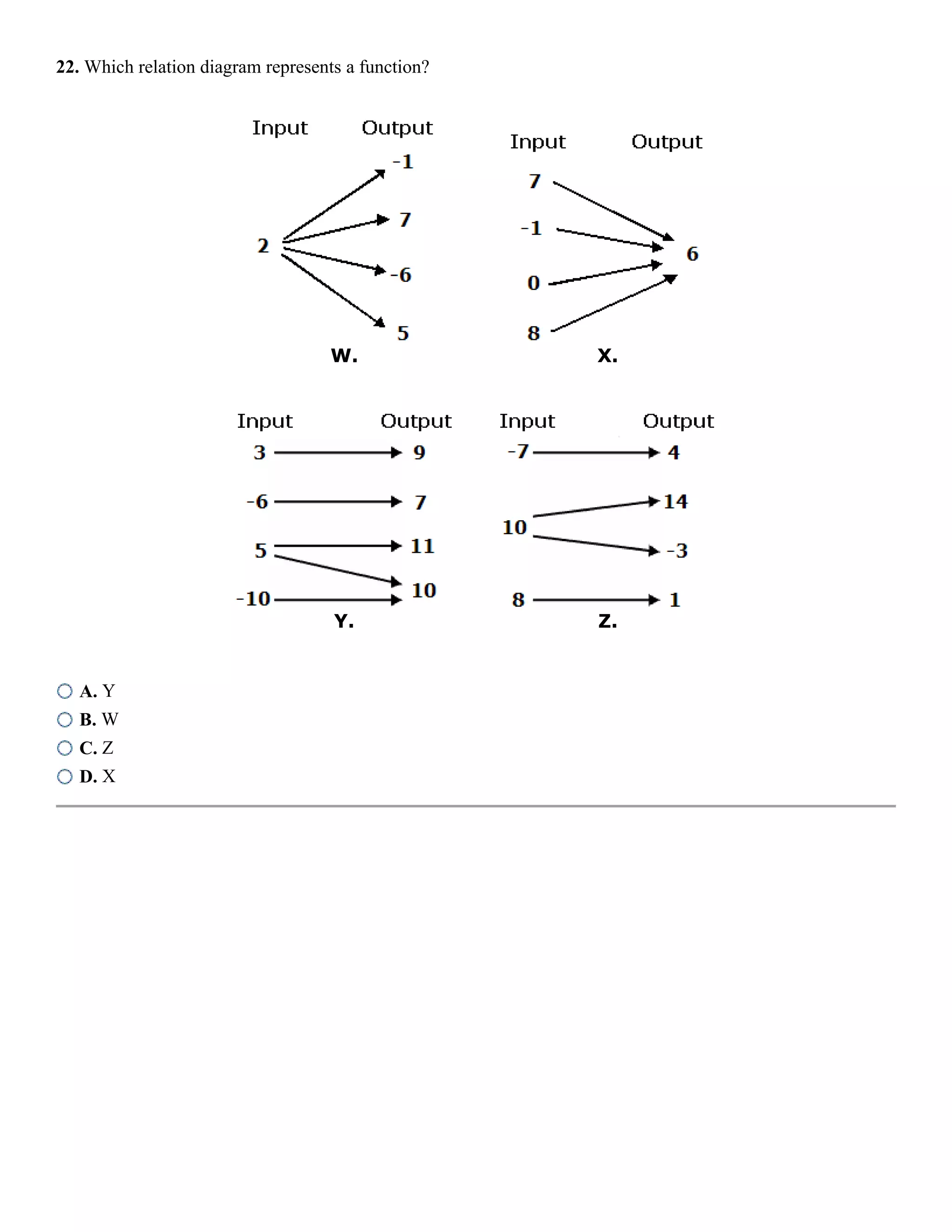
22. Which relationdiagram represents a function?
W. X.
Y. Z.
A. Y
B. W
C. Z
D. X
14.
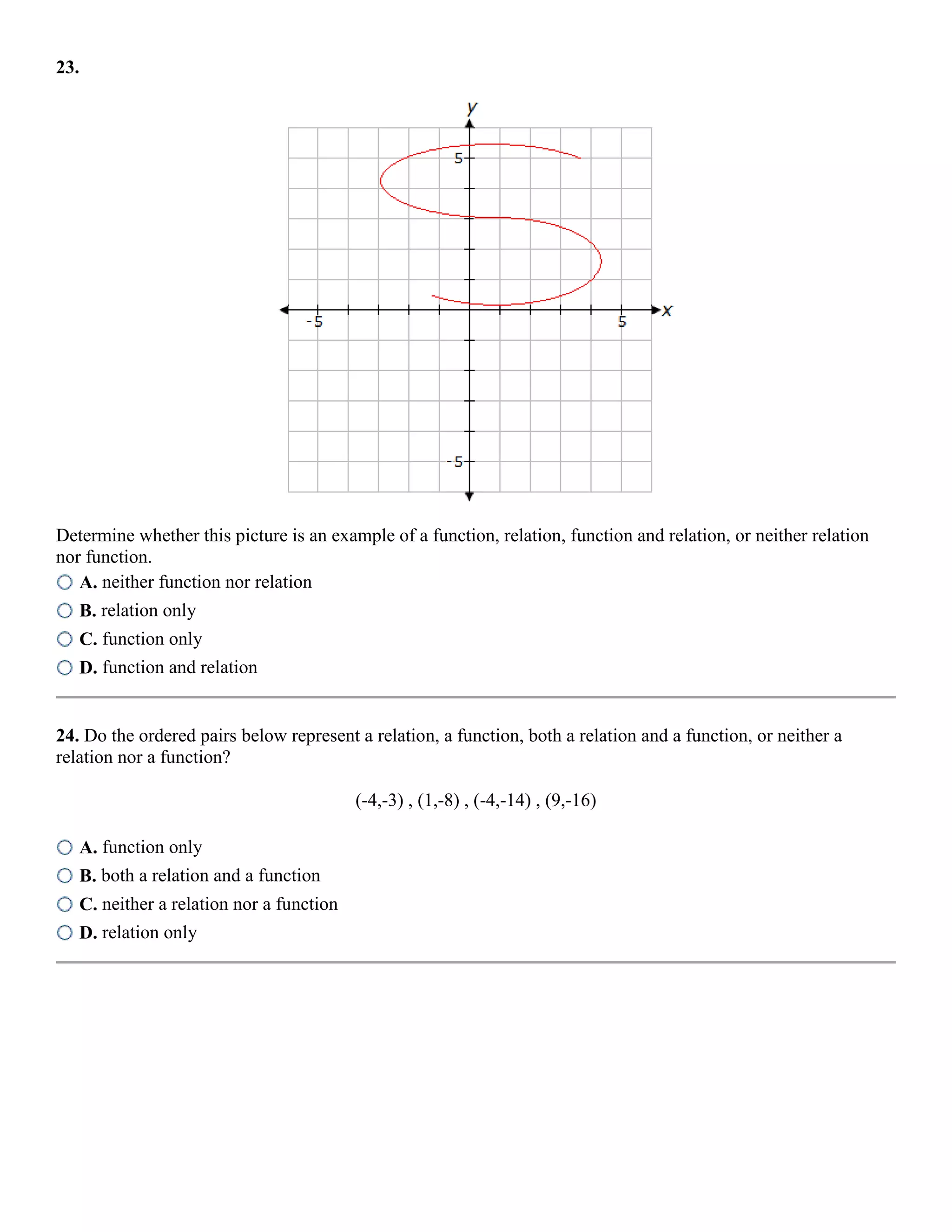
23.
Determine whether thispicture is an example of a function, relation, function and relation, or neither relation
nor function.
A. neither function nor relation
B. relation only
C. function only
D. function and relation
24. Do the ordered pairs below represent a relation, a function, both a relation and a function, or neither a
relation nor a function?
(-4,-3) , (1,-8) , (-4,-14) , (9,-16)
A. function only
B. both a relation and a function
C. neither a relation nor a function
D. relation only
15.
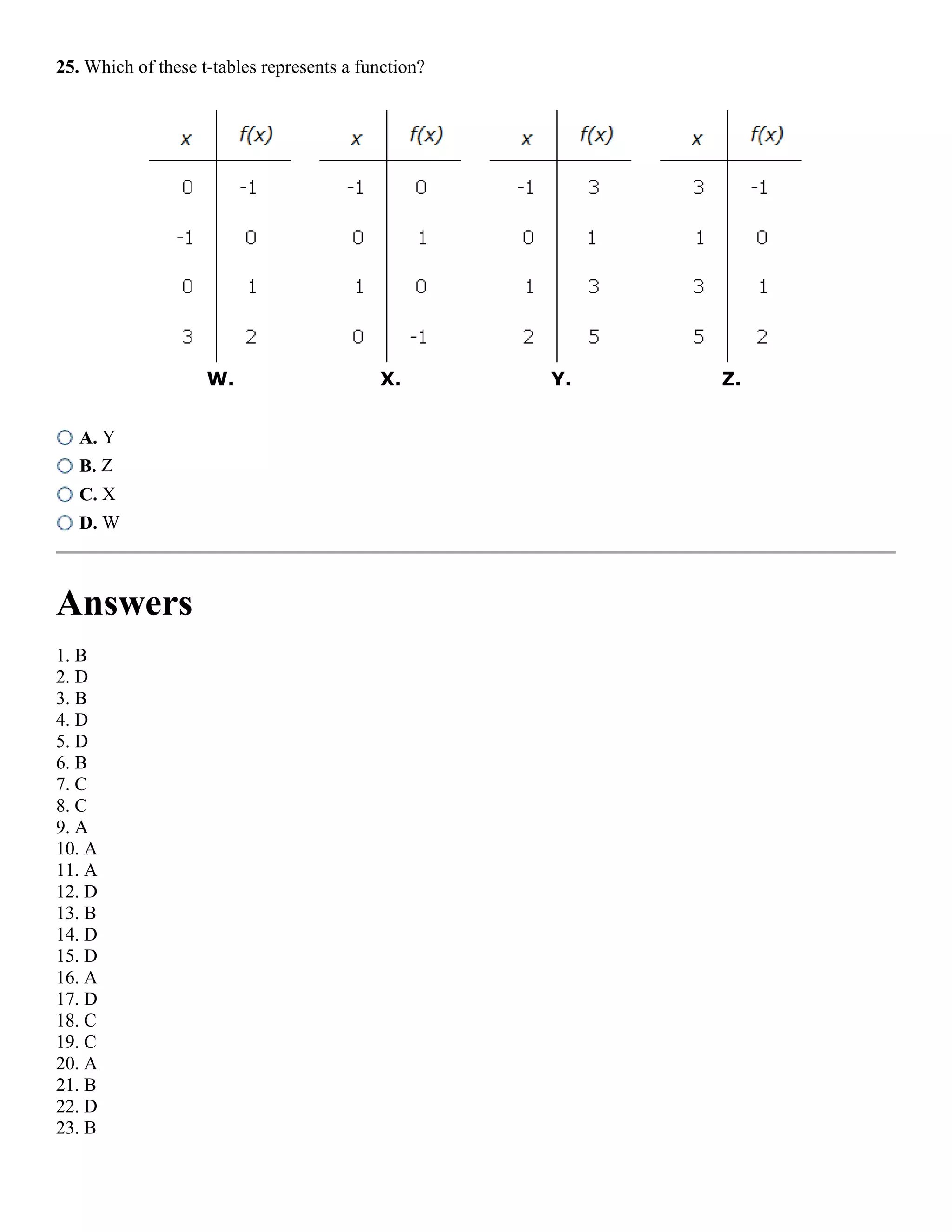
25. Which ofthese t-tables represents a function?
W. X. Y. Z.
A. Y
B. Z
C. X
D. W
Answers
1. B
2. D
3. B
4. D
5. D
6. B
7. C
8. C
9. A
10. A
11. A
12. D
13. B
14. D
15. D
16. A
17. D
18. C
19. C
20. A
21. B
22. D
23. B
16.
24. D
25. A
Explanations
1.A relation is a set of one or more ordered pairs.
A function is a relation in which each element of the domain is paired with EXACTLY one element of the
range.
The Vertical Line Test: Given the graph of a relation, if a vertical line can be drawn that crosses the graph in
more than one place, then the relation is not a function.
The graph does not pass the vertical line test; therefore, the graph is not a function, and it is a relation only.
2. Use the vertical line test to determine if the graphs represent a function.
The only graph given that passes the vertical line test is Y.
3. A function maps each domain element to only one range element.
The t-table Y is the only table that does not show a domain element paired with two or more range elements.
4. Use the vertical line test to determine if the graphs represent a function.
The only graph given that passes the vertical line test is Y.
5. A function is a set of ordered pairs such that for each domain element there is only one range element.
The set of ordered pairs { (-2, -3), (-3, -2), (2, 3), (3, 2) } is the only set that does not pair a domain element with
two or more range elements.
6. A relation is a set of one or more ordered pairs.
A function is a relation in which each element of the domain is paired with EXACTLY one element of the
range.
In this case, there is one y-coordinate for every x-coordinate.
The vertical line test can be used to determine this.
Therefore, it is both a relation and a function.
7. A relation is a set of one or more ordered pairs.
A function is a relation in which each element of the domain is paired with EXACTLY one element of the
range.
The Vertical-Line Test: Given the graph of a relation, if a vertical line can be drawn that does not cross the
graph in more than one place, it is a function.
17.
Any vertical linedrawn where x > -4 will cross the graph in more than one place.
Therefore, the graph is not a function, it is a relation only.
8. For a relation to be a function, each input value can only correspond to one output value. The relation
diagram where each input value has exactly one arrow drawn to an output value will represent a function.
Therefore, diagram W represents a function.
9. A function is a set of ordered pairs such that for each domain element there is only one range element.
The set of ordered pairs { (2, 2), (3, 2), (4, 2), (5, 2) } is the only set that does not pair a domain element with
two or more range elements.
10. Use the vertical line test to determine if the graphs represent a function.
The only graph given that passes the vertical line test is Y.
11. For a relation to be a function, each input value can only correspond to one output value. The relation
diagram where each input value has exactly one arrow drawn to an output value will represent a function.
Therefore, diagram W represents a function.
12. A function is a set of ordered pairs such that for each domain element there is only one range element.
The set of ordered pairs { (-2, 2), (-1, 1), (1, 1), (2, 2) } is the only set that does not pair a domain element with
two or more range elements.
13. A function maps each domain element to only one range element.
The only mapping that does not map a domain element to two or more range elements is Z.
14. Use the vertical line test to determine if the graphs represent a function.
The only graph given that passes the vertical line test is Z.
15. A function maps each domain element to only one range element.
The only mapping that does not map a domain element to two or more range elements is Z.
16. A relation is a set of one or more ordered pairs.
A function is a relation in which each element of the domain is paired with EXACTLY one element of the
range.
In the table below, there are two y-coordinates for the x-coordinate -10. Therefore, it is a relation only and not a
function.
x
-
10
-6
-
10
1
y 34 32 40 34
18.
17. A relationis a set of one or more ordered pairs.
A function is a relation in which each element of the domain is paired with EXACTLY one element of the
range.
The Vertical-Line Test: Given the graph of a relation, if a vertical line can be drawn that does not cross any of
the graphs in more than one place, it is a function.
If the relation being tested is a vertical line, then any x in the domain of the relation (which there would be only
one) will correspond with every y of the range (an infinite number of points).
So, a vertical line can be drawn that crosses the graph in more than one place (the vertical line itself).
Therefore, a vertical line is not a function, and it is a relation only.
18. A relation is a set of one or more ordered pairs.
A function is a relation in which each element of the domain is paired with EXACTLY one element of the
range.
The Vertical Line Test: Given the graph of a relation, if a vertical line can be drawn that crosses the graph in
more than one place, then the relation is not a function.
Therefore, graph Z is not a function.
19. A function maps each domain element to only one range element.
The t-table Y is the only table that does not show a domain element paired with two or more range elements.
20. A function is a set of ordered pairs such that for each domain element there is only one range element.
The set of ordered pairs { (-3, 9), (-2, 4), (2, 4), (3, 9) } is the only set that does not pair a domain element with
two or more range elements.
21. A relation is a set of one or more ordered pairs.
A function is a relation in which each element of the domain is paired with EXACTLY one element of the
range.
The Vertical-Line Test: Given the graph of a relation, if a vertical line can be drawn that does not cross any of
the graphs in more than one place, it is a function.
Therefore, Z is not a function.
22. For a relation to be a function, each input value can only correspond to one output value. The relation
diagram where each input value has exactly one arrow drawn to an output value will represent a function.
Therefore, diagram X represents a function.
19.
23. A relationis a set of one or more ordered pairs.
A function is a relation in which each element of the domain is paired with EXACTLY one element of the
range.
The Vertical Line Test: Given the graph of a relation, if a vertical line can be drawn that crosses the graph in
more than one place, then the relation is not a function.
Since the graph does not pass the vertical line test, it is not a function, it is a relation only.
24. A relation is a set of one or more ordered pairs.
A function is a relation in which each element of the domain is paired with EXACTLY one element of the
range.
There are two y-coordinates (range element) when x = -4.
Therefore, it is a relation only.
25. A function maps each domain element to only one range element.
The t-table Y is the only table that does not show a domain element paired with two or more range elements.


![[Template] 3.0 Relations and Functions. Intro Unit 4 ppt Student.pptx](https://cdn.slidesharecdn.com/ss_thumbnails/template3-241209144810-22b6602e-thumbnail.jpg?width=640&height=640&fit=bounds)


