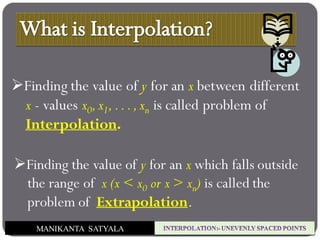
Finding the value of y for an x between different
x - values x0,x1,...,xn is called problem of
Interpolation.
Finding the value of y for an x which falls outside
the range of x (x < x0 or x > xn) is called the
problem of Extrapolation.
MANIKANTA SATYALA
MANIKANTA SATYALA
MANIKANTA SATYALA
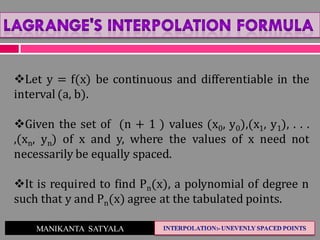
Let y = f(x) be continuous and differentiable in the
interval (a, b).
Given the set of (n + 1 ) values (x0, y0),(x1, y1), . . .
,(xn, yn) of x and y, where the values of x need not
necessarily be equally spaced.
It is required to find Pn(x), a polynomial of degree n
such that y and Pn(x) agree at the tabulated points.
MANIKANTA SATYALA
n
nnnn
n
n
n
n
n
y
xxxxxx
xxxxxx
y
xxxxxx
xxxxxx
y
xxxxxx
xxxxxx
))...()((
))...()((
...
))...()((
))...()((
))...()((
))...()((
110
110
1
12101
20
0
02010
21










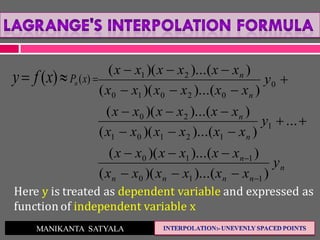
 )()( xPnxfy
Here y is treated as dependent variable and expressed as
function of independent variable x
MANIKANTA SATYALA
n
nnnn
n
n
n
n
n
x
yyyyyy
yyyyyy
x
yyyyyy
yyyyyy
x
yyyyyy
yyyyyy
))...()((
))...()((
...
))...()((
))...()((
))...()((
))...()((
110
110
1
12101
20
0
02010
21









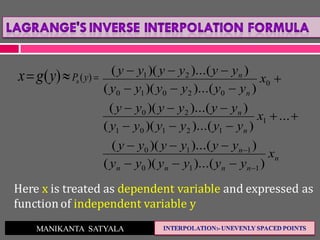
 )()( yPnygx
Here x is treated as dependent variable and expressed as
function of independent variable y
MANIKANTA SATYALA
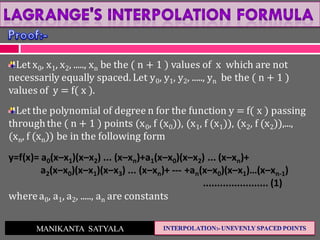
Let x0, x1, x2, ....., xn be the ( n + 1 ) values of x which are not
necessarily equally spaced. Let y0, y1, y2, ....., yn be the ( n + 1 )
values of y = f( x ).
Let the polynomial of degree n for the function y = f( x ) passing
throughthe ( n + 1 ) points (x0, f (x0)), (x1, f (x1)), (x2, f (x2)),...,
(xn, f (xn)) be in the following form
y=f(x)= a0(x–x1)(x–x2) ... (x–xn)+a1(x–x0)(x–x2) ... (x–xn)+
a2(x–x0)(x–x1)(x–x3) ... (x–xn)+ --- +an(x–x0)(x–x1)…(x–xn-1)
....................... (1)
wherea0, a1, a2, ....., an are constants
MANIKANTA SATYALA
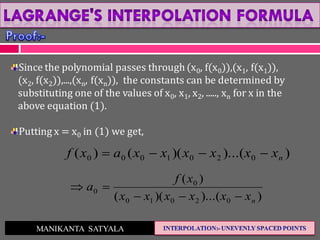
Since the polynomial passes through(x0, f(x0)),(x1, f(x1)),
(x2, f(x2)),...,(xn, f(xn)), the constants can be determined by
substituting one of the values of x0, x1, x2, ....., xn for x in the
above equation (1).
Putting x = x0 in (1) we get,
))...()(()( 0201000 nxxxxxxaxf 
))...()((
)(
02010
0
0
nxxxxxx
xf
a


MANIKANTA SATYALA
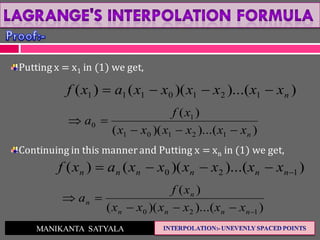
Putting x = x1 in (1) we get,
))...()(()( 1210111 nxxxxxxaxf 
))...()((
)(
12101
1
0
nxxxxxx
xf
a


Continuing in this manner and Putting x = xn in (1) we get,
))...()(()( 120  nnnnnn xxxxxxaxf
))...()((
)(
120 

nnnn
n
n
xxxxxx
xf
a
MANIKANTA SATYALA
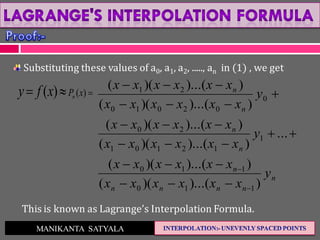
Substituting these values of a0, a1, a2, ....., an in (1) , we get
n
nnnn
n
n
n
n
n
y
xxxxxx
xxxxxx
y
xxxxxx
xxxxxx
y
xxxxxx
xxxxxx
))...()((
))...()((
...
))...()((
))...()((
))...()((
))...()((
110
110
1
12101
20
0
02010
21










 )()( xPnxfy
This is known as Lagrange’s Interpolation Formula.
MANIKANTA SATYALA
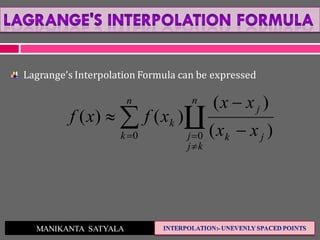
Lagrange’s Interpolation Formula can be expressed


 


n
k
n
kj
j jk
j
k
xx
xx
xfxf
0 0 )(
)(
)()( 
MANIKANTA SATYALA
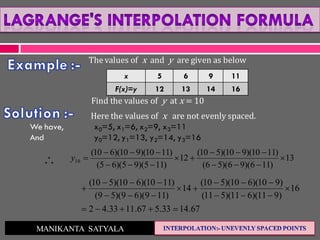
The values of x and y are given as below
x 5 6 9 11
F(x)=y 12 13 14 16
Find the values of y at x = 10
Here the values of x are not evenly spaced.
We have, x0=5, x1=6, x2=9, x3=11
And y0=12, y1=13, y2=14, y3=16
13
)116)(96)(56(
)1110)(910)(510(
12
)115)(95)(65(
)1110)(910)(610(
10 





y
67.1433.567.1133.42
16
)911)(611)(511(
)910)(610)(510(
14
)119)(69)(59(
)1110)(610)(510(








MANIKANTA SATYALA
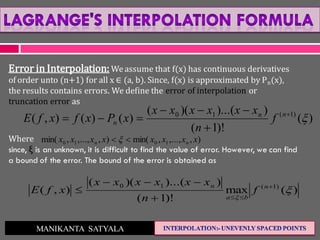
Error in Interpolation: We assume that f(x) has continuous derivatives
of order unto (n+1) for all x ∈ (a, b). Since, f(x) is approximated by Pn(x),
the results contains errors. We define the error of interpolation or
truncation error as
Where
since, ξ is an unknown, it is difficult to find the value of error. However, we can find
a bound of the error. The bound of the error is obtained as
)(
)!1(
))...()((
)()(),( )1(10



 nn
n f
n
xxxxxx
xPxfxfE
),,...,,min(),,...,,min( 1010 xxxxxxxx nn  
)(max
)!1(
))...()((
),( )1(10





 n
ba
n
f
n
xxxxxx
xfE
MANIKANTA SATYALA
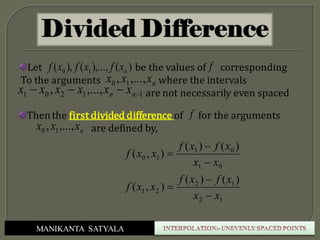
)(),...,(),( 10 nxfxfxfLet be the values of corresponding
To the arguments where the intervals
are not necessarily even spaced
f
nxxx ,...,, 10
11201 ,...,,  nn xxxxxx
Thenthe first divided difference of for the arguments
are defined by,nxxx ,...,, 10
f
12
12
21
01
01
10
)()(
),(
)()(
),(
xx
xfxf
xxf
xx
xfxf
xxf






MANIKANTA SATYALA
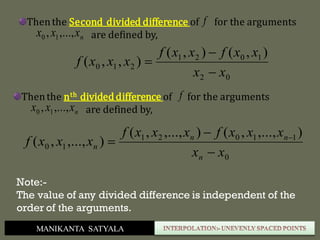
Thenthe Second divided difference of for the arguments
are defined by,nxxx ,...,, 10
f
02
1021
210
),(),(
),,(
xx
xxfxxf
xxxf



Thenthe nth divideddifference of for the arguments
are defined by,nxxx ,...,, 10
f
0
11021
10
),...,,(),...,,(
),...,,(
xx
xxxfxxxf
xxxf
n
nn
n


 
Note:-
The value of any divided difference is independent of the
order of the arguments.
MANIKANTA SATYALA
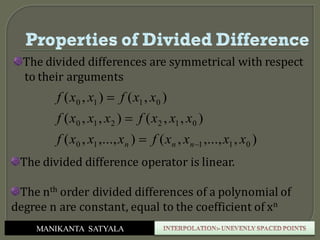
),,...,,(),...,,(
),,(),,(
),(),(
01110
012210
0110
xxxxfxxxf
xxxfxxxf
xxfxxf
nnn 


The divided differences are symmetrical with respect
to their arguments
The divided difference operator is linear.
The nth order divided differences of a polynomial of
degree n are constant, equal to the coefficient of xn
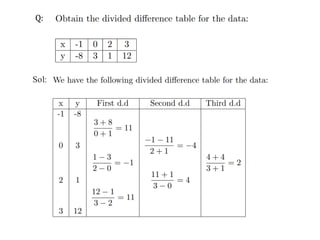
Q:
Sol:
...),,())((),()()()( 2110100  xxxfxxxxxxfxxxfxf oo
),...,,,())...()()(( 211210 non xxxxfxxxxxxxx 
MANIKANTA SATYALA
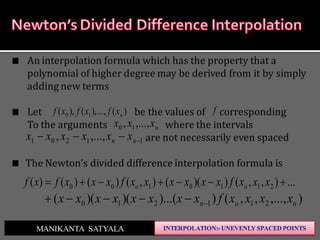
An interpolation formula which has the property that a
polynomial of higher degree may be derived from it by simply
adding new terms
Let be the values of corresponding
To the arguments where the intervals
are not necessarily even spaced
The Newton’s divided difference interpolation formula is
nxxx ,...,, 10
11201 ,...,,  nn xxxxxx
f)(),...,(),( 10 nxfxfxf
MANIKANTA SATYALA
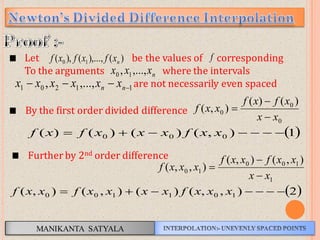
 1),()()()( 000  xxfxxxfxf
Let be the values of corresponding
To the arguments where the intervals
are not necessarily even spaced
nxxx ,...,, 10
11201 ,...,,  nn xxxxxx
f)(),...,(),( 10 nxfxfxf
0
0
0
)()(
),(
xx
xfxf
xxf


By the first order divided difference
Further by 2nd order difference
1
100
10
),(),(
),,(
xx
xxfxxf
xxxf



 2),,()(),(),( 101100  xxxfxxxxfxxf
MANIKANTA SATYALA
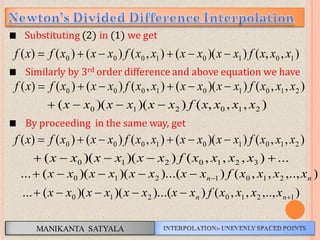
),,())((),()()()( 10101000 xxxfxxxxxxfxxxfxf 
Substituting (2) in (1) we get
Similarly by 3rd order difference and above equation we have
By proceeding in the same way, get
),,())((),()()()( 210101000 xxxfxxxxxxfxxxfxf 
),,,())()(( 210210 xxxxfxxxxxx 
),,())((),()()()( 210101000 xxxfxxxxxxfxxxfxf 
...),,,())()(( 3210210  xxxxfxxxxxx
),..,,,())...()()((... 2101210 nn xxxxfxxxxxxxx 
),..,,,())...()()((... 1210210  nn xxxxfxxxxxxxx
MANIKANTA SATYALA
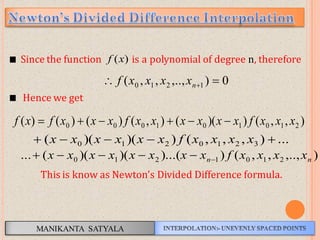
Since the function is a polynomial of degree n, therefore
Hence we get
This is know as Newton’s Divided Difference formula.
),,())((),()()()( 210101000 xxxfxxxxxxfxxxfxf 
...),,,())()(( 3210210  xxxxfxxxxxx
),..,,,())...()()((... 2101210 nn xxxxfxxxxxxxx 
)(xf
0),..,,,( 1210  nxxxxf
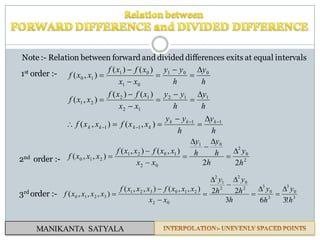
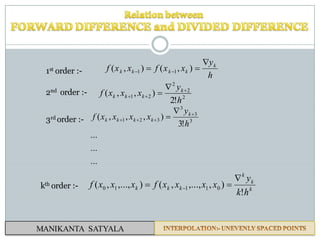
Note :- Relation between forward and divided differences exits at equal intervals
1st order :-
h
y
h
yy
xxfxxf
h
y
h
yy
xx
xfxf
xxf
h
y
h
yy
xx
xfxf
xxf
kkk
kkkk
11
11
112
12
12
21
001
01
01
10
),(),(
)()(
),(
)()(
),(




















2nd order :- 2
0
2
01
02
1021
210
22
),(),(
),,(
h
y
h
h
y
h
y
xx
xxfxxf
xxxf









3rd order :- 3
0
3
3
0
32
0
2
2
1
2
02
210321
3210
!363
22),,(),,(
),,,(
h
y
h
y
h
h
y
h
y
xx
xxxfxxxf
xxxxf











MANIKANTA SATYALA
h
y
xxfxxf k
kkkk

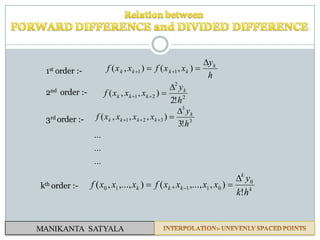
  ),(),( 111st order :-
2nd order :-
3rd order :-
2
2
21
!2
),,(
h
y
xxxf k
kkk


...
...
...
!3
),,,( 3
3
321
h
y
xxxxf k
kkkk


kth order :- k
k
kkk
hk
y
xxxxfxxxf
!
),,...,,(),...,,( 0
01110

 
MANIKANTA SATYALA
MANIKANTA SATYALA
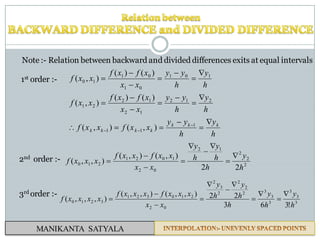
Note :- Relation between backward and divided differences exits at equal intervals
1st order :-
h
y
h
yy
xxfxxf
h
y
h
yy
xx
xfxf
xxf
h
y
h
yy
xx
xfxf
xxf
kkk
kkkk




















1
11
212
12
12
21
101
01
01
10
),(),(
)()(
),(
)()(
),(
2nd order :-
2
2
2
12
02
1021
210
22
),(),(
),,(
h
y
h
h
y
h
y
xx
xxfxxf
xxxf









3rd order :-
3
3
3
3
3
32
2
2
2
3
2
02
210321
3210
!363
22),,(),,(
),,,(
h
y
h
y
h
h
y
h
y
xx
xxxfxxxf
xxxxf











MANIKANTA SATYALA
h
y
xxfxxf k
kkkk

  ),(),( 111st order :-
2nd order :-
3rd order :-
2
2
2
21
!2
),,(
h
y
xxxf k
kkk




...
...
...
!3
),,,( 3
3
3
321
h
y
xxxxf k
kkkk




kth order :- k
k
k
kkk
hk
y
xxxxfxxxf
!
),,...,,(),...,,( 01110

 
Numerical analysis  interpolation-III

Numerical analysis interpolation-III

  • 2.
    Finding the valueof y for an x between different x - values x0,x1,...,xn is called problem of Interpolation. Finding the value of y for an x which falls outside the range of x (x < x0 or x > xn) is called the problem of Extrapolation. MANIKANTA SATYALA
  • 3.
  • 4.
    MANIKANTA SATYALA Let y= f(x) be continuous and differentiable in the interval (a, b). Given the set of (n + 1 ) values (x0, y0),(x1, y1), . . . ,(xn, yn) of x and y, where the values of x need not necessarily be equally spaced. It is required to find Pn(x), a polynomial of degree n such that y and Pn(x) agree at the tabulated points.
  • 5.
  • 6.
  • 7.
    MANIKANTA SATYALA Let x0,x1, x2, ....., xn be the ( n + 1 ) values of x which are not necessarily equally spaced. Let y0, y1, y2, ....., yn be the ( n + 1 ) values of y = f( x ). Let the polynomial of degree n for the function y = f( x ) passing throughthe ( n + 1 ) points (x0, f (x0)), (x1, f (x1)), (x2, f (x2)),..., (xn, f (xn)) be in the following form y=f(x)= a0(x–x1)(x–x2) ... (x–xn)+a1(x–x0)(x–x2) ... (x–xn)+ a2(x–x0)(x–x1)(x–x3) ... (x–xn)+ --- +an(x–x0)(x–x1)…(x–xn-1) ....................... (1) wherea0, a1, a2, ....., an are constants
  • 8.
    MANIKANTA SATYALA Since thepolynomial passes through(x0, f(x0)),(x1, f(x1)), (x2, f(x2)),...,(xn, f(xn)), the constants can be determined by substituting one of the values of x0, x1, x2, ....., xn for x in the above equation (1). Putting x = x0 in (1) we get, ))...()(()( 0201000 nxxxxxxaxf  ))...()(( )( 02010 0 0 nxxxxxx xf a  
  • 9.
    MANIKANTA SATYALA Putting x= x1 in (1) we get, ))...()(()( 1210111 nxxxxxxaxf  ))...()(( )( 12101 1 0 nxxxxxx xf a   Continuing in this manner and Putting x = xn in (1) we get, ))...()(()( 120  nnnnnn xxxxxxaxf ))...()(( )( 120   nnnn n n xxxxxx xf a
  • 10.
    MANIKANTA SATYALA Substituting thesevalues of a0, a1, a2, ....., an in (1) , we get n nnnn n n n n n y xxxxxx xxxxxx y xxxxxx xxxxxx y xxxxxx xxxxxx ))...()(( ))...()(( ... ))...()(( ))...()(( ))...()(( ))...()(( 110 110 1 12101 20 0 02010 21            )()( xPnxfy This is known as Lagrange’s Interpolation Formula.
  • 11.
    MANIKANTA SATYALA Lagrange’s InterpolationFormula can be expressed       n k n kj j jk j k xx xx xfxf 0 0 )( )( )()( 
  • 12.
    MANIKANTA SATYALA The valuesof x and y are given as below x 5 6 9 11 F(x)=y 12 13 14 16 Find the values of y at x = 10 Here the values of x are not evenly spaced. We have, x0=5, x1=6, x2=9, x3=11 And y0=12, y1=13, y2=14, y3=16 13 )116)(96)(56( )1110)(910)(510( 12 )115)(95)(65( )1110)(910)(610( 10       y 67.1433.567.1133.42 16 )911)(611)(511( )910)(610)(510( 14 )119)(69)(59( )1110)(610)(510(        
  • 13.
    MANIKANTA SATYALA Error inInterpolation: We assume that f(x) has continuous derivatives of order unto (n+1) for all x ∈ (a, b). Since, f(x) is approximated by Pn(x), the results contains errors. We define the error of interpolation or truncation error as Where since, ξ is an unknown, it is difficult to find the value of error. However, we can find a bound of the error. The bound of the error is obtained as )( )!1( ))...()(( )()(),( )1(10     nn n f n xxxxxx xPxfxfE ),,...,,min(),,...,,min( 1010 xxxxxxxx nn   )(max )!1( ))...()(( ),( )1(10       n ba n f n xxxxxx xfE
  • 14.
    MANIKANTA SATYALA )(),...,(),( 10nxfxfxfLet be the values of corresponding To the arguments where the intervals are not necessarily even spaced f nxxx ,...,, 10 11201 ,...,,  nn xxxxxx Thenthe first divided difference of for the arguments are defined by,nxxx ,...,, 10 f 12 12 21 01 01 10 )()( ),( )()( ),( xx xfxf xxf xx xfxf xxf      
  • 15.
    MANIKANTA SATYALA Thenthe Seconddivided difference of for the arguments are defined by,nxxx ,...,, 10 f 02 1021 210 ),(),( ),,( xx xxfxxf xxxf    Thenthe nth divideddifference of for the arguments are defined by,nxxx ,...,, 10 f 0 11021 10 ),...,,(),...,,( ),...,,( xx xxxfxxxf xxxf n nn n     Note:- The value of any divided difference is independent of the order of the arguments.
  • 16.
    MANIKANTA SATYALA ),,...,,(),...,,( ),,(),,( ),(),( 01110 012210 0110 xxxxfxxxf xxxfxxxf xxfxxf nnn    Thedivided differences are symmetrical with respect to their arguments The divided difference operator is linear. The nth order divided differences of a polynomial of degree n are constant, equal to the coefficient of xn
  • 18.
  • 19.
    ...),,())((),()()()( 2110100 xxxfxxxxxxfxxxfxf oo ),...,,,())...()()(( 211210 non xxxxfxxxxxxxx  MANIKANTA SATYALA An interpolation formula which has the property that a polynomial of higher degree may be derived from it by simply adding new terms Let be the values of corresponding To the arguments where the intervals are not necessarily even spaced The Newton’s divided difference interpolation formula is nxxx ,...,, 10 11201 ,...,,  nn xxxxxx f)(),...,(),( 10 nxfxfxf
  • 20.
    MANIKANTA SATYALA  1),()()()(000  xxfxxxfxf Let be the values of corresponding To the arguments where the intervals are not necessarily even spaced nxxx ,...,, 10 11201 ,...,,  nn xxxxxx f)(),...,(),( 10 nxfxfxf 0 0 0 )()( ),( xx xfxf xxf   By the first order divided difference Further by 2nd order difference 1 100 10 ),(),( ),,( xx xxfxxf xxxf     2),,()(),(),( 101100  xxxfxxxxfxxf
  • 21.
    MANIKANTA SATYALA ),,())((),()()()( 10101000xxxfxxxxxxfxxxfxf  Substituting (2) in (1) we get Similarly by 3rd order difference and above equation we have By proceeding in the same way, get ),,())((),()()()( 210101000 xxxfxxxxxxfxxxfxf  ),,,())()(( 210210 xxxxfxxxxxx  ),,())((),()()()( 210101000 xxxfxxxxxxfxxxfxf  ...),,,())()(( 3210210  xxxxfxxxxxx ),..,,,())...()()((... 2101210 nn xxxxfxxxxxxxx  ),..,,,())...()()((... 1210210  nn xxxxfxxxxxxxx
  • 22.
    MANIKANTA SATYALA Since thefunction is a polynomial of degree n, therefore Hence we get This is know as Newton’s Divided Difference formula. ),,())((),()()()( 210101000 xxxfxxxxxxfxxxfxf  ...),,,())()(( 3210210  xxxxfxxxxxx ),..,,,())...()()((... 2101210 nn xxxxfxxxxxxxx  )(xf 0),..,,,( 1210  nxxxxf
  • 23.
    Note :- Relationbetween forward and divided differences exits at equal intervals 1st order :- h y h yy xxfxxf h y h yy xx xfxf xxf h y h yy xx xfxf xxf kkk kkkk 11 11 112 12 12 21 001 01 01 10 ),(),( )()( ),( )()( ),(                     2nd order :- 2 0 2 01 02 1021 210 22 ),(),( ),,( h y h h y h y xx xxfxxf xxxf          3rd order :- 3 0 3 3 0 32 0 2 2 1 2 02 210321 3210 !363 22),,(),,( ),,,( h y h y h h y h y xx xxxfxxxf xxxxf            MANIKANTA SATYALA
  • 24.
    h y xxfxxf k kkkk   ),(),( 111st order :- 2nd order :- 3rd order :- 2 2 21 !2 ),,( h y xxxf k kkk   ... ... ... !3 ),,,( 3 3 321 h y xxxxf k kkkk   kth order :- k k kkk hk y xxxxfxxxf ! ),,...,,(),...,,( 0 01110    MANIKANTA SATYALA
  • 25.
    MANIKANTA SATYALA Note :-Relation between backward and divided differences exits at equal intervals 1st order :- h y h yy xxfxxf h y h yy xx xfxf xxf h y h yy xx xfxf xxf kkk kkkk                     1 11 212 12 12 21 101 01 01 10 ),(),( )()( ),( )()( ),( 2nd order :- 2 2 2 12 02 1021 210 22 ),(),( ),,( h y h h y h y xx xxfxxf xxxf          3rd order :- 3 3 3 3 3 32 2 2 2 3 2 02 210321 3210 !363 22),,(),,( ),,,( h y h y h h y h y xx xxxfxxxf xxxxf           
  • 26.
    MANIKANTA SATYALA h y xxfxxf k kkkk   ),(),( 111st order :- 2nd order :- 3rd order :- 2 2 2 21 !2 ),,( h y xxxf k kkk     ... ... ... !3 ),,,( 3 3 3 321 h y xxxxf k kkkk     kth order :- k k k kkk hk y xxxxfxxxf ! ),,...,,(),...,,( 01110   