Tancuj, tancuj, konverguj
             Jako v konvergenci i v tanci nezáleží na pár prvních
            krocích, ale jak tancujete ke konci a kam dotancujete.
Photo by tyle_r on Flickr
Které vlastnosti
jdou vyjádřit
konvergencí
Které vlastnosti
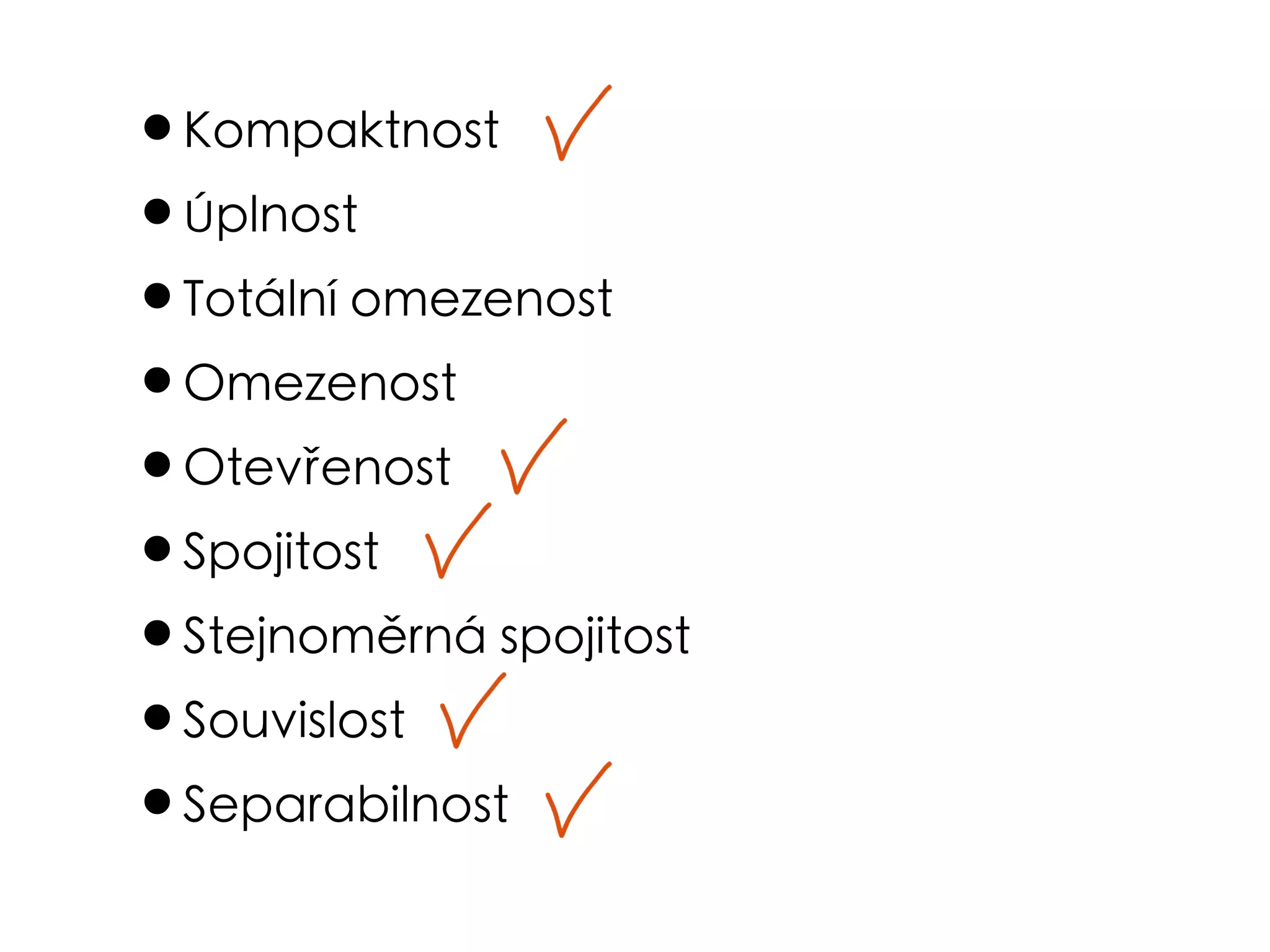
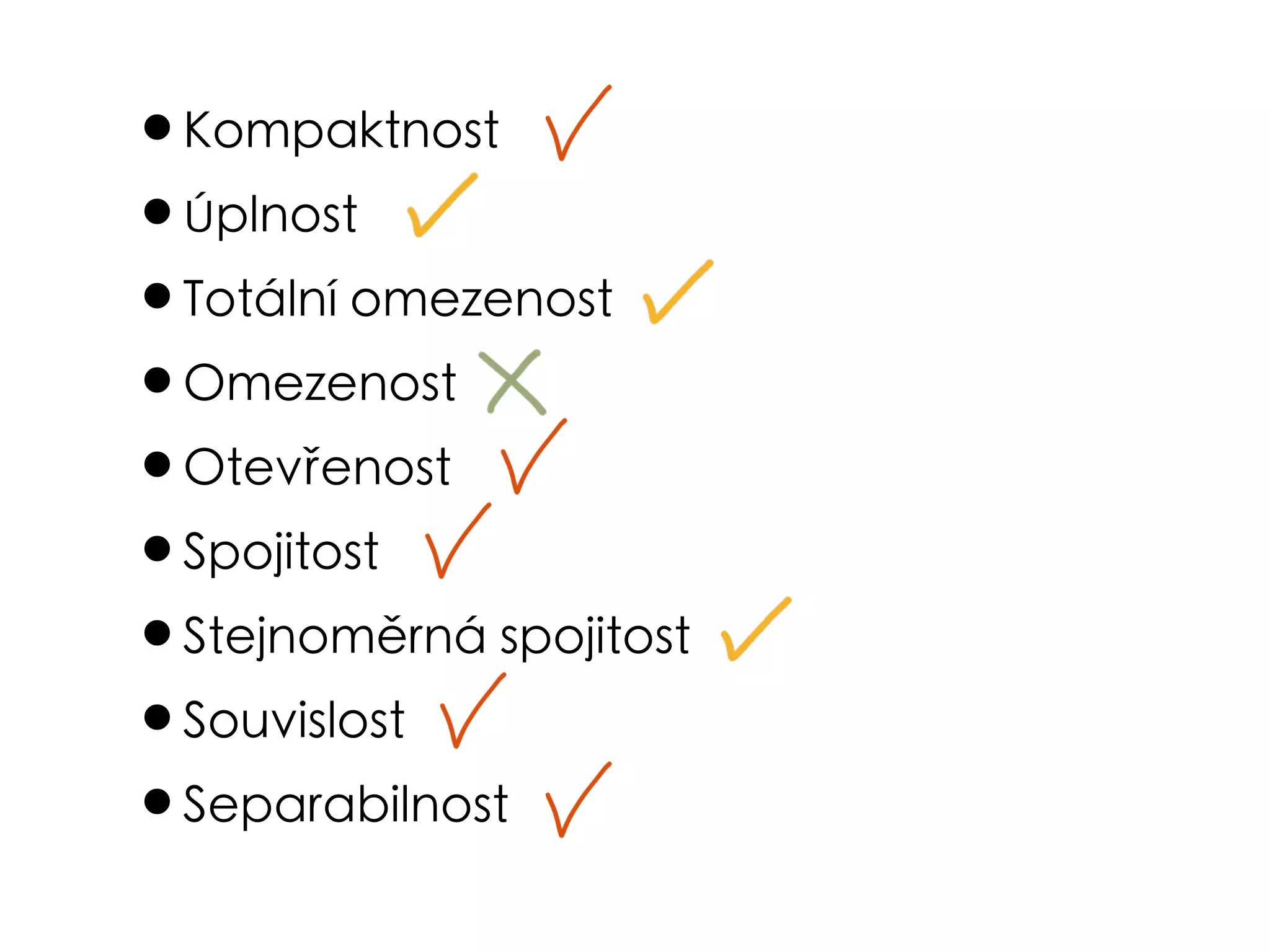
jdou vyjádřit      •Kompaktnost
konvergencí        •Úplnost
                   •Totální omezenost
                   •Omezenost
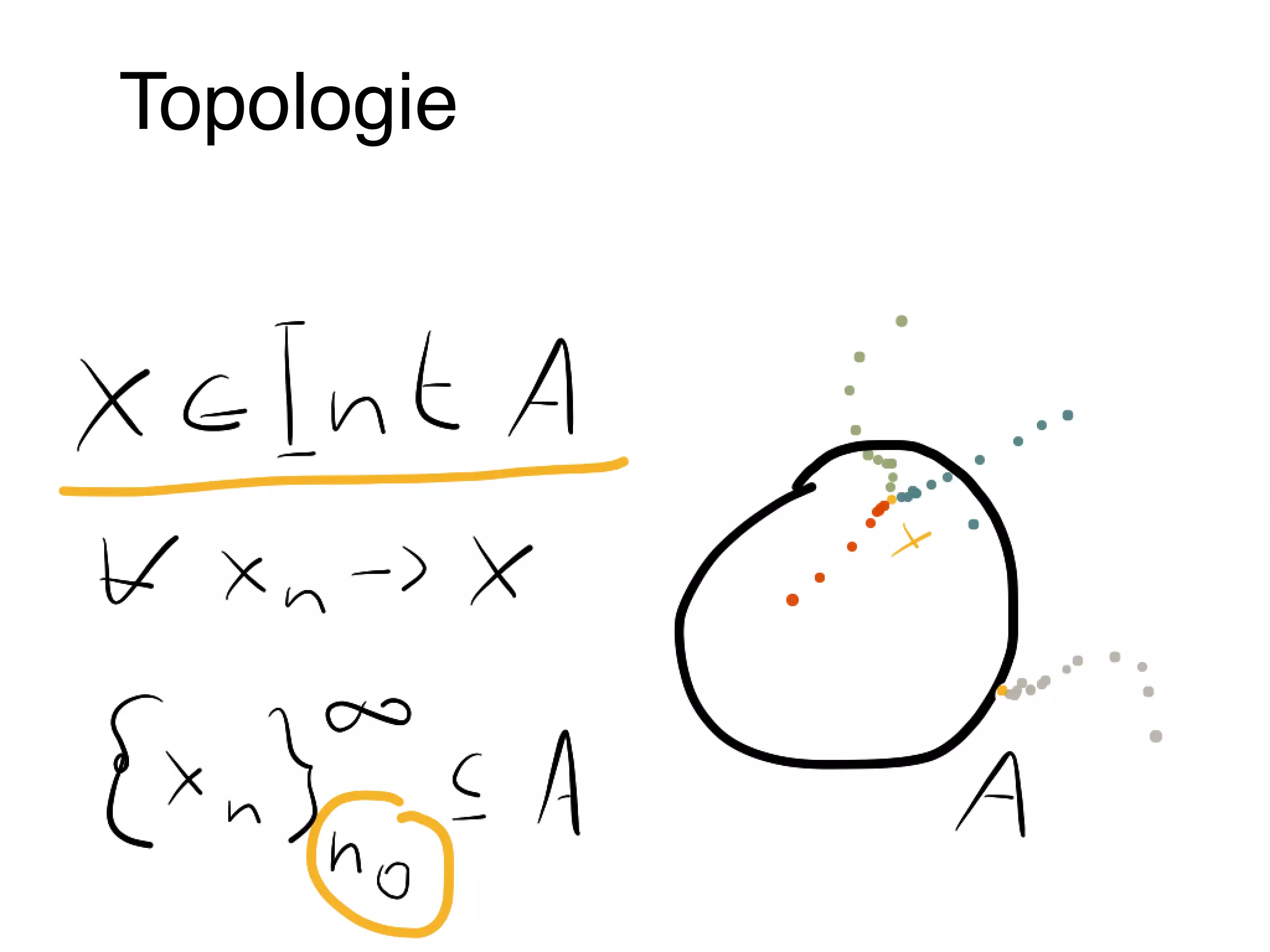
                   •Otevřenost
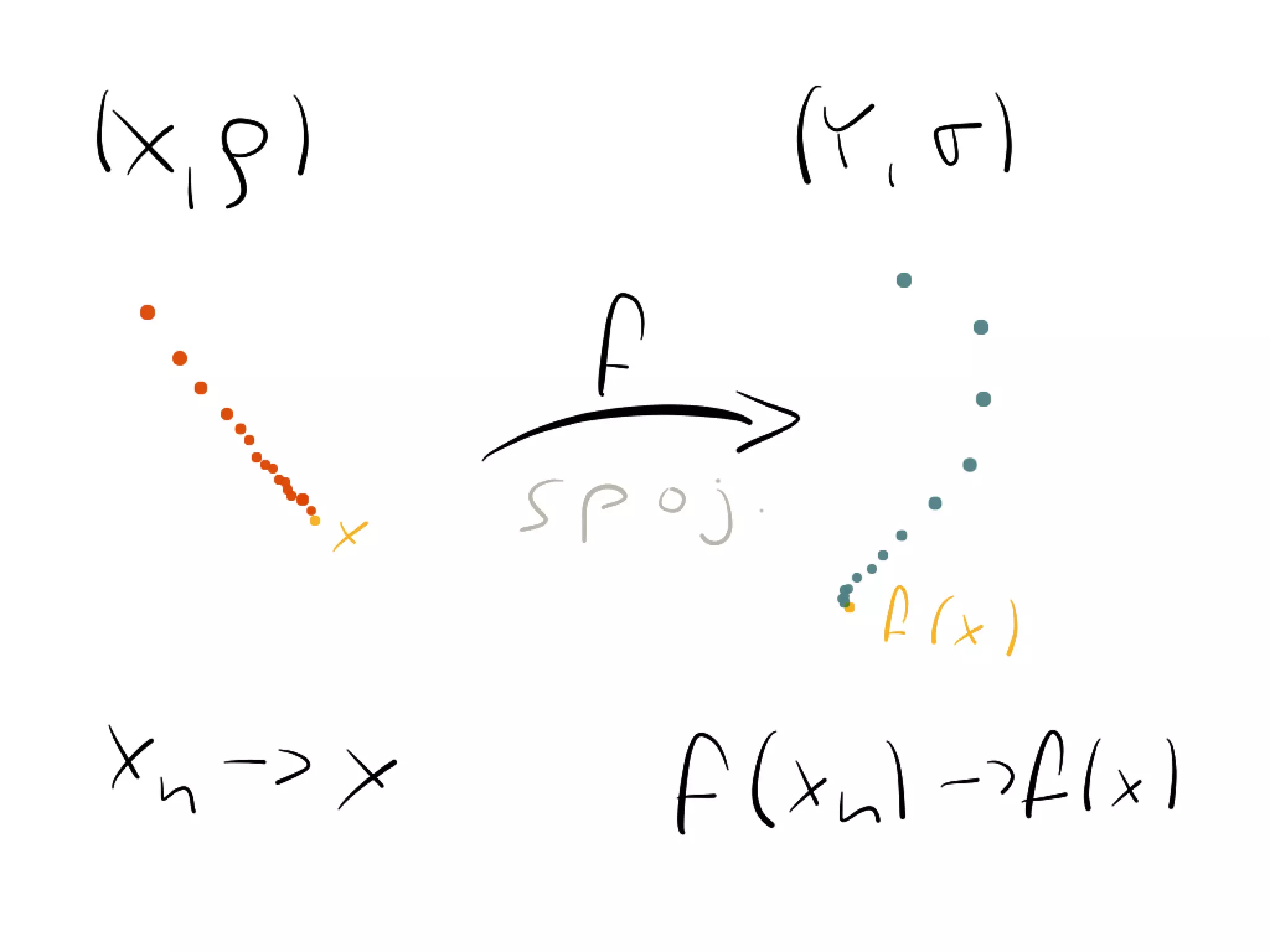
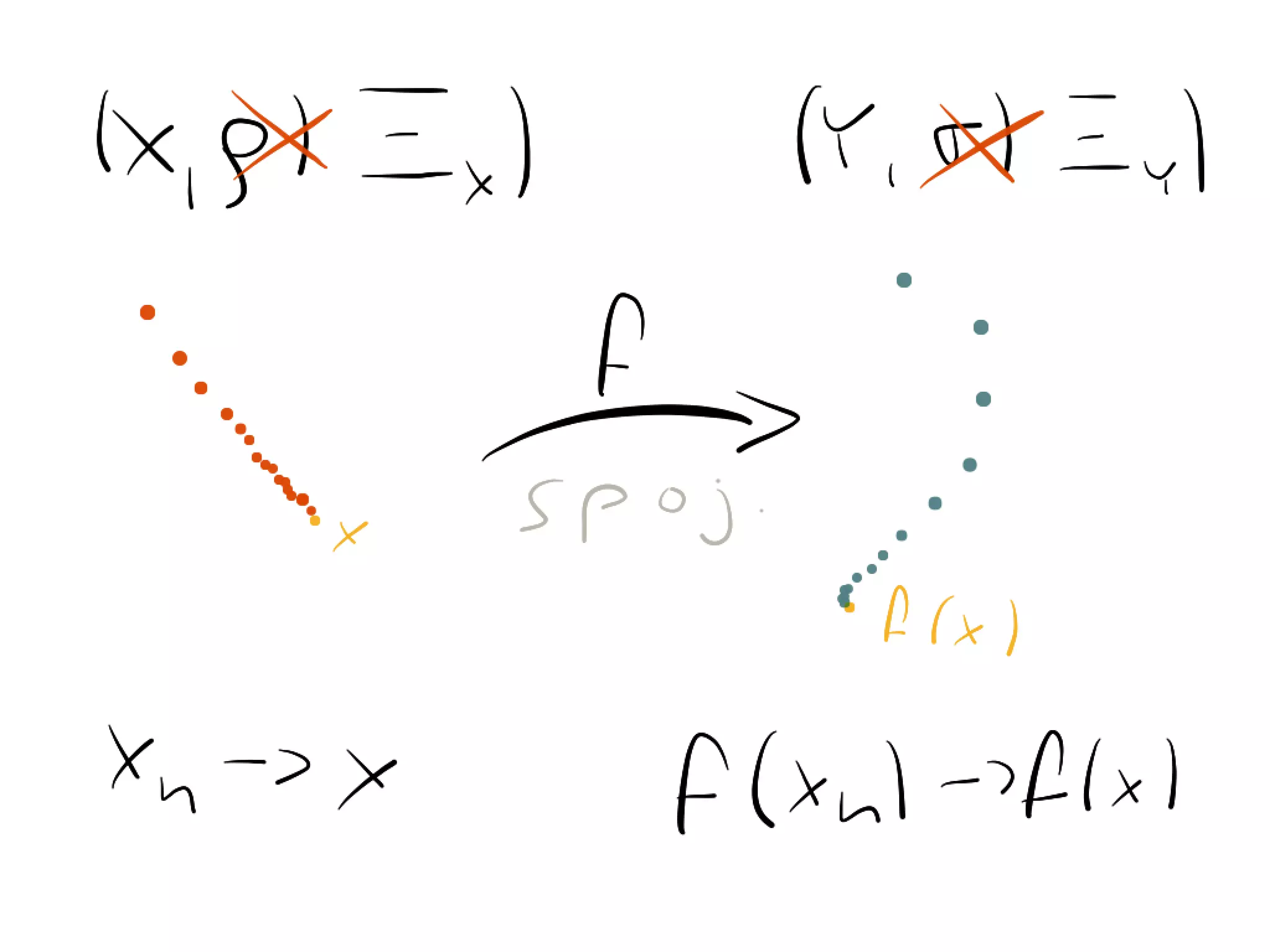
                   •Spojitost
                   • Stejnoměrná spojitost
                   • Souvislost
                   •   Separabilnost
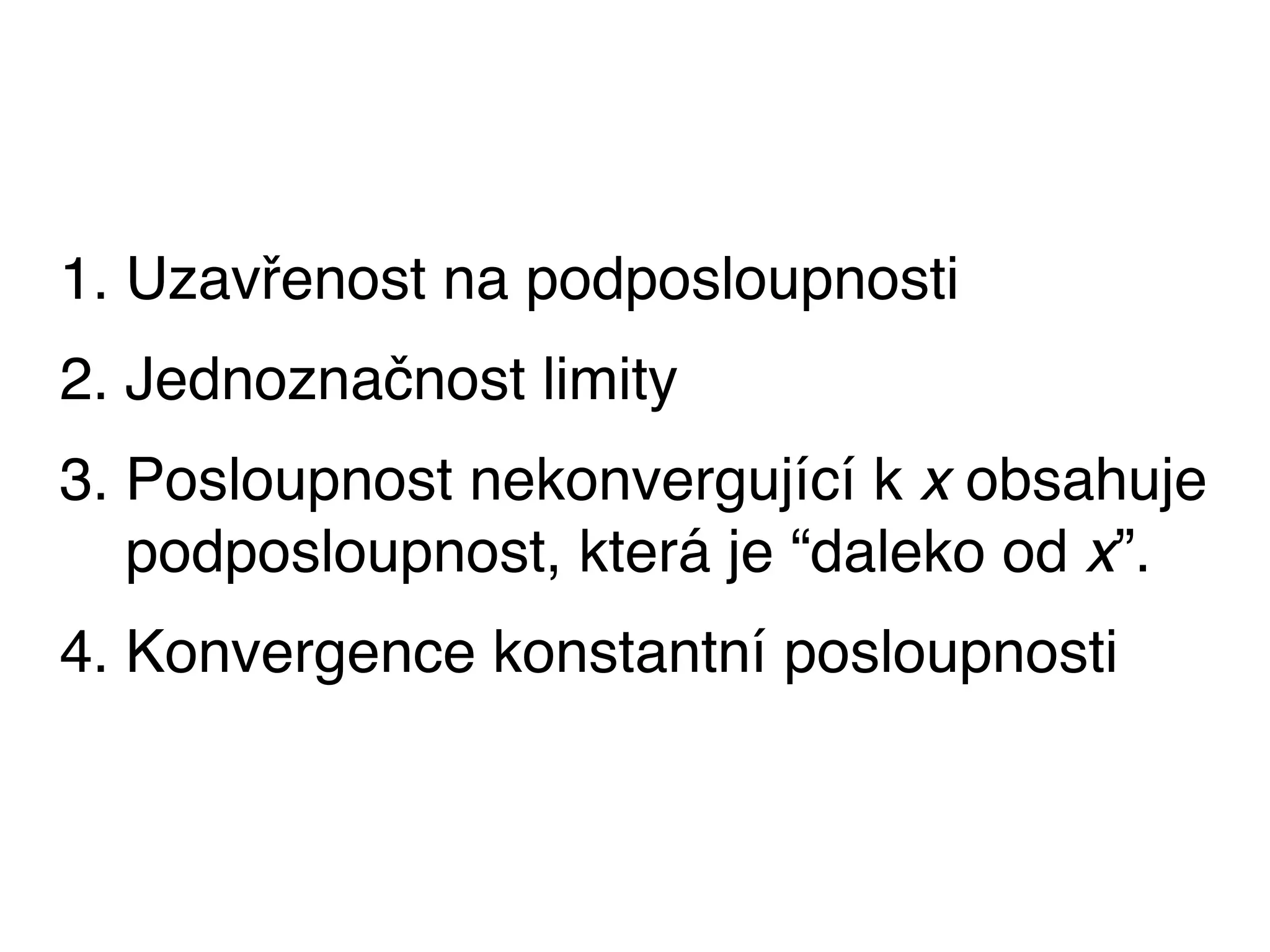
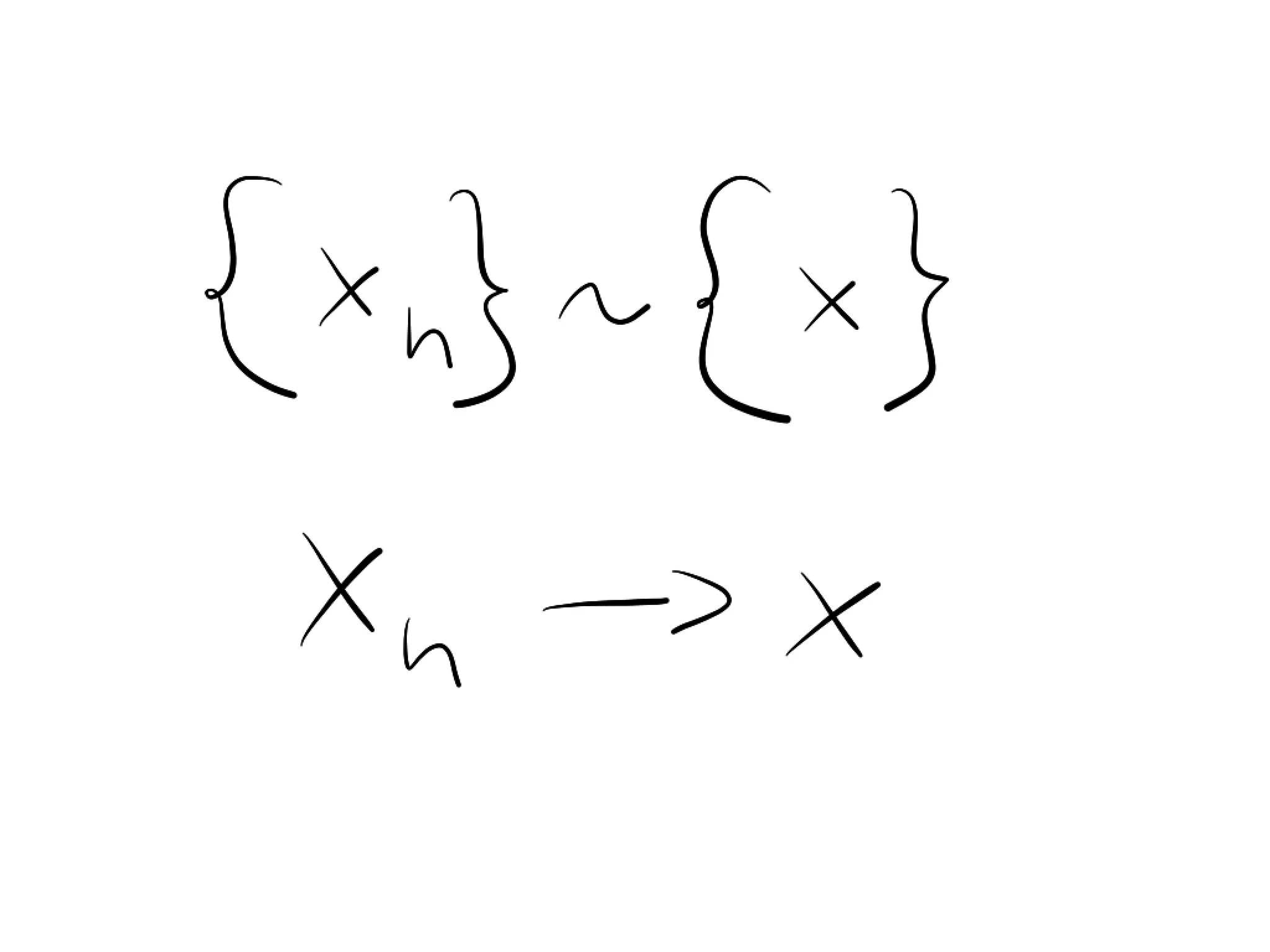
1. Uzavřenost na podposloupnosti
2. Jednoznačnost limity
3. Posloupnost nekonvergující k x obsahuje
   podposloupnost, která je “daleko od x”.
4. Konvergence konstantní posloupnosti
Topologie
•Kompaktnost
•Úplnost
•Totální omezenost
•Omezenost
•Otevřenost
•Spojitost
•Stejnoměrná spojitost
•Souvislost
•Separabilnost
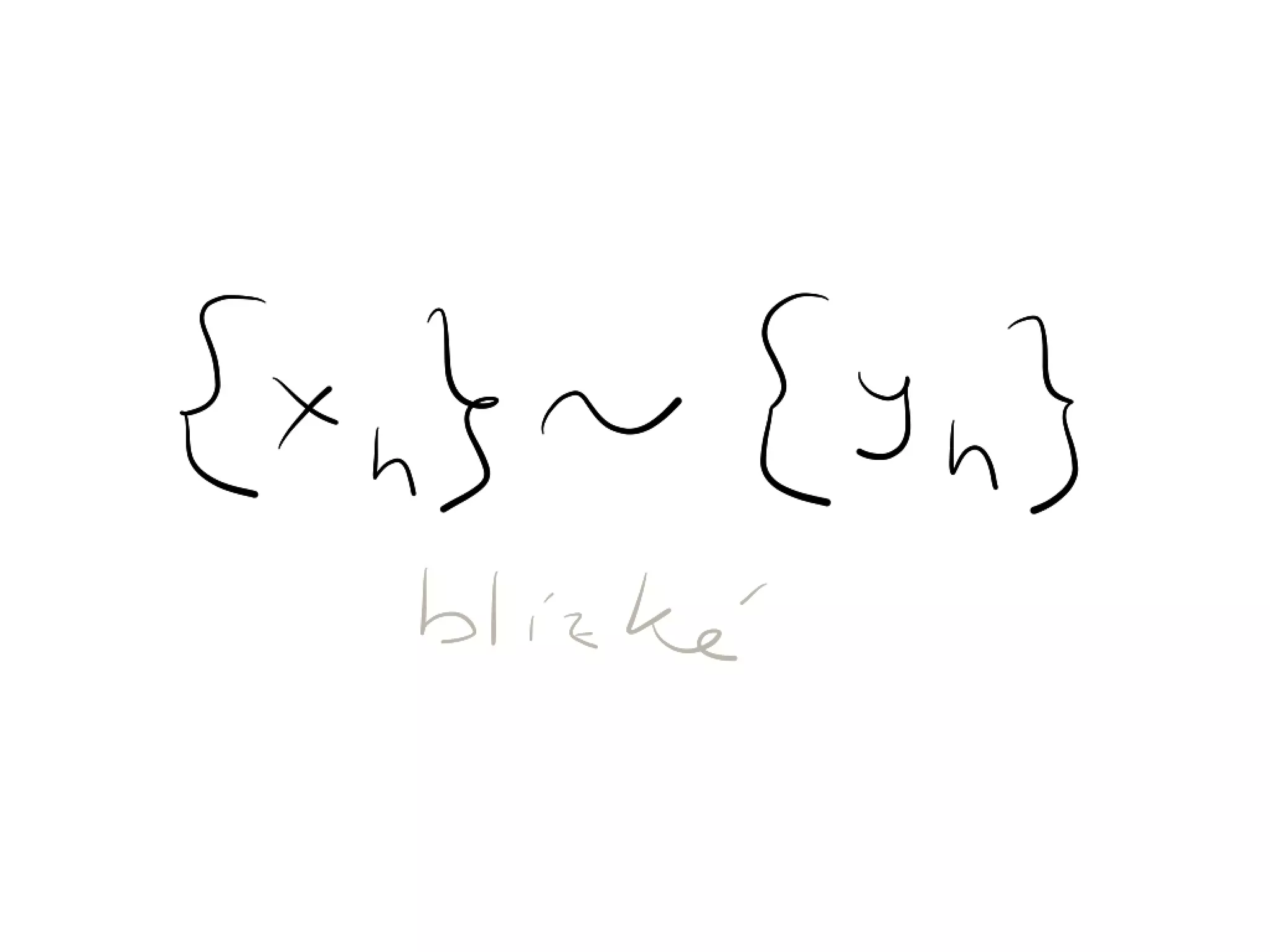
1. Podposloupnosti blízkých jsou blízké
2. Různé konstantní nejsou blízké
3. Neblízké posloupnosti obsahují
   podposloupnosti, které jsou
   “daleko od sebe”.
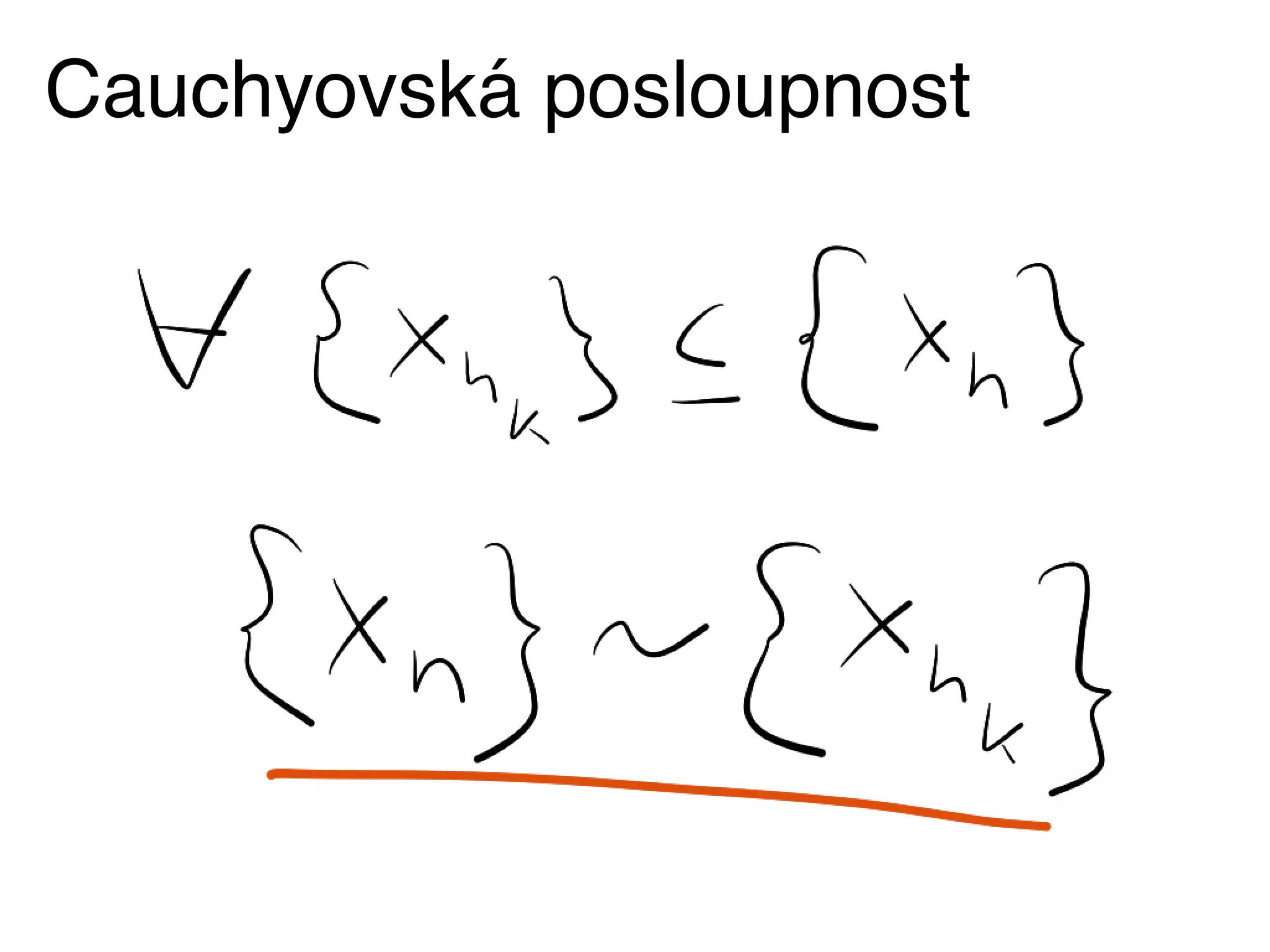
Cauchyovská posloupnost
Kam jsme dotancovali


Dirty Dancing (1987)
•Kompaktnost
•Úplnost
•Totální omezenost
•Omezenost
•Otevřenost
•Spojitost
•Stejnoměrná spojitost
•Souvislost
•Separabilnost
The following theorem is often covered in basic course of mathematic
lysis. We include it for completeness.
  3. Properties defined by
  convergence
Theorem 3.2. Let ⌅X and ⌅Y be two sequential structures generated by
  In this chapter we will use the following convention: when we say a uniformly
  sequential space (X, ⇠) has a property defined for a sequential space we mean
  that ⌅⇠ has this property.


spaces (X, %) and (Y, ). Let f : X ! Y be a mapping. Then the follow
  3.1     Continuous and uniformly continuous map-
          pings

equivalent:
  Definition 3.1. Let ⌅X and ⌅Y be two sequential structures on sets X and Y .
  We say f : X ! Y is a continuous mapping ⌅X to ⌅Y if ({xn }, x) 2 ⌅X implies
  that ({f (xn )}, f (x)) 2 ⌅Y .

      The following theorem is often covered in basic course of mathematical ana-
  lysis. We include it for completeness.


 (i) f : (X, %) ! (Y, ) is continuous;
  Theorem 3.2. Let ⌅X and ⌅Y be two sequential structures generated by metric
  spaces (X, %) and (Y, ). Let f : X ! Y be a mapping. Then the following are
  equivalent:

   (i) f : (X, %) ! (Y, ) is continuous;

   (ii) f : ⌅X ! ⌅Y is continuous.


 (ii) f : ⌅X ! ⌅Y is continuous.
  Proof. Let x 2 X be a fixed point.
       Let condition (i) hold and xn ! x (that is, ({xn }, x) 2 ⌅X ). For " > 0 we
  find > 0 from Definition 1.6. Then there exists n" such that for 8n          n" we
  have %(xn , x) < and then (f (xn ), f (x)) < ". Hence f (xn ) ! f (x) in Y , that
  is, ({f (xn )}, f (x)) 2 ⌅Y .
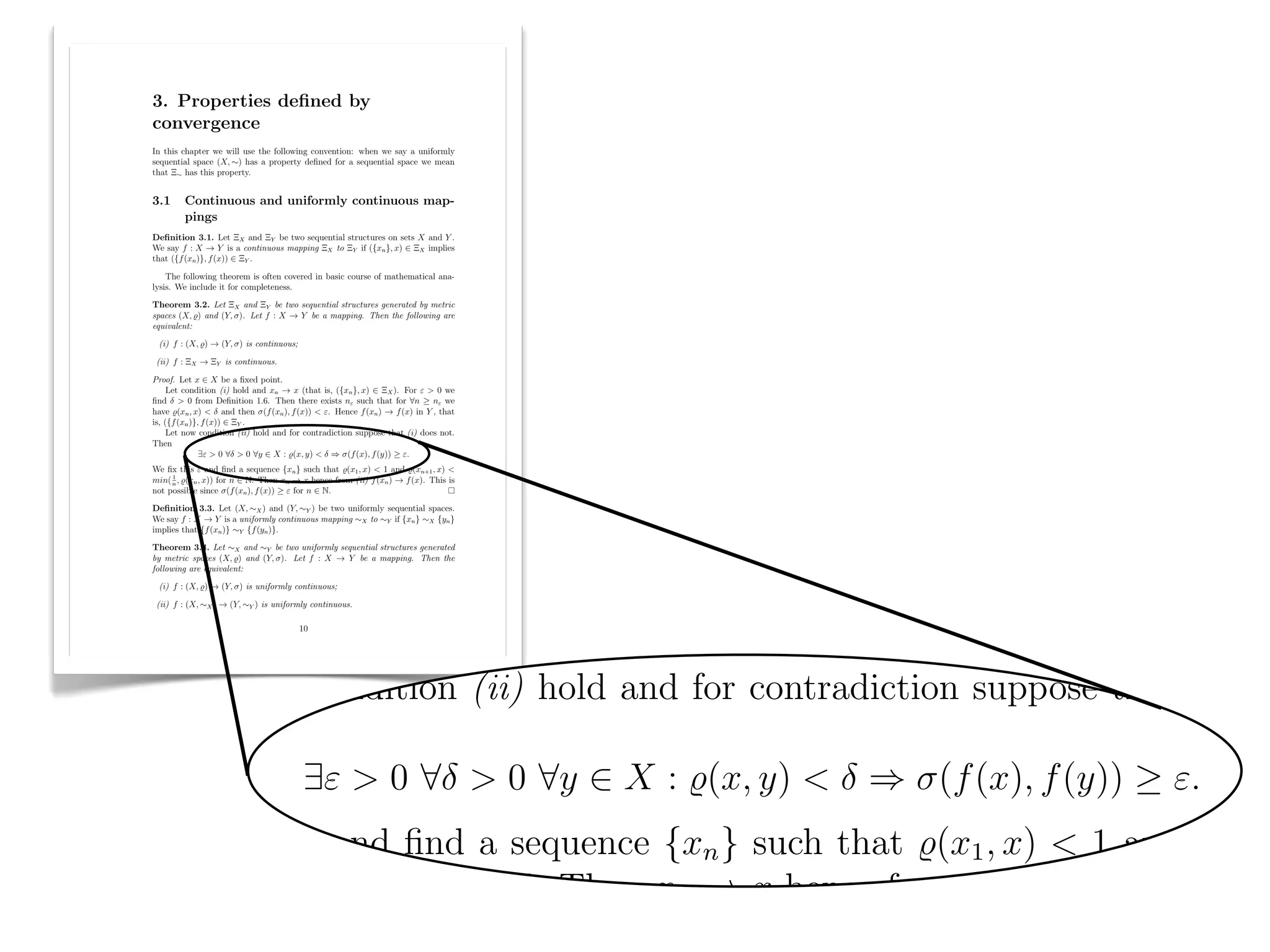
       Let now condition (ii) hold and for contradiction suppose that (i) does not.
  Then


Proof. Let x 2 X be a fixed point.
                 9" > 0 8 > 0 8y 2 X : %(x, y) < ) (f (x), f (y)) ".
  We fix this " and find a sequence {xn } such that %(x1 , x) < 1 and %(xn+1 , x) <
  min( n , %(xn , x)) for n 2 N. Then xn ! x hence from (ii) f (xn ) ! f (x). This is
       1

  not possible since (f (xn ), f (x)) " for n 2 N.

     Let condition (i) hold and xn ! x (that is, ({xn }, x) 2 ⌅X ). For "
  Definition 3.3. Let (X, ⇠X ) and (Y, ⇠Y ) be two uniformly sequential spaces.
  We say f : X ! Y is a uniformly continuous mapping ⇠X to ⇠Y if {xn } ⇠X {yn }
  implies that {f (xn )} ⇠Y {f (yn )}.


find > 0 from Definition 1.6. Then there exists n" such that for 8n
  Theorem 3.4. Let ⇠X and ⇠Y be two uniformly sequential structures generated
  by metric spaces (X, %) and (Y, ). Let f : X ! Y be a mapping. Then the
  following are equivalent:


have %(xn , x) < and then (f (xn ), f (x)) < ". Hence f (xn ) ! f (x) in
   (i) f : (X, %) ! (Y, ) is uniformly continuous;

   (ii) f : (X, ⇠X ) ! (Y, ⇠Y ) is uniformly continuous.

                                           10

is, ({f (xn )}, f (x)) 2 ⌅Y .
     Let now condition (ii) hold and for contradiction suppose that (i) do
Then
               9" > 0 8 > 0 8y 2 X : %(x, y) < ) (f (x), f (y)) ".
We fix this " and find a sequence {xn } such that %(x1 , x) < 1 and %(xn+
min( n , %(xn , x)) for n 2 N. Then xn ! x hence from (ii) f (xn ) ! f (x).
     1

not possible since (f (xn ), f (x)) " for n 2 N.
The following theorem is often covered in basic course of mathematic
lysis. We include it for completeness.
  3. Properties defined by
  convergence
Theorem 3.2. Let ⌅X and ⌅Y be two sequential structures generated by
  In this chapter we will use the following convention: when we say a uniformly
  sequential space (X, ⇠) has a property defined for a sequential space we mean
  that ⌅⇠ has this property.


spaces (X, %) and (Y, ). Let f : X ! Y be a mapping. Then the follow
  3.1     Continuous and uniformly continuous map-
          pings

equivalent:
  Definition 3.1. Let ⌅X and ⌅Y be two sequential structures on sets X and Y .
  We say f : X ! Y is a continuous mapping ⌅X to ⌅Y if ({xn }, x) 2 ⌅X implies
  that ({f (xn )}, f (x)) 2 ⌅Y .

      The following theorem is often covered in basic course of mathematical ana-
  lysis. We include it for completeness.


 (i) f : (X, %) ! (Y, ) is continuous;
  Theorem 3.2. Let ⌅X and ⌅Y be two sequential structures generated by metric
  spaces (X, %) and (Y, ). Let f : X ! Y be a mapping. Then the following are
  equivalent:

   (i) f : (X, %) ! (Y, ) is continuous;

   (ii) f : ⌅X ! ⌅Y is continuous.


 (ii) f : ⌅X ! ⌅Y is continuous.
  Proof. Let x 2 X be a fixed point.
       Let condition (i) hold and xn ! x (that is, ({xn }, x) 2 ⌅X ). For " > 0 we
  find > 0 from Definition 1.6. Then there exists n" such that for 8n          n" we
  have %(xn , x) < and then (f (xn ), f (x)) < ". Hence f (xn ) ! f (x) in Y , that
  is, ({f (xn )}, f (x)) 2 ⌅Y .
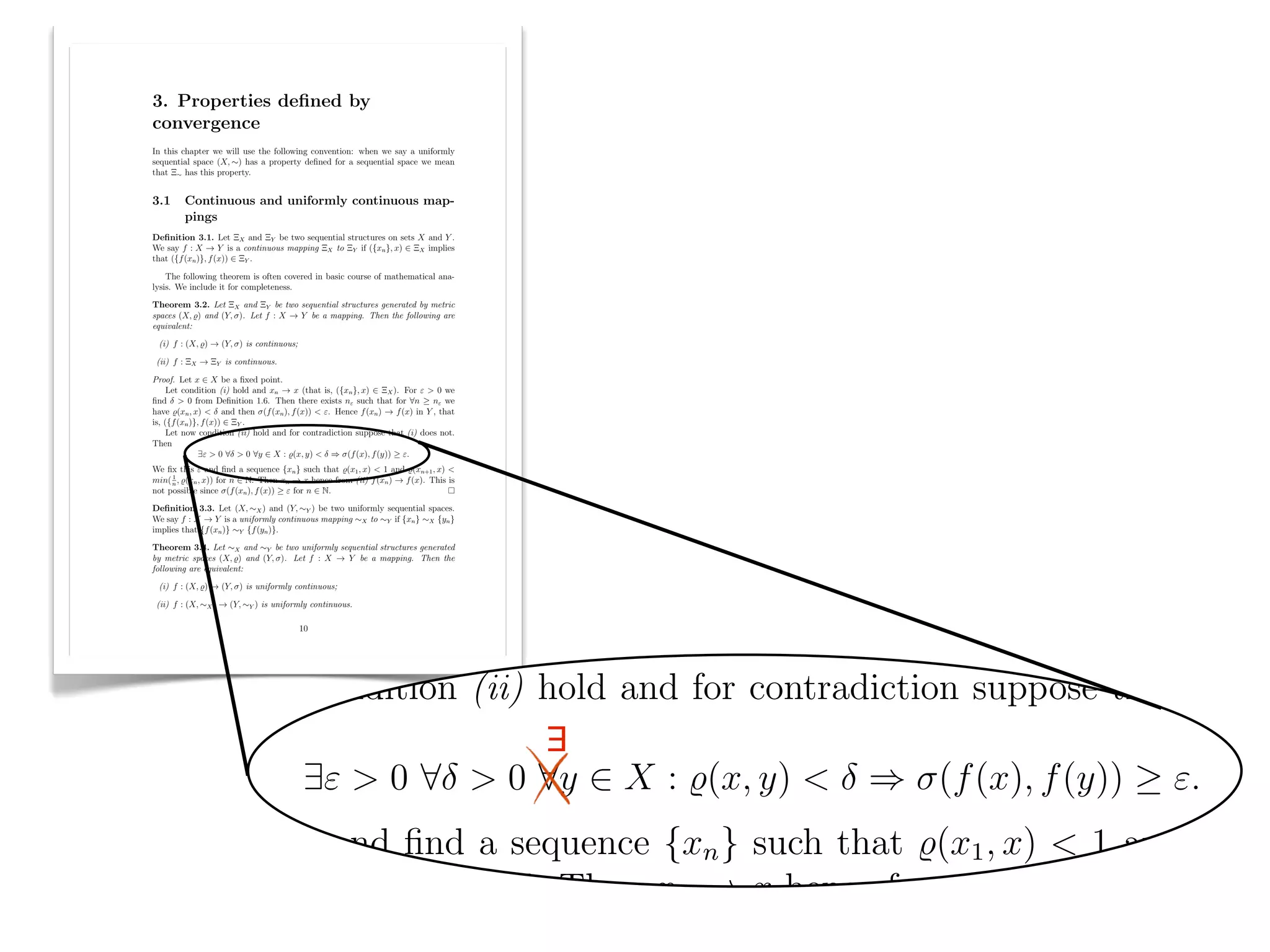
       Let now condition (ii) hold and for contradiction suppose that (i) does not.
  Then


Proof. Let x 2 X be a fixed point.
                 9" > 0 8 > 0 8y 2 X : %(x, y) < ) (f (x), f (y)) ".
  We fix this " and find a sequence {xn } such that %(x1 , x) < 1 and %(xn+1 , x) <
  min( n , %(xn , x)) for n 2 N. Then xn ! x hence from (ii) f (xn ) ! f (x). This is
       1

  not possible since (f (xn ), f (x)) " for n 2 N.

     Let condition (i) hold and xn ! x (that is, ({xn }, x) 2 ⌅X ). For "
  Definition 3.3. Let (X, ⇠X ) and (Y, ⇠Y ) be two uniformly sequential spaces.
  We say f : X ! Y is a uniformly continuous mapping ⇠X to ⇠Y if {xn } ⇠X {yn }
  implies that {f (xn )} ⇠Y {f (yn )}.


find > 0 from Definition 1.6. Then there exists n" such that for 8n
  Theorem 3.4. Let ⇠X and ⇠Y be two uniformly sequential structures generated
  by metric spaces (X, %) and (Y, ). Let f : X ! Y be a mapping. Then the
  following are equivalent:


have %(xn , x) < and then (f (xn ), f (x)) < ". Hence f (xn ) ! f (x) in
   (i) f : (X, %) ! (Y, ) is uniformly continuous;

   (ii) f : (X, ⇠X ) ! (Y, ⇠Y ) is uniformly continuous.

                                           10

is, ({f (xn )}, f (x)) 2 ⌅Y .
     Let now condition (ii) hold and for contradiction suppose that (i) do
Then                          ∃
               9" > 0 8 > 0 8y 2 X : %(x, y) < ) (f (x), f (y)) ".
We fix this " and find a sequence {xn } such that %(x1 , x) < 1 and %(xn+
min( n , %(xn , x)) for n 2 N. Then xn ! x hence from (ii) f (xn ) ! f (x).
     1

not possible since (f (xn ), f (x)) " for n 2 N.
Example 3.17. We say two infinite sets are almost disjoint if their inte
is finite. Let us assume an infinite maximal family of almost disjoint su
N and denote it as MAD(N).
  Theorem 3.16. Let (X, ⇠X ), (Y, ⇠Y ) be two uniformly sequential spaces, f :
  X ! Y be a continuous mapping and (X, ⇠X ) be compact. Then f is uniformly
  continuous.

  Proof. Let {xn } ⇠X {yn } and let us for contradiction suppose that {f (xn )} 6⇠Y

    For a reader’s image of some infinite family of almost disjoint subsets
  {f (yn )}. Then from (U3) we find subsequences {f (xnk )} and {f (ynk )} such
  that for none their subsequences we have {f (xnki )} ⇠Y {f (ynki )}. Because X
  is compact we can find subsequences {xnki } of {xnk }, {ynki } of {ynk } and points
  x, y 2 X such that ({xnki }, x) 2 ⌅⇠X and ({ynki }, y) 2 ⌅⇠X . Since {xn } ⇠X {yn }


will show a construction of one. Let f : N ! Q be a bijection of natural n
  we have {xnk } ⇠X {ynk } and therefore x = y. Mapping f is continuous so
  ({f (xnki )}, f (x)) 2 ⌅⇠Y and ({f (ynki )}, f (x)) 2 ⌅⇠Y . That is, {f (xnki )} ⇠Y
  {f (x)} and {f (ynki )} ⇠Y {f (x)} which gives us {f (xnki )} ⇠Y {f (ynki )} which is
  the contradiction.


onto rational numbers. For every irrational x 2 R  Q we will choose one
     The following example proves that the implication in the previous theorem
  can not be reversed.

  Example 3.17. We say two infinite sets are almost disjoint if their intersection


sequence {rn } such that rn ! x. Then Sx := f 1 [{rn }] ⇢ N is a prei
  is finite. Let us assume an infinite maximal family of almost disjoint subsets of
  N and denote it as MAD(N).
      For a reader’s image of some infinite family of almost disjoint subsets of N we
  will show a construction of one. Let f : N ! Q be a bijection of natural numbers


that sequence. Then {Sx : x 2 R  Q} is an infinite family of almost
  onto rational numbers. For every irrational x 2 R  Q we will choose one rational
  sequence {rn } such that rn ! x. Then Sx := f 1 [{rn }] ⇢ N is a preimage of
  that sequence. Then {Sx : x 2 R  Q} is an infinite family of almost disjoint
  subsets of N because if two sets had an infinite intersection the corresponding


subsets of N because if two sets had an infinite intersection the corres
  rational sequences would have an infinite intersection too and since they are both
  convergent it follows they would converge to the same point.
      Please note that using this construction we do not obtain a MAD(N) as for
  example the preimage of the set of all even numbers is almost disjoint with all
  constructed sets.


rational sequences would have an infinite intersection too and since they a
      We denote MAD(N) = {S↵ : ↵ 2 A} for some set A. Let X := N [ MAD(N)
  with the smallest sequential structure such that

                           S↵ ! {S↵ },    {S↵ } 2 MAD(N).


convergent it follows they would converge to the same point.
  This condition can be rephrased: members of S↵ as points in N converge to S↵
  as point in MAD(N). Then every continuous mapping to R is bounded but the
  space is evidently not compact.
     To prove this let f : X ! R be a continuous unbounded mapping. That is,

    Please note that using this construction we do not obtain a MAD(N
  there exists a sequence {xn } for which f (xn ) ! 1. Now we examine two cases.
     First, infinitely many members of {xn } lie in N, so we can find a subsequence
  {xnk } ⇢ N. Then there exists S↵ 2 MAD(N) such that {xnk } ! S↵ . Then we
  have {f (xnk )} ! f (S↵ ) and {f (xnk )} ! 1 which is a contradiction.


example the preimage of the set of all even numbers is almost disjoint
     Second, only finite number of members of {xn } lie in N. Without loss of
  generality we suppose that {xn } = {S↵n } ⇢ MAD(N). For every n 2 N we can
  find yn 2 N such that |f (yn ) f (S↵n )|  1. The first case yields {f (yn )} is
  bounded and so {f (S↵n )} is bounded.


constructed sets.                          14


    We denote MAD(N) = {S↵ : ↵ 2 A} for some set A. Let X := N [ M
with the smallest sequential structure such that

                                                                                          S↵ ! {S↵ },   {S↵ } 2 MAD(N).

This condition can be rephrased: members of S↵ as points in N converg
as point in MAD(N). Then every continuous mapping to R is bounded

Thesis defendence presentation

  • 1.
    Tancuj, tancuj, konverguj Jako v konvergenci i v tanci nezáleží na pár prvních krocích, ale jak tancujete ke konci a kam dotancujete. Photo by tyle_r on Flickr
  • 4.
  • 5.
    Které vlastnosti jdou vyjádřit •Kompaktnost konvergencí •Úplnost •Totální omezenost •Omezenost •Otevřenost •Spojitost • Stejnoměrná spojitost • Souvislost • Separabilnost
  • 7.
    1. Uzavřenost napodposloupnosti 2. Jednoznačnost limity 3. Posloupnost nekonvergující k x obsahuje podposloupnost, která je “daleko od x”. 4. Konvergence konstantní posloupnosti
  • 10.
  • 11.
  • 13.
    1. Podposloupnosti blízkýchjsou blízké 2. Různé konstantní nejsou blízké 3. Neblízké posloupnosti obsahují podposloupnosti, které jsou “daleko od sebe”.
  • 15.
  • 16.
  • 17.
  • 18.
    The following theoremis often covered in basic course of mathematic lysis. We include it for completeness. 3. Properties defined by convergence Theorem 3.2. Let ⌅X and ⌅Y be two sequential structures generated by In this chapter we will use the following convention: when we say a uniformly sequential space (X, ⇠) has a property defined for a sequential space we mean that ⌅⇠ has this property. spaces (X, %) and (Y, ). Let f : X ! Y be a mapping. Then the follow 3.1 Continuous and uniformly continuous map- pings equivalent: Definition 3.1. Let ⌅X and ⌅Y be two sequential structures on sets X and Y . We say f : X ! Y is a continuous mapping ⌅X to ⌅Y if ({xn }, x) 2 ⌅X implies that ({f (xn )}, f (x)) 2 ⌅Y . The following theorem is often covered in basic course of mathematical ana- lysis. We include it for completeness. (i) f : (X, %) ! (Y, ) is continuous; Theorem 3.2. Let ⌅X and ⌅Y be two sequential structures generated by metric spaces (X, %) and (Y, ). Let f : X ! Y be a mapping. Then the following are equivalent: (i) f : (X, %) ! (Y, ) is continuous; (ii) f : ⌅X ! ⌅Y is continuous. (ii) f : ⌅X ! ⌅Y is continuous. Proof. Let x 2 X be a fixed point. Let condition (i) hold and xn ! x (that is, ({xn }, x) 2 ⌅X ). For " > 0 we find > 0 from Definition 1.6. Then there exists n" such that for 8n n" we have %(xn , x) < and then (f (xn ), f (x)) < ". Hence f (xn ) ! f (x) in Y , that is, ({f (xn )}, f (x)) 2 ⌅Y . Let now condition (ii) hold and for contradiction suppose that (i) does not. Then Proof. Let x 2 X be a fixed point. 9" > 0 8 > 0 8y 2 X : %(x, y) < ) (f (x), f (y)) ". We fix this " and find a sequence {xn } such that %(x1 , x) < 1 and %(xn+1 , x) < min( n , %(xn , x)) for n 2 N. Then xn ! x hence from (ii) f (xn ) ! f (x). This is 1 not possible since (f (xn ), f (x)) " for n 2 N. Let condition (i) hold and xn ! x (that is, ({xn }, x) 2 ⌅X ). For " Definition 3.3. Let (X, ⇠X ) and (Y, ⇠Y ) be two uniformly sequential spaces. We say f : X ! Y is a uniformly continuous mapping ⇠X to ⇠Y if {xn } ⇠X {yn } implies that {f (xn )} ⇠Y {f (yn )}. find > 0 from Definition 1.6. Then there exists n" such that for 8n Theorem 3.4. Let ⇠X and ⇠Y be two uniformly sequential structures generated by metric spaces (X, %) and (Y, ). Let f : X ! Y be a mapping. Then the following are equivalent: have %(xn , x) < and then (f (xn ), f (x)) < ". Hence f (xn ) ! f (x) in (i) f : (X, %) ! (Y, ) is uniformly continuous; (ii) f : (X, ⇠X ) ! (Y, ⇠Y ) is uniformly continuous. 10 is, ({f (xn )}, f (x)) 2 ⌅Y . Let now condition (ii) hold and for contradiction suppose that (i) do Then 9" > 0 8 > 0 8y 2 X : %(x, y) < ) (f (x), f (y)) ". We fix this " and find a sequence {xn } such that %(x1 , x) < 1 and %(xn+ min( n , %(xn , x)) for n 2 N. Then xn ! x hence from (ii) f (xn ) ! f (x). 1 not possible since (f (xn ), f (x)) " for n 2 N.
  • 19.
    The following theoremis often covered in basic course of mathematic lysis. We include it for completeness. 3. Properties defined by convergence Theorem 3.2. Let ⌅X and ⌅Y be two sequential structures generated by In this chapter we will use the following convention: when we say a uniformly sequential space (X, ⇠) has a property defined for a sequential space we mean that ⌅⇠ has this property. spaces (X, %) and (Y, ). Let f : X ! Y be a mapping. Then the follow 3.1 Continuous and uniformly continuous map- pings equivalent: Definition 3.1. Let ⌅X and ⌅Y be two sequential structures on sets X and Y . We say f : X ! Y is a continuous mapping ⌅X to ⌅Y if ({xn }, x) 2 ⌅X implies that ({f (xn )}, f (x)) 2 ⌅Y . The following theorem is often covered in basic course of mathematical ana- lysis. We include it for completeness. (i) f : (X, %) ! (Y, ) is continuous; Theorem 3.2. Let ⌅X and ⌅Y be two sequential structures generated by metric spaces (X, %) and (Y, ). Let f : X ! Y be a mapping. Then the following are equivalent: (i) f : (X, %) ! (Y, ) is continuous; (ii) f : ⌅X ! ⌅Y is continuous. (ii) f : ⌅X ! ⌅Y is continuous. Proof. Let x 2 X be a fixed point. Let condition (i) hold and xn ! x (that is, ({xn }, x) 2 ⌅X ). For " > 0 we find > 0 from Definition 1.6. Then there exists n" such that for 8n n" we have %(xn , x) < and then (f (xn ), f (x)) < ". Hence f (xn ) ! f (x) in Y , that is, ({f (xn )}, f (x)) 2 ⌅Y . Let now condition (ii) hold and for contradiction suppose that (i) does not. Then Proof. Let x 2 X be a fixed point. 9" > 0 8 > 0 8y 2 X : %(x, y) < ) (f (x), f (y)) ". We fix this " and find a sequence {xn } such that %(x1 , x) < 1 and %(xn+1 , x) < min( n , %(xn , x)) for n 2 N. Then xn ! x hence from (ii) f (xn ) ! f (x). This is 1 not possible since (f (xn ), f (x)) " for n 2 N. Let condition (i) hold and xn ! x (that is, ({xn }, x) 2 ⌅X ). For " Definition 3.3. Let (X, ⇠X ) and (Y, ⇠Y ) be two uniformly sequential spaces. We say f : X ! Y is a uniformly continuous mapping ⇠X to ⇠Y if {xn } ⇠X {yn } implies that {f (xn )} ⇠Y {f (yn )}. find > 0 from Definition 1.6. Then there exists n" such that for 8n Theorem 3.4. Let ⇠X and ⇠Y be two uniformly sequential structures generated by metric spaces (X, %) and (Y, ). Let f : X ! Y be a mapping. Then the following are equivalent: have %(xn , x) < and then (f (xn ), f (x)) < ". Hence f (xn ) ! f (x) in (i) f : (X, %) ! (Y, ) is uniformly continuous; (ii) f : (X, ⇠X ) ! (Y, ⇠Y ) is uniformly continuous. 10 is, ({f (xn )}, f (x)) 2 ⌅Y . Let now condition (ii) hold and for contradiction suppose that (i) do Then ∃ 9" > 0 8 > 0 8y 2 X : %(x, y) < ) (f (x), f (y)) ". We fix this " and find a sequence {xn } such that %(x1 , x) < 1 and %(xn+ min( n , %(xn , x)) for n 2 N. Then xn ! x hence from (ii) f (xn ) ! f (x). 1 not possible since (f (xn ), f (x)) " for n 2 N.
  • 20.
    Example 3.17. Wesay two infinite sets are almost disjoint if their inte is finite. Let us assume an infinite maximal family of almost disjoint su N and denote it as MAD(N). Theorem 3.16. Let (X, ⇠X ), (Y, ⇠Y ) be two uniformly sequential spaces, f : X ! Y be a continuous mapping and (X, ⇠X ) be compact. Then f is uniformly continuous. Proof. Let {xn } ⇠X {yn } and let us for contradiction suppose that {f (xn )} 6⇠Y For a reader’s image of some infinite family of almost disjoint subsets {f (yn )}. Then from (U3) we find subsequences {f (xnk )} and {f (ynk )} such that for none their subsequences we have {f (xnki )} ⇠Y {f (ynki )}. Because X is compact we can find subsequences {xnki } of {xnk }, {ynki } of {ynk } and points x, y 2 X such that ({xnki }, x) 2 ⌅⇠X and ({ynki }, y) 2 ⌅⇠X . Since {xn } ⇠X {yn } will show a construction of one. Let f : N ! Q be a bijection of natural n we have {xnk } ⇠X {ynk } and therefore x = y. Mapping f is continuous so ({f (xnki )}, f (x)) 2 ⌅⇠Y and ({f (ynki )}, f (x)) 2 ⌅⇠Y . That is, {f (xnki )} ⇠Y {f (x)} and {f (ynki )} ⇠Y {f (x)} which gives us {f (xnki )} ⇠Y {f (ynki )} which is the contradiction. onto rational numbers. For every irrational x 2 R Q we will choose one The following example proves that the implication in the previous theorem can not be reversed. Example 3.17. We say two infinite sets are almost disjoint if their intersection sequence {rn } such that rn ! x. Then Sx := f 1 [{rn }] ⇢ N is a prei is finite. Let us assume an infinite maximal family of almost disjoint subsets of N and denote it as MAD(N). For a reader’s image of some infinite family of almost disjoint subsets of N we will show a construction of one. Let f : N ! Q be a bijection of natural numbers that sequence. Then {Sx : x 2 R Q} is an infinite family of almost onto rational numbers. For every irrational x 2 R Q we will choose one rational sequence {rn } such that rn ! x. Then Sx := f 1 [{rn }] ⇢ N is a preimage of that sequence. Then {Sx : x 2 R Q} is an infinite family of almost disjoint subsets of N because if two sets had an infinite intersection the corresponding subsets of N because if two sets had an infinite intersection the corres rational sequences would have an infinite intersection too and since they are both convergent it follows they would converge to the same point. Please note that using this construction we do not obtain a MAD(N) as for example the preimage of the set of all even numbers is almost disjoint with all constructed sets. rational sequences would have an infinite intersection too and since they a We denote MAD(N) = {S↵ : ↵ 2 A} for some set A. Let X := N [ MAD(N) with the smallest sequential structure such that S↵ ! {S↵ }, {S↵ } 2 MAD(N). convergent it follows they would converge to the same point. This condition can be rephrased: members of S↵ as points in N converge to S↵ as point in MAD(N). Then every continuous mapping to R is bounded but the space is evidently not compact. To prove this let f : X ! R be a continuous unbounded mapping. That is, Please note that using this construction we do not obtain a MAD(N there exists a sequence {xn } for which f (xn ) ! 1. Now we examine two cases. First, infinitely many members of {xn } lie in N, so we can find a subsequence {xnk } ⇢ N. Then there exists S↵ 2 MAD(N) such that {xnk } ! S↵ . Then we have {f (xnk )} ! f (S↵ ) and {f (xnk )} ! 1 which is a contradiction. example the preimage of the set of all even numbers is almost disjoint Second, only finite number of members of {xn } lie in N. Without loss of generality we suppose that {xn } = {S↵n } ⇢ MAD(N). For every n 2 N we can find yn 2 N such that |f (yn ) f (S↵n )|  1. The first case yields {f (yn )} is bounded and so {f (S↵n )} is bounded. constructed sets. 14 We denote MAD(N) = {S↵ : ↵ 2 A} for some set A. Let X := N [ M with the smallest sequential structure such that S↵ ! {S↵ }, {S↵ } 2 MAD(N). This condition can be rephrased: members of S↵ as points in N converg as point in MAD(N). Then every continuous mapping to R is bounded