NUMBER SYSTEMS
TYPES OF NUMBER SYSTEM
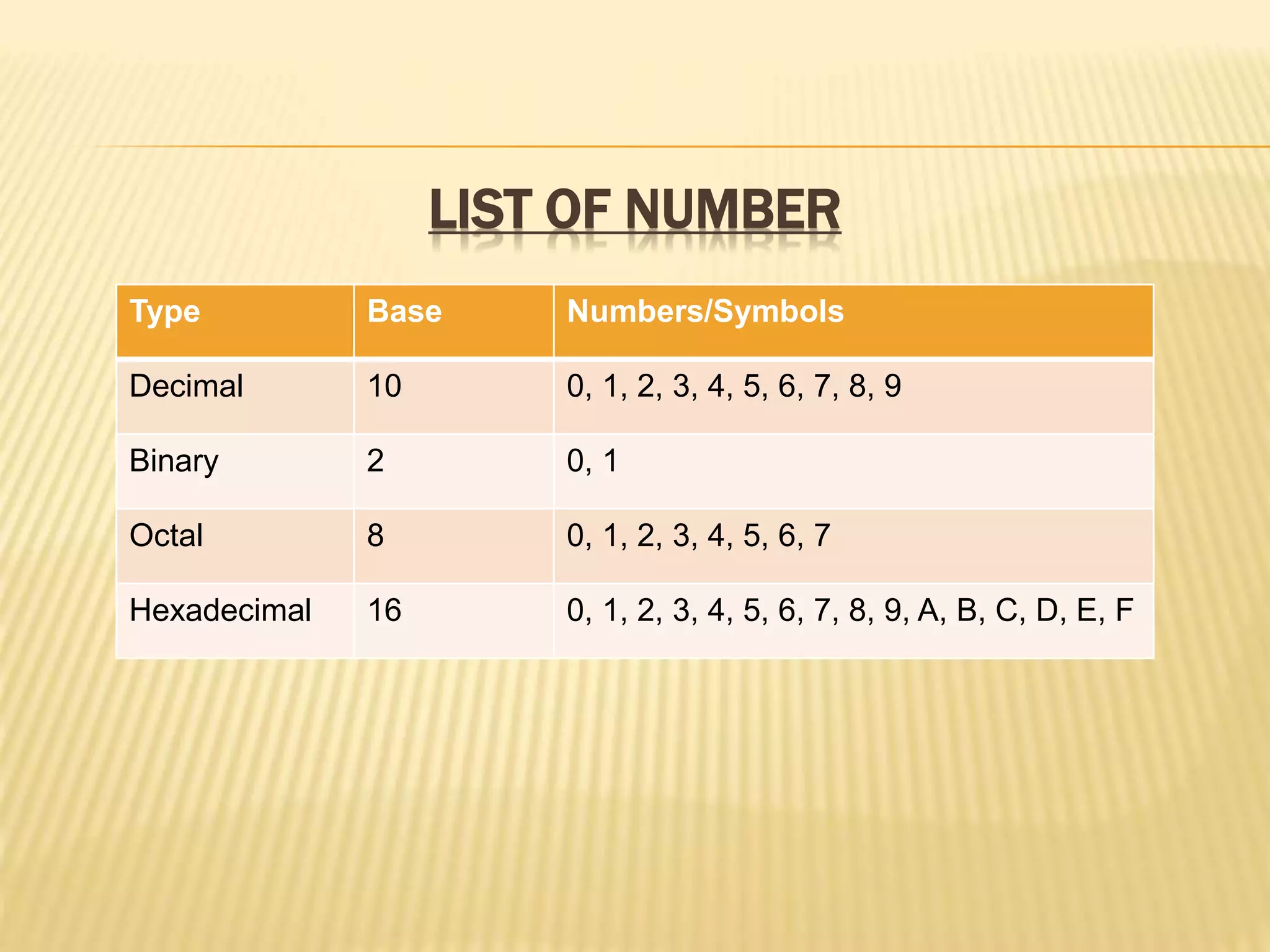
LIST OF NUMBER
Type Base Numbers/Symbols
Decimal 10 0, 1, 2, 3, 4, 5, 6, 7, 8, 9
Binary 2 0, 1
Octal 8 0, 1, 2, 3, 4, 5, 6, 7
Hexadecimal 16 0, 1, 2, 3, 4, 5, 6, 7, 8, 9, A, B, C, D, E, F
BINARY NUMBERS
 Used to represent the voltage levels of a digital circuit.
 Only two voltage levels present in a digital circuit, logic High and
logic Low.
 The high voltage is +5V and the low voltage is +0V.
 The binary numbers represent the logic low as a 0 and the logic high
as a 1.
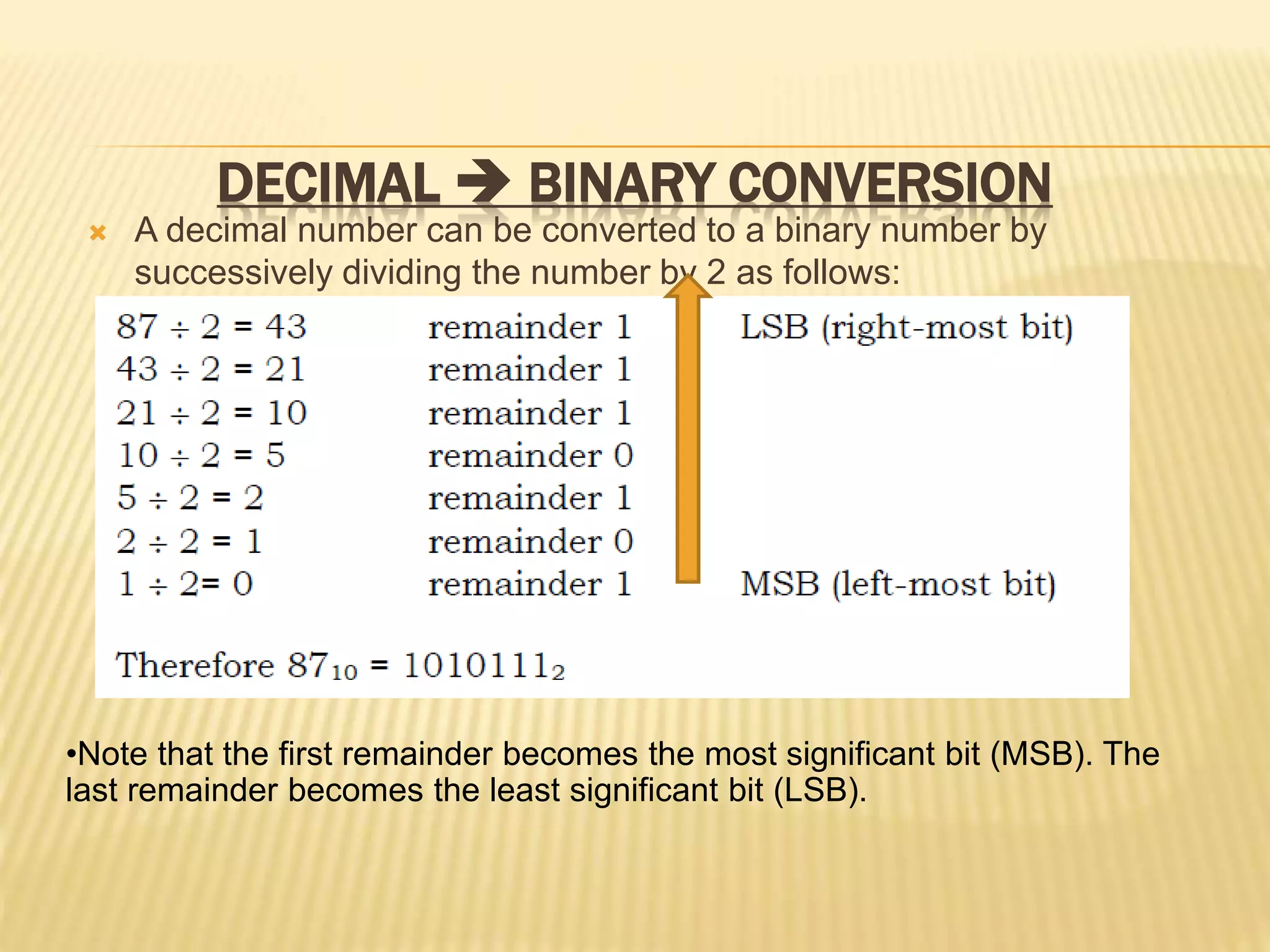
DECIMAL  BINARY CONVERSION
 A decimal number can be converted to a binary number by
successively dividing the number by 2 as follows:
•Note that the first remainder becomes the most significant bit (MSB). The
last remainder becomes the least significant bit (LSB).
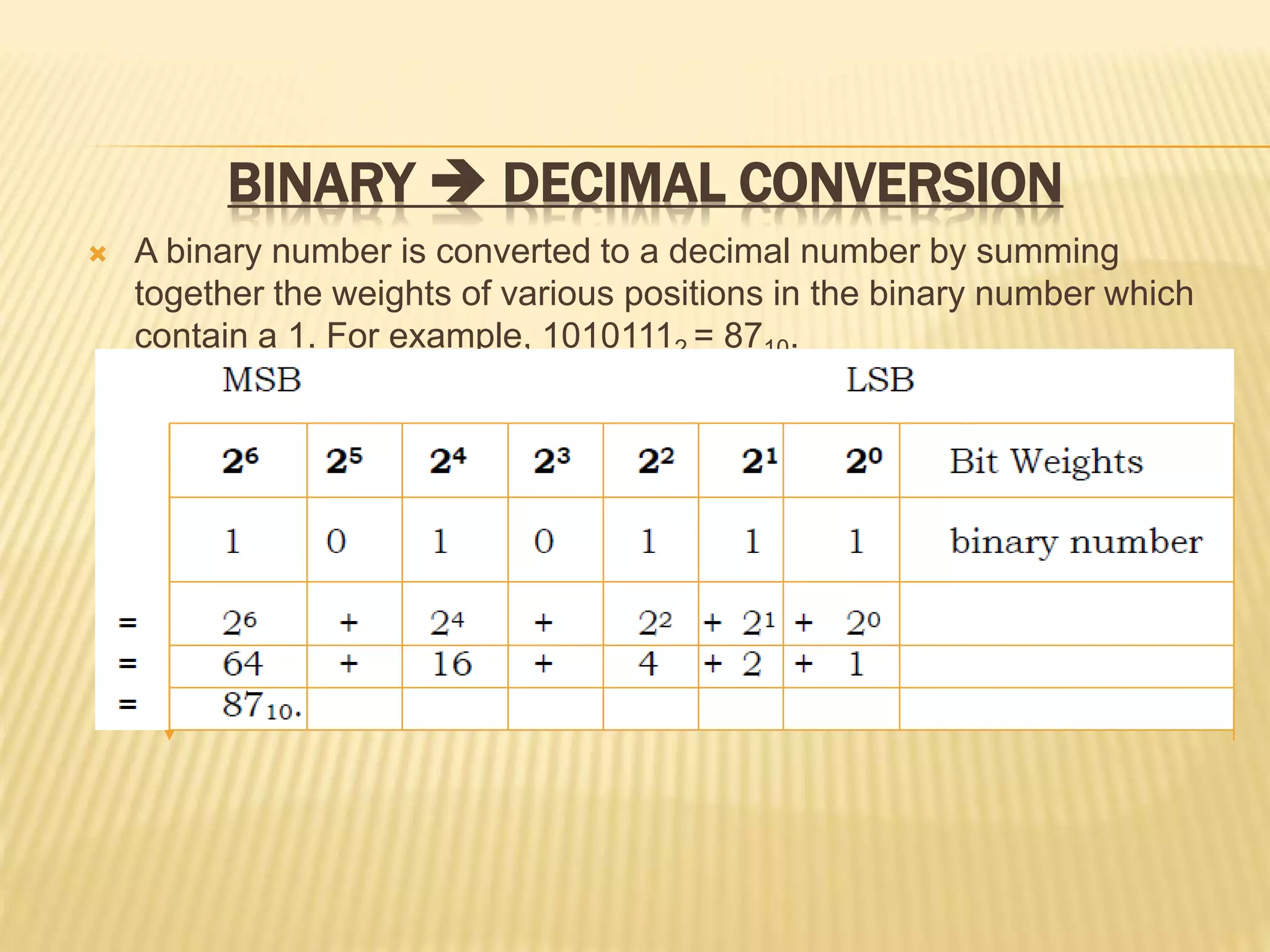
BINARY  DECIMAL CONVERSION
 A binary number is converted to a decimal number by summing
together the weights of various positions in the binary number which
contain a 1. For example, 10101112 = 8710.
DECIMAL  OCTAL CONVERSION
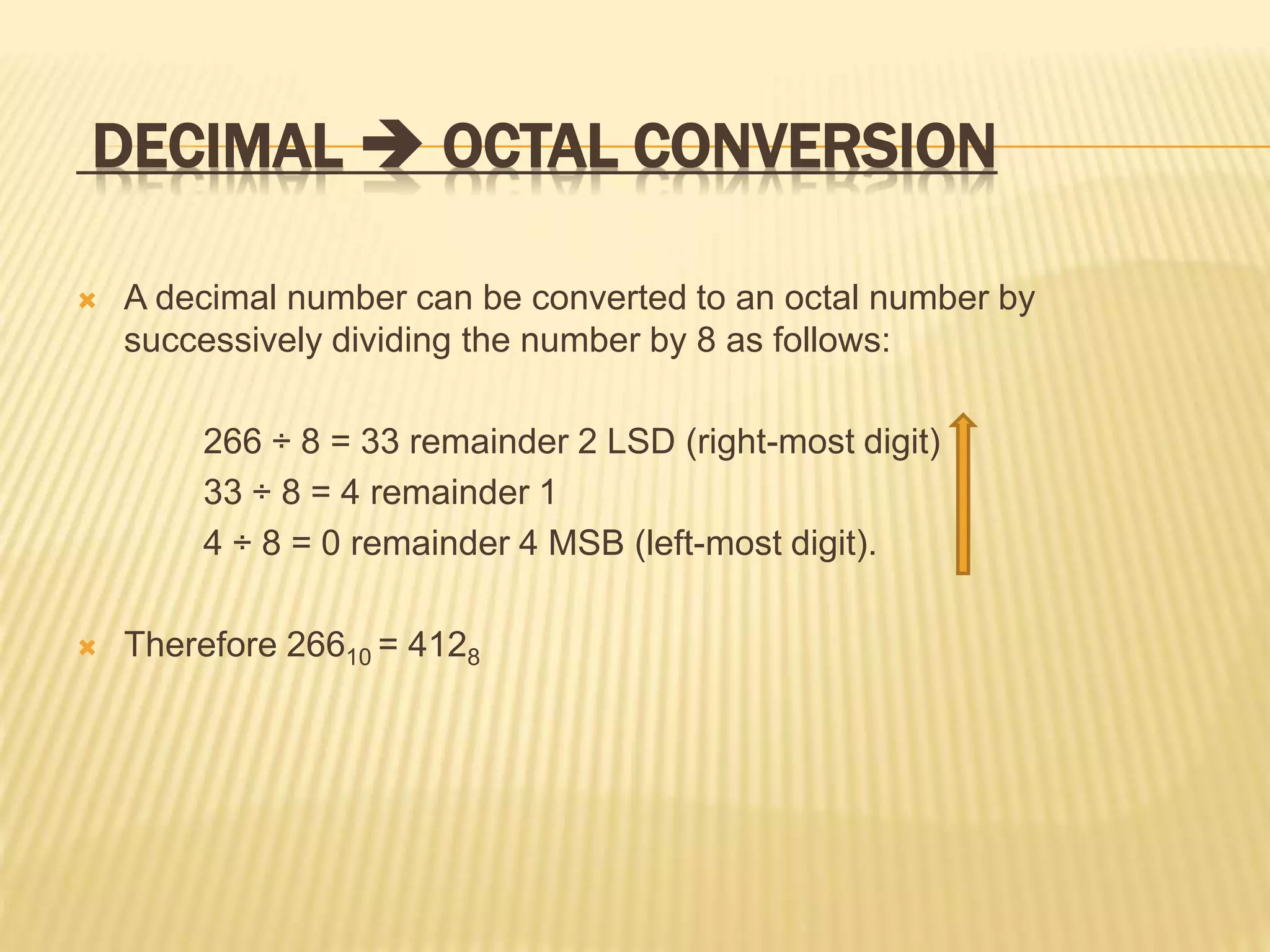
 A decimal number can be converted to an octal number by
successively dividing the number by 8 as follows:
266 ÷ 8 = 33 remainder 2 LSD (right-most digit)
33 ÷ 8 = 4 remainder 1
4 ÷ 8 = 0 remainder 4 MSB (left-most digit).
 Therefore 26610 = 4128
OCTAL  DECIMAL CONVERSION
 To convert an octal number to a decimal number, multiply each octal
value by the weight of the digit and sum the results. For example,
4128 = 26610.
OCTAL  BINARY REPRESENTATION
 Each octal digit can be represented by a 3-bit binary number as
shown below:
 Conversion from octal to binary is very straightforward. Each octal digit
is replaced by 3-bit binary number. For example, 4728 = 100 111 0102.
 A binary number is converted into an octal number by taking groups of
3 bits, starting from LSB, and replacing them with an octal digit. For
example, 11 010 1102 = 3268
.
OCTAL BINARY CONVERSION
HEXADECIMAL NUMBER
 The hexadecimal number uses base 16. It uses the digits 0 through
9 plus the letters A, B, C, D, E and F.
 The letter A stands for decimal 10, B for 11, C for 12, D for 13, E for
14 and F for 15.
HEXADECIMAL NUMBER
4.2 DECIMAL  HEXADECIMAL
CONVERSION
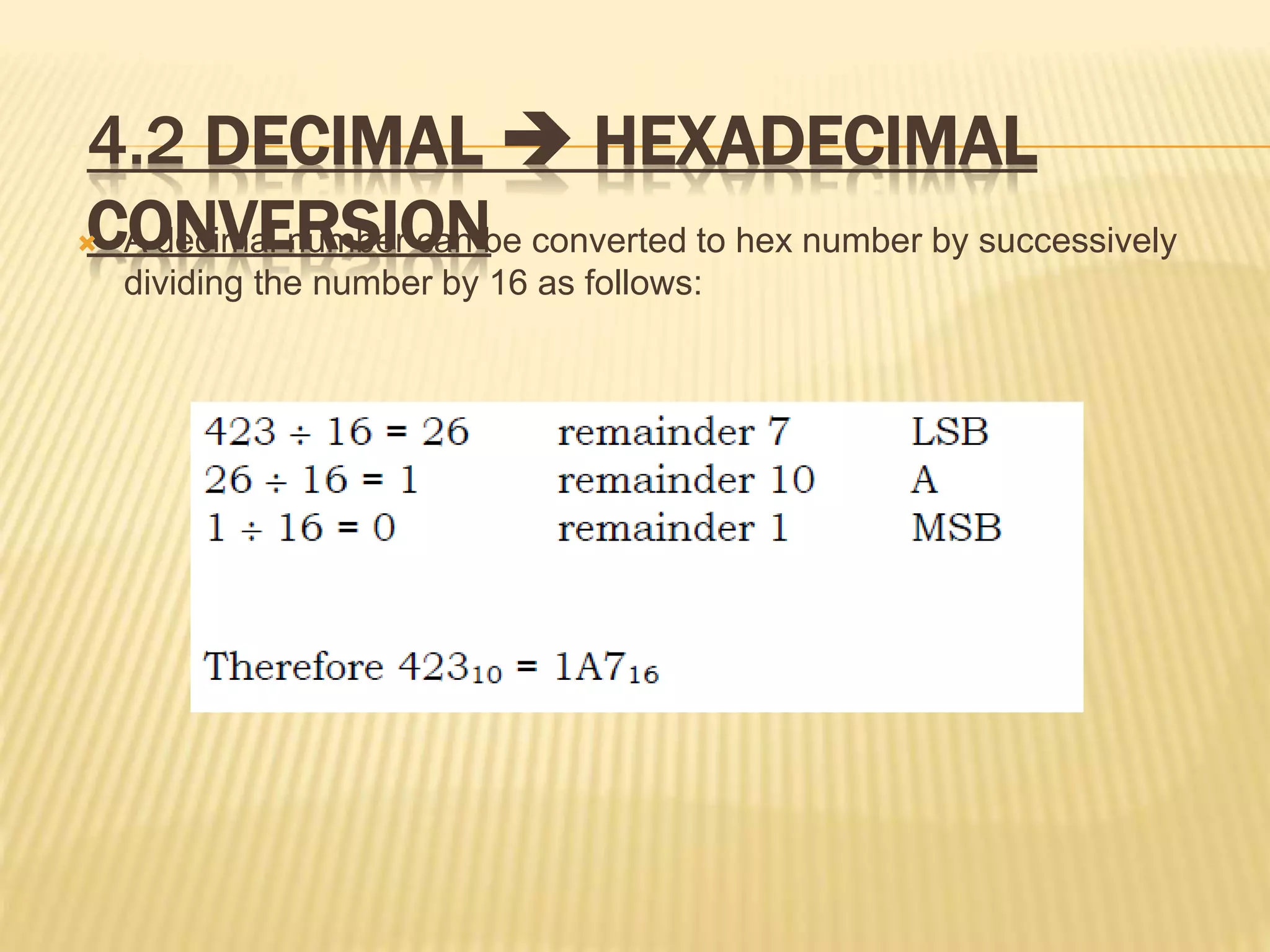
 A decimal number can be converted to hex number by successively
dividing the number by 16 as follows:
HEXADECIMAL  DECIMAL
CONVERSION
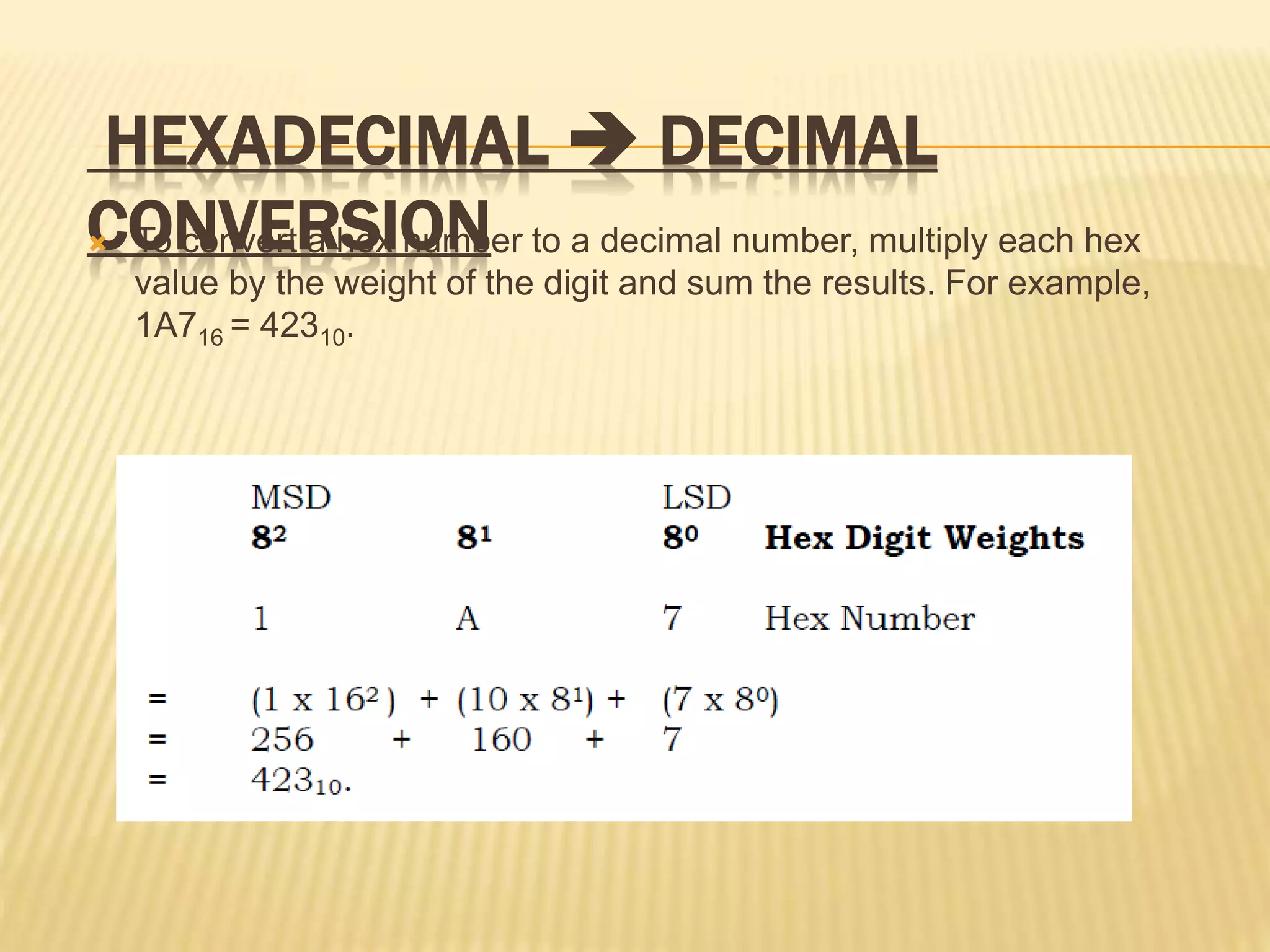
 To convert a hex number to a decimal number, multiply each hex
value by the weight of the digit and sum the results. For example,
1A716 = 42310.
HEXADECIMAL BINARY CONVERSI
 Each hex digit can be represented by a 4-bit binary number as
shown above. Conversion from hex to binary is very straightforward.
Each hex digit is replaced by 4-bit binary number.
 A binary number is converted into an octal number by taking groups
of 4 bits, starting from LSB, and replacing them with a hex digit. For
example, 110101102 = 3268
.
5.1 BINARY-CODED-DECIMAL
(BCD)
 The Binary-Coded-Decimal (BCD) code makes conversion much
easier. Each decimal digit, 0 through 9, is represented with a 4-Bit
BCD code as shown below. The BCD code 1010, 1011, 1100, 1101,
1110 and 1111 are not used.
5.2 DECIMAL  BCD
CONVERSION
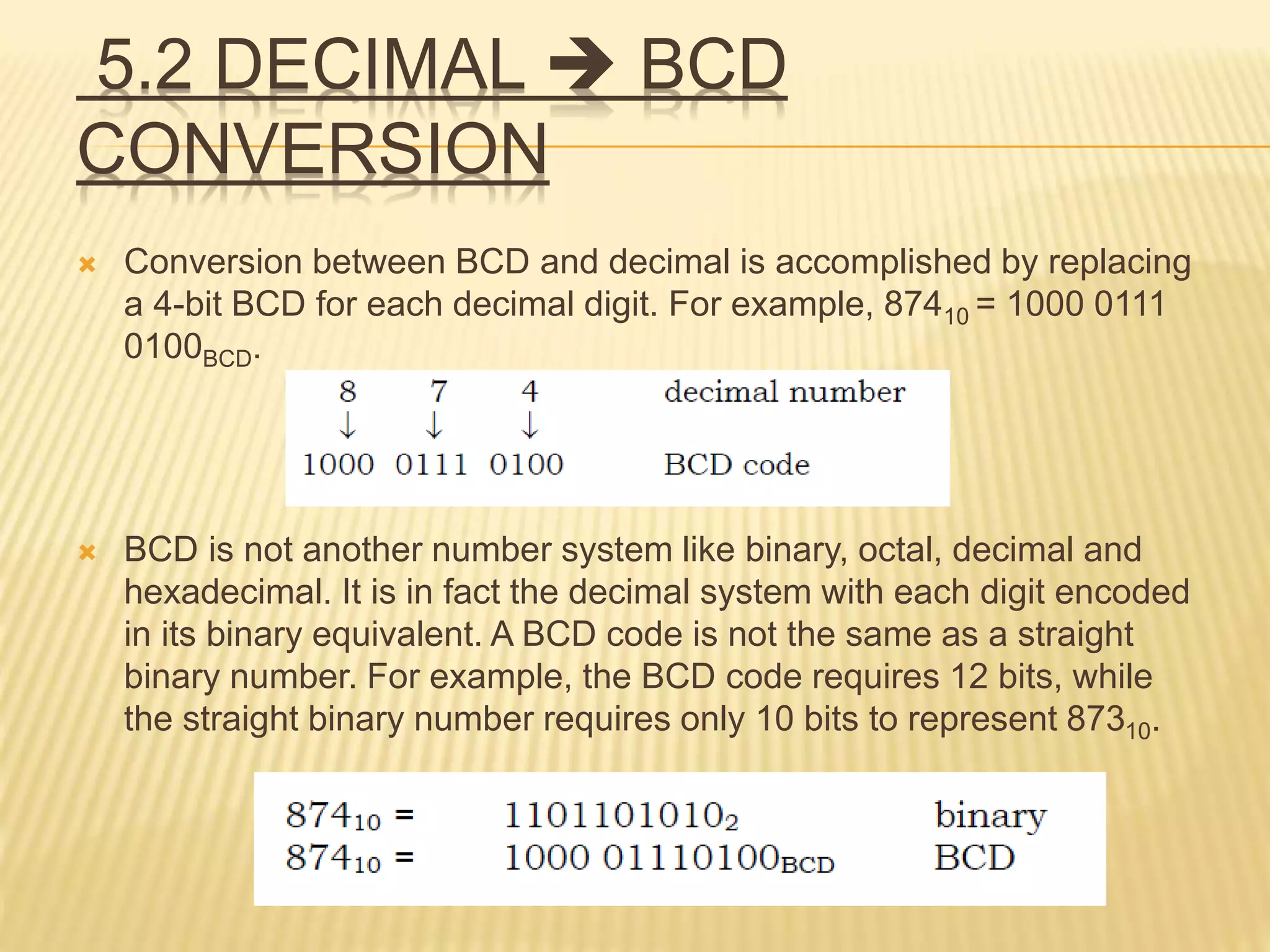
 Conversion between BCD and decimal is accomplished by replacing
a 4-bit BCD for each decimal digit. For example, 87410 = 1000 0111
0100BCD.
 BCD is not another number system like binary, octal, decimal and
hexadecimal. It is in fact the decimal system with each digit encoded
in its binary equivalent. A BCD code is not the same as a straight
binary number. For example, the BCD code requires 12 bits, while
the straight binary number requires only 10 bits to represent 87310.
BASE CONVERSION FOR FLOATING POINTS WITH
THE REMAINDER METHOD
Decimal  Binary
Eg. Convert 23.37510 to base 2.
Technique:
1. Start by converting the integer portion:
FLOATING POINTS CONVERSION USING
REMAINDER METHOD
Decimal  Binary
2. Then, convert the fraction by multiply it with the based we want to convert:
IF ZERO, THEN STOP
BASE CONVERSION FOR FLOATING POINTS WITH
THE REMAINDER METHOD
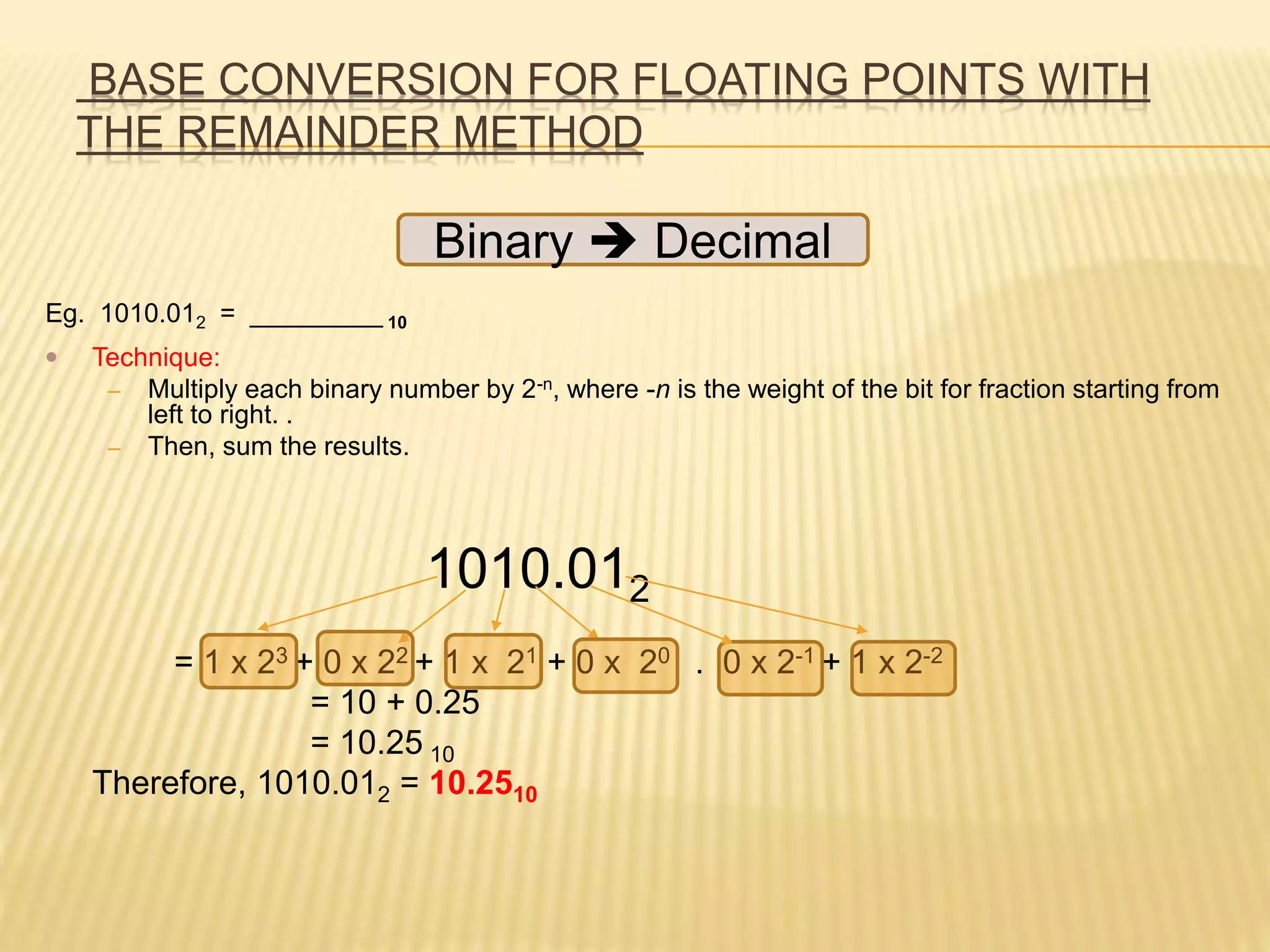
Eg. 1010.012 = _________ 10
 Technique:
– Multiply each binary number by 2-n, where -n is the weight of the bit for fraction starting from
left to right. .
– Then, sum the results.
1010.012
= 1 x 23 + 0 x 22 + 1 x 21 + 0 x 20 . 0 x 2-1 + 1 x 2-2
= 10 + 0.25
= 10.25 10
Therefore, 1010.012 = 10.2510
Binary  Decimal
BASE CONVERSION FOR FLOATING POINTS WITH
THE REMAINDER METHOD
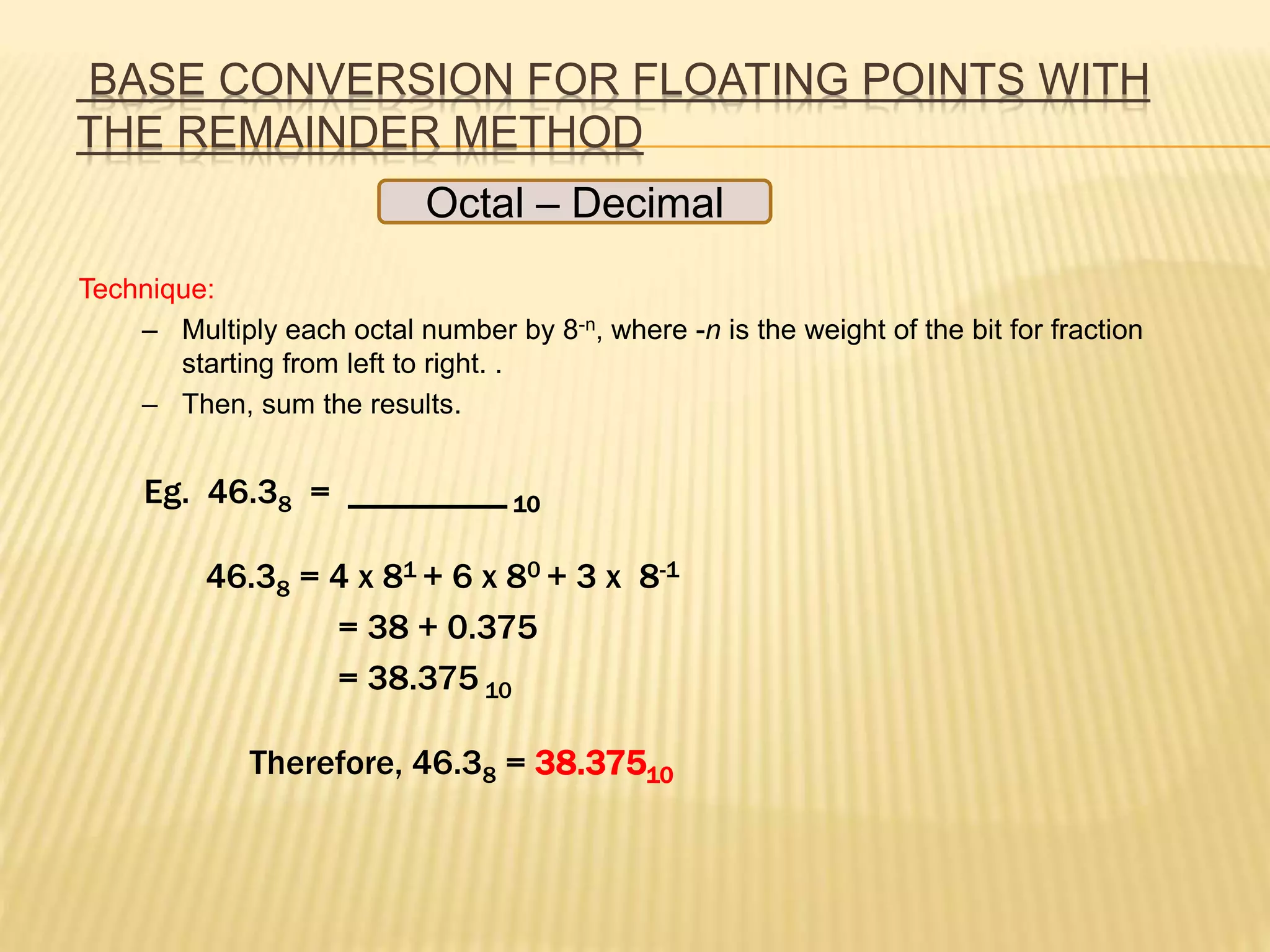
Octal – Decimal
Technique:
– Multiply each octal number by 8-n, where -n is the weight of the bit for fraction
starting from left to right. .
– Then, sum the results.
Eg. 46.38 = _________ 10
46.38 = 4 x 81 + 6 x 80 + 3 x 8-1
= 38 + 0.375
= 38.375 10
Therefore, 46.38 = 38.37510
BASE CONVERSION FOR FLOATING POINTS WITH
THE REMAINDER METHOD
Hexadecimal -
Decimal
Technique:
– Multiply each hexadecimal number by 16-n, where -n is the weight of the bit for
fraction starting from left to right.
– Then, sum the results.
Eg. A7.0F16 = _________ 10
A7.0F16 = 10 x 161 + 7 x 160 + 0 x 16-1 + 15 x 16-2
= 167 + 0.059
= 167.059 10
Therefore, A7.0F16 = 167.05910

Number system

  • 1.
  • 2.
  • 3.
    LIST OF NUMBER TypeBase Numbers/Symbols Decimal 10 0, 1, 2, 3, 4, 5, 6, 7, 8, 9 Binary 2 0, 1 Octal 8 0, 1, 2, 3, 4, 5, 6, 7 Hexadecimal 16 0, 1, 2, 3, 4, 5, 6, 7, 8, 9, A, B, C, D, E, F
  • 4.
    BINARY NUMBERS  Usedto represent the voltage levels of a digital circuit.  Only two voltage levels present in a digital circuit, logic High and logic Low.  The high voltage is +5V and the low voltage is +0V.  The binary numbers represent the logic low as a 0 and the logic high as a 1.
  • 5.
    DECIMAL  BINARYCONVERSION  A decimal number can be converted to a binary number by successively dividing the number by 2 as follows: •Note that the first remainder becomes the most significant bit (MSB). The last remainder becomes the least significant bit (LSB).
  • 6.
    BINARY  DECIMALCONVERSION  A binary number is converted to a decimal number by summing together the weights of various positions in the binary number which contain a 1. For example, 10101112 = 8710.
  • 7.
    DECIMAL  OCTALCONVERSION  A decimal number can be converted to an octal number by successively dividing the number by 8 as follows: 266 ÷ 8 = 33 remainder 2 LSD (right-most digit) 33 ÷ 8 = 4 remainder 1 4 ÷ 8 = 0 remainder 4 MSB (left-most digit).  Therefore 26610 = 4128
  • 8.
    OCTAL  DECIMALCONVERSION  To convert an octal number to a decimal number, multiply each octal value by the weight of the digit and sum the results. For example, 4128 = 26610.
  • 9.
    OCTAL  BINARYREPRESENTATION  Each octal digit can be represented by a 3-bit binary number as shown below:
  • 10.
     Conversion fromoctal to binary is very straightforward. Each octal digit is replaced by 3-bit binary number. For example, 4728 = 100 111 0102.  A binary number is converted into an octal number by taking groups of 3 bits, starting from LSB, and replacing them with an octal digit. For example, 11 010 1102 = 3268 . OCTAL BINARY CONVERSION
  • 11.
    HEXADECIMAL NUMBER  Thehexadecimal number uses base 16. It uses the digits 0 through 9 plus the letters A, B, C, D, E and F.  The letter A stands for decimal 10, B for 11, C for 12, D for 13, E for 14 and F for 15.
  • 12.
  • 13.
    4.2 DECIMAL HEXADECIMAL CONVERSION  A decimal number can be converted to hex number by successively dividing the number by 16 as follows:
  • 14.
    HEXADECIMAL  DECIMAL CONVERSION To convert a hex number to a decimal number, multiply each hex value by the weight of the digit and sum the results. For example, 1A716 = 42310.
  • 15.
    HEXADECIMAL BINARY CONVERSI Each hex digit can be represented by a 4-bit binary number as shown above. Conversion from hex to binary is very straightforward. Each hex digit is replaced by 4-bit binary number.  A binary number is converted into an octal number by taking groups of 4 bits, starting from LSB, and replacing them with a hex digit. For example, 110101102 = 3268 .
  • 16.
    5.1 BINARY-CODED-DECIMAL (BCD)  TheBinary-Coded-Decimal (BCD) code makes conversion much easier. Each decimal digit, 0 through 9, is represented with a 4-Bit BCD code as shown below. The BCD code 1010, 1011, 1100, 1101, 1110 and 1111 are not used.
  • 17.
    5.2 DECIMAL BCD CONVERSION  Conversion between BCD and decimal is accomplished by replacing a 4-bit BCD for each decimal digit. For example, 87410 = 1000 0111 0100BCD.  BCD is not another number system like binary, octal, decimal and hexadecimal. It is in fact the decimal system with each digit encoded in its binary equivalent. A BCD code is not the same as a straight binary number. For example, the BCD code requires 12 bits, while the straight binary number requires only 10 bits to represent 87310.
  • 18.
    BASE CONVERSION FORFLOATING POINTS WITH THE REMAINDER METHOD Decimal  Binary Eg. Convert 23.37510 to base 2. Technique: 1. Start by converting the integer portion:
  • 19.
    FLOATING POINTS CONVERSIONUSING REMAINDER METHOD Decimal  Binary 2. Then, convert the fraction by multiply it with the based we want to convert: IF ZERO, THEN STOP
  • 20.
    BASE CONVERSION FORFLOATING POINTS WITH THE REMAINDER METHOD Eg. 1010.012 = _________ 10  Technique: – Multiply each binary number by 2-n, where -n is the weight of the bit for fraction starting from left to right. . – Then, sum the results. 1010.012 = 1 x 23 + 0 x 22 + 1 x 21 + 0 x 20 . 0 x 2-1 + 1 x 2-2 = 10 + 0.25 = 10.25 10 Therefore, 1010.012 = 10.2510 Binary  Decimal
  • 21.
    BASE CONVERSION FORFLOATING POINTS WITH THE REMAINDER METHOD Octal – Decimal Technique: – Multiply each octal number by 8-n, where -n is the weight of the bit for fraction starting from left to right. . – Then, sum the results. Eg. 46.38 = _________ 10 46.38 = 4 x 81 + 6 x 80 + 3 x 8-1 = 38 + 0.375 = 38.375 10 Therefore, 46.38 = 38.37510
  • 22.
    BASE CONVERSION FORFLOATING POINTS WITH THE REMAINDER METHOD Hexadecimal - Decimal Technique: – Multiply each hexadecimal number by 16-n, where -n is the weight of the bit for fraction starting from left to right. – Then, sum the results. Eg. A7.0F16 = _________ 10 A7.0F16 = 10 x 161 + 7 x 160 + 0 x 16-1 + 15 x 16-2 = 167 + 0.059 = 167.059 10 Therefore, A7.0F16 = 167.05910