Download as PDF, PPTX
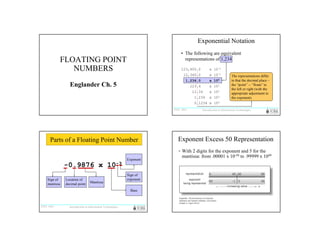
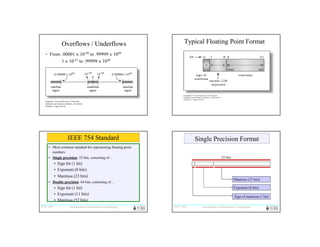
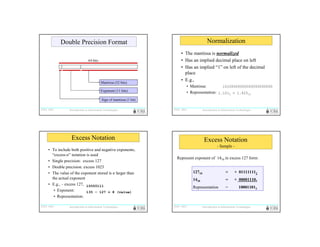
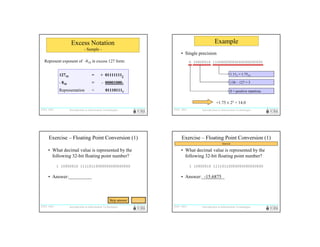
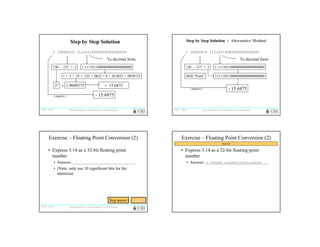
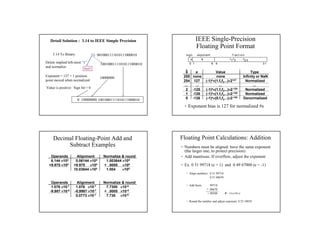
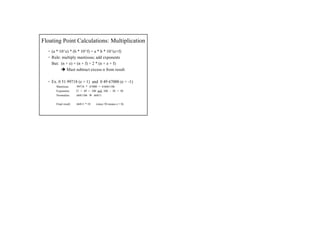

Exponential notation can be used to represent very large and very small numbers in a normalized form. A floating point number uses a sign, exponent, and mantissa to represent values in a fixed number of bits. Common standards like IEEE 754 specify single and double precision formats that use 1 sign bit, 8 or 11 exponent bits, and 23 or 52 mantissa bits respectively. Calculations with floating point numbers require aligning the exponents before adding or multiplying the mantissas and adjusting the result exponent.


