What is Data?
 The quantities, characters, or symbols
on which operations are performed by a
computer, which may be stored and
transmitted in the form of electrical
signals and recorded on magnetic,
optical, or mechanical recording media.
 facts and statistics collected together for
reference or analysis.
Definition of Big Data
 Big Data is a collection of data that is huge in volume, yet
growing exponentially with time.

 It is a data with so large size and complexity that none of
traditional data management tools can store it or process it
efficiently.
 Big data is also a data but with huge size.
 Big data refers to data sets that are too large or complex to
be dealt with by traditional data-processing application
software.
 Data with many fields offer greater statistical power, while
data with higher complexity may lead to a higher false
discovery rate.
What is a Big data used
for?
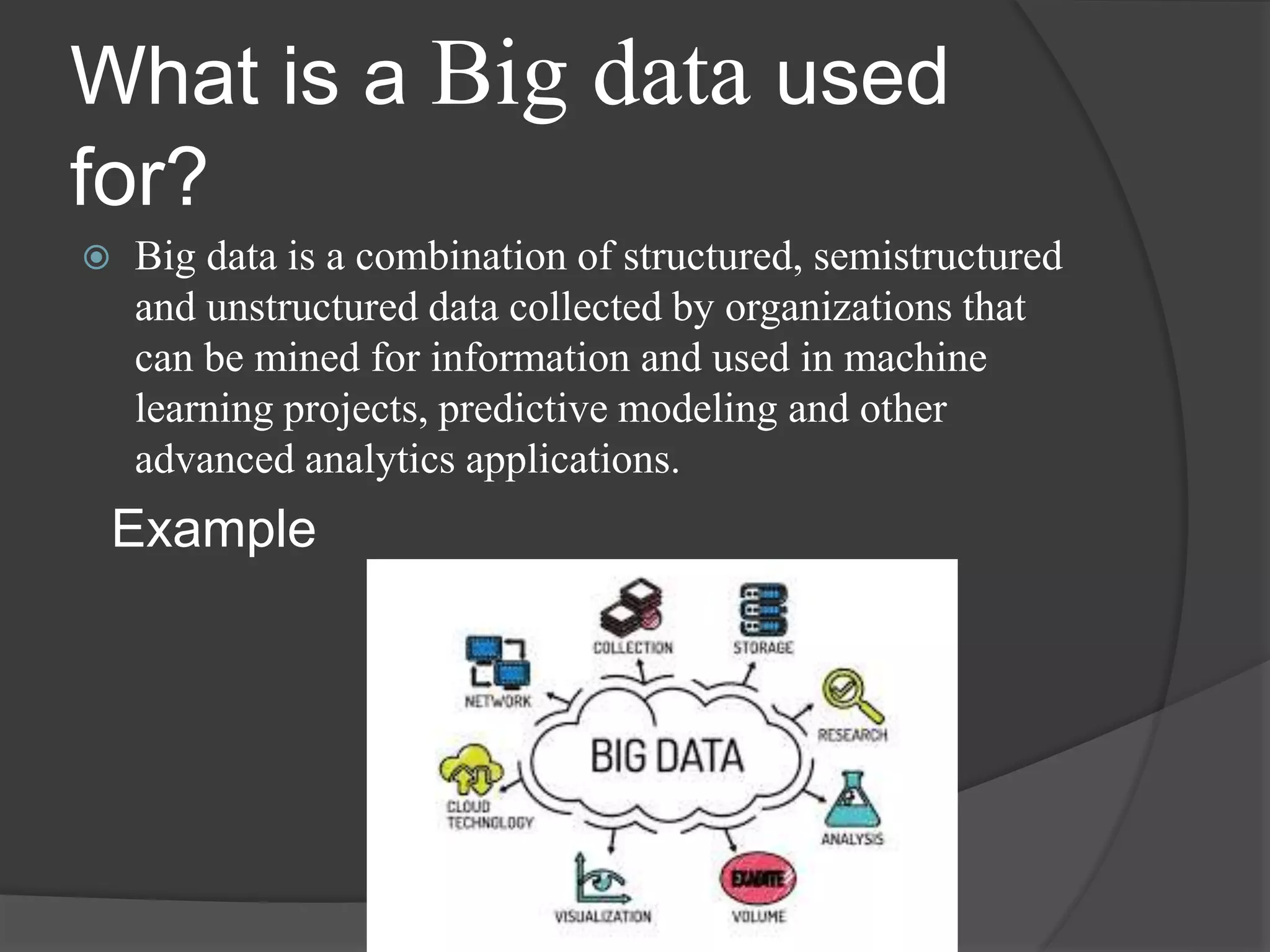
 Big data is a combination of structured, semistructured
and unstructured data collected by organizations that
can be mined for information and used in machine
learning projects, predictive modeling and other
advanced analytics applications.
Example
 Big data is classified in three ways:
○ Structured Data.
○ Unstructured Data.
○ Semi-Structured Data.
1. Structured - Any data that can be stored, accessed and processed in the form of fixed
format is termed as a ‘structured’ data. Example: An ‘Employee’ table in a database
is an example of Structured Data.
2. Unstructured - Any data with unknown form or the structure is classified as
unstructured data. In addition to the size being huge, un-structured data poses
multiple challenges in terms of its processing for deriving value out of it. Example :
The output returned by ‘Google Search’.
3 Semi-structured
 Semi-structured data can contain both the forms of data. We can see semi-structured
data as a structured in form but it is actually not defined. Example : data represented
in an XML file.
Types of Big data
 Big data can be described by the following
characteristics:
○ Volume
○ Variety
○ Velocity
○ Variability
Volume – The name Big Data itself is related to a size
which is enormous. Size of data plays a very crucial role in
determining value out of data. Also, whether a particular
data can actually be considered as a Big Data or not, is
dependent upon the volume of data.
Characteristics of Big data
Variety – Variety refers to heterogeneous sources and the
nature of data, both structured and unstructured. During
earlier days, spreadsheets and databases were the only
sources of data considered by most of the applications.
Velocity – The term ‘velocity’ refers to the speed of
generation of data. How fast the data is generated and
processed to meet the demands, determines real potential in
the data.
Variability – This refers to the inconsistency which can be
shown by the data at times, thus hampering the process of
being able to handle and manage the data effectively.
Characteristics of Big data
Advantages Of Big Data
Processing
 Businesses can utilize outside intelligence while
taking decisions
 Access to social data from search engines and
sites like facebook, twitter are enabling
organizations to fine tune their business
strategies.
 Improved customer service
 Traditional customer feedback systems are
getting replaced by new systems designed with
Big Data technologies.
 Better operational efficiency
Tools and Techniques of Big Data
 Hadoop.
 Xplenty.
 CDH (Cloudera Distribution for Hadoop)
 R.
 Cassandra.
 Knime.
 MongoDB.
 Lumify.
Why do we need big data tools
and techniques?
 Big data analytics tools help enterprises and
companies to manage big volumes of data
generated by different processes.
 There are thousands of big data tools that can
help you save time, money, and provide valuable
business insights.
Thank you

Big Data.pptx

  • 2.
    What is Data? The quantities, characters, or symbols on which operations are performed by a computer, which may be stored and transmitted in the form of electrical signals and recorded on magnetic, optical, or mechanical recording media.  facts and statistics collected together for reference or analysis.
  • 3.
    Definition of BigData  Big Data is a collection of data that is huge in volume, yet growing exponentially with time.   It is a data with so large size and complexity that none of traditional data management tools can store it or process it efficiently.  Big data is also a data but with huge size.  Big data refers to data sets that are too large or complex to be dealt with by traditional data-processing application software.  Data with many fields offer greater statistical power, while data with higher complexity may lead to a higher false discovery rate.
  • 4.
    What is aBig data used for?  Big data is a combination of structured, semistructured and unstructured data collected by organizations that can be mined for information and used in machine learning projects, predictive modeling and other advanced analytics applications. Example
  • 5.
     Big datais classified in three ways: ○ Structured Data. ○ Unstructured Data. ○ Semi-Structured Data. 1. Structured - Any data that can be stored, accessed and processed in the form of fixed format is termed as a ‘structured’ data. Example: An ‘Employee’ table in a database is an example of Structured Data. 2. Unstructured - Any data with unknown form or the structure is classified as unstructured data. In addition to the size being huge, un-structured data poses multiple challenges in terms of its processing for deriving value out of it. Example : The output returned by ‘Google Search’. 3 Semi-structured  Semi-structured data can contain both the forms of data. We can see semi-structured data as a structured in form but it is actually not defined. Example : data represented in an XML file. Types of Big data
  • 6.
     Big datacan be described by the following characteristics: ○ Volume ○ Variety ○ Velocity ○ Variability Volume – The name Big Data itself is related to a size which is enormous. Size of data plays a very crucial role in determining value out of data. Also, whether a particular data can actually be considered as a Big Data or not, is dependent upon the volume of data. Characteristics of Big data
  • 7.
    Variety – Varietyrefers to heterogeneous sources and the nature of data, both structured and unstructured. During earlier days, spreadsheets and databases were the only sources of data considered by most of the applications. Velocity – The term ‘velocity’ refers to the speed of generation of data. How fast the data is generated and processed to meet the demands, determines real potential in the data. Variability – This refers to the inconsistency which can be shown by the data at times, thus hampering the process of being able to handle and manage the data effectively. Characteristics of Big data
  • 8.
    Advantages Of BigData Processing  Businesses can utilize outside intelligence while taking decisions  Access to social data from search engines and sites like facebook, twitter are enabling organizations to fine tune their business strategies.  Improved customer service  Traditional customer feedback systems are getting replaced by new systems designed with Big Data technologies.  Better operational efficiency
  • 9.
    Tools and Techniquesof Big Data  Hadoop.  Xplenty.  CDH (Cloudera Distribution for Hadoop)  R.  Cassandra.  Knime.  MongoDB.  Lumify.
  • 10.
    Why do weneed big data tools and techniques?  Big data analytics tools help enterprises and companies to manage big volumes of data generated by different processes.  There are thousands of big data tools that can help you save time, money, and provide valuable business insights.
  • 11.