Introduction of Java Networking
Mrs.K.Kasthuri
INTRODUCTION
• Java Networking is a concept of connecting two or
more computing devices together.
• We can share resources.
• Java socket programming provides facility to share data
between different computing devices.
Advantages of Java Networking
• Sharing resources
• Centralize software management
Java Networking Terminology
• IP Address
• Protocol
• Port Number
• MAC Address
• Connection-oriented and connection-less protocol
• Socket
IP Address
• IP address is a unique number assigned to a node of a
network e.g. 192.168.0.1.
• It is composed of octets that range from 0 to 255.
• It is a logical address that can be changed.
Protocol
• A protocol is a set of rules basically that is followed for
communication.
For example:
• TCP
• FTP
• Telnet
• SMTP
• POP etc.
Port Number
• The port number is used to uniquely identify different
applications.
• It acts as a communication endpoint between
applications.
• The port number is associated with the IP address for
communication between two applications.
MAC Address
• MAC - Media Access Control
• Address is a unique identifier of NIC (Network Interface
Controller).
• A network node can have multiple NIC but each with
unique MAC.
Connection-oriented and connection-less
protocol
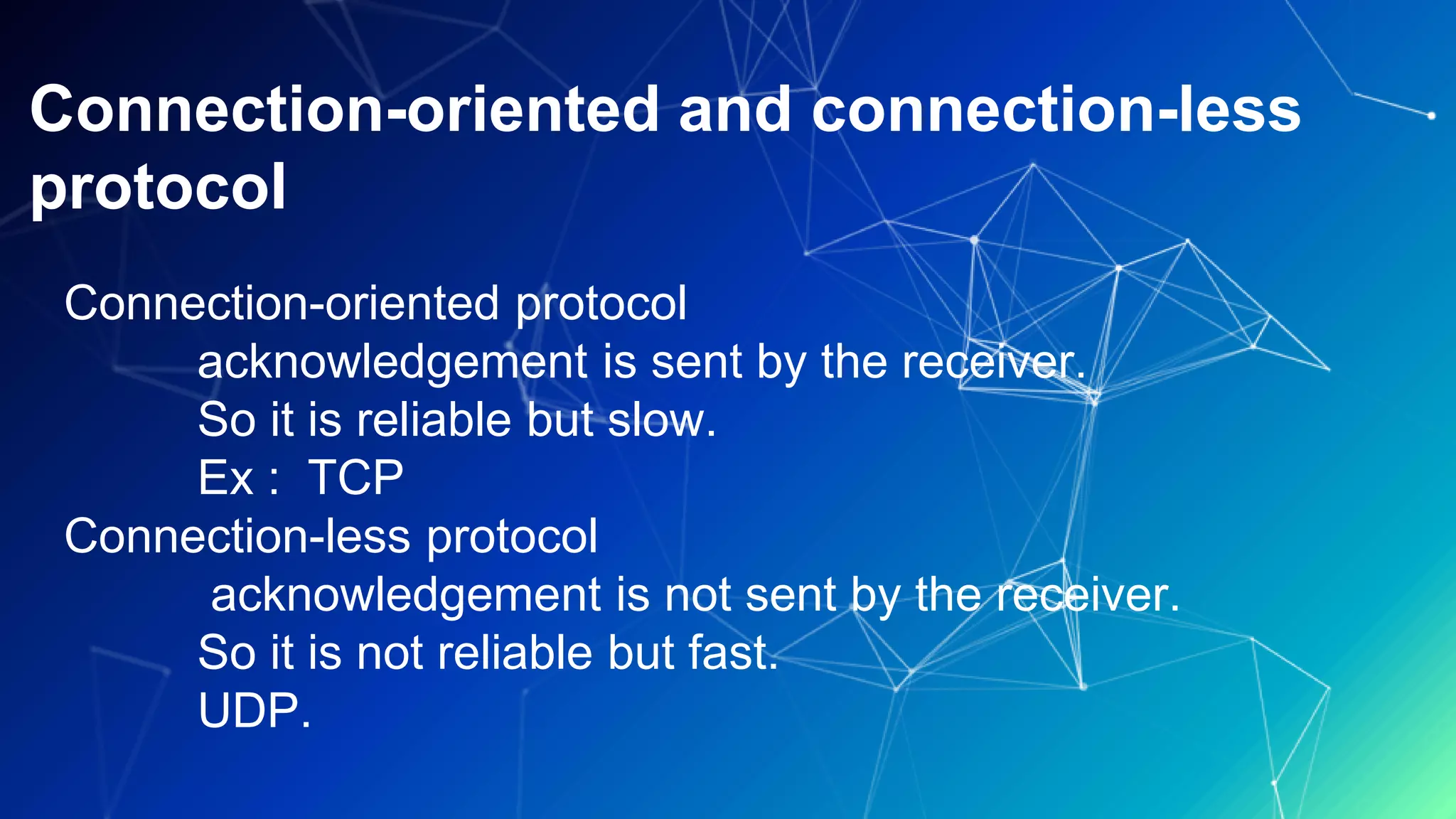
Connection-oriented protocol
acknowledgement is sent by the receiver.
So it is reliable but slow.
Ex : TCP
Connection-less protocol
acknowledgement is not sent by the receiver.
So it is not reliable but fast.
UDP.
Socket
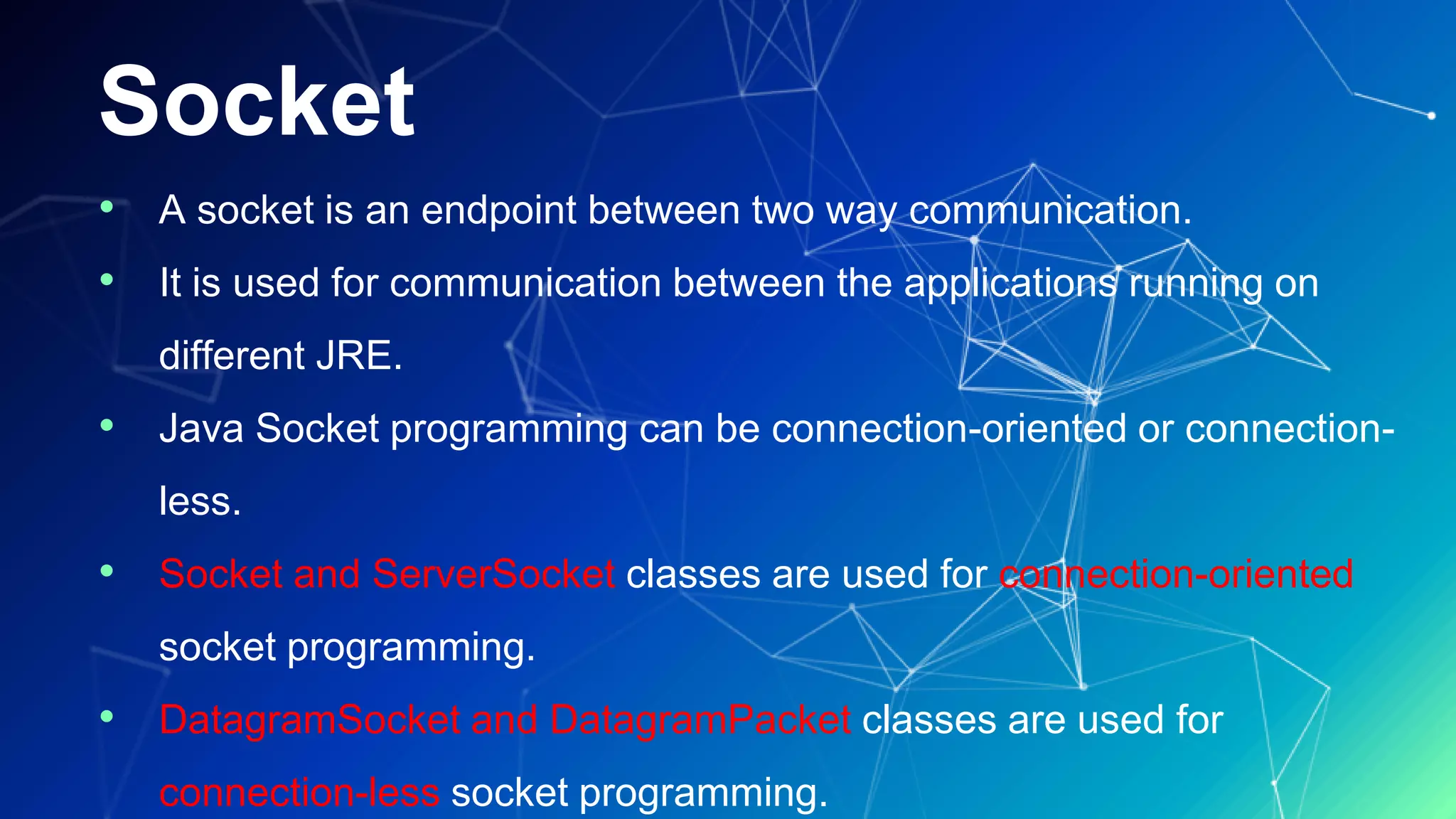
• A socket is an endpoint between two way communication.
• It is used for communication between the applications running on
different JRE.
• Java Socket programming can be connection-oriented or connection-
less.
• Socket and ServerSocket classes are used for connection-oriented
socket programming.
• DatagramSocket and DatagramPacket classes are used for
connection-less socket programming.
Java InetAddress class
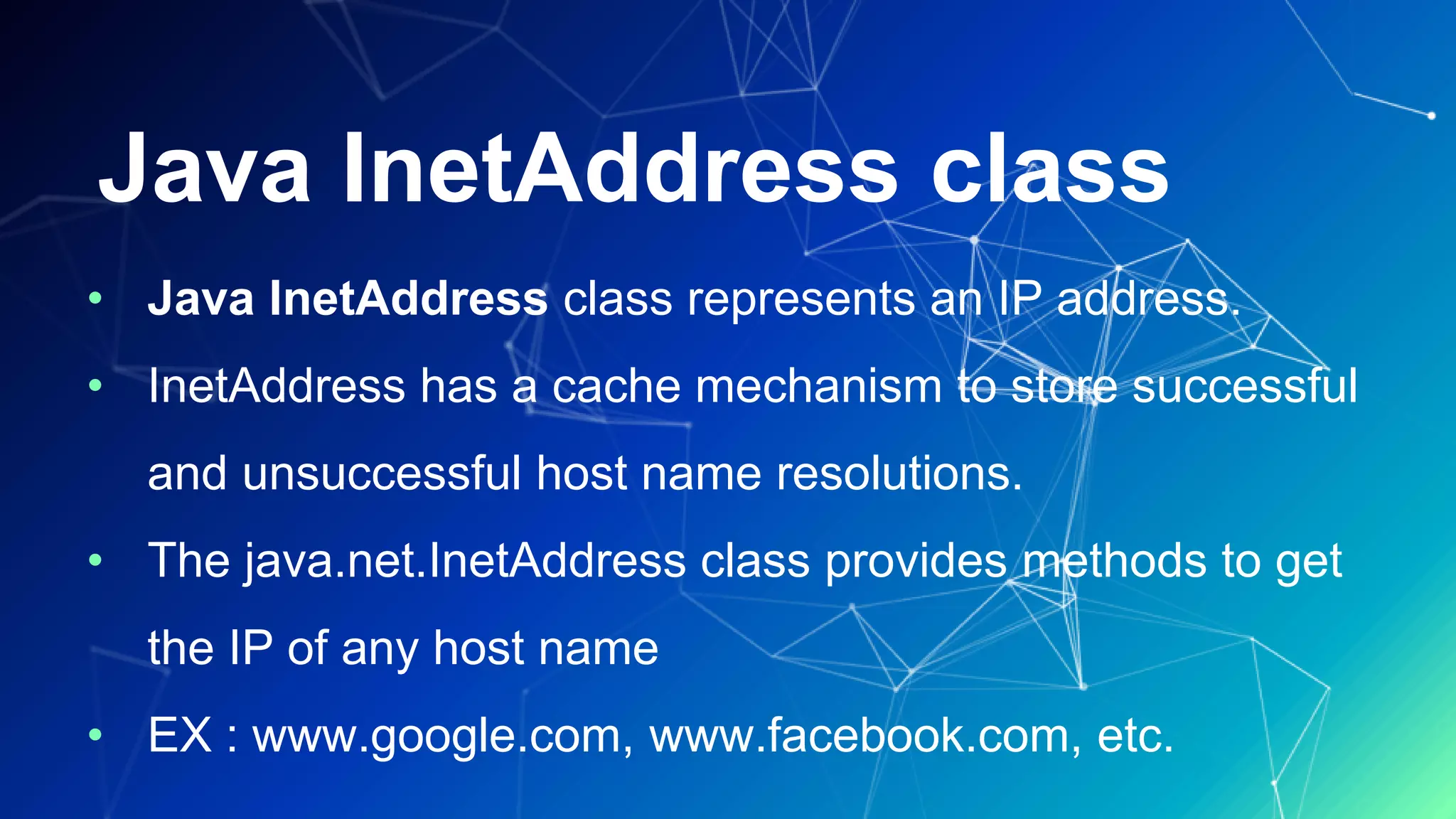
• Java InetAddress class represents an IP address.
• InetAddress has a cache mechanism to store successful
and unsuccessful host name resolutions.
• The java.net.InetAddress class provides methods to get
the IP of any host name
• EX : www.google.com, www.facebook.com, etc.
InetAddress class Methods
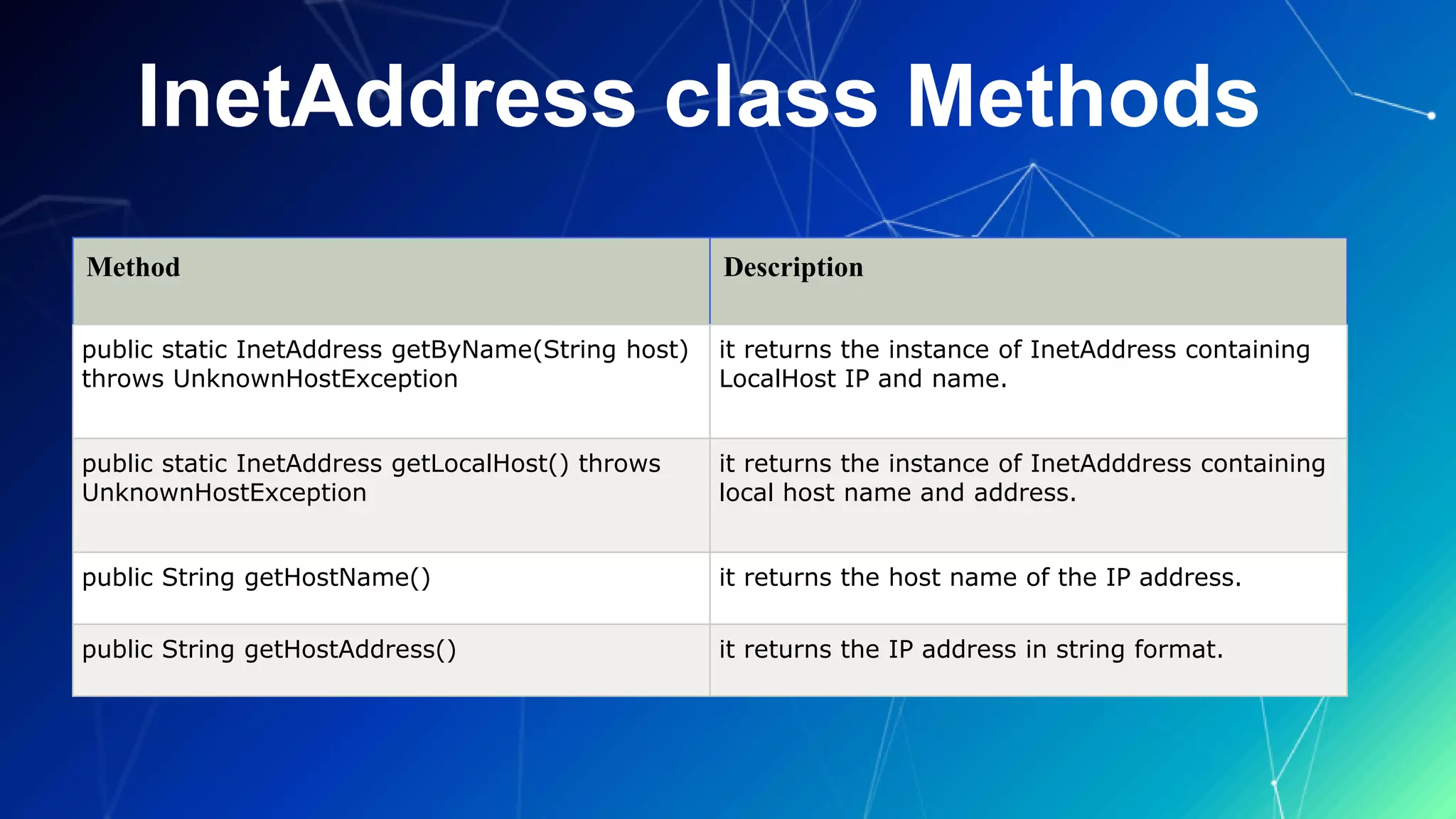
Method Description
public static InetAddress getByName(String host)
throws UnknownHostException
it returns the instance of InetAddress containing
LocalHost IP and name.
public static InetAddress getLocalHost() throws
UnknownHostException
it returns the instance of InetAdddress containing
local host name and address.
public String getHostName() it returns the host name of the IP address.
public String getHostAddress() it returns the IP address in string format.
Thank You

Java

  • 1.
    Introduction of JavaNetworking Mrs.K.Kasthuri
  • 2.
    INTRODUCTION • Java Networkingis a concept of connecting two or more computing devices together. • We can share resources. • Java socket programming provides facility to share data between different computing devices.
  • 3.
    Advantages of JavaNetworking • Sharing resources • Centralize software management
  • 4.
    Java Networking Terminology •IP Address • Protocol • Port Number • MAC Address • Connection-oriented and connection-less protocol • Socket
  • 5.
    IP Address • IPaddress is a unique number assigned to a node of a network e.g. 192.168.0.1. • It is composed of octets that range from 0 to 255. • It is a logical address that can be changed.
  • 6.
    Protocol • A protocolis a set of rules basically that is followed for communication. For example: • TCP • FTP • Telnet • SMTP • POP etc.
  • 7.
    Port Number • Theport number is used to uniquely identify different applications. • It acts as a communication endpoint between applications. • The port number is associated with the IP address for communication between two applications.
  • 8.
    MAC Address • MAC- Media Access Control • Address is a unique identifier of NIC (Network Interface Controller). • A network node can have multiple NIC but each with unique MAC.
  • 9.
    Connection-oriented and connection-less protocol Connection-orientedprotocol acknowledgement is sent by the receiver. So it is reliable but slow. Ex : TCP Connection-less protocol acknowledgement is not sent by the receiver. So it is not reliable but fast. UDP.
  • 10.
    Socket • A socketis an endpoint between two way communication. • It is used for communication between the applications running on different JRE. • Java Socket programming can be connection-oriented or connection- less. • Socket and ServerSocket classes are used for connection-oriented socket programming. • DatagramSocket and DatagramPacket classes are used for connection-less socket programming.
  • 11.
    Java InetAddress class •Java InetAddress class represents an IP address. • InetAddress has a cache mechanism to store successful and unsuccessful host name resolutions. • The java.net.InetAddress class provides methods to get the IP of any host name • EX : www.google.com, www.facebook.com, etc.
  • 12.
    InetAddress class Methods MethodDescription public static InetAddress getByName(String host) throws UnknownHostException it returns the instance of InetAddress containing LocalHost IP and name. public static InetAddress getLocalHost() throws UnknownHostException it returns the instance of InetAdddress containing local host name and address. public String getHostName() it returns the host name of the IP address. public String getHostAddress() it returns the IP address in string format.
  • 13.