CSE-2101 Lectures: 3hours/week
Digital Logic Design Credits: 3
Number systems & codes, Digital logic: Boolean algebra, De-Morgan's
Theorems, logic gates and their truth tables, canonical forms,
combinational logic circuits, minimization technique, Arithmetic and
data handling logic circuits, decoders and encoders, multiplexes and de-
multiplexers, Combinational circuit design, Flip-flops, race around
problems; Counters: asynchronous counters, synchronous counters and
their applications; PLA design; Synchronous and asynchronous logic
design; State diagram, Mealy and Moore machines; State
minimization’s and assignments; Pulse mode logic; Fundamental mode
design.
3.
Outline of Chapter1
1.1 Digital Systems
1.2 Binary Numbers
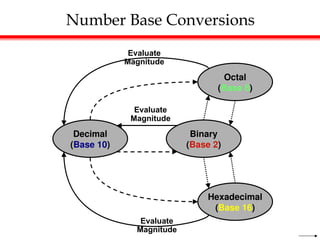
1.3 Number-base Conversions
1.4 Octal and Hexadecimal Numbers
1.5 Complements
1.6 Signed Binary Numbers
1.7 Binary Codes
1.8 Binary Storage and Registers
1.9 Binary Logic
4.
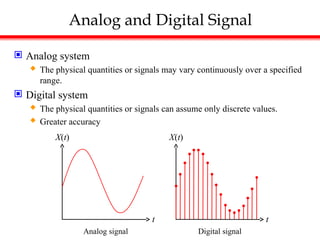
Analog and DigitalSignal
Analog system
The physical quantities or signals may vary continuously over a specified
range.
Digital system
The physical quantities or signals can assume only discrete values.
Greater accuracy
t
X(t)
t
X(t)
Analog signal Digital signal
5.
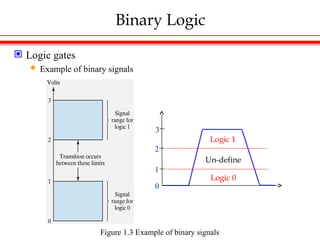
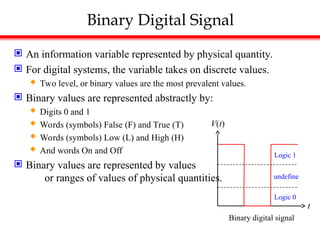
Binary Digital Signal
An information variable represented by physical quantity.
For digital systems, the variable takes on discrete values.
Two level, or binary values are the most prevalent values.
Binary values are represented abstractly by:
Digits 0 and 1
Words (symbols) False (F) and True (T)
Words (symbols) Low (L) and High (H)
And words On and Off
Binary values are represented by values
or ranges of values of physical quantities.
t
V(t)
Binary digital signal
Logic 1
Logic 0
undefine
6.
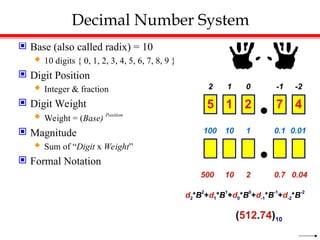
Decimal Number System
Base (also called radix) = 10
10 digits { 0, 1, 2, 3, 4, 5, 6, 7, 8, 9 }
Digit Position
Integer & fraction
Digit Weight
Weight = (Base) Position
Magnitude
Sum of “Digit x Weight”
Formal Notation
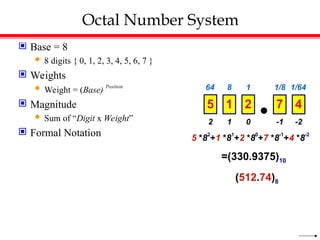
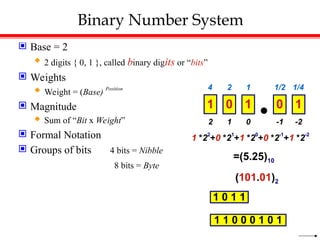
1 0 -1
2 -2
5 1 2 7 4
10 1 0.1
100 0.01
500 10 2 0.7 0.04
d2*B2
+d1*B1
+d0*B0
+d-1*B-1
+d-2*B-2
(512.74)10
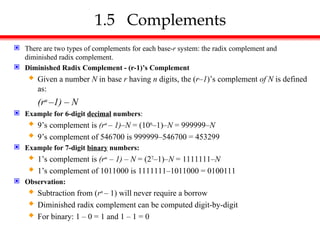
1.5 Complements
Thereare two types of complements for each base-r system: the radix complement and
diminished radix complement.
Diminished Radix Complement - (r-1)’s Complement
Given a number N in base r having n digits, the (r–1)’s complement of N is defined
as:
(rn
–1) – N
Example for 6-digit decimal numbers:
9’s complement is (rn
– 1)–N = (106
–1)–N = 999999–N
9’s complement of 546700 is 999999–546700 = 453299
Example for 7-digit binary numbers:
1’s complement is (rn
– 1) – N = (27
–1)–N = 1111111–N
1’s complement of 1011000 is 1111111–1011000 = 0100111
Observation:
Subtraction from (rn
– 1) will never require a borrow
Diminished radix complement can be computed digit-by-digit
For binary: 1 – 0 = 1 and 1 – 1 = 0
24.
Complements
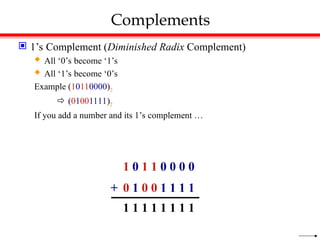
1’s Complement(Diminished Radix Complement)
All ‘0’s become ‘1’s
All ‘1’s become ‘0’s
Example (10110000)2
(01001111)2
If you add a number and its 1’s complement …
1 0 1 1 0 0 0 0
+ 0 1 0 0 1 1 1 1
1 1 1 1 1 1 1 1
25.
Complements
Radix Complement
Example: Base-10
Example: Base-2
The r's complement of an n-digit number N in base r is defined as
rn
– N for N ≠ 0 and as 0 for N = 0. Comparing with the (r 1) 's
complement, we note that the r's complement is obtained by adding 1
to the (r 1) 's complement, since rn
– N = [(rn
1) – N] + 1.
The 10's complement of 012398 is 987602
The 10's complement of 246700 is 753300
The 2's complement of 1101100 is 0010100
The 2's complement of 0110111 is 1001001
26.
Complements
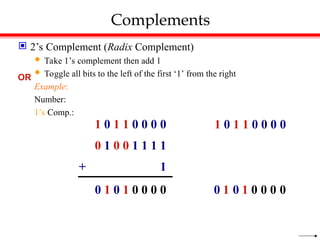
2’s Complement(Radix Complement)
Take 1’s complement then add 1
Toggle all bits to the left of the first ‘1’ from the right
Example:
Number:
1’s Comp.:
0 1 0 1 0 0 0 0
1 0 1 1 0 0 0 0
0 1 0 0 1 1 1 1
+ 1
OR
1 0 1 1 0 0 0 0
0
0
0
0
1
0
1
0
27.
Complements
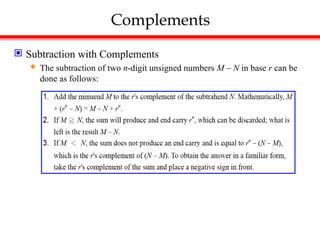
Subtraction withComplements
The subtraction of two n-digit unsigned numbers M – N in base r can be
done as follows:
28.
Complements
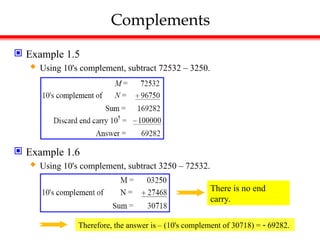
Example 1.5
Using 10's complement, subtract 72532 – 3250.
Example 1.6
Using 10's complement, subtract 3250 – 72532.
There is no end
carry.
Therefore, the answer is – (10's complement of 30718) = 69282.
29.
Complements
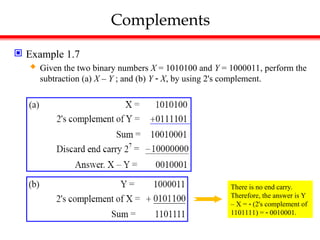
Example 1.7
Given the two binary numbers X = 1010100 and Y = 1000011, perform the
subtraction (a) X – Y ; and (b) Y X, by using 2's complement.
There is no end carry.
Therefore, the answer is Y
– X = (2's complement of
1101111) = 0010001.
30.
Complements
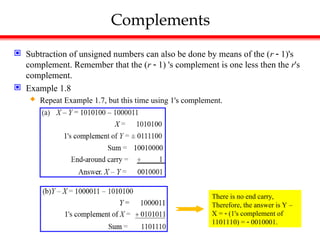
Subtraction ofunsigned numbers can also be done by means of the (r 1)'s
complement. Remember that the (r 1) 's complement is one less then the r's
complement.
Example 1.8
Repeat Example 1.7, but this time using 1's complement.
There is no end carry,
Therefore, the answer is Y –
X = (1's complement of
1101110) = 0010001.
31.
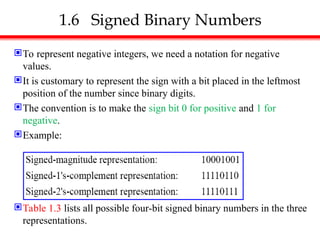
1.6 Signed BinaryNumbers
To represent negative integers, we need a notation for negative
values.
It is customary to represent the sign with a bit placed in the leftmost
position of the number since binary digits.
The convention is to make the sign bit 0 for positive and 1 for
negative.
Example:
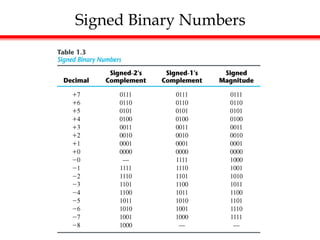
Table 1.3 lists all possible four-bit signed binary numbers in the three
representations.
Signed Binary Numbers
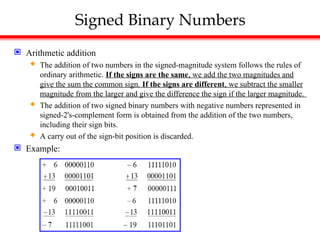
Arithmetic addition
The addition of two numbers in the signed-magnitude system follows the rules of
ordinary arithmetic. If the signs are the same, we add the two magnitudes and
give the sum the common sign. If the signs are different, we subtract the smaller
magnitude from the larger and give the difference the sign if the larger magnitude.
The addition of two signed binary numbers with negative numbers represented in
signed-2's-complement form is obtained from the addition of the two numbers,
including their sign bits.
A carry out of the sign-bit position is discarded.
Example:
34.
Signed Binary Numbers
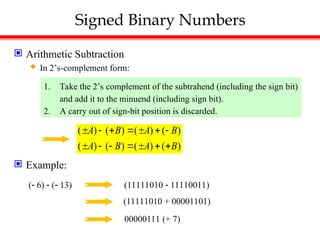
Arithmetic Subtraction
In 2’s-complement form:
Example:
1. Take the 2’s complement of the subtrahend (including the sign bit)
and add it to the minuend (including sign bit).
2. A carry out of sign-bit position is discarded.
( ) ( ) ( ) ( )
( ) ( ) ( ) ( )
A B A B
A B A B
( 6) ( 13) (11111010 11110011)
(11111010 + 00001101)
00000111 (+ 7)
35.
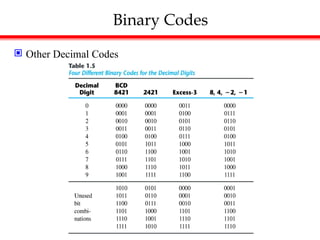
1.7 Binary Codes
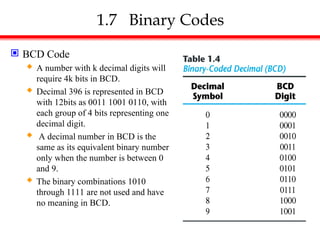
BCD Code
A number with k decimal digits will
require 4k bits in BCD.
Decimal 396 is represented in BCD
with 12bits as 0011 1001 0110, with
each group of 4 bits representing one
decimal digit.
A decimal number in BCD is the
same as its equivalent binary number
only when the number is between 0
and 9.
The binary combinations 1010
through 1111 are not used and have
no meaning in BCD.
36.
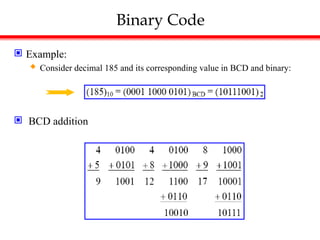
Binary Code
Example:
Consider decimal 185 and its corresponding value in BCD and binary:
BCD addition
37.
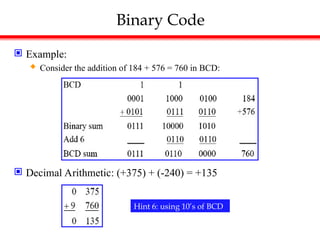
Binary Code
Example:
Consider the addition of 184 + 576 = 760 in BCD:
Decimal Arithmetic: (+375) + (-240) = +135
Hint 6: using 10’s of BCD
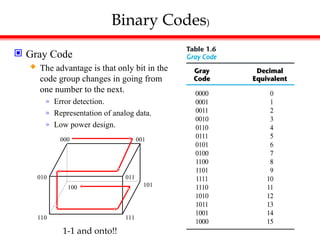
Binary Codes)
GrayCode
The advantage is that only bit in the
code group changes in going from
one number to the next.
» Error detection.
» Representation of analog data.
» Low power design.
000 001
010
100
110 111
101
011
1-1 and onto!!
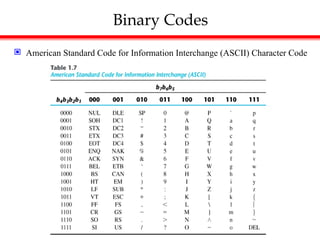
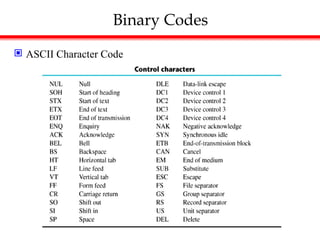
ASCII Character Codes
American Standard Code for Information Interchange (Refer to
Table 1.7)
A popular code used to represent information sent as character-
based data.
It uses 7-bits to represent:
94 Graphic printing characters.
34 Non-printing characters.
Some non-printing characters are used for text format (e.g. BS =
Backspace, CR = carriage return).
Other non-printing characters are used for record marking and
flow control (e.g. STX and ETX start and end text areas).
43.
ASCII Properties
ASCIIhas some interesting properties:
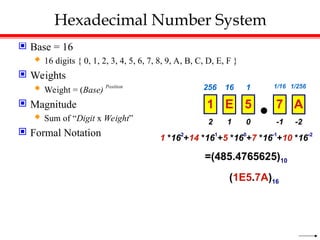
Digits 0 to 9 span Hexadecimal values 3016 to 3916
Upper case A-Z span 4116 to 5A16
Lower case a-z span 6116 to 7A16
» Lower to upper case translation (and vice versa) occurs by flipping bit 6.
44.
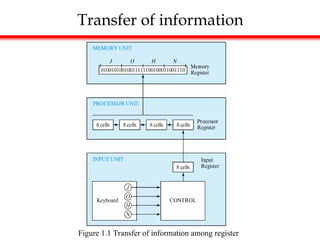
1.8 Binary Storageand Registers
Registers
A binary cell is a device that possesses two stable states and is capable of storing
one of the two states.
A register is a group of binary cells. A register with n cells can store any discrete
quantity of information that contains n bits.
A binary cell
Two stable state
Store one bit of information
Examples: flip-flop circuits, ferrite cores, capacitor
A register
A group of binary cells
AX in x86 CPU
Register Transfer
A transfer of the information stored in one register to another.
One of the major operations in digital system.
An example in next slides.
n cells 2n
possible states
45.
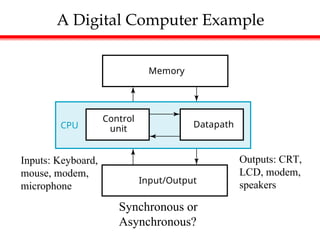
A Digital ComputerExample
Synchronous or
Asynchronous?
Inputs: Keyboard,
mouse, modem,
microphone
Outputs: CRT,
LCD, modem,
speakers
Memory
Control
unit Datapath
Input/Output
CPU
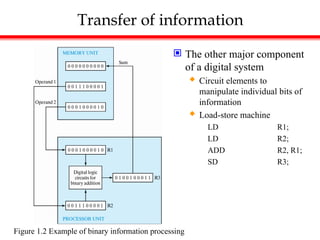
Transfer of information
The other major component
of a digital system
Circuit elements to
manipulate individual bits of
information
Load-store machine
LD R1;
LD R2;
ADD R2, R1;
SD R3;
Figure 1.2 Example of binary information processing
48.
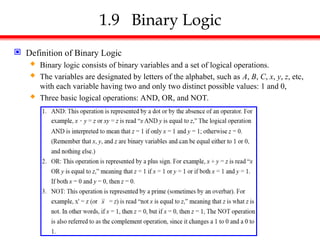
1.9 Binary Logic
Definition of Binary Logic
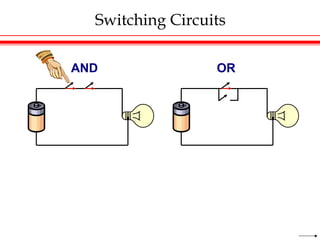
Binary logic consists of binary variables and a set of logical operations.
The variables are designated by letters of the alphabet, such as A, B, C, x, y, z, etc,
with each variable having two and only two distinct possible values: 1 and 0,
Three basic logical operations: AND, OR, and NOT.
49.
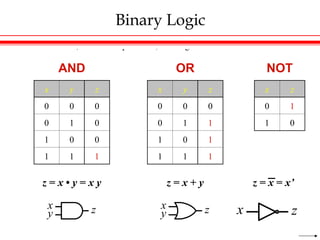
Binary Logic
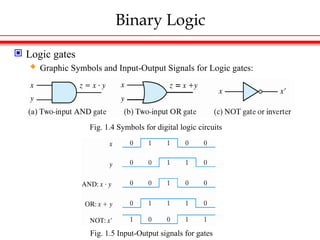
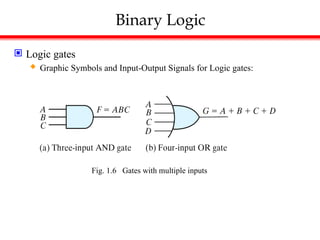
TruthTables, Boolean Expressions, and Logic Gates
x y z
0 0 0
0 1 0
1 0 0
1 1 1
x y z
0 0 0
0 1 1
1 0 1
1 1 1
x z
0 1
1 0
AND OR NOT
x
y z x
y z
z = x • y = x y z = x + y z = x = x’
x z

![Complements
Radix Complement
Example: Base-10
Example: Base-2
The r's complement of an n-digit number N in base r is defined as
rn
– N for N ≠ 0 and as 0 for N = 0. Comparing with the (r 1) 's
complement, we note that the r's complement is obtained by adding 1
to the (r 1) 's complement, since rn
– N = [(rn
1) – N] + 1.
The 10's complement of 012398 is 987602
The 10's complement of 246700 is 753300
The 2's complement of 1101100 is 0010100
The 2's complement of 0110111 is 1001001](https://image.slidesharecdn.com/bdch1-251208100956-744da0d9/85/Digital-Electronics-Basics-Number-Systems-and-Conversions-25-320.jpg)