CSE20 Lecture 3
Number Systems: Negative Numbers
1. Sign and Magnitude Representation
2. 1’s Complement Representation
3. 2’s Complement Representation
1
CK Cheng, UC San Diego
2
Outlines
1.Goal of the Negative Number
Systems
2.Definition
1.Sign Magnitude Rep.
2.1’s Complement Rep.
3.2.s Complement Rep.
3.Arithmetic Operations
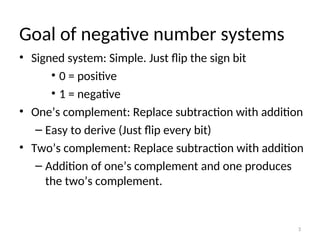
Goal of negative number systems
• Signed system: Simple. Just flip the sign bit
• 0 = positive
• 1 = negative
• One’s complement: Replace subtraction with addition
– Easy to derive (Just flip every bit)
• Two’s complement: Replace subtraction with addition
– Addition of one’s complement and one produces
the two’s complement.
3
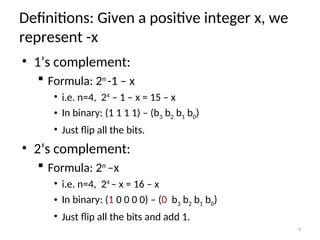
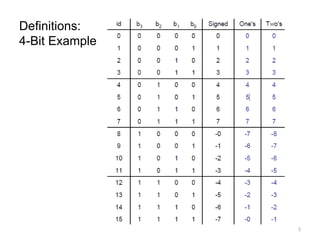
Definitions: Given a positive integer x, we
represent -x
• 1’s complement:
 Formula: 2n
-1 – x
• i.e. n=4, 24
– 1 – x = 15 – x
• In binary: (1 1 1 1) – (b3 b2 b1 b0)
• Just flip all the bits.
• 2’s complement:
 Formula: 2n
–x
• i.e. n=4, 24
– x = 16 – x
• In binary: (1 0 0 0 0) – (0 b3 b2 b1 b0)
• Just flip all the bits and add 1.
4
5
Definitions:
4-Bit Example
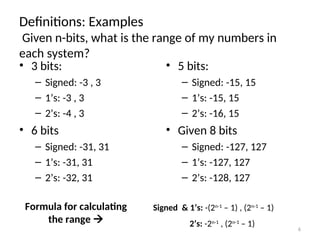
Definitions: Examples
Given n-bits, what is the range of my numbers in
each system?
• 3 bits:
– Signed: -3 , 3
– 1’s: -3 , 3
– 2’s: -4 , 3
• 6 bits
– Signed: -31, 31
– 1’s: -31, 31
– 2’s: -32, 31
• 5 bits:
– Signed: -15, 15
– 1’s: -15, 15
– 2’s: -16, 15
• Given 8 bits
– Signed: -127, 127
– 1’s: -127, 127
– 2’s: -128, 127
Formula for calculating
the range 
Signed & 1’s: -(2n-1
– 1) , (2n-1
– 1)
2’s: -2n-1
, (2n-1
– 1) 6
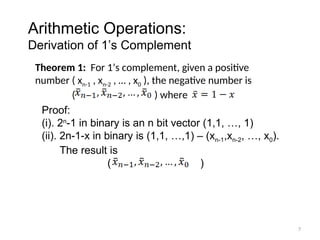
Theorem 1: For 1’s complement, given a positive
number ( xn-1 , xn-2 , … , x0 ), the negative number is
( ) where
7
Arithmetic Operations:
Derivation of 1’s Complement
Proof:
(i). 2n
-1 in binary is an n bit vector (1,1, …, 1)
(ii). 2n-1-x in binary is (1,1, …,1) – (xn-1,xn-2, …, x0).
The result is
( )
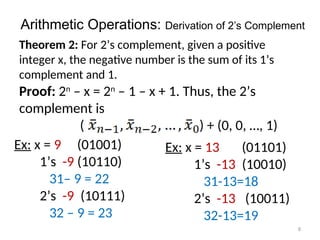
Theorem 2: For 2’s complement, given a positive
integer x, the negative number is the sum of its 1’s
complement and 1.
Proof: 2n
– x = 2n
– 1 – x + 1. Thus, the 2’s
complement is
( ) + (0, 0, …, 1)
Ex: x = 9 (01001)
1’s -9 (10110)
31– 9 = 22
2’s -9 (10111)
32 – 9 = 23
Ex: x = 13 (01101)
1’s -13 (10010)
31-13=18
2’s -13 (10011)
32-13=19
8
Arithmetic Operations: Derivation of 2’s Complement
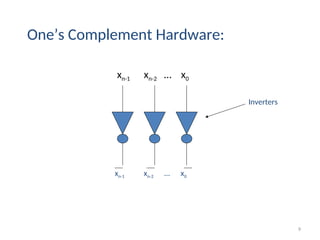
xn-1 xn-2 … x0
xn-1 xn-2 … x0
Inverters
One’s Complement Hardware:
9
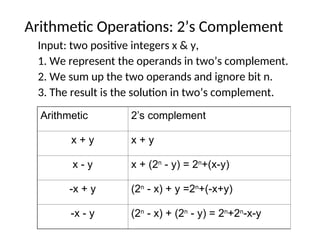
Arithmetic Operations: 2’s Complement
Input: two positive integers x & y,
1. We represent the operands in two’s complement.
2. We sum up the two operands and ignore bit n.
3. The result is the solution in two’s complement.
Arithmetic 2’s complement
x + y x + y
x - y x + (2n
- y) = 2n
+(x-y)
-x + y (2n
- x) + y =2n
+(-x+y)
-x - y (2n
- x) + (2n
- y) = 2n
+2n
-x-y
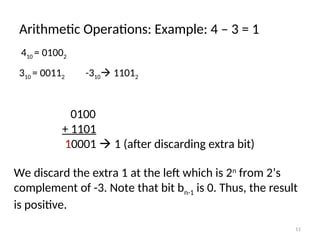
Arithmetic Operations: Example: 4 – 3 = 1
0100
+ 1101
10001  1 (after discarding extra bit)
410 = 01002
310 = 00112 -310 11012
We discard the extra 1 at the left which is 2n
from 2’s
complement of -3. Note that bit bn-1 is 0. Thus, the result
is positive.
11
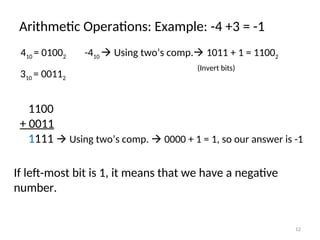
Arithmetic Operations: Example: -4 +3 = -1
1100
+ 0011
1111  Using two’s comp.  0000 + 1 = 1, so our answer is -1
410 = 01002 -410  Using two’s comp. 1011 + 1 = 11002
(Invert bits)
310 = 00112
If left-most bit is 1, it means that we have a negative
number.
12
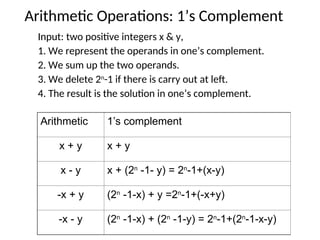
Arithmetic Operations: 1’s Complement
Input: two positive integers x & y,
1. We represent the operands in one’s complement.
2. We sum up the two operands.
3. We delete 2n
-1 if there is carry out at left.
4. The result is the solution in one’s complement.
Arithmetic 1’s complement
x + y x + y
x - y x + (2n
-1- y) = 2n
-1+(x-y)
-x + y (2n
-1-x) + y =2n
-1+(-x+y)
-x - y (2n
-1-x) + (2n
-1-y) = 2n
-1+(2n
-1-x-y)
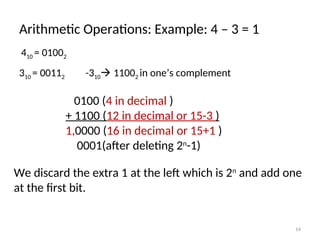
Arithmetic Operations: Example: 4 – 3 = 1
0100 (4 in decimal )
+ 1100 (12 in decimal or 15-3 )
1,0000 (16 in decimal or 15+1 )
0001(after deleting 2n
-1)
410 = 01002
310 = 00112 -310 11002 in one’s complement
We discard the extra 1 at the left which is 2n
and add one
at the first bit.
14
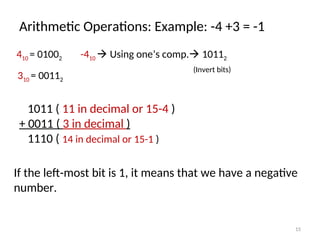
Arithmetic Operations: Example: -4 +3 = -1
1011 ( 11 in decimal or 15-4 )
+ 0011 ( 3 in decimal )
1110 ( 14 in decimal or 15-1 )
410 = 01002 -410  Using one’s comp. 10112
(Invert bits)
310 = 00112
If the left-most bit is 1, it means that we have a negative
number.
15
16
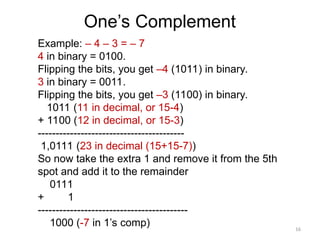
Example: – 4 – 3 = – 7
4 in binary = 0100.
Flipping the bits, you get –4 (1011) in binary.
3 in binary = 0011.
Flipping the bits, you get –3 (1100) in binary.
1011 (11 in decimal, or 15-4)
+ 1100 (12 in decimal, or 15-3)
-----------------------------------------
1,0111 (23 in decimal (15+15-7))
So now take the extra 1 and remove it from the 5th
spot and add it to the remainder
0111
+ 1
------------------------------------------
1000 (-7 in 1’s comp)
One’s Complement
17
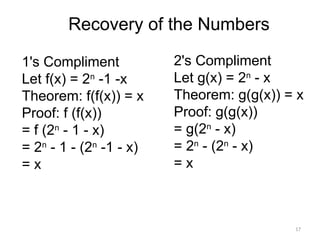
1's Compliment
Let f(x) = 2n
-1 -x
Theorem: f(f(x)) = x
Proof: f (f(x))
= f (2n
- 1 - x)
= 2n
- 1 - (2n
-1 - x)
= x
Recovery of the Numbers
2's Compliment
Let g(x) = 2n
- x
Theorem: g(g(x)) = x
Proof: g(g(x))
= g(2n
- x)
= 2n
- (2n
- x)
= x

สอนสนอนlec3สอนสนอนlec3สอนสนอนlec3สอนสนอนlec3สอนสนอนlec3

  • 1.
    CSE20 Lecture 3 NumberSystems: Negative Numbers 1. Sign and Magnitude Representation 2. 1’s Complement Representation 3. 2’s Complement Representation 1 CK Cheng, UC San Diego
  • 2.
    2 Outlines 1.Goal of theNegative Number Systems 2.Definition 1.Sign Magnitude Rep. 2.1’s Complement Rep. 3.2.s Complement Rep. 3.Arithmetic Operations
  • 3.
    Goal of negativenumber systems • Signed system: Simple. Just flip the sign bit • 0 = positive • 1 = negative • One’s complement: Replace subtraction with addition – Easy to derive (Just flip every bit) • Two’s complement: Replace subtraction with addition – Addition of one’s complement and one produces the two’s complement. 3
  • 4.
    Definitions: Given apositive integer x, we represent -x • 1’s complement:  Formula: 2n -1 – x • i.e. n=4, 24 – 1 – x = 15 – x • In binary: (1 1 1 1) – (b3 b2 b1 b0) • Just flip all the bits. • 2’s complement:  Formula: 2n –x • i.e. n=4, 24 – x = 16 – x • In binary: (1 0 0 0 0) – (0 b3 b2 b1 b0) • Just flip all the bits and add 1. 4
  • 5.
  • 6.
    Definitions: Examples Given n-bits,what is the range of my numbers in each system? • 3 bits: – Signed: -3 , 3 – 1’s: -3 , 3 – 2’s: -4 , 3 • 6 bits – Signed: -31, 31 – 1’s: -31, 31 – 2’s: -32, 31 • 5 bits: – Signed: -15, 15 – 1’s: -15, 15 – 2’s: -16, 15 • Given 8 bits – Signed: -127, 127 – 1’s: -127, 127 – 2’s: -128, 127 Formula for calculating the range  Signed & 1’s: -(2n-1 – 1) , (2n-1 – 1) 2’s: -2n-1 , (2n-1 – 1) 6
  • 7.
    Theorem 1: For1’s complement, given a positive number ( xn-1 , xn-2 , … , x0 ), the negative number is ( ) where 7 Arithmetic Operations: Derivation of 1’s Complement Proof: (i). 2n -1 in binary is an n bit vector (1,1, …, 1) (ii). 2n-1-x in binary is (1,1, …,1) – (xn-1,xn-2, …, x0). The result is ( )
  • 8.
    Theorem 2: For2’s complement, given a positive integer x, the negative number is the sum of its 1’s complement and 1. Proof: 2n – x = 2n – 1 – x + 1. Thus, the 2’s complement is ( ) + (0, 0, …, 1) Ex: x = 9 (01001) 1’s -9 (10110) 31– 9 = 22 2’s -9 (10111) 32 – 9 = 23 Ex: x = 13 (01101) 1’s -13 (10010) 31-13=18 2’s -13 (10011) 32-13=19 8 Arithmetic Operations: Derivation of 2’s Complement
  • 9.
    xn-1 xn-2 …x0 xn-1 xn-2 … x0 Inverters One’s Complement Hardware: 9
  • 10.
    Arithmetic Operations: 2’sComplement Input: two positive integers x & y, 1. We represent the operands in two’s complement. 2. We sum up the two operands and ignore bit n. 3. The result is the solution in two’s complement. Arithmetic 2’s complement x + y x + y x - y x + (2n - y) = 2n +(x-y) -x + y (2n - x) + y =2n +(-x+y) -x - y (2n - x) + (2n - y) = 2n +2n -x-y
  • 11.
    Arithmetic Operations: Example:4 – 3 = 1 0100 + 1101 10001  1 (after discarding extra bit) 410 = 01002 310 = 00112 -310 11012 We discard the extra 1 at the left which is 2n from 2’s complement of -3. Note that bit bn-1 is 0. Thus, the result is positive. 11
  • 12.
    Arithmetic Operations: Example:-4 +3 = -1 1100 + 0011 1111  Using two’s comp.  0000 + 1 = 1, so our answer is -1 410 = 01002 -410  Using two’s comp. 1011 + 1 = 11002 (Invert bits) 310 = 00112 If left-most bit is 1, it means that we have a negative number. 12
  • 13.
    Arithmetic Operations: 1’sComplement Input: two positive integers x & y, 1. We represent the operands in one’s complement. 2. We sum up the two operands. 3. We delete 2n -1 if there is carry out at left. 4. The result is the solution in one’s complement. Arithmetic 1’s complement x + y x + y x - y x + (2n -1- y) = 2n -1+(x-y) -x + y (2n -1-x) + y =2n -1+(-x+y) -x - y (2n -1-x) + (2n -1-y) = 2n -1+(2n -1-x-y)
  • 14.
    Arithmetic Operations: Example:4 – 3 = 1 0100 (4 in decimal ) + 1100 (12 in decimal or 15-3 ) 1,0000 (16 in decimal or 15+1 ) 0001(after deleting 2n -1) 410 = 01002 310 = 00112 -310 11002 in one’s complement We discard the extra 1 at the left which is 2n and add one at the first bit. 14
  • 15.
    Arithmetic Operations: Example:-4 +3 = -1 1011 ( 11 in decimal or 15-4 ) + 0011 ( 3 in decimal ) 1110 ( 14 in decimal or 15-1 ) 410 = 01002 -410  Using one’s comp. 10112 (Invert bits) 310 = 00112 If the left-most bit is 1, it means that we have a negative number. 15
  • 16.
    16 Example: – 4– 3 = – 7 4 in binary = 0100. Flipping the bits, you get –4 (1011) in binary. 3 in binary = 0011. Flipping the bits, you get –3 (1100) in binary. 1011 (11 in decimal, or 15-4) + 1100 (12 in decimal, or 15-3) ----------------------------------------- 1,0111 (23 in decimal (15+15-7)) So now take the extra 1 and remove it from the 5th spot and add it to the remainder 0111 + 1 ------------------------------------------ 1000 (-7 in 1’s comp) One’s Complement
  • 17.
    17 1's Compliment Let f(x)= 2n -1 -x Theorem: f(f(x)) = x Proof: f (f(x)) = f (2n - 1 - x) = 2n - 1 - (2n -1 - x) = x Recovery of the Numbers 2's Compliment Let g(x) = 2n - x Theorem: g(g(x)) = x Proof: g(g(x)) = g(2n - x) = 2n - (2n - x) = x