Radioactivity and Atomic nucleus
Dr. Moumita Roy, Assistant Professor,
Department of Chemistry
Ramsaday College, Amta, Howrah 711 401
Definitions
The Discovery of Radioactivity
Wilhelm Roentgen (1845–1923)
• Invisible rays were emitted when electrons bombarded the
surface of certain materials which caused darkening of
photographic plates (named as X-Ray).
Henri Becquerel (1852–1908)
• minerals like uranium salts produced spontaneous emissions
being exposed to sunlight which darkened photographic
plates.
Marie Curie (1867–1934) and Pierre Curie(1859–1906)
• Isolated the components emitting the rays from Becquerel’s
mineral sample (called pitchblende) and proved that uranium
atoms present in the mineral sample is responsible for the
phenomenon.
The Discovery of Radioactivity
Marie Curie named the process by which
materials give off such rays radioactivity
& the rays and particles emitted by a
radioactive source are called radiation.
Three types of radiation were known:
• Alpha particles (α)
• Beta particles (β)
• Gamma-rays (γ)
Alpha particles
Alpha particles
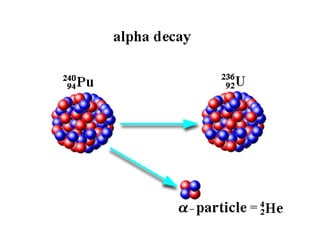
Alpha particles are made of 2 protons and 2
neutrons i.e. they have a charge of +2, and a
mass of 4
We can write them as , they're the same as
a helium nucleus
Alpha particles are relatively slow and heavy.
They have a low penetrating power
As they have a large charge, alpha particles
ionize other atoms strongly
Beta particles
Beta particles
Beta particles have a charge of minus 1, and a
mass of about 1/2000th of a proton. This
means that beta particles are the same as an
electron
We can write them as
They are fast, and light
Beta particles have a medium penetrating
power
Beta particles ionize atoms that they pass,
but not as strongly as alpha particles do
beta decay
beta decay
Gamma rays
Gamma rays
Gamma rays are waves, not particles
They have no mass and no charge
We can write them as
Gamma rays have a high penetrating power
Gamma rays do not directly ionize other
atoms
Changes due to different types of
emission
emission
Stability of atomic nucleus
The strong nuclear force (short range, effective within nuclus)
keeps the nucleons packed together even though protons
want to push each other away
Stable atoms have a neutron to proton ratio of about 1:1
1:1
As atomic number increases, more neutrons are required to
have enough of a strong force to keep the protons pushed
together
The neutron to proton ratio for stable atoms increases to
1.5:1
1.5:1
Isotopes are outside the band of stability will undergo nuclear
reactions to become more stable
Band of Stability
Band of Stability
• When the number of
protons and neutrons are
plotted, the stable nuclei are
found within the “band of
stability”
• Radioactive isotopes are
outside the band of stability
– They will undergo nuclear
reactions to become more
stable
– All elements higher than
atomic no. 83 are radioactive
Nuclear Forces
Nuclear Forces
short range, spin-orbital character
based on meson (π) exchange of π0, π+, and π–
Nuclear models
Nuclear models
Nuclear stability was explained using various models, such as :
Liquid drop Model:
first proposed by George Gamow and developed by Niels Bohr
and John Archibald Wheeler
Shell Model
First proposed by Dmitry Ivanenko in 1932 and developed by
Eugene P. Wigner, Maria G. Mayer and others
Liquid Drop Model
Liquid Drop Model
• One of the first models which could describe very well the
behavior of the nuclear binding energies
• According to this model, the atomic nucleus behaves like the
molecules in a drop of liquid
• nucleons (protons and neutrons), which are held together
by the strong nuclear force
• nuclear forces on the nucleons on the surface are different
from those on nucleons in the interior of the nucleus
• If the sufficient kinetic or binding energy is added, this
spherical nucleus may be distorted into a dumbbell shape and
then may be splitted into two fragments
Liquid Drop Model
Liquid Drop Model
Fact supporting this model:
Nuclear fission reaction of
heavy nuclei by addition of
little energy
little energy
Demerits of this model:
Failed to explain extra
Stability of certain nuclei
Shell Model
Shell Model
According to this model nucleons are thought to be
arranged in shells corresponding to different energy
levels
Explains why the elements with even atomic
numbers are more stable as well as more abundant
than elements with odd atomic numbers
Extraordinary stability of nuclei with no. of neutrons
& protons such as 2,8,20,28,50,82,126 (magic
numbers)
Nuclear decay and half
Nuclear decay and half-
-life
life
Nuclear decay and half
Nuclear decay and half-
-life
life
Derivation of half-life equation:
N = No of atoms present; ΔN no. of atoms disintegrating in Δt time & λ = decay constant
Decay eq.
Or
Or N0 =No. of atoms at time t0
Or
Or At t = t1/2 = half-life N = N0/2
The equation becomes Or
Atom Half-life
Polonium-194 0.7 seconds
Lead-212 10.6 hours
Iodine-131 8.04 days
Carbon-14 5370 years
Uranium-238 4.5 billion years
Natural Radioactivity
Nuclear reactions which occur spontaneously are said to be an
example of natural radioactivity.
There are three naturally occurring radioactive series among the
elements in the periodic table.
These are known as the uranium series, the actinium series and
the thorium series, each named after the element at which
the series start (except the actinium series which starts with a
different uranium isotope).
Each series decays through a number of unstable nuclei by
means of alpha
alpha and
and beta
beta emission
emission, until each series end on a
different stable isotope of lead.
Artificial Radioactivity
Not all nuclear reactions are spontaneous.
These reactions occur when stable isotopes are bombarded with
particles such as neutrons.
This method of inducing a nuclear reaction to proceed is termed
artificial radioactivity.
This meant new nuclear reactions, which wouldn't have been
viewed spontaneously, could now be observed.
Since about 1940, a set of new elements with atomic numbers
over 92 (the atomic number of the heaviest naturally
occurring Uranium) have been artificially made. They are
called the trans-uranium elements.
Spallation
Spallation
Spallation
Spallation is the process in which a heavy nucleus emits
numerous nucleons as a result of being hit by a high-energy particle,
thus greatly reducing its atomic weight
Nuclear energy & power generation
A. Fission reactor
Nuclear energy & power generation
Fission vs. Fusion reactor
Radio
Radio-
-chemical methods
chemical methods
RADIOMETRIC DATING METHODS
1. URANIUM-LEAD
2. POTASSIUM ARGON
3. RUBIDIUM STRONTIUM
4. CARBON DATING
URANIUM
URANIUM –
– LEAD DATING METHOD
LEAD DATING METHOD
• Uranium- Lead dating is one of the oldest and if done properly one of the most
accurate.
• Uranium comes as two common isotopes; U235 and U238.
• Both are unstable and radioactive, shedding nuclear particles in a cascade that
doesn't stop until they become lead (Pb).
• The two cascades are different—U235becomes Pb207(half life-704 million
years) and U238 becomes Pb206 (half life- 4.47 billion years).
• Lead atoms created by uranium decay are trapped in the crystal and build up
in concentration with time; helping us in dating.
• Uranium- lead dating works only for metamorphic and igneous rocks.
POTASSIUM ARGON METHOD
• The potassium-argon (K-Ar) isotopic dating method is especially useful for
determining the age of lavas.
• Potassium has one radioactive isotope (40K).
• Potassium-40 decays with a half-life of 1250 million years.
• What simplifies things is that potassium is a reactive metal and argon is an
inert gas.
• The mineral Sanidine, the high-temperature form of Potassium Feldspar, is the
most desirable.
• Meteoric and volcanic rocks have been analysed by this method.
RUBIDIUM
RUBIDIUM-
- STRONTIUM METHOD
STRONTIUM METHOD
• The utility of Rubidium Strontium isotope system results from the
fact that 87Rb (one of the isotopes of Rubidium) decays to 87Sr with a
half-life of 49 billion years.
• The method is applicable to very old rocks because the
transformation is extremely slow: the half-life, or time required for half
the initial quantity of rubidium-87 to disappear; is approximately 50
billion years.
• It is used to date igneous and metamorphic rocks.
CARBON DATING
CARBON DATING
• Carbon dating is a variety of radioactive dating; applicable only to
matter which was once living.
• Neutron produced by cosmic ray bombardment produces
radioactive isotope Carbon-14
• Carbon-14 decays with a half-life of about 5730 years by the
emission of an electron, disintegrating to nitrogen 14.
• Carbon dating only works on fossils that used to be alive. One can
not carbon date a rock or sedimentary layer.
CARBON DATING
CARBON DATING
• The ratio of 14C to 12C in the atmosphere has been roughly
constant over thousands of years. A living plant or tree will be
constantly exchanging carbon with the atmosphere, and will have
the same carbon ratio in its tissues.
• When the plant dies, this exchange stops. 14C has a half-life of
about 5730 years; it gradually decays away and becomes a smaller
and smaller fraction of the total carbon in the plant tissue. This
fraction can be measured, and tissue age deduced.
•Objects older than about 60,000 years cannot be dated this way –
there is too little 14C left.
Radiation Hazards
Radiation Hazards
• All nuclear radiations are harmful to living cells,
sometimes cause mutations also.
• Exposure to very high levels of radiation can cause
acute health effects such as skin burns and
acute radiation syndrome .
• It can also result in long-term health effects such as
cancer and cardiovascular disease etc.
• Proper safety measures should be taken while
exposing to radiation by reduction of dose, time,
distance etc.
Writing Nuclear Equations
Nuclear Equations:
Nuclear Equations:
212Po decays by alpha emission. Write the balanced
nuclear equation for the decay of 212
84Po.
Alpha particle = 4
2He
Nuclear Equations:
Nuclear Equations:
212
84Po 4
2He + A
Z X
212 = 4 + A A = 208
84 = 2 + Z Z = 82
212
84Po 4
2He + 208
82 Pb
Write the nuclear equation for the beta emitter 60
27Co
beta particle = 0
-1e
Nuclear Equations:
Nuclear Equations:
60
27Co 0
-1e + A
Z X
60= 0 + A A = 60
27 = Z - 1 Z = 28
60
27Co 0
-1e + 60
28 Ni
Numerical Problems
Numerical Problems
Q.1. Calculate the binding energy of lithium nucleus (3Li7) given
that:
Mass of p = 1.00814 a.m.u., mass of n = 1.00893 a.m. u.
Mass of lithium nucleus : 7.01822 a.m.u.
Q.2. Calculate the binding energy per nuceon of oxygen atom
8O16 ,Given that mass of 8O16 =15.994910 a.m.u. & mass of
proton = 1.007277a.m.u. & mass of electron = 0.0005486
a.m.u.
Q.3. If 25% of a radioactive element remains after 60 min.
Calculate λ & t1/2 of that element.
Numerical Problems
Numerical Problems
Q.4. Half Life of a radio element is 53,300 sec. show that the
time required o reach 1/10 of initial activity will be 2952 min.
Q.6. At a certain time decay rate of a radio isotope is 9500 d.p.m.
After 1h it becomes 8050 d.p.m. Calculate t of the isotope.
After 1h it becomes 8050 d.p.m. Calculate t1/2 of the isotope.
Q.7. Determine the age of a pitchblende ore in which75% of U238
15% of Pb206 but Pb204 is completely absent (Given t1/2 of U238
= 4.51 x 10² yrs.)

Rdioactivity -ppt-MR.pdf

  • 1.
    Radioactivity and Atomicnucleus Dr. Moumita Roy, Assistant Professor, Department of Chemistry Ramsaday College, Amta, Howrah 711 401
  • 5.
  • 6.
    The Discovery ofRadioactivity Wilhelm Roentgen (1845–1923) • Invisible rays were emitted when electrons bombarded the surface of certain materials which caused darkening of photographic plates (named as X-Ray). Henri Becquerel (1852–1908) • minerals like uranium salts produced spontaneous emissions • minerals like uranium salts produced spontaneous emissions being exposed to sunlight which darkened photographic plates. Marie Curie (1867–1934) and Pierre Curie(1859–1906) • Isolated the components emitting the rays from Becquerel’s mineral sample (called pitchblende) and proved that uranium atoms present in the mineral sample is responsible for the phenomenon.
  • 7.
    The Discovery ofRadioactivity Marie Curie named the process by which materials give off such rays radioactivity & the rays and particles emitted by a radioactive source are called radiation. radioactive source are called radiation. Three types of radiation were known: • Alpha particles (α) • Beta particles (β) • Gamma-rays (γ)
  • 8.
    Alpha particles Alpha particles Alphaparticles are made of 2 protons and 2 neutrons i.e. they have a charge of +2, and a mass of 4 We can write them as , they're the same as We can write them as , they're the same as a helium nucleus Alpha particles are relatively slow and heavy. They have a low penetrating power As they have a large charge, alpha particles ionize other atoms strongly
  • 10.
    Beta particles Beta particles Betaparticles have a charge of minus 1, and a mass of about 1/2000th of a proton. This means that beta particles are the same as an electron We can write them as They are fast, and light They are fast, and light Beta particles have a medium penetrating power Beta particles ionize atoms that they pass, but not as strongly as alpha particles do
  • 11.
  • 12.
    Gamma rays Gamma rays Gammarays are waves, not particles They have no mass and no charge We can write them as Gamma rays have a high penetrating power Gamma rays have a high penetrating power Gamma rays do not directly ionize other atoms
  • 13.
    Changes due todifferent types of Changes due to different types of emission emission
  • 14.
    Stability of atomicnucleus Stability of atomic nucleus The strong nuclear force (short range, effective within nuclus) keeps the nucleons packed together even though protons want to push each other away Stable atoms have a neutron to proton ratio of about 1:1 1:1 As atomic number increases, more neutrons are required to As atomic number increases, more neutrons are required to have enough of a strong force to keep the protons pushed together The neutron to proton ratio for stable atoms increases to 1.5:1 1.5:1 Isotopes are outside the band of stability will undergo nuclear reactions to become more stable
  • 15.
    Band of Stability Bandof Stability • When the number of protons and neutrons are plotted, the stable nuclei are found within the “band of stability” • Radioactive isotopes are • Radioactive isotopes are outside the band of stability – They will undergo nuclear reactions to become more stable – All elements higher than atomic no. 83 are radioactive
  • 16.
    Nuclear Forces Nuclear Forces shortrange, spin-orbital character based on meson (π) exchange of π0, π+, and π–
  • 17.
    Nuclear models Nuclear models Nuclearstability was explained using various models, such as : Liquid drop Model: first proposed by George Gamow and developed by Niels Bohr and John Archibald Wheeler and John Archibald Wheeler Shell Model First proposed by Dmitry Ivanenko in 1932 and developed by Eugene P. Wigner, Maria G. Mayer and others
  • 18.
    Liquid Drop Model LiquidDrop Model • One of the first models which could describe very well the behavior of the nuclear binding energies • According to this model, the atomic nucleus behaves like the molecules in a drop of liquid molecules in a drop of liquid • nucleons (protons and neutrons), which are held together by the strong nuclear force • nuclear forces on the nucleons on the surface are different from those on nucleons in the interior of the nucleus • If the sufficient kinetic or binding energy is added, this spherical nucleus may be distorted into a dumbbell shape and then may be splitted into two fragments
  • 19.
    Liquid Drop Model LiquidDrop Model Fact supporting this model: Nuclear fission reaction of heavy nuclei by addition of little energy little energy Demerits of this model: Failed to explain extra Stability of certain nuclei
  • 20.
    Shell Model Shell Model Accordingto this model nucleons are thought to be arranged in shells corresponding to different energy levels Explains why the elements with even atomic Explains why the elements with even atomic numbers are more stable as well as more abundant than elements with odd atomic numbers Extraordinary stability of nuclei with no. of neutrons & protons such as 2,8,20,28,50,82,126 (magic numbers)
  • 21.
    Nuclear decay andhalf Nuclear decay and half- -life life
  • 22.
    Nuclear decay andhalf Nuclear decay and half- -life life Derivation of half-life equation: N = No of atoms present; ΔN no. of atoms disintegrating in Δt time & λ = decay constant Decay eq. Or Or N0 =No. of atoms at time t0 Or N0 =No. of atoms at time t0 Or Or At t = t1/2 = half-life N = N0/2 The equation becomes Or
  • 23.
    Atom Half-life Polonium-194 0.7seconds Lead-212 10.6 hours Iodine-131 8.04 days Carbon-14 5370 years Uranium-238 4.5 billion years
  • 25.
    Natural Radioactivity Natural Radioactivity Nuclearreactions which occur spontaneously are said to be an example of natural radioactivity. There are three naturally occurring radioactive series among the elements in the periodic table. These are known as the uranium series, the actinium series and These are known as the uranium series, the actinium series and the thorium series, each named after the element at which the series start (except the actinium series which starts with a different uranium isotope). Each series decays through a number of unstable nuclei by means of alpha alpha and and beta beta emission emission, until each series end on a different stable isotope of lead.
  • 26.
    Artificial Radioactivity Artificial Radioactivity Notall nuclear reactions are spontaneous. These reactions occur when stable isotopes are bombarded with particles such as neutrons. This method of inducing a nuclear reaction to proceed is termed artificial radioactivity. artificial radioactivity. This meant new nuclear reactions, which wouldn't have been viewed spontaneously, could now be observed. Since about 1940, a set of new elements with atomic numbers over 92 (the atomic number of the heaviest naturally occurring Uranium) have been artificially made. They are called the trans-uranium elements.
  • 30.
    Spallation Spallation Spallation Spallation is theprocess in which a heavy nucleus emits numerous nucleons as a result of being hit by a high-energy particle, thus greatly reducing its atomic weight
  • 31.
    Nuclear energy &power generation Nuclear energy & power generation A. Fission reactor
  • 32.
    Nuclear energy &power generation Nuclear energy & power generation
  • 33.
    Nuclear energy &power generation Nuclear energy & power generation Fission vs. Fusion reactor
  • 34.
    Radio Radio- -chemical methods chemical methods RADIOMETRICDATING METHODS 1. URANIUM-LEAD 2. POTASSIUM ARGON 3. RUBIDIUM STRONTIUM 4. CARBON DATING
  • 35.
    URANIUM URANIUM – – LEADDATING METHOD LEAD DATING METHOD • Uranium- Lead dating is one of the oldest and if done properly one of the most accurate. • Uranium comes as two common isotopes; U235 and U238. • Both are unstable and radioactive, shedding nuclear particles in a cascade that doesn't stop until they become lead (Pb). doesn't stop until they become lead (Pb). • The two cascades are different—U235becomes Pb207(half life-704 million years) and U238 becomes Pb206 (half life- 4.47 billion years). • Lead atoms created by uranium decay are trapped in the crystal and build up in concentration with time; helping us in dating. • Uranium- lead dating works only for metamorphic and igneous rocks.
  • 36.
    POTASSIUM ARGON METHOD POTASSIUMARGON METHOD • The potassium-argon (K-Ar) isotopic dating method is especially useful for determining the age of lavas. • Potassium has one radioactive isotope (40K). • Potassium-40 decays with a half-life of 1250 million years. • What simplifies things is that potassium is a reactive metal and argon is an • What simplifies things is that potassium is a reactive metal and argon is an inert gas. • The mineral Sanidine, the high-temperature form of Potassium Feldspar, is the most desirable. • Meteoric and volcanic rocks have been analysed by this method.
  • 37.
    RUBIDIUM RUBIDIUM- - STRONTIUM METHOD STRONTIUMMETHOD • The utility of Rubidium Strontium isotope system results from the fact that 87Rb (one of the isotopes of Rubidium) decays to 87Sr with a half-life of 49 billion years. • The method is applicable to very old rocks because the • The method is applicable to very old rocks because the transformation is extremely slow: the half-life, or time required for half the initial quantity of rubidium-87 to disappear; is approximately 50 billion years. • It is used to date igneous and metamorphic rocks.
  • 38.
    CARBON DATING CARBON DATING •Carbon dating is a variety of radioactive dating; applicable only to matter which was once living. • Neutron produced by cosmic ray bombardment produces radioactive isotope Carbon-14 radioactive isotope Carbon-14 • Carbon-14 decays with a half-life of about 5730 years by the emission of an electron, disintegrating to nitrogen 14. • Carbon dating only works on fossils that used to be alive. One can not carbon date a rock or sedimentary layer.
  • 39.
    CARBON DATING CARBON DATING •The ratio of 14C to 12C in the atmosphere has been roughly constant over thousands of years. A living plant or tree will be constantly exchanging carbon with the atmosphere, and will have the same carbon ratio in its tissues. the same carbon ratio in its tissues. • When the plant dies, this exchange stops. 14C has a half-life of about 5730 years; it gradually decays away and becomes a smaller and smaller fraction of the total carbon in the plant tissue. This fraction can be measured, and tissue age deduced. •Objects older than about 60,000 years cannot be dated this way – there is too little 14C left.
  • 40.
    Radiation Hazards Radiation Hazards •All nuclear radiations are harmful to living cells, sometimes cause mutations also. • Exposure to very high levels of radiation can cause acute health effects such as skin burns and acute health effects such as skin burns and acute radiation syndrome . • It can also result in long-term health effects such as cancer and cardiovascular disease etc. • Proper safety measures should be taken while exposing to radiation by reduction of dose, time, distance etc.
  • 41.
  • 42.
  • 43.
    212Po decays byalpha emission. Write the balanced nuclear equation for the decay of 212 84Po. Alpha particle = 4 2He Nuclear Equations: Nuclear Equations: 212 84Po 4 2He + A Z X 212 = 4 + A A = 208 84 = 2 + Z Z = 82 212 84Po 4 2He + 208 82 Pb
  • 44.
    Write the nuclearequation for the beta emitter 60 27Co beta particle = 0 -1e Nuclear Equations: Nuclear Equations: 60 27Co 0 -1e + A Z X 60= 0 + A A = 60 27 = Z - 1 Z = 28 60 27Co 0 -1e + 60 28 Ni
  • 45.
    Numerical Problems Numerical Problems Q.1.Calculate the binding energy of lithium nucleus (3Li7) given that: Mass of p = 1.00814 a.m.u., mass of n = 1.00893 a.m. u. Mass of lithium nucleus : 7.01822 a.m.u. Q.2. Calculate the binding energy per nuceon of oxygen atom 8O16 ,Given that mass of 8O16 =15.994910 a.m.u. & mass of proton = 1.007277a.m.u. & mass of electron = 0.0005486 a.m.u. Q.3. If 25% of a radioactive element remains after 60 min. Calculate λ & t1/2 of that element.
  • 46.
    Numerical Problems Numerical Problems Q.4.Half Life of a radio element is 53,300 sec. show that the time required o reach 1/10 of initial activity will be 2952 min. Q.6. At a certain time decay rate of a radio isotope is 9500 d.p.m. After 1h it becomes 8050 d.p.m. Calculate t of the isotope. After 1h it becomes 8050 d.p.m. Calculate t1/2 of the isotope. Q.7. Determine the age of a pitchblende ore in which75% of U238 15% of Pb206 but Pb204 is completely absent (Given t1/2 of U238 = 4.51 x 10² yrs.)