NUCLEAR CHEMISTRY
Shafna Jose
Assistant Professor
Department Of Chemistry
St. Mary’s College
Thrissur
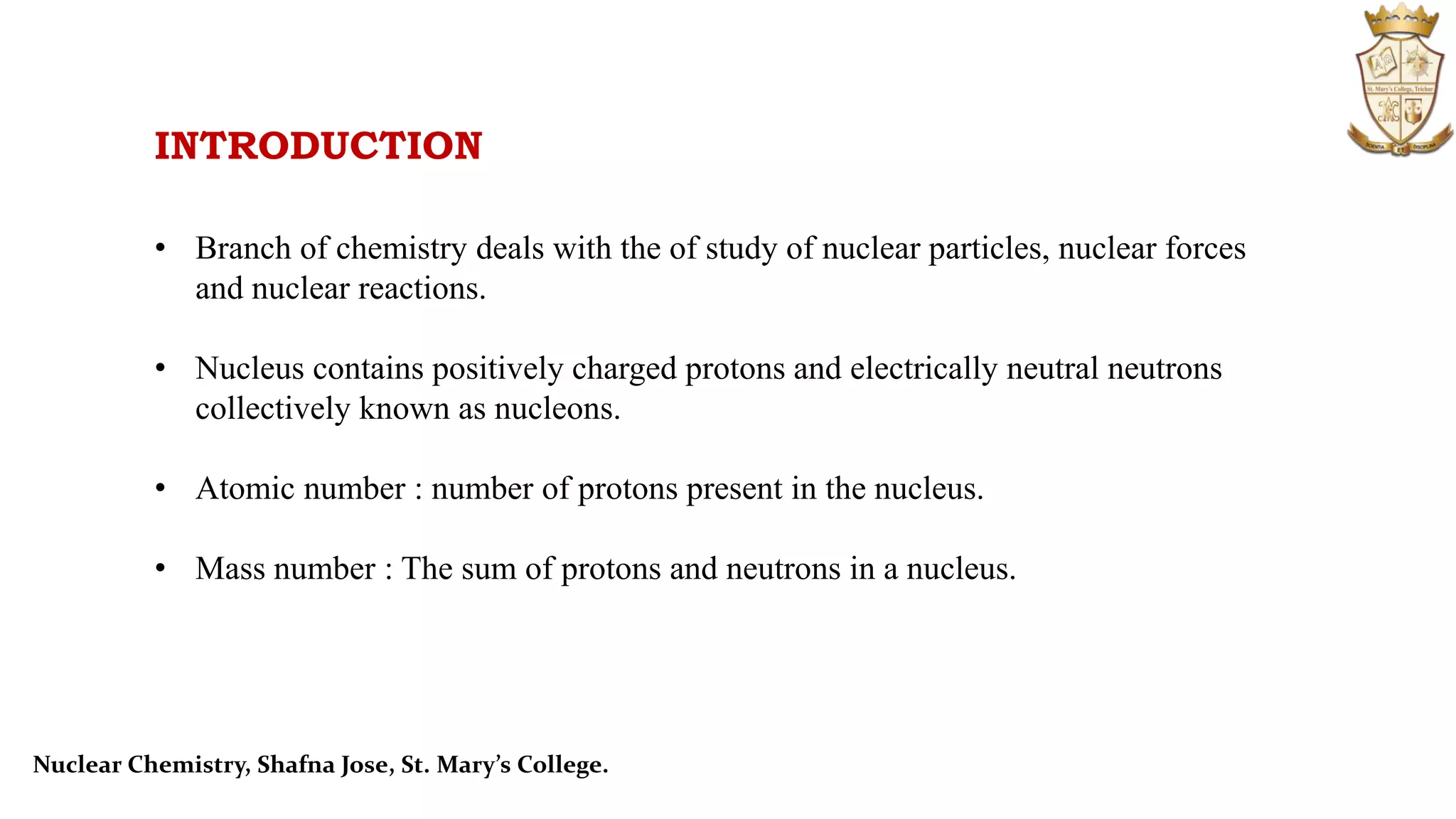
INTRODUCTION
• Branch of chemistry deals with the of study of nuclear particles, nuclear forces
and nuclear reactions.
• Nucleus contains positively charged protons and electrically neutral neutrons
collectively known as nucleons.
• Atomic number : number of protons present in the nucleus.
• Mass number : The sum of protons and neutrons in a nucleus.
Nuclear Chemistry, Shafna Jose, St. Mary’s College.
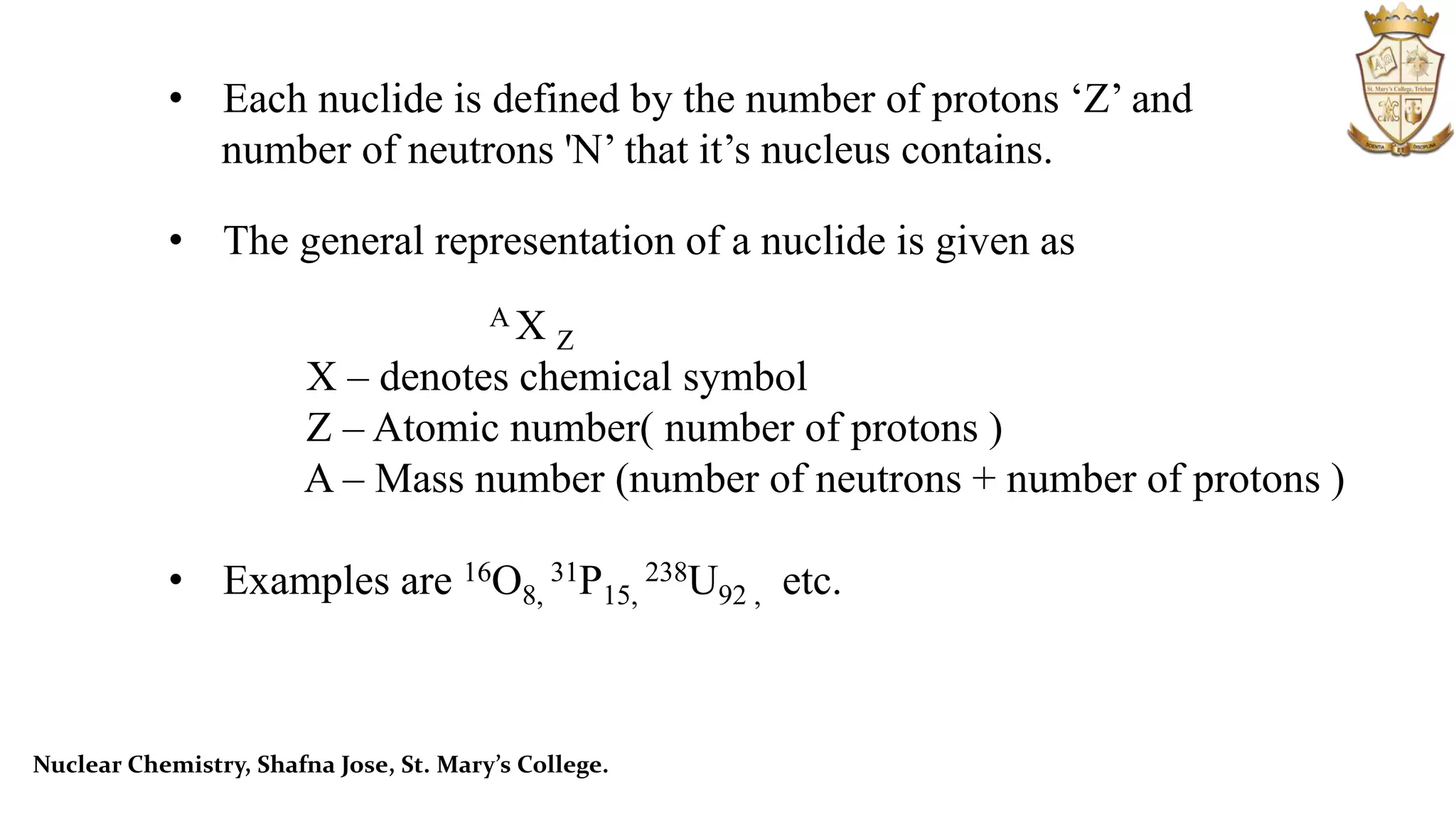
• Each nuclide is defined by the number of protons ‘Z’ and
number of neutrons 'N’ that it’s nucleus contains.
• The general representation of a nuclide is given as
A X Z
X – denotes chemical symbol
Z – Atomic number( number of protons )
A – Mass number (number of neutrons + number of protons )
• Examples are 16O8,
31P15,
238U92 , etc.
Nuclear Chemistry, Shafna Jose, St. Mary’s College.
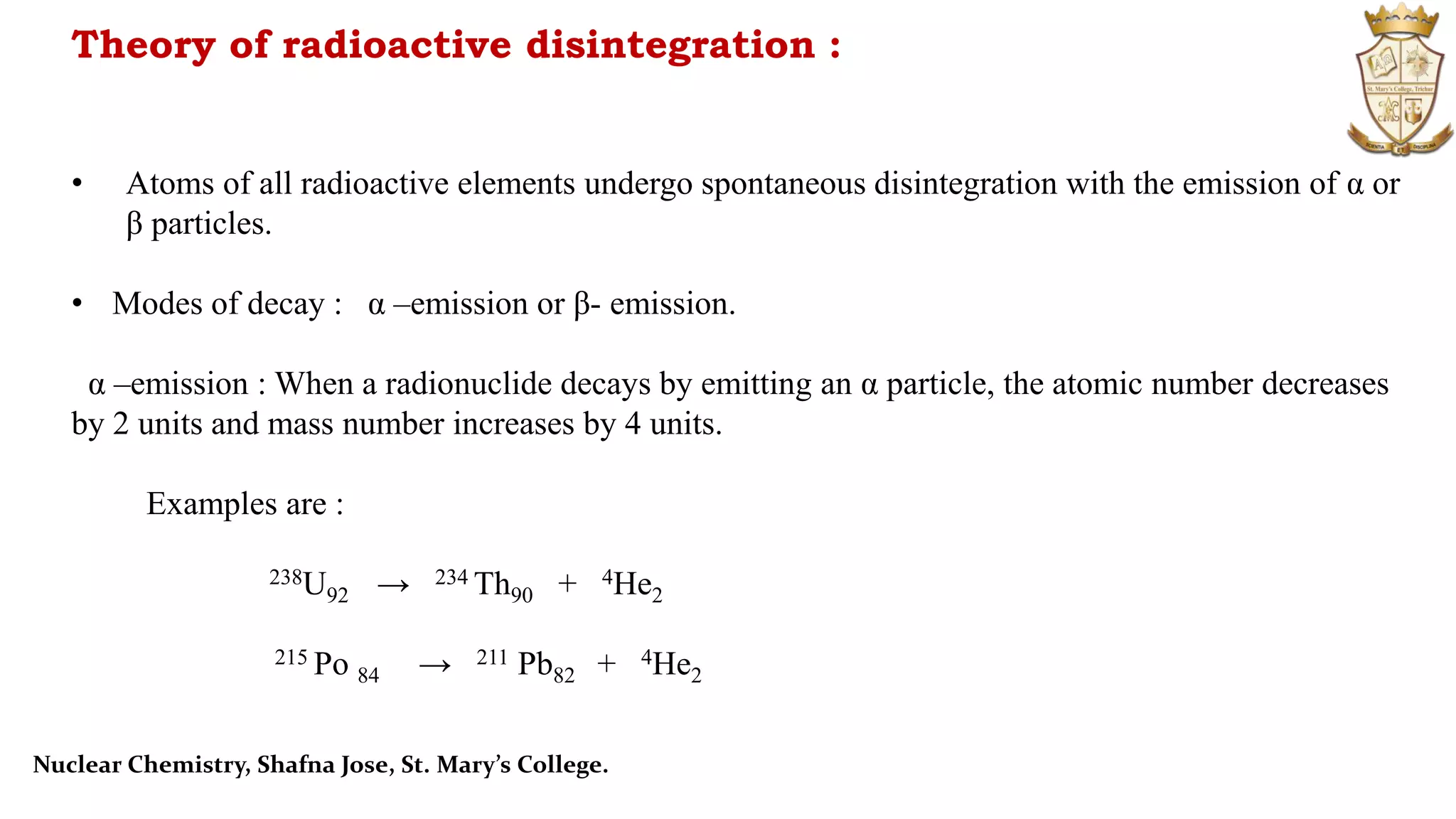
Theory of radioactive disintegration :
• Atoms of all radioactive elements undergo spontaneous disintegration with the emission of α or
β particles.
• Modes of decay : α –emission or β- emission.
α –emission : When a radionuclide decays by emitting an α particle, the atomic number decreases
by 2 units and mass number increases by 4 units.
Examples are :
238U92 → 234 Th90 + 4He2
215 Po 84 → 211 Pb82 + 4He2
Nuclear Chemistry, Shafna Jose, St. Mary’s College.
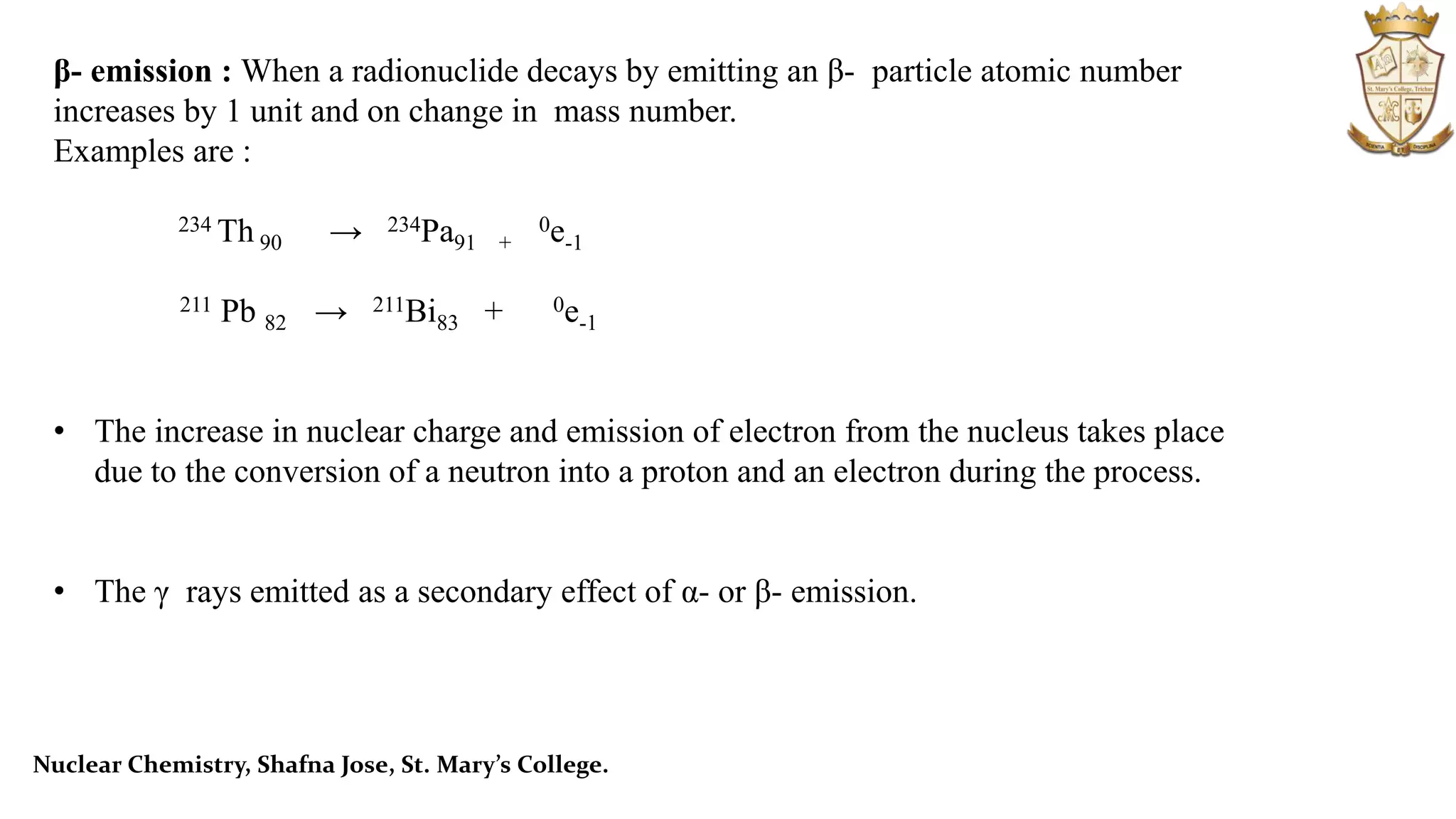
β- emission : When a radionuclide decays by emitting an β- particle atomic number
increases by 1 unit and on change in mass number.
Examples are :
234 Th 90 → 234Pa91 +
0e-1
211 Pb 82 → 211Bi83 + 0e-1
• The increase in nuclear charge and emission of electron from the nucleus takes place
due to the conversion of a neutron into a proton and an electron during the process.
• The γ rays emitted as a secondary effect of α- or β- emission.
Nuclear Chemistry, Shafna Jose, St. Mary’s College.
Mass Defect
• It is equal to the mass lost as an equivalent amount of energy during the formation of a given nucleus
from the component nucleons.
• If M, mp and mn are the masses of the nucleus (AXZ), a proton and a neutron, respectively, then
∆m = Zmp + Nmn – M = Zmp + (A – Z)mn - M
Binding Energy
• Energy released during the formation of a nucleus from it’s constituent nucleons.
• If ∆m is the mass defect , then binding energy , B.E = ∆mc2 .
B.E = [ Zmp + (A – Z)mn – M]c2
Nuclear Chemistry, Shafna Jose, St. Mary’s College.
Liquid Drop Model
Bohr tried to compare properties of a nucleus with a drop of a liquid and found many
similarities. Some of them are given below.
• Liquid drop has a large no: of molecules just like a nucleus has large no: of nucleons.
• Both the liquid drop and nucleus are homogenous and incompressible.
• Force between all the nucleons is same. Nuclear force is independent of charge and spin.
Nuclear Chemistry, Shafna Jose, St. Mary’s College.
• Heat of vaporization of a liquid corresponds to binding energy of nucleons in a
nucleus.
• Evaporation of a liquid corresponds to radioactive emission from a radioactive
isotope.
• In both liquid drop and nucleus, intermolecular forces are short range forces.
• By capturing high energy particle from outside nucleus form a compound nucleus as
does a liquid drop , to get excited.
Nuclear Chemistry, Shafna Jose, St. Mary’s College.
• Compound nucleus or the liquid drop may get de-excited by the following changes.
• Compound nucleus
a) By emission of radiation
b) By emission of a nucleon
c) By nuclear fission
• Liquid Drop
a)By cooling
b)By evaporation
c)By breaking up into droplets
• Two liquid drops undergo fusion and form a bigger drop, similarly lighter nuclei undergo
fusion and form a bigger nucleus.
Nuclear Chemistry, Shafna Jose, St. Mary’s College.
Nuclear Fission
• Splitting of a heavy nucleus into two fragments when bombarded with a suitable sub
atomic particle with the simultaneous release of a huge amount of energy.
235U92 + 0n1 → 144Ba56 + 20n1 + Energy
Fissile nuclides : undergo fission on bombardment with thermal or slow neutrons.
Eg: 239Pu94,
233U92
Fissionable nuclides : Require fast neutrons to produce their fission
Eg: 231Pa91,
238U92.
Critical mass : The minimum amount of the target material required to sustain a fission
chain reaction at a constant rate
Nuclear Chemistry, Shafna Jose, St. Mary’s College.
Nuclear Fusion
• Process in which lighter nuclei fuse together to form a heavier nucleus with the simultaneous
release of a huge amount of energy.
1H3 + 1H1 → 4He2 + 20 MeV
3H1 + 2H1 → 4He2 +0n1 + 17.8 MeV
• Fusion requires high temperature.
• These reactions are also called thermonuclear reactions.
• The function of a hydrogen bomb is based on nuclear fusion which is initiated by energy
from a fission bomb.
• Fusion reactions are common in the interior of stars.
Nuclear Chemistry, Shafna Jose, St. Mary’s College.
Nuclear Reactions
• It involves changes in the number of nucleons present in the nucleus.
• Nuclear reactions leads to atomic transformations or transmutations.
• Nuclear reactions involve energies a million times greater than those involved in
chemical reactions.
• Nuclear reactions may be divided into two categories :
a) radioactivity
b) artificial radioactivity
Nuclear Chemistry, Shafna Jose, St. Mary’s College.
Radioactivity :
• The nucleus undergoes a spontaneous change, i.e., a change by itself.
Artificial radioactivity :
• The reaction is brought about artificially through the interaction of two lighter nuclei.
•
• This is done by bombarding a relatively heavier nucleus with a lighter nucleus.
Induced radioactivity :
• The products in a nuclear reaction are a heavy nucleus and a proton, a neutron, an α
particle or a γ - ray photon.
• If the heavy nucleus is unstable it may start disintegrating like the natural radioactive
elements.
Nuclear Chemistry, Shafna Jose, St. Mary’s College.
Q Values of Nuclear Reactions
• The complete equation for a nuclear reaction include the energy change of
the reaction as well.
• It is denoted by Q.
• Rutherford’s transmutation reaction can be represented as
7N14 + 4He2 → 17O8 + 1H1 + Q
where Q is the nuclear reaction energy.
• Q is +ve if the reaction is exoergic.
• Q is –ve if the reaction is endoergic.
Nuclear Chemistry, Shafna Jose, St. Mary’s College.
References :
Physical Chemistry – Puri, Sharma, Pathania.
Essentials of Nuclear Chemistry – H.J. Arnikar
Nuclear Chemistry, Shafna Jose, St. Mary’s College.

Chemisrty:Nuclear chemistry

  • 1.
    NUCLEAR CHEMISTRY Shafna Jose AssistantProfessor Department Of Chemistry St. Mary’s College Thrissur
  • 2.
    INTRODUCTION • Branch ofchemistry deals with the of study of nuclear particles, nuclear forces and nuclear reactions. • Nucleus contains positively charged protons and electrically neutral neutrons collectively known as nucleons. • Atomic number : number of protons present in the nucleus. • Mass number : The sum of protons and neutrons in a nucleus. Nuclear Chemistry, Shafna Jose, St. Mary’s College.
  • 3.
    • Each nuclideis defined by the number of protons ‘Z’ and number of neutrons 'N’ that it’s nucleus contains. • The general representation of a nuclide is given as A X Z X – denotes chemical symbol Z – Atomic number( number of protons ) A – Mass number (number of neutrons + number of protons ) • Examples are 16O8, 31P15, 238U92 , etc. Nuclear Chemistry, Shafna Jose, St. Mary’s College.
  • 4.
    Theory of radioactivedisintegration : • Atoms of all radioactive elements undergo spontaneous disintegration with the emission of α or β particles. • Modes of decay : α –emission or β- emission. α –emission : When a radionuclide decays by emitting an α particle, the atomic number decreases by 2 units and mass number increases by 4 units. Examples are : 238U92 → 234 Th90 + 4He2 215 Po 84 → 211 Pb82 + 4He2 Nuclear Chemistry, Shafna Jose, St. Mary’s College.
  • 5.
    β- emission :When a radionuclide decays by emitting an β- particle atomic number increases by 1 unit and on change in mass number. Examples are : 234 Th 90 → 234Pa91 + 0e-1 211 Pb 82 → 211Bi83 + 0e-1 • The increase in nuclear charge and emission of electron from the nucleus takes place due to the conversion of a neutron into a proton and an electron during the process. • The γ rays emitted as a secondary effect of α- or β- emission. Nuclear Chemistry, Shafna Jose, St. Mary’s College.
  • 6.
    Mass Defect • Itis equal to the mass lost as an equivalent amount of energy during the formation of a given nucleus from the component nucleons. • If M, mp and mn are the masses of the nucleus (AXZ), a proton and a neutron, respectively, then ∆m = Zmp + Nmn – M = Zmp + (A – Z)mn - M Binding Energy • Energy released during the formation of a nucleus from it’s constituent nucleons. • If ∆m is the mass defect , then binding energy , B.E = ∆mc2 . B.E = [ Zmp + (A – Z)mn – M]c2 Nuclear Chemistry, Shafna Jose, St. Mary’s College.
  • 7.
    Liquid Drop Model Bohrtried to compare properties of a nucleus with a drop of a liquid and found many similarities. Some of them are given below. • Liquid drop has a large no: of molecules just like a nucleus has large no: of nucleons. • Both the liquid drop and nucleus are homogenous and incompressible. • Force between all the nucleons is same. Nuclear force is independent of charge and spin. Nuclear Chemistry, Shafna Jose, St. Mary’s College.
  • 8.
    • Heat ofvaporization of a liquid corresponds to binding energy of nucleons in a nucleus. • Evaporation of a liquid corresponds to radioactive emission from a radioactive isotope. • In both liquid drop and nucleus, intermolecular forces are short range forces. • By capturing high energy particle from outside nucleus form a compound nucleus as does a liquid drop , to get excited. Nuclear Chemistry, Shafna Jose, St. Mary’s College.
  • 9.
    • Compound nucleusor the liquid drop may get de-excited by the following changes. • Compound nucleus a) By emission of radiation b) By emission of a nucleon c) By nuclear fission • Liquid Drop a)By cooling b)By evaporation c)By breaking up into droplets • Two liquid drops undergo fusion and form a bigger drop, similarly lighter nuclei undergo fusion and form a bigger nucleus. Nuclear Chemistry, Shafna Jose, St. Mary’s College.
  • 10.
    Nuclear Fission • Splittingof a heavy nucleus into two fragments when bombarded with a suitable sub atomic particle with the simultaneous release of a huge amount of energy. 235U92 + 0n1 → 144Ba56 + 20n1 + Energy Fissile nuclides : undergo fission on bombardment with thermal or slow neutrons. Eg: 239Pu94, 233U92 Fissionable nuclides : Require fast neutrons to produce their fission Eg: 231Pa91, 238U92. Critical mass : The minimum amount of the target material required to sustain a fission chain reaction at a constant rate Nuclear Chemistry, Shafna Jose, St. Mary’s College.
  • 11.
    Nuclear Fusion • Processin which lighter nuclei fuse together to form a heavier nucleus with the simultaneous release of a huge amount of energy. 1H3 + 1H1 → 4He2 + 20 MeV 3H1 + 2H1 → 4He2 +0n1 + 17.8 MeV • Fusion requires high temperature. • These reactions are also called thermonuclear reactions. • The function of a hydrogen bomb is based on nuclear fusion which is initiated by energy from a fission bomb. • Fusion reactions are common in the interior of stars. Nuclear Chemistry, Shafna Jose, St. Mary’s College.
  • 12.
    Nuclear Reactions • Itinvolves changes in the number of nucleons present in the nucleus. • Nuclear reactions leads to atomic transformations or transmutations. • Nuclear reactions involve energies a million times greater than those involved in chemical reactions. • Nuclear reactions may be divided into two categories : a) radioactivity b) artificial radioactivity Nuclear Chemistry, Shafna Jose, St. Mary’s College.
  • 13.
    Radioactivity : • Thenucleus undergoes a spontaneous change, i.e., a change by itself. Artificial radioactivity : • The reaction is brought about artificially through the interaction of two lighter nuclei. • • This is done by bombarding a relatively heavier nucleus with a lighter nucleus. Induced radioactivity : • The products in a nuclear reaction are a heavy nucleus and a proton, a neutron, an α particle or a γ - ray photon. • If the heavy nucleus is unstable it may start disintegrating like the natural radioactive elements. Nuclear Chemistry, Shafna Jose, St. Mary’s College.
  • 14.
    Q Values ofNuclear Reactions • The complete equation for a nuclear reaction include the energy change of the reaction as well. • It is denoted by Q. • Rutherford’s transmutation reaction can be represented as 7N14 + 4He2 → 17O8 + 1H1 + Q where Q is the nuclear reaction energy. • Q is +ve if the reaction is exoergic. • Q is –ve if the reaction is endoergic. Nuclear Chemistry, Shafna Jose, St. Mary’s College.
  • 15.
    References : Physical Chemistry– Puri, Sharma, Pathania. Essentials of Nuclear Chemistry – H.J. Arnikar Nuclear Chemistry, Shafna Jose, St. Mary’s College.