Submitted by
Ms. Cindrella Burge
I Msc Nursing
Dept of medical surgical nursing
TMCON, TMU
Date of submission:1 /11/2018
TEERTHANKER MAHAVEER COLLEGE OF NURSING
Teerthanker Mahaveer University, Moradabad
NURSING EDUCATION
LESSON PLAN
ON
ESSAY AND SHORT ANSWER QUESTIONS
Submitted to
Mr. Basavaraj Mudhol
Asst Professor
Dept of Pediatric Nursing
TMCON, TMU
INTRODUCTION
An essay is a “short formal piece of
writing..dealing with a single subject”. It is
typically written to try to persuade the reader
using selected research evidence. In general,
an academic essay has three parts-
An Introduction,
A Body, or Middle section,
A Conclusion.
CONTI…
SAQs are open-ended questions that require
students to create an answer. They are
commonly used in examinations to assess
the basic knowledge and understanding of
a topic before more in- depth assessment
questions are asked on the topic.
DEFINITION OF ESSAY-
 ESSAY is derived from the French word
essayer, which means “to attempts”, or “to
try”.
 An essay is a short form of literary
composition based on a single subject matter,
and often gives the personal opinion of the
author.
 The Oxford Dictionary describes it as “a short
piece of writing on a particular subject”.
TYPES OF ESSAY
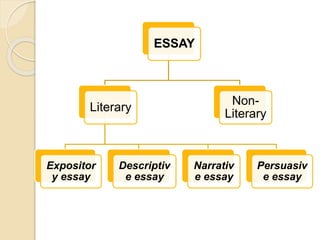
ESSAY
Literary
Expositor
y essay
Descriptiv
e essay
Narrativ
e essay
Persuasiv
e essay
Non-
Literary
 Expository essay: In an expository essay, the
writer gives an explanation of an idea, theme,
or issue to the audience.
 Descriptive essay: As it sounds, this type of
essay gives a description about a particular
topic.
 Narrative essay: The writer not only tells a
story, but also makes a point by giving reasons.
 Persuasive essay: In this type of essay,
the writer tries to convince his readers to
adopt his position or point of view on an
issue, after he provides them solid
reasoning in this connection.
It requires a lot of research to claim and
defend an idea.
It is also called an argumentative essay.
FUNCTION OF ESSAY
 essay increases the analytical and intellectual
abilities of the writer as well as readers.
 writing skills of a writer
 organizes his or her thinking to respond
personally or critically to an issue
 Through an essay, a writer presents his
argument in a more sophisticated manner.
EXCELLENT ESSAYS
The ability to write an excellent essay is
a
 skill that requires analysis, logic and
style
 structure:
an introduction,
body and
conclusion
 writing clearly
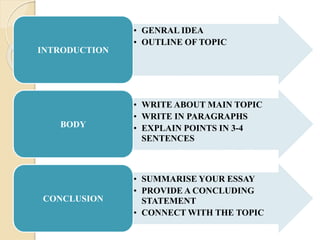
ESSAY STRUCTURE
• GENRAL IDEA
• OUTLINE OF TOPIC
INTRODUCTION
• WRITE ABOUT MAIN TOPIC
• WRITE IN PARAGRAPHS
• EXPLAIN POINTS IN 3-4
SENTENCES
BODY
• SUMMARISE YOUR ESSAY
• PROVIDE A CONCLUDING
STATEMENT
• CONNECT WITH THE TOPIC
CONCLUSION
RESTRICTED RESPONSE
QUESTIONS
 The restricted response question usually limits
both the content and the response. The
content is usually restricted by the topic to be
discussed.
EXAMPLES-
 State the main differences between
kwashiorkor and marasmus.
 How good nutrition prevents pressure sore?
ADVANTAGES AND
LIMITATIONS OF ESSAY
QUESTIONS
 it measures complex learning
outcomes that cannot be measured by
other means.
 its emphasis on the integration and
application of thinking and problem
solving skills
 essay test is often regarded as a
device for improving writing skills.
 serious limitation of the essay
question is the unreliability of the
scoring.
 Another limitation of essay questions
is the amount of time required for
scoring the answers.
 Another shortcoming of essay
questions is the limited sampling.
 Only few questions can be included in
a given test so that some areas are
measured thoroughly, but many others
are neglected.
BLUFFING-A SPECIAL
SCORING PROBLEM
It is possible for students to obtain higher
scores on essay questions than they
deserve by means of clever bluffing. This is
usually a combination of writing skill,
general knowledge and the use of common
"tricks of the trade".
UNDERSTANDING SHORT
ANSWER & ESSAY
QUESTIONS
 In order to understand, you need to
pay particular attention to words
like
“identify,”
“explain,”
“compare,”
“argue,”
“assess”
-these words dictate the nature of the
task before you.
Five Common
Questions
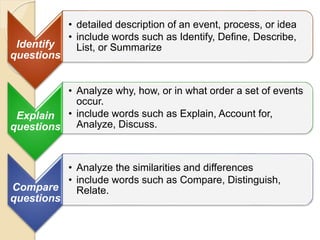
Identify
questions
• detailed description of an event, process, or idea
• include words such as Identify, Define, Describe,
List, or Summarize
Explain
questions
• Analyze why, how, or in what order a set of events
occur.
• include words such as Explain, Account for,
Analyze, Discuss.
Compare
questions
• Analyze the similarities and differences
• include words such as Compare, Distinguish,
Relate.
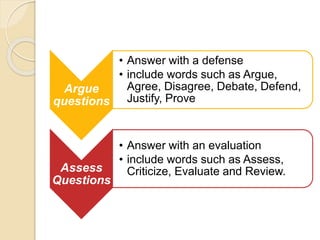
Argue
questions
• Answer with a defense
• include words such as Argue,
Agree, Disagree, Debate, Defend,
Justify, Prove
Assess
Questions
• Answer with an evaluation
• include words such as Assess,
Criticize, Evaluate and Review.
WHAT ARE SHORT-ANSWER
QUESTIONS (SAQS)?
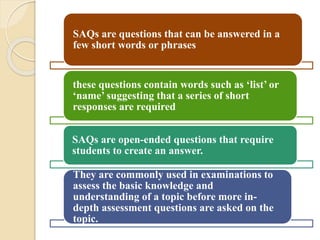
SAQs are questions that can be answered in a
few short words or phrases
these questions contain words such as ‘list’ or
‘name’ suggesting that a series of short
responses are required
SAQs are open-ended questions that require
students to create an answer.
They are commonly used in examinations to
assess the basic knowledge and
understanding of a topic before more in-
depth assessment questions are asked on the
topic.
HOW TO ANSWER THE SHORT
ANSWER QUESTIONS
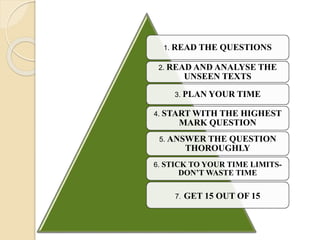
1. READ THE QUESTIONS
2. READ AND ANALYSE THE
UNSEEN TEXTS
3. PLAN YOUR TIME
4. START WITH THE HIGHEST
MARK QUESTION
5. ANSWER THE QUESTION
THOROUGHLY
6. STICK TO YOUR TIME LIMITS-
DON’T WASTE TIME
7. GET 15 OUT OF 15
CONCLUSION
An essay is a piece of writing, usually from an
author’s personal point of view. Essay are non-
frictional but often subjective; while expository,
they can also include narrative. Essay can be
literary criticism, political manifestos, learned
arguments, observations of daily life,
recollections, and reflections of the author.
Whereas, in a short answer question, the student
types in a word or phrase in response to a question
that may include image. Answer may or may not be
case sensitive. The answer could be a word or a
phrase, but it must match one of your acceptable
answers exactly. It’s a good idea to keep the required
answer as short as possible to avoid missing a correct
answer that’s phrased differently.
BIBLIOGRAPHY BOOKS
1. BT Basavanthappa, 2nd Edition (2009), NURSING EDUCATION.
2. B. Sankaranarayan , B. Sindhu, 4th Edition, Learning And
Teaching NURSING.
3. R. Sudha, Nursing Education, Principles And Concepts.
4. Sodhi Jk, Forwarded By Kaur S., Comprehensive Textbook Of
NURSING EDUCATION.
5. E. Sanatombi Devi, 1st Edition 2006, Textbook Of Manipal
Manual Of NURSING EDUCATION.
6. Barbara A. Moyar, And Ruth A. Wittmann, NURSING
EDUCATION.
 WEBSITES-
1. https://bowvalleycollege.libguides.com/c.p
hp?g=10222&p=51316
2. https://docs.moodle.org/35/en/short-
answer_question_type
3. https://literarydevices.net/essay/
THANKYOU

Nsg. edu.

  • 1.
    Submitted by Ms. CindrellaBurge I Msc Nursing Dept of medical surgical nursing TMCON, TMU Date of submission:1 /11/2018 TEERTHANKER MAHAVEER COLLEGE OF NURSING Teerthanker Mahaveer University, Moradabad NURSING EDUCATION LESSON PLAN ON ESSAY AND SHORT ANSWER QUESTIONS Submitted to Mr. Basavaraj Mudhol Asst Professor Dept of Pediatric Nursing TMCON, TMU
  • 2.
    INTRODUCTION An essay isa “short formal piece of writing..dealing with a single subject”. It is typically written to try to persuade the reader using selected research evidence. In general, an academic essay has three parts- An Introduction, A Body, or Middle section, A Conclusion.
  • 3.
    CONTI… SAQs are open-endedquestions that require students to create an answer. They are commonly used in examinations to assess the basic knowledge and understanding of a topic before more in- depth assessment questions are asked on the topic.
  • 4.
    DEFINITION OF ESSAY- ESSAY is derived from the French word essayer, which means “to attempts”, or “to try”.  An essay is a short form of literary composition based on a single subject matter, and often gives the personal opinion of the author.  The Oxford Dictionary describes it as “a short piece of writing on a particular subject”.
  • 5.
  • 6.
  • 7.
     Expository essay:In an expository essay, the writer gives an explanation of an idea, theme, or issue to the audience.  Descriptive essay: As it sounds, this type of essay gives a description about a particular topic.  Narrative essay: The writer not only tells a story, but also makes a point by giving reasons.
  • 8.
     Persuasive essay:In this type of essay, the writer tries to convince his readers to adopt his position or point of view on an issue, after he provides them solid reasoning in this connection. It requires a lot of research to claim and defend an idea. It is also called an argumentative essay.
  • 9.
  • 10.
     essay increasesthe analytical and intellectual abilities of the writer as well as readers.  writing skills of a writer  organizes his or her thinking to respond personally or critically to an issue  Through an essay, a writer presents his argument in a more sophisticated manner.
  • 11.
    EXCELLENT ESSAYS The abilityto write an excellent essay is a  skill that requires analysis, logic and style  structure: an introduction, body and conclusion  writing clearly
  • 12.
  • 13.
    • GENRAL IDEA •OUTLINE OF TOPIC INTRODUCTION • WRITE ABOUT MAIN TOPIC • WRITE IN PARAGRAPHS • EXPLAIN POINTS IN 3-4 SENTENCES BODY • SUMMARISE YOUR ESSAY • PROVIDE A CONCLUDING STATEMENT • CONNECT WITH THE TOPIC CONCLUSION
  • 14.
    RESTRICTED RESPONSE QUESTIONS  Therestricted response question usually limits both the content and the response. The content is usually restricted by the topic to be discussed. EXAMPLES-  State the main differences between kwashiorkor and marasmus.  How good nutrition prevents pressure sore?
  • 15.
    ADVANTAGES AND LIMITATIONS OFESSAY QUESTIONS  it measures complex learning outcomes that cannot be measured by other means.  its emphasis on the integration and application of thinking and problem solving skills  essay test is often regarded as a device for improving writing skills.
  • 16.
     serious limitationof the essay question is the unreliability of the scoring.  Another limitation of essay questions is the amount of time required for scoring the answers.  Another shortcoming of essay questions is the limited sampling.  Only few questions can be included in a given test so that some areas are measured thoroughly, but many others are neglected.
  • 17.
    BLUFFING-A SPECIAL SCORING PROBLEM Itis possible for students to obtain higher scores on essay questions than they deserve by means of clever bluffing. This is usually a combination of writing skill, general knowledge and the use of common "tricks of the trade".
  • 18.
    UNDERSTANDING SHORT ANSWER &ESSAY QUESTIONS  In order to understand, you need to pay particular attention to words like “identify,” “explain,” “compare,” “argue,” “assess” -these words dictate the nature of the task before you.
  • 19.
  • 20.
    Identify questions • detailed descriptionof an event, process, or idea • include words such as Identify, Define, Describe, List, or Summarize Explain questions • Analyze why, how, or in what order a set of events occur. • include words such as Explain, Account for, Analyze, Discuss. Compare questions • Analyze the similarities and differences • include words such as Compare, Distinguish, Relate.
  • 21.
    Argue questions • Answer witha defense • include words such as Argue, Agree, Disagree, Debate, Defend, Justify, Prove Assess Questions • Answer with an evaluation • include words such as Assess, Criticize, Evaluate and Review.
  • 22.
  • 23.
    SAQs are questionsthat can be answered in a few short words or phrases these questions contain words such as ‘list’ or ‘name’ suggesting that a series of short responses are required SAQs are open-ended questions that require students to create an answer. They are commonly used in examinations to assess the basic knowledge and understanding of a topic before more in- depth assessment questions are asked on the topic.
  • 24.
    HOW TO ANSWERTHE SHORT ANSWER QUESTIONS
  • 25.
    1. READ THEQUESTIONS 2. READ AND ANALYSE THE UNSEEN TEXTS 3. PLAN YOUR TIME 4. START WITH THE HIGHEST MARK QUESTION 5. ANSWER THE QUESTION THOROUGHLY 6. STICK TO YOUR TIME LIMITS- DON’T WASTE TIME 7. GET 15 OUT OF 15
  • 26.
  • 27.
    An essay isa piece of writing, usually from an author’s personal point of view. Essay are non- frictional but often subjective; while expository, they can also include narrative. Essay can be literary criticism, political manifestos, learned arguments, observations of daily life, recollections, and reflections of the author.
  • 28.
    Whereas, in ashort answer question, the student types in a word or phrase in response to a question that may include image. Answer may or may not be case sensitive. The answer could be a word or a phrase, but it must match one of your acceptable answers exactly. It’s a good idea to keep the required answer as short as possible to avoid missing a correct answer that’s phrased differently.
  • 29.
    BIBLIOGRAPHY BOOKS 1. BTBasavanthappa, 2nd Edition (2009), NURSING EDUCATION. 2. B. Sankaranarayan , B. Sindhu, 4th Edition, Learning And Teaching NURSING. 3. R. Sudha, Nursing Education, Principles And Concepts. 4. Sodhi Jk, Forwarded By Kaur S., Comprehensive Textbook Of NURSING EDUCATION. 5. E. Sanatombi Devi, 1st Edition 2006, Textbook Of Manipal Manual Of NURSING EDUCATION. 6. Barbara A. Moyar, And Ruth A. Wittmann, NURSING EDUCATION.
  • 30.
     WEBSITES- 1. https://bowvalleycollege.libguides.com/c.p hp?g=10222&p=51316 2.https://docs.moodle.org/35/en/short- answer_question_type 3. https://literarydevices.net/essay/
  • 31.