NON STANDARDIZED TESTS
Presented by : Garima Bhardwaj
(MSc nursing ist year )
General Objective :
At the end of the seminar the group will gain knowledge about Non
Standardized Test
Specific Objective : At the end of seminar, group
will be able to
 Define the term test
Differentiate between standardized and Non standardized test
Enlist the types of tests
Explain about Essay Type
Enumerate Advantages and disadvantages of Essay type test
Describe the guidelines for constructing essay type test
Discuss about short answer type test
State the advantages and disadvantages of short answer type test
What is test ?
A test is a systematic method for measuring students
behavior and evaluating these behaviors against
standards and norms .
Test is a method to determine a students ability to
complete certain tasks or demonstrate mastery of a skill
or knowledge of content .
Types of tests
Discrete - Test one item or skill at a time
Integrative - test combine various items , structures , skills into
one single test
Standardized Test
Standardization means uniformity of procedure in scoring , administering and
interpreting the results .
They are tools or instruments that measure and predict the ability / aptitude
and achievement .
Always administered , scored and interpreted in same manner .
E. G – IELTS , TOEFL
Non Standardized test
A non standardized test is one that is not given to people initially to standardize it
 Allows for an assessment of an individual's abilities or performances, but doesn't
allow for a fair comparison of one student to another
The most common type of test that are non standardized are the classroom test
given by teachers all the time
There reliability in usually unknown but if constructed carefully it can be highly
reliable
Teacher made paper and pencil test
They usually consist of essay or multiple
choice items .
The multiple choices , paper and pencil
test are probably the most frequent used
test
Other types such as true / false , essay
and performance tests
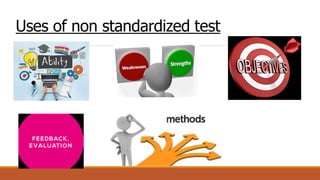
Uses of non standardized test
Limitations
Test are often ambiguous and unclear
They are either too short or too lengthy
Tests do not cover the entire content
Supervision is not proper
Lot of scope for copying
Conducted as rituals only
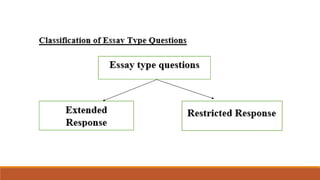
Essay type
The essay type refers to any written test that
requires an examination to write a sentence ,
a paragraph or longer passages
It demands a subjective judgement , about
its quality and completeness when it is scored
Definition
An essay test presents one or more questions or other tasks that require
extended written responses from the person being tested. – Robert Lebel
and David A Frishie , 1986
Essay item is an item that requires the student to structure a rather long
written response up to several paragraphs . – William Wiersma and
Stephen G Jurs , 1990
Extended Response
No restriction is placed on the student as to the points he or she will discuss and
the organization of student will use
The student may select those points that he / she thinks more important ,
pertinent and relevant to his / her argument and the student may organize the
material in whichever way he wishes
In response to such a question the examinee demonstrates his ability to select
and recall the facts which he thinks are pertinent , organize and present his ideas
in a logical and coherent form
This type of essay item is mostly useful in measuring learning outcomes at the
higher cognitive levels of educational objectives such as analysis , synthesis and
evaluation levels
Appropriate to measure the writing skills , organization of ideas
E. g Explain the role of nurse in health care team ?
Describe how to plan a care of child with HIV positive status
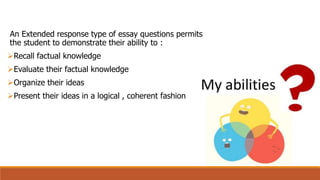
An Extended response type of essay questions permits
the student to demonstrate their ability to :
Recall factual knowledge
Evaluate their factual knowledge
Organize their ideas
Present their ideas in a logical , coherent fashion
 Handwriting can influence the scoring
 Can be time consuming
 Scoring is difficult
 Biasness can affect scoring
Restricted Response
In restricted response , the student is more limited or restricted in or as to form
and scope of his / her answer , because the student is specifically told the context
in which his / her answer is to be made .
The scope of the response is defined and restricted . The answers given are
controlled to some extend
E.g - Describe in not more than 100 words ,the recommendation made by the
health survey and development committee with regard to improvement of health
care delivery system in India ?
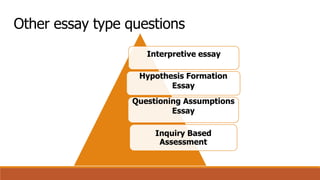
Other essay type questions
Interpretive essay
Hypothesis Formation
Essay
Questioning Assumptions
Essay
Inquiry Based
Assessment
Guidelines for constructing Essay type Questions
Clearly define the intended learning outcome to be assessed by the item
Avoid Using essay questions for intended learning outcomes that are better
assessed with other kinds of assessment .
Define the task and Shape The problem Situation
Helpful Instructions : specify the relative point value and the approximate time
limit in clear directions
Helpful Guidance : State the criteria for grading
Avoid The use of optional questions
Improve the essay question through preview and review
It can help to improve the essay item before and after it is handed out to students.
Preview ( before handing out the essay question to the students )
A. Predict student responses
B. Write a model answer
C. Ask a knowledgeable colleague to critically review the essay question , the
model answer and the intended learning outcome for alignment
D. Review student responses to the essay question
Uses of Essay Type Questions
To Assess students understanding of subject matter content
To assess higher order thinking skills that cannot be adequately assessed by
objectively scored test items
To assess students ability to construct rather than to select answers .
When a teacher has sufficient resources and/or help to score the student responses
to the essay questions
When the group to be tested is small
When a teacher is more confident of his/her ability as a critical and fair reader than
as an imaginative writer of good objective test items
Advantages
Logical thinking , critical reasoning can be
evaluated
Measures complex learning outcomes
Thinking and problem solving skills
Less scope for the use of unfair means
Test the ability of the student to communicate in
writing depth of knowledge and understanding .
Disadvantages
They possess relative low validity and reliability
Limited content Sampling
Subjectivity of scoring
Contaminated by extraneous factors like spelling , good handwriting ,coloured inks ,
neatness , grammar , lengths of answer
Time consuming both for the examiner and the examinee
Mood of examiner also influences marking
Short Answer Type Questions
Short answer items require the examinee to respond to the item with a word ,
short phrase , number or a symbol. – Anthony J Nitko
A short Answer test items aim to test the knowledge by asking students to supply
word , phrase or a number that answer a question to complete a sentence .- R
Eble et al, 1986
Question form : Here the item is presented as direct questions , E.g. who is the founder
of modern Nursing ?
Identification or association form : Here a few items are given outside the bracket.
Students are expected to write the exact related responses in bracket . e.g. Write the
name of instrument used which measure the following temperature ( …..) , blood
pressure ( ……..) . heart rate ( …….)
Complete form : Here an incomplete statement is used , e.g. Sphygmomanometer is
used to measure ……………
Forms of short answer questions
Advantages
Easy to construct as they measure only simple learning outcomes
They are useful to the lowest level of cognitive taxonomy, i.e. knowledge of
terminology, classification etc.
Relatively large sample of the content can be covered by the inclusion of a large
number of short answer questions
It is useful in evaluating the ability to interpret diagrams, chart and graphs
There is little scope for the influence of handwriting and spelling etc. on marking
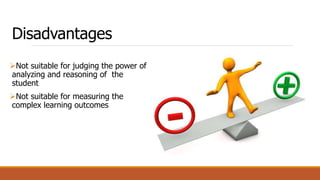
Disadvantages
Not suitable for judging the power of
analyzing and reasoning of the
student
Not suitable for measuring the
complex learning outcomes
Principals for constructing Short answer
tests
Clear and unambiguous
The test format must be consistent ( Do not
require fill in gaps and matching in the same
question )
 Enough space must be provided for filling in the
gaps or writing short answers
Candidates must know beforehand the
requirements and demands of the test
Suggestions for constructing question
Word the item so that the required answer is both brief and specific
The question should not be picked up exactly from the book
The question should not provide any clue
Blanks for answer should be equal in length and in a column to the right of
the question.
The scoring key should be prepared
If the answer is to be expressed in numerical units , indicate the type of
answer wanted
Summary
Conclusion
Test is a method to determine a students ability to complete certain tasks or
demonstrate mastery of a skill or knowledge of content .

Non standardized tests

  • 1.
    NON STANDARDIZED TESTS Presentedby : Garima Bhardwaj (MSc nursing ist year )
  • 2.
    General Objective : Atthe end of the seminar the group will gain knowledge about Non Standardized Test
  • 3.
    Specific Objective :At the end of seminar, group will be able to  Define the term test Differentiate between standardized and Non standardized test Enlist the types of tests Explain about Essay Type Enumerate Advantages and disadvantages of Essay type test Describe the guidelines for constructing essay type test Discuss about short answer type test State the advantages and disadvantages of short answer type test
  • 4.
    What is test? A test is a systematic method for measuring students behavior and evaluating these behaviors against standards and norms . Test is a method to determine a students ability to complete certain tasks or demonstrate mastery of a skill or knowledge of content .
  • 5.
    Types of tests Discrete- Test one item or skill at a time Integrative - test combine various items , structures , skills into one single test
  • 6.
    Standardized Test Standardization meansuniformity of procedure in scoring , administering and interpreting the results . They are tools or instruments that measure and predict the ability / aptitude and achievement . Always administered , scored and interpreted in same manner . E. G – IELTS , TOEFL
  • 7.
    Non Standardized test Anon standardized test is one that is not given to people initially to standardize it  Allows for an assessment of an individual's abilities or performances, but doesn't allow for a fair comparison of one student to another The most common type of test that are non standardized are the classroom test given by teachers all the time There reliability in usually unknown but if constructed carefully it can be highly reliable
  • 8.
    Teacher made paperand pencil test They usually consist of essay or multiple choice items . The multiple choices , paper and pencil test are probably the most frequent used test Other types such as true / false , essay and performance tests
  • 9.
    Uses of nonstandardized test
  • 10.
    Limitations Test are oftenambiguous and unclear They are either too short or too lengthy Tests do not cover the entire content Supervision is not proper Lot of scope for copying Conducted as rituals only
  • 11.
    Essay type The essaytype refers to any written test that requires an examination to write a sentence , a paragraph or longer passages It demands a subjective judgement , about its quality and completeness when it is scored
  • 12.
    Definition An essay testpresents one or more questions or other tasks that require extended written responses from the person being tested. – Robert Lebel and David A Frishie , 1986 Essay item is an item that requires the student to structure a rather long written response up to several paragraphs . – William Wiersma and Stephen G Jurs , 1990
  • 14.
    Extended Response No restrictionis placed on the student as to the points he or she will discuss and the organization of student will use The student may select those points that he / she thinks more important , pertinent and relevant to his / her argument and the student may organize the material in whichever way he wishes In response to such a question the examinee demonstrates his ability to select and recall the facts which he thinks are pertinent , organize and present his ideas in a logical and coherent form
  • 15.
    This type ofessay item is mostly useful in measuring learning outcomes at the higher cognitive levels of educational objectives such as analysis , synthesis and evaluation levels Appropriate to measure the writing skills , organization of ideas E. g Explain the role of nurse in health care team ? Describe how to plan a care of child with HIV positive status
  • 16.
    An Extended responsetype of essay questions permits the student to demonstrate their ability to : Recall factual knowledge Evaluate their factual knowledge Organize their ideas Present their ideas in a logical , coherent fashion
  • 17.
     Handwriting caninfluence the scoring  Can be time consuming  Scoring is difficult  Biasness can affect scoring
  • 18.
    Restricted Response In restrictedresponse , the student is more limited or restricted in or as to form and scope of his / her answer , because the student is specifically told the context in which his / her answer is to be made . The scope of the response is defined and restricted . The answers given are controlled to some extend E.g - Describe in not more than 100 words ,the recommendation made by the health survey and development committee with regard to improvement of health care delivery system in India ?
  • 19.
    Other essay typequestions Interpretive essay Hypothesis Formation Essay Questioning Assumptions Essay Inquiry Based Assessment
  • 20.
    Guidelines for constructingEssay type Questions Clearly define the intended learning outcome to be assessed by the item Avoid Using essay questions for intended learning outcomes that are better assessed with other kinds of assessment . Define the task and Shape The problem Situation Helpful Instructions : specify the relative point value and the approximate time limit in clear directions Helpful Guidance : State the criteria for grading Avoid The use of optional questions
  • 21.
    Improve the essayquestion through preview and review It can help to improve the essay item before and after it is handed out to students. Preview ( before handing out the essay question to the students ) A. Predict student responses B. Write a model answer C. Ask a knowledgeable colleague to critically review the essay question , the model answer and the intended learning outcome for alignment D. Review student responses to the essay question
  • 22.
    Uses of EssayType Questions To Assess students understanding of subject matter content To assess higher order thinking skills that cannot be adequately assessed by objectively scored test items To assess students ability to construct rather than to select answers . When a teacher has sufficient resources and/or help to score the student responses to the essay questions When the group to be tested is small When a teacher is more confident of his/her ability as a critical and fair reader than as an imaginative writer of good objective test items
  • 23.
    Advantages Logical thinking ,critical reasoning can be evaluated Measures complex learning outcomes Thinking and problem solving skills Less scope for the use of unfair means Test the ability of the student to communicate in writing depth of knowledge and understanding .
  • 24.
    Disadvantages They possess relativelow validity and reliability Limited content Sampling Subjectivity of scoring Contaminated by extraneous factors like spelling , good handwriting ,coloured inks , neatness , grammar , lengths of answer Time consuming both for the examiner and the examinee Mood of examiner also influences marking
  • 25.
    Short Answer TypeQuestions Short answer items require the examinee to respond to the item with a word , short phrase , number or a symbol. – Anthony J Nitko A short Answer test items aim to test the knowledge by asking students to supply word , phrase or a number that answer a question to complete a sentence .- R Eble et al, 1986
  • 26.
    Question form :Here the item is presented as direct questions , E.g. who is the founder of modern Nursing ? Identification or association form : Here a few items are given outside the bracket. Students are expected to write the exact related responses in bracket . e.g. Write the name of instrument used which measure the following temperature ( …..) , blood pressure ( ……..) . heart rate ( …….) Complete form : Here an incomplete statement is used , e.g. Sphygmomanometer is used to measure …………… Forms of short answer questions
  • 27.
    Advantages Easy to constructas they measure only simple learning outcomes They are useful to the lowest level of cognitive taxonomy, i.e. knowledge of terminology, classification etc. Relatively large sample of the content can be covered by the inclusion of a large number of short answer questions It is useful in evaluating the ability to interpret diagrams, chart and graphs There is little scope for the influence of handwriting and spelling etc. on marking
  • 28.
    Disadvantages Not suitable forjudging the power of analyzing and reasoning of the student Not suitable for measuring the complex learning outcomes
  • 29.
    Principals for constructingShort answer tests Clear and unambiguous The test format must be consistent ( Do not require fill in gaps and matching in the same question )  Enough space must be provided for filling in the gaps or writing short answers Candidates must know beforehand the requirements and demands of the test
  • 30.
    Suggestions for constructingquestion Word the item so that the required answer is both brief and specific The question should not be picked up exactly from the book The question should not provide any clue Blanks for answer should be equal in length and in a column to the right of the question. The scoring key should be prepared If the answer is to be expressed in numerical units , indicate the type of answer wanted
  • 31.
  • 32.
    Conclusion Test is amethod to determine a students ability to complete certain tasks or demonstrate mastery of a skill or knowledge of content .